Price Discrimination
made understandable
José L. Giráldez
Customers & Added Value
Provider
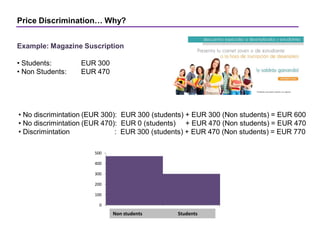
Price Discrimination… Why?
Example: Magazine Suscription
• Students: EUR 300
• Non Students: EUR 470
• No discrimintation (EUR 300): EUR 300 (students) + EUR 300 (Non students) = EUR 600
• No discrimintation (EUR 470): EUR 0 (students) + EUR 470 (Non students) = EUR 470
• Discrimintation : EUR 300 (students) + EUR 470 (Non students) = EUR 770
0
100
200
300
400
500
1 2
Non students Students
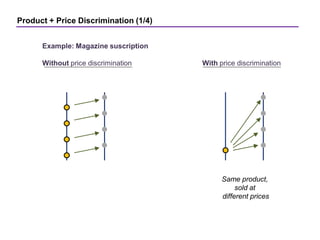
Product + Price Discrimination (1/4)
Example: Magazine suscription
Without price discrimination With price discrimination
Same product,
sold at
different prices
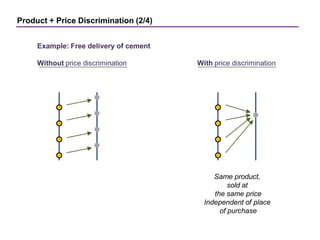
Product + Price Discrimination (2/4)
Example: Free delivery of cement
Without price discrimination With price discrimination
Same product,
sold at
the same price
Independent of place
of purchase
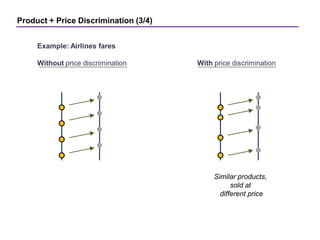
Product + Price Discrimination (3/4)
Example: Airlines fares
Without price discrimination With price discrimination
Similar products,
sold at
different price
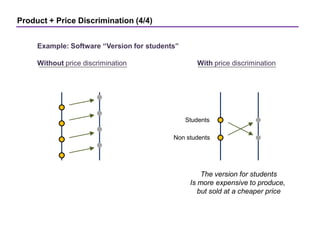
Product + Price Discrimination (4/4)
Example: Software “Version for students”
Without price discrimination With price discrimination
The version for students
Is more expensive to produce,
but sold at a cheaper price
Students
Non students
First degree price discrimination
• Each consumer has a different willingness to pay (WTP)
• That means, that each consumer can be charged a different price
• In order to make a price discrimination, we must know the different WTP of our consumers
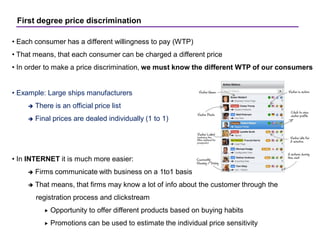
• Example: Large ships manufacturers
 There is an official price list
 Final prices are dealed individually (1 to 1)
• In INTERNET it is much more easier:
 Firms communicate with business on a 1to1 basis
 That means, that firms may know a lot of info about the customer through the
registration process and clickstream
 Opportunity to offer different products based on buying habits
 Promotions can be used to estimate the individual price sensitivity
Second degree price discrimination
• Also known as INDIRECT price discrimination
• Firms offer different deals (example: combinations of P/Q/Qy)
• Consumer choose according to their willingnes-to-pay (WTP) and preferences
• In order to make a price discrimination, we do not need to know the consumers´
characteristics and preferences
• Types:
 Non linear pricing (every unit of the product does not cost the same)
 Versioning (all consumers are offered slightly different versions of the same product)
 Bundling
Second degree price discrimination – Non linear pricing (1/3)
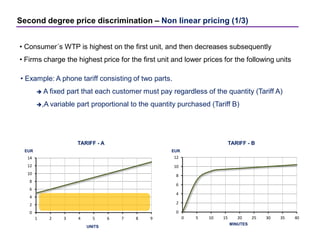
• Consumer´s WTP is highest on the first unit, and then decreases subsequently
• Firms charge the highest price for the first unit and lower prices for the following units
• Example: A phone tariff consisting of two parts.
 A fixed part that each customer must pay regardless of the quantity (Tariff A)
,A variable part proportional to the quantity purchased (Tariff B)
0
2
4
6
8
10
12
14
1 2 3 4 5 6 7 8 9
UNITS
EUR
0
2
4
6
8
10
12
0 5 10 15 20 25 30 35 40
EUR
MINUTES
TARIFF - A TARIFF - B
Second degree price discrimination – Non linear pricing (2/3)
• Non linear pricing is used regularly and can improve profits
• Offering several non-linear tariffs can be even more attractive
• However we must take into account the additional costs of a new tariff:
 Development
 Billing
 Sales force training
 Advertising, …
• According to some real experiences:
 The benefits of additional tariffs decrease very quickly
 Due to the high costs associated, firms should offer only a few tariffs
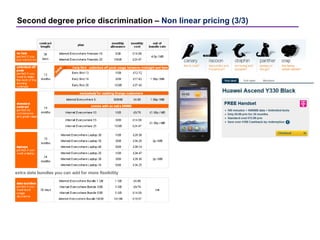
Second degree price discrimination – Non linear pricing (3/3)
Second degree price discrimination – Versioning
• Firms offer different versions of the product at different price levels
• These versions differ in their quality/funtionality/flexibility/…
• This kind of price discrimination has no clear boundaries with a product differentiation
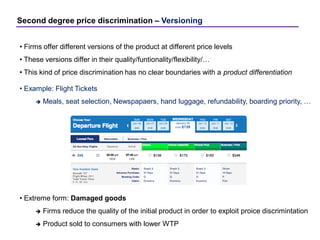
• Example: Flight Tickets
 Meals, seat selection, Newspapaers, hand luggage, refundability, boarding priority, …
• Extreme form: Damaged goods
 Firms reduce the quality of the initial product in order to exploit proice discrimintation
 Product sold to consumers with lower WTP
Second degree price discrimination – Bundling
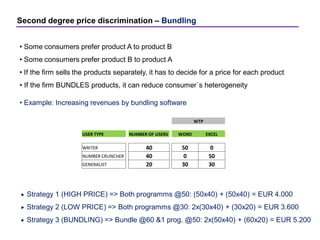
• Some consumers prefer product A to product B
• Some consumers prefer product B to product A
• If the firm sells the products separately, it has to decide for a price for each product
• If the firm BUNDLES products, it can reduce consumer´s heterogeneity
 Strategy 1 (HIGH PRICE) => Both programms @50: (50x40) + (50x40) = EUR 4.000
 Strategy 2 (LOW PRICE) => Both programms @30: 2x(30x40) + (30x20) = EUR 3.600
 Strategy 3 (BUNDLING) => Bundle @60 &1 prog. @50: 2x(50x40) + (60x20) = EUR 5.200
• Example: Increasing revenues by bundling software
WTP
USER TYPE NUMBER OF USERS WORD EXCEL
WRITER 40 50 0
NUMBER CRUNCHER 40 0 50
GENERALIST 20 30 30
Third degree price discrimination
• Also known as GROUP PRICING
• Firms observe consumer´s characteristics that allow them to infer WTP and price accordingly
• Geography, job, age, profession, … (different prices for different groups of consumers)
• Lower prices for consumers with greater price elasticity
• Sellers must identify each consumer´s group by observable characteristics
• Examples:
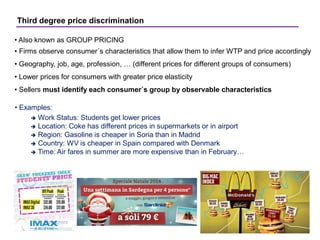
 Work Status: Students get lower prices
 Location: Coke has different prices in supermarkets or in airport
 Region: Gasoline is cheaper in Soria than in Madrid
 Country: WV is cheaper in Spain compared with Denmark
 Time: Air fares in summer are more expensive than in February…
Some of the graphics come from public documents or web sites, and have been used with the sole intention of
delivering the messsage There are no commercial purposes behind this document
José L. Giráldez
Hunter of Customers
& Added Value provider
jose-madrid.es@googlemail.com
Athos-world
http://es.linkedin.com/pub/jose-l-giraldez/6/a08/0
GiraldezGo
+34 639657973

Price discrimination (made understandable)

  • 1.
    Price Discrimination made understandable JoséL. Giráldez Customers & Added Value Provider
  • 2.
    Price Discrimination… Why? Example:Magazine Suscription • Students: EUR 300 • Non Students: EUR 470 • No discrimintation (EUR 300): EUR 300 (students) + EUR 300 (Non students) = EUR 600 • No discrimintation (EUR 470): EUR 0 (students) + EUR 470 (Non students) = EUR 470 • Discrimintation : EUR 300 (students) + EUR 470 (Non students) = EUR 770 0 100 200 300 400 500 1 2 Non students Students
  • 3.
    Product + PriceDiscrimination (1/4) Example: Magazine suscription Without price discrimination With price discrimination Same product, sold at different prices
  • 4.
    Product + PriceDiscrimination (2/4) Example: Free delivery of cement Without price discrimination With price discrimination Same product, sold at the same price Independent of place of purchase
  • 5.
    Product + PriceDiscrimination (3/4) Example: Airlines fares Without price discrimination With price discrimination Similar products, sold at different price
  • 6.
    Product + PriceDiscrimination (4/4) Example: Software “Version for students” Without price discrimination With price discrimination The version for students Is more expensive to produce, but sold at a cheaper price Students Non students
  • 7.
    First degree pricediscrimination • Each consumer has a different willingness to pay (WTP) • That means, that each consumer can be charged a different price • In order to make a price discrimination, we must know the different WTP of our consumers • Example: Large ships manufacturers  There is an official price list  Final prices are dealed individually (1 to 1) • In INTERNET it is much more easier:  Firms communicate with business on a 1to1 basis  That means, that firms may know a lot of info about the customer through the registration process and clickstream  Opportunity to offer different products based on buying habits  Promotions can be used to estimate the individual price sensitivity
  • 8.
    Second degree pricediscrimination • Also known as INDIRECT price discrimination • Firms offer different deals (example: combinations of P/Q/Qy) • Consumer choose according to their willingnes-to-pay (WTP) and preferences • In order to make a price discrimination, we do not need to know the consumers´ characteristics and preferences • Types:  Non linear pricing (every unit of the product does not cost the same)  Versioning (all consumers are offered slightly different versions of the same product)  Bundling
  • 9.
    Second degree pricediscrimination – Non linear pricing (1/3) • Consumer´s WTP is highest on the first unit, and then decreases subsequently • Firms charge the highest price for the first unit and lower prices for the following units • Example: A phone tariff consisting of two parts.  A fixed part that each customer must pay regardless of the quantity (Tariff A) ,A variable part proportional to the quantity purchased (Tariff B) 0 2 4 6 8 10 12 14 1 2 3 4 5 6 7 8 9 UNITS EUR 0 2 4 6 8 10 12 0 5 10 15 20 25 30 35 40 EUR MINUTES TARIFF - A TARIFF - B
  • 10.
    Second degree pricediscrimination – Non linear pricing (2/3) • Non linear pricing is used regularly and can improve profits • Offering several non-linear tariffs can be even more attractive • However we must take into account the additional costs of a new tariff:  Development  Billing  Sales force training  Advertising, … • According to some real experiences:  The benefits of additional tariffs decrease very quickly  Due to the high costs associated, firms should offer only a few tariffs
  • 11.
    Second degree pricediscrimination – Non linear pricing (3/3)
  • 12.
    Second degree pricediscrimination – Versioning • Firms offer different versions of the product at different price levels • These versions differ in their quality/funtionality/flexibility/… • This kind of price discrimination has no clear boundaries with a product differentiation • Example: Flight Tickets  Meals, seat selection, Newspapaers, hand luggage, refundability, boarding priority, … • Extreme form: Damaged goods  Firms reduce the quality of the initial product in order to exploit proice discrimintation  Product sold to consumers with lower WTP
  • 13.
    Second degree pricediscrimination – Bundling • Some consumers prefer product A to product B • Some consumers prefer product B to product A • If the firm sells the products separately, it has to decide for a price for each product • If the firm BUNDLES products, it can reduce consumer´s heterogeneity  Strategy 1 (HIGH PRICE) => Both programms @50: (50x40) + (50x40) = EUR 4.000  Strategy 2 (LOW PRICE) => Both programms @30: 2x(30x40) + (30x20) = EUR 3.600  Strategy 3 (BUNDLING) => Bundle @60 &1 prog. @50: 2x(50x40) + (60x20) = EUR 5.200 • Example: Increasing revenues by bundling software WTP USER TYPE NUMBER OF USERS WORD EXCEL WRITER 40 50 0 NUMBER CRUNCHER 40 0 50 GENERALIST 20 30 30
  • 14.
    Third degree pricediscrimination • Also known as GROUP PRICING • Firms observe consumer´s characteristics that allow them to infer WTP and price accordingly • Geography, job, age, profession, … (different prices for different groups of consumers) • Lower prices for consumers with greater price elasticity • Sellers must identify each consumer´s group by observable characteristics • Examples:  Work Status: Students get lower prices  Location: Coke has different prices in supermarkets or in airport  Region: Gasoline is cheaper in Soria than in Madrid  Country: WV is cheaper in Spain compared with Denmark  Time: Air fares in summer are more expensive than in February…
  • 15.
    Some of thegraphics come from public documents or web sites, and have been used with the sole intention of delivering the messsage There are no commercial purposes behind this document José L. Giráldez Hunter of Customers & Added Value provider jose-madrid.es@googlemail.com Athos-world http://es.linkedin.com/pub/jose-l-giraldez/6/a08/0 GiraldezGo +34 639657973