BY:
RUTVIK
1221421
BASIC DETERMINANTS OF PRICE


DEGREE OF COMPETITION
PRICING OF COMPETITORS PRODUCT
OBJECTIVE OF THE FIRM
COST OF PRODUCTION
DEMAND IN MARKET
SUPPLY OF PRODUCT IN MARKET
PRICING STRATEGY OF PRODUCT

COST BASED PRICING

  Under cost based pricing price of the product is the
  sum of cost plus a profit margin

  It can be further classified as:-
   cost plus pricing
   marginal cost pricing
   target return pricing
VALUE PRICING

• Price set in accordance with customer
  perceptions about the value of the
  product/service
• Examples include status
  products/exclusive products
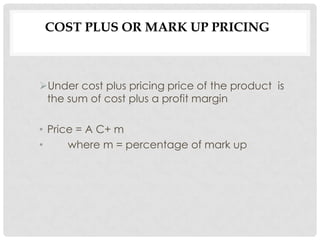
COST PLUS OR MARK UP PRICING


Under cost plus pricing price of the product is
 the sum of cost plus a profit margin

• Price = A C+ m
•     where m = percentage of mark up
MARGINAL COST PRICING


Under marginal cost pricing price is the sum of
 variable cost plus a profit margin.

Here margin is either calculated on total cost or
 variable cost.

Margin calculated on total cost   > margin
 calculated on variable cost
TARGET RETURN PRICING


Under target return pricing a producer rationally
 decides the minimum rate of return that the
 producer must earn.
GOING RATE (PRICE LEADERSHIP)

• In case of price leader, rivals have difficulty
  in competing on price – too high and they
  lose market share, too low and the price
  leader would match price and force smaller
  rival out of market
• May follow pricing leads of rivals especially
  where those rivals have a clear dominance
  of market share
• Where competition is limited, ‘going rate’
  pricing may be applicable – banks, petrol,
  supermarkets, electrical goods – find very
  similar prices in all outlets
PRICING BASED ON FIRM’S OBJECTIVE


• PROFIT MAXIMISATION:
   • The basic objective of a firm is to maximize profit and to attain it
     they prefer to adopt COST PLUS PRICING


 SALES MAXIMISATION:
   • Some firm would like to maximize sale instead of profit
     maximization therefore they adopt MARGINAL COSTING
     method
TENDER PRICING

• Many contracts awarded on a tender basis
• Firm (or firms) submit their price for carrying
  out the work
• Purchaser then chooses which represents
  best value
• Mostly done in secret
COMPETITION BASED PRICING:


  PENETRATION PRICING:
          WHILE ENTERING A NEW MARKET WHICH IS ALREADY
  DOMINATED BY EXISTING PLAYERS,THEY WILL CHARGE A LOWER
  PRICE THAN THE ONGOING.


  ENTRY DETERRING PRICING:
         THE PRICE IS KEPT LOW, THUS MAKING THE MARKET
  UNATTRACTIVE FOR THE OTHER PLAYERS.


  GOING RATE PRICING:
         THE PRICE OF ALL THE COMPANIES IN A COMPETATIVE
  MARKET WILL BE SAME.
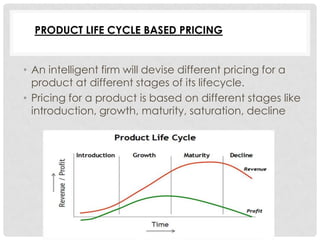
PRODUCT LIFE CYCLE BASED PRICING


• An intelligent firm will devise different pricing for a
  product at different stages of its lifecycle.
• Pricing for a product is based on different stages like
  introduction, growth, maturity, saturation, decline
PRICE SKIMMING:
          A product pricing strategy by which a firm charges the highest initial price
that customers will pay. As the demand of the first customers is satisfied, the firm
lowers the price to attract another, more price-sensitive segment.

PRODUCT BUNDLING:
           Under product bundling two or more products are bundled together for a
single price.

PERCEIVED VALUE PRICING:
         The value of the goods for different consumers depends upon their
perception of utility of the goods.

VALUE PRICING:
        Under value pricing sellers try to create a high value of the product and
charge a low price.

LOSS LEADER PRICING:
         Multi product firms sell one product at a low price and compensate the loss
by other products.
MULTIPRODUCT PRICING

This strategy is used when a company      produces
more than one product and the products can act as
substitutes or complements to each other.
MULTIPRODUCT PRICING CONT...

 Demand Interdependence:
    • Interdependence of two or more products’ demands on each
      other’s prices. Products may be substitutes or complements.
    Substitutes : Increase in price of one will
     increase the substitute’s demand.
    Compliments: Increase in demand of the
     compliment will result in increase in price of
 the main product which will impact          demands
 of both products.
DUMPING

• It’s a pricing strategy adopted by a country where
  a product is exported in bulk to a foreign country at
  a price which is either below the domestic market
  price or below the marginal cost of production.
• Government has initiated antidumping measures
  against imports of consumer good items
• e.g. dry cell batteries, sports shoes and toys from
  China.
• India topped the list of countries initiating new
  antidumping investigations.
RETAIL PRICING

• Marketing channel categorically consists of at
  least two sections, wholesalers and retailers.
• Wholesaler normally deals with retailers & retailer
  sells a product to the final consumer.
• Retailers constitute nearly 97% of all business
  activities & organized retail is just 7-8% in India.
• Upper limit pricing (Maximum retail price) plus
  commission.
PEAK LOAD PRICING

• Different prices are charged for the same facility
  used at different points of time by the same
  consumers.
• Consumers using the product at peak load time
  pay higher price & users at off peak period pay a
  lower price.
• Example:
   • Phone tariff during night hours is low.
   • Airlines provide discounts on tickets purchased at different point
     of time
EVERY DAY LOW PRICING STRATEGY

• As per EDLP, low price is charged throughout the
  year and none or very few special discounts are
  given on special occasions .
• Eg: Wal-Mart, Big Bazaar.
• High-Low Pricing:
• The price is higher on all days but lower on discount
  days than EDLP.
• The firms attracts or snatches the customers from
  rivals by using EDLP.
SEALED BID PRICING STRATEGY

• This is a separate market in which the buyer does
  not prefer an open market price but demands that
  the sellers provide their rates in sealed form,
  commonly known as tenders.
• It may be considered as a case of limited
  Monopsony.
• Example:
   • All government departments including construction,
     procurement of goods, vehicles, machinery are done through
     tendering.
   • Indian Railways.
EXPORT PRICING

• These are the prices which are determined based
  on the characteristics of foreign market situations.
• On the basis of tariff and trade restrictions prices are
  determined.
• Factors include:
    •   unknown demand,
    •   unpredictable attitude,
    •   medium of exchange,
    •   risk in exchange
• WTO insisting its members to provide level playing
  field to all the players.
PRICE DISCRIMINATION

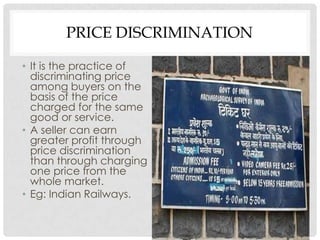
• It is the practice of
  discriminating price
  among buyers on the
  basis of the price
  charged for the same
  good or service.
• A seller can earn
  greater profit through
  price discrimination
  than through charging
  one price from the
  whole market.
• Eg: Indian Railways.
PRICE DISCRIMINATION CONT...

• Prerequisites to Price discrimination:

• Market Control
    • The greater the imperfection in the market, the higher is the
      possibility of price discrimination.
• Division of Market
    • Eg: Doctor’s Fee,
    • Petrol Price, Mobile Tariffs
• Different Price Elasticities of Demand in Different
  Markets
1.MARKET CONTROL

 The greater the imperfection in the market, the
  higher is the possibility of price discrimination.
 monopoly is the most suited for price
  discrimination .
 oligopoly and monopolistic competition can also
  discriminate on the basis of price but it is
  restricted to the extent of their ability to control
  the price of the product.
 a firm in perfect competition cannot do this as it
  has no control over market price.
2.DIVISION OF MARKET


• -Price discrimination is possible only when the
  market can be divided into various segments and
  the product is identical.
    -Absence of arbitrage: There should be no buying
  of goods from the cheaper market and selling them
  in the costlier market.
    Example for arbitrate- selling of movie tickets in
  black.
    -Market can be divided the market on the basis of
  the consumers’ paying capacity, their needs,
  geography etc.,
3.DIFFERENT PRICE ELASTICITY OF
DEMAND IN DIFFERENT MARKETS

 Price elasticity of demand helps in determination
  of appropriate price.
 A seller charges
    -higher price if elasticity is low.
    -lower price if elasticity is high.
 Price elasticity of demand should be different
  for different market segments for the segregation
  to result in an increased income.
BASE OF PRICE DISCRIMINATION

• Price discrimination can be done on the basis of:
    -personal
    -geography
    -demographical
    -time
    -paying capacity
    -purpose of use
    -need
DEGREES OF PRICE DISCRIMINATION

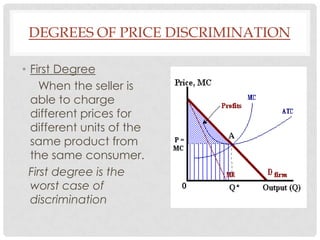
• First Degree
     When the seller is
  able to charge
  different prices for
  different units of the
  same product from
  the same consumer.
  First degree is the
  worst case of
  discrimination
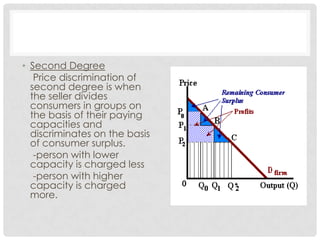
• Second Degree
   Price discrimination of
  second degree is when
  the seller divides
  consumers in groups on
  the basis of their paying
  capacities and
  discriminates on the basis
  of consumer surplus.
   -person with lower
  capacity is charged less
   -person with higher
  capacity is charged
  more.
• Third Degree
   In this degree of discrimination, the seller
  manages to take away only a small portion of
  the consumer surplus.
   -consumers are segregated such that each
  group is a separate market
    -different prices are charged for that group
  based on its price elasticity
   Eg- movie tickets
ADVANTAGES OF PRICE
           DISCRIMINATION


• Firms will be able to increase revenue. This will
  enable some firms to stay in business who otherwise
  would have made a loss.
    For example price discrimination is important for
  train companies who offer different prices for peak
  and off peak.
• Increased revenues can be used for research and
  development which benefit consumers
• Some consumers will benefit from lower fares.
    Ex-old people benefit from lower train companies.
DISADVANTAGES OF PRICE
            DISCRIMINATION


• Some consumers will end up paying higher prices. These
  higher prices are likely to be allocatively inefficient
  because P > MC.
• Decline in consumer surplus.
• Those who pay higher prices may not be the poorest. Eg-
  adults could be unemployed, OAPs well off.
• There may be administration costs in separating the
  markets.
• Profits from price discrimination could be used to finance
  predatory pricing.
PRICE AND OUTPUT DECISIONS OF
 DISCRIMINATING MONOPOLIST
• Rule for determining profit maximizing output is
  MC=MR when MC is increasing.
• Markets are divided into two parts
   -One with lesser outputs with higher price (low price
  elasticity of demand)
   -One with higher outputs with lesser price (high price
  elasticity of demand)
• Output at the point where MC=MR is taken, the
  corresponding price for that output is decided in
  both the markets.
• Without price discrimination, the firm would earn less
  profit because the profit earned without price
  discrimination in the total market would be lesser
  than the sum of the profit earned in individual
  markets.
•THANK YOU
•MERCI
•SHUKRAN

Price strategy & price discrimination

  • 1.
  • 2.
    BASIC DETERMINANTS OFPRICE DEGREE OF COMPETITION PRICING OF COMPETITORS PRODUCT OBJECTIVE OF THE FIRM COST OF PRODUCTION DEMAND IN MARKET SUPPLY OF PRODUCT IN MARKET
  • 3.
    PRICING STRATEGY OFPRODUCT COST BASED PRICING Under cost based pricing price of the product is the sum of cost plus a profit margin It can be further classified as:-  cost plus pricing  marginal cost pricing  target return pricing
  • 4.
    VALUE PRICING • Priceset in accordance with customer perceptions about the value of the product/service • Examples include status products/exclusive products
  • 5.
    COST PLUS ORMARK UP PRICING Under cost plus pricing price of the product is the sum of cost plus a profit margin • Price = A C+ m • where m = percentage of mark up
  • 6.
    MARGINAL COST PRICING Undermarginal cost pricing price is the sum of variable cost plus a profit margin. Here margin is either calculated on total cost or variable cost. Margin calculated on total cost > margin calculated on variable cost
  • 7.
    TARGET RETURN PRICING Undertarget return pricing a producer rationally decides the minimum rate of return that the producer must earn.
  • 8.
    GOING RATE (PRICELEADERSHIP) • In case of price leader, rivals have difficulty in competing on price – too high and they lose market share, too low and the price leader would match price and force smaller rival out of market • May follow pricing leads of rivals especially where those rivals have a clear dominance of market share • Where competition is limited, ‘going rate’ pricing may be applicable – banks, petrol, supermarkets, electrical goods – find very similar prices in all outlets
  • 9.
    PRICING BASED ONFIRM’S OBJECTIVE • PROFIT MAXIMISATION: • The basic objective of a firm is to maximize profit and to attain it they prefer to adopt COST PLUS PRICING  SALES MAXIMISATION: • Some firm would like to maximize sale instead of profit maximization therefore they adopt MARGINAL COSTING method
  • 10.
    TENDER PRICING • Manycontracts awarded on a tender basis • Firm (or firms) submit their price for carrying out the work • Purchaser then chooses which represents best value • Mostly done in secret
  • 11.
    COMPETITION BASED PRICING: PENETRATION PRICING: WHILE ENTERING A NEW MARKET WHICH IS ALREADY DOMINATED BY EXISTING PLAYERS,THEY WILL CHARGE A LOWER PRICE THAN THE ONGOING. ENTRY DETERRING PRICING: THE PRICE IS KEPT LOW, THUS MAKING THE MARKET UNATTRACTIVE FOR THE OTHER PLAYERS. GOING RATE PRICING: THE PRICE OF ALL THE COMPANIES IN A COMPETATIVE MARKET WILL BE SAME.
  • 12.
    PRODUCT LIFE CYCLEBASED PRICING • An intelligent firm will devise different pricing for a product at different stages of its lifecycle. • Pricing for a product is based on different stages like introduction, growth, maturity, saturation, decline
  • 13.
    PRICE SKIMMING: A product pricing strategy by which a firm charges the highest initial price that customers will pay. As the demand of the first customers is satisfied, the firm lowers the price to attract another, more price-sensitive segment. PRODUCT BUNDLING: Under product bundling two or more products are bundled together for a single price. PERCEIVED VALUE PRICING: The value of the goods for different consumers depends upon their perception of utility of the goods. VALUE PRICING: Under value pricing sellers try to create a high value of the product and charge a low price. LOSS LEADER PRICING: Multi product firms sell one product at a low price and compensate the loss by other products.
  • 14.
    MULTIPRODUCT PRICING This strategyis used when a company produces more than one product and the products can act as substitutes or complements to each other.
  • 15.
    MULTIPRODUCT PRICING CONT... Demand Interdependence: • Interdependence of two or more products’ demands on each other’s prices. Products may be substitutes or complements.  Substitutes : Increase in price of one will increase the substitute’s demand.  Compliments: Increase in demand of the compliment will result in increase in price of the main product which will impact demands of both products.
  • 16.
    DUMPING • It’s apricing strategy adopted by a country where a product is exported in bulk to a foreign country at a price which is either below the domestic market price or below the marginal cost of production. • Government has initiated antidumping measures against imports of consumer good items • e.g. dry cell batteries, sports shoes and toys from China. • India topped the list of countries initiating new antidumping investigations.
  • 17.
    RETAIL PRICING • Marketingchannel categorically consists of at least two sections, wholesalers and retailers. • Wholesaler normally deals with retailers & retailer sells a product to the final consumer. • Retailers constitute nearly 97% of all business activities & organized retail is just 7-8% in India. • Upper limit pricing (Maximum retail price) plus commission.
  • 18.
    PEAK LOAD PRICING •Different prices are charged for the same facility used at different points of time by the same consumers. • Consumers using the product at peak load time pay higher price & users at off peak period pay a lower price. • Example: • Phone tariff during night hours is low. • Airlines provide discounts on tickets purchased at different point of time
  • 19.
    EVERY DAY LOWPRICING STRATEGY • As per EDLP, low price is charged throughout the year and none or very few special discounts are given on special occasions . • Eg: Wal-Mart, Big Bazaar. • High-Low Pricing: • The price is higher on all days but lower on discount days than EDLP. • The firms attracts or snatches the customers from rivals by using EDLP.
  • 20.
    SEALED BID PRICINGSTRATEGY • This is a separate market in which the buyer does not prefer an open market price but demands that the sellers provide their rates in sealed form, commonly known as tenders. • It may be considered as a case of limited Monopsony. • Example: • All government departments including construction, procurement of goods, vehicles, machinery are done through tendering. • Indian Railways.
  • 21.
    EXPORT PRICING • Theseare the prices which are determined based on the characteristics of foreign market situations. • On the basis of tariff and trade restrictions prices are determined. • Factors include: • unknown demand, • unpredictable attitude, • medium of exchange, • risk in exchange • WTO insisting its members to provide level playing field to all the players.
  • 22.
    PRICE DISCRIMINATION • Itis the practice of discriminating price among buyers on the basis of the price charged for the same good or service. • A seller can earn greater profit through price discrimination than through charging one price from the whole market. • Eg: Indian Railways.
  • 23.
    PRICE DISCRIMINATION CONT... •Prerequisites to Price discrimination: • Market Control • The greater the imperfection in the market, the higher is the possibility of price discrimination. • Division of Market • Eg: Doctor’s Fee, • Petrol Price, Mobile Tariffs • Different Price Elasticities of Demand in Different Markets
  • 24.
    1.MARKET CONTROL  Thegreater the imperfection in the market, the higher is the possibility of price discrimination.  monopoly is the most suited for price discrimination .  oligopoly and monopolistic competition can also discriminate on the basis of price but it is restricted to the extent of their ability to control the price of the product.  a firm in perfect competition cannot do this as it has no control over market price.
  • 25.
    2.DIVISION OF MARKET •-Price discrimination is possible only when the market can be divided into various segments and the product is identical. -Absence of arbitrage: There should be no buying of goods from the cheaper market and selling them in the costlier market. Example for arbitrate- selling of movie tickets in black. -Market can be divided the market on the basis of the consumers’ paying capacity, their needs, geography etc.,
  • 26.
    3.DIFFERENT PRICE ELASTICITYOF DEMAND IN DIFFERENT MARKETS  Price elasticity of demand helps in determination of appropriate price.  A seller charges -higher price if elasticity is low. -lower price if elasticity is high.  Price elasticity of demand should be different for different market segments for the segregation to result in an increased income.
  • 27.
    BASE OF PRICEDISCRIMINATION • Price discrimination can be done on the basis of: -personal -geography -demographical -time -paying capacity -purpose of use -need
  • 28.
    DEGREES OF PRICEDISCRIMINATION • First Degree When the seller is able to charge different prices for different units of the same product from the same consumer. First degree is the worst case of discrimination
  • 29.
    • Second Degree Price discrimination of second degree is when the seller divides consumers in groups on the basis of their paying capacities and discriminates on the basis of consumer surplus. -person with lower capacity is charged less -person with higher capacity is charged more.
  • 30.
    • Third Degree In this degree of discrimination, the seller manages to take away only a small portion of the consumer surplus. -consumers are segregated such that each group is a separate market -different prices are charged for that group based on its price elasticity Eg- movie tickets
  • 31.
    ADVANTAGES OF PRICE DISCRIMINATION • Firms will be able to increase revenue. This will enable some firms to stay in business who otherwise would have made a loss. For example price discrimination is important for train companies who offer different prices for peak and off peak. • Increased revenues can be used for research and development which benefit consumers • Some consumers will benefit from lower fares. Ex-old people benefit from lower train companies.
  • 32.
    DISADVANTAGES OF PRICE DISCRIMINATION • Some consumers will end up paying higher prices. These higher prices are likely to be allocatively inefficient because P > MC. • Decline in consumer surplus. • Those who pay higher prices may not be the poorest. Eg- adults could be unemployed, OAPs well off. • There may be administration costs in separating the markets. • Profits from price discrimination could be used to finance predatory pricing.
  • 33.
    PRICE AND OUTPUTDECISIONS OF DISCRIMINATING MONOPOLIST • Rule for determining profit maximizing output is MC=MR when MC is increasing. • Markets are divided into two parts -One with lesser outputs with higher price (low price elasticity of demand) -One with higher outputs with lesser price (high price elasticity of demand) • Output at the point where MC=MR is taken, the corresponding price for that output is decided in both the markets. • Without price discrimination, the firm would earn less profit because the profit earned without price discrimination in the total market would be lesser than the sum of the profit earned in individual markets.
  • 34.