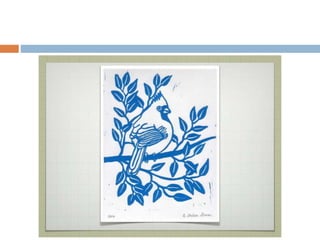
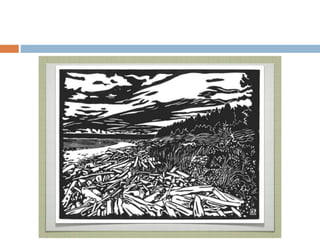
PRINTMAKING
What is PRINTMAKING?
 Printmaking is the act of making
series of identical images made by
transferring an original image to a
block, screen, stone or plate to
produce multiples of that image.
 This process is capable of making
multiple copies of the same artwork.
 Any textured surface can be used to
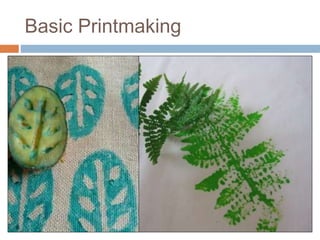
Basic Printmaking
VOCABULARY
 Print/Impression: Each individual copy of the
artwork
 Edition: A set of prints (3 or more)
 Limited Edition: a signed and numbered set of
prints (3 or more)
Add words as the slide
progresses.
History of Printmaking
The
Chinese
developed
a printing
technique
called
“woodcut”
to print
books of
Chinese
characters
and
images,
around 100
AD.
Printmaking
started in
China. The
Chinese
developed a
printing
technique
called
“woodcut” to
print books
of Chinese
characters
and images,
around 100
AD.
Types of Printmaking
 There are 4 types of printmaking;
 Intaglio Printmaking
 Screen/Stencil Printmaking
 Lithography
 Relief Printmaking
Intaglio Printmaking
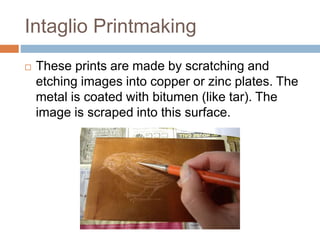
 These prints are made by scratching and
etching images into copper or zinc plates. The
metal is coated with bitumen (like tar). The
image is scraped into this surface.
Intaglio (cont)
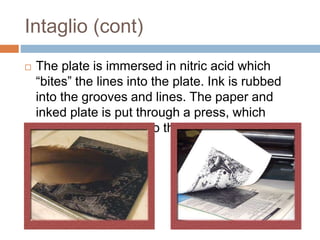
 The plate is immersed in nitric acid which
“bites” the lines into the plate. Ink is rubbed
into the grooves and lines. The paper and
inked plate is put through a press, which
pushes the paper into the inked lines.
Stencil Printing
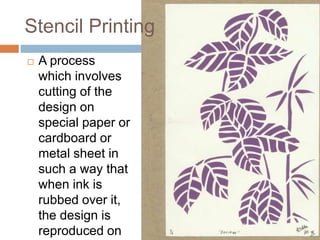
 A process
which involves
cutting of the
design on
special paper or
cardboard or
metal sheet in
such a way that
when ink is
rubbed over it,
the design is
reproduced on
Screen Printing
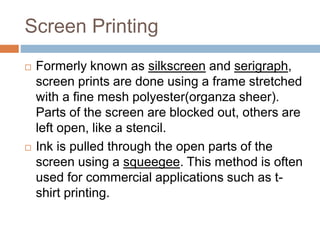
 Formerly known as silkscreen and serigraph,
screen prints are done using a frame stretched
with a fine mesh polyester(organza sheer).
Parts of the screen are blocked out, others are
left open, like a stencil.
 Ink is pulled through the open parts of the
screen using a squeegee. This method is often
used for commercial applications such as t-
shirt printing.
Parts of a Screen
Lithography
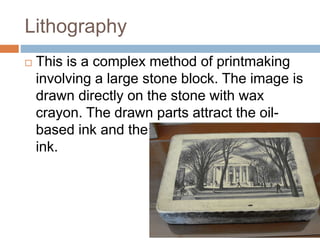
 This is a complex method of printmaking
involving a large stone block. The image is
drawn directly on the stone with wax
crayon. The drawn parts attract the oil-
based ink and the wet stone resists the
ink.
Relief Printmaking
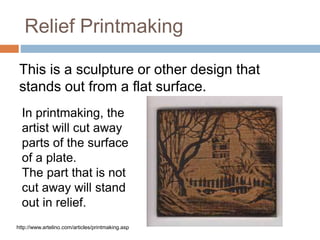
This is a sculpture or other design that
stands out from a flat surface.
http://www.artelino.com/articles/printmaking.asp
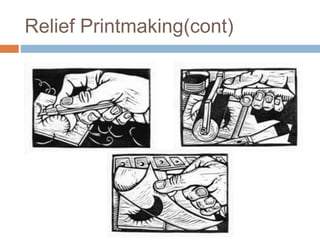
In printmaking, the
artist will cut away
parts of the surface
of a plate.
The part that is not
cut away will stand
out in relief.
Relief Printmaking(cont)
Things to consider
 Your image will print backwards
(mirror-imaged)
 There is no shading in linoleum cuts;
only black or white
 Your print is created by carving out
lines
 It’s very difficult to put detail into a
lino cut
White space is
carved out of
the block.
Leaving some
lines visible
adds texture.
On black
surfaces, white
lines are used
to differentiate
from the
background.
Good prints
balance light
and dark areas.
Textures can be created by varying lines, patterns and surfaces
with the carving tool.
Examples of Linoprints
Printmaking
Printmaking
Printmaking

Printmaking

  • 1.
  • 2.
    What is PRINTMAKING? Printmaking is the act of making series of identical images made by transferring an original image to a block, screen, stone or plate to produce multiples of that image.  This process is capable of making multiple copies of the same artwork.  Any textured surface can be used to
  • 3.
  • 4.
    VOCABULARY  Print/Impression: Eachindividual copy of the artwork  Edition: A set of prints (3 or more)  Limited Edition: a signed and numbered set of prints (3 or more) Add words as the slide progresses.
  • 5.
    History of Printmaking The Chinese developed aprinting technique called “woodcut” to print books of Chinese characters and images, around 100 AD. Printmaking started in China. The Chinese developed a printing technique called “woodcut” to print books of Chinese characters and images, around 100 AD.
  • 6.
    Types of Printmaking There are 4 types of printmaking;  Intaglio Printmaking  Screen/Stencil Printmaking  Lithography  Relief Printmaking
  • 7.
    Intaglio Printmaking  Theseprints are made by scratching and etching images into copper or zinc plates. The metal is coated with bitumen (like tar). The image is scraped into this surface.
  • 8.
    Intaglio (cont)  Theplate is immersed in nitric acid which “bites” the lines into the plate. Ink is rubbed into the grooves and lines. The paper and inked plate is put through a press, which pushes the paper into the inked lines.
  • 9.
    Stencil Printing  Aprocess which involves cutting of the design on special paper or cardboard or metal sheet in such a way that when ink is rubbed over it, the design is reproduced on
  • 10.
    Screen Printing  Formerlyknown as silkscreen and serigraph, screen prints are done using a frame stretched with a fine mesh polyester(organza sheer). Parts of the screen are blocked out, others are left open, like a stencil.  Ink is pulled through the open parts of the screen using a squeegee. This method is often used for commercial applications such as t- shirt printing.
  • 11.
    Parts of aScreen
  • 12.
    Lithography  This isa complex method of printmaking involving a large stone block. The image is drawn directly on the stone with wax crayon. The drawn parts attract the oil- based ink and the wet stone resists the ink.
  • 13.
    Relief Printmaking This isa sculpture or other design that stands out from a flat surface. http://www.artelino.com/articles/printmaking.asp In printmaking, the artist will cut away parts of the surface of a plate. The part that is not cut away will stand out in relief.
  • 14.
  • 15.
    Things to consider Your image will print backwards (mirror-imaged)  There is no shading in linoleum cuts; only black or white  Your print is created by carving out lines  It’s very difficult to put detail into a lino cut
  • 16.
    White space is carvedout of the block. Leaving some lines visible adds texture. On black surfaces, white lines are used to differentiate from the background. Good prints balance light and dark areas. Textures can be created by varying lines, patterns and surfaces with the carving tool.
  • 17.