HISTORY OF PAINTING
 The history of painting reaches back in time to
artifacts from pre-historic humans, and spans all
cultures. It represents a continuous, though
periodically disrupted tradition from Antiquity.
Across cultures, and spanning continents and
millennia, the history of painting is an ongoing river
of creativity, that continues into the 21st
century.[1] Until the early 20th century it relied
primarily
on representational, religious and classical motifs,
after which time more
purely abstract and conceptualapproaches
gained favor.
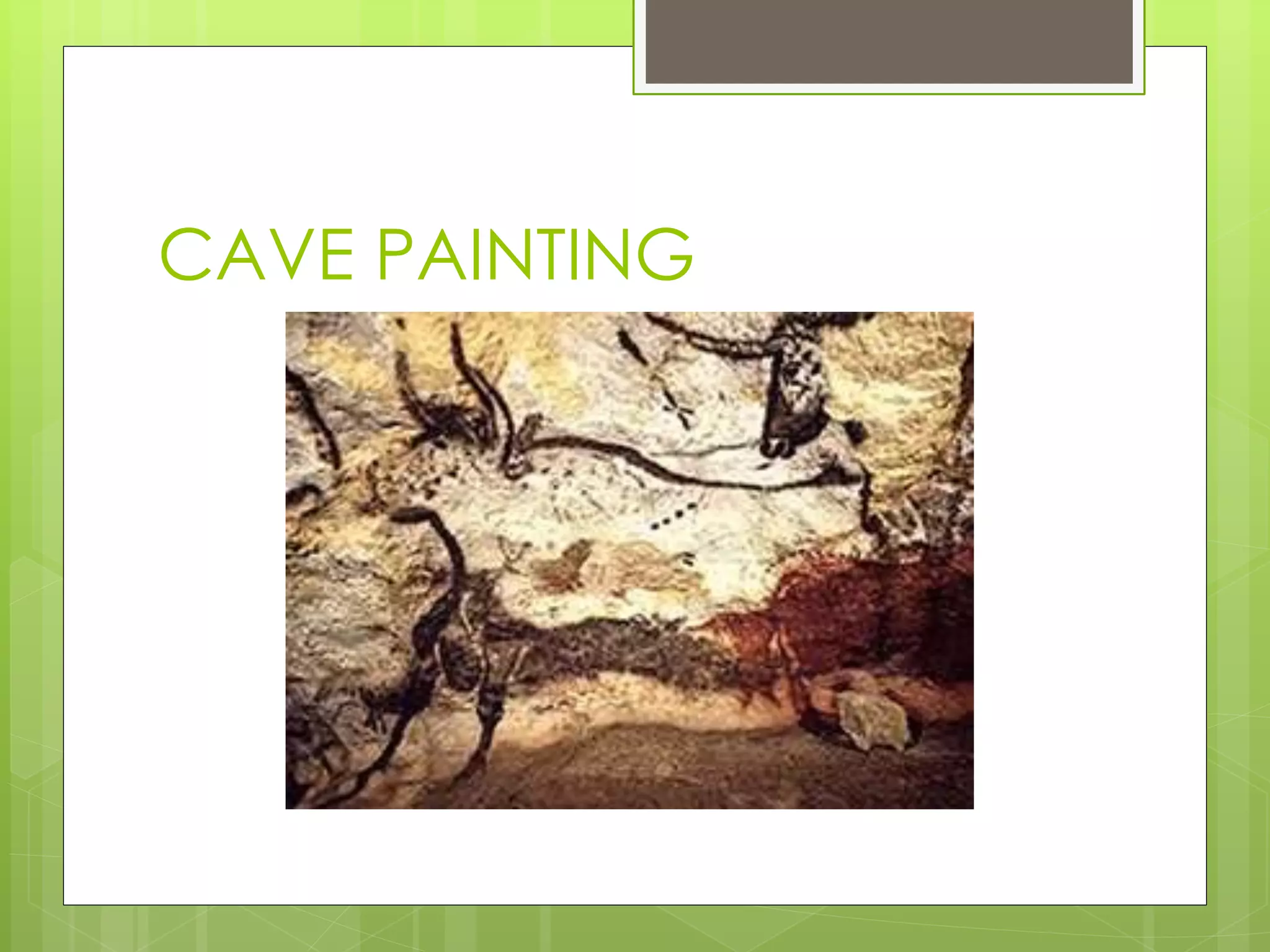
CAVE PAINTING
PAINTING
A painting is an image (artwork)
created using pigments (color) on
a surface (ground) such as paper
or canvas. The pigment may be in
a wet form, such as paint, or a dry
form, such as pastels.
TYPES OF PAINTING
 A still life shows objects, such as flowers,
food, or musical instruments. A still life
reveals an artist's skill in painting shapes,
light, and shadow.
 A real life scene captures life in action. It
could show a busy street, a beach party,
a dinner gathering, or anyplace where
living goes on.
 A religious work of art shares a religious
message. It might portray a sacred story
or express an artist's faith.
TYPES OF PAINTING
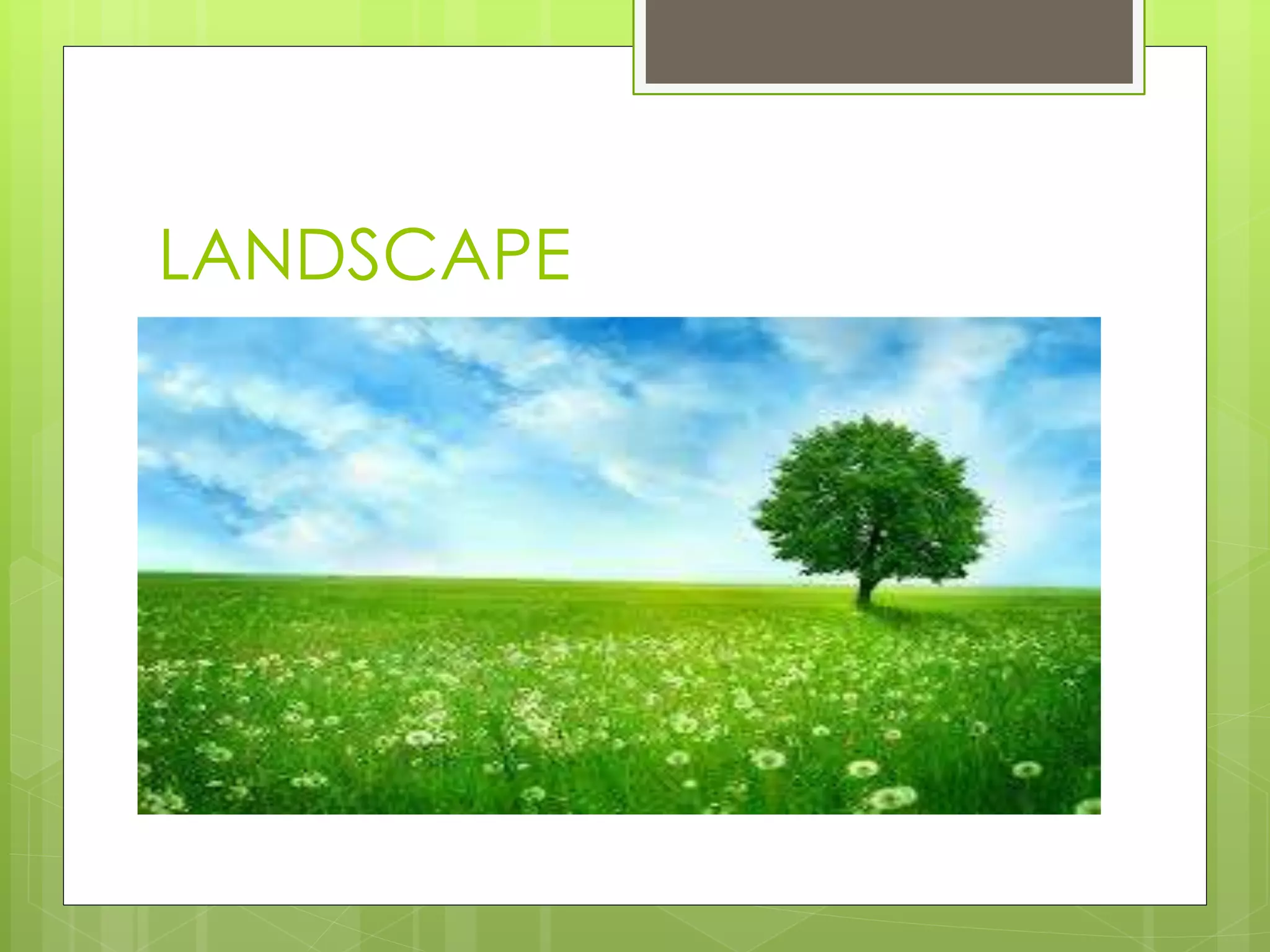
 A landscape is an outdoor scene. A landscape artist uses paint to
create not only land, water, and clouds but air, wind, and sunlight.
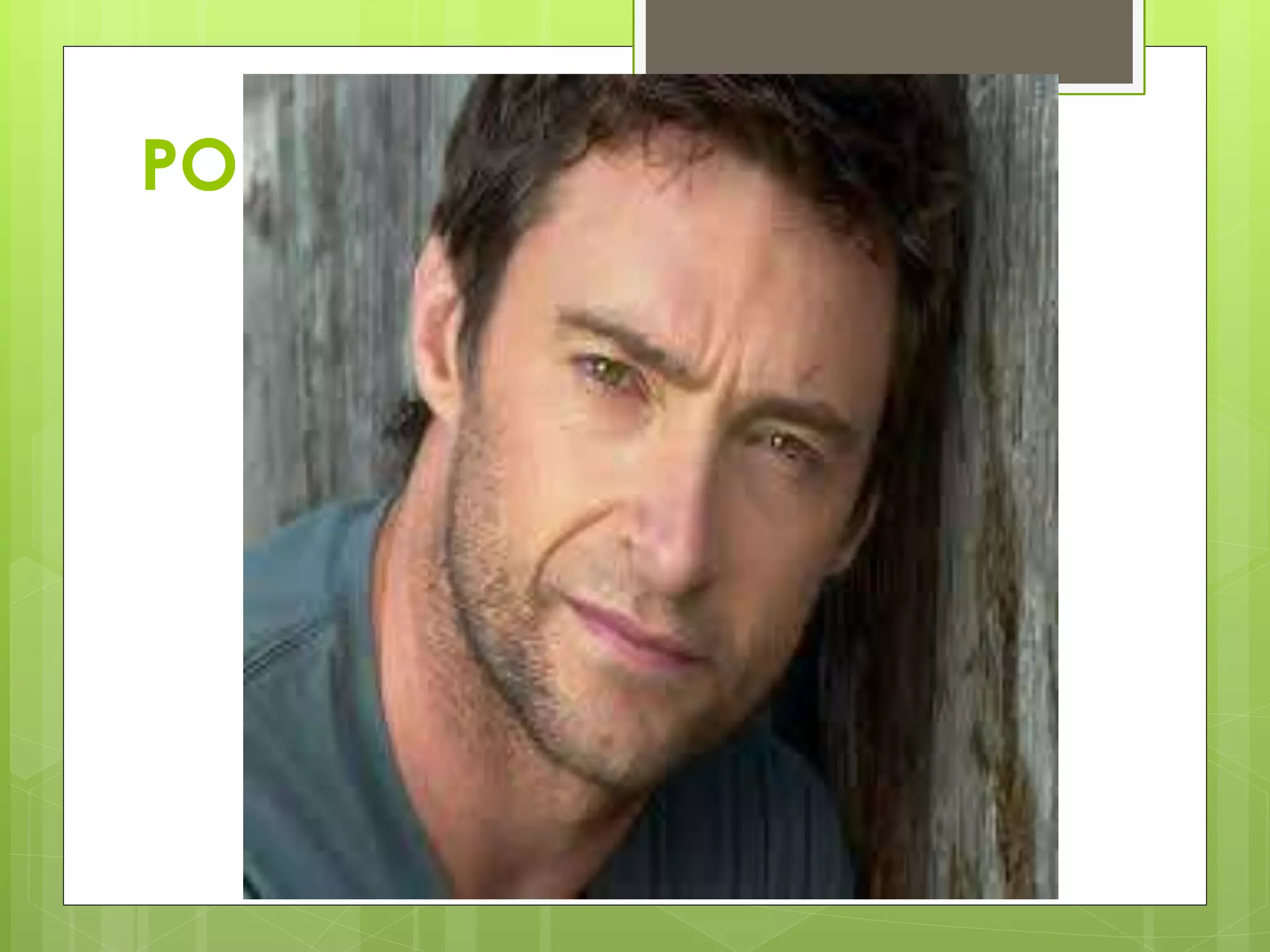
 A portrait is an image of a person or animal. Besides showing what
someone looks like, a portrait often captures a mood or
personality.
LANDSCAPE
STILL LIFE
PORTRAIT
MEDIUMS OF PAINTING
 There are different mediums in paintings that are
used today. Artist's uses different kinds of
mediums, they includes acrylic, pastels, fresco,
gouache, oil tempura, water color and water
miscible oil paint.
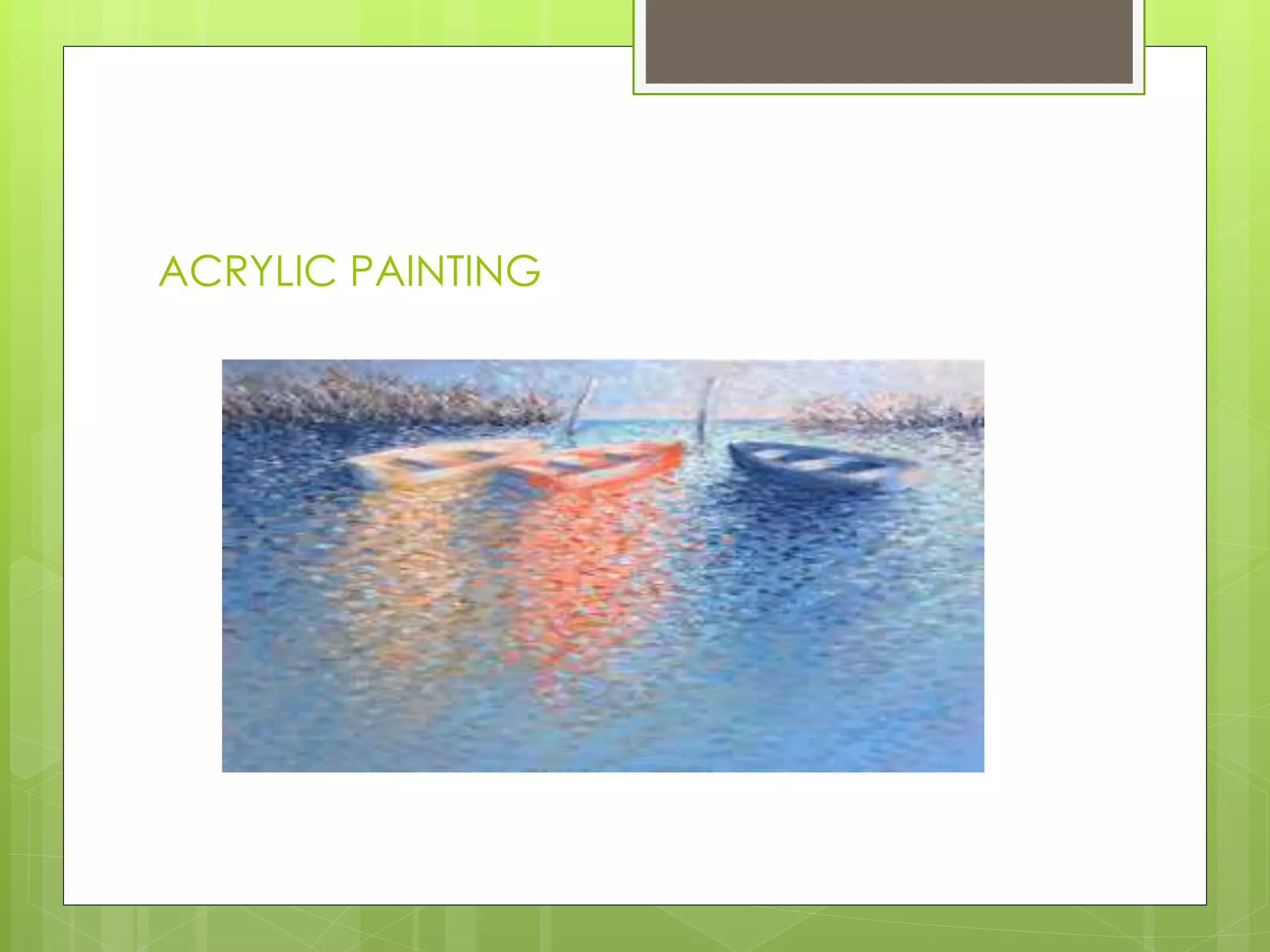
 Acrylic is a fast drying paint. It contains pigments
suspended in polymer emulsion. Acrylic paints are
usually diluted with waters.
 Another medium that is being used is the Pastel.
Pastel comes in three different types, the soft
pastels, the hard pastels and the pastel pencils.
The soft pastels are the most widely used; it has a
higher portion of pigments and less binder. The
hard pastel has a higher portion of binder and less
pigment. The pastel pencils are pencils with pastel
leads.
ACRYLIC PAINTING
PASTEL PAINTING
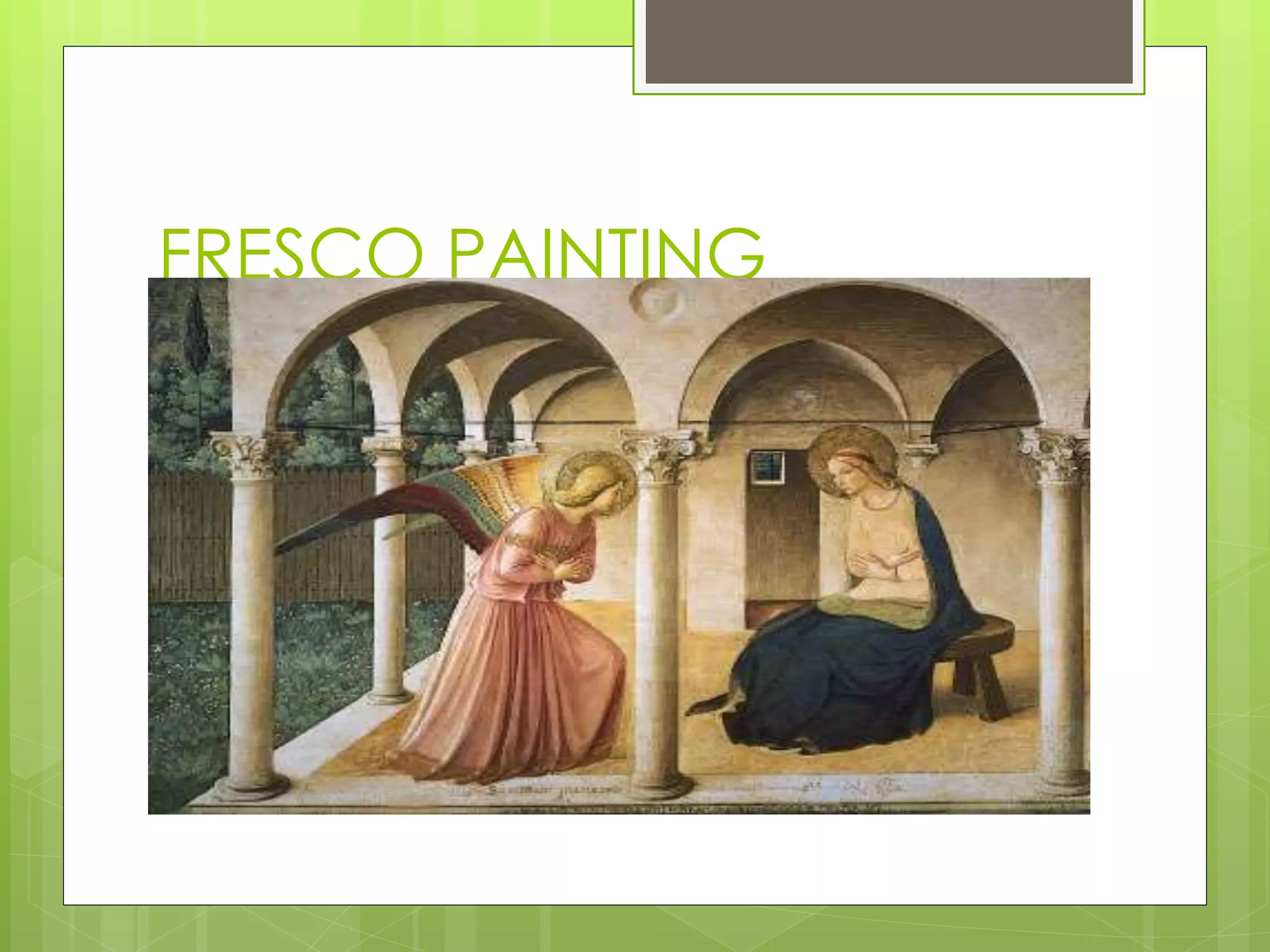
Fresco paintings can often be seen
on walls and ceilings. The word fresco came
from the Italian word fresco (fresh). There are
three types of fresco, the Buon fresco, which
consist of painting pigments mixed with water
on a thin layer of plaster. Secco, which done
in dry plaster. The pigment requires a binding
medium such as egg (tempura, glue or oil to
attach pigments). The Mezzo-fresco. In this
type, the pigment should only penetrate
slightly on the plaster.
FRESCO PAINTING
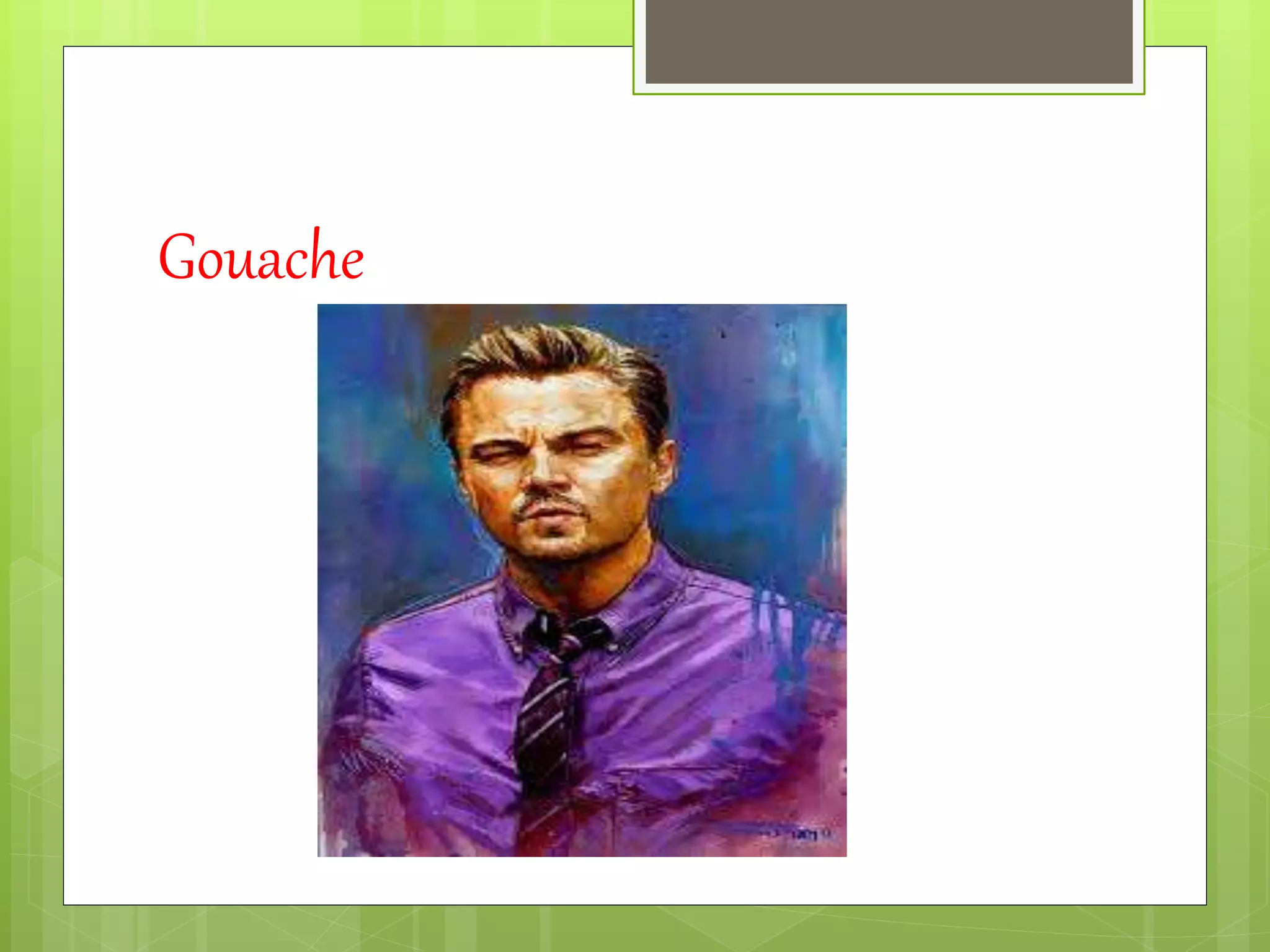
Gouache, derived from Italian guazzo, water pan,
splash or body color. This medium is also dilute in water. It
differs from water color considering that its particles are
larger, the ratio of pigment to water is much bigger and
white pigment such as chalk is present on it.
Oil, oil is a type of slow drying paint. It consists of
particular pigments suspended in a drying oil. This kind of
medium does not dry quickly. It blends into the surroundings
and allow the blending of color. It produces vivid colors
with a natural sheen and distinct context. It provides a
surface translucency similar to human skin making it an
ideal for portrait painting.
Gouache
OIL PAINTING
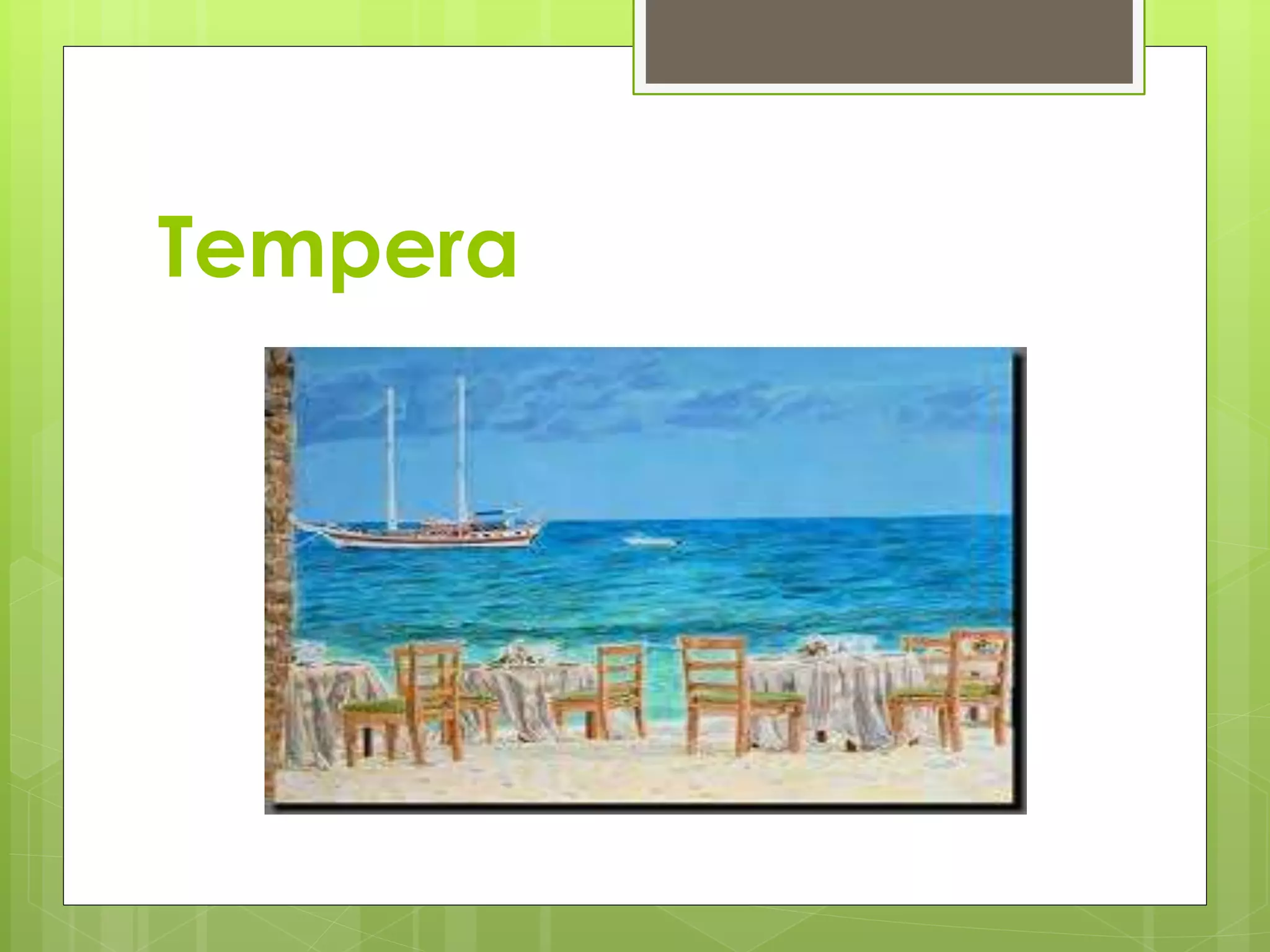
Tempera, another medium is the
Tempera. also known as egg tempera, is
a permanent, fast-drying painting
medium consisting of colored pigment
mixed with a water-soluble binder
medium (usually a glutinous material such
as egg yolk or some other size). Tempera
also refers to the paintings done in this
medium.
 It is a permanent fast drying painting
medium consisting of colored pigment
Tempera
MURAL PAINTING
 A mural is any piece of artwork painted or
applied directly on a wall, ceiling or other
large permanent surface. A distinguishing
characteristic of mural painting is that the
architectural elements of the given space are
harmoniously incorporated into the picture.
Paul Cézanne
The Card Players, 1892/93
$250 million
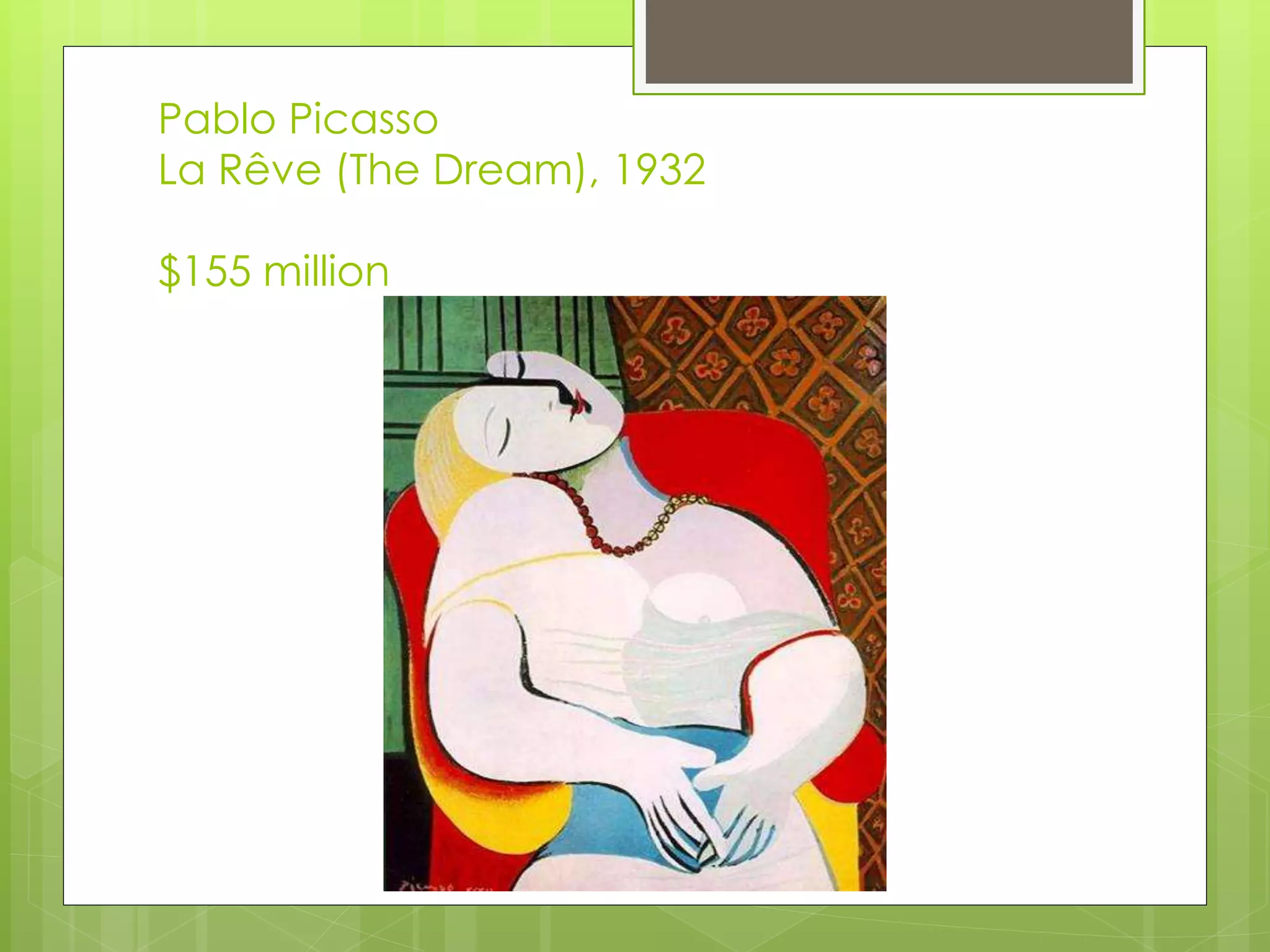
Pablo Picasso
La Rêve (The Dream), 1932
$155 million
Francis Bacon
Three Studies of Lucian Freud, 1969
$142,4 million
Painting Final

Painting Final

  • 2.
    HISTORY OF PAINTING The history of painting reaches back in time to artifacts from pre-historic humans, and spans all cultures. It represents a continuous, though periodically disrupted tradition from Antiquity. Across cultures, and spanning continents and millennia, the history of painting is an ongoing river of creativity, that continues into the 21st century.[1] Until the early 20th century it relied primarily on representational, religious and classical motifs, after which time more purely abstract and conceptualapproaches gained favor.
  • 3.
  • 4.
    PAINTING A painting isan image (artwork) created using pigments (color) on a surface (ground) such as paper or canvas. The pigment may be in a wet form, such as paint, or a dry form, such as pastels.
  • 5.
    TYPES OF PAINTING A still life shows objects, such as flowers, food, or musical instruments. A still life reveals an artist's skill in painting shapes, light, and shadow.  A real life scene captures life in action. It could show a busy street, a beach party, a dinner gathering, or anyplace where living goes on.  A religious work of art shares a religious message. It might portray a sacred story or express an artist's faith.
  • 6.
    TYPES OF PAINTING A landscape is an outdoor scene. A landscape artist uses paint to create not only land, water, and clouds but air, wind, and sunlight.  A portrait is an image of a person or animal. Besides showing what someone looks like, a portrait often captures a mood or personality.
  • 7.
  • 8.
  • 9.
  • 10.
    MEDIUMS OF PAINTING There are different mediums in paintings that are used today. Artist's uses different kinds of mediums, they includes acrylic, pastels, fresco, gouache, oil tempura, water color and water miscible oil paint.  Acrylic is a fast drying paint. It contains pigments suspended in polymer emulsion. Acrylic paints are usually diluted with waters.  Another medium that is being used is the Pastel. Pastel comes in three different types, the soft pastels, the hard pastels and the pastel pencils. The soft pastels are the most widely used; it has a higher portion of pigments and less binder. The hard pastel has a higher portion of binder and less pigment. The pastel pencils are pencils with pastel leads.
  • 11.
  • 12.
  • 13.
    Fresco paintings canoften be seen on walls and ceilings. The word fresco came from the Italian word fresco (fresh). There are three types of fresco, the Buon fresco, which consist of painting pigments mixed with water on a thin layer of plaster. Secco, which done in dry plaster. The pigment requires a binding medium such as egg (tempura, glue or oil to attach pigments). The Mezzo-fresco. In this type, the pigment should only penetrate slightly on the plaster.
  • 14.
  • 15.
    Gouache, derived fromItalian guazzo, water pan, splash or body color. This medium is also dilute in water. It differs from water color considering that its particles are larger, the ratio of pigment to water is much bigger and white pigment such as chalk is present on it. Oil, oil is a type of slow drying paint. It consists of particular pigments suspended in a drying oil. This kind of medium does not dry quickly. It blends into the surroundings and allow the blending of color. It produces vivid colors with a natural sheen and distinct context. It provides a surface translucency similar to human skin making it an ideal for portrait painting.
  • 16.
  • 17.
  • 18.
    Tempera, another mediumis the Tempera. also known as egg tempera, is a permanent, fast-drying painting medium consisting of colored pigment mixed with a water-soluble binder medium (usually a glutinous material such as egg yolk or some other size). Tempera also refers to the paintings done in this medium.  It is a permanent fast drying painting medium consisting of colored pigment
  • 19.
  • 20.
    MURAL PAINTING  Amural is any piece of artwork painted or applied directly on a wall, ceiling or other large permanent surface. A distinguishing characteristic of mural painting is that the architectural elements of the given space are harmoniously incorporated into the picture.
  • 22.
    Paul Cézanne The CardPlayers, 1892/93 $250 million
  • 23.
    Pablo Picasso La Rêve(The Dream), 1932 $155 million
  • 24.
    Francis Bacon Three Studiesof Lucian Freud, 1969 $142,4 million