

Its all about Culture + People + Process + Tools
Agile – Kanban @
Support team
R Ragavendra Prasath
What is Agile
▪ Reflecting customer needs…
▪ a style of project management that focuses on
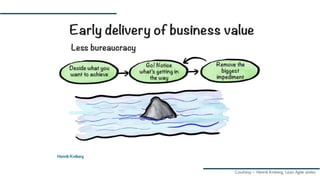
▪ Early delivery of business value
▪ Continuous improvement
▪ Scope flexibility
▪ Team input
▪ Delivering well tested products
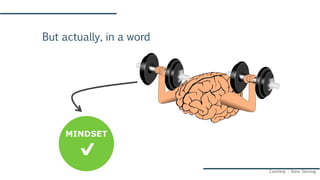
But actually, in a word
MINDSET
Courtesy – Steve Denning
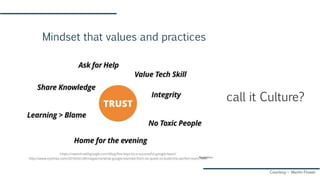
Mindset that values and practices
Courtesy – Martin Flower
call it Culture?
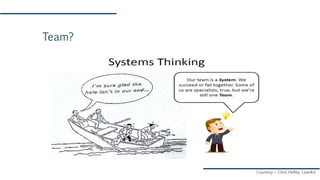
Team?
Courtesy – Chris Hefley, LeanKit
Courtesy – Henrik Kniberg, Lean Agile slides
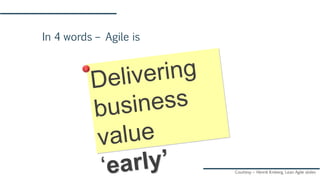
In 4 words – Agile is
Courtesy – Henrik Kniberg, Lean Agile slides
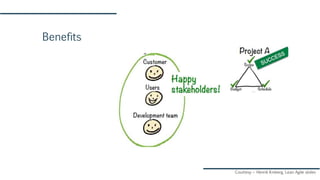
Benefits
Courtesy – Henrik Kniberg, Lean Agile slides
Core Kanban
Values . Principles . Practices
Inside Core-Kanban
▪ What is Kanban?
▪ Why Kanban?
▪ Why Kanban @ L3!
▪ Principles
▪ Practices
▪ Values
▪ How @ L3
▪ What will we measure?
▪ Lets start
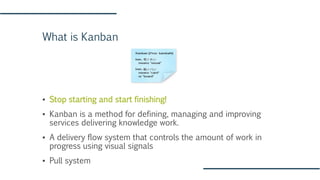
What is Kanban
▪ Stop starting and start finishing!
▪ Kanban is a method for defining, managing and improving
services delivering knowledge work.
▪ A delivery flow system that controls the amount of work in
progress using visual signals
▪ Pull system
Why Kanban
▪ Visually see work in progress
▪ Instantly understand impediments (things causing you to delay) and take
steps to remove them
▪ Improve communication between yourself and others on your team
▪ Empower teams to self-manage visual processes and work flows
▪ Inspire team collaboration
▪ Better risk management
▪ Eliminate overburdening
▪ Evolutionary change
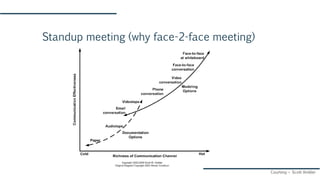
Standup meeting (why face-2-face meeting)
Courtesy – Scott Ambler
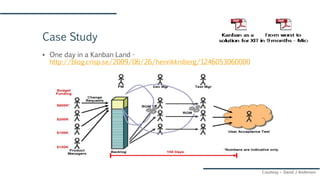
Case Study
▪ One day in a Kanban Land -
http://blog.crisp.se/2009/06/26/henrikkniberg/1246053060000
Courtesy – David J Anderson
Kanban contains…
▪ Meeting
– Standup meeting
– Delivery planning meeting
– Service delivery review
– Operations review
– Risk review
▪ Roles
– Flow master
– Team members (Developers & Testers)
▪ Logs
– Cumulative Flow Diagram
(To-do, In-progress, Done)
▪ Others
– Lead time
– Cycle time
– SLA
– Throughput
– Work In Progress (WIP)
Values
1) Transparency
2) Balance
3) Collaboration
4) Customer focus
5) Flow
6) Leadership
7) Understanding
8) Agreement
9) Respect
Principles
1) Start with what you do now
2) Agree to pursue incremental, evolutionary change
3) Respect the current process, roles, responsibilities and titles
4) Leadership at all levels
Principles (elongated)
▪ 3 change management principles
1) Start with what you do now
– Understanding the current processes, as actually practiced
– Respecting existing roles, responsibilities and job titles
2) Agree to purse improvement through evolutionary change
3) Encourage acts of leadership at every level, from individual contributor
to senior management
Principles (elongated)
▪ 3 service delivery principles
1) Understand and focus on your customers needs and expectations
2) Manage the work; let people self organize around it
3) Your organization is an ecosystem of independent services, steered by
its polices; reflect regularly on their effectives and improve them.
Practices
1) Visualize
▪ Split the work into pieces, write each item on a card and put on the wall
▪ Use named columns to illustrate where each item is in the workflow
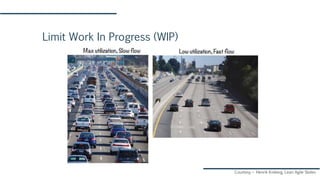
2) Limit Work In Progress (WIP)
▪ Assign explicit limits to how many items may be in progress at each workflow state
3) Manage flow
▪ Flow of work items through each state in the workflow should be monitored and reported -
often referred to as Measuring Flow
▪ speed of movement and the smoothness of that movement
▪ Measure lead time and cycle time
Properties!
Practices
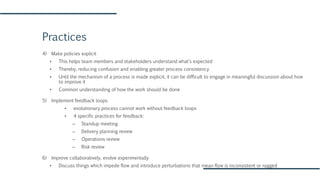
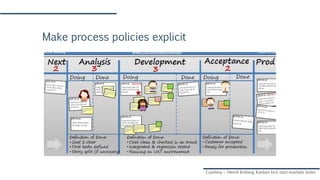
4) Make policies explicit
▪ This helps team members and stakeholders understand what’s expected
▪ Thereby, reducing confusion and enabling greater process consistency
▪ Until the mechanism of a process is made explicit, it can be difficult to engage in meaningful discussion about how
to improve it
▪ Common understanding of how the work should be done
5) Implement feedback loops
▪ evolutionary process cannot work without feedback loops
▪ 4 specific practices for feedback:
– Standup meeting
– Delivery planning review
– Operations review
– Risk review
6) Improve collaboratively, evolve experimentally
▪ Discuss things which impede flow and introduce perturbations that mean flow is inconsistent or ragged
Limit Work In Progress (WIP)
Courtesy – Henrik Kniberg, Lean Agile Slides
Make process policies explicit
Courtesy – Henrik Kniberg, Kanban kick start example slides
Kanban @ L3 Support
How do we do it
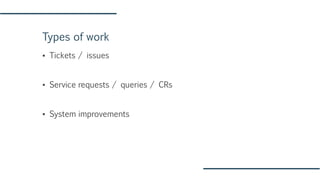
Types of work
▪ Tickets / issues
▪ Service requests / queries / CRs
▪ System improvements
Structure Expedite
P3 (10)
(Backlog)
P2 (7)
P1(5)
To do
Gather more
info
RCA Impact Coding
Unit
Testing
Code
review
Released to
Testing
On hold
= Tickets / Issues
= Service requests / queries /
CRs
= System improvements
Done
3
2
4
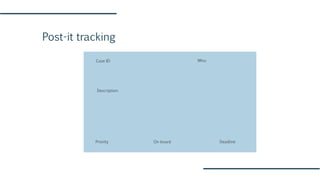
Post-it tracking
Case ID:
Description:
Who:
Priority On board Deadline
Metrics
▪ SLA
▪ Lead time / Cycle time
▪ Throughput / Delivery rate (Cards completed/day)
▪ Continuous Improvement
▪ Also measure (in the near future)
▪ Service level expectation: what the customer expects
▪ Service level capability: what the system can deliver
▪ Service level agreement: what is agreed with the customer
▪ Service fitness threshold: the service level below which the service
delivery is unacceptable to the customer
Lets start Kanban @
Support
To-Dos
▪ Mention the tasks in the Kanban board
▪ Perform daily standup
▪ Roles
▪ Decide Kanban captain for the week.
▪ Service Manager
– (Service Request Manager) Responsible for understanding customer needs and
expectations of customers, and for selecting and ordering work items accordingly
– (Service Delivery Manager) Responsible for the flow of work in delivering selected
items to customers
▪ Gather feedback and start working on the continuous improvement.
▪ Stop starting and start finishing!
Bibliography
▪ Book titled ' Essential-Kanban-Condensed-Guide’ by David J Anderson
▪ Article titled ‘From Worst to Best in 9 Months: Implementing a Drum-Buffer-Rope Solution in
Microsoft’s IT Department’ by David J. Anderson & Dragos Dumitriu, Microsoft Corporation,
November 2005
Courtesy to the Authors
My identity
▪ R Ragavendra Prasath
▪ ragavendraprasath@gmail.com
▪ Husband, Dad, Son, Friend, Student, Growth hacker, Employee,
Volunteer, Product Hunter, Process, Technology, Chocolate &
Coffee Enthusiast…!
Disclaimer
▪ All the slides given here are for information purposes only. Not
for commercial.
▪ Created for the benefit of the Agile / Users as a contribution
to the society.
▪ Used under Creative Common License.
▪ Inspirations from Steve Denning, Pete Deemer, Martin Flower,
and esp. Henrik Kniberg,
Thank you so much!
Made with

Agile Kanban

  • 1.
    Its all aboutCulture + People + Process + Tools Agile – Kanban @ Support team R Ragavendra Prasath
  • 2.
    What is Agile ▪Reflecting customer needs… ▪ a style of project management that focuses on ▪ Early delivery of business value ▪ Continuous improvement ▪ Scope flexibility ▪ Team input ▪ Delivering well tested products
  • 3.
    But actually, ina word MINDSET Courtesy – Steve Denning
  • 4.
    Mindset that valuesand practices Courtesy – Martin Flower call it Culture?
  • 5.
    Team? Courtesy – ChrisHefley, LeanKit
  • 6.
    Courtesy – HenrikKniberg, Lean Agile slides
  • 7.
    In 4 words– Agile is Courtesy – Henrik Kniberg, Lean Agile slides
  • 8.
    Courtesy – HenrikKniberg, Lean Agile slides
  • 9.
    Benefits Courtesy – HenrikKniberg, Lean Agile slides
  • 10.
    Core Kanban Values .Principles . Practices
  • 11.
    Inside Core-Kanban ▪ Whatis Kanban? ▪ Why Kanban? ▪ Why Kanban @ L3! ▪ Principles ▪ Practices ▪ Values ▪ How @ L3 ▪ What will we measure? ▪ Lets start
  • 12.
    What is Kanban ▪Stop starting and start finishing! ▪ Kanban is a method for defining, managing and improving services delivering knowledge work. ▪ A delivery flow system that controls the amount of work in progress using visual signals ▪ Pull system
  • 13.
    Why Kanban ▪ Visuallysee work in progress ▪ Instantly understand impediments (things causing you to delay) and take steps to remove them ▪ Improve communication between yourself and others on your team ▪ Empower teams to self-manage visual processes and work flows ▪ Inspire team collaboration ▪ Better risk management ▪ Eliminate overburdening ▪ Evolutionary change
  • 14.
    Standup meeting (whyface-2-face meeting) Courtesy – Scott Ambler
  • 15.
    Case Study ▪ Oneday in a Kanban Land - http://blog.crisp.se/2009/06/26/henrikkniberg/1246053060000 Courtesy – David J Anderson
  • 16.
    Kanban contains… ▪ Meeting –Standup meeting – Delivery planning meeting – Service delivery review – Operations review – Risk review ▪ Roles – Flow master – Team members (Developers & Testers) ▪ Logs – Cumulative Flow Diagram (To-do, In-progress, Done) ▪ Others – Lead time – Cycle time – SLA – Throughput – Work In Progress (WIP)
  • 17.
    Values 1) Transparency 2) Balance 3)Collaboration 4) Customer focus 5) Flow 6) Leadership 7) Understanding 8) Agreement 9) Respect
  • 18.
    Principles 1) Start withwhat you do now 2) Agree to pursue incremental, evolutionary change 3) Respect the current process, roles, responsibilities and titles 4) Leadership at all levels
  • 19.
    Principles (elongated) ▪ 3change management principles 1) Start with what you do now – Understanding the current processes, as actually practiced – Respecting existing roles, responsibilities and job titles 2) Agree to purse improvement through evolutionary change 3) Encourage acts of leadership at every level, from individual contributor to senior management
  • 20.
    Principles (elongated) ▪ 3service delivery principles 1) Understand and focus on your customers needs and expectations 2) Manage the work; let people self organize around it 3) Your organization is an ecosystem of independent services, steered by its polices; reflect regularly on their effectives and improve them.
  • 21.
    Practices 1) Visualize ▪ Splitthe work into pieces, write each item on a card and put on the wall ▪ Use named columns to illustrate where each item is in the workflow 2) Limit Work In Progress (WIP) ▪ Assign explicit limits to how many items may be in progress at each workflow state 3) Manage flow ▪ Flow of work items through each state in the workflow should be monitored and reported - often referred to as Measuring Flow ▪ speed of movement and the smoothness of that movement ▪ Measure lead time and cycle time Properties!
  • 22.
    Practices 4) Make policiesexplicit ▪ This helps team members and stakeholders understand what’s expected ▪ Thereby, reducing confusion and enabling greater process consistency ▪ Until the mechanism of a process is made explicit, it can be difficult to engage in meaningful discussion about how to improve it ▪ Common understanding of how the work should be done 5) Implement feedback loops ▪ evolutionary process cannot work without feedback loops ▪ 4 specific practices for feedback: – Standup meeting – Delivery planning review – Operations review – Risk review 6) Improve collaboratively, evolve experimentally ▪ Discuss things which impede flow and introduce perturbations that mean flow is inconsistent or ragged
  • 23.
    Limit Work InProgress (WIP) Courtesy – Henrik Kniberg, Lean Agile Slides
  • 24.
    Make process policiesexplicit Courtesy – Henrik Kniberg, Kanban kick start example slides
  • 25.
    Kanban @ L3Support How do we do it
  • 26.
    Types of work ▪Tickets / issues ▪ Service requests / queries / CRs ▪ System improvements
  • 27.
    Structure Expedite P3 (10) (Backlog) P2(7) P1(5) To do Gather more info RCA Impact Coding Unit Testing Code review Released to Testing On hold = Tickets / Issues = Service requests / queries / CRs = System improvements Done 3 2 4
  • 28.
  • 29.
    Metrics ▪ SLA ▪ Leadtime / Cycle time ▪ Throughput / Delivery rate (Cards completed/day) ▪ Continuous Improvement ▪ Also measure (in the near future) ▪ Service level expectation: what the customer expects ▪ Service level capability: what the system can deliver ▪ Service level agreement: what is agreed with the customer ▪ Service fitness threshold: the service level below which the service delivery is unacceptable to the customer
  • 30.
  • 31.
    To-Dos ▪ Mention thetasks in the Kanban board ▪ Perform daily standup ▪ Roles ▪ Decide Kanban captain for the week. ▪ Service Manager – (Service Request Manager) Responsible for understanding customer needs and expectations of customers, and for selecting and ordering work items accordingly – (Service Delivery Manager) Responsible for the flow of work in delivering selected items to customers ▪ Gather feedback and start working on the continuous improvement. ▪ Stop starting and start finishing!
  • 33.
    Bibliography ▪ Book titled' Essential-Kanban-Condensed-Guide’ by David J Anderson ▪ Article titled ‘From Worst to Best in 9 Months: Implementing a Drum-Buffer-Rope Solution in Microsoft’s IT Department’ by David J. Anderson & Dragos Dumitriu, Microsoft Corporation, November 2005 Courtesy to the Authors
  • 34.
    My identity ▪ RRagavendra Prasath ▪ ragavendraprasath@gmail.com ▪ Husband, Dad, Son, Friend, Student, Growth hacker, Employee, Volunteer, Product Hunter, Process, Technology, Chocolate & Coffee Enthusiast…!
  • 35.
    Disclaimer ▪ All theslides given here are for information purposes only. Not for commercial. ▪ Created for the benefit of the Agile / Users as a contribution to the society. ▪ Used under Creative Common License. ▪ Inspirations from Steve Denning, Pete Deemer, Martin Flower, and esp. Henrik Kniberg,
  • 36.
    Thank you somuch! Made with