Kaizen ~ Dinesh Kakkad
The philosophy of KAIZEN assumes that our way of life – be it our working life, our social
life or our home life – deserves to be made continuously better through improvements.
Today, most manufacturing companies are still organized for functional manufacturing. Raw
materials, parts and consumables are purchased, stocked and brought to shop floor, where
they are processed, assembled, quality tested and finished products goes to the warehouse
and dispatched as per orders. Vital Customer processes are almost absent and so much of
wastages happen in form of large inventories of raw material, semi-finished and finished
goods, rejected returned goods, sub-standard parts, assemblies, scrap and missed or
delayed and cancelled orders. Human resources are also not utilized as per their full
potential. Financial resources are always under strain.
No matter how much sophistication is added to our computerized shop floor control systems,
if we fail to master the basics, we will never be able to eliminate the chaos that grips our
shop floor day-to-day activities!
KAIZEN tool is unique in that it averts disasters by removing the root cause behind
unhealthy management styles and inculcates work discipline and efficiency.
Changing the factory floor realities is a focus of Kaizen. We need to shift from the order
generation and expedite system to a System Flow Technology, or Linear Production or Lean
Manufacturing. Kaizen is an important tool of LEAN.
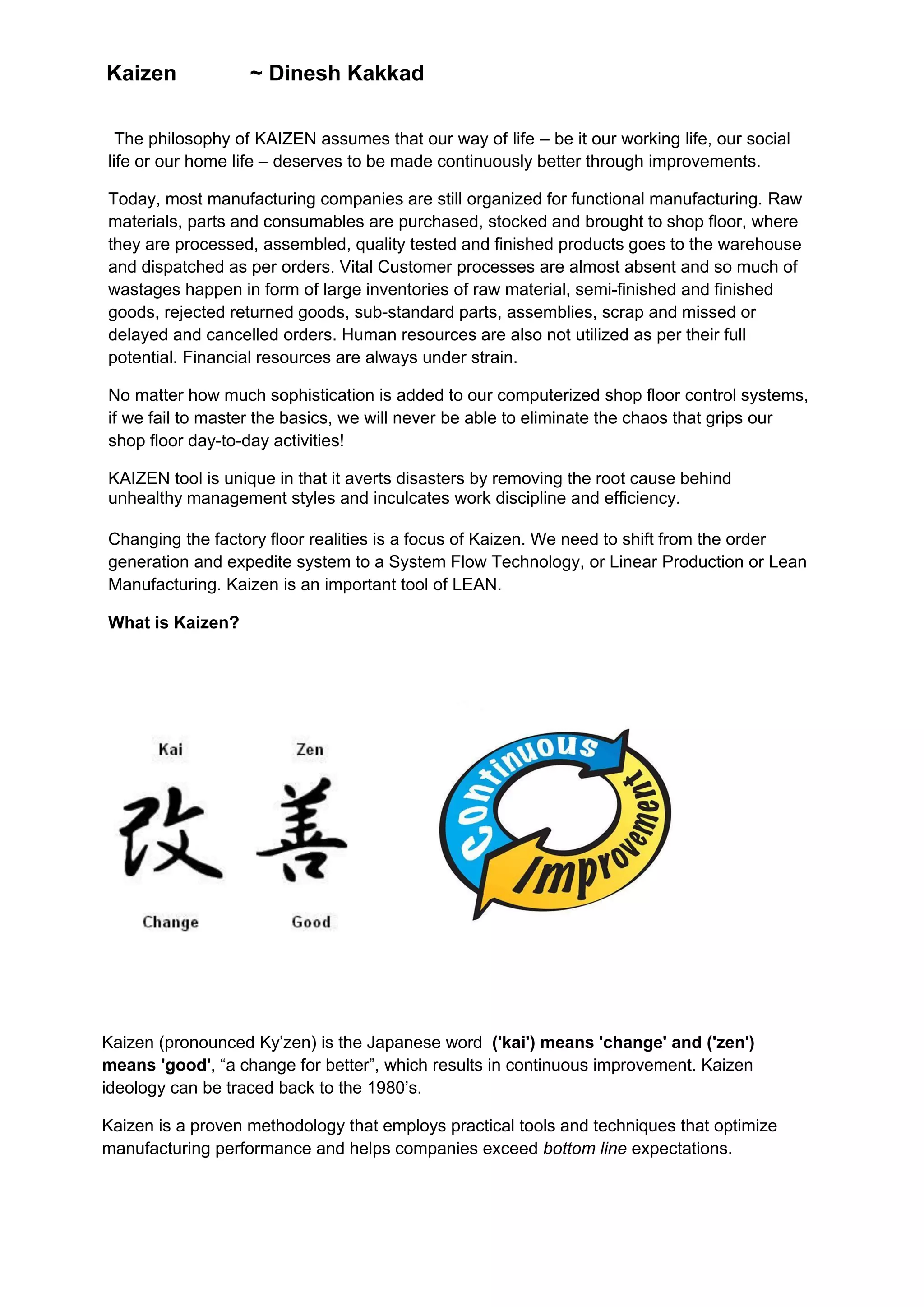
What is Kaizen?
Kaizen (pronounced Ky’zen) is the Japanese word ('kai') means 'change' and ('zen')
means 'good', “a change for better”, which results in continuous improvement. Kaizen
ideology can be traced back to the 1980’s.
Kaizen is a proven methodology that employs practical tools and techniques that optimize
manufacturing performance and helps companies exceed bottom line expectations.
How Kaizen is to be implemented?
KAIZEN promotes process-oriented way of thinking, leading to all around continuous
improvement, involving people at all levels of the organization.
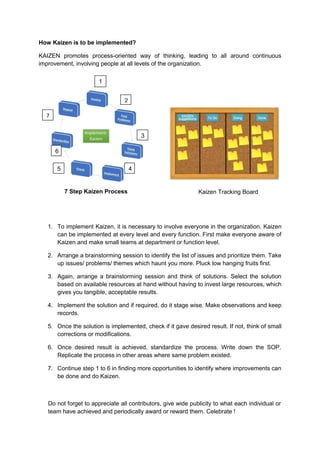
7 Step Kaizen Process
1. To implement Kaizen, it is necessary to involve everyone in the organization. Kaizen
can be implemented at every level and every function. First make everyone aware of
Kaizen and make small teams at department or function level.
2. Arrange a brainstorming session to identify the list of issues and prioritize them. Take
up issues/ problems/ themes which haunt you more. Pluck low hanging fruits first.
3. Again, arrange a brainstorming session and think of solutions. Select the solution
based on available resources at hand without having to invest large resources, which
gives you tangible, acceptable results.
4. Implement the solution and if required, do it stage wise. Make observations and keep
records.
5. Once the solution is implemented, check if it gave desired result. If not, think of small
corrections or modifications.
6. Once desired result is achieved, standardize the process. Write down the SOP.
Replicate the process in other areas where same problem existed.
7. Continue step 1 to 6 in finding more opportunities to identify where improvements can
be done and do Kaizen.
Do not forget to appreciate all contributors, give wide publicity to what each individual or
team have achieved and periodically award or reward them. Celebrate !
1
2
3
45
6
7
Kaizen Tracking Board
1. Customer Orientation, 2. Suggestion systems, 3. Low cost Automation, 4. Discipline in
the workplace, 5. Quality improvement 6. Just-in-time, 7. Zero defects, 8. Productivity
improvement, 9. New product development and the like
To make Kaizen successful, there should be a Kaizen Facilitator for each team to
guide, support and arrange resources needed for the implementation. Companywide, there
should be a Kaizen Leader to coordinate Kaizen idea selection, resource provision,
implementation, review progress, encourage teams and individuals, and celebrate
Kaizen. Kaizen (or any change initiative) does not last long and succeed if it does not
have Top Management continuous support and encouragement.
Some Examples of Small Kaizen ideas implemented
Hospitals
• reusing half used/ outdated IV infusion set for supplying water to plants and shrubs,
Manufacturing
• In a paint company, pigments required are kept in transparent containers (with its
Name Tag), so that it is easy for operators to collect correct pigment just by
visualizing its colour,
Office
• Reducing office clutter by keeping the files of different colour for each subject matter
and arranging them in Open file racks with Numbers or in Steel file Cabinets with
Subject labels and List outside and Numbering inside
Home
• When we go out of home for Office, men folk often forget to carry with them the things
they daily require and relent it afterwards when they need it but do not have it. Make
an acronym or Slogan which reminds you of which things you need to carry before
stepping out of home. W = Wallet, P = Pen, OK = Office Key, H =
Handkerchief, C = Comb, M = Mobile we mostly need every day.
Its acronym could be WP OK CHM !
Or slogan Whala Pankaj, OK Chhu Hu Maja Ma !
What are benefits of Kaizen?
Direct communications to employees will result in better decision-making. There will be a
decrease in direct supervision and an increase in people creativity and problem solving
participation. Team empowerment will result in more timely decision and resulting problem
solving. Quality will no longer require an inspection process, as process ownership occurs.
Self-direction will lead to people motivation, enhanced performance and retention. One will
be able to do more with fewer resources, in shorter time, in less floor space. A mindset of
“no status quo” will create a successful continuous improvement. Creative performance
recognition and reward will create a win-win work environment where work will become fun
again!
To make Kaizen effective, regularly get ideas on following topics or themes and
implement them.
Companies need to raise their performance expectations and realize that benefits come only
from the successful implementation of change.
World renowned Change Management expert Price Prichett says, “Kaizen keeps you
reaching, stretching to outdo yesterday. The continuous improvements may come bit by bit.
But enough of these small, incremental gains will eventually add up to a valuable competitive
advantage. Also, if every employee constantly keeps an eye out for improvements, major
innovations are more likely to occur. The spirit of kaizen can trigger dramatic breakthroughs.”
Dinesh Kakkad is Director of Excellence unLimited (A Management Consultancy
firm, based at Rajkot, Gujarat). He can be reached at dkk25945@hotmail.com or
9925028020

Kaizen basics

  • 1.
    Kaizen ~ DineshKakkad The philosophy of KAIZEN assumes that our way of life – be it our working life, our social life or our home life – deserves to be made continuously better through improvements. Today, most manufacturing companies are still organized for functional manufacturing. Raw materials, parts and consumables are purchased, stocked and brought to shop floor, where they are processed, assembled, quality tested and finished products goes to the warehouse and dispatched as per orders. Vital Customer processes are almost absent and so much of wastages happen in form of large inventories of raw material, semi-finished and finished goods, rejected returned goods, sub-standard parts, assemblies, scrap and missed or delayed and cancelled orders. Human resources are also not utilized as per their full potential. Financial resources are always under strain. No matter how much sophistication is added to our computerized shop floor control systems, if we fail to master the basics, we will never be able to eliminate the chaos that grips our shop floor day-to-day activities! KAIZEN tool is unique in that it averts disasters by removing the root cause behind unhealthy management styles and inculcates work discipline and efficiency. Changing the factory floor realities is a focus of Kaizen. We need to shift from the order generation and expedite system to a System Flow Technology, or Linear Production or Lean Manufacturing. Kaizen is an important tool of LEAN. What is Kaizen? Kaizen (pronounced Ky’zen) is the Japanese word ('kai') means 'change' and ('zen') means 'good', “a change for better”, which results in continuous improvement. Kaizen ideology can be traced back to the 1980’s. Kaizen is a proven methodology that employs practical tools and techniques that optimize manufacturing performance and helps companies exceed bottom line expectations.
  • 2.
    How Kaizen isto be implemented? KAIZEN promotes process-oriented way of thinking, leading to all around continuous improvement, involving people at all levels of the organization. 7 Step Kaizen Process 1. To implement Kaizen, it is necessary to involve everyone in the organization. Kaizen can be implemented at every level and every function. First make everyone aware of Kaizen and make small teams at department or function level. 2. Arrange a brainstorming session to identify the list of issues and prioritize them. Take up issues/ problems/ themes which haunt you more. Pluck low hanging fruits first. 3. Again, arrange a brainstorming session and think of solutions. Select the solution based on available resources at hand without having to invest large resources, which gives you tangible, acceptable results. 4. Implement the solution and if required, do it stage wise. Make observations and keep records. 5. Once the solution is implemented, check if it gave desired result. If not, think of small corrections or modifications. 6. Once desired result is achieved, standardize the process. Write down the SOP. Replicate the process in other areas where same problem existed. 7. Continue step 1 to 6 in finding more opportunities to identify where improvements can be done and do Kaizen. Do not forget to appreciate all contributors, give wide publicity to what each individual or team have achieved and periodically award or reward them. Celebrate ! 1 2 3 45 6 7 Kaizen Tracking Board
  • 3.
    1. Customer Orientation,2. Suggestion systems, 3. Low cost Automation, 4. Discipline in the workplace, 5. Quality improvement 6. Just-in-time, 7. Zero defects, 8. Productivity improvement, 9. New product development and the like To make Kaizen successful, there should be a Kaizen Facilitator for each team to guide, support and arrange resources needed for the implementation. Companywide, there should be a Kaizen Leader to coordinate Kaizen idea selection, resource provision, implementation, review progress, encourage teams and individuals, and celebrate Kaizen. Kaizen (or any change initiative) does not last long and succeed if it does not have Top Management continuous support and encouragement. Some Examples of Small Kaizen ideas implemented Hospitals • reusing half used/ outdated IV infusion set for supplying water to plants and shrubs, Manufacturing • In a paint company, pigments required are kept in transparent containers (with its Name Tag), so that it is easy for operators to collect correct pigment just by visualizing its colour, Office • Reducing office clutter by keeping the files of different colour for each subject matter and arranging them in Open file racks with Numbers or in Steel file Cabinets with Subject labels and List outside and Numbering inside Home • When we go out of home for Office, men folk often forget to carry with them the things they daily require and relent it afterwards when they need it but do not have it. Make an acronym or Slogan which reminds you of which things you need to carry before stepping out of home. W = Wallet, P = Pen, OK = Office Key, H = Handkerchief, C = Comb, M = Mobile we mostly need every day. Its acronym could be WP OK CHM ! Or slogan Whala Pankaj, OK Chhu Hu Maja Ma ! What are benefits of Kaizen? Direct communications to employees will result in better decision-making. There will be a decrease in direct supervision and an increase in people creativity and problem solving participation. Team empowerment will result in more timely decision and resulting problem solving. Quality will no longer require an inspection process, as process ownership occurs. Self-direction will lead to people motivation, enhanced performance and retention. One will be able to do more with fewer resources, in shorter time, in less floor space. A mindset of “no status quo” will create a successful continuous improvement. Creative performance recognition and reward will create a win-win work environment where work will become fun again! To make Kaizen effective, regularly get ideas on following topics or themes and implement them.
  • 4.
    Companies need toraise their performance expectations and realize that benefits come only from the successful implementation of change. World renowned Change Management expert Price Prichett says, “Kaizen keeps you reaching, stretching to outdo yesterday. The continuous improvements may come bit by bit. But enough of these small, incremental gains will eventually add up to a valuable competitive advantage. Also, if every employee constantly keeps an eye out for improvements, major innovations are more likely to occur. The spirit of kaizen can trigger dramatic breakthroughs.” Dinesh Kakkad is Director of Excellence unLimited (A Management Consultancy firm, based at Rajkot, Gujarat). He can be reached at dkk25945@hotmail.com or 9925028020