IOSR Journal of Mechanical and Civil Engineering (IOSR-JMCE)
e-ISSN: 2278-1684,p-ISSN: 2320-334X, Volume 12, Issue 2 Ver. VI (Mar - Apr. 2015), PP 59-65
www.iosrjournals.org
DOI: 10.9790/1684-12265965 www.iosrjournals.org 59 | Page
Parametric Optimization of Single Cylinder Diesel Engine for
Jatropha Biodiesel and Diesel Blend for Mechanical Efficiency
Using Taguchi Method
Dhruv V. Patel1
, Tushar M. Patel2
, Gaurav P Rathod3
1
ME Scholar, Mechanical Department, L.D.R.P.-I.T.R., Gandhinagar, India
2
Associate Professor, Mechanical Department, L.D.R.P.-I.T.R., Gandhinagar, India
3
Assistant Professor, Mechanical Department, L.D.R.P.-I.T.R., Gandhinagar, India
Abstract: An experimental study has been carried out for Jatropha biodiesel blended with diesel used in single
cylinder diesel engine. Jatropha biodiesel is obtained from Jatropha oil by tranesterification process. Blending
of Jatropha biodiesel with diesel in maximum possible proportion helps to reduce the consumption of diesel fuel.
In this study, the effects of parameters’ i.e. load, blend proportion and compression ratio are taken as variable
for optimization. As the experiment required simultaneously optimization of three parameters with three levels,
taguchi method of optimization is used in this experiment. The results of the taguchi experiment identifies that
50% blend ratio, compression ratio 16 and engine load 10kg are optimum parameter setting for highest
mechanical efficiency. Engine performance is mostly influenced by engine load and is least influenced by blend
ratio. Confirmation experiment was done using optimum combination showed that mechanical efficiency was
found by experiment is closer to the predicated value.
Keywords: Blend ratio, Compression ratio, Mechanical efficiency, Taguchi, Jatropha
I. Introduction
According to statistical review of world energy published by British Petroleum the increase of oil
reserves in world from 2012 to 2013 is 0.60% whereas oil consumption increases from 2012 to 2013 is 1.40%.
[1] Due to the increasing awareness of the depletion of fossil fuel resources and environmental issues, biodiesel
became more attractive in the recent years. Biodiesel production is a promising and important field of research
because the relevance it gains from the rising petroleum price and its environmental advantages. [2]
In present situation, there is much possibility of multifold increase in the research in biodiesel,
vegetable oils like soybean oil, rapeseeds oil, sunflower oil, methanol, ethanol and other alternate fuels.
Considering alternate fuels as a substitute of diesel, Researchers are continuously finding best
alternative solution, which gives the best performance and fuel characteristics. [3]
In such multivariate problem, use of non linear techniques like Design of Experiments (DoE), fuzzy
logic and neural network are suitable to explore the combined effects of input parameters. The optimum
operating parameters for a given system can be determined by using experimental techniques but it will be time
consuming and expensive when the number of parameters are in the order of 20, 30 etc., like in the case of IC
engines. In such situations mathematical modeling will be a very useful tool for optimizing the parameters. Such
a mathematical tool is Design of Experiment. Although few studies were reported using DoE in IC Engine
applications, the study on combined effects between input system parameters such as injection pressure, load,
blend proportion on the performance characteristics of CI engine was scarce and offered a scope for this study.
[4]
II. Jatropha Biodiesel
Jatropha biodiesel is obtained from Jatropha oil. It is reported that a dry seed of Jatropha curcas
contains about 55% of oil. Following are the steps to be followed to extract oil from seeds:
1. Shelling: This is to remove the seed coat.
2. Milling: The unshelled seeds were milled into dough using the corn mill machine.
3. Moisture content: If moisture is less than 12% w.b. add water or else remove water to achieve 12%
moisture content.
4. Rolling: Dough rolled into balls of about 1kg by weight.
5. Heating: Raise the temperature of the rolled dough to 75-8000
C by placing them in an oven.
6. Pressing: Rolled heated dough was pressed using the ram-press.
7. Filtration: The oil was collected and filtered. [5]
Parametric optimization of single cylinder diesel engine for Jatropha biodiesel and diesel…
DOI: 10.9790/1684-12265965 www.iosrjournals.org 60 | Page
However, the maximum amount of oil that can be extracted from a given sample of the seed depends
on the method of extraction and thus the quality of the feedstock. Two main methods of extracting the oil have
been identified. They are the chemical extraction method using solvent extraction with n-hexane and the
mechanical extraction method using either a manual ram-press or an engine driven-expeller. [5] The process of
converting vegetable oil into biodiesel fuel is called Transesterification.
2.1 Transesterification Process
Table 1 Transesterification Process [5]
Vegetable Oil Alcohol Catalyst Glycerin Biodiesel
100 gm 12 gm 1 gm 11 gm 95 gm
It is the displacement of alcohol from an ester by another alcohol in a similar process to hydrolysis.
Vegetable oil i.e. the triglyceride can be easily trans-esterified in the presence of alkaline catalyst at atmospheric
pressure and at temperature of approximately 60 to 700C with an excess of methanol. If 100 gm of vegetable oil
is taken, 1 gm of the alkaline catalyst (Potassium Hydroxide), and 12 gm of methanol would be required. As a
first step, the alkaline catalyst is mixed with methanol and the mixture is stirred for half an hour for its
homogenization. This mixture is mixed with vegetable oil and the resultant mixture is made to pass through
reflux condensation at 650C. The mixture at the end is allowed to settle. The lower layer will be of glycerin and
it is drained off. The upper layer of bio-diesel (a methyl ester) is washed to remove entrained glycerin. The
excess methanol recycled by distillation. This reaction works well with high quality oil. If the oil contains 1%
Free Fatty Acid (FFA), then difficulty arises because of soap formation. If FFA content is more than2% the
reaction becomes unworkable. Methanol is inflammable and potassium hydroxide is caustic, hence proper and
safe handling of these chemicals is must. [5]
Figure 1 chemical process of Transesterification [6]
Table 2 Comparison of properties
Sr. No. PROPERTIES JATROPHA BIODIESEL DIESEL
1 Colour Golden Yellow Orange
2 Specific Gravity at 30 °C 0.886 0.84 to 0.88
3 Gross Calorific Value (MJ/kg) 41 42
4 Kinematic Viscosity, Cst @ 40°C 4.20 2.0
5 Cetane number 57-62 55
7 Boiling point ºC 286 248
8 Solidifying point ºC -10 -14
III. Experimental Setup
The setup consists of single cylinder, four stroke, multi-fuel, research engine connected to eddy type
dynamometer for loading. The operation mode of the engine can be changed from diesel to Petrol and from
Parametric optimization of single cylinder diesel engine for Jatropha biodiesel and diesel…
DOI: 10.9790/1684-12265965 www.iosrjournals.org 61 | Page
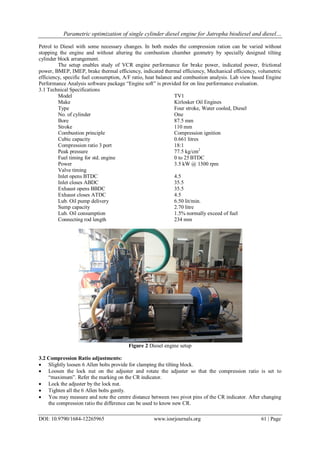
Petrol to Diesel with some necessary changes. In both modes the compression ration can be varied without
stopping the engine and without altering the combustion chamber geometry by specially designed tilting
cylinder block arrangement.
The setup enables study of VCR engine performance for brake power, indicated power, frictional
power, BMEP, IMEP, brake thermal efficiency, indicated thermal efficiency, Mechanical efficiency, volumetric
efficiency, specific fuel consumption, A/F ratio, heat balance and combustion analysis. Lab view based Engine
Performance Analysis software package “Engine soft” is provided for on line performance evaluation.
3.1 Technical Specifications
Model TV1
Make Kirlosker Oil Engines
Type Four stroke, Water cooled, Diesel
No. of cylinder One
Bore 87.5 mm
Stroke 110 mm
Combustion principle Compression ignition
Cubic capacity 0.661 litres
Compression ratio 3 port 18:1
Peak pressure 77.5 kg/cm2
Fuel timing for std. engine 0 to 25BTDC
Power 3.5 kW @ 1500 rpm
Valve timing
Inlet opens BTDC 4.5
Inlet closes ABDC 35.5
Exhaust opens BBDC 35.5
Exhaust closes ATDC 4.5
Lub. Oil pump delivery 6.50 lit/min.
Sump capacity 2.70 litre
Lub. Oil consumption 1.5% normally exceed of fuel
Connecting rod length 234 mm
Figure 2 Diesel engine setup
3.2 Compression Ratio adjustments:
 Slightly loosen 6 Allen bolts provide for clamping the tilting block.
 Loosen the lock nut on the adjuster and rotate the adjuster so that the compression ratio is set to
“maximum”. Refer the marking on the CR indicator.
 Lock the adjuster by the lock nut.
 Tighten all the 6 Allen bolts gently.
 You may measure and note the centre distance between two pivot pins of the CR indicator. After changing
the compression ratio the difference can be used to know new CR.
Parametric optimization of single cylinder diesel engine for Jatropha biodiesel and diesel…
DOI: 10.9790/1684-12265965 www.iosrjournals.org 62 | Page
IV. Methodology
Blending is the simplest technique for admitting mixture of alternate fuel and diesel engines. In this
method, the fuel selected for investigation is mixed with diesel on volume basis. We used 50% blend and pure
biodiesel. A method called „Taguchi‟ was used in the experiment for simultaneous optimization of engine such
as compression ratio, blend composition and load condition.
4.1Taguchi Method of Optimisation
Taguchi method is one of the simplest methods of optimising experimental parameters in less number
of trials. The number of parameters involved in the experiment determines the number of trials required in the
experiment. This method uses an orthogonal array to study the entire parameter space with only less number of
experiments. To select an appropriate orthogonal array for the experiments, the total degrees of freedom have to
be computed. The present study uses three factors at three levels and hence, L9 orthogonal array was used for
the construction of experimental layout. The L9 has the parameters such as load, compression ratio and blend
proportions. According to this layout, nine (9) experiments were designed and trials were selected at random, to
avoid systematic error creeping into the experimental procedure. For each trial, the mechanical efficiency was
calculated and uses as a response parameter.
Taguchi method uses a parameter called signal to noise ratio (S/N) to measure the quality
characteristics. There are three kinds of S/N are in practice. Of which, higher-the-better S/N ratio was used in
this experiment because this optimisation is based on higher mechanical efficiency. The taguchi method used in
the investigation was designed by statistical software called „Minitab 16‟ to simplify the taguchi procedure and
its results. A confirmation experiment for the optimum set of parameters was also conducted for validation of
the predicted value obtained by Minitab software. This is mainly used to compare the mechanical efficiency of
predicted value and experimental value of optimum set of parameters.
Figure 3 Flow chart of the Taguchi method.
Experiment was conducted as per above steps in Fig. 3 in flow chart of Taguchi method.
4.2 Selection of factor levels and orthogonal array
In this experiment, three parameters for three levels were considered. Control parameter and their
levels are given in the table L9 single orthogonal array as shown in the table. Bigger-the-better is being taken as
quality characteristics, since the objective function is to maximise performance.
Table 3 Process parameters and their levels
Parameters Blend Ratio Compression Ratio Engine Load(kg)
Level 1 0 18 1
Level 2 50 17 5
Level 3 100 16 10
Parametric optimization of single cylinder diesel engine for Jatropha biodiesel and diesel…
DOI: 10.9790/1684-12265965 www.iosrjournals.org 63 | Page
V. Result And Discussion
Experiment was done for selected sets of parameters by Minitab software and find mechanical
efficiency for those sets of parameters.
Table 4 Result table for mechanical efficiency
Sr. No. BR V/V CR load(kg) Mech. Eff. (%)
1 100D0B 18 1 10.09
2 100D0B 17 5 37.02
3 100D0B 16 10 54.86
4 50D50B 18 5 36.15
5 50D50B 17 10 54.75
6 50D50B 16 1 11.49
7 0D100B 18 10 53.65
8 0D100B 17 1 10.21
9 0D100B 16 5 37.21
5.1 Response Curve analysis
Response curve analysis is aimed at determining influential parameters and their optimum levels. It is
the graphical representations of change in performance characteristics with the variation in process parameter.
The curves gives a pictorial view of variation of each factor and describe what the effect on the system
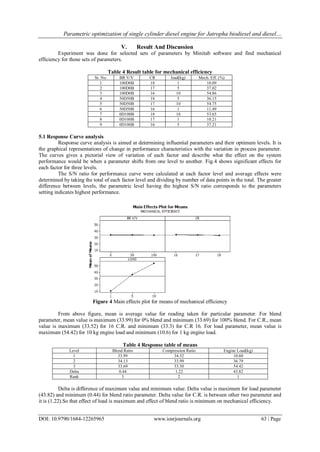
performance would be when a parameter shifts from one level to another. Fig.4 shows significant effects for
each factor for three levels.
The S/N ratio for performance curve were calculated at each factor level and average effects were
determined by taking the total of each factor level and dividing by number of data points in the total. The greater
difference between levels, the parametric level having the highest S/N ratio corresponds to the parameters
setting indicates highest performance.
Figure 4 Main effects plot for means of mechanical efficiency
From above figure, mean is average value for reading taken for particular parameter. For blend
parameter, mean value is maximum (33.99) for 0% blend and minimum (33.69) for 100% blend. For C.R., mean
value is maximum (33.52) for 16 C.R. and minimum (33.3) for C.R 16. For load parameter, mean value is
maximum (54.42) for 10 kg engine load and minimum (10.6) for 1 kg engine load.
Table 4 Response table of means
Level Blend Ratio Compression Ratio Engine Load(kg)
1 33.99 34.52 10.60
2 34.13 33.99 36.79
3 33.69 33.30 54.42
Delta 0.44 1.22 43.82
Rank 3 2 1
Delta is difference of maximum value and minimum value. Delta value is maximum for load parameter
(43.82) and minimum (0.44) for blend ratio parameter. Delta value for C.R. is between other two parameter and
it is (1.22).So that effect of load is maximum and effect of blend ratio is minimum on mechanical efficiency.
Parametric optimization of single cylinder diesel engine for Jatropha biodiesel and diesel…
DOI: 10.9790/1684-12265965 www.iosrjournals.org 64 | Page
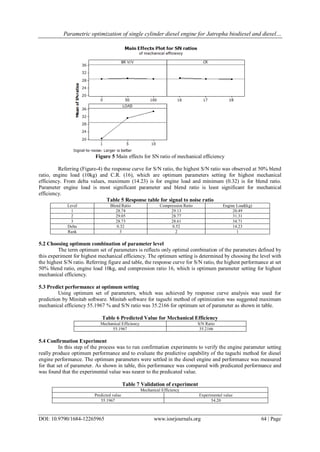
Figure 5 Main effects for SN ratio of mechanical efficiency
Referring (Figure-4) the response curve for S/N ratio, the highest S/N ratio was observed at 50% blend
ratio, engine load (10kg) and C.R. (16), which are optimum parameters setting for highest mechanical
efficiency. From delta values, maximum (14.23) is for engine load and minimum (0.32) is for blend ratio.
Parameter engine load is most significant parameter and blend ratio is least significant for mechanical
efficiency.
Table 5 Response table for signal to noise ratio
Level Blend Ratio Compression Ratio Engine Load(kg)
1 28.74 29.13 20.49
2 29.05 28.77 31.31
3 28.73 28.61 34.71
Delta 0.32 0.52 14.23
Rank 3 2 1
5.2 Choosing optimum combination of parameter level
The term optimum set of parameters is reflects only optimal combination of the parameters defined by
this experiment for highest mechanical efficiency. The optimum setting is determined by choosing the level with
the highest S/N ratio. Referring figure and table, the response curve for S/N ratio, the highest performance at set
50% blend ratio, engine load 10kg, and compression ratio 16, which is optimum parameter setting for highest
mechanical efficiency.
5.3 Predict performance at optimum setting
Using optimum set of parameters, which was achieved by response curve analysis was used for
prediction by Minitab software. Minitab software for taguchi method of optimization was suggested maximum
mechanical efficiency 55.1967 % and S/N ratio was 35.2166 for optimum set of parameter as shown in table.
Table 6 Predicted Value for Mechanical Efficiency
Mechanical Efficiency S/N Ratio
55.1967 35.2166
5.4 Confirmation Experiment
In this step of the process was to run confirmation experiments to verify the engine parameter setting
really produce optimum performance and to evaluate the predictive capability of the taguchi method for diesel
engine performance. The optimum parameters were settled in the diesel engine and performance was measured
for that set of parameter. As shown in table, this performance was compared with predicated performance and
was found that the experimental value was nearer to the predicated value.
Table 7 Validation of experiment
Mechanical Efficiency
Predicted value Experimental value
55.1967 54.20
Parametric optimization of single cylinder diesel engine for Jatropha biodiesel and diesel…
DOI: 10.9790/1684-12265965 www.iosrjournals.org 65 | Page
VI. Conclusion
The feasibility of using taguchi method to optimize selected diesel engine parameter for highest
performance was investigated using single cylinder, 4-stroke diesel engine. The conclusions from this work are
summarized as follow:
1) The taguchi method was found to be an efficient technique for quantifying the effect of control parameter.
2) The highest performance at set 50% blend ratio, engine load 10kg, and compression ratio 16, which are
optimum parameter setting for highest mechanical efficiency.
3) Engine performance is mostly influenced by engine load and is least influenced by blend ratio.
4) Performance results obtained from the confirmation experiment using optimum combination showed
excellent agreement with the predicated result.
References
[1]. http://www.bp.com/en/global/corporate/about-bp/energy-economics/statistical-review-of-world-energy/2013-in-review.html. Last
retrieved on 3/29/2014.
[2]. Huang, Daming, Haining Zhou, and Lin Lin. "Biodiesel: an alternative to conventional fuel." Energy Procedia 16 (2012): 1874-
1885.
[3]. Ganapathy T., Murugesan K., Gakkhar R.P., “Performance optimization of Jatropha biodiesel engine model using Taguchi
approach.” Applied Energy 86 (2009) 2476–2486.
[4]. Pandian M, Sivapirakasam S.P, Udayakumar M, “Investigation on the effect of injection system parameters on performance and
emission characteristics of a twin cylinder compression ignition direct injection engine fuelled with pongamia biodiesel–diesel
blend using response surface methodology.”Applied Energy 88 (2011) 2663–2676.
[5]. Sohan Lal, Comparative study of non edible bio diesel fuel, Master of Engineering, Thapar University, Patiala, India, 2013.
[6]. Abdullah Ali A Abuhabaya, Investigation of engine performance and exhaust gas emissions by using bio-diesel in compression
ignition engine and optimisation of bio-diesel production from feedstock by using response surface methodology, Doctor of
Philosophy, University of Huddersfield, England, 2012.
Appendix
Nomenclatures
bsfc Brake specific fuel consumption
BR V/V Blend ratio by volume
100D0B 100% diesel 0% biodiesel
50D50B 50% diesel 50% biodiesel
0D100B 0% diesel 100% biodiesel

K012265965

  • 1.
    IOSR Journal ofMechanical and Civil Engineering (IOSR-JMCE) e-ISSN: 2278-1684,p-ISSN: 2320-334X, Volume 12, Issue 2 Ver. VI (Mar - Apr. 2015), PP 59-65 www.iosrjournals.org DOI: 10.9790/1684-12265965 www.iosrjournals.org 59 | Page Parametric Optimization of Single Cylinder Diesel Engine for Jatropha Biodiesel and Diesel Blend for Mechanical Efficiency Using Taguchi Method Dhruv V. Patel1 , Tushar M. Patel2 , Gaurav P Rathod3 1 ME Scholar, Mechanical Department, L.D.R.P.-I.T.R., Gandhinagar, India 2 Associate Professor, Mechanical Department, L.D.R.P.-I.T.R., Gandhinagar, India 3 Assistant Professor, Mechanical Department, L.D.R.P.-I.T.R., Gandhinagar, India Abstract: An experimental study has been carried out for Jatropha biodiesel blended with diesel used in single cylinder diesel engine. Jatropha biodiesel is obtained from Jatropha oil by tranesterification process. Blending of Jatropha biodiesel with diesel in maximum possible proportion helps to reduce the consumption of diesel fuel. In this study, the effects of parameters’ i.e. load, blend proportion and compression ratio are taken as variable for optimization. As the experiment required simultaneously optimization of three parameters with three levels, taguchi method of optimization is used in this experiment. The results of the taguchi experiment identifies that 50% blend ratio, compression ratio 16 and engine load 10kg are optimum parameter setting for highest mechanical efficiency. Engine performance is mostly influenced by engine load and is least influenced by blend ratio. Confirmation experiment was done using optimum combination showed that mechanical efficiency was found by experiment is closer to the predicated value. Keywords: Blend ratio, Compression ratio, Mechanical efficiency, Taguchi, Jatropha I. Introduction According to statistical review of world energy published by British Petroleum the increase of oil reserves in world from 2012 to 2013 is 0.60% whereas oil consumption increases from 2012 to 2013 is 1.40%. [1] Due to the increasing awareness of the depletion of fossil fuel resources and environmental issues, biodiesel became more attractive in the recent years. Biodiesel production is a promising and important field of research because the relevance it gains from the rising petroleum price and its environmental advantages. [2] In present situation, there is much possibility of multifold increase in the research in biodiesel, vegetable oils like soybean oil, rapeseeds oil, sunflower oil, methanol, ethanol and other alternate fuels. Considering alternate fuels as a substitute of diesel, Researchers are continuously finding best alternative solution, which gives the best performance and fuel characteristics. [3] In such multivariate problem, use of non linear techniques like Design of Experiments (DoE), fuzzy logic and neural network are suitable to explore the combined effects of input parameters. The optimum operating parameters for a given system can be determined by using experimental techniques but it will be time consuming and expensive when the number of parameters are in the order of 20, 30 etc., like in the case of IC engines. In such situations mathematical modeling will be a very useful tool for optimizing the parameters. Such a mathematical tool is Design of Experiment. Although few studies were reported using DoE in IC Engine applications, the study on combined effects between input system parameters such as injection pressure, load, blend proportion on the performance characteristics of CI engine was scarce and offered a scope for this study. [4] II. Jatropha Biodiesel Jatropha biodiesel is obtained from Jatropha oil. It is reported that a dry seed of Jatropha curcas contains about 55% of oil. Following are the steps to be followed to extract oil from seeds: 1. Shelling: This is to remove the seed coat. 2. Milling: The unshelled seeds were milled into dough using the corn mill machine. 3. Moisture content: If moisture is less than 12% w.b. add water or else remove water to achieve 12% moisture content. 4. Rolling: Dough rolled into balls of about 1kg by weight. 5. Heating: Raise the temperature of the rolled dough to 75-8000 C by placing them in an oven. 6. Pressing: Rolled heated dough was pressed using the ram-press. 7. Filtration: The oil was collected and filtered. [5]
  • 2.
    Parametric optimization ofsingle cylinder diesel engine for Jatropha biodiesel and diesel… DOI: 10.9790/1684-12265965 www.iosrjournals.org 60 | Page However, the maximum amount of oil that can be extracted from a given sample of the seed depends on the method of extraction and thus the quality of the feedstock. Two main methods of extracting the oil have been identified. They are the chemical extraction method using solvent extraction with n-hexane and the mechanical extraction method using either a manual ram-press or an engine driven-expeller. [5] The process of converting vegetable oil into biodiesel fuel is called Transesterification. 2.1 Transesterification Process Table 1 Transesterification Process [5] Vegetable Oil Alcohol Catalyst Glycerin Biodiesel 100 gm 12 gm 1 gm 11 gm 95 gm It is the displacement of alcohol from an ester by another alcohol in a similar process to hydrolysis. Vegetable oil i.e. the triglyceride can be easily trans-esterified in the presence of alkaline catalyst at atmospheric pressure and at temperature of approximately 60 to 700C with an excess of methanol. If 100 gm of vegetable oil is taken, 1 gm of the alkaline catalyst (Potassium Hydroxide), and 12 gm of methanol would be required. As a first step, the alkaline catalyst is mixed with methanol and the mixture is stirred for half an hour for its homogenization. This mixture is mixed with vegetable oil and the resultant mixture is made to pass through reflux condensation at 650C. The mixture at the end is allowed to settle. The lower layer will be of glycerin and it is drained off. The upper layer of bio-diesel (a methyl ester) is washed to remove entrained glycerin. The excess methanol recycled by distillation. This reaction works well with high quality oil. If the oil contains 1% Free Fatty Acid (FFA), then difficulty arises because of soap formation. If FFA content is more than2% the reaction becomes unworkable. Methanol is inflammable and potassium hydroxide is caustic, hence proper and safe handling of these chemicals is must. [5] Figure 1 chemical process of Transesterification [6] Table 2 Comparison of properties Sr. No. PROPERTIES JATROPHA BIODIESEL DIESEL 1 Colour Golden Yellow Orange 2 Specific Gravity at 30 °C 0.886 0.84 to 0.88 3 Gross Calorific Value (MJ/kg) 41 42 4 Kinematic Viscosity, Cst @ 40°C 4.20 2.0 5 Cetane number 57-62 55 7 Boiling point ºC 286 248 8 Solidifying point ºC -10 -14 III. Experimental Setup The setup consists of single cylinder, four stroke, multi-fuel, research engine connected to eddy type dynamometer for loading. The operation mode of the engine can be changed from diesel to Petrol and from
  • 3.
    Parametric optimization ofsingle cylinder diesel engine for Jatropha biodiesel and diesel… DOI: 10.9790/1684-12265965 www.iosrjournals.org 61 | Page Petrol to Diesel with some necessary changes. In both modes the compression ration can be varied without stopping the engine and without altering the combustion chamber geometry by specially designed tilting cylinder block arrangement. The setup enables study of VCR engine performance for brake power, indicated power, frictional power, BMEP, IMEP, brake thermal efficiency, indicated thermal efficiency, Mechanical efficiency, volumetric efficiency, specific fuel consumption, A/F ratio, heat balance and combustion analysis. Lab view based Engine Performance Analysis software package “Engine soft” is provided for on line performance evaluation. 3.1 Technical Specifications Model TV1 Make Kirlosker Oil Engines Type Four stroke, Water cooled, Diesel No. of cylinder One Bore 87.5 mm Stroke 110 mm Combustion principle Compression ignition Cubic capacity 0.661 litres Compression ratio 3 port 18:1 Peak pressure 77.5 kg/cm2 Fuel timing for std. engine 0 to 25BTDC Power 3.5 kW @ 1500 rpm Valve timing Inlet opens BTDC 4.5 Inlet closes ABDC 35.5 Exhaust opens BBDC 35.5 Exhaust closes ATDC 4.5 Lub. Oil pump delivery 6.50 lit/min. Sump capacity 2.70 litre Lub. Oil consumption 1.5% normally exceed of fuel Connecting rod length 234 mm Figure 2 Diesel engine setup 3.2 Compression Ratio adjustments:  Slightly loosen 6 Allen bolts provide for clamping the tilting block.  Loosen the lock nut on the adjuster and rotate the adjuster so that the compression ratio is set to “maximum”. Refer the marking on the CR indicator.  Lock the adjuster by the lock nut.  Tighten all the 6 Allen bolts gently.  You may measure and note the centre distance between two pivot pins of the CR indicator. After changing the compression ratio the difference can be used to know new CR.
  • 4.
    Parametric optimization ofsingle cylinder diesel engine for Jatropha biodiesel and diesel… DOI: 10.9790/1684-12265965 www.iosrjournals.org 62 | Page IV. Methodology Blending is the simplest technique for admitting mixture of alternate fuel and diesel engines. In this method, the fuel selected for investigation is mixed with diesel on volume basis. We used 50% blend and pure biodiesel. A method called „Taguchi‟ was used in the experiment for simultaneous optimization of engine such as compression ratio, blend composition and load condition. 4.1Taguchi Method of Optimisation Taguchi method is one of the simplest methods of optimising experimental parameters in less number of trials. The number of parameters involved in the experiment determines the number of trials required in the experiment. This method uses an orthogonal array to study the entire parameter space with only less number of experiments. To select an appropriate orthogonal array for the experiments, the total degrees of freedom have to be computed. The present study uses three factors at three levels and hence, L9 orthogonal array was used for the construction of experimental layout. The L9 has the parameters such as load, compression ratio and blend proportions. According to this layout, nine (9) experiments were designed and trials were selected at random, to avoid systematic error creeping into the experimental procedure. For each trial, the mechanical efficiency was calculated and uses as a response parameter. Taguchi method uses a parameter called signal to noise ratio (S/N) to measure the quality characteristics. There are three kinds of S/N are in practice. Of which, higher-the-better S/N ratio was used in this experiment because this optimisation is based on higher mechanical efficiency. The taguchi method used in the investigation was designed by statistical software called „Minitab 16‟ to simplify the taguchi procedure and its results. A confirmation experiment for the optimum set of parameters was also conducted for validation of the predicted value obtained by Minitab software. This is mainly used to compare the mechanical efficiency of predicted value and experimental value of optimum set of parameters. Figure 3 Flow chart of the Taguchi method. Experiment was conducted as per above steps in Fig. 3 in flow chart of Taguchi method. 4.2 Selection of factor levels and orthogonal array In this experiment, three parameters for three levels were considered. Control parameter and their levels are given in the table L9 single orthogonal array as shown in the table. Bigger-the-better is being taken as quality characteristics, since the objective function is to maximise performance. Table 3 Process parameters and their levels Parameters Blend Ratio Compression Ratio Engine Load(kg) Level 1 0 18 1 Level 2 50 17 5 Level 3 100 16 10
  • 5.
    Parametric optimization ofsingle cylinder diesel engine for Jatropha biodiesel and diesel… DOI: 10.9790/1684-12265965 www.iosrjournals.org 63 | Page V. Result And Discussion Experiment was done for selected sets of parameters by Minitab software and find mechanical efficiency for those sets of parameters. Table 4 Result table for mechanical efficiency Sr. No. BR V/V CR load(kg) Mech. Eff. (%) 1 100D0B 18 1 10.09 2 100D0B 17 5 37.02 3 100D0B 16 10 54.86 4 50D50B 18 5 36.15 5 50D50B 17 10 54.75 6 50D50B 16 1 11.49 7 0D100B 18 10 53.65 8 0D100B 17 1 10.21 9 0D100B 16 5 37.21 5.1 Response Curve analysis Response curve analysis is aimed at determining influential parameters and their optimum levels. It is the graphical representations of change in performance characteristics with the variation in process parameter. The curves gives a pictorial view of variation of each factor and describe what the effect on the system performance would be when a parameter shifts from one level to another. Fig.4 shows significant effects for each factor for three levels. The S/N ratio for performance curve were calculated at each factor level and average effects were determined by taking the total of each factor level and dividing by number of data points in the total. The greater difference between levels, the parametric level having the highest S/N ratio corresponds to the parameters setting indicates highest performance. Figure 4 Main effects plot for means of mechanical efficiency From above figure, mean is average value for reading taken for particular parameter. For blend parameter, mean value is maximum (33.99) for 0% blend and minimum (33.69) for 100% blend. For C.R., mean value is maximum (33.52) for 16 C.R. and minimum (33.3) for C.R 16. For load parameter, mean value is maximum (54.42) for 10 kg engine load and minimum (10.6) for 1 kg engine load. Table 4 Response table of means Level Blend Ratio Compression Ratio Engine Load(kg) 1 33.99 34.52 10.60 2 34.13 33.99 36.79 3 33.69 33.30 54.42 Delta 0.44 1.22 43.82 Rank 3 2 1 Delta is difference of maximum value and minimum value. Delta value is maximum for load parameter (43.82) and minimum (0.44) for blend ratio parameter. Delta value for C.R. is between other two parameter and it is (1.22).So that effect of load is maximum and effect of blend ratio is minimum on mechanical efficiency.
  • 6.
    Parametric optimization ofsingle cylinder diesel engine for Jatropha biodiesel and diesel… DOI: 10.9790/1684-12265965 www.iosrjournals.org 64 | Page Figure 5 Main effects for SN ratio of mechanical efficiency Referring (Figure-4) the response curve for S/N ratio, the highest S/N ratio was observed at 50% blend ratio, engine load (10kg) and C.R. (16), which are optimum parameters setting for highest mechanical efficiency. From delta values, maximum (14.23) is for engine load and minimum (0.32) is for blend ratio. Parameter engine load is most significant parameter and blend ratio is least significant for mechanical efficiency. Table 5 Response table for signal to noise ratio Level Blend Ratio Compression Ratio Engine Load(kg) 1 28.74 29.13 20.49 2 29.05 28.77 31.31 3 28.73 28.61 34.71 Delta 0.32 0.52 14.23 Rank 3 2 1 5.2 Choosing optimum combination of parameter level The term optimum set of parameters is reflects only optimal combination of the parameters defined by this experiment for highest mechanical efficiency. The optimum setting is determined by choosing the level with the highest S/N ratio. Referring figure and table, the response curve for S/N ratio, the highest performance at set 50% blend ratio, engine load 10kg, and compression ratio 16, which is optimum parameter setting for highest mechanical efficiency. 5.3 Predict performance at optimum setting Using optimum set of parameters, which was achieved by response curve analysis was used for prediction by Minitab software. Minitab software for taguchi method of optimization was suggested maximum mechanical efficiency 55.1967 % and S/N ratio was 35.2166 for optimum set of parameter as shown in table. Table 6 Predicted Value for Mechanical Efficiency Mechanical Efficiency S/N Ratio 55.1967 35.2166 5.4 Confirmation Experiment In this step of the process was to run confirmation experiments to verify the engine parameter setting really produce optimum performance and to evaluate the predictive capability of the taguchi method for diesel engine performance. The optimum parameters were settled in the diesel engine and performance was measured for that set of parameter. As shown in table, this performance was compared with predicated performance and was found that the experimental value was nearer to the predicated value. Table 7 Validation of experiment Mechanical Efficiency Predicted value Experimental value 55.1967 54.20
  • 7.
    Parametric optimization ofsingle cylinder diesel engine for Jatropha biodiesel and diesel… DOI: 10.9790/1684-12265965 www.iosrjournals.org 65 | Page VI. Conclusion The feasibility of using taguchi method to optimize selected diesel engine parameter for highest performance was investigated using single cylinder, 4-stroke diesel engine. The conclusions from this work are summarized as follow: 1) The taguchi method was found to be an efficient technique for quantifying the effect of control parameter. 2) The highest performance at set 50% blend ratio, engine load 10kg, and compression ratio 16, which are optimum parameter setting for highest mechanical efficiency. 3) Engine performance is mostly influenced by engine load and is least influenced by blend ratio. 4) Performance results obtained from the confirmation experiment using optimum combination showed excellent agreement with the predicated result. References [1]. http://www.bp.com/en/global/corporate/about-bp/energy-economics/statistical-review-of-world-energy/2013-in-review.html. Last retrieved on 3/29/2014. [2]. Huang, Daming, Haining Zhou, and Lin Lin. "Biodiesel: an alternative to conventional fuel." Energy Procedia 16 (2012): 1874- 1885. [3]. Ganapathy T., Murugesan K., Gakkhar R.P., “Performance optimization of Jatropha biodiesel engine model using Taguchi approach.” Applied Energy 86 (2009) 2476–2486. [4]. Pandian M, Sivapirakasam S.P, Udayakumar M, “Investigation on the effect of injection system parameters on performance and emission characteristics of a twin cylinder compression ignition direct injection engine fuelled with pongamia biodiesel–diesel blend using response surface methodology.”Applied Energy 88 (2011) 2663–2676. [5]. Sohan Lal, Comparative study of non edible bio diesel fuel, Master of Engineering, Thapar University, Patiala, India, 2013. [6]. Abdullah Ali A Abuhabaya, Investigation of engine performance and exhaust gas emissions by using bio-diesel in compression ignition engine and optimisation of bio-diesel production from feedstock by using response surface methodology, Doctor of Philosophy, University of Huddersfield, England, 2012. Appendix Nomenclatures bsfc Brake specific fuel consumption BR V/V Blend ratio by volume 100D0B 100% diesel 0% biodiesel 50D50B 50% diesel 50% biodiesel 0D100B 0% diesel 100% biodiesel