@nicolas_frankel
Neither for fun nor for profit,
but do you have a choice?
Securing the JVM
@nicolas_frankel
• Developer, team lead, architect,
whatever it takes
• Recent Developer Advocate
Me, myself and I
@nicolas_frankel
Hazelcast
HAZELCAST IMDG is an operational,
in-memory, distributed computing
platform that manages data using
in-memory storage, and performs
parallel execution for breakthrough
application speed and scale.
HAZELCAST JET is the ultra fast,
application embeddable, 3rd
generation stream processing
engine for low latency batch
and stream processing.
@nicolas_frankel
• Part of the JRE
• In the java.lang.reflect package
The Reflection API
5
@nicolas_frankel
• Dynamically-typed languages
• Groovy
• JPA frameworks
• Hibernate
• Others
• Spring
• etc.
Used by a lot of languages/frameworks
@nicolas_frankel
• Make networks calls
• Compile code on the fly
• Execute code
• etc.
But everything is possible
8
@nicolas_frankel
• Static analyzers
• Byte-code analyzers
• Code reviews
• Security team
• etc.
Safeguards?
@nicolas_frankel
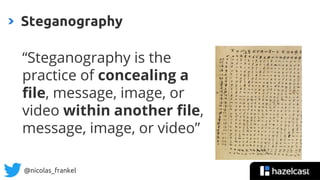
“Steganography is the
practice of concealing a
file, message, image, or
video within another file,
message, image, or video”
Steganography
10
@nicolas_frankel
@nicolas_frankel
A simple process
1. Publish a new library to central
• With hidden steganographic/compile/run
features
2. Add the library to your POM
3. Add an image with embedded code
4. Call the library
• Pretend to read the image
5. Enjoy
@nicolas_frankel
Remember?
@nicolas_frankel
• Meant to run on the client machine
• Forbidden to do “dangerous” stuff
• Run in a sandbox
Applets
@nicolas_frankel
• Standard mode
• a.k.a. “God Mode”
• Sandbox mode
• Through a SecurityManager
Available « modes »
@nicolas_frankel
• On the command line
• java -Djava.security.manager …
• Via the API
• System.setSecurityManager()
Activating the Security Manager
@nicolas_frankel
• Java 9
• conf/security/java.security
• ➔ conf/security/java.policy
• Java 8
• jre/lib/security/java.security
• ➔ jre/lib/security/java.policy
Permissions configuration
@nicolas_frankel
• Setting the policy file
• -Djava.security.policy==my.policy
• Adding additional permissions
• -Djava.security.policy=my.policy
Alternative policy file
@nicolas_frankel
“Requires that in a
particular abstraction layer of a
computing environment, every
module must be able to access only
the information and resources that
are necessary for its legitimate
purpose”
Principle of least privilege
@nicolas_frankel
• Listen on ports
• Read a few System properties
Default permissions
@nicolas_frankel
public class AccessibleObject
implements AnnotatedElement {
public void setAccessible(boolean flag)
throws SecurityException {
SecurityManager sm =
System.getSecurityManager();
if (sm != null)
sm.checkPermission(ACCESS_PERMISSION);
setAccessible0(this, flag);
}
}
Permissions are enforced in the JDK
@nicolas_frankel
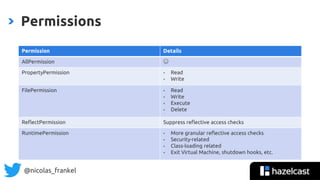
Permissions
Permission Details
AllPermission ☺
PropertyPermission • Read
• Write
FilePermission • Read
• Write
• Execute
• Delete
ReflectPermission Suppress reflective access checks
RuntimePermission • More granular reflective access checks
• Security-related
• Class-loading related
• Exit Virtual Machine, shutdown hooks, etc.
@nicolas_frankel
Permissions (continued)
Permission Details
SocketPermission • accept
• connect
• listen
• resolve
SSLPermission • Get/set SSL context
• Set hostname verifier
AuthPermission
ServicePermission Kerberos-related
AWTPermission • Clipboard
• Tray
• Windows
• Pointer
• etc.
@nicolas_frankel
grant codebase "file:myjar" {
permission Foo "foo";
permission Bar "bar", "baz";
};
Structure of a policy file (simplified)
@nicolas_frankel
@nicolas_frankel
@nicolas_frankel
• https://blog.frankel.ch/
• @nicolas_frankel
• https://git.io/fx54L
• https://git.io/fhZ4t
• https://bit.ly/2DQBRrt
Thanks a lot!

JVM-Con - Securing the JVM