Java Security
                   Ferenc Tollas
       Sun Certified Developer for Java 2 Platform
            Sun Certified Programmer for JSE 5.0
“Java is secure”
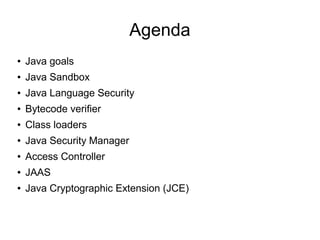
Agenda
●   Java goals
●   Java Sandbox
●   Java Language Security
●   Bytecode verifier
●   Class loaders
●   Java Security Manager
●   Access Controller
●   JAAS
●   Java Cryptographic Extension (JCE)
Java goals
●   Originally developed by James Gosling
●   Goals:
    –   It should be "simple, object-oriented and familiar"
    –   It should be "robust and secure"
    –   It should be "architecture-neutral and portable"
    –   It should execute with "high performance"
    –   It should be "interpreted, threaded, and dynamic"
●   JDK 1.0 : January, 1996
Security requirements
Safe from malevolent programs
Programs should not be allowed to harm a user's computing environment, such as
Trojan horses and harmful programs that replicate, like computer viruses.
Non−intrusive
Programs should be prevented from discovering private information on the host
computer or the host computer's network
Authenticated, Encrypted, Audited, Well-defined security specification.....
●   Only the first two were within the province of Java's 1.0 default security model!
●   The other requirements were added in later versions of Java
How to provide the security related requirements:
●   Java Language security
●   Java sandbox implementation
●   Pluggable Security Extensions
Java Sandbox
●   provide an environment where the program can play
●   must be configurable by an end user or system administrator
●   Protect:
    – Memory
    – Files
    – Network
●   Minimal Sandbox: program has access to the CPU, the screen, keyboard, mouse and
    memory
●   Default Sandbox: CPU and its own memory as well as access to the web server from
    which it was loaded
●   Open sandbox : the program has access to whatever resources the host machine
    normally has access to
●   In early versions of Java, only applets were run within a sandbox.
●   In the Java 2 platform, all programs have the potential to run in a sandbox
Which is faster?
            Java's new or C's malloc?


Response:
www.ibm.com/developerworks/java/library/j-
jtp09275/index.html
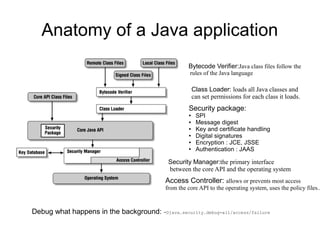
Anatomy of a Java application
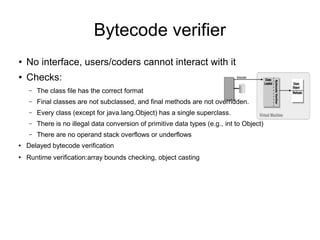
                                                    Bytecode Verifier:Java class files follow the
                                                     rules of the Java language

                                                        Class Loader: loads all Java classes and
                                                        can set permissions for each class it loads.
                                                    Security package:
                                                    ●    SPI
                                                    ●    Message digest
                                                    ●    Key and certificate handling
                                                    ●    Digital signatures
                                                    ●    Encryption : JCE, JSSE
                                                    ●    Authentication : JAAS

                                            Security Manager:the primary interface
                                            between the core API and the operating system
                                           Access Controller: allows or prevents most access
                                           from the core API to the operating system, uses the policy files..


Debug what happens in the background: −Djava.security.debug=all/access/failure
What is this:
           jre/lib/[arch]/client/clases.jsa
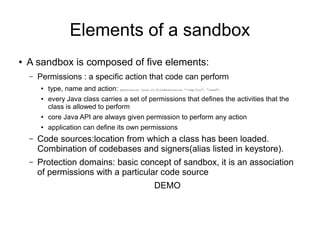
Elements of a sandbox
●   A sandbox is composed of five elements:
    –   Permissions : a specific action that code can perform
        ●   type, name and action: permission java.io.FilePermission "/tmp/foo", "read";
        ●   every Java class carries a set of permissions that defines the activities that the
            class is allowed to perform
        ●   core Java API are always given permission to perform any action
        ●   application can define its own permissions
    –   Code sources:location from which a class has been loaded.
        Combination of codebases and signers(alias listed in keystore).
    –   Protection domains: basic concept of sandbox, it is an association
        of permissions with a particular code source
                                                          DEMO
Elements of a sandbox
–   Policy files : contains one or more entries that define
    a protection domain.
     ● Global policy file:$JREHOME/lib/security/java.policy


     ● User specific: $HOME/.java.policy

    ●   Result: union of permissions contained in the global and user policy files
    ●   IMPORTANT: deny setting new policy file: java.security :
                         policy.allowSystemProperty=true
–   Keystores: The certificates themselves are held in a
    location (usually a file) called the keystore.
                      java −Djava.security.manager −Djava.security.policy=<URL>
Java language security
●   Question: how Java operates on things that are in memory?
●   Objects, primitive types has access level: public, protected,
    default/package or private
●   Programs cannot access arbitrary memory locations, no pointer and
    casting between int and Object is illegal.
●   Entities that are declared as final must not be changed.
●   Variables may not be used before they are initialized->instance variables
    are initialized automatically
●   Array bounds must be checked on all array accesses.
●   Object serialization....Mark with java.io.Serializable, and use keyword
    “transient”
●   These rules must be enforced! Compiler enforcement. Is it enough???
Bytecode verifier
●   No interface, users/coders cannot interact with it
●   Checks:
    –   The class file has the correct format
    –   Final classes are not subclassed, and final methods are not overridden.
    –   Every class (except for java.lang.Object) has a single superclass.
    –   There is no illegal data conversion of primitive data types (e.g., int to Object)
    –   There are no operand stack overflows or underflows
●   Delayed bytecode verification
●   Runtime verification:array bounds checking, object casting
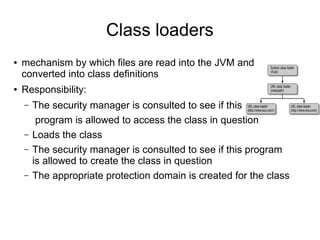
Class loaders
●   mechanism by which files are read into the JVM and
    converted into class definitions
●   Responsibility:
    –   The security manager is consulted to see if this
         program is allowed to access the class in question
    –   Loads the class
    –   The security manager is consulted to see if this program
        is allowed to create the class in question
    –   The appropriate protection domain is created for the class
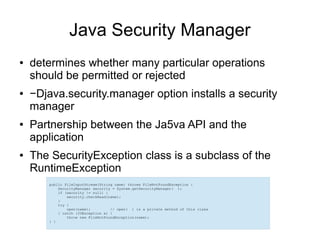
Java Security Manager
●   determines whether many particular operations
    should be permitted or rejected
●   −Djava.security.manager option installs a security
    manager
●   Partnership between the Ja5va API and the
    application
●   The SecurityException class is a subclass of the
    RuntimeException
       public FileInputStream(String name) throws FileNotFoundException {
           SecurityManager security = System.getSecurityManager( );
           if (security != null) {
               security.checkRead(name);
           }
           try {
               open(name);         // open( ) is a private method of this class
           } catch (IOException e) {
               throw new FileNotFoundException(name);
       } }
Access Controller
●   Security Manager is based entirely on access controller
●   Uses the policy file; is built on permissions, protection
    domains, code sources and policies
●   the access controller can do everything the security
    manager can do; historic reasons
●   the access controller is only available in Java 1.2
●   Applications always interact with the SecurityManager
JAAS
●   Java Authentication and Authorization Service
●   enforce access controls based on who runs
    the code(policy files: where code came from)
●   Features:
    –   Single sign-on support
    –   Pure Java
    –   Pluggable Authentication Module framework fir
        authentication
JCE
●   Java Cryptographic Extension
●   Features:
    –   Support for a wide range of standard algorithms
        including RSA, DSA, AES, Triple DES, SHA,
        PKCS#5, RC2, and RC4.
    –   Comprehensive API with support for a wide range of
        cryptographic services including digital signatures,
        message digests, ciphers (symmetric, asymmetric,
        stream & block), message authentication codes, key
        generators and key factories
JSSE
●   Java Secure Socket Extension
●   APIs and implementations for :
    –   Transport Layer Security (TLS),
    –   Secure Sockets Layer (SSL),
    –   Kerberos (accessible through GSS-API) and
    –   full support for HTTPS over SSL/TLS.
Questions?

Tollas Ferenc - Java security

  • 1.
    Java Security Ferenc Tollas Sun Certified Developer for Java 2 Platform Sun Certified Programmer for JSE 5.0
  • 2.
  • 3.
    Agenda ● Java goals ● Java Sandbox ● Java Language Security ● Bytecode verifier ● Class loaders ● Java Security Manager ● Access Controller ● JAAS ● Java Cryptographic Extension (JCE)
  • 4.
    Java goals ● Originally developed by James Gosling ● Goals: – It should be "simple, object-oriented and familiar" – It should be "robust and secure" – It should be "architecture-neutral and portable" – It should execute with "high performance" – It should be "interpreted, threaded, and dynamic" ● JDK 1.0 : January, 1996
  • 5.
    Security requirements Safe frommalevolent programs Programs should not be allowed to harm a user's computing environment, such as Trojan horses and harmful programs that replicate, like computer viruses. Non−intrusive Programs should be prevented from discovering private information on the host computer or the host computer's network Authenticated, Encrypted, Audited, Well-defined security specification..... ● Only the first two were within the province of Java's 1.0 default security model! ● The other requirements were added in later versions of Java How to provide the security related requirements: ● Java Language security ● Java sandbox implementation ● Pluggable Security Extensions
  • 6.
    Java Sandbox ● provide an environment where the program can play ● must be configurable by an end user or system administrator ● Protect: – Memory – Files – Network ● Minimal Sandbox: program has access to the CPU, the screen, keyboard, mouse and memory ● Default Sandbox: CPU and its own memory as well as access to the web server from which it was loaded ● Open sandbox : the program has access to whatever resources the host machine normally has access to ● In early versions of Java, only applets were run within a sandbox. ● In the Java 2 platform, all programs have the potential to run in a sandbox
  • 7.
    Which is faster? Java's new or C's malloc? Response: www.ibm.com/developerworks/java/library/j- jtp09275/index.html
  • 8.
    Anatomy of aJava application Bytecode Verifier:Java class files follow the rules of the Java language Class Loader: loads all Java classes and can set permissions for each class it loads. Security package: ● SPI ● Message digest ● Key and certificate handling ● Digital signatures ● Encryption : JCE, JSSE ● Authentication : JAAS Security Manager:the primary interface between the core API and the operating system Access Controller: allows or prevents most access from the core API to the operating system, uses the policy files.. Debug what happens in the background: −Djava.security.debug=all/access/failure
  • 9.
    What is this: jre/lib/[arch]/client/clases.jsa
  • 10.
    Elements of asandbox ● A sandbox is composed of five elements: – Permissions : a specific action that code can perform ● type, name and action: permission java.io.FilePermission "/tmp/foo", "read"; ● every Java class carries a set of permissions that defines the activities that the class is allowed to perform ● core Java API are always given permission to perform any action ● application can define its own permissions – Code sources:location from which a class has been loaded. Combination of codebases and signers(alias listed in keystore). – Protection domains: basic concept of sandbox, it is an association of permissions with a particular code source DEMO
  • 11.
    Elements of asandbox – Policy files : contains one or more entries that define a protection domain. ● Global policy file:$JREHOME/lib/security/java.policy ● User specific: $HOME/.java.policy ● Result: union of permissions contained in the global and user policy files ● IMPORTANT: deny setting new policy file: java.security : policy.allowSystemProperty=true – Keystores: The certificates themselves are held in a location (usually a file) called the keystore. java −Djava.security.manager −Djava.security.policy=<URL>
  • 12.
    Java language security ● Question: how Java operates on things that are in memory? ● Objects, primitive types has access level: public, protected, default/package or private ● Programs cannot access arbitrary memory locations, no pointer and casting between int and Object is illegal. ● Entities that are declared as final must not be changed. ● Variables may not be used before they are initialized->instance variables are initialized automatically ● Array bounds must be checked on all array accesses. ● Object serialization....Mark with java.io.Serializable, and use keyword “transient” ● These rules must be enforced! Compiler enforcement. Is it enough???
  • 13.
    Bytecode verifier ● No interface, users/coders cannot interact with it ● Checks: – The class file has the correct format – Final classes are not subclassed, and final methods are not overridden. – Every class (except for java.lang.Object) has a single superclass. – There is no illegal data conversion of primitive data types (e.g., int to Object) – There are no operand stack overflows or underflows ● Delayed bytecode verification ● Runtime verification:array bounds checking, object casting
  • 14.
    Class loaders ● mechanism by which files are read into the JVM and converted into class definitions ● Responsibility: – The security manager is consulted to see if this program is allowed to access the class in question – Loads the class – The security manager is consulted to see if this program is allowed to create the class in question – The appropriate protection domain is created for the class
  • 15.
    Java Security Manager ● determines whether many particular operations should be permitted or rejected ● −Djava.security.manager option installs a security manager ● Partnership between the Ja5va API and the application ● The SecurityException class is a subclass of the RuntimeException public FileInputStream(String name) throws FileNotFoundException { SecurityManager security = System.getSecurityManager( ); if (security != null) { security.checkRead(name); } try { open(name); // open( ) is a private method of this class } catch (IOException e) { throw new FileNotFoundException(name); } }
  • 16.
    Access Controller ● Security Manager is based entirely on access controller ● Uses the policy file; is built on permissions, protection domains, code sources and policies ● the access controller can do everything the security manager can do; historic reasons ● the access controller is only available in Java 1.2 ● Applications always interact with the SecurityManager
  • 17.
    JAAS ● Java Authentication and Authorization Service ● enforce access controls based on who runs the code(policy files: where code came from) ● Features: – Single sign-on support – Pure Java – Pluggable Authentication Module framework fir authentication
  • 18.
    JCE ● Java Cryptographic Extension ● Features: – Support for a wide range of standard algorithms including RSA, DSA, AES, Triple DES, SHA, PKCS#5, RC2, and RC4. – Comprehensive API with support for a wide range of cryptographic services including digital signatures, message digests, ciphers (symmetric, asymmetric, stream & block), message authentication codes, key generators and key factories
  • 19.
    JSSE ● Java Secure Socket Extension ● APIs and implementations for : – Transport Layer Security (TLS), – Secure Sockets Layer (SSL), – Kerberos (accessible through GSS-API) and – full support for HTTPS over SSL/TLS.
  • 20.