Managing Long Term Conditions 
What information is available to help you and your organisation 
Healthcare Efficiency Through Technology 2014
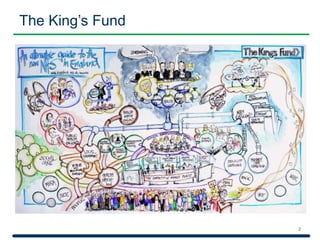
The King’s Fund 
2
The National Picture 
• National Institute for Health and Care 
Excellence (NICE) 
– Quality Standards, Technology Appraisals, 
Guidelines; social care, public health, healthcare 
• Public Health England (PHE) 
• Office for National Statistics 
• NHS England 
• Department of Health 
• Health and Social Care Information Centre 
3
Population Level Health Information 
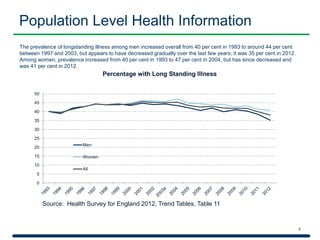
The prevalence of longstanding illness among men increased overall from 40 per cent in 1993 to around 44 per cent 
between 1997 and 2003, but appears to have decreased gradually over the last few years; it was 35 per cent in 2012. 
Among women, prevalence increased from 40 per cent in 1993 to 47 per cent in 2004, but has since decreased and 
was 41 per cent in 2012. 
4 
50 
45 
40 
35 
30 
25 
20 
15 
10 
5 
0 
Percentage with Long Standing Illness 
Men 
Women 
All 
Source: Health Survey for England 2012, Trend Tables, Table 11
More women than men reported chronic pain 
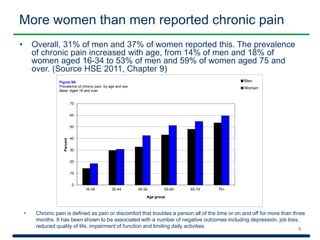
• Overall, 31% of men and 37% of women reported this. The prevalence 
of chronic pain increased with age, from 14% of men and 18% of 
women aged 16-34 to 53% of men and 59% of women aged 75 and 
over. (Source HSE 2011, Chapter 9) 
5 
70 
60 
50 
40 
30 
20 
10 
0 
16-34 35-44 45-54 55-64 65-74 75+ 
Percent 
Age group 
Men 
Women 
Figure 9A 
Prevalence of chronic pain, by age and sex 
Base: Aged 16 and over 
• Chronic pain is defined as pain or discomfort that troubles a person all of the time or on and off for more than three 
months. It has been shown to be associated with a number of negative outcomes including depression, job loss, 
reduced quality of life, impairment of function and limiting daily activities.
Less affluent people more likely to report 
chronic pain. 
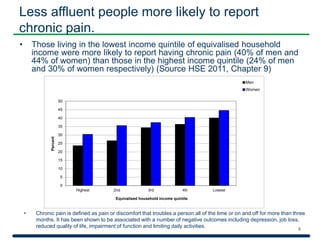
• Those living in the lowest income quintile of equivalised household 
income were more likely to report having chronic pain (40% of men and 
44% of women) than those in the highest income quintile (24% of men 
and 30% of women respectively) (Source HSE 2011, Chapter 9) 
50 
45 
40 
35 
30 
25 
20 
15 
10 
5 
• Chronic pain is defined as pain or discomfort that troubles a person all of the time or on and off for more than three 
months. It has been shown to be associated with a number of negative outcomes including depression, job loss, 
reduced quality of life, impairment of function and limiting daily activities. 
6 
0 
Highest 2nd 3rd 4th Lowest 
Percent 
Equivalised household income quintile 
Men 
Women
Relationship between longstanding illness and 
mental health 
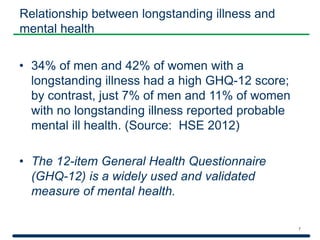
• 34% of men and 42% of women with a 
longstanding illness had a high GHQ-12 score; 
by contrast, just 7% of men and 11% of women 
with no longstanding illness reported probable 
mental ill health. (Source: HSE 2012) 
• The 12-item General Health Questionnaire 
(GHQ-12) is a widely used and validated 
measure of mental health. 
7
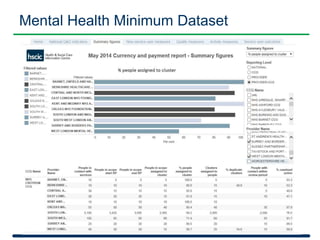
Mental Health Minimum Dataset 
8
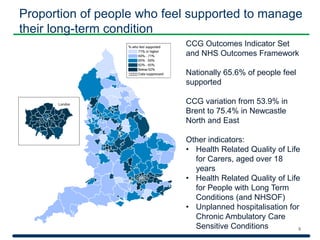
Proportion of people who feel supported to manage 
their long-term condition 
CCG Outcomes Indicator Set 
and NHS Outcomes Framework 
9 
Nationally 65.6% of people feel 
supported 
CCG variation from 53.9% in 
Brent to 75.4% in Newcastle 
North and East 
Other indicators: 
• Health Related Quality of Life 
for Carers, aged over 18 
years 
• Health Related Quality of Life 
for People with Long Term 
Conditions (and NHSOF) 
• Unplanned hospitalisation for 
Chronic Ambulatory Care 
Sensitive Conditions
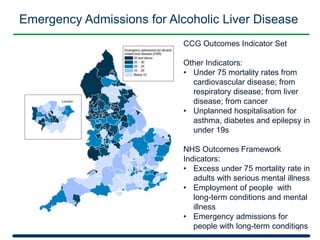
Emergency Admissions for Alcoholic Liver Disease 
10 
CCG Outcomes Indicator Set 
Other Indicators: 
• Under 75 mortality rates from 
cardiovascular disease; from 
respiratory disease; from liver 
disease; from cancer 
• Unplanned hospitalisation for 
asthma, diabetes and epilepsy in 
under 19s 
NHS Outcomes Framework 
Indicators: 
• Excess under 75 mortality rate in 
adults with serious mental illness 
• Employment of people with 
long-term conditions and mental 
illness 
• Emergency admissions for 
people with long-term conditions
Quality and Outcomes Framework (QOF) 
• The primary use of QOF is an incentive payment 
scheme. Its main objective is to improve the quality of 
care patients receive by rewarding practices for this 
care. It is a voluntary scheme that most practices 
participate in – 8020 in 2012/13. 
• At HSCIC we use this data for secondary purposes and 
publish recorded prevalence, points achieved and 
exceptions for each general practice that takes part. 
• One of the domains (Clinical) within QOF deals primarily 
with long term conditions. There are 20 in total of these 
for 2013/14 and they include Cancer, Dementia, 
Coronary Heart Disease, Mental Health and Stroke. 
11
Quality and Outcomes Framework (QOF) 
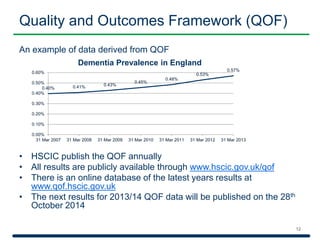
An example of data derived from QOF 
0.60% 
0.50% 
0.40% 
0.30% 
0.20% 
0.10% 
Dementia Prevalence in England 
• HSCIC publish the QOF annually 
• All results are publicly available through www.hscic.gov.uk/qof 
• There is an online database of the latest years results at 
www.qof.hscic.gov.uk 
• The next results for 2013/14 QOF data will be published on the 28th 
October 2014 
12 
0.40% 0.41% 
0.43% 
0.45% 
0.48% 
0.53% 
0.57% 
0.00% 
31 Mar 2007 31 Mar 2008 31 Mar 2009 31 Mar 2010 31 Mar 2011 31 Mar 2012 31 Mar 2013
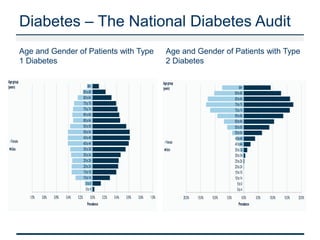
Diabetes – The National Diabetes Audit 
Age and Gender of Patients with Type 
1 Diabetes 
Age and Gender of Patients with Type 
2 Diabetes
Mortality Analysis: 2011-2012 
• Linked NDA patients to death registrations using the MRIS 
service 
• Between 1 January 2012 and 31 December 2012 people with 
all types of diabetes were 37.5 per cent more likely to die than 
their peers in the general population. 
• Among those with Type 1 diabetes, mortality was 129.5 per 
cent greater than would be expected if they had the same 
mortality rates as the general population in England and 
Wales 
• People with Type 2 diabetes were 34.5 per cent more likely to 
die
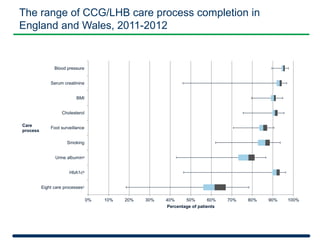
The range of CCG/LHB care process completion in 
England and Wales, 2011-2012 
0% 10% 20% 30% 40% 50% 60% 70% 80% 90% 100% 
Blood pressure 
Serum creatinine 
BMI 
Cholesterol 
Foot surveillance 
Smoking 
Urine albuminᵃ 
HbA1cᵇ 
Eight care processesᶜ 
Percentage of patients 
Care 
process
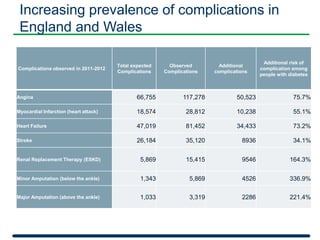
Increasing prevalence of complications in 
England and Wales 
Complications observed in 2011-2012 
Total expected 
Complications 
Observed 
Complications 
Additional 
complications 
Additional risk of 
complication among 
people with diabetes 
Angina 66,755 117,278 50,523 75.7% 
Myocardial Infarction (heart attack) 18,574 28,812 10,238 55.1% 
Heart Failure 47,019 81,452 34,433 73.2% 
Stroke 26,184 35,120 8936 34.1% 
Renal Replacement Therapy (ESKD) 5,869 15,415 9546 164.3% 
Minor Amputation (below the ankle) 1,343 5,869 4526 336.9% 
Major Amputation (above the ankle) 1,033 3,319 2286 221.4%
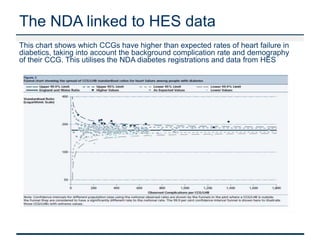
The NDA linked to HES data 
This chart shows which CCGs have higher than expected rates of heart failure in 
diabetics, taking into account the background complication rate and demography 
of their CCG. This utilises the NDA diabetes registrations and data from HES
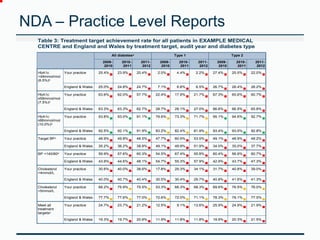
NDA – Practice Level Reports 
Table 3: Treatment target achievement rate for all patients in EXAMPLE MEDICAL 
CENTRE and England and Wales by treatment target, audit year and diabetes type 
All diabetesᵃ Type 1 Type 2 
2009- 
2010 
2010- 
2011 
2011- 
2012 
2009- 
2010 
2010- 
2011 
2011- 
2012 
2009- 
2010 
2010- 
2011 
2011- 
2012 
HbA1c 
<48mmol/mol 
(6.5%)ᵇ 
Your practice 25.4% 23.9% 20.4% 2.0% 4.4% 2.2% 27.4% 25.5% 22.0% 
England & Wales 25.0% 24.8% 24.7% 7.1% 6.8% 6.5% 26.7% 26.4% 26.2% 
HbA1c 
≤58mmol/mol 
(7.5%)ᵇ 
Your practice 63.6% 62.0% 57.7% 22.4% 17.8% 21.7% 67.3% 65.6% 60.7% 
England & Wales 63.3% 63.3% 62.7% 28.7% 28.1% 27.0% 66.6% 66.5% 65.8% 
HbA1c 
≤86mmol/mol 
(10.0%)ᵇ 
Your practice 93.8% 93.0% 91.1% 79.6% 73.3% 71.7% 95.1% 94.6% 92.7% 
England & Wales 92.5% 92.1% 91.9% 83.2% 82.4% 81.9% 93.4% 93.0% 92.8% 
Target BPᶜ Your practice 48.9% 49.8% 48.5% 47.7% 60.5% 53.5% 49.1% 48.9% 48.2% 
England & Wales 35.2% 36.2% 38.8% 49.1% 49.9% 51.9% 34.0% 35.0% 37.7% 
BP <140/80ᵈ Your practice 59.9% 57.6% 60.3% 54.5% 67.4% 55.8% 60.4% 56.9% 60.7% 
England & Wales 43.9% 44.6% 48.1% 54.7% 55.3% 57.9% 42.9% 43.7% 47.3% 
Cholesterol 
<4mmol/L 
Your practice 30.6% 40.0% 38.6% 17.8% 29.3% 34.1% 31.7% 40.8% 39.0% 
England & Wales 40.0% 40.7% 40.4% 30.5% 30.4% 29.7% 40.8% 41.6% 41.3% 
Cholesterol 
<5mmol/L 
Your practice 68.2% 75.9% 75.5% 53.3% 68.3% 68.3% 69.6% 76.5% 76.0% 
England & Wales 77.7% 77.6% 77.0% 72.6% 72.0% 71.1% 78.3% 78.1% 77.5% 
Meet all 
treatment 
targetsᵉ 
Your practice 24.7% 23.7% 21.2% 12.5% 9.1% 13.6% 25.9% 24.9% 21.9% 
England & Wales 19.3% 19.7% 20.8% 11.9% 11.8% 11.8% 19.9% 20.3% 21.5%
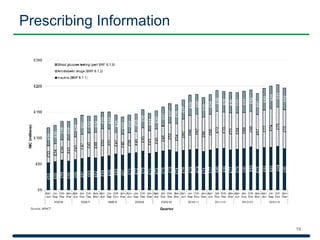
Prescribing Information 
19
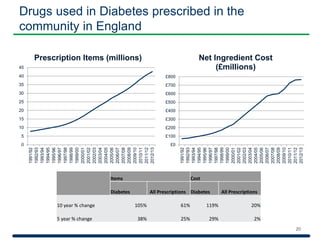
Drugs used in Diabetes prescribed in the 
community in England 
20 
0 
5 
10 
15 
20 
25 
30 
35 
40 
45 
1991/92 
1992/93 
1993/94 
1994/95 
1995/96 
1996/97 
1997/98 
1998/99 
1999/00 
2000/01 
2001/02 
2002/03 
2003/04 
2004/05 
2005/06 
2006/07 
2007/08 
2008/09 
2009/10 
2010/11 
2011/12 
2012/13 
Prescription Items (millions) 
£0 
£100 
£200 
£300 
£400 
£500 
£600 
£700 
£800 
1991/92 
1992/93 
1993/94 
1994/95 
1995/96 
1996/97 
1997/98 
1998/99 
1999/00 
2000/01 
2001/02 
2002/03 
2003/04 
2004/05 
2005/06 
2006/07 
2007/08 
2008/09 
2009/10 
2010/11 
2011/12 
2012/13 
Net Ingredient Cost 
(£millions) 
Items Cost 
Diabetes All Prescriptions Diabetes All Prescriptions 
10 year % change 105% 61% 119% 20% 
5 year % change 38% 25% 29% 2%
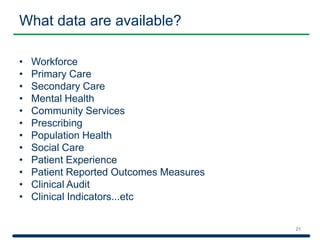
What data are available? 
• Workforce 
• Primary Care 
• Secondary Care 
• Mental Health 
• Community Services 
• Prescribing 
• Population Health 
• Social Care 
• Patient Experience 
• Patient Reported Outcomes Measures 
• Clinical Audit 
• Clinical Indicators...etc 
21
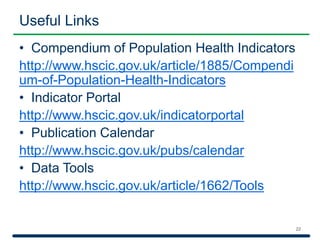
Useful Links 
• Compendium of Population Health Indicators 
http://www.hscic.gov.uk/article/1885/Compendi 
um-of-Population-Health-Indicators 
• Indicator Portal 
http://www.hscic.gov.uk/indicatorportal 
• Publication Calendar 
http://www.hscic.gov.uk/pubs/calendar 
• Data Tools 
http://www.hscic.gov.uk/article/1662/Tools 
22
Connect with us 
www.hscic.gov.uk 
@hscic 
www.slideshare.net/hscic 
0300 303 5678

Managing Long Term Conditions

  • 1.
    Managing Long TermConditions What information is available to help you and your organisation Healthcare Efficiency Through Technology 2014
  • 2.
  • 3.
    The National Picture • National Institute for Health and Care Excellence (NICE) – Quality Standards, Technology Appraisals, Guidelines; social care, public health, healthcare • Public Health England (PHE) • Office for National Statistics • NHS England • Department of Health • Health and Social Care Information Centre 3
  • 4.
    Population Level HealthInformation The prevalence of longstanding illness among men increased overall from 40 per cent in 1993 to around 44 per cent between 1997 and 2003, but appears to have decreased gradually over the last few years; it was 35 per cent in 2012. Among women, prevalence increased from 40 per cent in 1993 to 47 per cent in 2004, but has since decreased and was 41 per cent in 2012. 4 50 45 40 35 30 25 20 15 10 5 0 Percentage with Long Standing Illness Men Women All Source: Health Survey for England 2012, Trend Tables, Table 11
  • 5.
    More women thanmen reported chronic pain • Overall, 31% of men and 37% of women reported this. The prevalence of chronic pain increased with age, from 14% of men and 18% of women aged 16-34 to 53% of men and 59% of women aged 75 and over. (Source HSE 2011, Chapter 9) 5 70 60 50 40 30 20 10 0 16-34 35-44 45-54 55-64 65-74 75+ Percent Age group Men Women Figure 9A Prevalence of chronic pain, by age and sex Base: Aged 16 and over • Chronic pain is defined as pain or discomfort that troubles a person all of the time or on and off for more than three months. It has been shown to be associated with a number of negative outcomes including depression, job loss, reduced quality of life, impairment of function and limiting daily activities.
  • 6.
    Less affluent peoplemore likely to report chronic pain. • Those living in the lowest income quintile of equivalised household income were more likely to report having chronic pain (40% of men and 44% of women) than those in the highest income quintile (24% of men and 30% of women respectively) (Source HSE 2011, Chapter 9) 50 45 40 35 30 25 20 15 10 5 • Chronic pain is defined as pain or discomfort that troubles a person all of the time or on and off for more than three months. It has been shown to be associated with a number of negative outcomes including depression, job loss, reduced quality of life, impairment of function and limiting daily activities. 6 0 Highest 2nd 3rd 4th Lowest Percent Equivalised household income quintile Men Women
  • 7.
    Relationship between longstandingillness and mental health • 34% of men and 42% of women with a longstanding illness had a high GHQ-12 score; by contrast, just 7% of men and 11% of women with no longstanding illness reported probable mental ill health. (Source: HSE 2012) • The 12-item General Health Questionnaire (GHQ-12) is a widely used and validated measure of mental health. 7
  • 8.
  • 9.
    Proportion of peoplewho feel supported to manage their long-term condition CCG Outcomes Indicator Set and NHS Outcomes Framework 9 Nationally 65.6% of people feel supported CCG variation from 53.9% in Brent to 75.4% in Newcastle North and East Other indicators: • Health Related Quality of Life for Carers, aged over 18 years • Health Related Quality of Life for People with Long Term Conditions (and NHSOF) • Unplanned hospitalisation for Chronic Ambulatory Care Sensitive Conditions
  • 10.
    Emergency Admissions forAlcoholic Liver Disease 10 CCG Outcomes Indicator Set Other Indicators: • Under 75 mortality rates from cardiovascular disease; from respiratory disease; from liver disease; from cancer • Unplanned hospitalisation for asthma, diabetes and epilepsy in under 19s NHS Outcomes Framework Indicators: • Excess under 75 mortality rate in adults with serious mental illness • Employment of people with long-term conditions and mental illness • Emergency admissions for people with long-term conditions
  • 11.
    Quality and OutcomesFramework (QOF) • The primary use of QOF is an incentive payment scheme. Its main objective is to improve the quality of care patients receive by rewarding practices for this care. It is a voluntary scheme that most practices participate in – 8020 in 2012/13. • At HSCIC we use this data for secondary purposes and publish recorded prevalence, points achieved and exceptions for each general practice that takes part. • One of the domains (Clinical) within QOF deals primarily with long term conditions. There are 20 in total of these for 2013/14 and they include Cancer, Dementia, Coronary Heart Disease, Mental Health and Stroke. 11
  • 12.
    Quality and OutcomesFramework (QOF) An example of data derived from QOF 0.60% 0.50% 0.40% 0.30% 0.20% 0.10% Dementia Prevalence in England • HSCIC publish the QOF annually • All results are publicly available through www.hscic.gov.uk/qof • There is an online database of the latest years results at www.qof.hscic.gov.uk • The next results for 2013/14 QOF data will be published on the 28th October 2014 12 0.40% 0.41% 0.43% 0.45% 0.48% 0.53% 0.57% 0.00% 31 Mar 2007 31 Mar 2008 31 Mar 2009 31 Mar 2010 31 Mar 2011 31 Mar 2012 31 Mar 2013
  • 13.
    Diabetes – TheNational Diabetes Audit Age and Gender of Patients with Type 1 Diabetes Age and Gender of Patients with Type 2 Diabetes
  • 14.
    Mortality Analysis: 2011-2012 • Linked NDA patients to death registrations using the MRIS service • Between 1 January 2012 and 31 December 2012 people with all types of diabetes were 37.5 per cent more likely to die than their peers in the general population. • Among those with Type 1 diabetes, mortality was 129.5 per cent greater than would be expected if they had the same mortality rates as the general population in England and Wales • People with Type 2 diabetes were 34.5 per cent more likely to die
  • 15.
    The range ofCCG/LHB care process completion in England and Wales, 2011-2012 0% 10% 20% 30% 40% 50% 60% 70% 80% 90% 100% Blood pressure Serum creatinine BMI Cholesterol Foot surveillance Smoking Urine albuminᵃ HbA1cᵇ Eight care processesᶜ Percentage of patients Care process
  • 16.
    Increasing prevalence ofcomplications in England and Wales Complications observed in 2011-2012 Total expected Complications Observed Complications Additional complications Additional risk of complication among people with diabetes Angina 66,755 117,278 50,523 75.7% Myocardial Infarction (heart attack) 18,574 28,812 10,238 55.1% Heart Failure 47,019 81,452 34,433 73.2% Stroke 26,184 35,120 8936 34.1% Renal Replacement Therapy (ESKD) 5,869 15,415 9546 164.3% Minor Amputation (below the ankle) 1,343 5,869 4526 336.9% Major Amputation (above the ankle) 1,033 3,319 2286 221.4%
  • 17.
    The NDA linkedto HES data This chart shows which CCGs have higher than expected rates of heart failure in diabetics, taking into account the background complication rate and demography of their CCG. This utilises the NDA diabetes registrations and data from HES
  • 18.
    NDA – PracticeLevel Reports Table 3: Treatment target achievement rate for all patients in EXAMPLE MEDICAL CENTRE and England and Wales by treatment target, audit year and diabetes type All diabetesᵃ Type 1 Type 2 2009- 2010 2010- 2011 2011- 2012 2009- 2010 2010- 2011 2011- 2012 2009- 2010 2010- 2011 2011- 2012 HbA1c <48mmol/mol (6.5%)ᵇ Your practice 25.4% 23.9% 20.4% 2.0% 4.4% 2.2% 27.4% 25.5% 22.0% England & Wales 25.0% 24.8% 24.7% 7.1% 6.8% 6.5% 26.7% 26.4% 26.2% HbA1c ≤58mmol/mol (7.5%)ᵇ Your practice 63.6% 62.0% 57.7% 22.4% 17.8% 21.7% 67.3% 65.6% 60.7% England & Wales 63.3% 63.3% 62.7% 28.7% 28.1% 27.0% 66.6% 66.5% 65.8% HbA1c ≤86mmol/mol (10.0%)ᵇ Your practice 93.8% 93.0% 91.1% 79.6% 73.3% 71.7% 95.1% 94.6% 92.7% England & Wales 92.5% 92.1% 91.9% 83.2% 82.4% 81.9% 93.4% 93.0% 92.8% Target BPᶜ Your practice 48.9% 49.8% 48.5% 47.7% 60.5% 53.5% 49.1% 48.9% 48.2% England & Wales 35.2% 36.2% 38.8% 49.1% 49.9% 51.9% 34.0% 35.0% 37.7% BP <140/80ᵈ Your practice 59.9% 57.6% 60.3% 54.5% 67.4% 55.8% 60.4% 56.9% 60.7% England & Wales 43.9% 44.6% 48.1% 54.7% 55.3% 57.9% 42.9% 43.7% 47.3% Cholesterol <4mmol/L Your practice 30.6% 40.0% 38.6% 17.8% 29.3% 34.1% 31.7% 40.8% 39.0% England & Wales 40.0% 40.7% 40.4% 30.5% 30.4% 29.7% 40.8% 41.6% 41.3% Cholesterol <5mmol/L Your practice 68.2% 75.9% 75.5% 53.3% 68.3% 68.3% 69.6% 76.5% 76.0% England & Wales 77.7% 77.6% 77.0% 72.6% 72.0% 71.1% 78.3% 78.1% 77.5% Meet all treatment targetsᵉ Your practice 24.7% 23.7% 21.2% 12.5% 9.1% 13.6% 25.9% 24.9% 21.9% England & Wales 19.3% 19.7% 20.8% 11.9% 11.8% 11.8% 19.9% 20.3% 21.5%
  • 19.
  • 20.
    Drugs used inDiabetes prescribed in the community in England 20 0 5 10 15 20 25 30 35 40 45 1991/92 1992/93 1993/94 1994/95 1995/96 1996/97 1997/98 1998/99 1999/00 2000/01 2001/02 2002/03 2003/04 2004/05 2005/06 2006/07 2007/08 2008/09 2009/10 2010/11 2011/12 2012/13 Prescription Items (millions) £0 £100 £200 £300 £400 £500 £600 £700 £800 1991/92 1992/93 1993/94 1994/95 1995/96 1996/97 1997/98 1998/99 1999/00 2000/01 2001/02 2002/03 2003/04 2004/05 2005/06 2006/07 2007/08 2008/09 2009/10 2010/11 2011/12 2012/13 Net Ingredient Cost (£millions) Items Cost Diabetes All Prescriptions Diabetes All Prescriptions 10 year % change 105% 61% 119% 20% 5 year % change 38% 25% 29% 2%
  • 21.
    What data areavailable? • Workforce • Primary Care • Secondary Care • Mental Health • Community Services • Prescribing • Population Health • Social Care • Patient Experience • Patient Reported Outcomes Measures • Clinical Audit • Clinical Indicators...etc 21
  • 22.
    Useful Links •Compendium of Population Health Indicators http://www.hscic.gov.uk/article/1885/Compendi um-of-Population-Health-Indicators • Indicator Portal http://www.hscic.gov.uk/indicatorportal • Publication Calendar http://www.hscic.gov.uk/pubs/calendar • Data Tools http://www.hscic.gov.uk/article/1662/Tools 22
  • 23.
    Connect with us www.hscic.gov.uk @hscic www.slideshare.net/hscic 0300 303 5678

Editor's Notes

  • #12 List of 20 Asthma Atrial fibrillation Cancer Chronic kidney disease COPD Dementia Depression Diabetes mellitus Epilepsy Heart failure Hypertension Hypothyroidism Learning disability Mental health Osteoporosis Palliative care Peripheral arterial disease Rheumatoid arthritis (Secondary prevention of) coronary heart disease Stroke and transient ischaemic attack