ForInternalUseOnly–NotForExternalDistribution©2014CRISILLtd.Allrightsreserved.
New norms will temper ARC growth
But they will improve price-discovery and recovery prospects
Pawan Agrawal
Senior Director – CRISIL Ratings
Rajat Bahl
Director – CRISIL Ratings
August 7, 2014
1
ForInternalUseOnly–NotForExternalDistribution©2014CRISILLtd.Allrightsreserved.
Key messages
 Growth will settle at a lower level for ARC industry
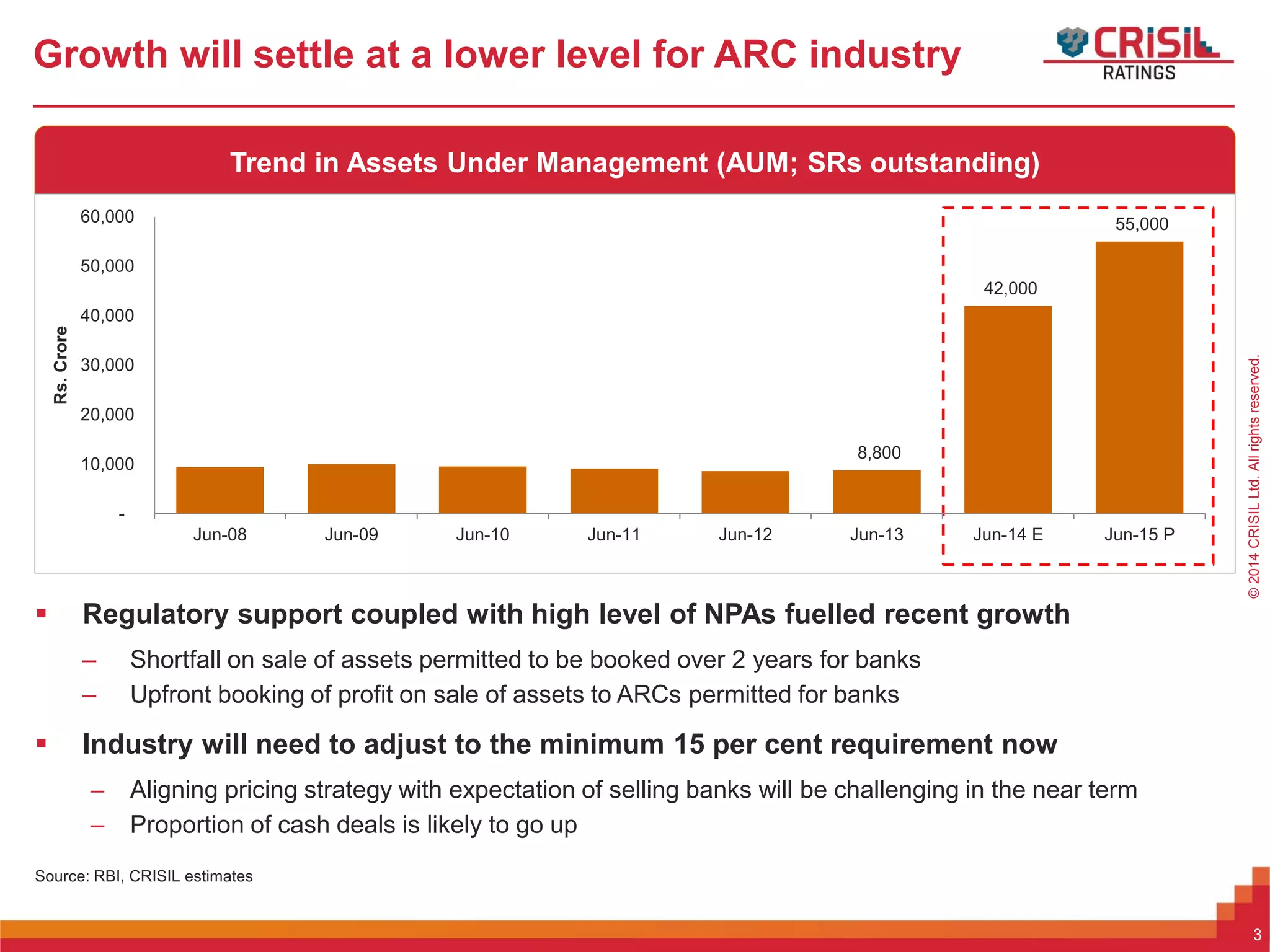
– AUM reached Rs.42,000 crore by June 2014, a 4 times increase in a year
– Growth to moderate to 30 per cent in the current year, given the recent regulations
 Capital and earnings will emerge as challenges
– Recent regulatory changes significantly increase the capital requirements of ARCs
– ARCs that can raise capital in a timely manner will be better positioned
 Track record of asset resolution critical for long term sustainability of ARCs
– ARCs have successfully reconstructed several large accounts
– However, experience shows that the recovery till date has not been up to potential
– Cumulative redemption ratio* till June 2013 stood at 53 per cent
 Better recovery prospects ahead
– Lower vintage and quicker debt aggregation to be the key drivers
 Recent regulations structurally positive for the sector
* Redemption ratio = SRs redeemed / SRs issued; Source: RBI
2
ForInternalUseOnly–NotForExternalDistribution©2014CRISILLtd.Allrightsreserved.
Trend in Assets Under Management (AUM; SRs outstanding)
Growth will settle at a lower level for ARC industry
 Regulatory support coupled with high level of NPAs fuelled recent growth
– Shortfall on sale of assets permitted to be booked over 2 years for banks
– Upfront booking of profit on sale of assets to ARCs permitted for banks
 Industry will need to adjust to the minimum 15 per cent requirement now
– Aligning pricing strategy with expectation of selling banks will be challenging in the near term
– Proportion of cash deals is likely to go up
Source: RBI, CRISIL estimates
3
8,800
42,000
55,000
-
10,000
20,000
30,000
40,000
50,000
60,000
Jun-08 Jun-09 Jun-10 Jun-11 Jun-12 Jun-13 Jun-14 E Jun-15 P
Rs.Crore
ForInternalUseOnly–NotForExternalDistribution©2014CRISILLtd.Allrightsreserved.
Capital and earnings will emerge as challenges
 Given the nature of assets, ARC business has traditionally been equity-
funded
 Aggregate net worth is modest at ~Rs.2,500 crore as on June 30, 2014
– Gearing has increased to 1x as on June 2014 from 0.1x as on June 2013
– Gearing philosophy varies significantly among ARCs
 Capital raising will emerge as a significant challenge
– Earnings will come under pressure due to revision in management fees norms
– Regulatory restrictions on sponsor shareholding and listing can act as a constraint…
– …may be partly offset by higher regulatory limit for FDI and FII investment in ARCs
– Could result in lower growth or higher gearing
 Ability to raise capital in a timely manner will become a differentiator
Source: CRISIL estimates
4
ForInternalUseOnly–NotForExternalDistribution©2014CRISILLtd.Allrightsreserved.
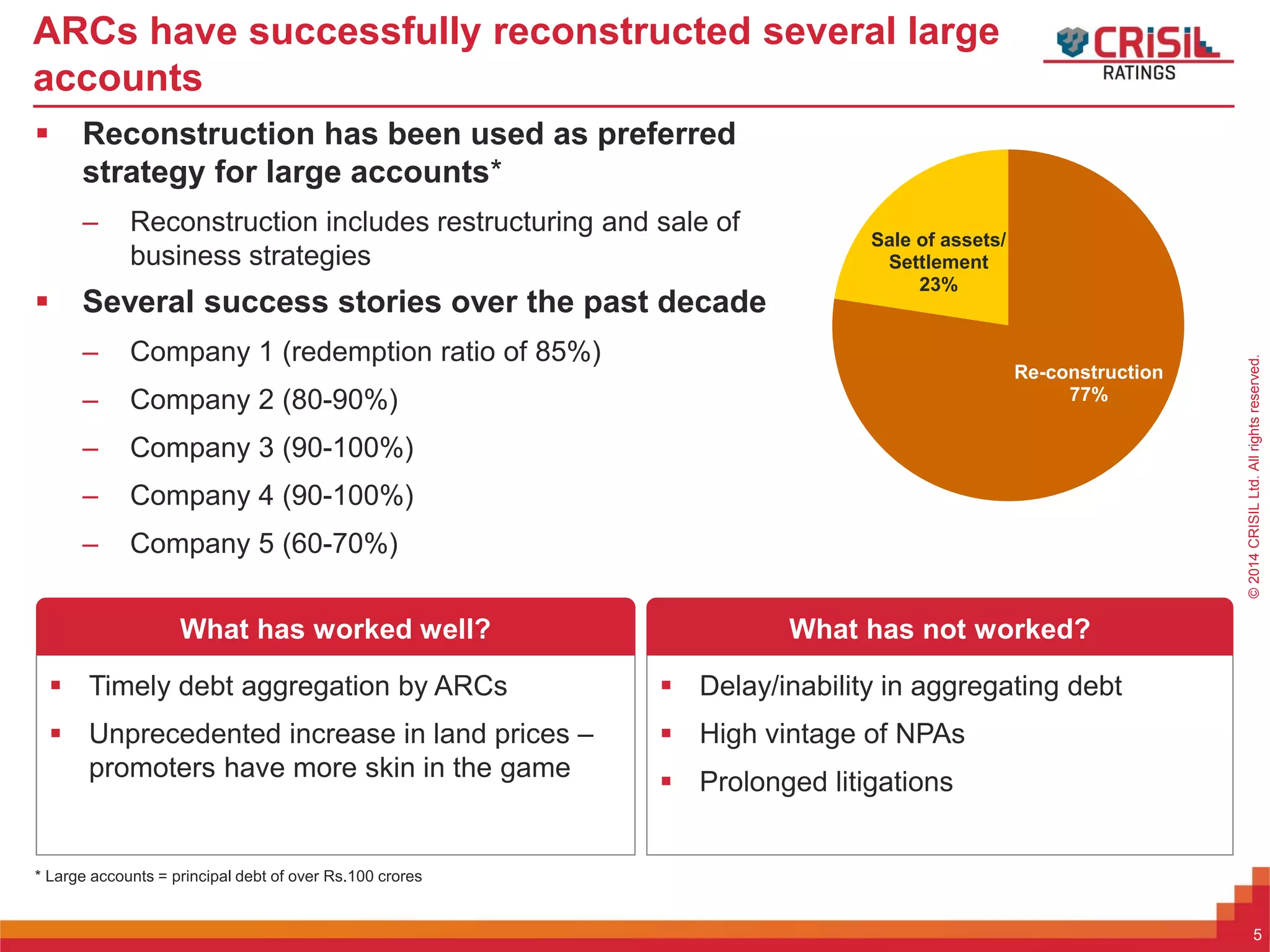
 Reconstruction has been used as preferred
strategy for large accounts*
– Reconstruction includes restructuring and sale of
business strategies
ARCs have successfully reconstructed several large
accounts
Re-construction
77%
Sale of assets/
Settlement
23%
* Large accounts = principal debt of over Rs.100 crores
5
 Timely debt aggregation by ARCs
 Unprecedented increase in land prices –
promoters have more skin in the game
 Delay/inability in aggregating debt
 High vintage of NPAs
 Prolonged litigations
What has worked well? What has not worked?
 Several success stories over the past decade
– Company 1 (redemption ratio of 85%)
– Company 2 (80-90%)
– Company 3 (90-100%)
– Company 4 (90-100%)
– Company 5 (60-70%)
ForInternalUseOnly–NotForExternalDistribution©2014CRISILLtd.Allrightsreserved.
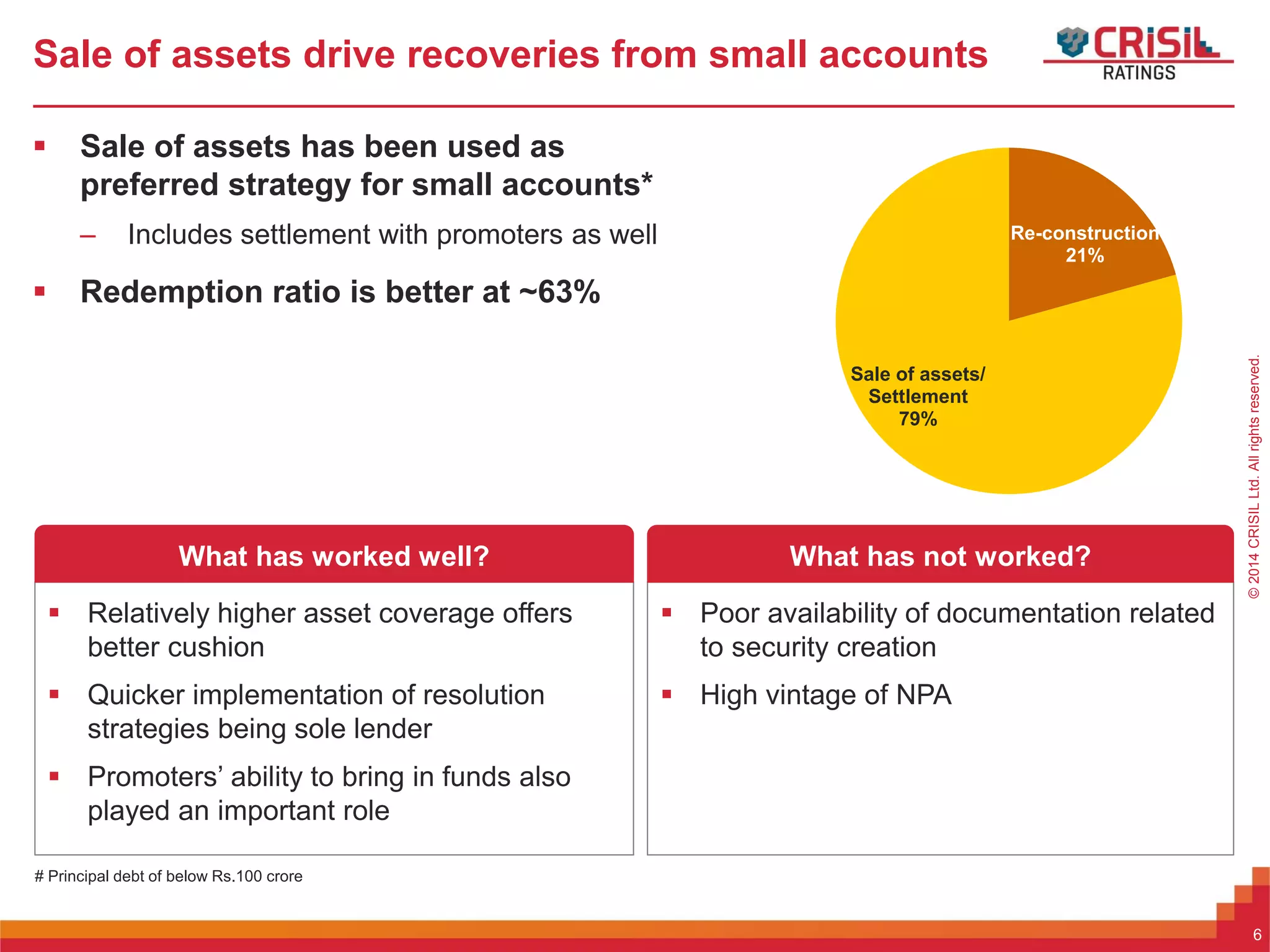
Sale of assets drive recoveries from small accounts
 Sale of assets has been used as
preferred strategy for small accounts*
– Includes settlement with promoters as well
 Redemption ratio is better at ~63%
# Principal debt of below Rs.100 crore
Re-construction
21%
Sale of assets/
Settlement
79%
6
 Relatively higher asset coverage offers
better cushion
 Quicker implementation of resolution
strategies being sole lender
 Promoters’ ability to bring in funds also
played an important role
 Poor availability of documentation related
to security creation
 High vintage of NPA
What has worked well? What has not worked?
ForInternalUseOnly–NotForExternalDistribution©2014CRISILLtd.Allrightsreserved.
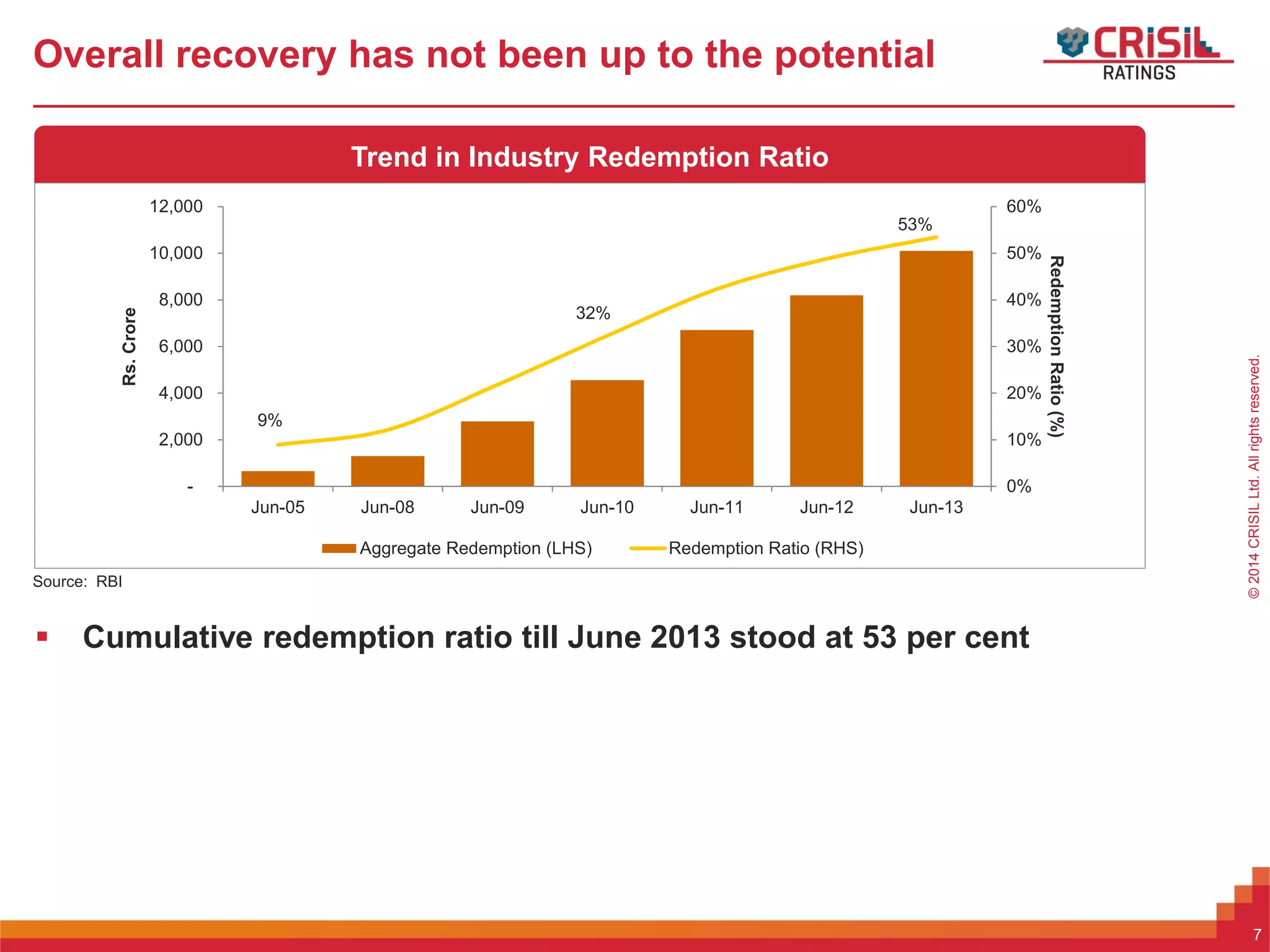
Trend in Industry Redemption Ratio
Overall recovery has not been up to the potential
 Cumulative redemption ratio till June 2013 stood at 53 per cent
Source: RBI
9%
32%
53%
0%
10%
20%
30%
40%
50%
60%
-
2,000
4,000
6,000
8,000
10,000
12,000
Jun-05 Jun-08 Jun-09 Jun-10 Jun-11 Jun-12 Jun-13
RedemptionRatio(%)
Rs.Crore
Aggregate Redemption (LHS) Redemption Ratio (RHS)
7
ForInternalUseOnly–NotForExternalDistribution©2014CRISILLtd.Allrightsreserved.
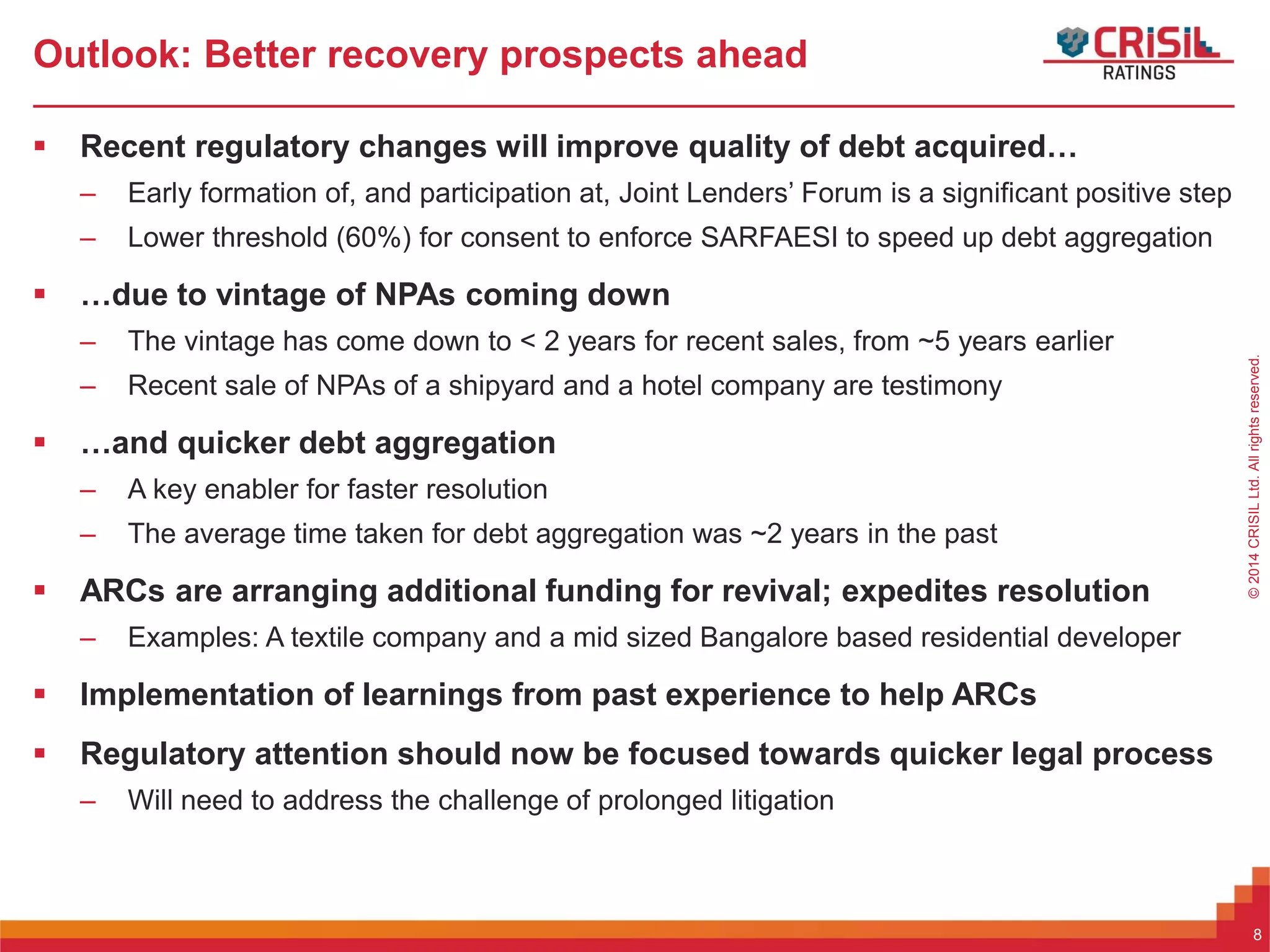
Outlook: Better recovery prospects ahead
 Recent regulatory changes will improve quality of debt acquired…
– Early formation of, and participation at, Joint Lenders’ Forum is a significant positive step
– Lower threshold (60%) for consent to enforce SARFAESI to speed up debt aggregation
 …due to vintage of NPAs coming down
– The vintage has come down to < 2 years for recent sales, from ~5 years earlier
– Recent sale of NPAs of a shipyard and a hotel company are testimony
 …and quicker debt aggregation
– A key enabler for faster resolution
– The average time taken for debt aggregation was ~2 years in the past
 ARCs are arranging additional funding for revival; expedites resolution
– Examples: A textile company and a mid sized Bangalore based residential developer
 Implementation of learnings from past experience to help ARCs
 Regulatory attention should now be focused towards quicker legal process
– Will need to address the challenge of prolonged litigation
8
ForInternalUseOnly–NotForExternalDistribution©2014CRISILLtd.Allrightsreserved.
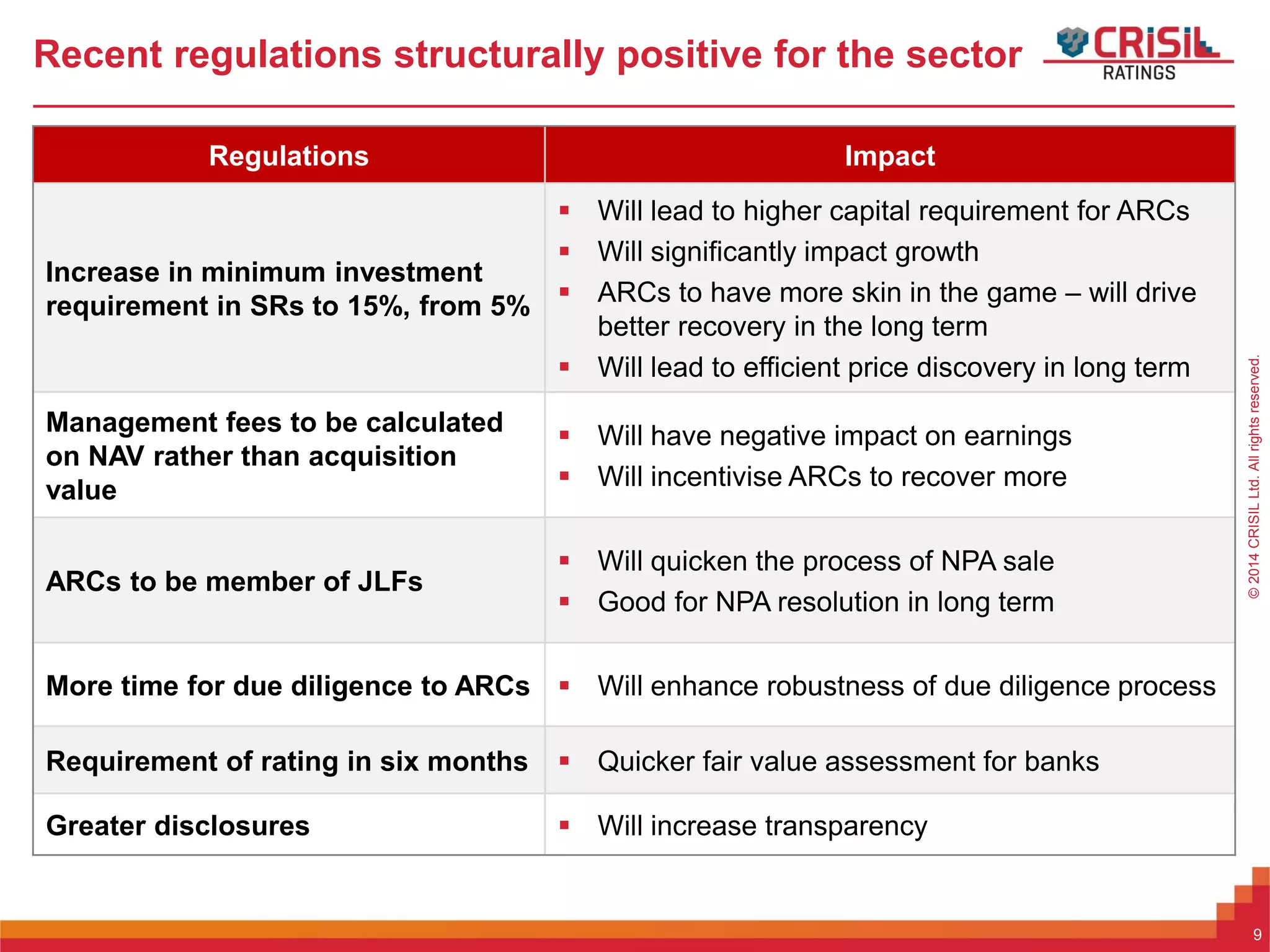
Recent regulations structurally positive for the sector
9
Regulations Impact
Increase in minimum investment
requirement in SRs to 15%, from 5%
 Will lead to higher capital requirement for ARCs
 Will significantly impact growth
 ARCs to have more skin in the game – will drive
better recovery in the long term
 Will lead to efficient price discovery in long term
Management fees to be calculated
on NAV rather than acquisition
value
 Will have negative impact on earnings
 Will incentivise ARCs to recover more
ARCs to be member of JLFs
 Will quicken the process of NPA sale
 Good for NPA resolution in long term
More time for due diligence to ARCs  Will enhance robustness of due diligence process
Requirement of rating in six months  Quicker fair value assessment for banks
Greater disclosures  Will increase transparency
ForInternalUseOnly–NotForExternalDistribution©2014CRISILLtd.Allrightsreserved.
CRISIL Limited
www.crisil.com
LinkedIn YouTube FacebookStay Connected | | | |Twitter
10
ForInternalUseOnly–NotForExternalDistribution©2014CRISILLtd.Allrightsreserved.
Primer on ARCs and CRISIL’s experience in
the sector
11
ForInternalUseOnly–NotForExternalDistribution©2014CRISILLtd.Allrightsreserved.
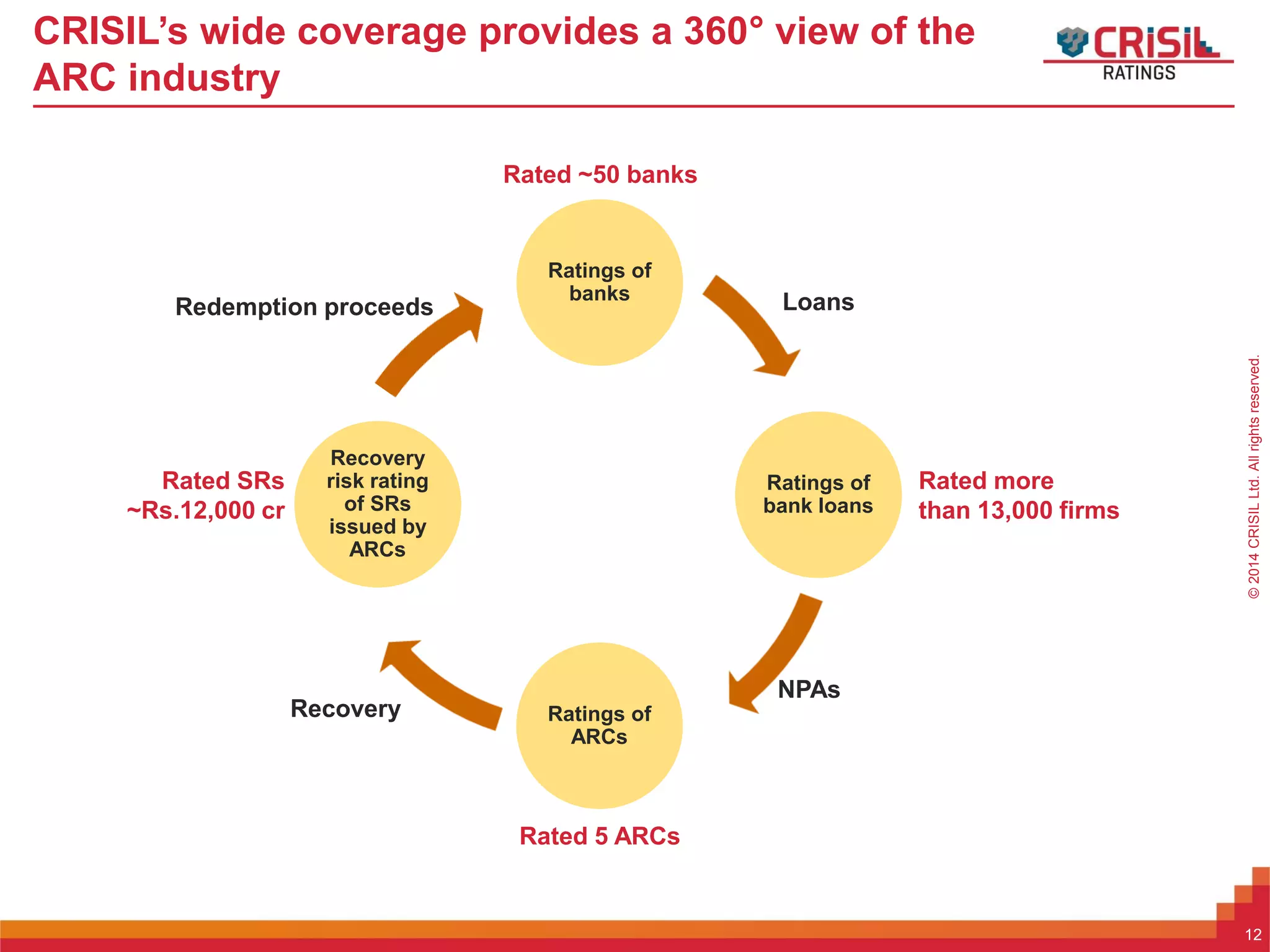
CRISIL’s wide coverage provides a 360° view of the
ARC industry
Ratings of
bank loans
Ratings of
banks
Ratings of
ARCs
Recovery
risk rating
of SRs
issued by
ARCs
Rated more
than 13,000 firms
Rated ~50 banks
Rated 5 ARCs
Rated SRs
~Rs.12,000 cr
Loans
NPAs
Recovery
Redemption proceeds
12
ForInternalUseOnly–NotForExternalDistribution©2014CRISILLtd.Allrightsreserved.
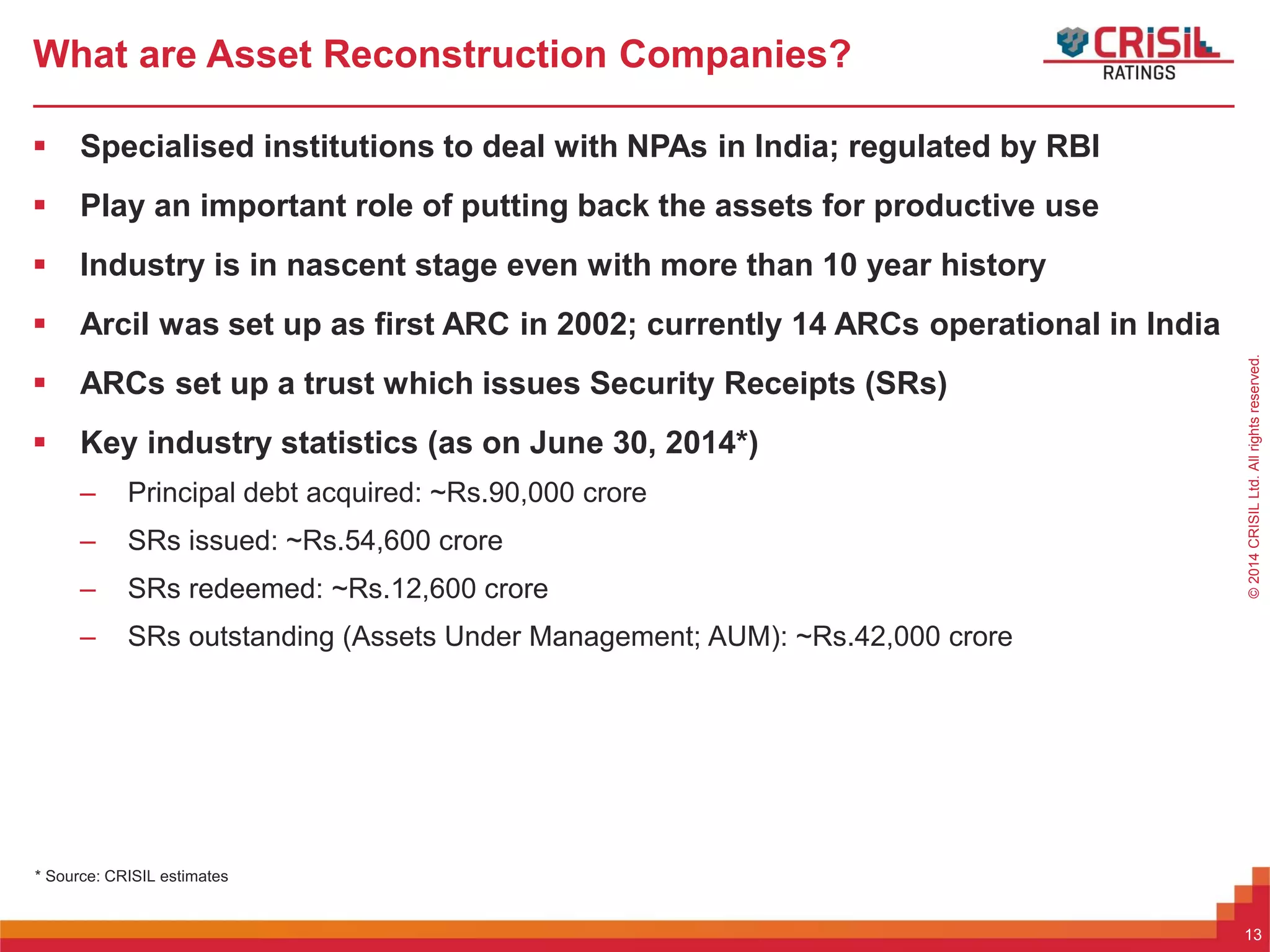
What are Asset Reconstruction Companies?
 Specialised institutions to deal with NPAs in India; regulated by RBI
 Play an important role of putting back the assets for productive use
 Industry is in nascent stage even with more than 10 year history
 Arcil was set up as first ARC in 2002; currently 14 ARCs operational in India
 ARCs set up a trust which issues Security Receipts (SRs)
 Key industry statistics (as on June 30, 2014*)
– Principal debt acquired: ~Rs.90,000 crore
– SRs issued: ~Rs.54,600 crore
– SRs redeemed: ~Rs.12,600 crore
– SRs outstanding (Assets Under Management; AUM): ~Rs.42,000 crore
* Source: CRISIL estimates
13

New norms will temper ARC growth

  • 1.
    ForInternalUseOnly–NotForExternalDistribution©2014CRISILLtd.Allrightsreserved. New norms willtemper ARC growth But they will improve price-discovery and recovery prospects Pawan Agrawal Senior Director – CRISIL Ratings Rajat Bahl Director – CRISIL Ratings August 7, 2014 1
  • 2.
    ForInternalUseOnly–NotForExternalDistribution©2014CRISILLtd.Allrightsreserved. Key messages  Growthwill settle at a lower level for ARC industry – AUM reached Rs.42,000 crore by June 2014, a 4 times increase in a year – Growth to moderate to 30 per cent in the current year, given the recent regulations  Capital and earnings will emerge as challenges – Recent regulatory changes significantly increase the capital requirements of ARCs – ARCs that can raise capital in a timely manner will be better positioned  Track record of asset resolution critical for long term sustainability of ARCs – ARCs have successfully reconstructed several large accounts – However, experience shows that the recovery till date has not been up to potential – Cumulative redemption ratio* till June 2013 stood at 53 per cent  Better recovery prospects ahead – Lower vintage and quicker debt aggregation to be the key drivers  Recent regulations structurally positive for the sector * Redemption ratio = SRs redeemed / SRs issued; Source: RBI 2
  • 3.
    ForInternalUseOnly–NotForExternalDistribution©2014CRISILLtd.Allrightsreserved. Trend in AssetsUnder Management (AUM; SRs outstanding) Growth will settle at a lower level for ARC industry  Regulatory support coupled with high level of NPAs fuelled recent growth – Shortfall on sale of assets permitted to be booked over 2 years for banks – Upfront booking of profit on sale of assets to ARCs permitted for banks  Industry will need to adjust to the minimum 15 per cent requirement now – Aligning pricing strategy with expectation of selling banks will be challenging in the near term – Proportion of cash deals is likely to go up Source: RBI, CRISIL estimates 3 8,800 42,000 55,000 - 10,000 20,000 30,000 40,000 50,000 60,000 Jun-08 Jun-09 Jun-10 Jun-11 Jun-12 Jun-13 Jun-14 E Jun-15 P Rs.Crore
  • 4.
    ForInternalUseOnly–NotForExternalDistribution©2014CRISILLtd.Allrightsreserved. Capital and earningswill emerge as challenges  Given the nature of assets, ARC business has traditionally been equity- funded  Aggregate net worth is modest at ~Rs.2,500 crore as on June 30, 2014 – Gearing has increased to 1x as on June 2014 from 0.1x as on June 2013 – Gearing philosophy varies significantly among ARCs  Capital raising will emerge as a significant challenge – Earnings will come under pressure due to revision in management fees norms – Regulatory restrictions on sponsor shareholding and listing can act as a constraint… – …may be partly offset by higher regulatory limit for FDI and FII investment in ARCs – Could result in lower growth or higher gearing  Ability to raise capital in a timely manner will become a differentiator Source: CRISIL estimates 4
  • 5.
    ForInternalUseOnly–NotForExternalDistribution©2014CRISILLtd.Allrightsreserved.  Reconstruction hasbeen used as preferred strategy for large accounts* – Reconstruction includes restructuring and sale of business strategies ARCs have successfully reconstructed several large accounts Re-construction 77% Sale of assets/ Settlement 23% * Large accounts = principal debt of over Rs.100 crores 5  Timely debt aggregation by ARCs  Unprecedented increase in land prices – promoters have more skin in the game  Delay/inability in aggregating debt  High vintage of NPAs  Prolonged litigations What has worked well? What has not worked?  Several success stories over the past decade – Company 1 (redemption ratio of 85%) – Company 2 (80-90%) – Company 3 (90-100%) – Company 4 (90-100%) – Company 5 (60-70%)
  • 6.
    ForInternalUseOnly–NotForExternalDistribution©2014CRISILLtd.Allrightsreserved. Sale of assetsdrive recoveries from small accounts  Sale of assets has been used as preferred strategy for small accounts* – Includes settlement with promoters as well  Redemption ratio is better at ~63% # Principal debt of below Rs.100 crore Re-construction 21% Sale of assets/ Settlement 79% 6  Relatively higher asset coverage offers better cushion  Quicker implementation of resolution strategies being sole lender  Promoters’ ability to bring in funds also played an important role  Poor availability of documentation related to security creation  High vintage of NPA What has worked well? What has not worked?
  • 7.
    ForInternalUseOnly–NotForExternalDistribution©2014CRISILLtd.Allrightsreserved. Trend in IndustryRedemption Ratio Overall recovery has not been up to the potential  Cumulative redemption ratio till June 2013 stood at 53 per cent Source: RBI 9% 32% 53% 0% 10% 20% 30% 40% 50% 60% - 2,000 4,000 6,000 8,000 10,000 12,000 Jun-05 Jun-08 Jun-09 Jun-10 Jun-11 Jun-12 Jun-13 RedemptionRatio(%) Rs.Crore Aggregate Redemption (LHS) Redemption Ratio (RHS) 7
  • 8.
    ForInternalUseOnly–NotForExternalDistribution©2014CRISILLtd.Allrightsreserved. Outlook: Better recoveryprospects ahead  Recent regulatory changes will improve quality of debt acquired… – Early formation of, and participation at, Joint Lenders’ Forum is a significant positive step – Lower threshold (60%) for consent to enforce SARFAESI to speed up debt aggregation  …due to vintage of NPAs coming down – The vintage has come down to < 2 years for recent sales, from ~5 years earlier – Recent sale of NPAs of a shipyard and a hotel company are testimony  …and quicker debt aggregation – A key enabler for faster resolution – The average time taken for debt aggregation was ~2 years in the past  ARCs are arranging additional funding for revival; expedites resolution – Examples: A textile company and a mid sized Bangalore based residential developer  Implementation of learnings from past experience to help ARCs  Regulatory attention should now be focused towards quicker legal process – Will need to address the challenge of prolonged litigation 8
  • 9.
    ForInternalUseOnly–NotForExternalDistribution©2014CRISILLtd.Allrightsreserved. Recent regulations structurallypositive for the sector 9 Regulations Impact Increase in minimum investment requirement in SRs to 15%, from 5%  Will lead to higher capital requirement for ARCs  Will significantly impact growth  ARCs to have more skin in the game – will drive better recovery in the long term  Will lead to efficient price discovery in long term Management fees to be calculated on NAV rather than acquisition value  Will have negative impact on earnings  Will incentivise ARCs to recover more ARCs to be member of JLFs  Will quicken the process of NPA sale  Good for NPA resolution in long term More time for due diligence to ARCs  Will enhance robustness of due diligence process Requirement of rating in six months  Quicker fair value assessment for banks Greater disclosures  Will increase transparency
  • 10.
  • 11.
  • 12.
    ForInternalUseOnly–NotForExternalDistribution©2014CRISILLtd.Allrightsreserved. CRISIL’s wide coverageprovides a 360° view of the ARC industry Ratings of bank loans Ratings of banks Ratings of ARCs Recovery risk rating of SRs issued by ARCs Rated more than 13,000 firms Rated ~50 banks Rated 5 ARCs Rated SRs ~Rs.12,000 cr Loans NPAs Recovery Redemption proceeds 12
  • 13.
    ForInternalUseOnly–NotForExternalDistribution©2014CRISILLtd.Allrightsreserved. What are AssetReconstruction Companies?  Specialised institutions to deal with NPAs in India; regulated by RBI  Play an important role of putting back the assets for productive use  Industry is in nascent stage even with more than 10 year history  Arcil was set up as first ARC in 2002; currently 14 ARCs operational in India  ARCs set up a trust which issues Security Receipts (SRs)  Key industry statistics (as on June 30, 2014*) – Principal debt acquired: ~Rs.90,000 crore – SRs issued: ~Rs.54,600 crore – SRs redeemed: ~Rs.12,600 crore – SRs outstanding (Assets Under Management; AUM): ~Rs.42,000 crore * Source: CRISIL estimates 13