The Application of EQ-5D in
Reimbursement Decision Making
      – The Case of NICE
                Professor Nancy J. Devlin
           Director of Research, Office of Health Economics
              Chair, EuroQol Group Executive Committee


Valuing Health Outcomes for Healthcare Decision Making Using the
 EQ-5D: A Symposium for Policy Makers and Researchers in Asia

                            Singapore
                          22 March 2013
Contents
1.   Introduction: HTA, value for money, and outcomes
     measurement
2.   NICE Health Technology Appraisal: purpose & process
3.   The relationship between cost effectiveness and NICE
     decisions
4.   The role of EQ-5D in NICE decision making
5.   Collecting and analysing EQ-5D data to inform HTA
6.   Utility weighting EQ-5D profiles – the role of value sets
7.   What if EQ-5D data are not available?
8.   Is EQ-5D always appropriate?
9.   Concluding remarks
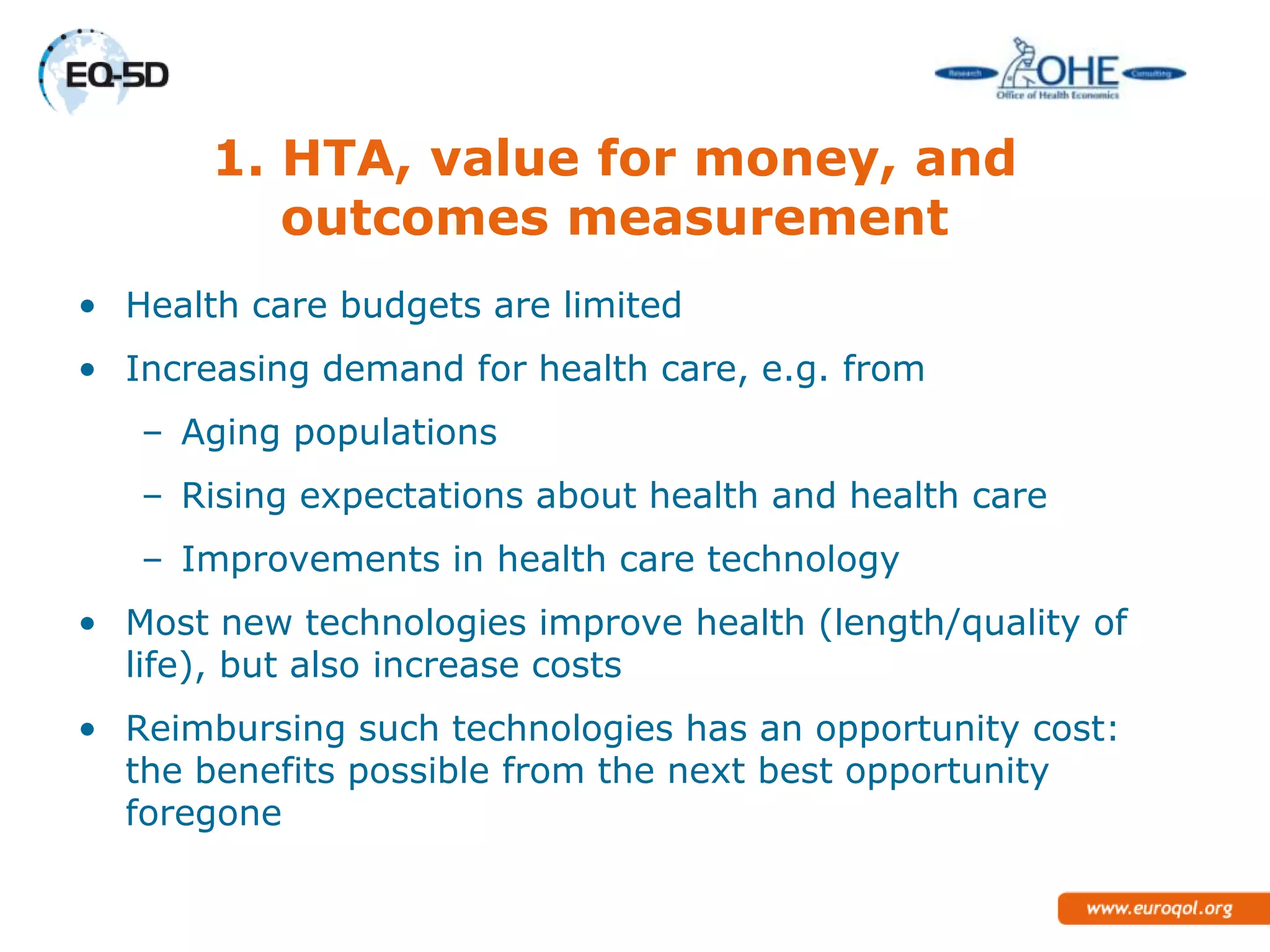
1. HTA, value for money, and
          outcomes measurement
• Health care budgets are limited
• Increasing demand for health care, e.g. from
   – Aging populations
   – Rising expectations about health and health care
   – Improvements in health care technology
• Most new technologies improve health (length/quality of
  life), but also increase costs
• Reimbursing such technologies has an opportunity cost:
  the benefits possible from the next best opportunity
  foregone
• How can we judge whether new technologies are good
  value for money?
• Need to be able to compare health gained with health
  foregone
• Aim is to achieve an allocation of budgets that
  maximises health
• Cost effectiveness analysis provides a means of
  comparing value for money
• This requires a standardised measure of health
  outcomes, e.g. the QALY
• Which in turn requires a standardised, generic means of
  measuring patients‘ quality of life, e.g. EQ-5D
2. NICE HTA: Purpose & Process
• Purpose: ―to offer health professionals guidance on the use of
  technologies, based on a rigorous review of the available
  evidence‖
• In doing so, it takes the following six matters into account:
    – The clinical needs of patients
    – NHS priorities
    – The broad balance between benefits and
      costs, incorporating both clinical and cost effectiveness
    – Potential impact on other NHS resources
    – Encouragement of innovation
    – Guidance from ministers on the resources available
3. Cost Effectiveness and NICE Decisions

  – ―[NICE] should, generally, accept as cost effective those
    interventions with an incremental cost-effectiveness
    ratio of less than £20,000 per QALY and that there
    should be increasingly strong reasons for accepting as
    cost effective interventions with an incremental cost-
    effectiveness ratio of over £30,000 per QALY.‖
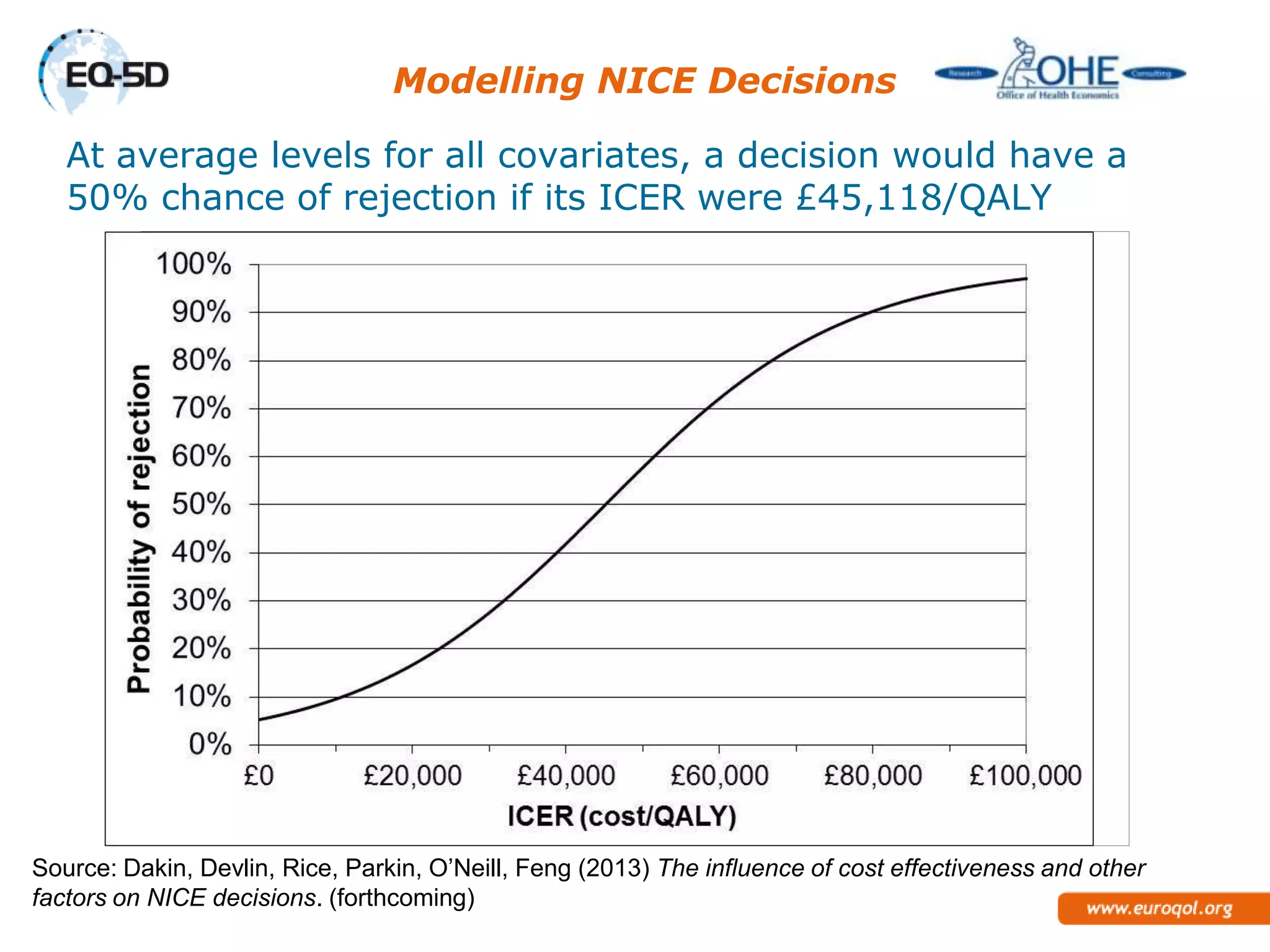
Modelling NICE Decisions

At average levels for all covariates, a decision would have a
50% chance of rejection if its ICER were £45,118/QALY


 Source: Dakin, Devlin, Rice, Parkin, O’Neill, Feng (2013) The influence of cost effectiveness and other factors
 on NICE decisions. (forthcoming)
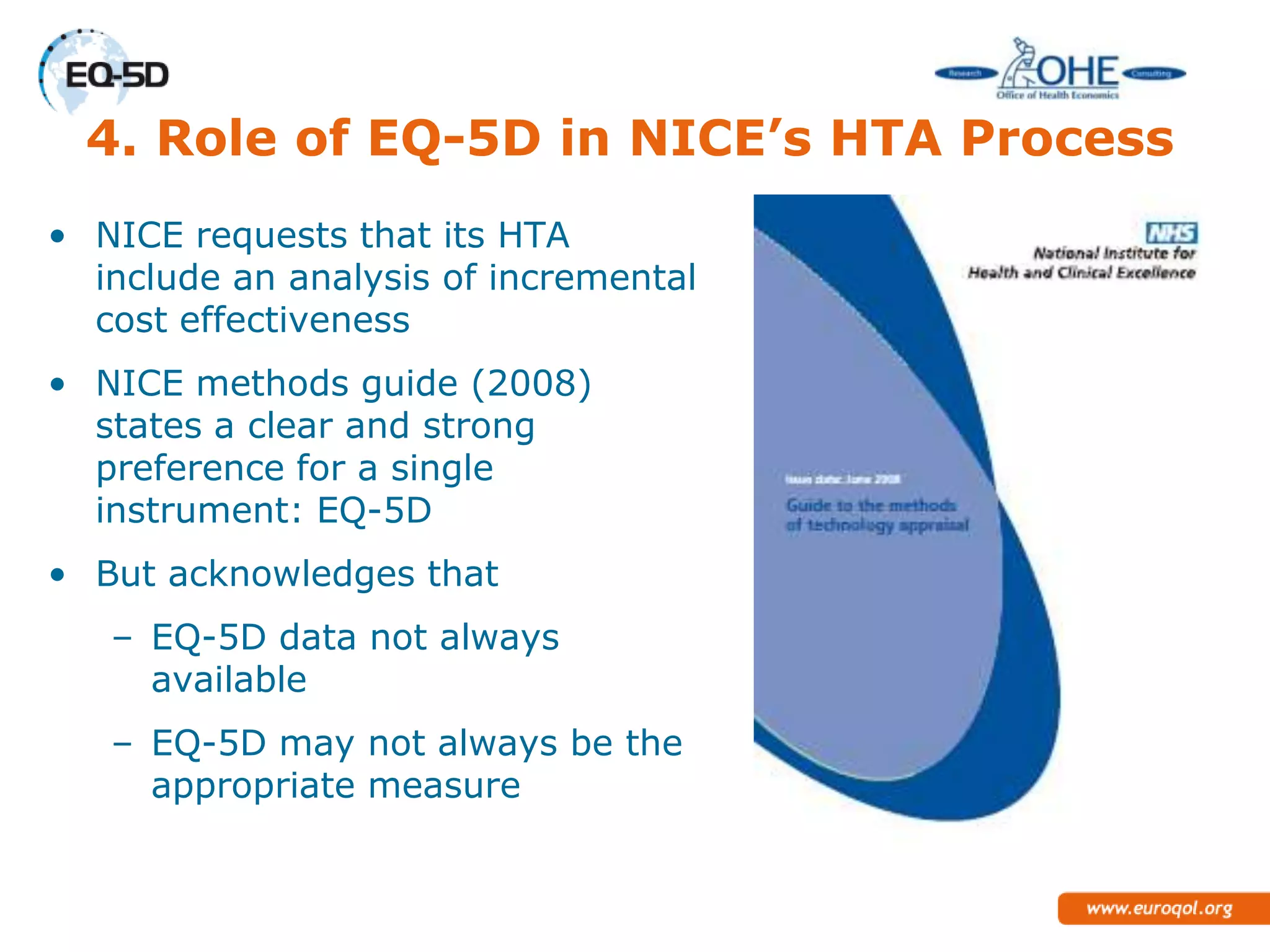
4. Role of EQ-5D in NICE’s HTA Process
• NICE requests that its HTA
  include an analysis of incremental
  cost effectiveness
• NICE methods guide (2008)
  states a clear and strong
  preference for a single
  instrument: EQ-5D
• But acknowledges that
   – EQ-5D data not always
     available
   – EQ-5D may not always be the
     appropriate measure
5. Collecting and Analysing EQ-5D
   Data to Inform HTA
• EQ-5D can be included alongside disease specific PROs in clinical
  trials and observational studies
   – E.g. baseline; 4 weeks; 8 weeks; 12 weeks
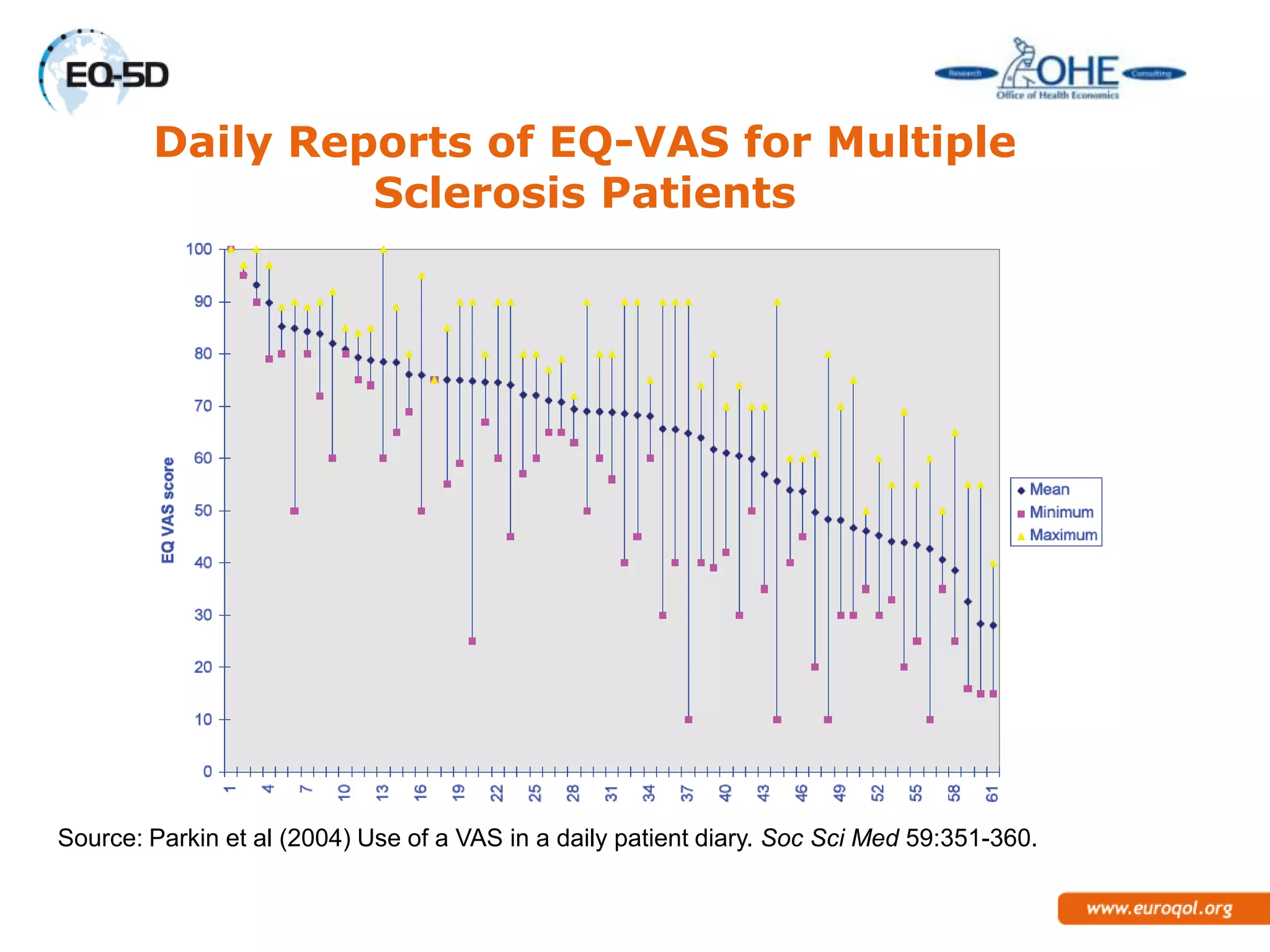
   – More frequent data collection also feasible, e.g. daily patient diary
   – Which is appropriate will depend on the nature of the disease and
     intervention

• Various modes of data collection possible, e.g. paper and pencil;
  web-based; PDA; telephone
• Data can be used to test for statistically significant improvements
  in outcomes compared to placebo and/or relevant comparators
• Results used to populate health economics models
Daily Reports of EQ-VAS for Multiple
                    Sclerosis Patients


Source: Parkin, et al. (2004) Use of a VAS in a daily patient diary. Soc Sci Med 59:351-360.
6. Utility Weighting EQ-5D Profiles
           – the Role of Value Sets
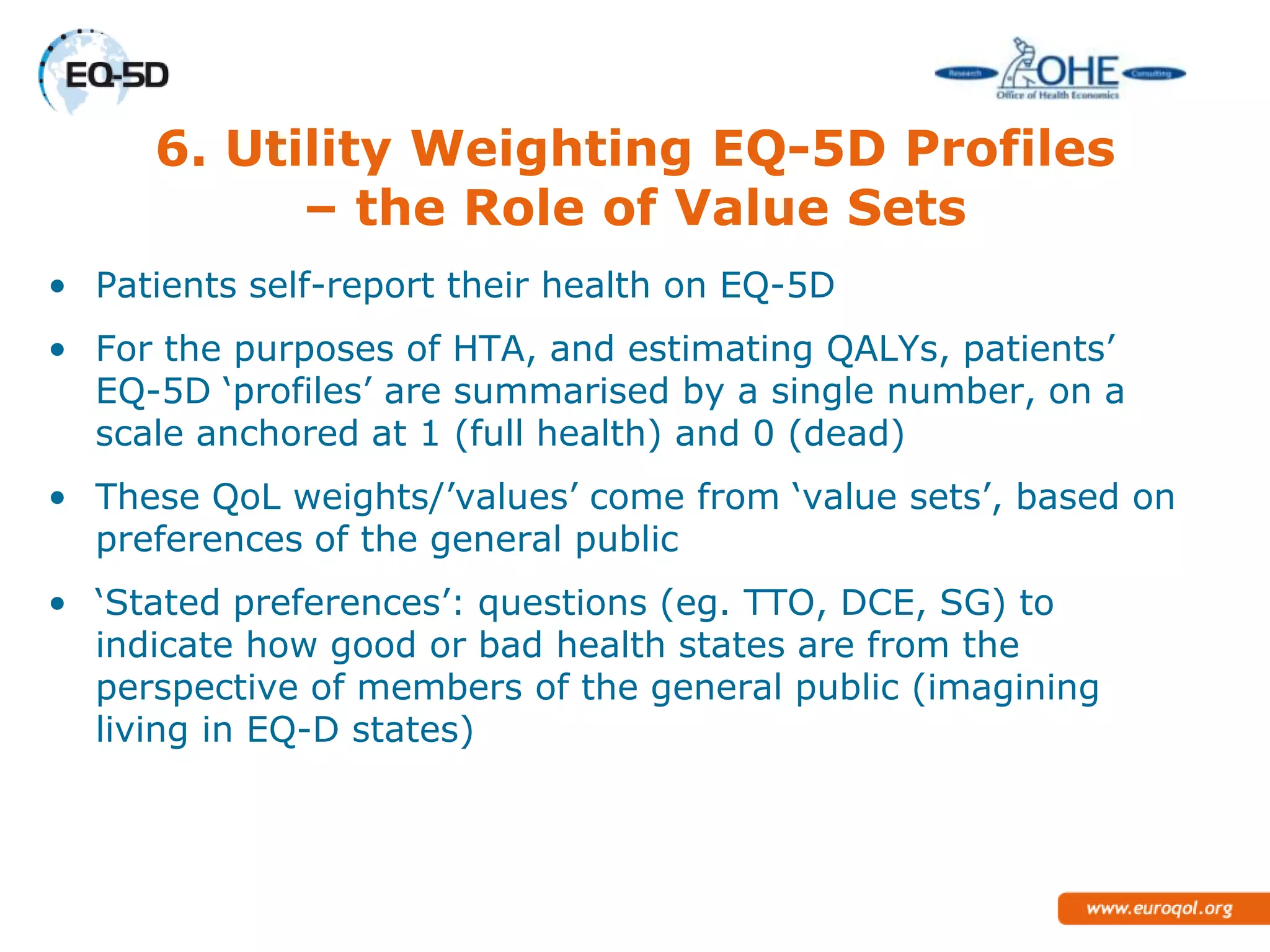
• Patients self-report their health on EQ-5D
• For the purposes of HTA, and estimating QALYs, patients‘
  EQ-5D ‗profiles‘ are summarised by a single number, on a
  scale anchored at 1 (full health) and 0 (dead)
• These QoL weights/‘values‘ come from ‗value sets‘, based on
  preferences of the general public
• ‗Stated preferences‘: questions (eg. TTO, DCE, SG) to
  indicate how good or bad health states are from the
  perspective of members of the general public (imagining
  living in EQ-D states)
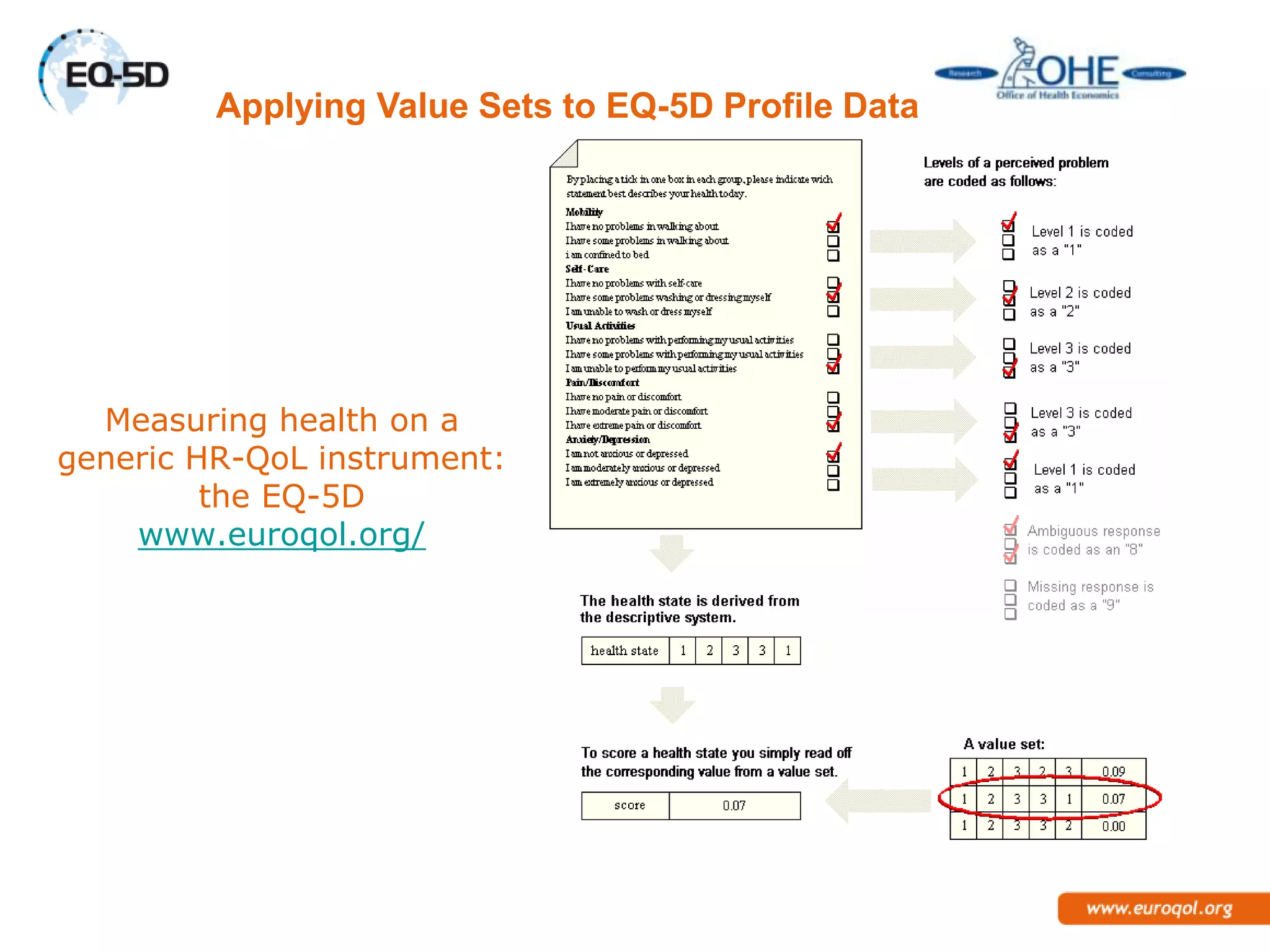
Applying Value Sets to EQ-5D Profile Data


  Measuring health on a
generic HR-QoL instrument:
         the EQ-5D
    www.euroqol.org/
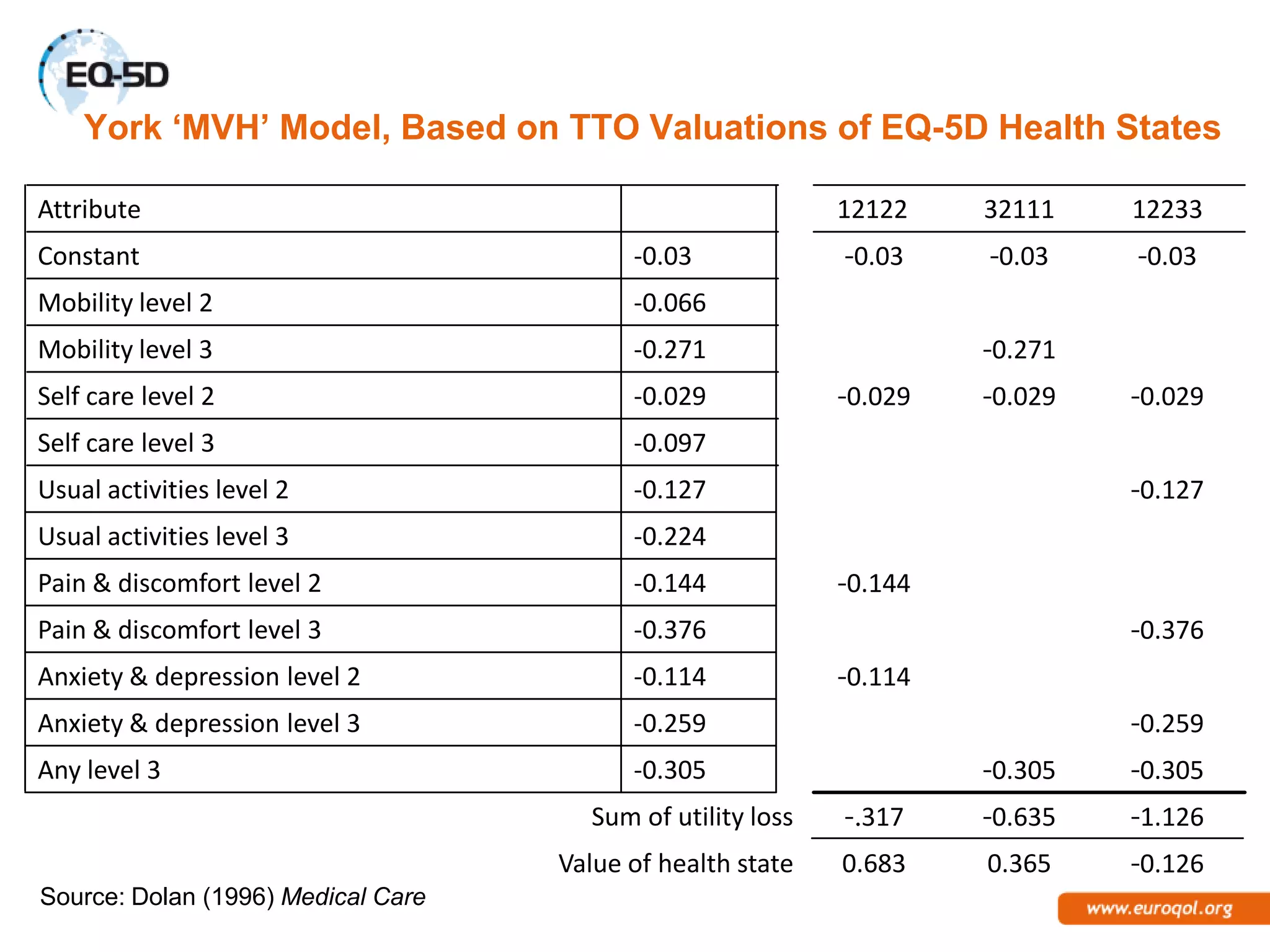
York ‘MVH’ Model, Based on TTO Valuations of EQ-5D Health States

Attribute                                                   12122    32111    12233
Constant                                  -0.03             -0.03    -0.03    -0.03
Mobility level 2                          -0.066
Mobility level 3                          -0.271                     -0.271
Self care level 2                         -0.029            -0.029   -0.029   -0.029
Self care level 3                         -0.097
Usual activities level 2                  -0.127                              -0.127
Usual activities level 3                  -0.224
Pain & discomfort level 2                 -0.144            -0.144
Pain & discomfort level 3                 -0.376                              -0.376
Anxiety & depression level 2              -0.114            -0.114
Anxiety & depression level 3              -0.259                              -0.259
Any level 3                               -0.305                     -0.305   -0.305
                                      Sum of utility loss   -.317    -0.635   -1.126
                                    Value of health state   0.683    0.365    -0.126
Source: Dolan (1996) Medical Care
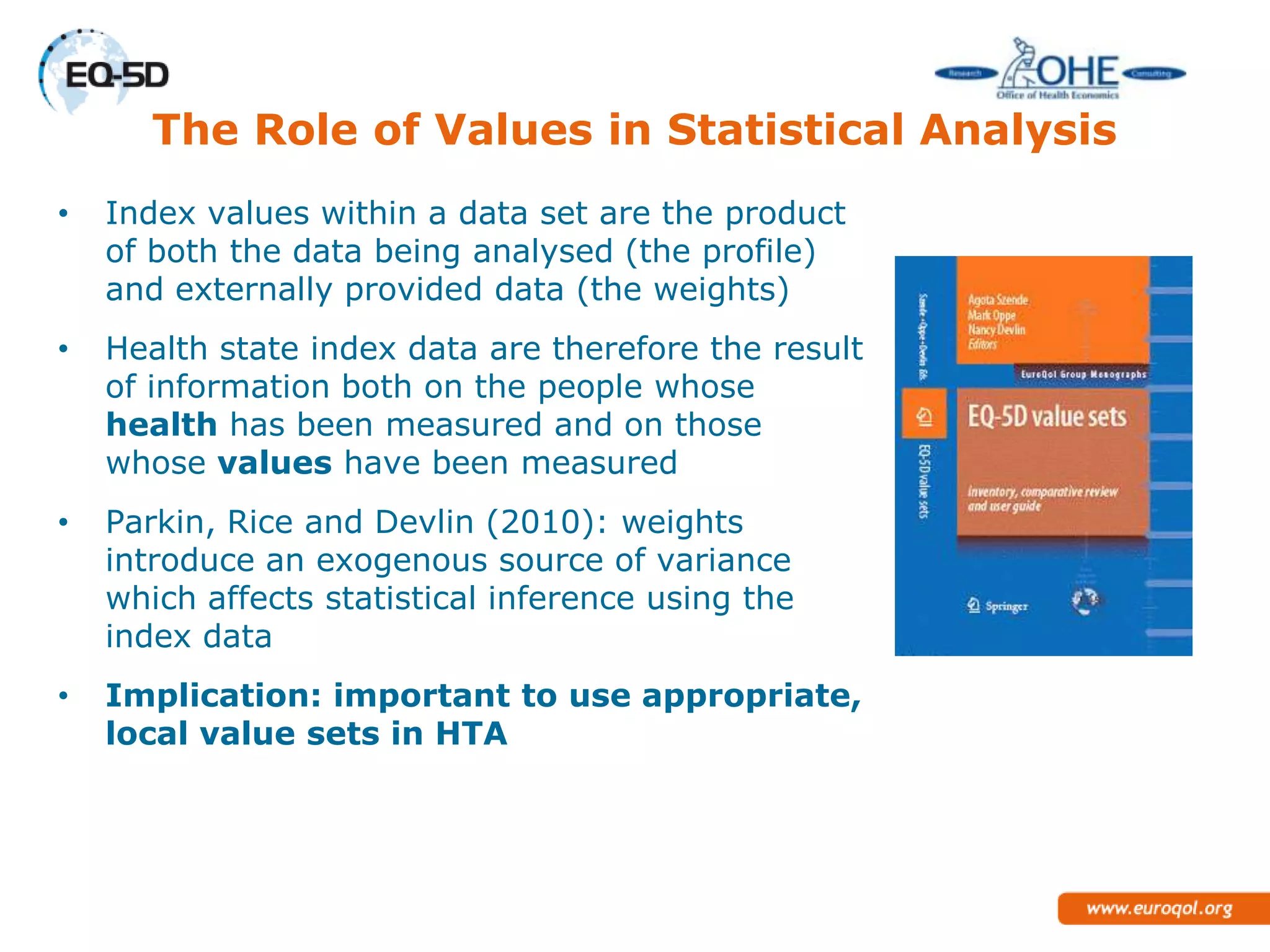
The Role of Values in Statistical Analysis
•   Index values within a data set are the product
    of both the data being analysed (the profile)
    and externally provided data (the weights)
•   Health state index data are therefore the result
    of information both on the people whose
    health has been measured and on those
    whose values have been measured
•   Parkin, Rice and Devlin (2010): weights
    introduce an exogenous source of variance
    which affects statistical inference using the
    index data
•   Implication: important to use
    appropriate, local value sets in HTA
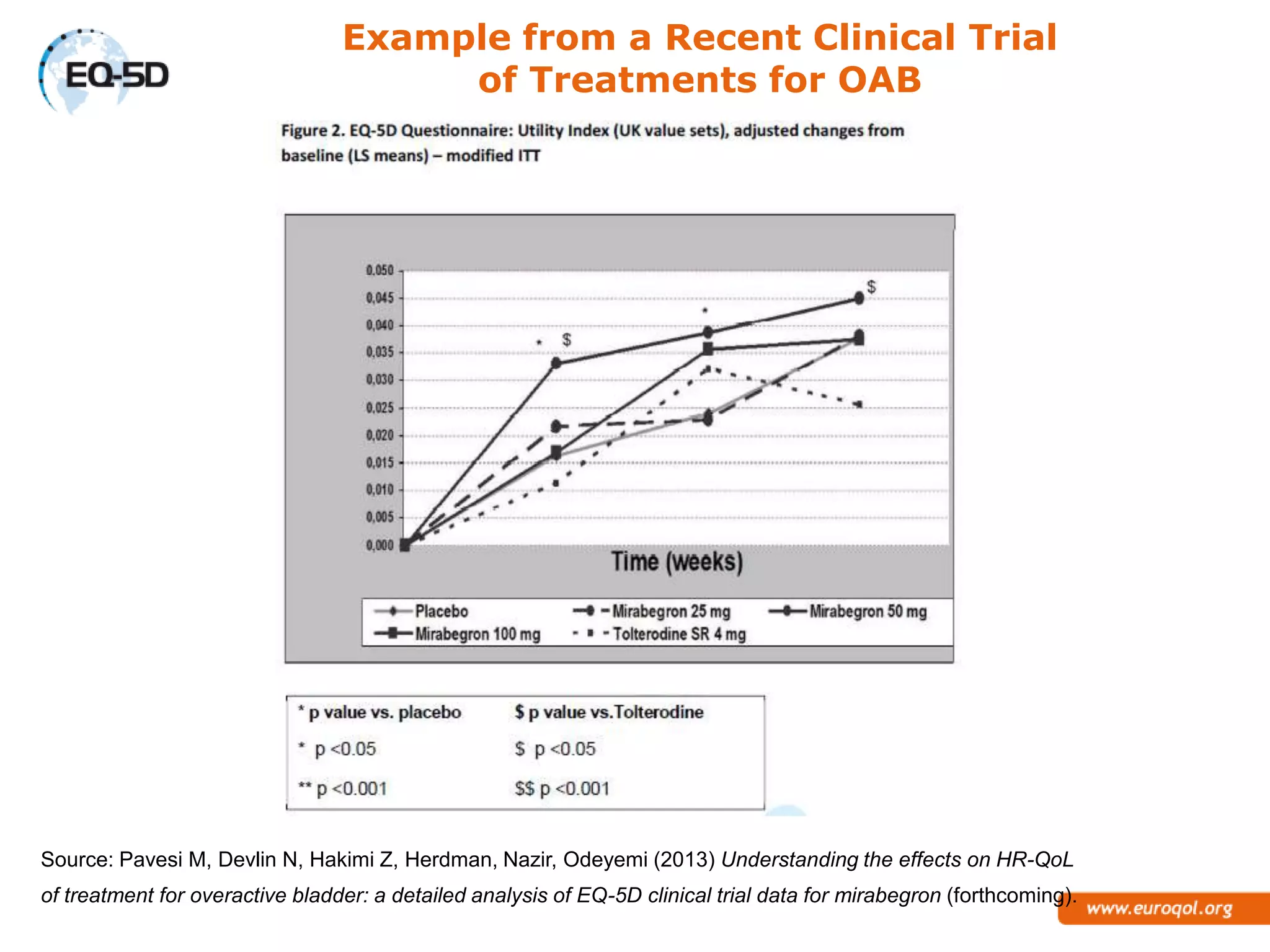
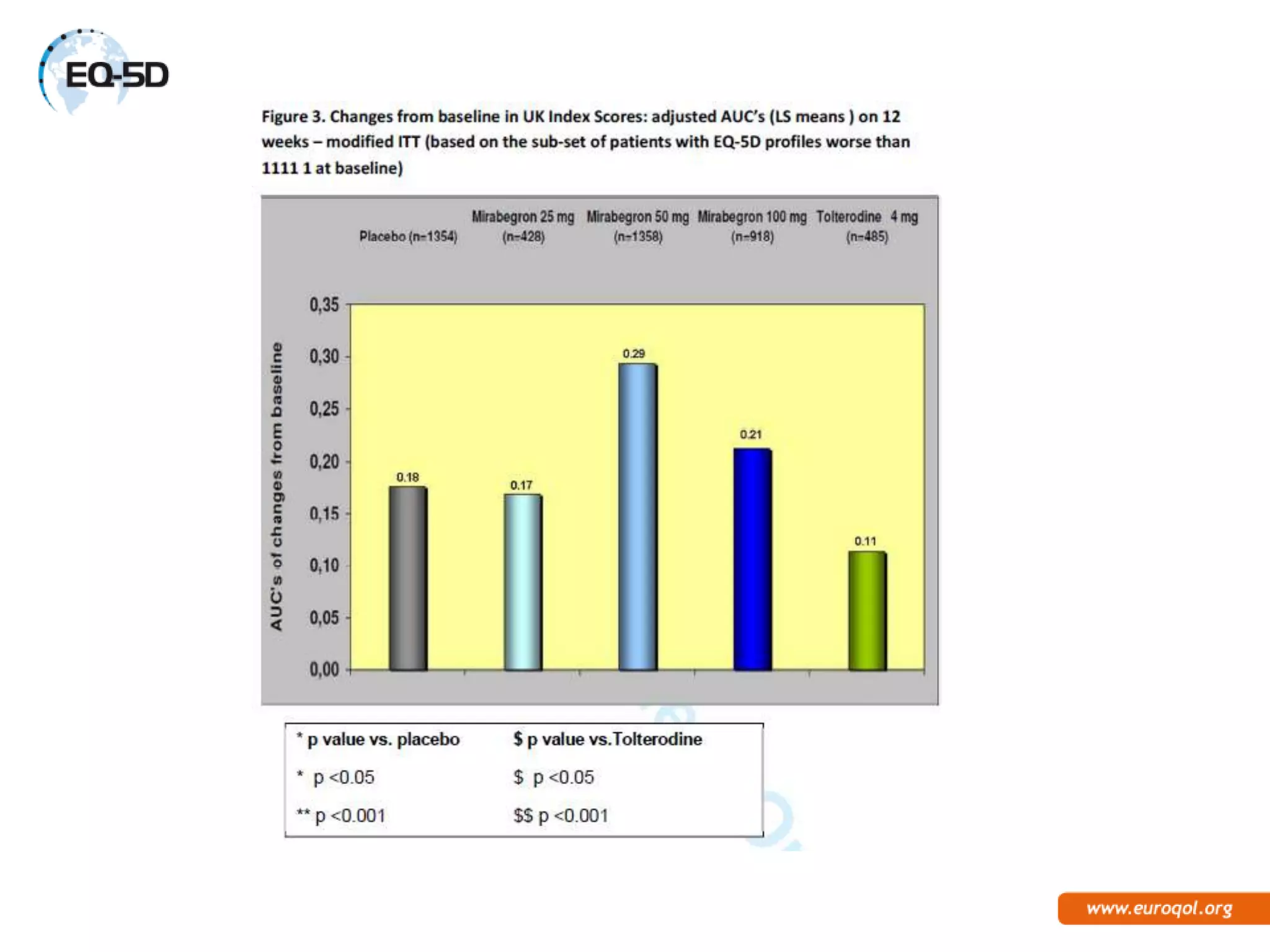
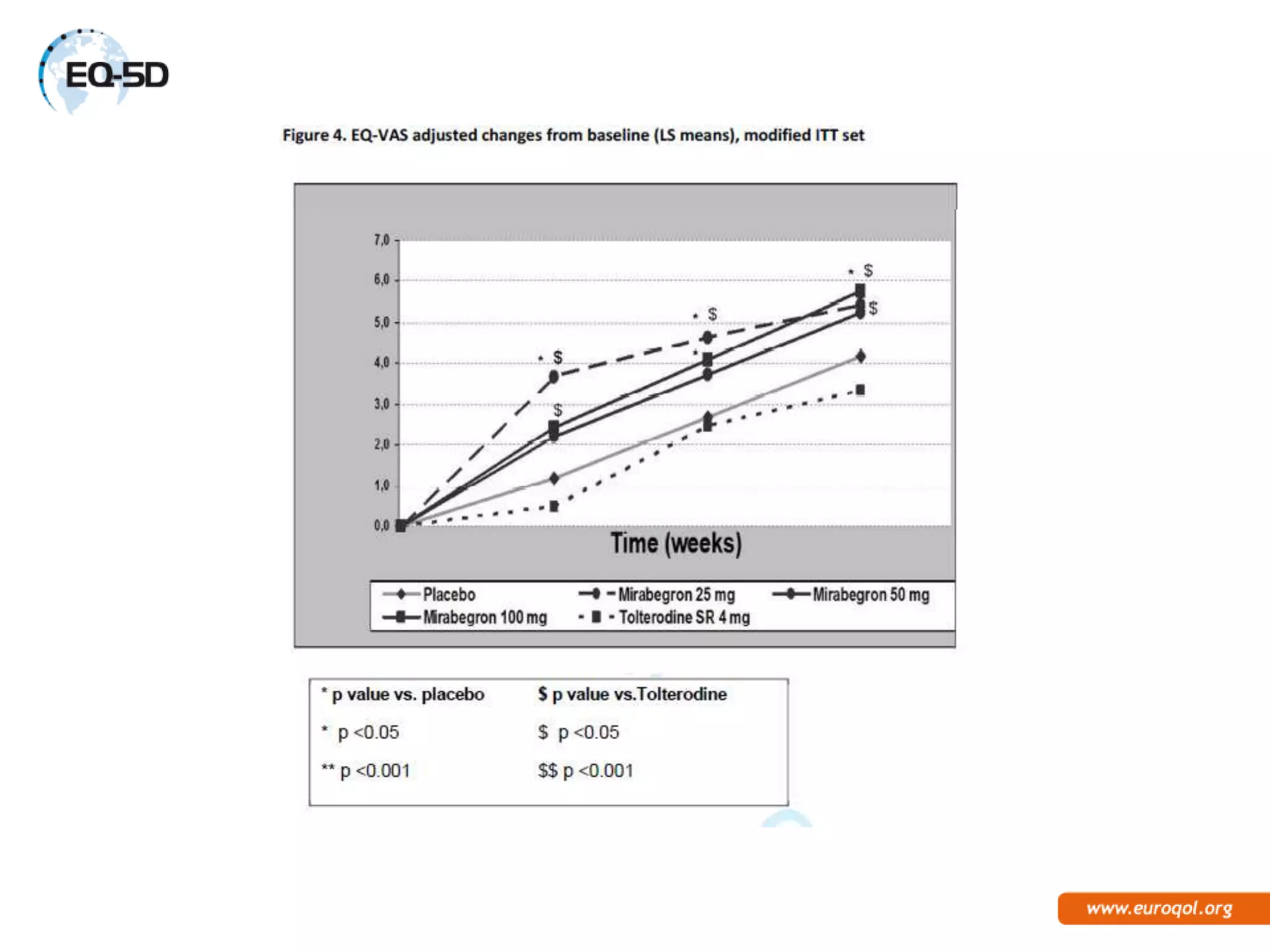
Example from a Recent Clinical Trial
                                      of Treatments for OAB


Source: Pavesi, Devlin, Hakimi, Herdman, Nazir, Odeyemi. (2013) Understanding the effects on HR-QoL of treatment for
overactive bladder: a detailed analysis of EQ-5D clinical trial data for mirabegron. (forthcoming).
7. What if EQ-5D Data Are Not
              Available?
• Mapping from a disease specific PRO to EQ-5D is
  possible.
• Various methods available (direct vs. indirect)
• NICE DSU recommendations on mapping
• Mapping is subject to some important challenges and
  limitations…
“Where relevant EQ-5D data are not available, then another solution would be to
map from another measure of HRQL or disease severity that has been used in
relevant studies and to predict EQ-5D responses from statistical mapping
functions. These can be estimated from other data sets containing both
instruments. This strategy is accepted by NICE in the absence of EQ-5D
data, but it is always second best to the direct use of EQ-5D and may come with
a penalty of increased uncertainty.”
8. Is EQ-5D Always Appropriate?

• EQ-5D shown to be a reliable and sensitive measure of
  patient reported outcomes in many disease areas—but not
  all
• EQ-5D may not always be the appropriate measure:
  lacking sensitivity; ‗missing‘ descriptive items
• For a recent review, see NICE DSU report on EQ-5D
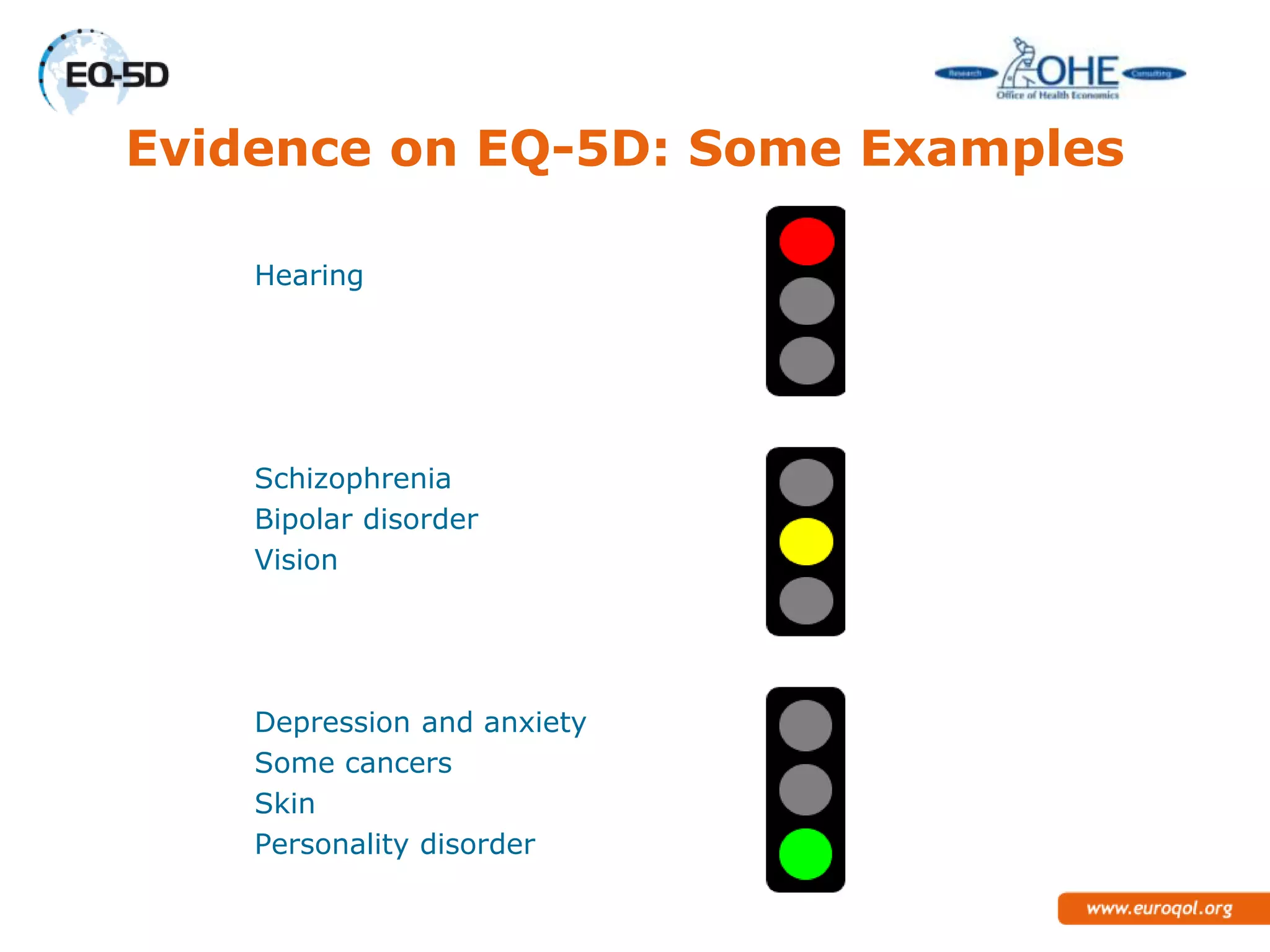
Evidence on EQ-5D: Some Examples

    Hearing


    Schizophrenia
    Bipolar disorder
    Vision


    Depression and anxiety
    Some cancers
    Skin
    Personality disorder
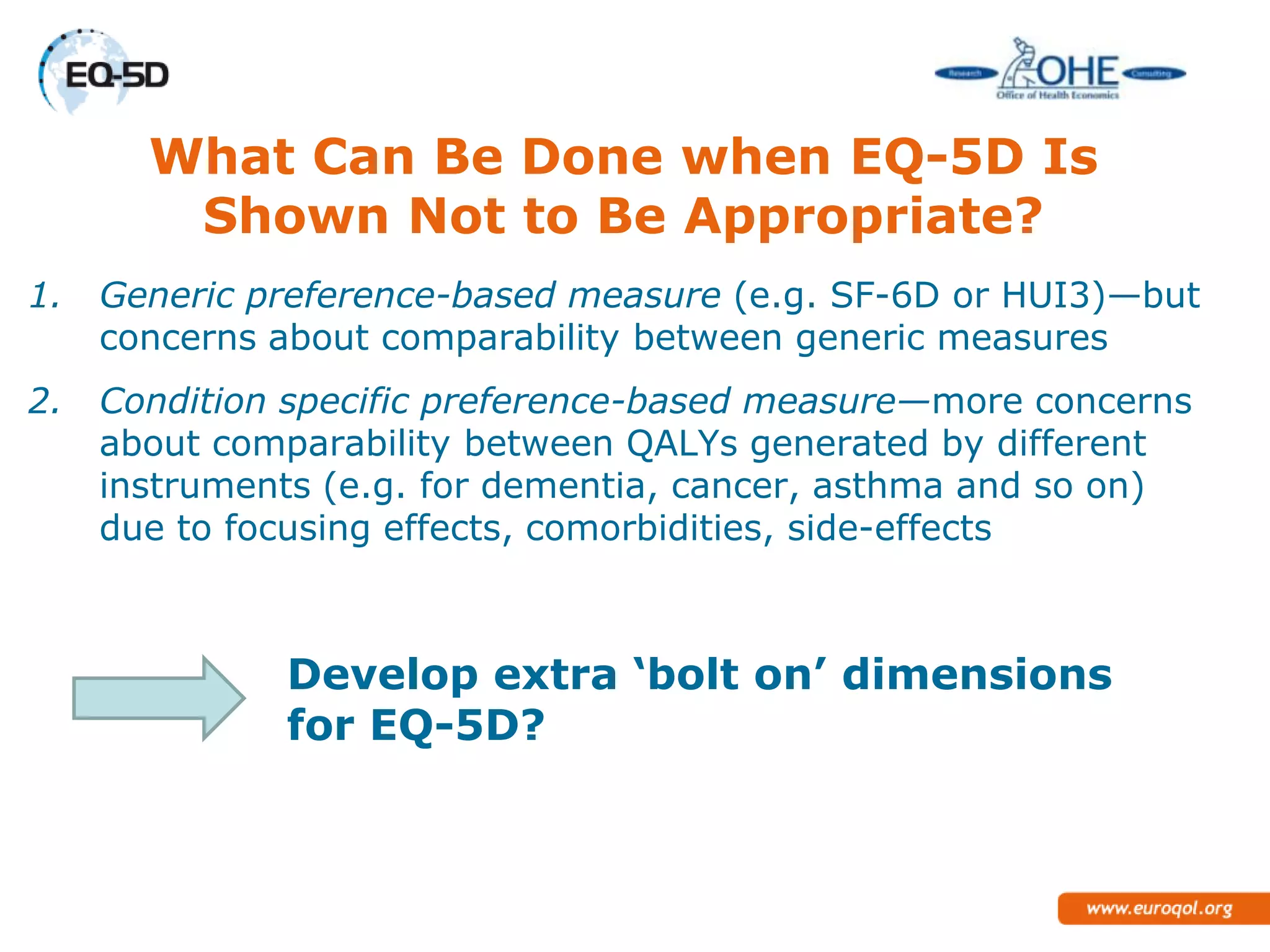
What Can Be Done when EQ-5D Is
        Shown Not to Be Appropriate?
1.   Generic preference-based measure (e.g. SF-6D or HUI3)—but
     concerns about comparability between generic measures
2.   Condition specific preference-based measure—more concerns
     about comparability between QALYs generated by different
     instruments (e.g. for dementia, cancer, asthma and so on)
     due to focusing effects, comorbidities, side-effects


              Develop extra ‘bolt on’ dimensions
              for EQ-5D?
What Are the Issues for
         Bolt-On Development?

1.   Determine candidate dimensions
2.   Develop labels and levels
3.   Psychometric testing
4.   Test impact on health state values
5.   Test impact on the form of the preference function for
     whole EQ-5D – are bolt-ons simply additive?
6.   Estimating value sets/functions with new bolt-ons
9. Concluding Remarks
• From 2014 in UK: Value Based Pricing (VBP)
   – Changing (expanded) role for NICE
   – QALYs (and EQ-5D) highly likely to be central to
     assessments of the value of new technologies in VBP
• Plans to introduce VBP have further highlighted questions
  about what the ‗cost effectiveness threshold‘ should be.
   – Debate over what methods best identify the opportunity
     cost
• To ensure budgets used efficiently (produce as much health as
  possible) important to look at value for money of both new
  and old technologies
• Measurement of outcomes in ‗real world‘ settings will become
  increasingly important
For additional information, please contact Prof Nancy Devlin at
ndevlin@ohe.org

To keep up with the latest news and research, subscribe to our blog, OHE News.
Follow us on Twitter @OHENews, LinkedIn and SlideShare.

Office of Health Economics (OHE)
Southside, 7th Floor
105 Victoria Street
London SW1E 6QT
United Kingdom
+44 20 7747 8850
www.ohe.org

OHE’s publications may be downloaded free of charge by registered users of its website.

©2013 OHE

Application of EQ-5D in Reimbursement Decision Making: The Case of NICE

  • 1.
    The Application ofEQ-5D in Reimbursement Decision Making – The Case of NICE Professor Nancy J. Devlin Director of Research, Office of Health Economics Chair, EuroQol Group Executive Committee Valuing Health Outcomes for Healthcare Decision Making Using the EQ-5D: A Symposium for Policy Makers and Researchers in Asia Singapore 22 March 2013
  • 2.
    Contents 1. Introduction: HTA, value for money, and outcomes measurement 2. NICE Health Technology Appraisal: purpose & process 3. The relationship between cost effectiveness and NICE decisions 4. The role of EQ-5D in NICE decision making 5. Collecting and analysing EQ-5D data to inform HTA 6. Utility weighting EQ-5D profiles – the role of value sets 7. What if EQ-5D data are not available? 8. Is EQ-5D always appropriate? 9. Concluding remarks
  • 3.
    1. HTA, valuefor money, and outcomes measurement • Health care budgets are limited • Increasing demand for health care, e.g. from – Aging populations – Rising expectations about health and health care – Improvements in health care technology • Most new technologies improve health (length/quality of life), but also increase costs • Reimbursing such technologies has an opportunity cost: the benefits possible from the next best opportunity foregone
  • 4.
    • How canwe judge whether new technologies are good value for money? • Need to be able to compare health gained with health foregone • Aim is to achieve an allocation of budgets that maximises health • Cost effectiveness analysis provides a means of comparing value for money • This requires a standardised measure of health outcomes, e.g. the QALY • Which in turn requires a standardised, generic means of measuring patients‘ quality of life, e.g. EQ-5D
  • 5.
    2. NICE HTA:Purpose & Process • Purpose: ―to offer health professionals guidance on the use of technologies, based on a rigorous review of the available evidence‖ • In doing so, it takes the following six matters into account: – The clinical needs of patients – NHS priorities – The broad balance between benefits and costs, incorporating both clinical and cost effectiveness – Potential impact on other NHS resources – Encouragement of innovation – Guidance from ministers on the resources available
  • 6.
    3. Cost Effectivenessand NICE Decisions – ―[NICE] should, generally, accept as cost effective those interventions with an incremental cost-effectiveness ratio of less than £20,000 per QALY and that there should be increasingly strong reasons for accepting as cost effective interventions with an incremental cost- effectiveness ratio of over £30,000 per QALY.‖
  • 7.
    Modelling NICE Decisions Ataverage levels for all covariates, a decision would have a 50% chance of rejection if its ICER were £45,118/QALY Source: Dakin, Devlin, Rice, Parkin, O’Neill, Feng (2013) The influence of cost effectiveness and other factors on NICE decisions. (forthcoming)
  • 8.
    4. Role ofEQ-5D in NICE’s HTA Process • NICE requests that its HTA include an analysis of incremental cost effectiveness • NICE methods guide (2008) states a clear and strong preference for a single instrument: EQ-5D • But acknowledges that – EQ-5D data not always available – EQ-5D may not always be the appropriate measure
  • 9.
    5. Collecting andAnalysing EQ-5D Data to Inform HTA • EQ-5D can be included alongside disease specific PROs in clinical trials and observational studies – E.g. baseline; 4 weeks; 8 weeks; 12 weeks – More frequent data collection also feasible, e.g. daily patient diary – Which is appropriate will depend on the nature of the disease and intervention • Various modes of data collection possible, e.g. paper and pencil; web-based; PDA; telephone • Data can be used to test for statistically significant improvements in outcomes compared to placebo and/or relevant comparators • Results used to populate health economics models
  • 10.
    Daily Reports ofEQ-VAS for Multiple Sclerosis Patients Source: Parkin, et al. (2004) Use of a VAS in a daily patient diary. Soc Sci Med 59:351-360.
  • 11.
    6. Utility WeightingEQ-5D Profiles – the Role of Value Sets • Patients self-report their health on EQ-5D • For the purposes of HTA, and estimating QALYs, patients‘ EQ-5D ‗profiles‘ are summarised by a single number, on a scale anchored at 1 (full health) and 0 (dead) • These QoL weights/‘values‘ come from ‗value sets‘, based on preferences of the general public • ‗Stated preferences‘: questions (eg. TTO, DCE, SG) to indicate how good or bad health states are from the perspective of members of the general public (imagining living in EQ-D states)
  • 12.
    Applying Value Setsto EQ-5D Profile Data Measuring health on a generic HR-QoL instrument: the EQ-5D www.euroqol.org/
  • 13.
    York ‘MVH’ Model,Based on TTO Valuations of EQ-5D Health States Attribute 12122 32111 12233 Constant -0.03 -0.03 -0.03 -0.03 Mobility level 2 -0.066 Mobility level 3 -0.271 -0.271 Self care level 2 -0.029 -0.029 -0.029 -0.029 Self care level 3 -0.097 Usual activities level 2 -0.127 -0.127 Usual activities level 3 -0.224 Pain & discomfort level 2 -0.144 -0.144 Pain & discomfort level 3 -0.376 -0.376 Anxiety & depression level 2 -0.114 -0.114 Anxiety & depression level 3 -0.259 -0.259 Any level 3 -0.305 -0.305 -0.305 Sum of utility loss -.317 -0.635 -1.126 Value of health state 0.683 0.365 -0.126 Source: Dolan (1996) Medical Care
  • 14.
    The Role ofValues in Statistical Analysis • Index values within a data set are the product of both the data being analysed (the profile) and externally provided data (the weights) • Health state index data are therefore the result of information both on the people whose health has been measured and on those whose values have been measured • Parkin, Rice and Devlin (2010): weights introduce an exogenous source of variance which affects statistical inference using the index data • Implication: important to use appropriate, local value sets in HTA
  • 15.
    Example from aRecent Clinical Trial of Treatments for OAB Source: Pavesi, Devlin, Hakimi, Herdman, Nazir, Odeyemi. (2013) Understanding the effects on HR-QoL of treatment for overactive bladder: a detailed analysis of EQ-5D clinical trial data for mirabegron. (forthcoming).
  • 18.
    7. What ifEQ-5D Data Are Not Available? • Mapping from a disease specific PRO to EQ-5D is possible. • Various methods available (direct vs. indirect) • NICE DSU recommendations on mapping • Mapping is subject to some important challenges and limitations… “Where relevant EQ-5D data are not available, then another solution would be to map from another measure of HRQL or disease severity that has been used in relevant studies and to predict EQ-5D responses from statistical mapping functions. These can be estimated from other data sets containing both instruments. This strategy is accepted by NICE in the absence of EQ-5D data, but it is always second best to the direct use of EQ-5D and may come with a penalty of increased uncertainty.”
  • 19.
    8. Is EQ-5DAlways Appropriate? • EQ-5D shown to be a reliable and sensitive measure of patient reported outcomes in many disease areas—but not all • EQ-5D may not always be the appropriate measure: lacking sensitivity; ‗missing‘ descriptive items • For a recent review, see NICE DSU report on EQ-5D
  • 20.
    Evidence on EQ-5D:Some Examples Hearing Schizophrenia Bipolar disorder Vision Depression and anxiety Some cancers Skin Personality disorder
  • 21.
    What Can BeDone when EQ-5D Is Shown Not to Be Appropriate? 1. Generic preference-based measure (e.g. SF-6D or HUI3)—but concerns about comparability between generic measures 2. Condition specific preference-based measure—more concerns about comparability between QALYs generated by different instruments (e.g. for dementia, cancer, asthma and so on) due to focusing effects, comorbidities, side-effects Develop extra ‘bolt on’ dimensions for EQ-5D?
  • 22.
    What Are theIssues for Bolt-On Development? 1. Determine candidate dimensions 2. Develop labels and levels 3. Psychometric testing 4. Test impact on health state values 5. Test impact on the form of the preference function for whole EQ-5D – are bolt-ons simply additive? 6. Estimating value sets/functions with new bolt-ons
  • 23.
    9. Concluding Remarks •From 2014 in UK: Value Based Pricing (VBP) – Changing (expanded) role for NICE – QALYs (and EQ-5D) highly likely to be central to assessments of the value of new technologies in VBP • Plans to introduce VBP have further highlighted questions about what the ‗cost effectiveness threshold‘ should be. – Debate over what methods best identify the opportunity cost • To ensure budgets used efficiently (produce as much health as possible) important to look at value for money of both new and old technologies • Measurement of outcomes in ‗real world‘ settings will become increasingly important
  • 24.
    For additional information,please contact Prof Nancy Devlin at ndevlin@ohe.org To keep up with the latest news and research, subscribe to our blog, OHE News. Follow us on Twitter @OHENews, LinkedIn and SlideShare. Office of Health Economics (OHE) Southside, 7th Floor 105 Victoria Street London SW1E 6QT United Kingdom +44 20 7747 8850 www.ohe.org OHE’s publications may be downloaded free of charge by registered users of its website. ©2013 OHE