






HSCIC / ESR Data Quality and Data
Standards Roadshow
The Royal Marsden Education and Conference Centre, Thursday
1st October 2015
presented by Nick Armitage, Kieron Walsh and Stuart Jones
HSCIC/ESR Data Quality and Data Standards Road Show
• Thursday 1st October 2015
• The Royal Marsden Education and
Conference Centre
• Stewart’s Grove, London. SW3 6JJ.
Housekeeping Arrangements
• Please can you all ensure that you have signed in and if not, please can you
do so at some point in the day. Thank you!
• Guest Wi-fi is available in the Conference Centre – Royal Marsden Guest,
fill in your details and accept t&c’s.
• There are currently no scheduled fire drills or works for today.
• Smoking is not permitted within the Marsden grounds, however the
Conference Centre entrance is situated directly onto Stewarts Grove which
is not part of the trust.
• Food and refreshments will be provided in the function rooms on the ground
floor of the facility below the Julian Bloom lecture theatre on the 1st floor.
• Feedback forms have been provided – please do fill them in, all comments
welcomed to make future sessions as useful as possible!
• Also, Post-it notes are available for questions…
3
Today’s Agenda
• 10:00 Coffee and Networking
• 10:30 Welcome, Introduction - the importance of data quality, objectives of the day (Nick Armitage);
• 10:45 Recent and future developments in data quality and data standards (Kieron Walsh / Nick
Armitage);
• 11:30 Data quality tools and guidance:
– WOVEN and HSCIC Guidance (Nick Armitage);
– ESR Business Intelligence Reporting Tools and Guidance (Stuart Jones);
• 12:30 Lunch and Networking
• 13:00 The importance of good data quality, how workforce data is put to use by regional and national
bodies and the implications of poor data quality for you (Kieron Walsh/Nick Armitage);
• 14:10 NHS Jobs data quality / Healthcare recruitment information development (Nick Armitage);
• 14:30 Plenary, questions and answers – next steps (Nick Armitage/All);
• 15:00 Finish
10:30 Welcome, Introduction - the importance of data quality, objectives
of the day (Nick Armitage);
• Why are we here?
– The importance of Data Quality and consistent Data Standards
– To consider how attendees could implement what is discussed in the
meeting
– What individuals can do themselves
– How we all need to involve others and what we can do to help each
other
– DQ is part of everyone's responsibility - help is there, but opportunities
must be acted upon and choices taken to maximise the rich data
available.
– To make ESR the one source of truth…
– Part of the HSCIC corporate role for Data Quality
11:30 Welcome, Introduction - the importance of data quality, objectives
of the day (Nick Armitage);
• Data quality is all about collaborative working with a shared purpose –
hence getting you all here today.
• Please speak to each other – the greatest data quality resource we
have is you!
• Any efforts should have mutual benefits and should provide a platform
for discourse between all involved.
• The purpose is to improve the data that is used at all stages, to inform
decisions about the workforce at local, regional and national levels.
• Good data quality can’t guarantee good decisions are made, but poor
data quality will definitely increase the likelihood of poor decisions and
poor outcomes.
• We welcome your feedback to improve future events!
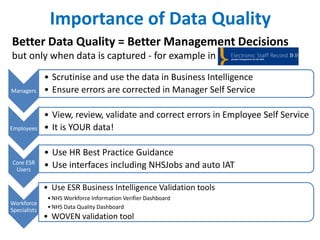
Importance of Data Quality
Better Data Quality = Better Management Decisions
but only when data is captured - for example in
Managers
• Scrutinise and use the data in Business Intelligence
• Ensure errors are corrected in Manager Self Service
Employees
• View, review, validate and correct errors in Employee Self Service
• It is YOUR data!
Core ESR
Users
• Use HR Best Practice Guidance
• Use interfaces including NHSJobs and auto IAT
Workforce
Specialists
• Use ESR Business Intelligence Validation tools
•NHS Workforce Information Verifier Dashboard
•NHS Data Quality Dashboard
• WOVEN validation tool
HSCIC corporate data quality role
• A new strategy for the delivery of the HSCIC’s corporate
responsibility for data quality across all health and social care
information (as set out in the HaSC Act 2012) is nearing completion.
• An element of that strategy will be an expert reference group, on
which the workforce information community will have
representation.
• Therefore workforce information is very much part of the remit of
this strategy and the additional scrutiny / resources it may bring.
• Anyone who is interested can look at previous corporate DQ reports
on our website for information, though the new work is likely to take
a slightly different direction.
• The corporate DQ section of HSCIC website:
http://www.hscic.gov.uk/dq
Objectives of the day
• The Objectives today are therefore to:
– provide a platform to encourage collaborative
working;
– to highlight the tools and guidance available;
– to promote the importance of data quality and
consistent data standards;
– to communicate important developments; and
– to learn from your experiences and expertise
Recent and future
developments in
Data Quality and
Data Standards
Kieron Walsh
ESR NHS Development Team
kieron.walsh@nhs.net
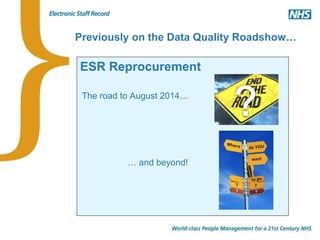
Previously on the Data Quality Roadshow…
The road to August 2014…
… and beyond!
ESR Reprocurement
ESR Reprocurement and beyond…
How did we get here?
• December 2013 Tender Notice in Official Journal
of the European Union (OJEU) to supply ESR
• December 2014 DH award contract to IBM
• Initial contract term 5 years:
o Initial term 2015 to 2020
o Extension Term 2 years 2020 to 2022
• June 2015 IBM take full responsibility for delivery
of the ESR Service
ESR Reprocurement and beyond…
Where are we now?
• Transition
Seamless transfer of service provision:
McKesson >>> IBM
• Enhance
16 Work Packages agreed
1st 3 WP’s include: Portal for OLM & SS,
Streamlined task-driven forms, Mobile access
• Operate (aka Service Delivery)
Continue to run and develop ESR in line with legal
and NHS requirements, including user-driven
changes
ESR Reprocurement and beyond…
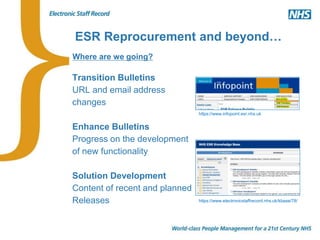
Transition Bulletins
URL and email address
changes
Enhance Bulletins
Progress on the development
of new functionality
Solution Development
Content of recent and planned
Releases
https://www.infopoint.esr.nhs.uk
Where are we going?
https://www.electronicstaffrecord.nhs.uk/kbase/78/
ESR Reprocurement and beyond…
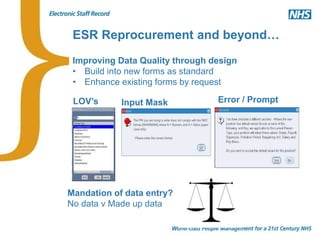
Improving Data Quality through design
• Build into new forms as standard
• Enhance existing forms by request
LOV’s Input Mask Error / Prompt
Mandation of data entry?
No data v Made up data
Improving ESR Data Quality
Under-utilised ESR functionality:
• Establishment Control
o Establishment WTE v Staff in Post WTE
o Effective control of the recruitment process and
planned v actual staffing levels
 Check Estab WTE values!
 ESR-NHS0058 ESR Finance User Guide
 Case Study: Royal Liverpool and Broadgreen
University Hospitals NHS Trust
• Vacancies
o Control over recruitment (process and reports)
o ESR Vacancies >>> NHS Jobs Adverts
o NHS Jobs Applicants >>> ESR
 Housekeeping: Close down vacancies!
Improving ESR Data Quality
Streamlining ESR processes in HR and Recruitment:
Webinar sessions (Sep-Nov ‘15):
o Using ESR with recruitment campaigns
o Standard references via IAT
o Occupational Health and ESR
o Transferring ‘stat & mand’ competencies via IAT
o Employment checklist including DBS
o Hiring applicants to substantive role who already have a
Bank (or other) assignment
o Recruitment housekeeping
o New starter process
o Employee Relations module overview
o OLM – Self Enrolment on classroom courses
Further details and booking via ESR website
https://www.electronicstaffrecord.nhs.uk/fileadmin/documents/Events_News/Streamlining_HR___Recruitment_-_ESR_Webinars_Sept15.pdf
Functional Advisors
o New team to assist uptake of functionality
https://www.electronicstaffrecord.nhs.uk/
esr-benefits/benefits-calculator/
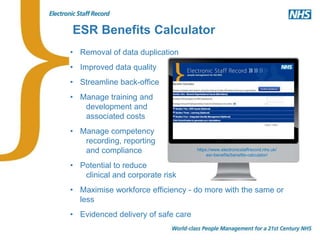
• Removal of data duplication
• Improved data quality
• Streamline back-office
• Manage training and
development and
associated costs
• Manage competency
recording, reporting
and compliance
• Potential to reduce
clinical and corporate risk
• Maximise workforce efficiency - do more with the same or
less
• Evidenced delivery of safe care
ESR Benefits Calculator
Questions?
10:45 Recent and future developments in data quality and data standards
(Kieron Walsh / Nick Armitage);
NHS Jobs data quality:
• First ever provisional experimental NHS Vacancy Statistics report, based
upon administrative data extracted from NHS Jobs was published 18th August
• Based on Job Adverts, not Vacancies directly – saves a burdensome direct
data collection, but…
• The statistics are exploratory and provide information on the administrative
data available from NHS Jobs as much as on the recruitment of staff.
• This publication provides figures which are an insight to recruitment in the
NHS but which should be treated with caution, and users have been
discouraged from attempting to draw any conclusions from this data at this
time.
• The publication high-lights a range of DQ issues including:
– Completeness of Occ Code;
– Apparent contradiction between fields;
– Difficulties of producing ‘rates’ and considering long-term or hard to fill vancancies
NHS Jobs data quality:
• One of the main functions of this publication is to ask users to respond to the
figures published, and the information about the available data, with their own
views on what should be published and whether the tables provided are
potentially useful.
• Additionally, feedback is particularly welcome from users regarding their own
practical experience of recruitment in the NHS (including other potential sources
of information to supplement NHS Jobs) and we will use this information to
refine and focus further statistics.
• The publication includes a ‘consultation’ regarding the development of
Healthcare Recruitment Statistics and responses are welcomed by 20th
November
• This afternoon there is a session which will look in more detail at this
development, and remember;
– Vacancies information is part of the wMDS;
– Information on vacancies exists in ESR (and elsewhere) but in need of work…
21
22
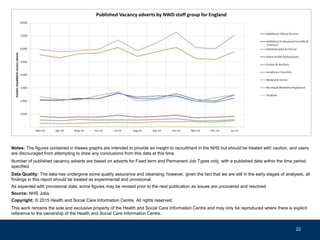
Notes: The figures contained in theses graphs are intended to provide an insight to recruitment in the NHS but should be treated with caution, and users
are discouraged from attempting to draw any conclusions from this data at this time.
Number of published vacancy adverts are based on adverts for Fixed term and Permanent Job Types only, with a published date within the time period
specified.
Data Quality: The data has undergone some quality assurance and cleansing, however, given the fact that we are still in the early stages of analyses, all
findings in this report should be treated as experimental and provisional.
As expected with provisional data, some figures may be revised prior to the next publication as issues are uncovered and resolved.
Source: NHS Jobs.
Copyright: © 2015 Health and Social Care Information Centre. All rights reserved.
This work remains the sole and exclusive property of the Health and Social Care Information Centre and may only be reproduced where there is explicit
reference to the ownership of the Health and Social Care Information Centre.
NWD2.8 and NHS Occupation Codes Version 14 – proposed changes
• NWD2.8 currently seeking Standardisation Committee for Care Information (SCCI)
approval for a number of changes:
– Additional Job Roles, Occupation Codes and Nationalities;
– Amended Job Roles and Occupation Codes;
– Removal of Job roles and Occupation Codes
• At same time ESR are to introduce a new Position Workplace Organisation code of
‘GenGP’ for staff working in General Practice, especially for lead employers to use in
ESR for trainee GPs
• Once approved Information Standards Notice to be published November / December
• Hope to be live in ESR at the end of December – more communications / guidance
updates soon
• Future proposals being developed for:
– Ambulance staff;
– Public Health (including HCS updates and Bioinformatics);
– Psychological Therapies Workforce / IAPT (other adult and child elements of mental health
workforce?)
• On the horizon – Nurses? Modernising AHPs? Support Staff and Nursing Assistants?
23
10:45 Recent and future developments – the workforce Minimum Data Set (wMDS)
• Workforce Information Architecture recommendations published on DH website here and
guidance documentation on the workforce Minimum Data Set (wMDS) will continue to be
regularly updated on the HSCIC website here
• First data (as at 31st March 2015) based on the wMDS published on the 2nd of September.
• Included separate information for Independent Sector Healthcare Providers and much more
detail for GPs and Practice staff.
• There will be no Census collection for 2015 – launching the September 30th 2015 wMDS
collection today in its place
• DQ implications for organisations using ESR; for Chesterfield and Moorfields Foundation Trusts;
for General Practice and for Independent Sector Healthcare Providers…
• wMDS – expansion of fields of interest, DQ related to Primary care / GP staff on ESR and how
to code GPs/Registrars etc. correctly
• GPs - use code 921, use 921 for GP Registrars on placements in GP Practices and differentiate
trainees with Payscale, use Position Workplace Organisation code of Gen05 (Other) then
GenGP when available
24
• Add screen shot of wMDS web page
wMDS – expansion of fields of interest, DQ related to Primary care / GP staff
on ESR and how to code GPs/Registrars etc. correctly (NA)
• Data quality will be a focus – for ESR and beyond, the wMDS its capture and promulgation will be a
developing process for years to come for all sectors but particularly for new elements not previously
covered by the census
• Already the development of the wMDS is highlighting lots of issues to feedback into the data
standards and guidance – for example updating the definitional information within the NWD
• Shining a light on the elements of the data standards which have not been focused upon at a national
level previously – likely to link to future DQ push as issues are discovered
• WOVEN tests to be refined to meet the needs of wMDS extract from ESR – also ESR BI data quality
reporting
• Implementation of wMDS is leading to requests for new values to ensure the NWD is fit for the new
areas it is to cover (e.g. Primary Care, Independent Sector),
• Increasing the scope of the Workforce Information Review Group (WIRG) to cover more sectors
• How to handle DQ initiatives outside of ESR – validation elements of wMDS Collection Vehicle,
Primary Care Web Tool, other focused tests?
• Other sectors also need workforce information – a Public Health Minimum Data Set on the horizon, a
subset of the wMDS and beyond?
Hospital and Community Health Service Workforce Consultation
• The response from the HSCIC to the consultation is still very much a work in progress – lots of useful
responses received to the consultation and now deciding how best to act upon them
• Some emerging headlines are that there are a lot of references to workforce data quality in the responses
– a key theme being that it is crucial to get the data quality issues resolved at source rather than trying to
accommodate them within subsequent data processing
• A mixture of relatively straight forward data quality issues, e.g. Chief Execs with Z codes or Chairpersons
with G codes, and grade mismatches.
• With more complex issues – for example, although use of Job Role and AoW are wanted by many
responders, some, particularly trusts, question its accuracy and usefulness.
• There will be an initial set of suggestions for change derived from the consultation which will be shared in
October. This will be open to comment for 2 weeks and then a final set will be issued.
• Anyone who wants to see the initial set should contact Bernard Horan Bernard.horan@hscic.gov.uk and
ask to be added to the mailing list.
• The response below from the National Audit Office has some pertinent observations:
– As the HSCIC’s data show, there are some 1.2 million Hospital and Community Health Service staff, accounting for
around two-thirds of providers’ expenditure. Given the scale of the workforce, we would expect providers,
commissioners, regulators and other national bodies involved in oversight of health services and workforce planning
to have adequate data to support their role, and a good flow of data around the health system in order to exploit the
possible insights…….More generally, we have previously highlighted that there is often a lack of common data
definitions across health and social care, and we are concerned that the importance of data quality is not
communicated effectively to frontline staff: often little or no information is given about why data is collected, how it
will be used, or the impact of poor data quality.
27
HCS and Informatics re-coding feedback.
• At the last Roadshows we provided a considerable focus on the Healthcare Science
recoding and the drive to use the new Areas of Work for Informatics staff
• What have been the lessons learnt? What feedback have we received?
• Positives of involving the clinical / service managers – need to provide clear and timely
communications and guidance
• Timing is importance – clash with Equivalence process and confusion caused
• To be unambiguous and to take on-board issues that are high-lighted – Pan-Pathology.
• In general, for HCS changes the Occupation Code changes have been made and look
consistent, though issues remain – especially for staff with BMS / CS registration.
• Job Role and Area of Work need to be looked at further
• Still getting feedback from Trusts about validations of Job Roles versus Occ Codes etc.
28
Feedback on
Healthcare Science
re-coding to ‘U’
Matrix.
Prepared by Stuart
Jones of the NHS
ESR Central Team
30
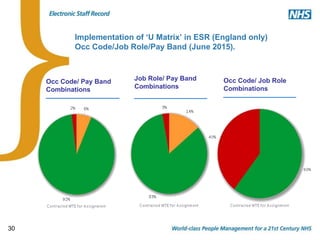
Implementation of ‘U Matrix’ in ESR (England only)
Occ Code/Job Role/Pay Band (June 2015).
Occ Code/ Pay Band
Combinations
Job Role/ Pay Band
Combinations
Occ Code/ Job Role
Combinations
31
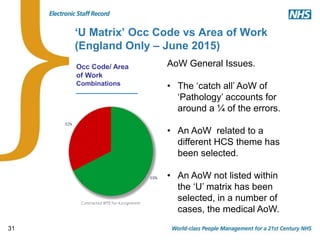
‘U Matrix’ Occ Code vs Area of Work
(England Only – June 2015)
Occ Code/ Area
of Work
Combinations
AoW General Issues.
• The ‘catch all’ AoW of
‘Pathology’ accounts for
around a ¼ of the errors.
• An AoW related to a
different HCS theme has
been selected.
• An AoW not listed within
the ‘U’ matrix has been
selected, in a number of
cases, the medical AoW.
Healthcare Science – the Hidden
Workforce
Lessons Learned
• Use the Healthcare Science data
standard guidance
• Engage with Lead Healthcare Science
specialists in each Trust to led the
audit, review and verification of the
HCS staff in post data.
• In partnership with the Workforce
Information Teams implement the
finalised changes in ESR
• Ensure standardisation by asking
questions for clarification
• Use the Business Intelligence
Workforce Information Verifier
Dashboard to monitor progress
Benefits
When applied correctly in ESR, the new
values will:
 Enable all stakeholders to understand the
size and structure of the Healthcare
Science workforce (40+ specialisms)
 Enable greater accuracy in workforce
planning at local, regional and national
levels.
Healthcare Science workforce data is available
locally in ESRBI, regionally in ESR Data
Warehouse BI and nationally in NHS iView.
The healthcare science (HCS) workforce forms approximately 5% of the workforce, yet their
work provides input to around 80% of all diagnostic decisions.
Based on the Modernising Scientific Careers (MSC) terminology, the HSCIC published new
data standard guidance includes Occupation Codes, Staff Group, Job Roles and Area of
Work coupled with an Indicative Job Title guidance.
In Wales 100% of Occupation Codes have changes to ‘U’ Matrix, 99% of Job Roles and
98% of Area of Work.
Health Informatics Area of Work
Reclassification
• Health informatics is one of the fastest growing areas in the health sector, and plays a vital role
in supporting clinicians to provide healthcare to patients.
• Health Informatics Area of Work guidance including Indicative Job Titles is available on the
HSCIC website.
• Lessons Learned
– Use the Health Informatics data standard guidance
– Engage with Lead Health Informatics specialist in each Trust to led the review and
verification of the HI data and in partnership with the Workforce Information Teams
implement the changes in ESR
• When applied correctly, the new Health Informatics Area of Work values will enable workforce
planners, HR teams, directors and clinical managers to better understand and manage the
Health Informatics workforce. Health Informatics area of work data is available locally in ESRBI,
England level in ESR Data Warehouse BI and nationally in NHS iView.
11:30 Data quality tools and guidance: WOVEN Background
• The Workforce Validation Engine (WOVEN) reports are now a familiar feature of the NHS workforce
landscape.
• Still many organisations not choosing to open / action their reports despite attempts to increase
participation.
• A number of organisations use their WOVEN scores and rankings as part of their Board reporting
process on a monthly basis.
• Used regionally as part of workforce DQ efforts – e.g. North West, Yorks and Humber, East Mids etc.
• Highlights data inconsistencies and provides detail for correction directly in ESR
• Reduced the need for burdensome DQ efforts associated with the HSCIC data collections and improves
the utility of the data at a local and regional level
• The concept is just as relevant to the wMDS as it was to the census - additional DQ efforts more
focused – e.g. issues with position workplace organisation, issues with unusual assignment status
information
• Ability to override genuine inconsistencies and focus on issues
11:30 Data quality tools and guidance:
• WOVEN should be seen as an additional prompt to action (as
are other DQ exercises…)
• The key is to make use of the guidance available and the
importance of organisations taking responsibility before the
reports are sent to them
• A growing library of data standards and data quality guidance is
available on the HSCIC website and we encourage feedback
• If you have a particular WOVEN DQ or Data Standards issue,
please contact the team – we’re here to help!
• HSCIC battles with our own DQ, what has been done, what will
be done and a better understanding of the challenges you face –
especially of transition from one organisation to another…
35
WOVEN hints and tips
• The key is to ensure that practices and processes are in place to capture the
information at source and input the data in an accurate and timely fashion
• Work with clinical / functional teams
• Share best practice across teams – Recruitment, HR, Payroll and Finance and
beyond!
• Make use of recently updated guidance materials and tools available
• Acting on your ESRBI DQ reports will help to improve WOVEN scores
• ESR Self Service / Manager Self Service should help
• Some means by which people can maximise the impact of their efforts:
– How to best handle large numbers of errors – ESR mass update facility?
– Deal with inconstancies against the lowest record count first to have the biggest impact
on your overall score
– Quick-wins e.g. equality if you have asked the questions and staff have not responded
after a sensible length of time, then it is appropriate to complete the field as ‘not stated’.
WOVEN The Future
• Focus on Items of national importance in WOVEN – for strategic /
workforce planning purposes
• HCS implementation and the workforce Minimum Data Set (wMDS) are
likely to influence further WOVEN developments, with possible
suggestions:
– Providing a means of testing use of new occupation codes / JR and
AoW values and their combinations for the correct identification of HCS
roles
– Informatics Area of Work checking (to avoid use of catch-all
‘Informatics’ value rather than detailed values)
– Considering fields or combinations of fields which have not been
heavily validated previously but which are essential for the wMDS
• ESR Business Intelligence DQ reports (and collection mechanisms for
the wMDS) are likely to lead to refocusing of WOVEN DQ reports away
from ‘validity’ and towards ‘accuracy’
WOVEN The Future – what next?
• The updated WoVEn reports finally went live for the August run, including the restrictive date change (to
01/04/2013) and the formalisation of the new LETB summary level.
• Clear guidance regarding the Restrictive Date change has been circulated to users.
• All other proposed changes previously discussed are currently on hold, pending… Drumroll… Trumpet
Fanfare… the proposal to fully redevelop the system and make it fit for purpose with support from a
technical team within the HSCIC which will make future updates by the team much more flexible!
• The redevelopment is due to begin in November 2015, with exploratory sessions with the technical team
due to start in October.
• In future WOVEN more easily configurable by HSCIC workforce team – more targeted DQ,
testing implementation of data standards updates
• This is the first stage in gaining input to the proposed updates from the WOVEN user community so that
we can develop a proposal to take WIRG and the ESR HR SIG before we can make the changes
• We will be in touch shortly for your feedback 3 particular elements of the development:
– Existing WoVEn validations – any changes required, any tests to be dropped?
– Minimum changes which have already been agreed by the HR SIG – are these proposals still valid?
– Suggested additional changes for consideration – any additions, changes, comments (including Priority)?
38
ESR
Reporting, Tools,
and Guidance.
Stuart Jones
NHS ESR Central
Team
40
ESR Reporting, Tools, and Guidance.
• ESR NHS0078 - ESR HR Best
Practice Guide.
• ESR Business Intelligence (BI).
41
ESR NHS0078 - HR Best Practice Guide.
• Available via Kbase.
• Advises users on how to best utilise ESR functionality.
• Reviewed and revised after each major ESR release.
• It is an aid to understanding the flow of processes and
system interaction to drive the most effective and
efficient use of ESR.
• Underpinning ESR best practice is an understanding
of the data requirements and when, where, and how
they should be populated within ESR.
42
ESR NHS0078
- HR Best Practice Guide
• The guide covers:
– Establishment Control via Workstructures.
– Recruitment processes, including use of 3rd party e-
recruitment systems.
– Inter Authority Transfer (IAT) process and
Occupational Health Details.
– New Starters
– Changes to Person and Assignment records.
– Terminations.
– Re-hires.
– Reporting that supports each process.
– Data Standards.
– Interfaces that can be used to enhance the core ESR
functionality and streamline business processes.
43
ESR NHS0078
- HR Best Practice Guide
• One key aspect of ESR is the ability to report on
a wide range of workforce information, at a local,
regional, and national level.
• This reporting will be more straightforward and
useful, if, by following best practice, the data
quality of the information can be relied upon.
44
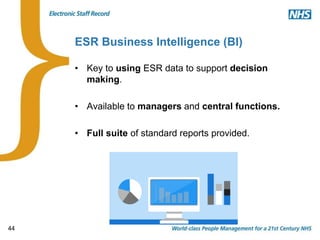
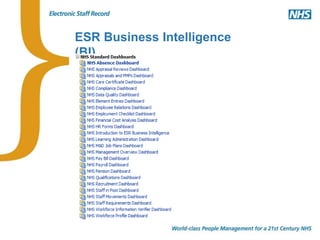
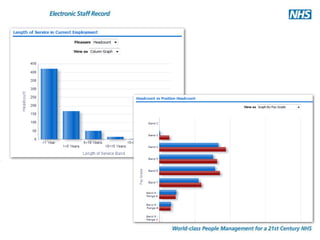
ESR Business Intelligence (BI)
• Key to using ESR data to support decision
making.
• Available to managers and central functions.
• Full suite of standard reports provided.
45
ESR Business Intelligence (BI)
• Documentation / Captivates.
• ESR-NHS0151 Guide to ESR BI Dashboards.
(available on Kbase)
ESR Business Intelligence
(BI)
• Insight into employee workforce structure,
numbers, performance, and compliance.
• Managers and Employees have the access to
view reports.
• Very much reliant on processes being in place to
capture accurate data and requirements.
ESR Business Intelligence
(BI)
Compliance
• Recorded in ESR as ‘Competencies’.
• Requirements set centrally.
• Managers and Employees see status on learner
homepage.
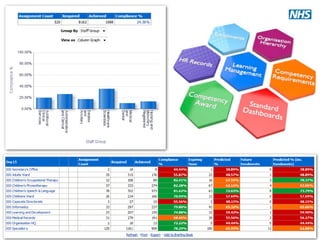
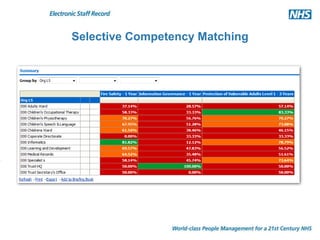
• Compliance Dashboard provides:
– Matching
– Selective Matching
– Expiration Prediction
Selective Competency Matching
53
ESR Business Intelligence (BI)
Data Quality Dashboard.
• Dashboard released in June 2013.
• The majority of the tests mirror and support the
HSCIC WOVEN checks, but there are a number of
additional measures.
• These additional tests within the Dashboard are
designed to assess key data quality tests agreed by
NSIG chairs.
• It has been designed to provide the user with a
summary of all available tests, followed by six data
quality areas under which, a detailed analysis of each
test falls.
54
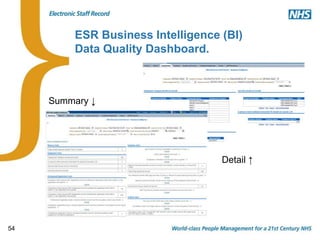
ESR Business Intelligence (BI)
Data Quality Dashboard.
Summary ↓
Detail ↑
55
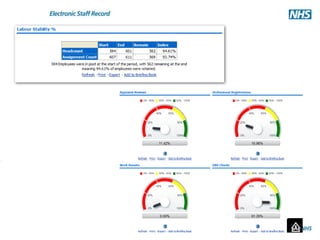
Workforce Information Verifier
Dashboard
• References guidance from HSCIC – NWD &
Occupation Code Manual.
• Describes a Position data set by:
Occ Code/Pay Band
Job Role / Pay Band
Occ Code/Job Role
Occ Code vs Area Of Work (Healthcare Scientists
‘U’ Matrix Only)
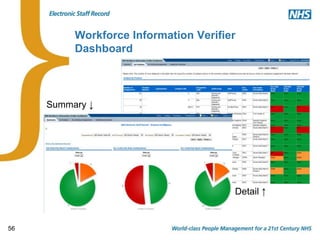
• Compares these against Assignments/ Positions,
giving a Red/Amber/Green rating.
• Reports at both summary and detailed level.
56
Workforce Information Verifier
Dashboard
Summary ↓
Detail ↑
Further Information
• ESR Website : http://www.esr.nhs.uk
– ESR Account Manager
– ESR Transition & Enhance
• Kbase: http://www.esr.nhs.uk/kbase
– Guide to National Dashboards
– Captivates
Questions
58
ESR Reporting, Tools, and Guidance.
12:30 Lunch
• Enjoy your lunch and the chance to chat to friends and
colleagues.
• All special dietary requirements have been passed on to
the venue.
• Lots still to discuss – aim to restart at 13:00 prompt.
59
The importance of good
Data Quality, how
workforce data is put to
use by regional and
national bodies and the
implications of poor data
quality for you
Kieron Walsh
ESR NHS Development Team
kieron.walsh@nhs.net
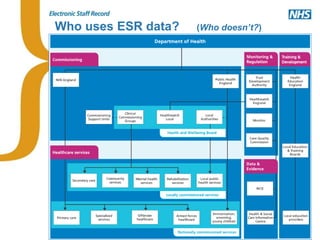
Who uses ESR data? (Who doesn’t?)
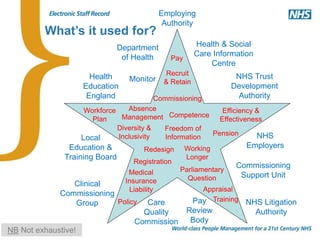
NHS Litigation
Authority
Monitor NHS Trust
Development
Authority
Health
Education
England
Local
Education &
Training Board
Employing
Authority
Department
of Health
NHS
Employers
Pay
Review
Body
Medical
Insurance
Liability
Workforce
Plan
Diversity &
Inclusivity
Efficiency &
Effectiveness
Parliamentary
Question
Freedom of
Information
Absence
Management
Pay
Working
Longer
Redesign
Training
Registration
Recruit
& Retain
Competence
Care
Quality
Commission
Health & Social
Care Information
Centre
NB Not exhaustive!
Clinical
Commissioning
Group
Commissioning
Support Unit
Pension
Policy
Commissioning
What’s it used for?
Appraisal
Widely used data items
“All data items are equal, but some data items are more
equal than others.” Apologies to George Orwell
Position data
• Pay Grade
• Occupation Code
• Staff Group/Job Role
• Area of Work
Person/Assignment data
• Protected characteristics
• Contracted WTE
• Headcount (NHS Unique ID)
 All the data is collected for a purpose!
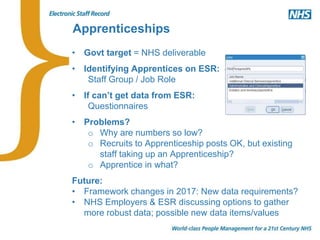
Apprenticeships
• Govt target = NHS deliverable
• Identifying Apprentices on ESR:
Staff Group / Job Role
• If can’t get data from ESR:
Questionnaires
• Problems?
o Why are numbers so low?
o Recruits to Apprenticeship posts OK, but existing
staff taking up an Apprenticeship?
o Apprentice in what?
Future:
• Framework changes in 2017: New data requirements?
• NHS Employers & ESR discussing options to gather
more robust data; possible new data items/values
Sickness Absence (1)
Poor data impacts on:
• Local and wider workforce resourcing and planning
• Failure to identify and take action on Sickness Reasons
Close down Sickness records!
• Examples of ‘open’ absences lasting years!
• Use BI Reports to identify ‘Long Term’ Sickness:
o Address genuine cases as per local procedures
(Refer to OH, Assess Employment, 1/2 or No-pay)
o Close any left ‘open’ in error
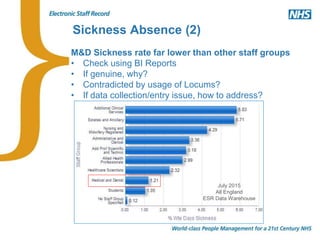
Sickness Absence (2)
M&D Sickness rate far lower than other staff groups
• Check using BI Reports
• If genuine, why?
• Contradicted by usage of Locums?
• If data collection/entry issue, how to address?
July 2015
All England
ESR Data Warehouse
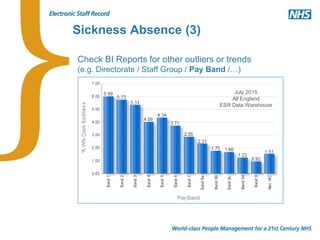
Sickness Absence (3)
Check BI Reports for other outliers or trends
(e.g. Directorate / Staff Group / Pay Band /…)
July 2015
All England
ESR Data Warehouse
Equality & Diversity (Diversity & Inclusion)
• Data needed for:
o Public Sector Equality Duty
o Workforce Race Equality Standard (WRES)
o Working Longer
• NHS England ‘position paper’ >>> Data Standard
o Sets out data items and values in use within NHS
(patients and workforce) http://www.england.nhs.uk/ourwork/gov/equality-hub/intelligence/
o Consider impact on service (cost, training), and
demands on system suppliers (cost, timing)
o Data Standard >>> Changes to ESR
o Inclusion of Transgender? (tbd)
 Check for ‘old’ (numeric) Ethnic Group values
o Obsolete since 2001
o Amend via Employee Self Service or HR Core Form
o Do not ‘map’, individual must select current value
 National Workforce Dataset v2.8: Nationality LOV’s
ESR Interfaces enable transfer of data
from other systems
ESR Interfaces with GMC, NMC, Deanery, NHS Jobs,
T&A, General Ledger, etc..,
• Saves time and effort on data entry
• Data is transferred accurately
Relies on identifying the individual and/or the position
so initial data entry is crucial.
ESR / GMC Interface:
• Must match on GMC No and Name
• Correct match will then maintain ESR using data from
GMC Register
• No match = No update (Prof Reg report will flag up)
• ESR must hold person’s legal name, GMC may hold a
‘professional’ name
• Once the ‘link’ is established remove any previous
manually entered rows with overlapping dates
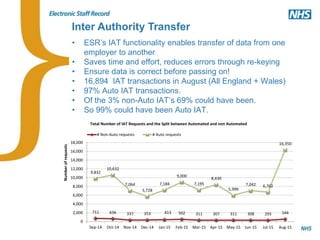
• ESR’s IAT functionality enables transfer of data from one
employer to another
• Saves time and effort, reduces errors through re-keying
• Ensure data is correct before passing on!
• 16,894 IAT transactions in August (All England + Wales)
• 97% Auto IAT transactions.
• Of the 3% non-Auto IAT’s 69% could have been.
• So 99% could have been Auto IAT.
711 636 337 353 413 502 311 307 311 308 293 544
9,832
10,632
7,064
5,728
7,184
9,000
7,195
8,439
5,996
7,042 6,702
16,350
0
2,000
4,000
6,000
8,000
10,000
12,000
14,000
16,000
18,000
Sep-14 Oct-14 Nov-14 Dec-14 Jan-15 Feb-15 Mar-15 Apr-15 May-15 Jun-15 Jul-15 Aug-15
Numberofrequests
Total Number of IAT Requests and the Split between Automated and non Automated
# Non-Auto requests # Auto requests
Inter Authority Transfer
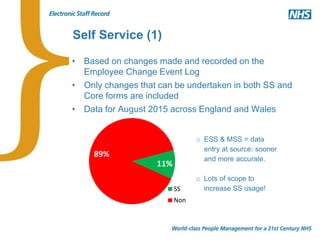
Self Service (1)
• Based on changes made and recorded on the
Employee Change Event Log
• Only changes that can be undertaken in both SS and
Core forms are included
• Data for August 2015 across England and Wales
11%
89%
SS
Non
o ESS & MSS = data
entry at source: sooner
and more accurate.
o Lots of scope to
increase SS usage!
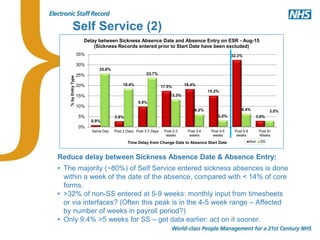
Reduce delay between Sickness Absence Date & Absence Entry:
• The majority (~80%) of Self Service entered sickness absences is done
within a week of the date of the absence, compared with < 14% of core
forms.
• >32% of non-SS entered at 5-9 weeks: monthly input from timesheets
or via interfaces? (Often this peak is in the 4-5 week range – Affected
by number of weeks in payroll period?)
• Only 9.4% >5 weeks for SS – get data earlier: act on it sooner.
Self Service (2)
0.9%
2.8%
9.9%
17.5% 18.4%
15.2%
32.3%
3.0%
25.8%
18.4%
23.7%
13.3%
6.2%
3.2%
6.4% 3.0%
0%
5%
10%
15%
20%
25%
30%
35%
Same Day Post 2 Days Post 3-7 Days Post 2-3
weeks
Post 3-4
weeks
Post 4-5
weeks
Post 5-9
weeks
Post 9>
Weeks
%byEntryType
Time Delay from Change Date to Absence Start Date
Delay between Sickness Absence Date and Absence Entry on ESR - Aug-15
(Sickness Records entered prior to Start Date have been excluded)
Non SS
ESR BI Reports
Whole range of reports are available
• Use BI compliance reports (Prof Reg, Competence,
etc..) to look for gaps in data as well as expired entries
• Use BI Data Quality report mirroring WoVEn
o Check >> fix >> re-check
o Own timescale & frequency
• Other BI reports (staff in post analyses, lists, etc..)
o Odd values
o Odd combinations (Occ Code v Staff Group/Job
Role)
Further information on ESR
• User Manual
• Kbase
• Development Schedule
• User Notices
• ESR News
• Reporting Guides
• Case Studies
• HR Best Practice
All available via ESR website:
http://www.electronicstaffrecord.nhs.uk
Questions?
The importance of good data quality, how workforce data is put to use - Nick
Armitage
• Workforce planning and education
commissioning
• A key use of the data – drives so much of the work for both
Staff in Post information and future forecasts
• Crucial that the information is correct or issues with over /
under supply will be inevitable
• Issues with HCS workforce forecast template – getting the
data right…
• Policy planning & monitoring, etc…
• Not just PQs, Targets and FoIs
• How to understand how healthcare can be modernised – a
key element of the evaluation of the Vanguards?
76
The importance of good data quality, how workforce data is put to use - Nick
Armitage
• Further examples of data (not necessarily DQ issues in
themselves) issues.
• Who’s staff group is it anyway?
– Differences between:
 HEE workforce plans
 NWD/ESR Staff Group
 Staff Groups in HSCIC publications
– There are differences – need to understand and explain
why the differences exist
– The outcome of the HCHS consultation will have an impact
– But good data capture and coding allows different splits…
• Difficult questions – e.g. Acute Nursing versus Community –
how to identify?
• Different models of care, integrated health and social care…
77
14:10 NHS Jobs data quality / Healthcare recruitment information development
(Nick Armitage);
• The need for recruitment / vacancy information is not going away:
– workforce planning,
– pay review bodies,
– shortage occupations,
– safe staffing,
– public accountability etc. etc.
• Building on the Vacancy Statistics publication we have already made we would
ideally like to publish a lot more:
– Finer detail of roles and occupations,
– Hard to fill vacancies
– Vacancy rates etc.
• But there is no totally comprehensive data source which provides a full and
accurate picture - different sources (NHS Jobs, ESR, BMJ etc. – survey!?!?!)
• Need to get DQ right here for recruitment information and to remember it also
feeds issues down the line…
78
14:10 NHS Jobs data quality / Healthcare recruitment information development
(Nick Armitage);
• Early days for DQ in NHS Jobs – not like ESR!
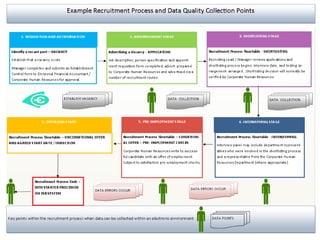
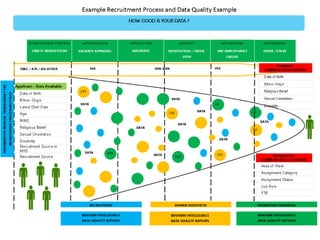
• DQ and the new NHS Vacancy Statistics development / consultation,
data quality in NHS Jobs and the starting point of a lot of DQ issues,
which cross into ESR – e.g. Equalities information - (See Michelle’s
high-level summary. every stage potential for data not to be captured or
entered correctly, ripples down the system and feeds ESR – links back
to individual responsibility in DQ
• Close down Vacancies on ESR, Establishment FTE value – found one that
is actually an Employee Number.
– Important to make it clear that ESR is the key data source – other systems
/ processes feed ESR and ESR is used to make decisions etc.
– It is everyone’s responsibility to ensure data is on ESR – not just for
vacancies, links to other sections
79
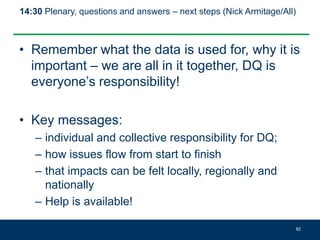
14:30 Plenary, questions and answers – next steps (Nick Armitage/All)
• Remember what the data is used for, why it is
important – we are all in it together, DQ is
everyone’s responsibility!
• Key messages:
– individual and collective responsibility for DQ;
– how issues flow from start to finish
– that impacts can be felt locally, regionally and
nationally
– Help is available!
82
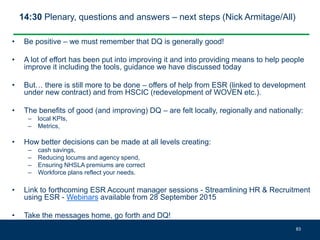
14:30 Plenary, questions and answers – next steps (Nick Armitage/All)
• Be positive – we must remember that DQ is generally good!
• A lot of effort has been put into improving it and into providing means to help people
improve it including the tools, guidance we have discussed today
• But… there is still more to be done – offers of help from ESR (linked to development
under new contract) and from HSCIC (redevelopment of WOVEN etc.).
• The benefits of good (and improving) DQ – are felt locally, regionally and nationally:
– local KPIs,
– Metrics,
• How better decisions can be made at all levels creating:
– cash savings,
– Reducing locums and agency spend,
– Ensuring NHSLA premiums are correct
– Workforce plans reflect your needs.
• Link to forthcoming ESR Account manager sessions - Streamlining HR & Recruitment
using ESR - Webinars available from 28 September 2015
• Take the messages home, go forth and DQ!
83
14:30 Plenary, questions and answers – next steps (Nick Armitage/All)
• Questions and Answers;
– Including those captured but not yet answered over the course
of the day
• Did we meet the objectives of the day?
– Please complete your feedback forms so we can learn from
the event
• Next Steps;
– Slides to be made available on HSCIC website
– Responses to any questions not answered today to be
included
• Thank you for your interest and your continued
involvement!
Changes to the workforce classifications for Healthcare Scientists and
how it will be handled in the NWD and ESR
Useful Links / Resources
• WOVEN Guidance / Override request form
• NHS Occupation Code Manual and sub-specialty
annex
• NWD Specification
• NWD Guidance documents, including Job Role &
Area of Work guidance, Informatics Guidance and
Healthcare Science Guidance
• DH WIA Report
• HSCIC wMDS Guidance
• The HSCIC Corporate DQ role – 3rd annual report
as published in October 2014
• The Health Education England (HEE) Mandate
• DH Priorities from their corporate plan
HSCIC/ESR Data Quality / Data Standards Road Shows 2015/16

HSCIC/ESR Data Quality / Data Standards Road Shows 2015/16

  • 1.
    HSCIC / ESRData Quality and Data Standards Roadshow The Royal Marsden Education and Conference Centre, Thursday 1st October 2015 presented by Nick Armitage, Kieron Walsh and Stuart Jones
  • 2.
    HSCIC/ESR Data Qualityand Data Standards Road Show • Thursday 1st October 2015 • The Royal Marsden Education and Conference Centre • Stewart’s Grove, London. SW3 6JJ.
  • 3.
    Housekeeping Arrangements • Pleasecan you all ensure that you have signed in and if not, please can you do so at some point in the day. Thank you! • Guest Wi-fi is available in the Conference Centre – Royal Marsden Guest, fill in your details and accept t&c’s. • There are currently no scheduled fire drills or works for today. • Smoking is not permitted within the Marsden grounds, however the Conference Centre entrance is situated directly onto Stewarts Grove which is not part of the trust. • Food and refreshments will be provided in the function rooms on the ground floor of the facility below the Julian Bloom lecture theatre on the 1st floor. • Feedback forms have been provided – please do fill them in, all comments welcomed to make future sessions as useful as possible! • Also, Post-it notes are available for questions… 3
  • 4.
    Today’s Agenda • 10:00Coffee and Networking • 10:30 Welcome, Introduction - the importance of data quality, objectives of the day (Nick Armitage); • 10:45 Recent and future developments in data quality and data standards (Kieron Walsh / Nick Armitage); • 11:30 Data quality tools and guidance: – WOVEN and HSCIC Guidance (Nick Armitage); – ESR Business Intelligence Reporting Tools and Guidance (Stuart Jones); • 12:30 Lunch and Networking • 13:00 The importance of good data quality, how workforce data is put to use by regional and national bodies and the implications of poor data quality for you (Kieron Walsh/Nick Armitage); • 14:10 NHS Jobs data quality / Healthcare recruitment information development (Nick Armitage); • 14:30 Plenary, questions and answers – next steps (Nick Armitage/All); • 15:00 Finish
  • 5.
    10:30 Welcome, Introduction- the importance of data quality, objectives of the day (Nick Armitage); • Why are we here? – The importance of Data Quality and consistent Data Standards – To consider how attendees could implement what is discussed in the meeting – What individuals can do themselves – How we all need to involve others and what we can do to help each other – DQ is part of everyone's responsibility - help is there, but opportunities must be acted upon and choices taken to maximise the rich data available. – To make ESR the one source of truth… – Part of the HSCIC corporate role for Data Quality
  • 6.
    11:30 Welcome, Introduction- the importance of data quality, objectives of the day (Nick Armitage); • Data quality is all about collaborative working with a shared purpose – hence getting you all here today. • Please speak to each other – the greatest data quality resource we have is you! • Any efforts should have mutual benefits and should provide a platform for discourse between all involved. • The purpose is to improve the data that is used at all stages, to inform decisions about the workforce at local, regional and national levels. • Good data quality can’t guarantee good decisions are made, but poor data quality will definitely increase the likelihood of poor decisions and poor outcomes. • We welcome your feedback to improve future events!
  • 7.
    Importance of DataQuality Better Data Quality = Better Management Decisions but only when data is captured - for example in Managers • Scrutinise and use the data in Business Intelligence • Ensure errors are corrected in Manager Self Service Employees • View, review, validate and correct errors in Employee Self Service • It is YOUR data! Core ESR Users • Use HR Best Practice Guidance • Use interfaces including NHSJobs and auto IAT Workforce Specialists • Use ESR Business Intelligence Validation tools •NHS Workforce Information Verifier Dashboard •NHS Data Quality Dashboard • WOVEN validation tool
  • 8.
    HSCIC corporate dataquality role • A new strategy for the delivery of the HSCIC’s corporate responsibility for data quality across all health and social care information (as set out in the HaSC Act 2012) is nearing completion. • An element of that strategy will be an expert reference group, on which the workforce information community will have representation. • Therefore workforce information is very much part of the remit of this strategy and the additional scrutiny / resources it may bring. • Anyone who is interested can look at previous corporate DQ reports on our website for information, though the new work is likely to take a slightly different direction. • The corporate DQ section of HSCIC website: http://www.hscic.gov.uk/dq
  • 9.
    Objectives of theday • The Objectives today are therefore to: – provide a platform to encourage collaborative working; – to highlight the tools and guidance available; – to promote the importance of data quality and consistent data standards; – to communicate important developments; and – to learn from your experiences and expertise
  • 10.
    Recent and future developmentsin Data Quality and Data Standards Kieron Walsh ESR NHS Development Team kieron.walsh@nhs.net
  • 11.
    Previously on theData Quality Roadshow… The road to August 2014… … and beyond! ESR Reprocurement
  • 12.
    ESR Reprocurement andbeyond… How did we get here? • December 2013 Tender Notice in Official Journal of the European Union (OJEU) to supply ESR • December 2014 DH award contract to IBM • Initial contract term 5 years: o Initial term 2015 to 2020 o Extension Term 2 years 2020 to 2022 • June 2015 IBM take full responsibility for delivery of the ESR Service
  • 13.
    ESR Reprocurement andbeyond… Where are we now? • Transition Seamless transfer of service provision: McKesson >>> IBM • Enhance 16 Work Packages agreed 1st 3 WP’s include: Portal for OLM & SS, Streamlined task-driven forms, Mobile access • Operate (aka Service Delivery) Continue to run and develop ESR in line with legal and NHS requirements, including user-driven changes
  • 14.
    ESR Reprocurement andbeyond… Transition Bulletins URL and email address changes Enhance Bulletins Progress on the development of new functionality Solution Development Content of recent and planned Releases https://www.infopoint.esr.nhs.uk Where are we going? https://www.electronicstaffrecord.nhs.uk/kbase/78/
  • 15.
    ESR Reprocurement andbeyond… Improving Data Quality through design • Build into new forms as standard • Enhance existing forms by request LOV’s Input Mask Error / Prompt Mandation of data entry? No data v Made up data
  • 16.
    Improving ESR DataQuality Under-utilised ESR functionality: • Establishment Control o Establishment WTE v Staff in Post WTE o Effective control of the recruitment process and planned v actual staffing levels  Check Estab WTE values!  ESR-NHS0058 ESR Finance User Guide  Case Study: Royal Liverpool and Broadgreen University Hospitals NHS Trust • Vacancies o Control over recruitment (process and reports) o ESR Vacancies >>> NHS Jobs Adverts o NHS Jobs Applicants >>> ESR  Housekeeping: Close down vacancies!
  • 17.
    Improving ESR DataQuality Streamlining ESR processes in HR and Recruitment: Webinar sessions (Sep-Nov ‘15): o Using ESR with recruitment campaigns o Standard references via IAT o Occupational Health and ESR o Transferring ‘stat & mand’ competencies via IAT o Employment checklist including DBS o Hiring applicants to substantive role who already have a Bank (or other) assignment o Recruitment housekeeping o New starter process o Employee Relations module overview o OLM – Self Enrolment on classroom courses Further details and booking via ESR website https://www.electronicstaffrecord.nhs.uk/fileadmin/documents/Events_News/Streamlining_HR___Recruitment_-_ESR_Webinars_Sept15.pdf Functional Advisors o New team to assist uptake of functionality
  • 18.
    https://www.electronicstaffrecord.nhs.uk/ esr-benefits/benefits-calculator/ • Removal ofdata duplication • Improved data quality • Streamline back-office • Manage training and development and associated costs • Manage competency recording, reporting and compliance • Potential to reduce clinical and corporate risk • Maximise workforce efficiency - do more with the same or less • Evidenced delivery of safe care ESR Benefits Calculator
  • 19.
  • 20.
    10:45 Recent andfuture developments in data quality and data standards (Kieron Walsh / Nick Armitage); NHS Jobs data quality: • First ever provisional experimental NHS Vacancy Statistics report, based upon administrative data extracted from NHS Jobs was published 18th August • Based on Job Adverts, not Vacancies directly – saves a burdensome direct data collection, but… • The statistics are exploratory and provide information on the administrative data available from NHS Jobs as much as on the recruitment of staff. • This publication provides figures which are an insight to recruitment in the NHS but which should be treated with caution, and users have been discouraged from attempting to draw any conclusions from this data at this time. • The publication high-lights a range of DQ issues including: – Completeness of Occ Code; – Apparent contradiction between fields; – Difficulties of producing ‘rates’ and considering long-term or hard to fill vancancies
  • 21.
    NHS Jobs dataquality: • One of the main functions of this publication is to ask users to respond to the figures published, and the information about the available data, with their own views on what should be published and whether the tables provided are potentially useful. • Additionally, feedback is particularly welcome from users regarding their own practical experience of recruitment in the NHS (including other potential sources of information to supplement NHS Jobs) and we will use this information to refine and focus further statistics. • The publication includes a ‘consultation’ regarding the development of Healthcare Recruitment Statistics and responses are welcomed by 20th November • This afternoon there is a session which will look in more detail at this development, and remember; – Vacancies information is part of the wMDS; – Information on vacancies exists in ESR (and elsewhere) but in need of work… 21
  • 22.
    22 Notes: The figurescontained in theses graphs are intended to provide an insight to recruitment in the NHS but should be treated with caution, and users are discouraged from attempting to draw any conclusions from this data at this time. Number of published vacancy adverts are based on adverts for Fixed term and Permanent Job Types only, with a published date within the time period specified. Data Quality: The data has undergone some quality assurance and cleansing, however, given the fact that we are still in the early stages of analyses, all findings in this report should be treated as experimental and provisional. As expected with provisional data, some figures may be revised prior to the next publication as issues are uncovered and resolved. Source: NHS Jobs. Copyright: © 2015 Health and Social Care Information Centre. All rights reserved. This work remains the sole and exclusive property of the Health and Social Care Information Centre and may only be reproduced where there is explicit reference to the ownership of the Health and Social Care Information Centre.
  • 23.
    NWD2.8 and NHSOccupation Codes Version 14 – proposed changes • NWD2.8 currently seeking Standardisation Committee for Care Information (SCCI) approval for a number of changes: – Additional Job Roles, Occupation Codes and Nationalities; – Amended Job Roles and Occupation Codes; – Removal of Job roles and Occupation Codes • At same time ESR are to introduce a new Position Workplace Organisation code of ‘GenGP’ for staff working in General Practice, especially for lead employers to use in ESR for trainee GPs • Once approved Information Standards Notice to be published November / December • Hope to be live in ESR at the end of December – more communications / guidance updates soon • Future proposals being developed for: – Ambulance staff; – Public Health (including HCS updates and Bioinformatics); – Psychological Therapies Workforce / IAPT (other adult and child elements of mental health workforce?) • On the horizon – Nurses? Modernising AHPs? Support Staff and Nursing Assistants? 23
  • 24.
    10:45 Recent andfuture developments – the workforce Minimum Data Set (wMDS) • Workforce Information Architecture recommendations published on DH website here and guidance documentation on the workforce Minimum Data Set (wMDS) will continue to be regularly updated on the HSCIC website here • First data (as at 31st March 2015) based on the wMDS published on the 2nd of September. • Included separate information for Independent Sector Healthcare Providers and much more detail for GPs and Practice staff. • There will be no Census collection for 2015 – launching the September 30th 2015 wMDS collection today in its place • DQ implications for organisations using ESR; for Chesterfield and Moorfields Foundation Trusts; for General Practice and for Independent Sector Healthcare Providers… • wMDS – expansion of fields of interest, DQ related to Primary care / GP staff on ESR and how to code GPs/Registrars etc. correctly • GPs - use code 921, use 921 for GP Registrars on placements in GP Practices and differentiate trainees with Payscale, use Position Workplace Organisation code of Gen05 (Other) then GenGP when available 24
  • 25.
    • Add screenshot of wMDS web page
  • 26.
    wMDS – expansionof fields of interest, DQ related to Primary care / GP staff on ESR and how to code GPs/Registrars etc. correctly (NA) • Data quality will be a focus – for ESR and beyond, the wMDS its capture and promulgation will be a developing process for years to come for all sectors but particularly for new elements not previously covered by the census • Already the development of the wMDS is highlighting lots of issues to feedback into the data standards and guidance – for example updating the definitional information within the NWD • Shining a light on the elements of the data standards which have not been focused upon at a national level previously – likely to link to future DQ push as issues are discovered • WOVEN tests to be refined to meet the needs of wMDS extract from ESR – also ESR BI data quality reporting • Implementation of wMDS is leading to requests for new values to ensure the NWD is fit for the new areas it is to cover (e.g. Primary Care, Independent Sector), • Increasing the scope of the Workforce Information Review Group (WIRG) to cover more sectors • How to handle DQ initiatives outside of ESR – validation elements of wMDS Collection Vehicle, Primary Care Web Tool, other focused tests? • Other sectors also need workforce information – a Public Health Minimum Data Set on the horizon, a subset of the wMDS and beyond?
  • 27.
    Hospital and CommunityHealth Service Workforce Consultation • The response from the HSCIC to the consultation is still very much a work in progress – lots of useful responses received to the consultation and now deciding how best to act upon them • Some emerging headlines are that there are a lot of references to workforce data quality in the responses – a key theme being that it is crucial to get the data quality issues resolved at source rather than trying to accommodate them within subsequent data processing • A mixture of relatively straight forward data quality issues, e.g. Chief Execs with Z codes or Chairpersons with G codes, and grade mismatches. • With more complex issues – for example, although use of Job Role and AoW are wanted by many responders, some, particularly trusts, question its accuracy and usefulness. • There will be an initial set of suggestions for change derived from the consultation which will be shared in October. This will be open to comment for 2 weeks and then a final set will be issued. • Anyone who wants to see the initial set should contact Bernard Horan Bernard.horan@hscic.gov.uk and ask to be added to the mailing list. • The response below from the National Audit Office has some pertinent observations: – As the HSCIC’s data show, there are some 1.2 million Hospital and Community Health Service staff, accounting for around two-thirds of providers’ expenditure. Given the scale of the workforce, we would expect providers, commissioners, regulators and other national bodies involved in oversight of health services and workforce planning to have adequate data to support their role, and a good flow of data around the health system in order to exploit the possible insights…….More generally, we have previously highlighted that there is often a lack of common data definitions across health and social care, and we are concerned that the importance of data quality is not communicated effectively to frontline staff: often little or no information is given about why data is collected, how it will be used, or the impact of poor data quality. 27
  • 28.
    HCS and Informaticsre-coding feedback. • At the last Roadshows we provided a considerable focus on the Healthcare Science recoding and the drive to use the new Areas of Work for Informatics staff • What have been the lessons learnt? What feedback have we received? • Positives of involving the clinical / service managers – need to provide clear and timely communications and guidance • Timing is importance – clash with Equivalence process and confusion caused • To be unambiguous and to take on-board issues that are high-lighted – Pan-Pathology. • In general, for HCS changes the Occupation Code changes have been made and look consistent, though issues remain – especially for staff with BMS / CS registration. • Job Role and Area of Work need to be looked at further • Still getting feedback from Trusts about validations of Job Roles versus Occ Codes etc. 28
  • 29.
    Feedback on Healthcare Science re-codingto ‘U’ Matrix. Prepared by Stuart Jones of the NHS ESR Central Team
  • 30.
    30 Implementation of ‘UMatrix’ in ESR (England only) Occ Code/Job Role/Pay Band (June 2015). Occ Code/ Pay Band Combinations Job Role/ Pay Band Combinations Occ Code/ Job Role Combinations
  • 31.
    31 ‘U Matrix’ OccCode vs Area of Work (England Only – June 2015) Occ Code/ Area of Work Combinations AoW General Issues. • The ‘catch all’ AoW of ‘Pathology’ accounts for around a ¼ of the errors. • An AoW related to a different HCS theme has been selected. • An AoW not listed within the ‘U’ matrix has been selected, in a number of cases, the medical AoW.
  • 32.
    Healthcare Science –the Hidden Workforce Lessons Learned • Use the Healthcare Science data standard guidance • Engage with Lead Healthcare Science specialists in each Trust to led the audit, review and verification of the HCS staff in post data. • In partnership with the Workforce Information Teams implement the finalised changes in ESR • Ensure standardisation by asking questions for clarification • Use the Business Intelligence Workforce Information Verifier Dashboard to monitor progress Benefits When applied correctly in ESR, the new values will:  Enable all stakeholders to understand the size and structure of the Healthcare Science workforce (40+ specialisms)  Enable greater accuracy in workforce planning at local, regional and national levels. Healthcare Science workforce data is available locally in ESRBI, regionally in ESR Data Warehouse BI and nationally in NHS iView. The healthcare science (HCS) workforce forms approximately 5% of the workforce, yet their work provides input to around 80% of all diagnostic decisions. Based on the Modernising Scientific Careers (MSC) terminology, the HSCIC published new data standard guidance includes Occupation Codes, Staff Group, Job Roles and Area of Work coupled with an Indicative Job Title guidance. In Wales 100% of Occupation Codes have changes to ‘U’ Matrix, 99% of Job Roles and 98% of Area of Work.
  • 33.
    Health Informatics Areaof Work Reclassification • Health informatics is one of the fastest growing areas in the health sector, and plays a vital role in supporting clinicians to provide healthcare to patients. • Health Informatics Area of Work guidance including Indicative Job Titles is available on the HSCIC website. • Lessons Learned – Use the Health Informatics data standard guidance – Engage with Lead Health Informatics specialist in each Trust to led the review and verification of the HI data and in partnership with the Workforce Information Teams implement the changes in ESR • When applied correctly, the new Health Informatics Area of Work values will enable workforce planners, HR teams, directors and clinical managers to better understand and manage the Health Informatics workforce. Health Informatics area of work data is available locally in ESRBI, England level in ESR Data Warehouse BI and nationally in NHS iView.
  • 34.
    11:30 Data qualitytools and guidance: WOVEN Background • The Workforce Validation Engine (WOVEN) reports are now a familiar feature of the NHS workforce landscape. • Still many organisations not choosing to open / action their reports despite attempts to increase participation. • A number of organisations use their WOVEN scores and rankings as part of their Board reporting process on a monthly basis. • Used regionally as part of workforce DQ efforts – e.g. North West, Yorks and Humber, East Mids etc. • Highlights data inconsistencies and provides detail for correction directly in ESR • Reduced the need for burdensome DQ efforts associated with the HSCIC data collections and improves the utility of the data at a local and regional level • The concept is just as relevant to the wMDS as it was to the census - additional DQ efforts more focused – e.g. issues with position workplace organisation, issues with unusual assignment status information • Ability to override genuine inconsistencies and focus on issues
  • 35.
    11:30 Data qualitytools and guidance: • WOVEN should be seen as an additional prompt to action (as are other DQ exercises…) • The key is to make use of the guidance available and the importance of organisations taking responsibility before the reports are sent to them • A growing library of data standards and data quality guidance is available on the HSCIC website and we encourage feedback • If you have a particular WOVEN DQ or Data Standards issue, please contact the team – we’re here to help! • HSCIC battles with our own DQ, what has been done, what will be done and a better understanding of the challenges you face – especially of transition from one organisation to another… 35
  • 36.
    WOVEN hints andtips • The key is to ensure that practices and processes are in place to capture the information at source and input the data in an accurate and timely fashion • Work with clinical / functional teams • Share best practice across teams – Recruitment, HR, Payroll and Finance and beyond! • Make use of recently updated guidance materials and tools available • Acting on your ESRBI DQ reports will help to improve WOVEN scores • ESR Self Service / Manager Self Service should help • Some means by which people can maximise the impact of their efforts: – How to best handle large numbers of errors – ESR mass update facility? – Deal with inconstancies against the lowest record count first to have the biggest impact on your overall score – Quick-wins e.g. equality if you have asked the questions and staff have not responded after a sensible length of time, then it is appropriate to complete the field as ‘not stated’.
  • 37.
    WOVEN The Future •Focus on Items of national importance in WOVEN – for strategic / workforce planning purposes • HCS implementation and the workforce Minimum Data Set (wMDS) are likely to influence further WOVEN developments, with possible suggestions: – Providing a means of testing use of new occupation codes / JR and AoW values and their combinations for the correct identification of HCS roles – Informatics Area of Work checking (to avoid use of catch-all ‘Informatics’ value rather than detailed values) – Considering fields or combinations of fields which have not been heavily validated previously but which are essential for the wMDS • ESR Business Intelligence DQ reports (and collection mechanisms for the wMDS) are likely to lead to refocusing of WOVEN DQ reports away from ‘validity’ and towards ‘accuracy’
  • 38.
    WOVEN The Future– what next? • The updated WoVEn reports finally went live for the August run, including the restrictive date change (to 01/04/2013) and the formalisation of the new LETB summary level. • Clear guidance regarding the Restrictive Date change has been circulated to users. • All other proposed changes previously discussed are currently on hold, pending… Drumroll… Trumpet Fanfare… the proposal to fully redevelop the system and make it fit for purpose with support from a technical team within the HSCIC which will make future updates by the team much more flexible! • The redevelopment is due to begin in November 2015, with exploratory sessions with the technical team due to start in October. • In future WOVEN more easily configurable by HSCIC workforce team – more targeted DQ, testing implementation of data standards updates • This is the first stage in gaining input to the proposed updates from the WOVEN user community so that we can develop a proposal to take WIRG and the ESR HR SIG before we can make the changes • We will be in touch shortly for your feedback 3 particular elements of the development: – Existing WoVEn validations – any changes required, any tests to be dropped? – Minimum changes which have already been agreed by the HR SIG – are these proposals still valid? – Suggested additional changes for consideration – any additions, changes, comments (including Priority)? 38
  • 39.
  • 40.
    40 ESR Reporting, Tools,and Guidance. • ESR NHS0078 - ESR HR Best Practice Guide. • ESR Business Intelligence (BI).
  • 41.
    41 ESR NHS0078 -HR Best Practice Guide. • Available via Kbase. • Advises users on how to best utilise ESR functionality. • Reviewed and revised after each major ESR release. • It is an aid to understanding the flow of processes and system interaction to drive the most effective and efficient use of ESR. • Underpinning ESR best practice is an understanding of the data requirements and when, where, and how they should be populated within ESR.
  • 42.
    42 ESR NHS0078 - HRBest Practice Guide • The guide covers: – Establishment Control via Workstructures. – Recruitment processes, including use of 3rd party e- recruitment systems. – Inter Authority Transfer (IAT) process and Occupational Health Details. – New Starters – Changes to Person and Assignment records. – Terminations. – Re-hires. – Reporting that supports each process. – Data Standards. – Interfaces that can be used to enhance the core ESR functionality and streamline business processes.
  • 43.
    43 ESR NHS0078 - HRBest Practice Guide • One key aspect of ESR is the ability to report on a wide range of workforce information, at a local, regional, and national level. • This reporting will be more straightforward and useful, if, by following best practice, the data quality of the information can be relied upon.
  • 44.
    44 ESR Business Intelligence(BI) • Key to using ESR data to support decision making. • Available to managers and central functions. • Full suite of standard reports provided.
  • 45.
    45 ESR Business Intelligence(BI) • Documentation / Captivates. • ESR-NHS0151 Guide to ESR BI Dashboards. (available on Kbase)
  • 46.
    ESR Business Intelligence (BI) •Insight into employee workforce structure, numbers, performance, and compliance. • Managers and Employees have the access to view reports. • Very much reliant on processes being in place to capture accurate data and requirements.
  • 47.
  • 50.
    Compliance • Recorded inESR as ‘Competencies’. • Requirements set centrally. • Managers and Employees see status on learner homepage. • Compliance Dashboard provides: – Matching – Selective Matching – Expiration Prediction
  • 52.
  • 53.
    53 ESR Business Intelligence(BI) Data Quality Dashboard. • Dashboard released in June 2013. • The majority of the tests mirror and support the HSCIC WOVEN checks, but there are a number of additional measures. • These additional tests within the Dashboard are designed to assess key data quality tests agreed by NSIG chairs. • It has been designed to provide the user with a summary of all available tests, followed by six data quality areas under which, a detailed analysis of each test falls.
  • 54.
    54 ESR Business Intelligence(BI) Data Quality Dashboard. Summary ↓ Detail ↑
  • 55.
    55 Workforce Information Verifier Dashboard •References guidance from HSCIC – NWD & Occupation Code Manual. • Describes a Position data set by: Occ Code/Pay Band Job Role / Pay Band Occ Code/Job Role Occ Code vs Area Of Work (Healthcare Scientists ‘U’ Matrix Only) • Compares these against Assignments/ Positions, giving a Red/Amber/Green rating. • Reports at both summary and detailed level.
  • 56.
  • 57.
    Further Information • ESRWebsite : http://www.esr.nhs.uk – ESR Account Manager – ESR Transition & Enhance • Kbase: http://www.esr.nhs.uk/kbase – Guide to National Dashboards – Captivates
  • 58.
  • 59.
    12:30 Lunch • Enjoyyour lunch and the chance to chat to friends and colleagues. • All special dietary requirements have been passed on to the venue. • Lots still to discuss – aim to restart at 13:00 prompt. 59
  • 60.
    The importance ofgood Data Quality, how workforce data is put to use by regional and national bodies and the implications of poor data quality for you Kieron Walsh ESR NHS Development Team kieron.walsh@nhs.net
  • 61.
    Who uses ESRdata? (Who doesn’t?)
  • 62.
    NHS Litigation Authority Monitor NHSTrust Development Authority Health Education England Local Education & Training Board Employing Authority Department of Health NHS Employers Pay Review Body Medical Insurance Liability Workforce Plan Diversity & Inclusivity Efficiency & Effectiveness Parliamentary Question Freedom of Information Absence Management Pay Working Longer Redesign Training Registration Recruit & Retain Competence Care Quality Commission Health & Social Care Information Centre NB Not exhaustive! Clinical Commissioning Group Commissioning Support Unit Pension Policy Commissioning What’s it used for? Appraisal
  • 63.
    Widely used dataitems “All data items are equal, but some data items are more equal than others.” Apologies to George Orwell Position data • Pay Grade • Occupation Code • Staff Group/Job Role • Area of Work Person/Assignment data • Protected characteristics • Contracted WTE • Headcount (NHS Unique ID)  All the data is collected for a purpose!
  • 64.
    Apprenticeships • Govt target= NHS deliverable • Identifying Apprentices on ESR: Staff Group / Job Role • If can’t get data from ESR: Questionnaires • Problems? o Why are numbers so low? o Recruits to Apprenticeship posts OK, but existing staff taking up an Apprenticeship? o Apprentice in what? Future: • Framework changes in 2017: New data requirements? • NHS Employers & ESR discussing options to gather more robust data; possible new data items/values
  • 65.
    Sickness Absence (1) Poordata impacts on: • Local and wider workforce resourcing and planning • Failure to identify and take action on Sickness Reasons Close down Sickness records! • Examples of ‘open’ absences lasting years! • Use BI Reports to identify ‘Long Term’ Sickness: o Address genuine cases as per local procedures (Refer to OH, Assess Employment, 1/2 or No-pay) o Close any left ‘open’ in error
  • 66.
    Sickness Absence (2) M&DSickness rate far lower than other staff groups • Check using BI Reports • If genuine, why? • Contradicted by usage of Locums? • If data collection/entry issue, how to address? July 2015 All England ESR Data Warehouse
  • 67.
    Sickness Absence (3) CheckBI Reports for other outliers or trends (e.g. Directorate / Staff Group / Pay Band /…) July 2015 All England ESR Data Warehouse
  • 68.
    Equality & Diversity(Diversity & Inclusion) • Data needed for: o Public Sector Equality Duty o Workforce Race Equality Standard (WRES) o Working Longer • NHS England ‘position paper’ >>> Data Standard o Sets out data items and values in use within NHS (patients and workforce) http://www.england.nhs.uk/ourwork/gov/equality-hub/intelligence/ o Consider impact on service (cost, training), and demands on system suppliers (cost, timing) o Data Standard >>> Changes to ESR o Inclusion of Transgender? (tbd)  Check for ‘old’ (numeric) Ethnic Group values o Obsolete since 2001 o Amend via Employee Self Service or HR Core Form o Do not ‘map’, individual must select current value  National Workforce Dataset v2.8: Nationality LOV’s
  • 69.
    ESR Interfaces enabletransfer of data from other systems ESR Interfaces with GMC, NMC, Deanery, NHS Jobs, T&A, General Ledger, etc.., • Saves time and effort on data entry • Data is transferred accurately Relies on identifying the individual and/or the position so initial data entry is crucial. ESR / GMC Interface: • Must match on GMC No and Name • Correct match will then maintain ESR using data from GMC Register • No match = No update (Prof Reg report will flag up) • ESR must hold person’s legal name, GMC may hold a ‘professional’ name • Once the ‘link’ is established remove any previous manually entered rows with overlapping dates
  • 70.
    • ESR’s IATfunctionality enables transfer of data from one employer to another • Saves time and effort, reduces errors through re-keying • Ensure data is correct before passing on! • 16,894 IAT transactions in August (All England + Wales) • 97% Auto IAT transactions. • Of the 3% non-Auto IAT’s 69% could have been. • So 99% could have been Auto IAT. 711 636 337 353 413 502 311 307 311 308 293 544 9,832 10,632 7,064 5,728 7,184 9,000 7,195 8,439 5,996 7,042 6,702 16,350 0 2,000 4,000 6,000 8,000 10,000 12,000 14,000 16,000 18,000 Sep-14 Oct-14 Nov-14 Dec-14 Jan-15 Feb-15 Mar-15 Apr-15 May-15 Jun-15 Jul-15 Aug-15 Numberofrequests Total Number of IAT Requests and the Split between Automated and non Automated # Non-Auto requests # Auto requests Inter Authority Transfer
  • 71.
    Self Service (1) •Based on changes made and recorded on the Employee Change Event Log • Only changes that can be undertaken in both SS and Core forms are included • Data for August 2015 across England and Wales 11% 89% SS Non o ESS & MSS = data entry at source: sooner and more accurate. o Lots of scope to increase SS usage!
  • 72.
    Reduce delay betweenSickness Absence Date & Absence Entry: • The majority (~80%) of Self Service entered sickness absences is done within a week of the date of the absence, compared with < 14% of core forms. • >32% of non-SS entered at 5-9 weeks: monthly input from timesheets or via interfaces? (Often this peak is in the 4-5 week range – Affected by number of weeks in payroll period?) • Only 9.4% >5 weeks for SS – get data earlier: act on it sooner. Self Service (2) 0.9% 2.8% 9.9% 17.5% 18.4% 15.2% 32.3% 3.0% 25.8% 18.4% 23.7% 13.3% 6.2% 3.2% 6.4% 3.0% 0% 5% 10% 15% 20% 25% 30% 35% Same Day Post 2 Days Post 3-7 Days Post 2-3 weeks Post 3-4 weeks Post 4-5 weeks Post 5-9 weeks Post 9> Weeks %byEntryType Time Delay from Change Date to Absence Start Date Delay between Sickness Absence Date and Absence Entry on ESR - Aug-15 (Sickness Records entered prior to Start Date have been excluded) Non SS
  • 73.
    ESR BI Reports Wholerange of reports are available • Use BI compliance reports (Prof Reg, Competence, etc..) to look for gaps in data as well as expired entries • Use BI Data Quality report mirroring WoVEn o Check >> fix >> re-check o Own timescale & frequency • Other BI reports (staff in post analyses, lists, etc..) o Odd values o Odd combinations (Occ Code v Staff Group/Job Role)
  • 74.
    Further information onESR • User Manual • Kbase • Development Schedule • User Notices • ESR News • Reporting Guides • Case Studies • HR Best Practice All available via ESR website: http://www.electronicstaffrecord.nhs.uk
  • 75.
  • 76.
    The importance ofgood data quality, how workforce data is put to use - Nick Armitage • Workforce planning and education commissioning • A key use of the data – drives so much of the work for both Staff in Post information and future forecasts • Crucial that the information is correct or issues with over / under supply will be inevitable • Issues with HCS workforce forecast template – getting the data right… • Policy planning & monitoring, etc… • Not just PQs, Targets and FoIs • How to understand how healthcare can be modernised – a key element of the evaluation of the Vanguards? 76
  • 77.
    The importance ofgood data quality, how workforce data is put to use - Nick Armitage • Further examples of data (not necessarily DQ issues in themselves) issues. • Who’s staff group is it anyway? – Differences between:  HEE workforce plans  NWD/ESR Staff Group  Staff Groups in HSCIC publications – There are differences – need to understand and explain why the differences exist – The outcome of the HCHS consultation will have an impact – But good data capture and coding allows different splits… • Difficult questions – e.g. Acute Nursing versus Community – how to identify? • Different models of care, integrated health and social care… 77
  • 78.
    14:10 NHS Jobsdata quality / Healthcare recruitment information development (Nick Armitage); • The need for recruitment / vacancy information is not going away: – workforce planning, – pay review bodies, – shortage occupations, – safe staffing, – public accountability etc. etc. • Building on the Vacancy Statistics publication we have already made we would ideally like to publish a lot more: – Finer detail of roles and occupations, – Hard to fill vacancies – Vacancy rates etc. • But there is no totally comprehensive data source which provides a full and accurate picture - different sources (NHS Jobs, ESR, BMJ etc. – survey!?!?!) • Need to get DQ right here for recruitment information and to remember it also feeds issues down the line… 78
  • 79.
    14:10 NHS Jobsdata quality / Healthcare recruitment information development (Nick Armitage); • Early days for DQ in NHS Jobs – not like ESR! • DQ and the new NHS Vacancy Statistics development / consultation, data quality in NHS Jobs and the starting point of a lot of DQ issues, which cross into ESR – e.g. Equalities information - (See Michelle’s high-level summary. every stage potential for data not to be captured or entered correctly, ripples down the system and feeds ESR – links back to individual responsibility in DQ • Close down Vacancies on ESR, Establishment FTE value – found one that is actually an Employee Number. – Important to make it clear that ESR is the key data source – other systems / processes feed ESR and ESR is used to make decisions etc. – It is everyone’s responsibility to ensure data is on ESR – not just for vacancies, links to other sections 79
  • 82.
    14:30 Plenary, questionsand answers – next steps (Nick Armitage/All) • Remember what the data is used for, why it is important – we are all in it together, DQ is everyone’s responsibility! • Key messages: – individual and collective responsibility for DQ; – how issues flow from start to finish – that impacts can be felt locally, regionally and nationally – Help is available! 82
  • 83.
    14:30 Plenary, questionsand answers – next steps (Nick Armitage/All) • Be positive – we must remember that DQ is generally good! • A lot of effort has been put into improving it and into providing means to help people improve it including the tools, guidance we have discussed today • But… there is still more to be done – offers of help from ESR (linked to development under new contract) and from HSCIC (redevelopment of WOVEN etc.). • The benefits of good (and improving) DQ – are felt locally, regionally and nationally: – local KPIs, – Metrics, • How better decisions can be made at all levels creating: – cash savings, – Reducing locums and agency spend, – Ensuring NHSLA premiums are correct – Workforce plans reflect your needs. • Link to forthcoming ESR Account manager sessions - Streamlining HR & Recruitment using ESR - Webinars available from 28 September 2015 • Take the messages home, go forth and DQ! 83
  • 84.
    14:30 Plenary, questionsand answers – next steps (Nick Armitage/All) • Questions and Answers; – Including those captured but not yet answered over the course of the day • Did we meet the objectives of the day? – Please complete your feedback forms so we can learn from the event • Next Steps; – Slides to be made available on HSCIC website – Responses to any questions not answered today to be included • Thank you for your interest and your continued involvement!
  • 85.
    Changes to theworkforce classifications for Healthcare Scientists and how it will be handled in the NWD and ESR
  • 86.
    Useful Links /Resources • WOVEN Guidance / Override request form • NHS Occupation Code Manual and sub-specialty annex • NWD Specification • NWD Guidance documents, including Job Role & Area of Work guidance, Informatics Guidance and Healthcare Science Guidance • DH WIA Report • HSCIC wMDS Guidance • The HSCIC Corporate DQ role – 3rd annual report as published in October 2014 • The Health Education England (HEE) Mandate • DH Priorities from their corporate plan

Editor's Notes

  • #12 REPROCUREMENT (and On-going Development) Today is all about recording and reporting using ESR but the contract for ESR expires 31st August 2014 – end of the road? No. Re-procurement process is ongoing: Tender Notice in Official Journal of the European Union (OJEU) published on 13 December 2013. Contingency plan is in place to extend the current contract beyond August 2014 whilst re-procurement is taking place. (Max. 2 years) See the ESR re-procurement FAQ webpage where updates will be given: http://www.electronicstaffrecord.nhs.uk/strategic-esr/reprocurement/   So what happens to ESR until re-procurement is complete? Business As Usual – Developments from both the User Groups and ESR Central Team. Future Release details published in latest Development Schedule (Kbase): v17 covers: 21 (27 Dec) + 22 (March ‘14). Release 21 (Dec) – included the HCS changes presented later. Some ‘ESR2’ developments identified by users brought forward into BAU. (e.g. ESRBI, others detailed in the NUG minutes on Kbase) So yes; ESR will continue to evolve up until re-procurement takes place and then into the new contract. Note that ‘ESR2’ will be a rollover of the ‘ESR1’ service on day one of the new contract – to minimise risk - additional features and functionality will be phased in over time.