PRESENTER:Dr CIJU BENJAMIN
CHAIR:Dr THANGADURAI
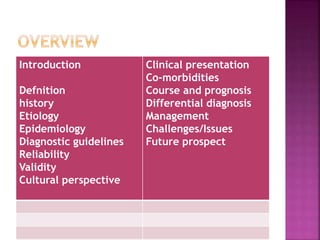
Introduction
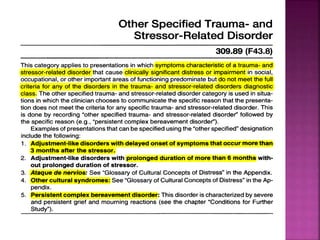
Defnition
history
Etiology
Epidemiology
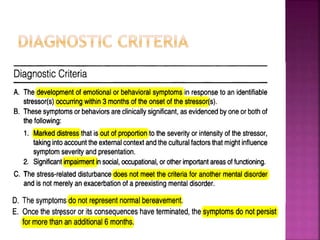
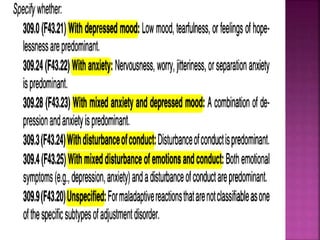
Diagnostic guidelines
Reliability
Validity
Cultural perspective
Clinical presentation
Co-morbidities
Course and prognosis
Differential diagnosis
Management
Challenges/Issues
Future prospect
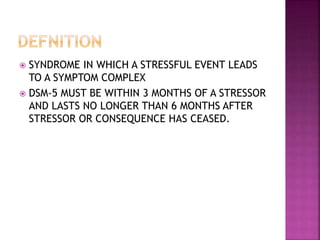
 SYNDROME IN WHICH A STRESSFUL EVENT LEADS
TO A SYMPTOM COMPLEX
 DSM-5 MUST BE WITHIN 3 MONTHS OF A STRESSOR
AND LASTS NO LONGER THAN 6 MONTHS AFTER
STRESSOR OR CONSEQUENCE HAS CEASED.
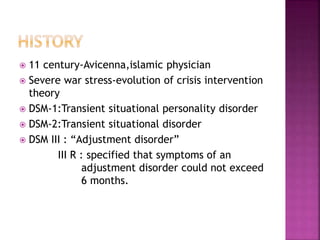
 11 century-Avicenna,islamic physician
 Severe war stress-evolution of crisis intervention
theory
 DSM-1:Transient situational personality disorder
 DSM-2:Transient situational disorder
 DSM III : “Adjustment disorder”
III R : specified that symptoms of an
adjustment disorder could not exceed
6 months.
 The subtypes of mixed emotional features,
work inhibition, withdrawal, and physical
complaints were eliminated.
 The stressor was allowed to persist for an
indefinite period of time.
 A descriptor of chronicity was specified,
whereby symptoms persisting for greater
than 6 months were deemed chronic
In DSM-5,
 Now included in the Trauma- and
Stressor-Related Disorders section of the
DSM-5.
 No change in the diagnostic guidelines
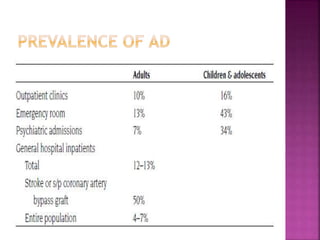
 Epidemiology
 Principal diagnosis in OPD : 5% - 20%
 According to DSM-5, estimates approach 50%
in hospital psychiatric consultation settings.
 Women are more likely to be diagnosed with
AD compared to men.
 Outcome of Depression International Network
(ODIN) study (18), which found a prevalence
of only 1% for adjustment disorder in five
European countries
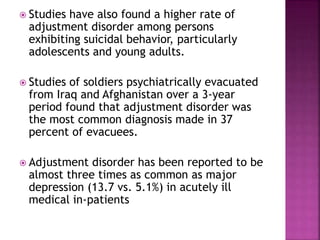
 Studies have also found a higher rate of
adjustment disorder among persons
exhibiting suicidal behavior, particularly
adolescents and young adults.
 Studies of soldiers psychiatrically evacuated
from Iraq and Afghanistan over a 3-year
period found that adjustment disorder was
the most common diagnosis made in 37
percent of evacuees.
 Adjustment disorder has been reported to be
almost three times as common as major
depression (13.7 vs. 5.1%) in acutely ill
medical in-patients
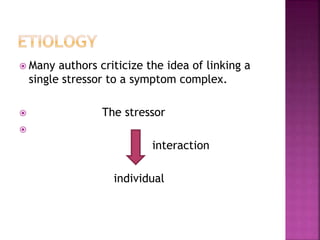
 Many authors criticize the idea of linking a
single stressor to a symptom complex.
 The stressor

interaction
individual
• A person’s “ego strength” determines his or her
vulnerability to stressors.
• Studies of children have revealed a consistent
pattern of individual characteristics associated
with successful adaptation.
• Early experience with diminished control may
foster a cognitive style characterized by an
increased probability of interpreting or
processing subsequent events as out of one’s
control
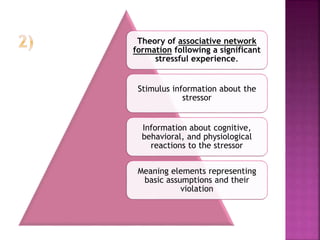
Theory of associative network
formation following a significant
stressful experience.
Stimulus information about the
stressor
Information about cognitive,
behavioral, and physiological
reactions to the stressor
Meaning elements representing
basic assumptions and their
violation
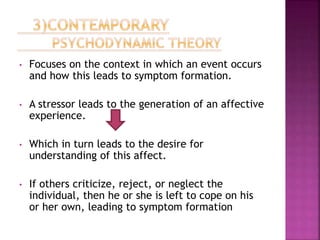
• Focuses on the context in which an event occurs
and how this leads to symptom formation.
• A stressor leads to the generation of an affective
experience.
• Which in turn leads to the desire for
understanding of this affect.
• If others criticize, reject, or neglect the
individual, then he or she is left to cope on his
or her own, leading to symptom formation
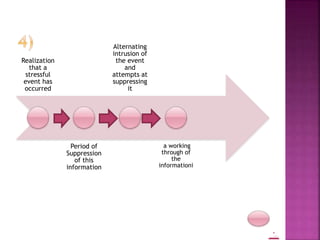
Realization
that a
stressful
event has
occurred
Period of
Suppression
of this
information
Alternating
intrusion of
the event
and
attempts at
suppressing
it
a working
through of
the
informationi
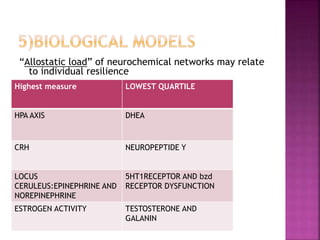
“Allostatic load” of neurochemical networks may relate
to individual resilience
 Lowest quartile
 HPA axis
 DHEA
 CRH
 Neuropeptide Y
 Locus ceruleus: norepinephrine and dopamine
 5-HT1A receptor and BZD receptor function
 Estrogen activity
 Testosterone
 Galanin
Highest measure LOWEST QUARTILE
HPA AXIS DHEA
CRH NEUROPEPTIDE Y
LOCUS
CERULEUS:EPINEPHRINE AND
NOREPINEPHRINE
5HT1RECEPTOR AND bzd
RECEPTOR DYSFUNCTION
ESTROGEN ACTIVITY TESTOSTERONE AND
GALANIN
 DSM-5
 ICD -10
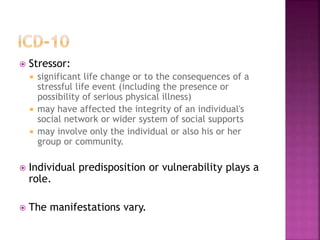
 Stressor:
 significant life change or to the consequences of a
stressful life event (including the presence or
possibility of serious physical illness)
 may have affected the integrity of an individual's
social network or wider system of social supports
 may involve only the individual or also his or her
group or community.
 Individual predisposition or vulnerability plays a
role.
 The manifestations vary.
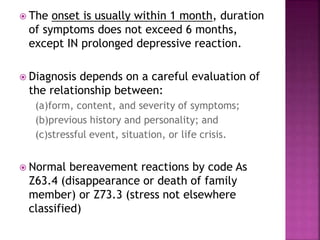
 The onset is usually within 1 month, duration
of symptoms does not exceed 6 months,
except IN prolonged depressive reaction.
 Diagnosis depends on a careful evaluation of
the relationship between:
(a)form, content, and severity of symptoms;
(b)previous history and personality; and
(c)stressful event, situation, or life crisis.
 Normal bereavement reactions by code As
Z63.4 (disappearance or death of family
member) or Z73.3 (stress not elsewhere
classified)
 ICD-10 points to "usually interfering with
social functioning and performance" and
"some degree of disability in the
performance of daily routines" whereas
 DSM-IV/5 points to "marked distress that is in
excess of what would be expected given the
nature of the stressor by significant
impairment in social or occupational
functioning“
 Difference of onset duration
 One study showed an interrater agreement
for adjustment disorders to be 0.05 (p = not
significant) in a survey using 27 child and
adolescent case histories.
 The results of the (UK-WHO) study of
reliability of the ICD-9 categories in children
and adolescents were consistent with this.
 European Outcome of Depression International
Network (ODIN) research failed to demonstrate
content validity.
 A study to assess the predictive validity of the
diagnosis reveal that 79% percent of adults in the
study were well at 5-year follow-up. While
adolescents with 57 percent well at 5 years
 As per the findings of a recent study, patients
with adjustment disorders had higher mental
quality-of-life scores than patients with major
depressive disorder but lower than patients
without mental disorder.
 Those with adjustment disorder had shorter
duration of hospitalizations, more presented
suicidality, fewer psychiatric readmissions,
and re-hospitalization days 2 years after
discharge
 Diagnostic stability of Adjustment disorder –
A retrospective two year follow up, done in
our setup, highlighted the importance of the
need of adjustment disorder to remain a
separate entity
 It is important to consider diverse idioms of
distress
 This parallels the lay concept of a “nervous
breakdown” within a particular cultural
setting. In this sense, the adjustment
disorders share features with other culture-
bound syndromes such as susto, koro, and
Arctic hysteria.
 Common symptoms of adjustment disorders
identified in a large study of adjustment
disorder included
 depressed mood,
 low self esteem,
 suicidal behavior,
 increased motor activity,
 hypervigilance, impulsivity, and substance use.
 There is no impairment of emotional
modulation, and patients may find joy in
thoughts of revenge.
 Additional symptoms may include
 feelings of helplessness, self-blame,
rejection of help, suicidal ideation,
dysphoria, aggression,
 downheartedness, seeming melancholic
depression, unspecific somatic complaints,
loss of appetite, sleep disturbance,
 pain, phobic symptoms in respect to the
place or to persons related to the event, and
reduced drive.
 Anxious subtype>depressed subtype
 Few research studies have examined the
disorders that are comorbid with AD.
 About 70 percent of patients with adjustment
disorders had at least one additional Axis I
diagnosis.
 Personality disorder was commonly co-morbid
(15%) with adjustment disorder (Strain et al.,
1998).
 Distinguishing between adjustment disorder and
depressive episode in clinical practice: The role
of personality disorder
 Suicidality:
 Several studies have reported a significant
association of adjustment disorders with suicidal
ideation.
 . Thirty percent of AD patients have suicidal
thoughts, 58% of suicide attempters have AD, and
9–19% of those completing suicide have this
disorder
 In another study in an urban hospital setting, 56
percent of all admissions for suicidal behavior
were classified as having transient situational
disorders using the DSM-II criteria.
 Depressive disorders:
 “disorder not otherwise specified” only in the
absence of a preceding stressor. The presence of
a stressor warrants the diagnosis of AD. Change
to the appropriate NOS category after 6 months
 MDD.
 PTSD and Acute Stress Reaction
 There are both timing and symptom profile
considerations.
 With regard to symptom profiles, an adjustment
disorder may be diagnosed following a traumatic
event when an individual exhibits symptoms of
either acute stress disorder or PTSD that do not
meet or exceed the diagnostic threshold for
either disorder.
 Personality disorders:
 Lifetime history of personality functioning
 In the presence of a personality disorder, if the
symptom criteria for an adjustment disorder are
met, and the stress-related disturbance exceeds
what may be attributable to maladaptive
personality disorder symptoms (i.e.. Criterion C
is met), then the diagnosis of an adjustment
disorder should be made.
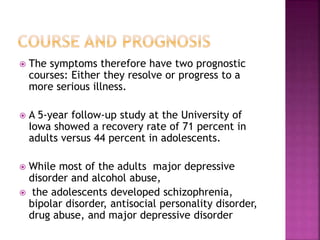
 The symptoms therefore have two prognostic
courses: Either they resolve or progress to a
more serious illness.
 A 5-year follow-up study at the University of
Iowa showed a recovery rate of 71 percent in
adults versus 44 percent in adolescents.
 While most of the adults major depressive
disorder and alcohol abuse,
 the adolescents developed schizophrenia,
bipolar disorder, antisocial personality disorder,
drug abuse, and major depressive disorder
 In 1978, Looney said that AD was found to be
less severe and disabling than other major
psychiatric disorders in terms of chronicity,
length of hospitalization, and disposition.
 A 16-year-old high school senior experienced
rejection in his first serious relationship.
 Dysphoric mood accompanied by anxiety and
psychomotor agitation.
 He had received counseling in junior-high school
when his parents divorced and he began using
alcohol and marijuana.
 A month after the breakup, he began to tell his
parents that life was no longer worth living
without his former girlfriend.
 Two months later his parents came home from
work and found him hanging in the garage with a
note stating he could not go on alone.
 Important to collect clinically relevant
information through interview and collateral
informant reports.
 Adjustment Disorder module of the Mini-
International Neuropsychiatric Interview
(Sheehan et al., 1998)
 Schedules for Clinical Assessment in
Neuropsychiatry (Wing et al., 1990)
 Adjustment Disorder module of the Structured
Clinical Interview for DSM-IV-TR (First et al.,
1994
Development and validation of the Diagnostic
Interview Adjustment Disorder (DIAD) L. R.
Cornelius, S. Brouwer, M. R. De Boer, J. W.
Groothoff & J. J. L. Vanderklink
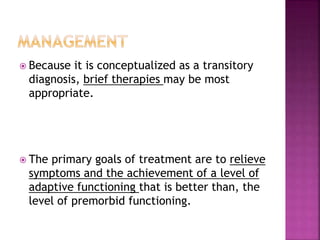
 Because it is conceptualized as a transitory
diagnosis, brief therapies may be most
appropriate.
 The primary goals of treatment are to relieve
symptoms and the achievement of a level of
adaptive functioning that is better than, the
level of premorbid functioning.
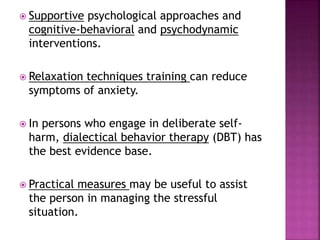
 Supportive psychological approaches and
cognitive-behavioral and psychodynamic
interventions.
 Relaxation techniques training can reduce
symptoms of anxiety.
 In persons who engage in deliberate self-
harm, dialectical behavior therapy (DBT) has
the best evidence base.
 Practical measures may be useful to assist
the person in managing the stressful
situation.
 Ego enhancing therapy was found to be
useful during periods of transition in older
patients. This approach promotes the coping
strategy and helps the patient acknowledge
the stressors. [Frankel]
 “Mirror therapy”, a therapy including
psychocorporeal, cognitive, and
neurolinguistics components, was effective in
patients with adjustment disorder secondary
to myocardial infarction
 Other studies have demonstrated efficacy for
Kava-Kava and Ginkgo Biloba.
 The basic pharmacological management of
adjustment disorder consists of symptomatic
treatment of insomnia, anxiety and panic
attacks.
 Agents commonly used : benzodiazepines and
antidepressants.
 Nguyen [80] in 2006 explored the differences in
treating Adjustment Disorder with Anxiety with
etifoxine (a nonbenzodiazepine anxiolytic drug)
and lorazepam.
 A pilot study of cancer patients with anxious and
depressed mood found trazodone superior to a
benzodiazepine
 It is a shared opinion that currently,
psychotherapy remains the treatment of
choice for adjustment disorders.
 Maina et al. [68] in 1999 effectiveness of
brief dynamic psychotherapy and brief
supportive psychotherapy in the treatment of
minor depressive episodes.
 Interpersonal psychotherapy :
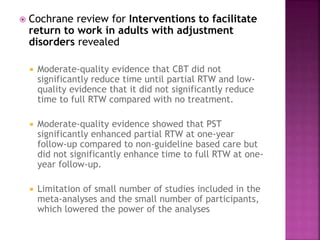
 Cochrane review for Interventions to facilitate
return to work in adults with adjustment
disorders revealed
 Moderate-quality evidence that CBT did not
significantly reduce time until partial RTW and low-
quality evidence that it did not significantly reduce
time to full RTW compared with no treatment.
 Moderate-quality evidence showed that PST
significantly enhanced partial RTW at one-year
follow-up compared to non-guideline based care but
did not significantly enhance time to full RTW at one-
year follow-up.
 Limitation of small number of studies included in the
meta-analyses and the small number of participants,
which lowered the power of the analyses
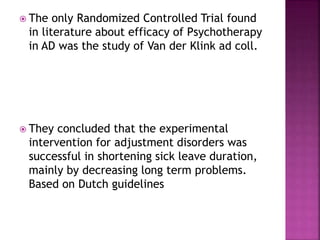
 The only Randomized Controlled Trial found
in literature about efficacy of Psychotherapy
in AD was the study of Van der Klink ad coll.
 They concluded that the experimental
intervention for adjustment disorders was
successful in shortening sick leave duration,
mainly by decreasing long term problems.
Based on Dutch guidelines
 Criticized as “wastebasket” or
“afterthought” diagnosis.
 increased medicalization of life problems as well
as the bias of biological models in psychiatry
 Symptoms lack specificity
 Use of AD for presentations that fail to meet the
criteria of other Axis I diagnoses, particularly
major or minor depression.
Stressor criteria :
 The DSM-IV-TR states only that the
stressor is identifiable but makes no
mention as to what would qualify as a
stressor.
Duration criteria:
It is extremely difficult for a clinician to
gauge when a stressor is no longer a
stressor
 Definition: Cluster of symptoms which are in
excess of the normal reaction to a stressor.
Types or stressors and subtypes of AD.
 Evolution from DSM I to DSM 5, starting off
with WW II.
 A common diagnosis in consultation liaison
setting and OPD as well. Although no large
epidemiological study supporting the figures
due to poor assessment tools.
 Various etiological models
 Diagnostic guidelines – DSM 5 and ICD 10 and the
differences.
 Doubts regarding validity and reliability of the
diagnosis with insufficient and varying data to
support either claims.
 Cultural perspectives
 Clinical presentation/Differential diagnoses to
be considered
 Association with suicidality, personality disorders
and substance use.
 Variable course, but mainly seen as a self
limiting disorder.
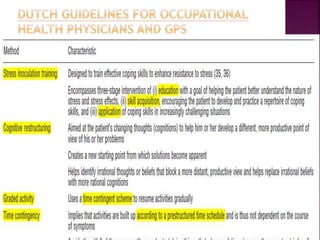
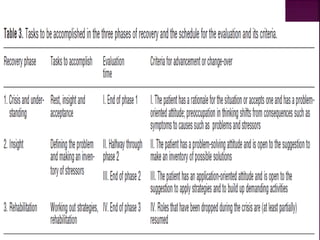
 Management – Psychotherapy, pharmacotherapy
and practical changes. Dutch guidelines for GPs
and occupational therapists.
 Challenges and issues with the diagnosis
 Creating an interactive model that takes into
account both stress and resiliency factors that
are responsive to individual and cultural
differences remains challenging.
 Obstacles are linked to the inadequate
operationalization of adjustment disorders, we
need to adjust the adjustment disorder category
to overcome the present shortcomings.
 Although has been widely criticized diagnosis
with vague criteria and questionable
reliability/validity, it remains as one of the most
commonly diagnosed disorder.
Adjustment disorder in Psychiatry

Adjustment disorder in Psychiatry

  • 1.
  • 2.
    Introduction Defnition history Etiology Epidemiology Diagnostic guidelines Reliability Validity Cultural perspective Clinicalpresentation Co-morbidities Course and prognosis Differential diagnosis Management Challenges/Issues Future prospect
  • 3.
     SYNDROME INWHICH A STRESSFUL EVENT LEADS TO A SYMPTOM COMPLEX  DSM-5 MUST BE WITHIN 3 MONTHS OF A STRESSOR AND LASTS NO LONGER THAN 6 MONTHS AFTER STRESSOR OR CONSEQUENCE HAS CEASED.
  • 4.
     11 century-Avicenna,islamicphysician  Severe war stress-evolution of crisis intervention theory  DSM-1:Transient situational personality disorder  DSM-2:Transient situational disorder  DSM III : “Adjustment disorder” III R : specified that symptoms of an adjustment disorder could not exceed 6 months.
  • 5.
     The subtypesof mixed emotional features, work inhibition, withdrawal, and physical complaints were eliminated.  The stressor was allowed to persist for an indefinite period of time.  A descriptor of chronicity was specified, whereby symptoms persisting for greater than 6 months were deemed chronic
  • 6.
    In DSM-5,  Nowincluded in the Trauma- and Stressor-Related Disorders section of the DSM-5.  No change in the diagnostic guidelines
  • 7.
     Epidemiology  Principaldiagnosis in OPD : 5% - 20%  According to DSM-5, estimates approach 50% in hospital psychiatric consultation settings.  Women are more likely to be diagnosed with AD compared to men.  Outcome of Depression International Network (ODIN) study (18), which found a prevalence of only 1% for adjustment disorder in five European countries
  • 9.
     Studies havealso found a higher rate of adjustment disorder among persons exhibiting suicidal behavior, particularly adolescents and young adults.  Studies of soldiers psychiatrically evacuated from Iraq and Afghanistan over a 3-year period found that adjustment disorder was the most common diagnosis made in 37 percent of evacuees.  Adjustment disorder has been reported to be almost three times as common as major depression (13.7 vs. 5.1%) in acutely ill medical in-patients
  • 10.
     Many authorscriticize the idea of linking a single stressor to a symptom complex.  The stressor  interaction individual
  • 11.
    • A person’s“ego strength” determines his or her vulnerability to stressors. • Studies of children have revealed a consistent pattern of individual characteristics associated with successful adaptation. • Early experience with diminished control may foster a cognitive style characterized by an increased probability of interpreting or processing subsequent events as out of one’s control
  • 12.
    Theory of associativenetwork formation following a significant stressful experience. Stimulus information about the stressor Information about cognitive, behavioral, and physiological reactions to the stressor Meaning elements representing basic assumptions and their violation
  • 13.
    • Focuses onthe context in which an event occurs and how this leads to symptom formation. • A stressor leads to the generation of an affective experience. • Which in turn leads to the desire for understanding of this affect. • If others criticize, reject, or neglect the individual, then he or she is left to cope on his or her own, leading to symptom formation
  • 14.
    Realization that a stressful event has occurred Periodof Suppression of this information Alternating intrusion of the event and attempts at suppressing it a working through of the informationi
  • 15.
    “Allostatic load” ofneurochemical networks may relate to individual resilience  Lowest quartile  HPA axis  DHEA  CRH  Neuropeptide Y  Locus ceruleus: norepinephrine and dopamine  5-HT1A receptor and BZD receptor function  Estrogen activity  Testosterone  Galanin Highest measure LOWEST QUARTILE HPA AXIS DHEA CRH NEUROPEPTIDE Y LOCUS CERULEUS:EPINEPHRINE AND NOREPINEPHRINE 5HT1RECEPTOR AND bzd RECEPTOR DYSFUNCTION ESTROGEN ACTIVITY TESTOSTERONE AND GALANIN
  • 16.
  • 19.
     Stressor:  significantlife change or to the consequences of a stressful life event (including the presence or possibility of serious physical illness)  may have affected the integrity of an individual's social network or wider system of social supports  may involve only the individual or also his or her group or community.  Individual predisposition or vulnerability plays a role.  The manifestations vary.
  • 20.
     The onsetis usually within 1 month, duration of symptoms does not exceed 6 months, except IN prolonged depressive reaction.  Diagnosis depends on a careful evaluation of the relationship between: (a)form, content, and severity of symptoms; (b)previous history and personality; and (c)stressful event, situation, or life crisis.  Normal bereavement reactions by code As Z63.4 (disappearance or death of family member) or Z73.3 (stress not elsewhere classified)
  • 21.
     ICD-10 pointsto "usually interfering with social functioning and performance" and "some degree of disability in the performance of daily routines" whereas  DSM-IV/5 points to "marked distress that is in excess of what would be expected given the nature of the stressor by significant impairment in social or occupational functioning“  Difference of onset duration
  • 22.
     One studyshowed an interrater agreement for adjustment disorders to be 0.05 (p = not significant) in a survey using 27 child and adolescent case histories.  The results of the (UK-WHO) study of reliability of the ICD-9 categories in children and adolescents were consistent with this.
  • 23.
     European Outcomeof Depression International Network (ODIN) research failed to demonstrate content validity.  A study to assess the predictive validity of the diagnosis reveal that 79% percent of adults in the study were well at 5-year follow-up. While adolescents with 57 percent well at 5 years  As per the findings of a recent study, patients with adjustment disorders had higher mental quality-of-life scores than patients with major depressive disorder but lower than patients without mental disorder.
  • 24.
     Those withadjustment disorder had shorter duration of hospitalizations, more presented suicidality, fewer psychiatric readmissions, and re-hospitalization days 2 years after discharge  Diagnostic stability of Adjustment disorder – A retrospective two year follow up, done in our setup, highlighted the importance of the need of adjustment disorder to remain a separate entity
  • 25.
     It isimportant to consider diverse idioms of distress  This parallels the lay concept of a “nervous breakdown” within a particular cultural setting. In this sense, the adjustment disorders share features with other culture- bound syndromes such as susto, koro, and Arctic hysteria.
  • 26.
     Common symptomsof adjustment disorders identified in a large study of adjustment disorder included  depressed mood,  low self esteem,  suicidal behavior,  increased motor activity,  hypervigilance, impulsivity, and substance use.  There is no impairment of emotional modulation, and patients may find joy in thoughts of revenge.
  • 27.
     Additional symptomsmay include  feelings of helplessness, self-blame, rejection of help, suicidal ideation, dysphoria, aggression,  downheartedness, seeming melancholic depression, unspecific somatic complaints, loss of appetite, sleep disturbance,  pain, phobic symptoms in respect to the place or to persons related to the event, and reduced drive.  Anxious subtype>depressed subtype
  • 28.
     Few researchstudies have examined the disorders that are comorbid with AD.  About 70 percent of patients with adjustment disorders had at least one additional Axis I diagnosis.  Personality disorder was commonly co-morbid (15%) with adjustment disorder (Strain et al., 1998).  Distinguishing between adjustment disorder and depressive episode in clinical practice: The role of personality disorder
  • 29.
     Suicidality:  Severalstudies have reported a significant association of adjustment disorders with suicidal ideation.  . Thirty percent of AD patients have suicidal thoughts, 58% of suicide attempters have AD, and 9–19% of those completing suicide have this disorder  In another study in an urban hospital setting, 56 percent of all admissions for suicidal behavior were classified as having transient situational disorders using the DSM-II criteria.
  • 30.
     Depressive disorders: “disorder not otherwise specified” only in the absence of a preceding stressor. The presence of a stressor warrants the diagnosis of AD. Change to the appropriate NOS category after 6 months  MDD.
  • 31.
     PTSD andAcute Stress Reaction  There are both timing and symptom profile considerations.  With regard to symptom profiles, an adjustment disorder may be diagnosed following a traumatic event when an individual exhibits symptoms of either acute stress disorder or PTSD that do not meet or exceed the diagnostic threshold for either disorder.
  • 32.
     Personality disorders: Lifetime history of personality functioning  In the presence of a personality disorder, if the symptom criteria for an adjustment disorder are met, and the stress-related disturbance exceeds what may be attributable to maladaptive personality disorder symptoms (i.e.. Criterion C is met), then the diagnosis of an adjustment disorder should be made.
  • 34.
     The symptomstherefore have two prognostic courses: Either they resolve or progress to a more serious illness.  A 5-year follow-up study at the University of Iowa showed a recovery rate of 71 percent in adults versus 44 percent in adolescents.  While most of the adults major depressive disorder and alcohol abuse,  the adolescents developed schizophrenia, bipolar disorder, antisocial personality disorder, drug abuse, and major depressive disorder
  • 35.
     In 1978,Looney said that AD was found to be less severe and disabling than other major psychiatric disorders in terms of chronicity, length of hospitalization, and disposition.
  • 36.
     A 16-year-oldhigh school senior experienced rejection in his first serious relationship.  Dysphoric mood accompanied by anxiety and psychomotor agitation.  He had received counseling in junior-high school when his parents divorced and he began using alcohol and marijuana.  A month after the breakup, he began to tell his parents that life was no longer worth living without his former girlfriend.  Two months later his parents came home from work and found him hanging in the garage with a note stating he could not go on alone.
  • 37.
     Important tocollect clinically relevant information through interview and collateral informant reports.  Adjustment Disorder module of the Mini- International Neuropsychiatric Interview (Sheehan et al., 1998)  Schedules for Clinical Assessment in Neuropsychiatry (Wing et al., 1990)  Adjustment Disorder module of the Structured Clinical Interview for DSM-IV-TR (First et al., 1994
  • 38.
    Development and validationof the Diagnostic Interview Adjustment Disorder (DIAD) L. R. Cornelius, S. Brouwer, M. R. De Boer, J. W. Groothoff & J. J. L. Vanderklink
  • 39.
     Because itis conceptualized as a transitory diagnosis, brief therapies may be most appropriate.  The primary goals of treatment are to relieve symptoms and the achievement of a level of adaptive functioning that is better than, the level of premorbid functioning.
  • 40.
     Supportive psychologicalapproaches and cognitive-behavioral and psychodynamic interventions.  Relaxation techniques training can reduce symptoms of anxiety.  In persons who engage in deliberate self- harm, dialectical behavior therapy (DBT) has the best evidence base.  Practical measures may be useful to assist the person in managing the stressful situation.
  • 41.
     Ego enhancingtherapy was found to be useful during periods of transition in older patients. This approach promotes the coping strategy and helps the patient acknowledge the stressors. [Frankel]  “Mirror therapy”, a therapy including psychocorporeal, cognitive, and neurolinguistics components, was effective in patients with adjustment disorder secondary to myocardial infarction  Other studies have demonstrated efficacy for Kava-Kava and Ginkgo Biloba.
  • 42.
     The basicpharmacological management of adjustment disorder consists of symptomatic treatment of insomnia, anxiety and panic attacks.  Agents commonly used : benzodiazepines and antidepressants.  Nguyen [80] in 2006 explored the differences in treating Adjustment Disorder with Anxiety with etifoxine (a nonbenzodiazepine anxiolytic drug) and lorazepam.  A pilot study of cancer patients with anxious and depressed mood found trazodone superior to a benzodiazepine
  • 43.
     It isa shared opinion that currently, psychotherapy remains the treatment of choice for adjustment disorders.  Maina et al. [68] in 1999 effectiveness of brief dynamic psychotherapy and brief supportive psychotherapy in the treatment of minor depressive episodes.  Interpersonal psychotherapy :
  • 44.
     Cochrane reviewfor Interventions to facilitate return to work in adults with adjustment disorders revealed  Moderate-quality evidence that CBT did not significantly reduce time until partial RTW and low- quality evidence that it did not significantly reduce time to full RTW compared with no treatment.  Moderate-quality evidence showed that PST significantly enhanced partial RTW at one-year follow-up compared to non-guideline based care but did not significantly enhance time to full RTW at one- year follow-up.  Limitation of small number of studies included in the meta-analyses and the small number of participants, which lowered the power of the analyses
  • 45.
     The onlyRandomized Controlled Trial found in literature about efficacy of Psychotherapy in AD was the study of Van der Klink ad coll.  They concluded that the experimental intervention for adjustment disorders was successful in shortening sick leave duration, mainly by decreasing long term problems. Based on Dutch guidelines
  • 48.
     Criticized as“wastebasket” or “afterthought” diagnosis.  increased medicalization of life problems as well as the bias of biological models in psychiatry  Symptoms lack specificity  Use of AD for presentations that fail to meet the criteria of other Axis I diagnoses, particularly major or minor depression.
  • 49.
    Stressor criteria : The DSM-IV-TR states only that the stressor is identifiable but makes no mention as to what would qualify as a stressor. Duration criteria: It is extremely difficult for a clinician to gauge when a stressor is no longer a stressor
  • 50.
     Definition: Clusterof symptoms which are in excess of the normal reaction to a stressor. Types or stressors and subtypes of AD.  Evolution from DSM I to DSM 5, starting off with WW II.  A common diagnosis in consultation liaison setting and OPD as well. Although no large epidemiological study supporting the figures due to poor assessment tools.
  • 51.
     Various etiologicalmodels  Diagnostic guidelines – DSM 5 and ICD 10 and the differences.  Doubts regarding validity and reliability of the diagnosis with insufficient and varying data to support either claims.  Cultural perspectives  Clinical presentation/Differential diagnoses to be considered  Association with suicidality, personality disorders and substance use.  Variable course, but mainly seen as a self limiting disorder.  Management – Psychotherapy, pharmacotherapy and practical changes. Dutch guidelines for GPs and occupational therapists.  Challenges and issues with the diagnosis
  • 52.
     Creating aninteractive model that takes into account both stress and resiliency factors that are responsive to individual and cultural differences remains challenging.  Obstacles are linked to the inadequate operationalization of adjustment disorders, we need to adjust the adjustment disorder category to overcome the present shortcomings.  Although has been widely criticized diagnosis with vague criteria and questionable reliability/validity, it remains as one of the most commonly diagnosed disorder.

Editor's Notes

  • #4 Development of emotional/behavioural symptoms in response to an identifiable stressor(traumatic and non traumatic) See magnitude of patients distress and severity of functional impairment If out of proportion to severity of stressor
  • #5 1952- 6 stages-1)gross stress reaction2)adult situational reaction3)adjustment disorder of infancy,childhood,adolescence and late life Stress depends on depressed or anxious personality. Transient disorder of any severity(including psychosis) that occur in individuals without any apparent underlying mental disorders and represent an acute reaction to environment stress 8 Development periods were removed. categorised based on affect.depressed mood,anxious mood,mixed emotional features,disturbance of conduct,mixed disturbance of emotion and conduct,work inhibition and work withdrawal and atypical Above +one involving physical complaints
  • #7 Reactive attachment disorder,disinhibited social engagement disorder,asd,ptsd, Other specified trauma and stressor related disorders(onset was greater than 3 months and lasts>6 months) Unspecified trauma and stressor related disorders. Dsm 1-4 coded on axis 1 and stressor on axis 3 or 4. Dsm-5 eliminated axis 3 or 4 and axis 1. If an axis 1 disorder is present then cant assign AD. Should faciliate high quality of research evidence based treatments.
  • #8 Increased in population with increased stressors-individuals coping with chronic illness and disability. 2 phase community assessment with BDI and SCAN . OTHER study-patient on entry to clinical services of western psychiatric institute-11,000 individuals of all ages DSM-111 criteria and semistructured assessment. 10% AD-ADULTS.femal: male=2:1 16%AD-children and adolescents <18 years
  • #10 Danish born citizens-treatment between 1995-2011 90.5%-AD OR SEVERE STRESS 97% ADULTS AND 37.6% CHILDREN.women>men. Pts with cancer and palliative care-107 patients with HEAD AND NECK CANCER was taken. 12.1% AD 55 WOMEN WITH BREAST CANCER-35%AD Women with still birth-AD in first one month WHO and ILO study-german study for bullying and harassment at work place:pysical and psychiatric sequelae-4 times higher for depressive and 3 times higher for anxiety.
  • #12 Difficulty in processing stressful life experiences. Xposed to war,family violence,poverty and natural disaster-good intellectual functioning and effective self regulation of emotion and attachment behaviours. Positive self concept optimism,altruism,active coping style,capacity to convert traumatic helplessness to learned helplessness. Vulnerability to anxiety
  • #13 Eg-meeting ones former boss ,how it can trigger thoughts about unexpected dismissal from work Treatment aimed at modifying this associative network
  • #14 Lack of affective experience-generates problems-represented a threat-feelings-signal danger and anxiety-psychological defense-anger at individual-directed to self-depression and demoralisation.
  • #15 Integration of stressful experience as a series of responses. Integrating material into ones cognitive schema or symptom formation
  • #16 Relate to individuals resilience in the face of traumatic events. Highest index for psychobiological allostatic load and increased risk for psychopathology.
  • #20 Manifestations : include depressed mood, anxiety, worry (or a mixture of these), a feeling of inability to cope, plan ahead, or continue in the present situation, and some degree of disability in the performance of daily routine.
  • #21 Lasts for upto 2 years.
  • #23 Interrater reliability for AD was found to be 0.23
  • #24 Content validity showed that patients with AD had lower illness severity and more diminished reaction to stress
  • #26 when determining whether a reaction to a stressor is maladaptive or normal within a particular cultural context. This perspective considers the evidence that most cultures have an entity named for a process whereby an individual is stressed to the point of symptom development. in that they all describe the development of a set of symptoms following a particular stressor
  • #29 Perhaps this lack of research is due in part to the fact the diagnostic criteria for AD essentially preclude the diagnosis of another Axis I disorder that shares symptoms with AD. Only the personality trait of perfectionism is significantly more common in those with depressive episode, compared to adjustment disorder. Personality disorder is also more common in those with depressive episode. On this basis, we propose that the emphasis that ICD-10 and, especially, DSM-5 place on personality features in adjustment disorder should be reconsidered.
  • #30 Furthermore, up to 25% of adolescents with a diagnosis of adjustment disorder engage in suicidal behavior , while among adults with this disorder the figure is 60% Diagnostic criteria for psychosomatic research -54% of patients with AD-phobia,health anxiety,nasophobia and tantophobia 1/3-somatisation
  • #31 More social phobia,more anhedonia,increased sleep and appetite,indecisiveness,risk of depression in first degree relatives SEVERITY OF SYMPTOMS EXCEED WHAT IS EXPECTED IN A PARTICULAR CIRCUMSTANCE AND CULTURAL GROUP
  • #35 LESS than 30%-adults 70% adolescents.
  • #37 Case depicting the risk of suicidality and the varied prognosis of the disorder
  • #39 Intrusive memories of event Avoidance of feelings Failure to adapt
  • #40 There is no single treatment intervention approach for the heterogeneous clinical manifestation of the disorder. Reduce or remove stressor
  • #41 assistance in finding alternative responses that do not involve self-destruction may be of benefit and to date . Distress tolerance module of DBT promote adaptive and goal oriented behaviour in context of distress. Assertiveness training and coping strategies Practical: A person being bullied at work might decide to invoke an internal redress system or may seek the support of the trade union. A person in an abusive relationship might seek a barring order. A vulnerable person taking on too much work may benefit from simple directive advice. Harnessing family members’ input, involving supportive agencies such as social services or encouraging involvement in a support or self-help group may alleviate distress.
  • #43 the results were that both drugs demonstrated efficacy in the treatment of the disorder, but more etifoxine patients improved markedly and had a notable therapeutic effects without side effects. Moreover, 1 week after stopping treatment, fewer etifoxine patients experienced a rebound of anxiety, compared to the others. Overall, these studies lend little support for the superiority of antidepressants, and arguably for any specific treatment, in the management of adjustment disorder, but further studies are clearly required
  • #44 Maina : and the superior improvement in a 6 months follow up of the dynamic approach. Unfortunately the trial did not study the efficacy of brief dynamic psychotherapy in AD. include psychoeducation about the patient's role, a here and now frame work, formulation of the problems from an interpersonal perspective, exploration of options for changing dysfunctional behavior pattern
  • #48 The stressor and solution inventory are at the core of this phase. Intervention in the crisis and understanding phase aims at supporting the acquisition of insight and the acceptance of what has happened. Intervention in the insight phase aims to support the making of an inventory of problems or stressors and consequently of possible solutions.
  • #49 at the expense of social, psychological, cultural, and spiritual conceptualizations and responses to illness Temporal course between stressor and development of symptoms lack scientific evidence. The DSM-IV-TR does make some allowance for this with the designation of acute versus chronic adjustment disorders. The designation of a chronic disorder is reserved for those with symptoms lasting longer than 6 months in the context of ongoing stressors.
  • #50 Bereavement, for example, requires a death. PTSD requires a stressor involving a threat of death, a serious injury to self or others, or a response involving intense fear, helplessness, or horror. No clear cut consistent coherent explanation of relation between stressor and illness "the lack of specificity allows the tagging of early or temporary mental states when the clinical picture is vague and indistinct, but the morbidity is greater than expected in a normal reaction“ Why some develop symptoms?
  • #52 Crisis and understanding phase Insight phase