Adult Social Care Outcomes Framework (ASCOF)
Highlights from the 2014-15 annual report
Social care related
quality of life (Measure 1A)
The North East and South East
have the highest SCRQoL
scores at 19.4, followed by the
South West (19.3). London has
the lowest score of 18.5.
19.1
Social Care
related quality of
life score out of 24
for England
Service users’ control
over their lives (1B)
A higher percentage (81) of
18-64 year olds felt they had
control over their daily lives
compared to 75 per cent of
those aged 65 and over.
77%
Proportion of
service users who feel
they have control over
their daily lives
Carer reported quality of life (1D)
Carers’ satisfaction with services (3B)
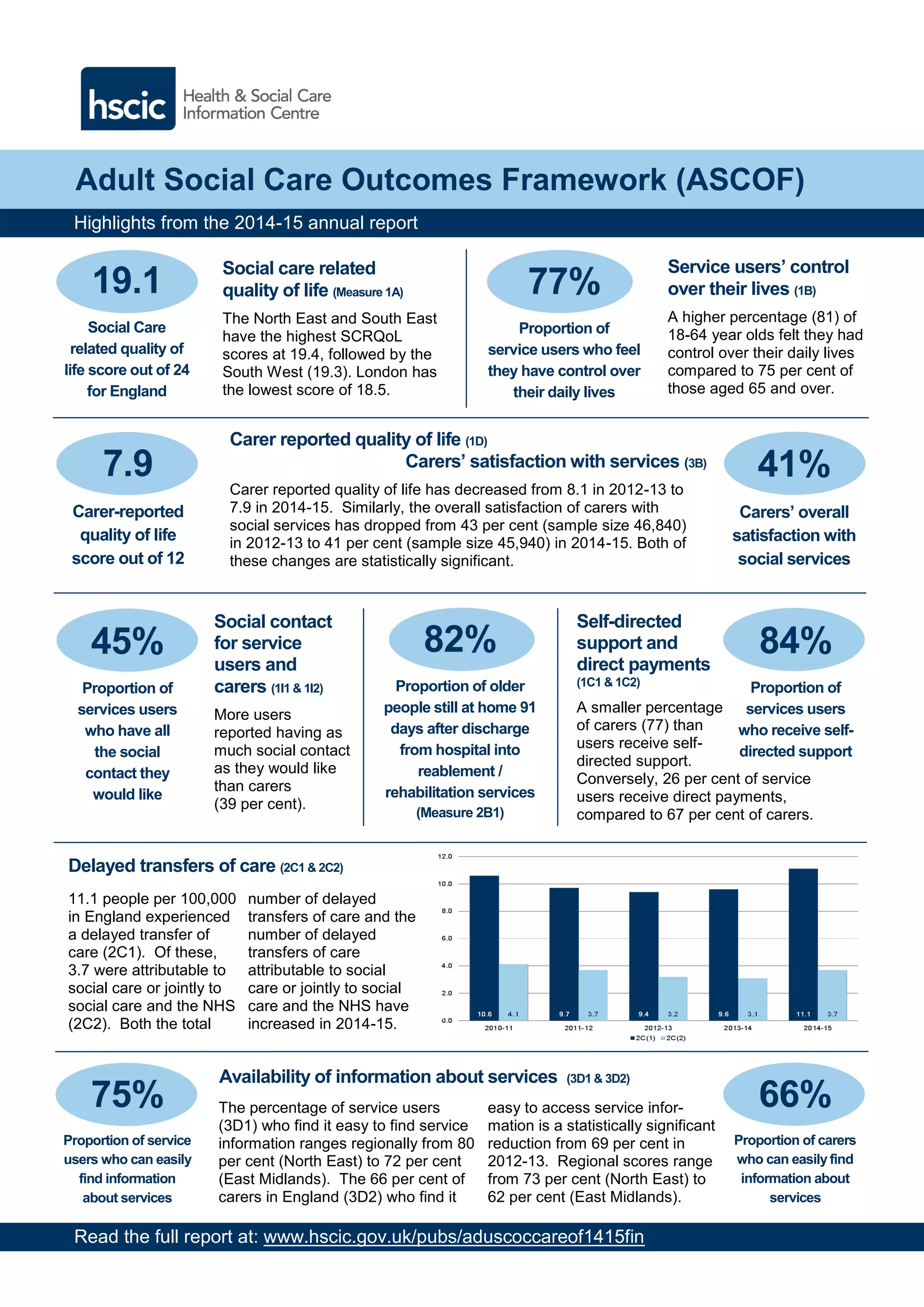
11.1 people per 100,000
in England experienced
a delayed transfer of
care (2C1). Of these,
3.7 were attributable to
social care or jointly to
social care and the NHS
(2C2). Both the total
number of delayed
transfers of care and the
number of delayed
transfers of care
attributable to social
care or jointly to social
care and the NHS have
increased in 2014-15.
82%
Proportion of older
people still at home 91
days after discharge
from hospital into
reablement /
rehabilitation services
(Measure 2B1)
45%
Proportion of
services users
who have all
the social
contact they
would like
Read the full report at: www.hscic.gov.uk/pubs/aduscoccareof1415fin
Social contact
for service
users and
carers (1I1 & 1I2)
More users
reported having as
much social contact
as they would like
than carers
(39 per cent).
The percentage of service users
(3D1) who find it easy to find service
information ranges regionally from 80
per cent (North East) to 72 per cent
(East Midlands). The 66 per cent of
carers in England (3D2) who find it
easy to access service infor-
mation is a statistically significant
reduction from 69 per cent in
2012-13. Regional scores range
from 73 per cent (North East) to
62 per cent (East Midlands).
Delayed transfers of care (2C1 & 2C2)
Availability of information about services (3D1 & 3D2)
75%
Proportion of service
users who can easily
find information
about services
7.9
Carer-reported
quality of life
score out of 12
41%
Carers’ overall
satisfaction with
social services
66%
Proportion of carers
who can easily find
information about
services
Carer reported quality of life has decreased from 8.1 in 2012-13 to
7.9 in 2014-15. Similarly, the overall satisfaction of carers with
social services has dropped from 43 per cent (sample size 46,840)
in 2012-13 to 41 per cent (sample size 45,940) in 2014-15. Both of
these changes are statistically significant.
Self-directed
support and
direct payments
(1C1 & 1C2)
A smaller percentage
of carers (77) than
users receive self-
directed support.
Conversely, 26 per cent of service
users receive direct payments,
compared to 67 per cent of carers.
84%
Proportion of
services users
who receive self-
directed support

Measures from the Adult Social Care Outcomes Framework, England - 2014-15

  • 1.
    Adult Social CareOutcomes Framework (ASCOF) Highlights from the 2014-15 annual report Social care related quality of life (Measure 1A) The North East and South East have the highest SCRQoL scores at 19.4, followed by the South West (19.3). London has the lowest score of 18.5. 19.1 Social Care related quality of life score out of 24 for England Service users’ control over their lives (1B) A higher percentage (81) of 18-64 year olds felt they had control over their daily lives compared to 75 per cent of those aged 65 and over. 77% Proportion of service users who feel they have control over their daily lives Carer reported quality of life (1D) Carers’ satisfaction with services (3B) 11.1 people per 100,000 in England experienced a delayed transfer of care (2C1). Of these, 3.7 were attributable to social care or jointly to social care and the NHS (2C2). Both the total number of delayed transfers of care and the number of delayed transfers of care attributable to social care or jointly to social care and the NHS have increased in 2014-15. 82% Proportion of older people still at home 91 days after discharge from hospital into reablement / rehabilitation services (Measure 2B1) 45% Proportion of services users who have all the social contact they would like Read the full report at: www.hscic.gov.uk/pubs/aduscoccareof1415fin Social contact for service users and carers (1I1 & 1I2) More users reported having as much social contact as they would like than carers (39 per cent). The percentage of service users (3D1) who find it easy to find service information ranges regionally from 80 per cent (North East) to 72 per cent (East Midlands). The 66 per cent of carers in England (3D2) who find it easy to access service infor- mation is a statistically significant reduction from 69 per cent in 2012-13. Regional scores range from 73 per cent (North East) to 62 per cent (East Midlands). Delayed transfers of care (2C1 & 2C2) Availability of information about services (3D1 & 3D2) 75% Proportion of service users who can easily find information about services 7.9 Carer-reported quality of life score out of 12 41% Carers’ overall satisfaction with social services 66% Proportion of carers who can easily find information about services Carer reported quality of life has decreased from 8.1 in 2012-13 to 7.9 in 2014-15. Similarly, the overall satisfaction of carers with social services has dropped from 43 per cent (sample size 46,840) in 2012-13 to 41 per cent (sample size 45,940) in 2014-15. Both of these changes are statistically significant. Self-directed support and direct payments (1C1 & 1C2) A smaller percentage of carers (77) than users receive self- directed support. Conversely, 26 per cent of service users receive direct payments, compared to 67 per cent of carers. 84% Proportion of services users who receive self- directed support