Leveraging your team’s “personality”
to drive team success
Delivery Transformation – Enterprise
2015
Linked In: Julie Moroni
Twitter: @jamoroni2
2
Today’s Goal
• Appreciate what makes us all unique
• Understand relationship of our uniqueness and behavior
• Realize the value of understanding our differences
• Review of options to discuss differences
• Explain the DiSC Model & how it can be used with teams
• Learn some tools to help teams work more effectively
3
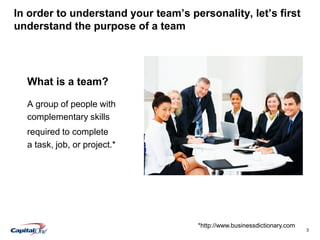
In order to understand your team’s personality, let’s first
understand the purpose of a team
A group of people with
complementary skills
required to complete
a task, job, or project.*
*http://www.businessdictionary.com
What is a team?
4
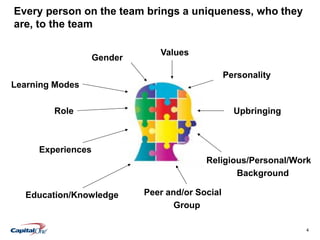
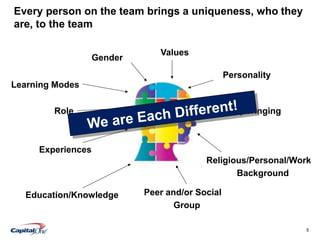
Every person on the team brings a uniqueness, who they
are, to the team
Experiences
Religious/Personal/Work
Background
Values
Personality
Role Upbringing
Peer and/or Social
Group
Education/Knowledge
Gender
Learning Modes
5
Every person on the team brings a uniqueness, who they
are, to the team
Experiences
Religious/Personal/Work
Background
Values
Personality
Role Upbringing
Peer and/or Social
Group
Education/Knowledge
Gender
Learning Modes
6
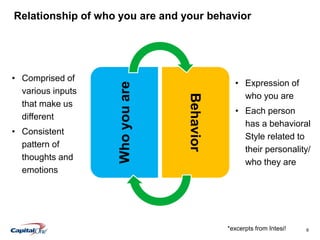
Relationship of who you are and your behavior
Whoyouare
Behavior
• Comprised of
various inputs
that make us
different
• Consistent
pattern of
thoughts and
emotions
*excerpts from Intesi!
• Expression of
who you are
• Each person
has a behavioral
Style related to
their personality/
who they are
7
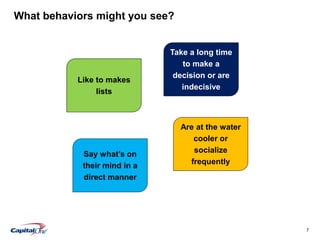
What behaviors might you see?
Take a long time
to make a
decision or are
indecisive
Say what’s on
their mind in a
direct manner
Like to makes
lists
Are at the water
cooler or
socialize
frequently
8
What behaviors might you see?
Take a long time
to make a
decision or are
indecisive
Say what’s on
their mind in a
direct manner
Like to makes
lists
Are at the water
cooler or
socialize
frequently
9
How instead can we benefit by understanding the
differences?
• Increase your self-knowledge: how you respond to conflict,
what motivates you, what causes you stress and how you
solve problems
• Minimize conflict and handle conflicts (when they do occur)
more effectively
• Facilitate better teamwork through improved communication
and collaboration
• Enable better decision making conversations
• Reduce awkward social interactions
10
Everyone is a unique blend - what’s yours?
11
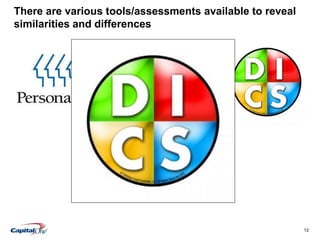
There are various tools/assessments available to reveal
similarities and differences
12
There are various tools/assessments available to reveal
similarities and differences
13
Tool…
• To understand team members’ temperament and behaviors
– How they think, act and interact
• That provides a common language to allow team members to better
understand themselves and how they can adapt their behaviors when
working with others.
• To allow discussion of behavioral differences
• That is composed of two dimensions: Pace & Focus
What is the DiSC Model?
*excerpt from http://discpersonalitytesting.com/
14
Understanding how each team member is different will
shape how to best interact
Active: Fast-Paced, Bold, Dynamic, Assertive
Thoughtful: Moderate-Paced, Calm, Careful, Methodical
Questioning:
Logic-
Focused,
Challenging,
Skeptical,
Objective
Accepting:
People-
Focused, Go
with the
Flow,
Subjective
Separate the BEHAVIOR from the PERSON!
*excerpt from http://discpersonalitytesting.com/
15
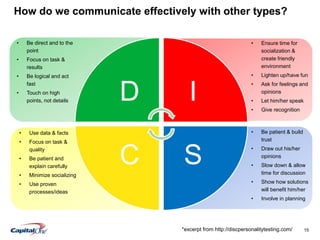
How do we communicate effectively with other types?
• Be direct and to the
point
• Focus on task &
results
• Be logical and act
fast
• Touch on high
points, not details
• Be patient & build
trust
• Draw out his/her
opinions
• Slow down & allow
time for discussion
• Show how solutions
will benefit him/her
• Involve in planning
• Ensure time for
socialization &
create friendly
environment
• Lighten up/have fun
• Ask for feelings and
opinions
• Let him/her speak
• Give recognition
• Use data & facts
• Focus on task &
quality
• Be patient and
explain carefully
• Minimize socializing
• Use proven
processes/ideas
Dominance
Correctness Steadiness
Influence
D I
SC
*excerpt from http://discpersonalitytesting.com/
16
Six Thinking Hats Tool – using all perspectives
*created by Edward de Bono
17
Various tools are recommended to help collaboration
with all DiSC Personalities
• Create environment/activities for all types
– Use stickies or way to give everyone a voice
– Give time to folks who need to process to provide input/feedback,
– Send out agenda to allow team members to pre-think what’s going to
be discussed and/or determine if they need to attend
• Six Thinking Hats
• Use team norms to allow the team to have agreements
with ‘how’ they will work together
18
Recap
• Team members that understand
themselves AND their team members are
able to better work together more
effectively
• The team conversation is the most critical
part of discovering similarities and
differences and how they like to interact
• As a facilitator or coach for the team – you
will need to be sure to create an
environment to help the team thrive

Julianne Moroni Presentation

  • 1.
    Leveraging your team’s“personality” to drive team success Delivery Transformation – Enterprise 2015 Linked In: Julie Moroni Twitter: @jamoroni2
  • 2.
    2 Today’s Goal • Appreciatewhat makes us all unique • Understand relationship of our uniqueness and behavior • Realize the value of understanding our differences • Review of options to discuss differences • Explain the DiSC Model & how it can be used with teams • Learn some tools to help teams work more effectively
  • 3.
    3 In order tounderstand your team’s personality, let’s first understand the purpose of a team A group of people with complementary skills required to complete a task, job, or project.* *http://www.businessdictionary.com What is a team?
  • 4.
    4 Every person onthe team brings a uniqueness, who they are, to the team Experiences Religious/Personal/Work Background Values Personality Role Upbringing Peer and/or Social Group Education/Knowledge Gender Learning Modes
  • 5.
    5 Every person onthe team brings a uniqueness, who they are, to the team Experiences Religious/Personal/Work Background Values Personality Role Upbringing Peer and/or Social Group Education/Knowledge Gender Learning Modes
  • 6.
    6 Relationship of whoyou are and your behavior Whoyouare Behavior • Comprised of various inputs that make us different • Consistent pattern of thoughts and emotions *excerpts from Intesi! • Expression of who you are • Each person has a behavioral Style related to their personality/ who they are
  • 7.
    7 What behaviors mightyou see? Take a long time to make a decision or are indecisive Say what’s on their mind in a direct manner Like to makes lists Are at the water cooler or socialize frequently
  • 8.
    8 What behaviors mightyou see? Take a long time to make a decision or are indecisive Say what’s on their mind in a direct manner Like to makes lists Are at the water cooler or socialize frequently
  • 9.
    9 How instead canwe benefit by understanding the differences? • Increase your self-knowledge: how you respond to conflict, what motivates you, what causes you stress and how you solve problems • Minimize conflict and handle conflicts (when they do occur) more effectively • Facilitate better teamwork through improved communication and collaboration • Enable better decision making conversations • Reduce awkward social interactions
  • 10.
    10 Everyone is aunique blend - what’s yours?
  • 11.
    11 There are varioustools/assessments available to reveal similarities and differences
  • 12.
    12 There are varioustools/assessments available to reveal similarities and differences
  • 13.
    13 Tool… • To understandteam members’ temperament and behaviors – How they think, act and interact • That provides a common language to allow team members to better understand themselves and how they can adapt their behaviors when working with others. • To allow discussion of behavioral differences • That is composed of two dimensions: Pace & Focus What is the DiSC Model? *excerpt from http://discpersonalitytesting.com/
  • 14.
    14 Understanding how eachteam member is different will shape how to best interact Active: Fast-Paced, Bold, Dynamic, Assertive Thoughtful: Moderate-Paced, Calm, Careful, Methodical Questioning: Logic- Focused, Challenging, Skeptical, Objective Accepting: People- Focused, Go with the Flow, Subjective Separate the BEHAVIOR from the PERSON! *excerpt from http://discpersonalitytesting.com/
  • 15.
    15 How do wecommunicate effectively with other types? • Be direct and to the point • Focus on task & results • Be logical and act fast • Touch on high points, not details • Be patient & build trust • Draw out his/her opinions • Slow down & allow time for discussion • Show how solutions will benefit him/her • Involve in planning • Ensure time for socialization & create friendly environment • Lighten up/have fun • Ask for feelings and opinions • Let him/her speak • Give recognition • Use data & facts • Focus on task & quality • Be patient and explain carefully • Minimize socializing • Use proven processes/ideas Dominance Correctness Steadiness Influence D I SC *excerpt from http://discpersonalitytesting.com/
  • 16.
    16 Six Thinking HatsTool – using all perspectives *created by Edward de Bono
  • 17.
    17 Various tools arerecommended to help collaboration with all DiSC Personalities • Create environment/activities for all types – Use stickies or way to give everyone a voice – Give time to folks who need to process to provide input/feedback, – Send out agenda to allow team members to pre-think what’s going to be discussed and/or determine if they need to attend • Six Thinking Hats • Use team norms to allow the team to have agreements with ‘how’ they will work together
  • 18.
    18 Recap • Team membersthat understand themselves AND their team members are able to better work together more effectively • The team conversation is the most critical part of discovering similarities and differences and how they like to interact • As a facilitator or coach for the team – you will need to be sure to create an environment to help the team thrive