Presentation licensedPresentation licensed CC-BY CanadaCC-BY Canada, except images licensed otherwise, except images licensed otherwise
PHIL 102
Christina Hendricks
Fall 2013
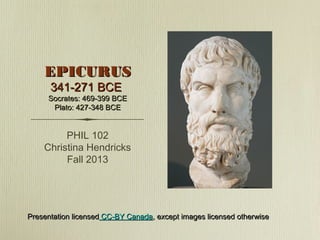
EPICURUSEPICURUS
341-271 BCE341-271 BCE
Socrates: 469-399 BCESocrates: 469-399 BCE
Plato: 427-348 BCEPlato: 427-348 BCE
Macedonia & Greece, 336 BCE
https://en.wikipedia.org/wiki/File:Map_Macedonia_336_BC-en.svg licensedlicensed CC-BY-SACC-BY-SA
Athens
conquered by
Philip of
Macedon, 338
BCE
Macedonian empire under Alexander
the Great, 334-323 BCE
https://en.wikipedia.org/wiki/File:MacedonEmpire.jpghttps://en.wikipedia.org/wiki/File:MacedonEmpire.jpg LicensedLicensed CC-BY-SACC-BY-SA
Epicurus: epistemology
• Empiricist
• the ultimate source of all knowledge is
information from the senses (see, e.g.,
http://plato.stanford.edu/entries/rationalism-empiricism/#1.2)
• sensation occurs through “films” of atoms
coming off material bodies and entering our
bodies
Epicurus: physics
• Reality is made up only of matter and void--nothing
immaterial (see http://plato.stanford.edu/entries/epicurus/#3)
• universe is eternal--nothing can emerge from
nothing (see http://www.iep.utm.edu/epicur/#H3
• Some material must be eternal, but it’s not large
bodies; must be smaller parts
• There are “atoms” as smallest parts of matter,
indivisible (or else could dissolve into nothing)
• Atoms exist eternally
Epicurus on the gods &
death
• The gods do not control the universe; it
works on its own through principles of
physics
• There is no such thing as an immaterial,
immortal soul
• We should not fear death (“Letter to
Menoeceus” para. 125; Principal Doctrines
(2))
All of this info about physics, gods,
death is to help people live the best life
• Best life has the “greatest good”: pleasure (for
oneself)
• ultimate end/goal of all action--everything we do
is for the sake of reaching this
• sought as intrinsic good--good in itself, not just
as instrumental good (as means to something
else good)
• serves as the “standard for judging the
goodness of everything” (“Ltr to M,” para 129)
Most pleasurable state:
ataraxia
• Ataraxia: Lack of physical or mental pain, not
having unfulfilled desires, sense of peace and
tranquility (see, e.g., “Letter to M,” para. 128, 132)
• This is a “static” pleasure, as opposed to a
“kinetic” one
• “kinetic” pleasures: pleasure gotten while in the
act of fulfilling desires
• kinetic pleasures require that one also has pain
(desire being fulfilled), and it may take significant
work & trouble to keep getting them
How to have the best life
Natural desires
Cultivate and fulfill mainly certain types of desiresCultivate and fulfill mainly certain types of desires
Vain desires
come from “baseless
opinion” (Pr Doct #29)
Unnecessary
Always
unnecessary;
insatiable;
troublesome to
fulfill
(LM, para 131, Pr
Doc #15) (e.g.,
power, wealth,
fame, immortality)
Necessary
Need not bring pain if not
fulfilled, b/c can get rid of
desire fairly easily; can be
troublesome to fulfill (Pr
Doc #26) (e.g., luxurious food
& clothing, (sometimes) sex)
Bring pain if not fulfilled;
necessary for happiness,
health or life itself; naturally
limited & easy to fulfill (LM
para 128, Pr Doc #15, 21) (e.g.,
food, shelter, rest, friendship)
How to have the best life
• Aim to fulfill (mostly) natural and necessary
desires
• Enjoy plain meals & simple lifestyle (Letter to
M, para. 131)
• Fulfill natural and unnecessary desires when it is
easy to do so, but don’t cultivate such desires in
self (Letter to M, para. 131)
• Don’t fulfill vain desires at all
How to have the best life
• Be sure to cultivate and preserve friendships
(Princ Doctrines #27-28, 39-40)
• Why would having friends be so important to
happiness?
• Note that the value of friendship, like anything
else, is for one’s own pleasure
• But it’s possible to get pleasure from really
caring about others for themselves, not just b/c
having friends is good for you (& genuine care
for others is probably necessary for preserving
friendship)
How to have the best life
• Live “prudently, honorably, and justly”; “the
virtues are inseparable from a happy life”
(Letter to M, para 132; also Princ Doctrines
#5)
• Justice: living according to agreements in a
society (e.g., laws) that actually lead to
mutual benefit (Princ Doctr #31-33, 36-38)
• Why can’t one be unjust and happy?
(Princ Doctr #34-35)
How can philosophy help us
live the best life?
• Not just providing arguments for how to reduce
pain/increase pleasure, but also encouraging
people to guide their lives by these
• The “principal doctrines” appear to be short
sayings that people might be able to
remember--keep these things in mind as much
as possible so can live by them
• Groups of friends could support/encourage each
other to put these ideas into action in their lives

All notes on Epicurus (Sept. 30 & Oct 2, 2013)

  • 1.
    Presentation licensedPresentation licensedCC-BY CanadaCC-BY Canada, except images licensed otherwise, except images licensed otherwise PHIL 102 Christina Hendricks Fall 2013 EPICURUSEPICURUS 341-271 BCE341-271 BCE Socrates: 469-399 BCESocrates: 469-399 BCE Plato: 427-348 BCEPlato: 427-348 BCE
  • 2.
    Macedonia & Greece,336 BCE https://en.wikipedia.org/wiki/File:Map_Macedonia_336_BC-en.svg licensedlicensed CC-BY-SACC-BY-SA Athens conquered by Philip of Macedon, 338 BCE
  • 3.
    Macedonian empire underAlexander the Great, 334-323 BCE https://en.wikipedia.org/wiki/File:MacedonEmpire.jpghttps://en.wikipedia.org/wiki/File:MacedonEmpire.jpg LicensedLicensed CC-BY-SACC-BY-SA
  • 4.
    Epicurus: epistemology • Empiricist •the ultimate source of all knowledge is information from the senses (see, e.g., http://plato.stanford.edu/entries/rationalism-empiricism/#1.2) • sensation occurs through “films” of atoms coming off material bodies and entering our bodies
  • 5.
    Epicurus: physics • Realityis made up only of matter and void--nothing immaterial (see http://plato.stanford.edu/entries/epicurus/#3) • universe is eternal--nothing can emerge from nothing (see http://www.iep.utm.edu/epicur/#H3 • Some material must be eternal, but it’s not large bodies; must be smaller parts • There are “atoms” as smallest parts of matter, indivisible (or else could dissolve into nothing) • Atoms exist eternally
  • 6.
    Epicurus on thegods & death • The gods do not control the universe; it works on its own through principles of physics • There is no such thing as an immaterial, immortal soul • We should not fear death (“Letter to Menoeceus” para. 125; Principal Doctrines (2))
  • 7.
    All of thisinfo about physics, gods, death is to help people live the best life • Best life has the “greatest good”: pleasure (for oneself) • ultimate end/goal of all action--everything we do is for the sake of reaching this • sought as intrinsic good--good in itself, not just as instrumental good (as means to something else good) • serves as the “standard for judging the goodness of everything” (“Ltr to M,” para 129)
  • 8.
    Most pleasurable state: ataraxia •Ataraxia: Lack of physical or mental pain, not having unfulfilled desires, sense of peace and tranquility (see, e.g., “Letter to M,” para. 128, 132) • This is a “static” pleasure, as opposed to a “kinetic” one • “kinetic” pleasures: pleasure gotten while in the act of fulfilling desires • kinetic pleasures require that one also has pain (desire being fulfilled), and it may take significant work & trouble to keep getting them
  • 9.
    How to havethe best life Natural desires Cultivate and fulfill mainly certain types of desiresCultivate and fulfill mainly certain types of desires Vain desires come from “baseless opinion” (Pr Doct #29) Unnecessary Always unnecessary; insatiable; troublesome to fulfill (LM, para 131, Pr Doc #15) (e.g., power, wealth, fame, immortality) Necessary Need not bring pain if not fulfilled, b/c can get rid of desire fairly easily; can be troublesome to fulfill (Pr Doc #26) (e.g., luxurious food & clothing, (sometimes) sex) Bring pain if not fulfilled; necessary for happiness, health or life itself; naturally limited & easy to fulfill (LM para 128, Pr Doc #15, 21) (e.g., food, shelter, rest, friendship)
  • 10.
    How to havethe best life • Aim to fulfill (mostly) natural and necessary desires • Enjoy plain meals & simple lifestyle (Letter to M, para. 131) • Fulfill natural and unnecessary desires when it is easy to do so, but don’t cultivate such desires in self (Letter to M, para. 131) • Don’t fulfill vain desires at all
  • 11.
    How to havethe best life • Be sure to cultivate and preserve friendships (Princ Doctrines #27-28, 39-40) • Why would having friends be so important to happiness? • Note that the value of friendship, like anything else, is for one’s own pleasure • But it’s possible to get pleasure from really caring about others for themselves, not just b/c having friends is good for you (& genuine care for others is probably necessary for preserving friendship)
  • 12.
    How to havethe best life • Live “prudently, honorably, and justly”; “the virtues are inseparable from a happy life” (Letter to M, para 132; also Princ Doctrines #5) • Justice: living according to agreements in a society (e.g., laws) that actually lead to mutual benefit (Princ Doctr #31-33, 36-38) • Why can’t one be unjust and happy? (Princ Doctr #34-35)
  • 13.
    How can philosophyhelp us live the best life? • Not just providing arguments for how to reduce pain/increase pleasure, but also encouraging people to guide their lives by these • The “principal doctrines” appear to be short sayings that people might be able to remember--keep these things in mind as much as possible so can live by them • Groups of friends could support/encourage each other to put these ideas into action in their lives