Beyond cost savings: The value of OER and
open pedagogy for student learning
Christina Hendricks
Deputy Academic Director, CTLT, UBC
Mt Royal U, March 9, 2018
Slides:
http://is.gd/mru_openped_2018
Agenda
◈ Introductions
◈ Open Education: What and How?
◈ What are OEP and open pedagogy?
 Your thoughts
 Themes, benefits, challenges
◈ Connecting to your own practice
 1-2-4-all (worksheet, discussion)
Introductions
What do you hope to get out of
this workshop?
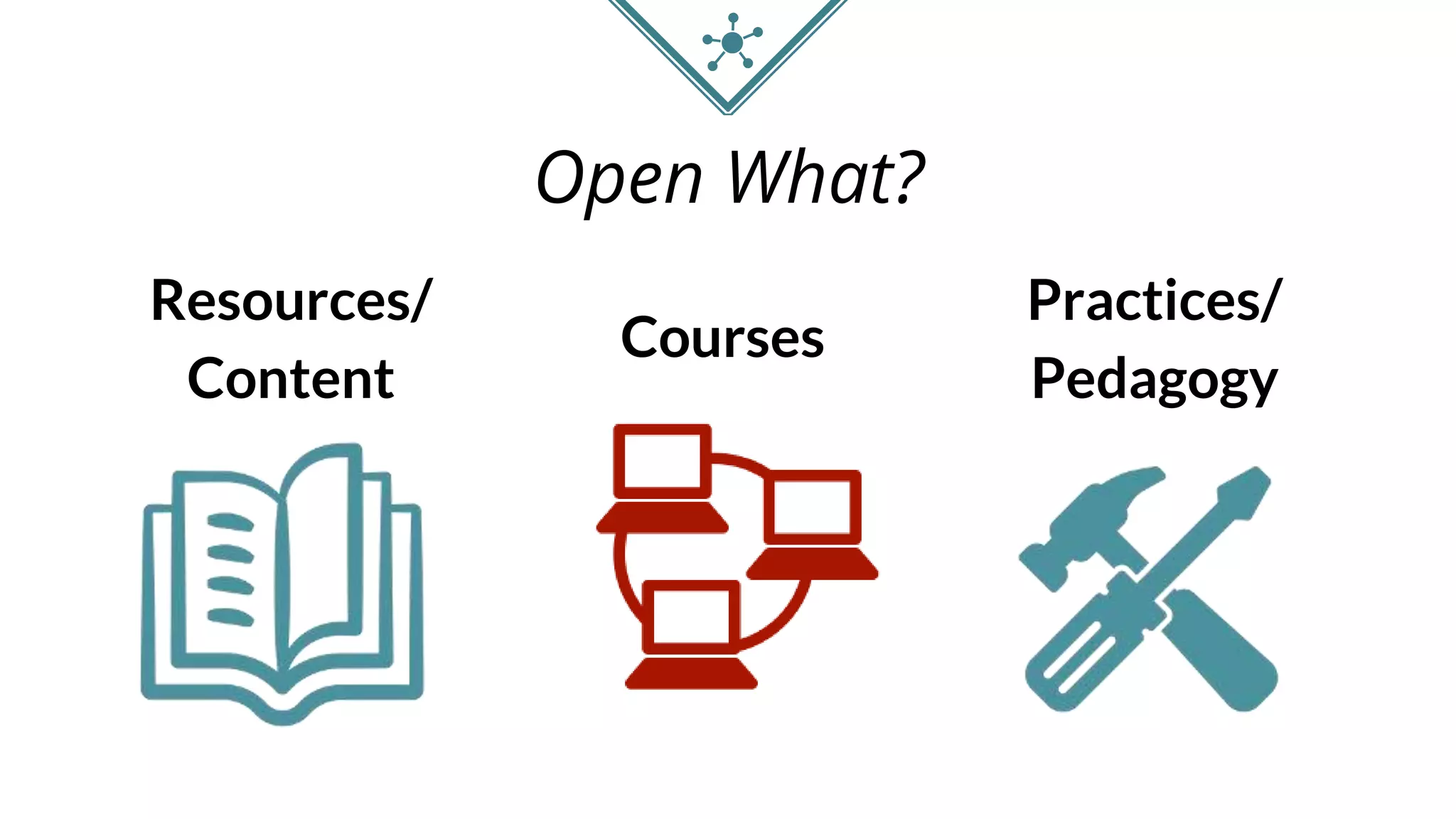
Open What?
Resources/
Content
Courses
Practices/
Pedagogy
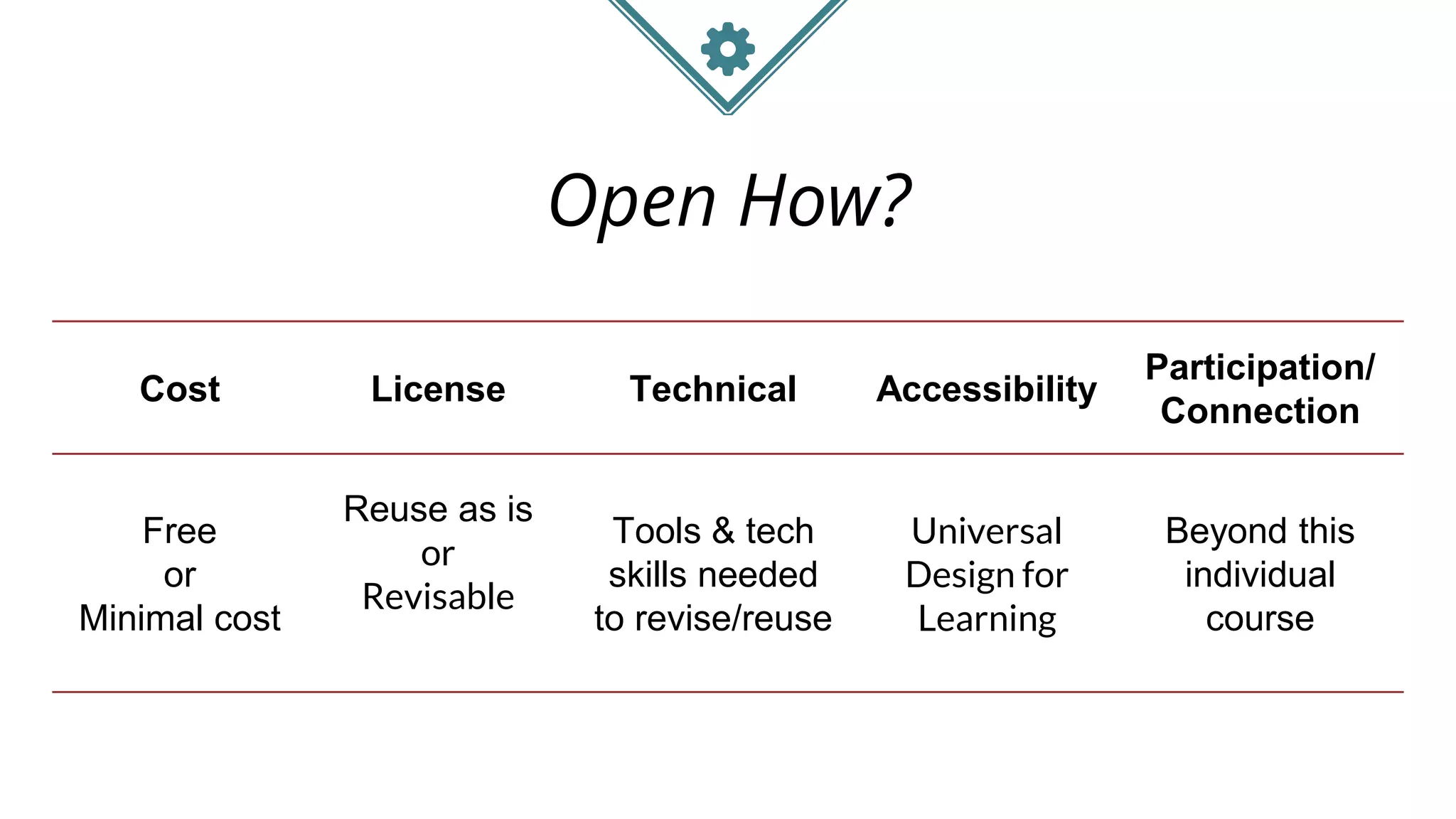
Open How?
Cost License Technical Accessibility
Participation/
Connection
Free
or
Minimal cost
Reuse as is
or
Revisable
Tools & tech
skills needed
to revise/reuse
Universal
Design for
Learning
Beyond this
individual
course
What are Open Edu Practices?
What is open pedagogy?
Your thoughts
Open Educational
Practices
Wider than open pedagogy
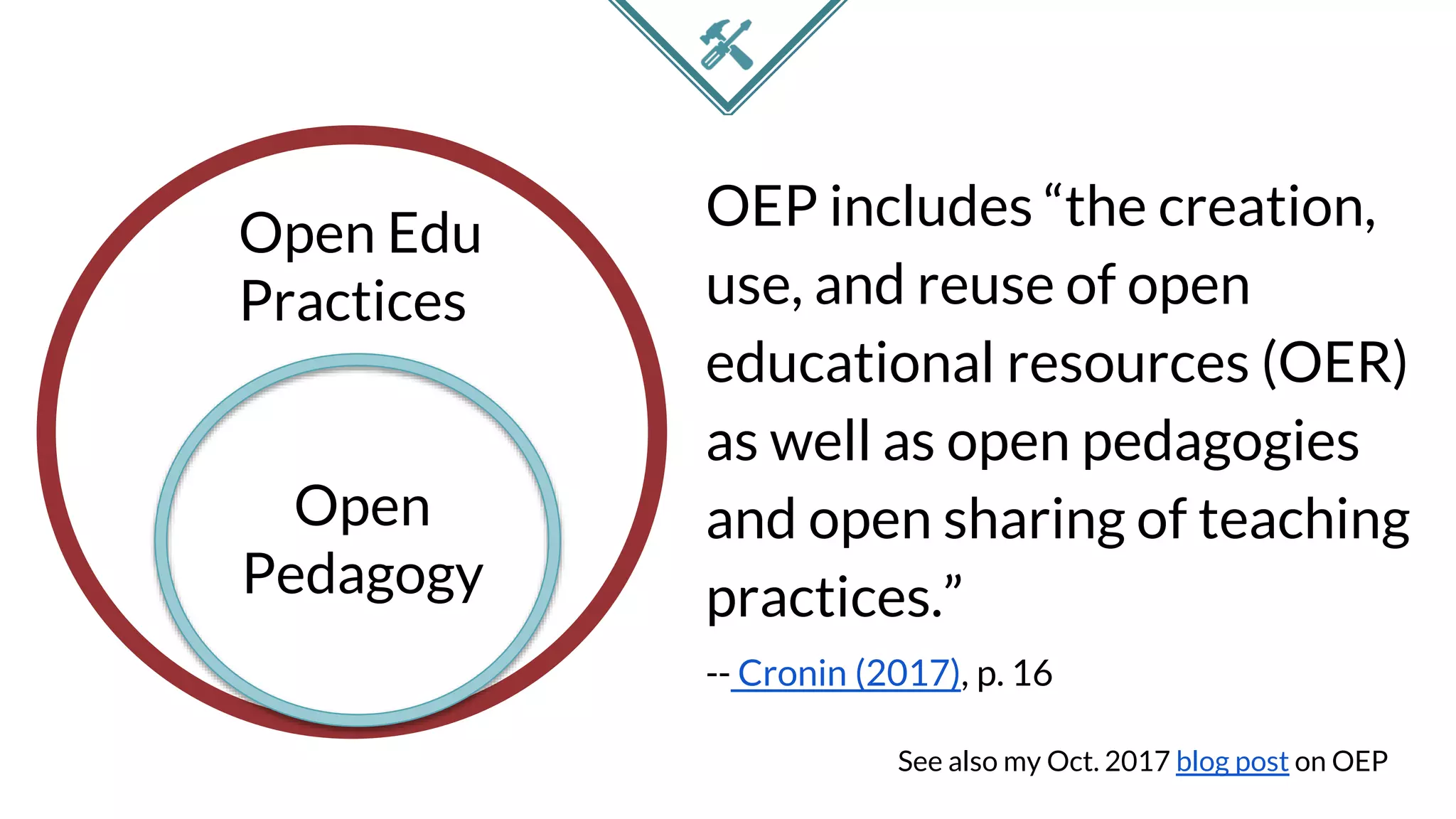
OEP includes “the creation,
use, and reuse of open
educational resources (OER)
as well as open pedagogies
and open sharing of teaching
practices.”
-- Cronin (2017), p. 16
See also my Oct. 2017 blog post on OEP
Open Edu
Practices
Open
Pedagogy
Some examples of OEP
◈ Use, revision & creation of OER; advocating these
◈ Open reflection & sharing of teaching ideas, practices,
process
◈ Open enrollment courses
◈ Open scholarship
-- Open Practices Briefing Paper
(Beetham et al., 2012) Open access logo from PLoS, licensed CC BY-
SA 3.0 on Wikimedia Commons
Open Pedagogy
Teaching and learning in the open
OER-enabled Pedagogy
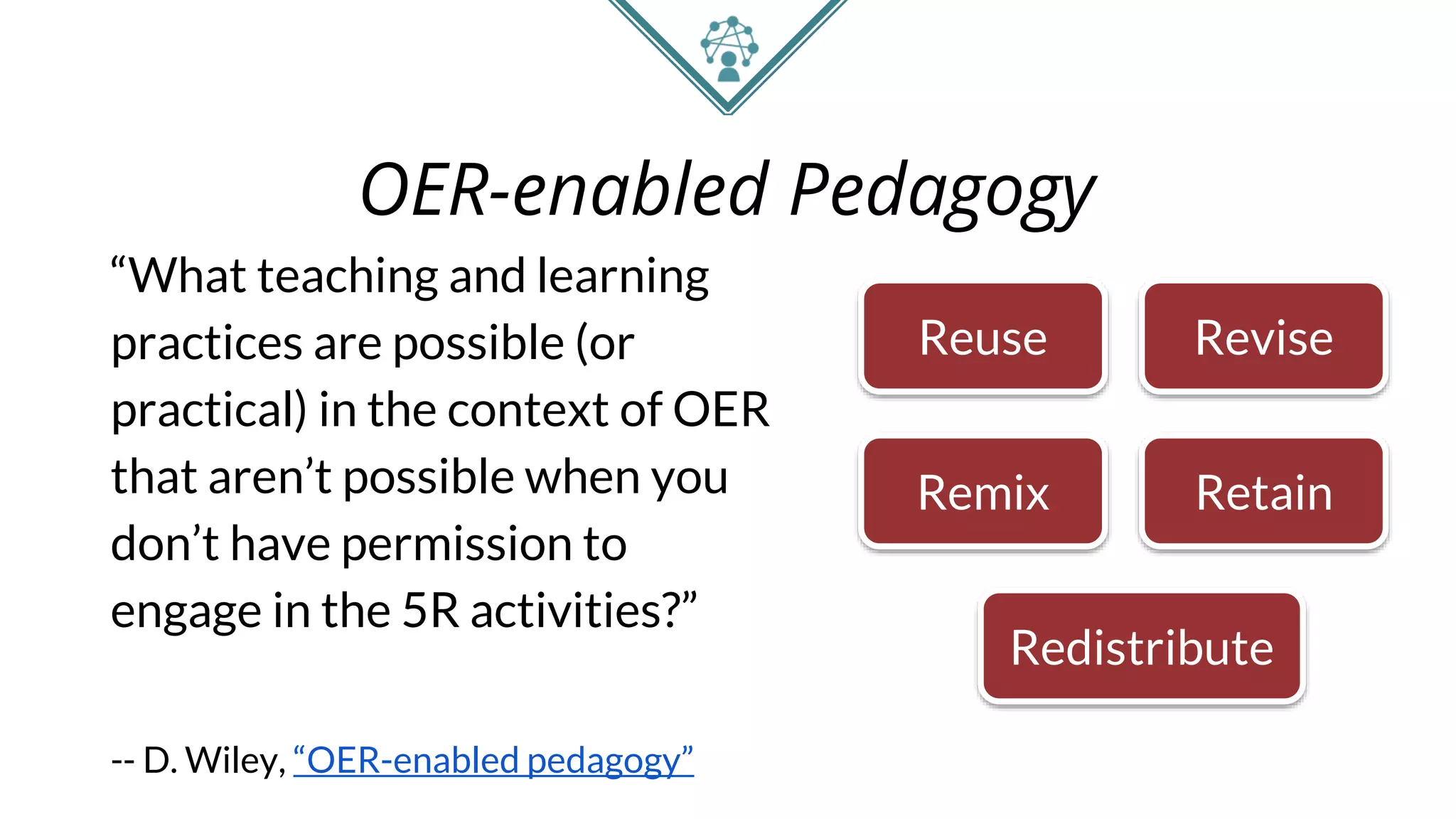
“What teaching and learning
practices are possible (or
practical) in the context of OER
that aren’t possible when you
don’t have permission to
engage in the 5R activities?”
-- D. Wiley, “OER-enabled pedagogy”
Reuse Revise
Remix Retain
Redistribute
Quotes re: Open Pedagogy
◈ “we shift the student emphasis to contribution to knowledge as
opposed to simple consumption of knowledge” (Heather Ross)
◈ “the ability for learners to shape and take ownership of their
own education” (Devon Ritter)
◈ “connect with a broader, global community” (Tannis Morgan)
◈ “teacher as ‘the’ authority vs. students being able to bring other
sources of authority” (Jim Luke)
Open
Pedagogy
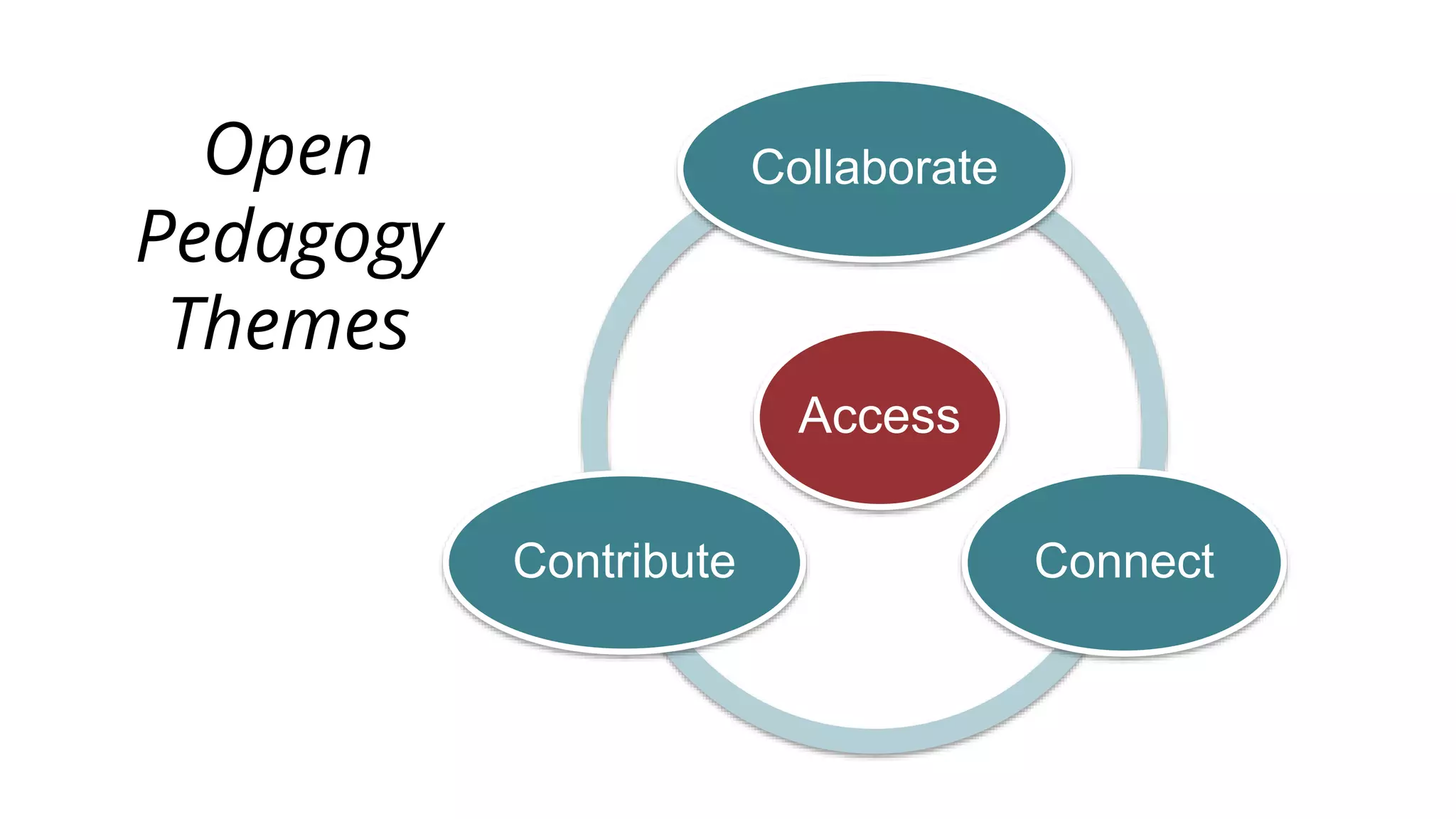
Themes
Access
Collaborate
ConnectContribute
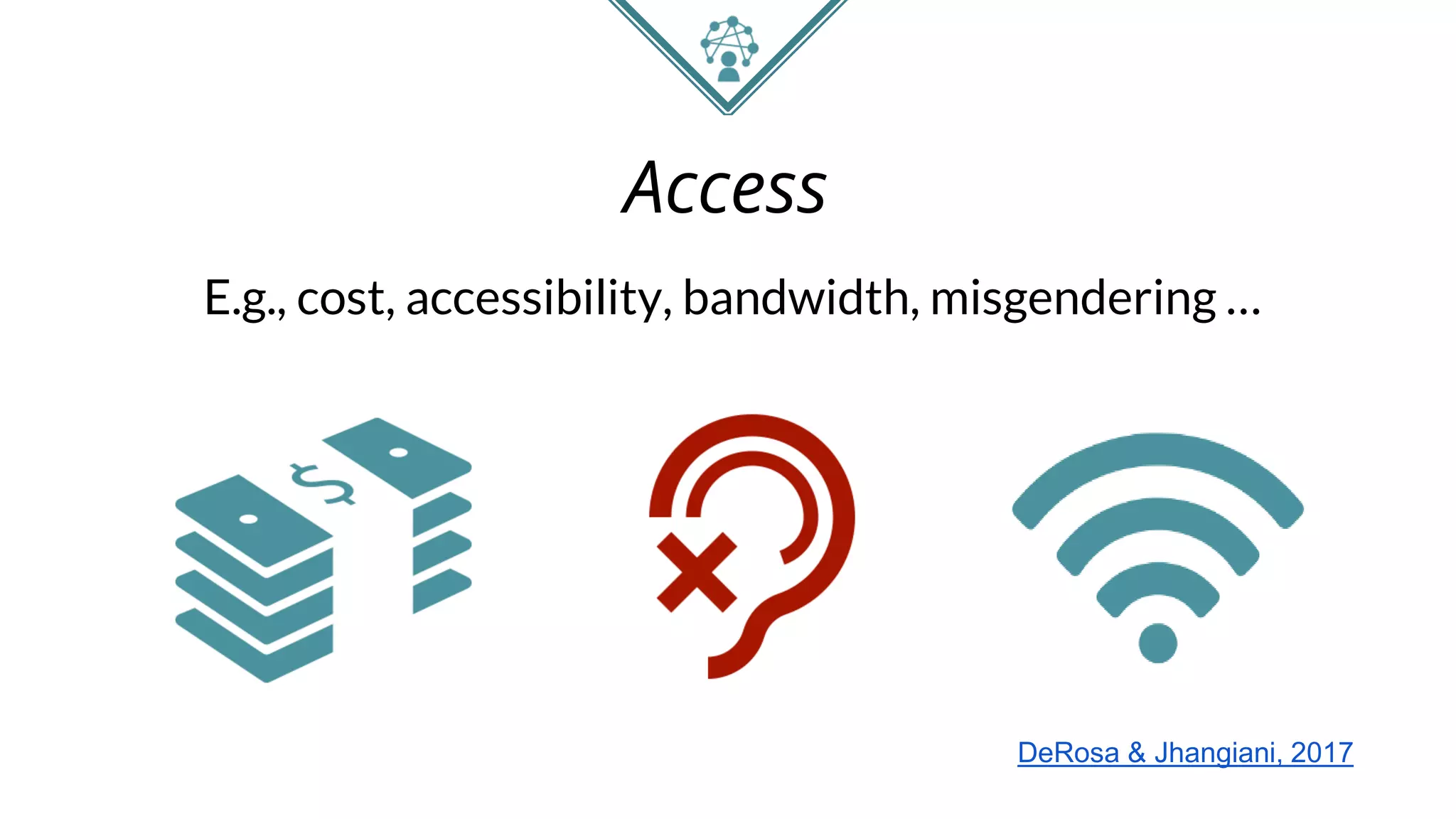
Access
E.g., cost, accessibility, bandwidth, misgendering …
DeRosa & Jhangiani, 2017
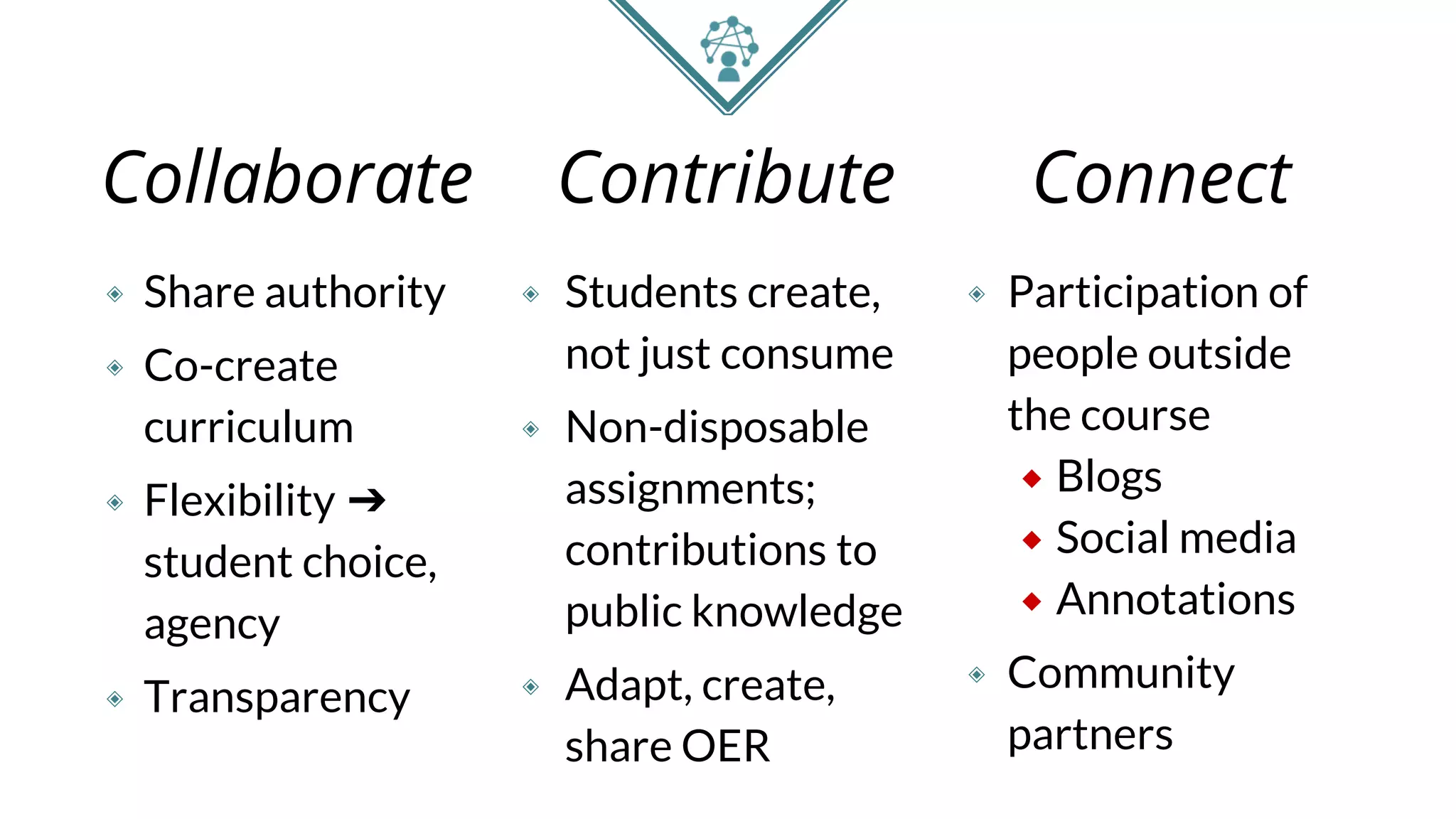
Collaborate Contribute Connect
◈ Share authority
◈ Co-create
curriculum
◈ Flexibility ➔
student choice,
agency
◈ Transparency
◈ Students create,
not just consume
◈ Non-disposable
assignments;
contributions to
public knowledge
◈ Adapt, create,
share OER
◈ Participation of
people outside
the course
⬥ Blogs
⬥ Social media
⬥ Annotations
◈ Community
partners
How are all these things “open”?
Reducing or crossing barriers & boundaries
Instructor Learner TransparencyCourse
Open Pedagogy
Examples
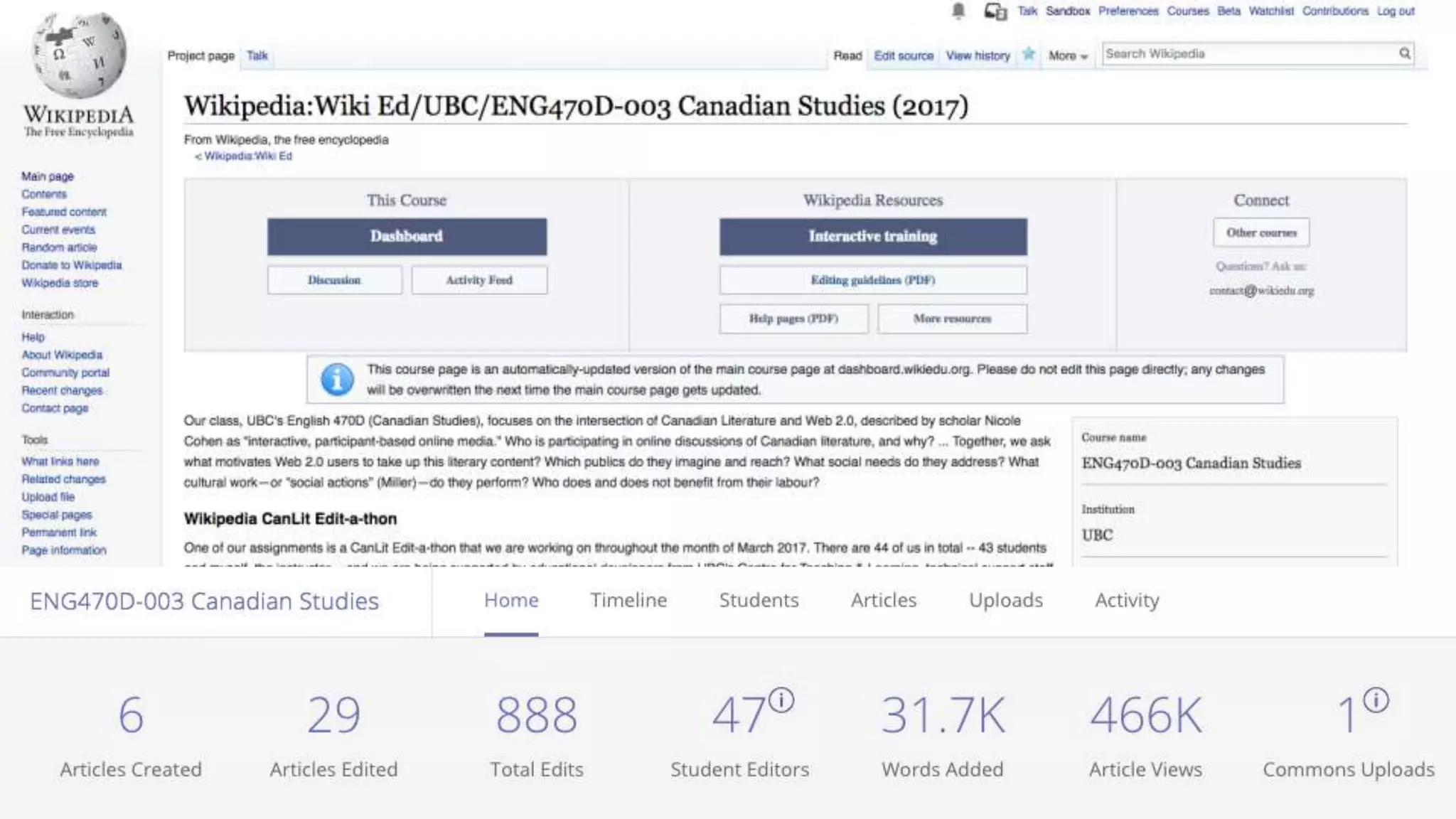
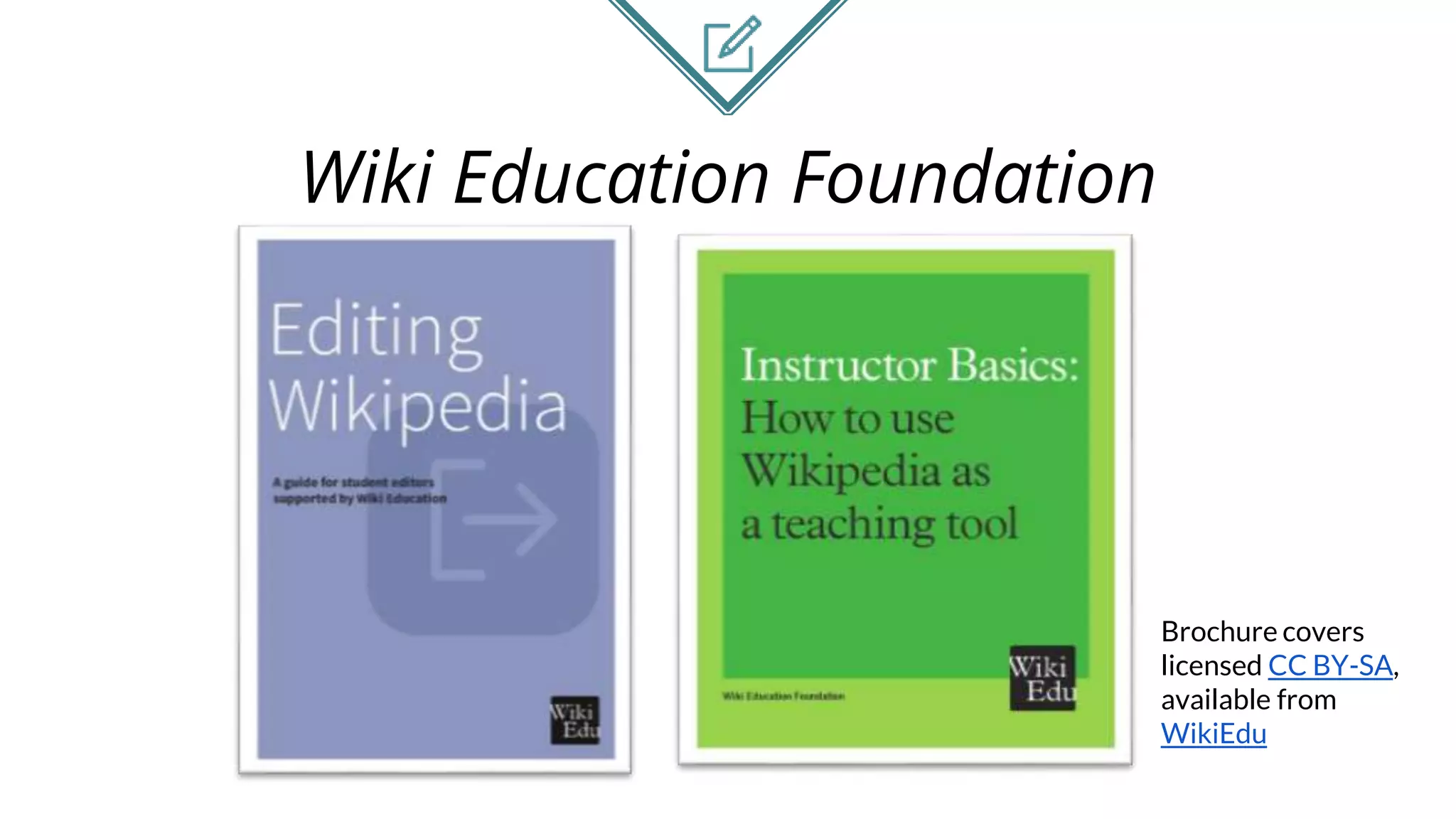
Wiki Education Foundation
Brochure covers
licensed CC BY-SA,
available from
WikiEdu
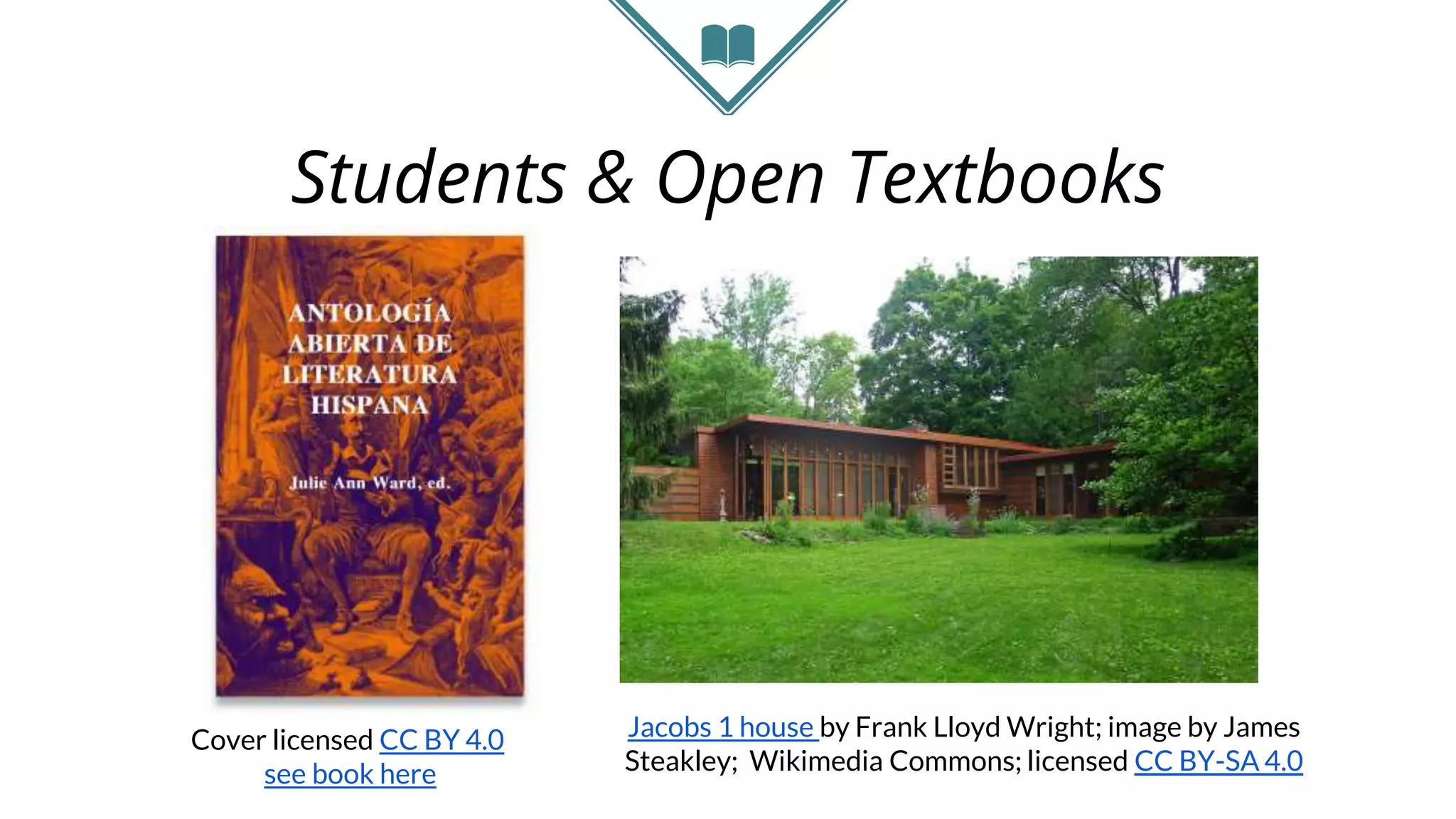
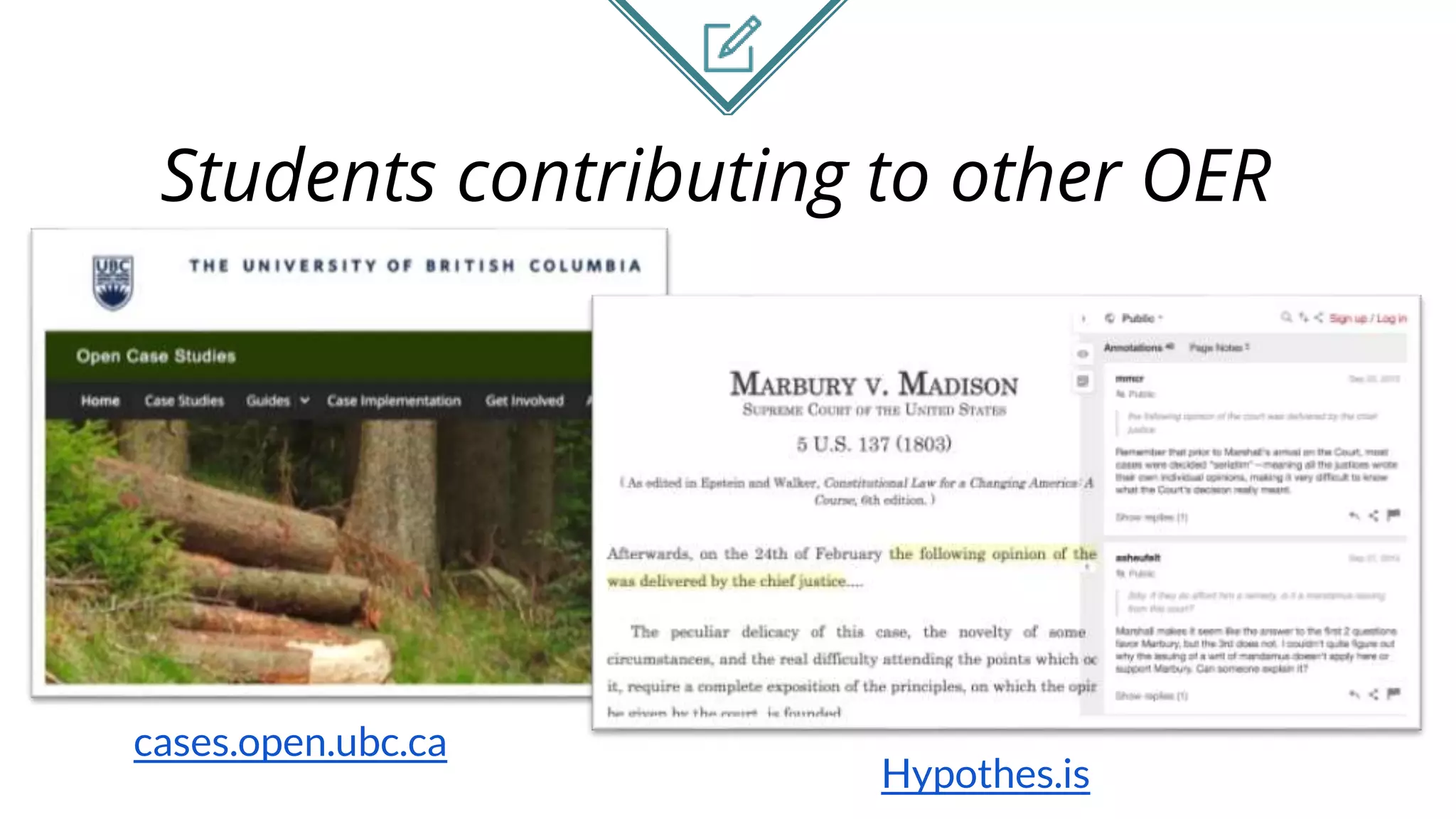
Students & Open Textbooks
Cover licensed CC BY 4.0
see book here
Jacobs 1 house by Frank Lloyd Wright; image by James
Steakley; Wikimedia Commons; licensed CC BY-SA 4.0
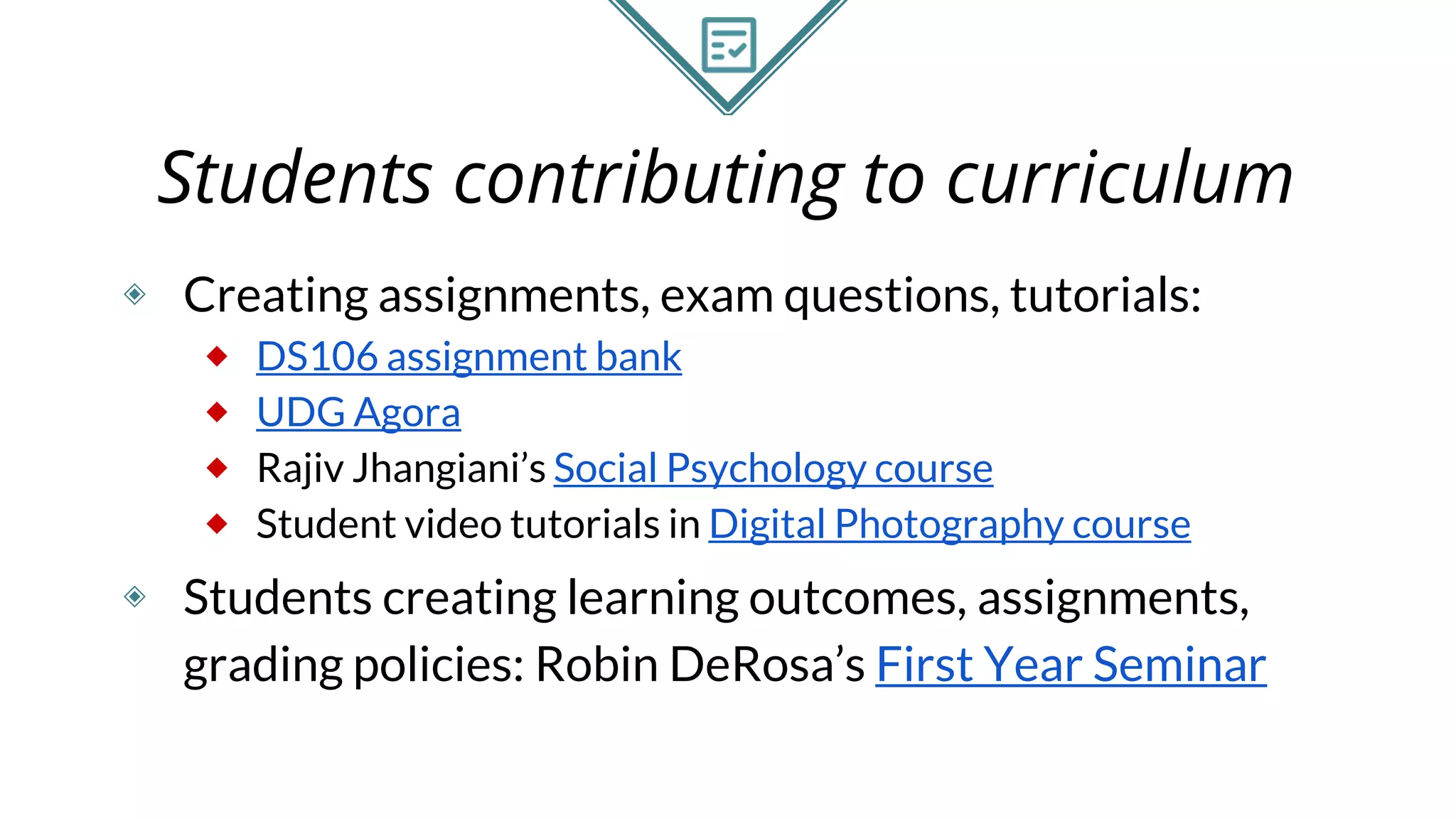
Students contributing to other OER
cases.open.ubc.ca
Hypothes.is
Students contributing to curriculum
◈ Creating assignments, exam questions, tutorials:
⬥ DS106 assignment bank
⬥ UDG Agora
⬥ Rajiv Jhangiani’s Social Psychology course
⬥ Student video tutorials in Digital Photography course
◈ Students creating learning outcomes, assignments,
grading policies: Robin DeRosa’s First Year Seminar
Benefits & Challenges
of Open Pedagogy
Discussion in small groups
“open pedagogy is an ethos that has two …
components:
• A belief in the potential of openness and sharing to
improve learning
• A social justice orientation – caring about equity,
with openness as one way to achieve this”
-- Maha Bali, “What is Open Pedagogy?” (2017)
Student perceptions: Benefits
You’re able to be part of community
conversations … happening right now.”
-- What Students Have to Say about Open ED
“I became a better writer .... I knew [the blog
posts] could potentially be seen by people
outside of Keene State so I wanted to make sure
my information was accurate and written well.”
-- student at Keene State College
“I liked how the wiki
made me feel like I
was actually making
a contribution with
my work – it’s
become meaningful.”
-- student contributor to
UBC Open Case Studies
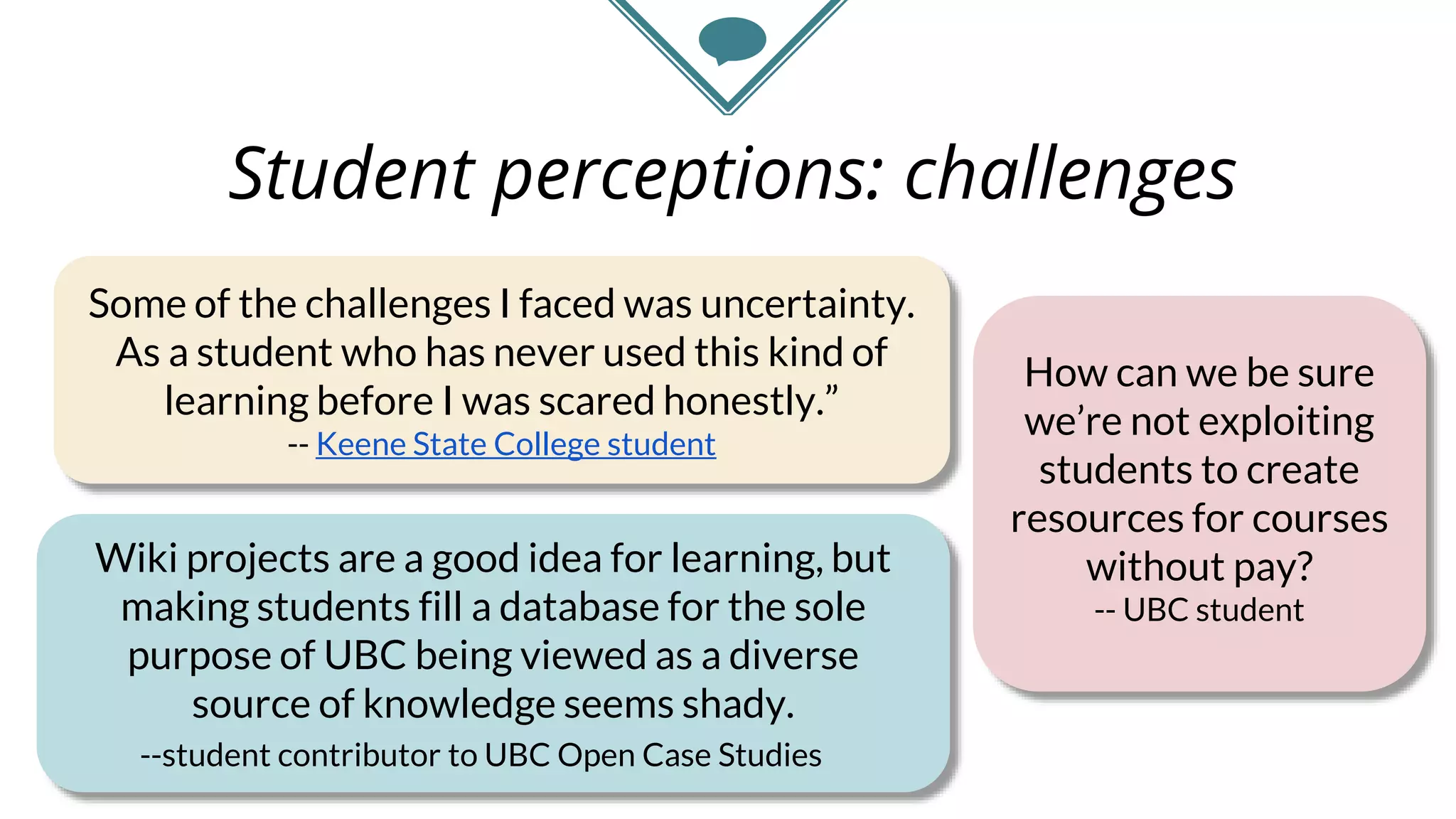
Student perceptions: challenges
Wiki projects are a good idea for learning, but
making students fill a database for the sole
purpose of UBC being viewed as a diverse
source of knowledge seems shady.
--student contributor to UBC Open Case Studies
Some of the challenges I faced was uncertainty.
As a student who has never used this kind of
learning before I was scared honestly.”
-- Keene State College student
How can we be sure
we’re not exploiting
students to create
resources for courses
without pay?
-- UBC student
OEP/Open Pedagogy in your context
1-2-4-all
• Worksheet individually
• Discuss any part of worksheet in pairs
• Two pairs discuss together
• Share back with full group
Thank you!
Web: http://chendricks.org
Blog: http://blogs.ubc.ca/chendricks
Twitter: @chendricksUBC @clhendricksbc
Slides: http://is.gd/mru_openped_2018
License & Credits
License:
◈ Except images or other elements licensed otherwise, this
presentation is licensed CC BY 4.0
Credits:
◈ Presentation template by SlidesCarnival
◈ Icons either from this Slides Carnival template or purchased with
a subscription from The Noun Project
◈ Image of statue with scales of justice licensed CC0 on pixabay.com

Beyond Cost Savings: The Value of OER and Open Pedagogy for Student Learning

  • 1.
    Beyond cost savings:The value of OER and open pedagogy for student learning Christina Hendricks Deputy Academic Director, CTLT, UBC Mt Royal U, March 9, 2018
  • 2.
  • 3.
    Agenda ◈ Introductions ◈ OpenEducation: What and How? ◈ What are OEP and open pedagogy?  Your thoughts  Themes, benefits, challenges ◈ Connecting to your own practice  1-2-4-all (worksheet, discussion)
  • 4.
    Introductions What do youhope to get out of this workshop?
  • 5.
  • 6.
    Open How? Cost LicenseTechnical Accessibility Participation/ Connection Free or Minimal cost Reuse as is or Revisable Tools & tech skills needed to revise/reuse Universal Design for Learning Beyond this individual course
  • 7.
    What are OpenEdu Practices? What is open pedagogy? Your thoughts
  • 8.
  • 9.
    OEP includes “thecreation, use, and reuse of open educational resources (OER) as well as open pedagogies and open sharing of teaching practices.” -- Cronin (2017), p. 16 See also my Oct. 2017 blog post on OEP Open Edu Practices Open Pedagogy
  • 10.
    Some examples ofOEP ◈ Use, revision & creation of OER; advocating these ◈ Open reflection & sharing of teaching ideas, practices, process ◈ Open enrollment courses ◈ Open scholarship -- Open Practices Briefing Paper (Beetham et al., 2012) Open access logo from PLoS, licensed CC BY- SA 3.0 on Wikimedia Commons
  • 11.
    Open Pedagogy Teaching andlearning in the open
  • 12.
    OER-enabled Pedagogy “What teachingand learning practices are possible (or practical) in the context of OER that aren’t possible when you don’t have permission to engage in the 5R activities?” -- D. Wiley, “OER-enabled pedagogy” Reuse Revise Remix Retain Redistribute
  • 13.
    Quotes re: OpenPedagogy ◈ “we shift the student emphasis to contribution to knowledge as opposed to simple consumption of knowledge” (Heather Ross) ◈ “the ability for learners to shape and take ownership of their own education” (Devon Ritter) ◈ “connect with a broader, global community” (Tannis Morgan) ◈ “teacher as ‘the’ authority vs. students being able to bring other sources of authority” (Jim Luke)
  • 14.
  • 15.
    Access E.g., cost, accessibility,bandwidth, misgendering … DeRosa & Jhangiani, 2017
  • 16.
    Collaborate Contribute Connect ◈Share authority ◈ Co-create curriculum ◈ Flexibility ➔ student choice, agency ◈ Transparency ◈ Students create, not just consume ◈ Non-disposable assignments; contributions to public knowledge ◈ Adapt, create, share OER ◈ Participation of people outside the course ⬥ Blogs ⬥ Social media ⬥ Annotations ◈ Community partners
  • 17.
    How are allthese things “open”? Reducing or crossing barriers & boundaries Instructor Learner TransparencyCourse
  • 18.
  • 20.
    Wiki Education Foundation Brochurecovers licensed CC BY-SA, available from WikiEdu
  • 21.
    Students & OpenTextbooks Cover licensed CC BY 4.0 see book here Jacobs 1 house by Frank Lloyd Wright; image by James Steakley; Wikimedia Commons; licensed CC BY-SA 4.0
  • 22.
    Students contributing toother OER cases.open.ubc.ca Hypothes.is
  • 23.
    Students contributing tocurriculum ◈ Creating assignments, exam questions, tutorials: ⬥ DS106 assignment bank ⬥ UDG Agora ⬥ Rajiv Jhangiani’s Social Psychology course ⬥ Student video tutorials in Digital Photography course ◈ Students creating learning outcomes, assignments, grading policies: Robin DeRosa’s First Year Seminar
  • 24.
    Benefits & Challenges ofOpen Pedagogy Discussion in small groups
  • 25.
    “open pedagogy isan ethos that has two … components: • A belief in the potential of openness and sharing to improve learning • A social justice orientation – caring about equity, with openness as one way to achieve this” -- Maha Bali, “What is Open Pedagogy?” (2017)
  • 26.
    Student perceptions: Benefits You’reable to be part of community conversations … happening right now.” -- What Students Have to Say about Open ED “I became a better writer .... I knew [the blog posts] could potentially be seen by people outside of Keene State so I wanted to make sure my information was accurate and written well.” -- student at Keene State College “I liked how the wiki made me feel like I was actually making a contribution with my work – it’s become meaningful.” -- student contributor to UBC Open Case Studies
  • 27.
    Student perceptions: challenges Wikiprojects are a good idea for learning, but making students fill a database for the sole purpose of UBC being viewed as a diverse source of knowledge seems shady. --student contributor to UBC Open Case Studies Some of the challenges I faced was uncertainty. As a student who has never used this kind of learning before I was scared honestly.” -- Keene State College student How can we be sure we’re not exploiting students to create resources for courses without pay? -- UBC student
  • 28.
    OEP/Open Pedagogy inyour context 1-2-4-all • Worksheet individually • Discuss any part of worksheet in pairs • Two pairs discuss together • Share back with full group
  • 29.
    Thank you! Web: http://chendricks.org Blog:http://blogs.ubc.ca/chendricks Twitter: @chendricksUBC @clhendricksbc Slides: http://is.gd/mru_openped_2018
  • 30.
    License & Credits License: ◈Except images or other elements licensed otherwise, this presentation is licensed CC BY 4.0 Credits: ◈ Presentation template by SlidesCarnival ◈ Icons either from this Slides Carnival template or purchased with a subscription from The Noun Project ◈ Image of statue with scales of justice licensed CC0 on pixabay.com

Editor's Notes

  • #10 Cronin, C. (2017). Openness and Praxis: Exploring the Use of Open Educational Practices in Higher Education. The International Review of Research in Open and Distributed Learning, 18(5). Retrieved from http://www.irrodl.org/index.php/irrodl/article/view/3096
  • #11 Beetham, H., Falconer, I., McGill, L., & Littlejohn, A. (2012). OER Synthesis and Evaluation / OpenPracticesBriefing. JISC. Retrieved from https://oersynth.pbworks.com/w/page/51668352/OpenPracticesBriefing
  • #14 Ross and Ritter quotes from the April 2017 Year of Open perspectives on Open Pedagogy: https://www.yearofopen.org/april-open-perspective-what-is-open-pedagogy/ Luke, J. (2017, April 23). What’s Open? Are OER Necessary? Retrieved March 8, 2018, from https://econproph.com/2017/04/23/whats-open-are-oer-necessary/ Morgan, T. (2017, April 13). Reflections on #OER17 – From Beyond Content to Open Pedagogy. Retrieved March 8, 2018, from https://homonym.ca/uncategorized/reflections-on-oer17-from-beyond-content-to-open-pedagogy/
  • #16 DeRosa, R., & Jhangiani, R. (2017). Open Pedagogy. In E. Mays (Ed.), A Guide to Making Open Textbooks with Students. Rebus Community. Retrieved from https://press.rebus.community/makingopentextbookswithstudents/chapter/open-pedagogy/
  • #22 The following is from Rebus’ Guide to Making Open Textbooks with Students: https://press.rebus.community/makingopentextbookswithstudents/chapter/case-study-antologia-abierta-de-literatura-hispanica/#footnote-81-2 Dr. Julie Ward, an assistant professor of twentieth- and twenty-first-century Latin American literature at University of Oklahoma…. In the fall 2016 semester, she embarked on a project in her Spanish-language literature course, Introduction to Hispanic Literature and Culture, in which groups of four to five students selected ten texts from the fifteenth century to the twentieth century to include in a critical edition. The included texts span different genres of literature, with authors ranging from Christopher Columbus to Horacio Quiroga. Ward and a graduate student “research guide” had pre-established lists of texts students could review and choose from. For each work, the student groups compiled context in the form of an introduction, at least ten annotations on the text about style, references and colloquialisms, an image and a biography about the author–their style, milieux and how the work relates to the rest of their works, and a bibliography. The texts, introductions and all other contextual elements of the book are all in Spanish. The content of the critical edition was developed in the class, but the work on the text didn’t end there. In the subsequent semester, two students were paid to take the critical edition, verify the facts and public domain licenses, and format it using Pressbooks. This one is from same book: https://press.rebus.community/makingopentextbookswithstudents/chapter/case-study-frank-lloyd-wright-and-his-madison-buildings/ Anna Andrzejewski, an art history professor and director of graduate studies at the University of Wisconsin-Madison, was looking for a hands-on learning project for her Frank Lloyd Wright art history course. The class was an upper-division, research course designed for art history majors or grad students, but also open to other disciplines. Andrzejewski had arranged access to seven historic local Frank Lloyd Wright houses for the course. At each home they visited, students all had the same shared experience, but two or three took ownership to document that home for a chapter of the book. Those students asked the others for feedback during and after the site visit on what they found most interesting and what they should write about. Students got to pick a theme for each chapter. First and foremost, the assignment specified that each chapter must include a theme appropriate to the home featured. For instance: preservation, a period of Wright’s career, modular design, a style of architecture. In addition, the assignment specified that each chapter should include three different sections: An introduction, a one- to two-paragraph overview of the house and thesis statement of the chapter to follow An architectural description of the building, to include three to five paragraphs of description and complementary images An interpretive thematic section, which was a minimum-three-paragraph, “abundantly illustrated” narrative that was to demonstrate evidence that they listened to their classmates at the class discussions at the site and that they had done additional research outside of class. (Sources for this research could include anything from oral histories to archival research, book research or interviews.) Students did all the writing, image collection and uploading, editing, book styling and footnotes as they built the book.
  • #24 Digital photography course is from Mountain Heights Academy: Wiley, D., Webb, A., Weston, S., & Tonks, D. (2017). A Preliminary Exploration of the Relationships Between Student-Created OER, Sustainability, and Students Success. The International Review of Research in Open and Distributed Learning, 18(4). Retrieved from http://www.irrodl.org/index.php/irrodl/article/view/3022 From Rajiv Jhangiani’s blog: https://thatpsychprof.com/why-have-students-answer-questions-when-they-can-write-them/ Here’s how it went: The students were asked to write 4 questions each week, 2 factual (e.g., a definition or evidence-based prediction) and 2 applied (e.g., scenario-type). For the first two weeks they wrote just one plausible distractor (I provided the question stem, the correct answer, and 2 plausible distractors). They also peer reviewed questions written by 3 of their (randomly assigned) peers. This entire procedure was double blind and performed using Google forms for the submission and Google sheets for the peer review. For the next two weeks they wrote two plausible distractors (the rest of the procedure was the same). For the next two weeks they wrote all 3 plausible distractors (the rest of the procedure was the same). For the remainder of the semester they wrote the stem, the correct answer, and all the distractors. … although I wouldn’t consider this a polished question bank ready for use by other instructors, I still consider this assignment to have been a success because the questions steadily improved over the semester (the experience of serving as peer reviewers was especially useful to the students when constructing their own questions). The students were also buoyed and motivated by my practice of including a few of their best questions on each of the three course exams. UDG agora: http://udg.theagoraonline.net/about/   “The UdG Agora is the site for University of Guadalajara (UdG) Student Centred and Mobile Learning Diploma.  The goal of this faculty development program is for UdG professors to confidently integrate student centred and mobile learning strategies and activities in their courses. Through the use of practical examples, challenges and experiential learning, the program will provide learners with the tools they need to meaningfully plan, design, implement and share student centred and mobile learning in their courses.  Learners will collaborate, share, and contribute openly to a community of practice that fosters the enrichment of student centred learning experiences with the use of mobile learning technologies (iPads).” They create challenges for each other and then do and submit them; there is also a “daily try” Robin DeRosa’s blog post: http://robinderosa.net/higher-ed/extreme-makeover-pedagogy-edition/ First Year Seminar: 25 students “After we had some basic plans in place for how we would communicate and where besides our classroom we would work, we started talking about content. What should we learn in the course? I presented the latest version of learning outcomes that I had collected from the leadership of our campus-wide FYS program, and brought them to the table. We talked about them, and whether or not we should use them all (thank you, tenure– more about that later). Students wanted to use most of them, though we tweaked a few words here and there. Then I asked students to contribute their own learning outcomes, on the basic principle that learning outcomes for the course should not be cemented without participation from the learners. After making some brainstormed lists together, students blogged a bit about what kinds of outcomes were important to them. They ranged from highly skills-oriented, like this one from Jordyn Hanos, to those that leaned more toward connection and engagement, like this one from Skyla Dore. We put all the outcomes we came up with into a GoogleDoc and students tweaked and revised and ultimately voted on them. I opened the online syllabus live at the front of the class when we finished and we updated the learning outcomes based on what they had created and chosen to upvote. … Some of these I love. Some of them I would probably never have included myself. There are others I would have liked to have seen in here, but my suggestions were outvoted…. We set about designing assignments to correspond to learning outcomes. … We built all of this week by week, with a syllabus that started almost completely blank and got filled in as we went along. In OpenSem, I decided to let students design the grading process.  It took a couple of weeks (while we simultaneously did other things as well) to hammer it out. Basically, they designed a competency-based model where they would have unlimited time within the confines of the course to improve each assignment if it initially they did not “achieve the competency.” Achieving the competency would require them to meet all of the parameters of the rubrics, which were often designed by the students as they crafted the assignments.
  • #26 Photo licensed CC0 on pixabay.com