Simulate all Page Replacement Algorithms

    a) FIFO Page Replacement Algorithm

#include<stdio.h>
#include<conio.h>
int str[30],z,count,fs,p[100],pf=0;
main()
{
 int i,j,k,temp;
 printf("n Enter the No.of frames:");
 scanf("%d",&fs);
 printf("n Enter string (-1 to stop):");
 i=0;
 while(1)
 {
  scanf("%d",&temp);
  if(temp==-1)
  break;
  str[i++]=temp;
 }
 count=i;
 for(i=0;i<fs;i++)
   p[i]=-1;
 printf("nt Pages t Frames");
 i=j=0;
 while(i<count)
 {
 if(!check(str[i]))
 {
  pf++;
  p[j]=str[i];
  j=(j+1)%fs;
 }
 printf("nt <%d> t",str[i]);
 for(k=0;k<fs;k++)
 if(p[k]!=-1)
  printf("%3d",p[k]);
 i++;
 }
 z=pf-fs;
 printf("nt Page Faults:%d",z);
 }
 check(int key)
 {
  int i;
  for(i=0;i<fs;i++)
  if(key==p[i])
  return 1;
return 0;
 }


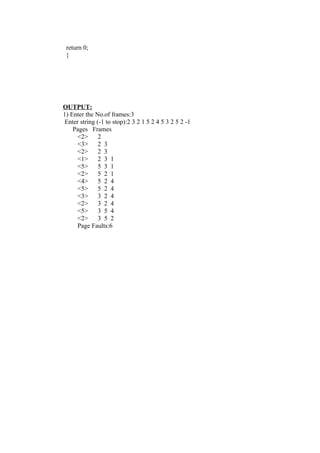
OUTPUT:
1) Enter the No.of frames:3
 Enter string (-1 to stop):2 3 2 1 5 2 4 5 3 2 5 2 -1
    Pages Frames
      <2>      2
      <3>      2 3
      <2>      2 3
      <1>      2 3 1
      <5>      5 3 1
      <2>      5 2 1
      <4>      5 2 4
      <5>      5 2 4
      <3>      3 2 4
      <2>      3 2 4
      <5>      3 5 4
      <2>      3 5 2
      Page Faults:6
b) LRU Page Replacement Algorithm

#include<stdio.h>
#include<conio.h>
int str[30],count,fs,p[100],pf;
main()
{
 int i,j,k,z,temp;
 printf("n Enter the No.of frames:");
 scanf("%d",&fs);
 printf("n Enter string (-1 to stop):");
 i=0;
 while(1)
 {
 scanf("%d",&temp);
 if(temp==-1)
 break;
 str[i++]=temp;
 }
 count=i;
 for(i=0;i<fs;i++)
 p[i]=-1;
 printf("n Pages tt Frames");
 i=0;
 while(i<count)
 {
 if(!check(str[i]))
 {
  pf++;
  j=lru(i);
  p[j]=str[i];
 }
 printf("n %3d tt",str[i]);
 for(k=0;k<fs;k++)
 if(p[k]!=-1)
printf("%3d",p[k]);
 i++;
 }
 z=pf-fs;
 printf("nn Page Faults:%d",z);
 }
 check(int key)
 {
 int i;
 for(i=0;i<fs;i++)
 if(key==p[i])
 return 1;
 return 0;
}
lru(int pos)
{
int i,j=0,r=0;
for(i=0;i<fs;i++)
{
if(p[i]==-1)
return i;
if(rec(i,pos)>=r)
{
 j=i;
 r=rec(i,pos);
} }
return j;
}
rec(int fn,int pn)
{
int i,c=0;
for(i=pn-1;i>=0;i--)
{
 c++;
 if(p[fn]==str[i])
  return c;
 }
 }


OUTPUT
1) Enter the No. of frames: 3
Enter string (-1 to stop):2 3 2 1 5 2 4 5 3 2 5 2 -1
Pages         Frames
 2          2
 3          2 3
 2          2 3
 1          2 3 1
 5          2 5 1
 2          2 5 1
 4          2 5 4
 5          2 5 4
 3          3 5 4
 2          3 5 2
 5          3 5 2
 2          3 5 2

Page Faults:4
c) LFU page replacement Algorithm

#include<stdio.h>
int i,j=1,s,k,l,re[30],p[10],ch,no,nr,c,a1=0,a,line=6,nk;
struct
{
         int st,l,ps,pos;
}opr;
main()
{
         clrscr();
         printf("Enter length of reference string:");
         scanf("%d",&nr);
         printf(" Enter reference string:");
         for(i=1;i<=nr;i++)
         scanf("%d",&re[i]);
         printf("n Enter number of frames:");
         scanf("%d",&no);
         clrscr();
         for(i=1;i<=no;i++)
         p[i]=-1;
         opr.st=100;
         for(i=1;i<=nr;i++)
         {
                  a1=0;
                  opr.st=100;
                  opr.pos=100;
                  for(c=1;c<=no;c++)
                  if(re[i]==p[c])
                  a1++;
                  if(a1==0)
                  {
                           if(j<=no)
                           {
                                  p[j]=re[i];
                                  j++;
                           }
                           else
                           {
                                  for(k=1;k<=no;k++)
                                  {
                                          a=0;
                                          for(ch=i-1;ch>0;ch--)
                                          {
                                                 if(p[k]==re[ch])
                                                 {
                                                         a++;
                                                         nk=ch;
                                                 }
}
                                       if(a>1)
                                       {
                                                 if(opr.st>a)
                                                 {
                                                         opr.st=a;
                                                         opr.ps=k;
                                                 }
                                                 else
                                                 if(opr.st==a)
                                                 {
                                                         if(opr.pos>ch)
                                                         opr.ps=k;
                                                 }
                                       }
                                       else
                                       if(a==1)
                                       {
                                              if(opr.pos>nk)
                                              {
                                                      opr.pos=nk;
                                                      opr.ps=k;
                                                      opr.st=a;
                                              }
                                       }
                              }
                              p[(opr.ps)]=re[i];
                      }
               }
               display(no,p,i);
       }
       printf("n");
       getch();
}
display(int no,int p[],int i)
{
       int k;
       if(i==1)
       {
                printf("ttt");
                for(k=1;k<=no;k++)
                printf("_ _");
       }
       printf("n%d",re[i]);
       gotoxy(25,line++);
       for(k=1;k<=no;k++)
       {                printf("|");
                printf("_");
                if(p[k]!=-1)
printf("%d",p[k]);
              else
              printf(" ");
              printf("_");
       }      printf("|"); }


OUTPUT:

Least frequently used

Enter no of frame 3

Enter no of pages 4

Enter page sequence 4 5    8

400F

450F

458F

No of page faults 3
3.Simulate all File Allocation Strategies

a) Sequential file allocation

#include<stdio.h>
#include<conio.h>
#include<stdlib.h>
typedef struct
{
        int bno,flag;
}block;
        block b[200];
void main()
{
        int rnum();


       int n,p[30],i,j,r,k[20][20],s,s1;
       printf("n input");


       printf("n enter no of files");
       scanf("%d",&n);
       printf("n-------------------------------");
       printf("n enter memory requirements");
       printf("n------------------------------");
       for(i=1;i<=n;i++)
       {
          printf("n enter %d file requirements:",i);
          scanf("%d",&p[i]);
       }
       for(i=1;i<=n;i++)
       {
          s1=rnum();
          j=0;
          for(s=s1;s<(s1+p[i]);s++)
          {
               j=j+1;
               b[s].bno=s;
               b[s].flag=1;
               k[i][j]=s;
          }
       }
       printf("n output");
       printf("n ---------------------------------");
       printf("n program blocka allocated");
       printf("n----------------------------------");
       for(i=1;i<=n;i++)
{
            printf("%5dt",i);
            for(j=1;j<=p[i];j++)
                 printf("%5d",k[i][j]);
            printf("'n");
        }
        printf("n------------------------------------");

printf("n allocated blocks:");
        printf("n-----------------------------------");
        for(i=1;i<=200;i++)
                if(b[i].flag==1)
                         printf("%5dt",b[i].bno);
}
int rnum()
{
        int i,k=0;
        for(i=1;i<=200;i++)
        {
                k=rand()%200;
                if(k%2==0)
                  k=k+10;
                if(b[k].flag!=1)
                  break;
                return k;
        }
}


OUTPUT:

Enter the no of input files : 3
Input the requirements:
Enter the no of blocks needed in file 1: 2
Enter the no of blocks needed in file2 :4
Enter the no of blocks needed in file3: 3
Allocation
Allocate for file1: 8386
Allocate for file2: 77159335
Allocate for file3:924921
b) Indexed File allocation

#include<stdio.h>
#include<conio.h>
#include<stdlib.h>
struct block
{
  int bno,flag;
};
struct block b[100];
int rnum();

void main()
{
   int p[10],r[10][10],ab[10],i,j,n,s;
    printf("n INPUT");
    printf("enter no of files:");
    scanf("%d",&n);
     for(i=1;i<=n;i++)
      {
         printf("n enter the size of block %d:",i);
         scanf("%d",&p[i]);
          }
  for(i=1;i<=n;i++)
  {
     s=rnum();
    ab[i]=s;
    for(j=0;j<p[i];j++)
    {
       s=rnum();
        r[i][j]=s;
    }
}
printf("n output:");
 for(i=1;i<=n;i++)
{
   printf("n file %d n block %d contains:",i,ab[i]);
   for(j=0;j<p[i];j++)
   {
      printf("%6d",r[i][j]);
    }
}
}
int rnum()
{
int k=0,i;
 for(i=1;i<=100;i++)
 {
k=rand()%100;
     if(b[k].flag!=-1)


       break;
  }
return k;
}


OUTPUT:

Enter the no of files: 3
Enter the memory requirements:

Enter the 1 file requirement: 3
Enter the 2 file requirement: 2
Enter the 3 file requirement: 4

Program blocks allocated
1      70     71     72
2      115    116
3      212    213    214    215
Allocated blocks
70 71 72 115 116 212 213 214 215
c) Linked File Allocation

#include<stdio.h>
#include<conio.h>
#include<stdlib.h>
typedef struct
{
        int bno,flag,bn[20];
}block;
        block b[100],b1;
void main()
{
        int rnum();
        int p[30],kk[20],i,n,t,s1,s,r,j,c=1;
        printf("n enter no of i/p files");
        scanf("%d",&n);
        printf("n input the requirements");
        for(i=1;i<=n;i++)
        {
                printf("n enter the no of blocks needed for file%d",i);
                scanf("%d",&p[i]);
        }
        t=1;
        for(i=1;i<=n;i++)
        {
           for(j=1;j<=p[i];j++)
           {
                s=rnum();
                b[s].flag=1;
                b[c].bno=s;
                r=p[i]-1;
                kk[i]=s;
                t=1;
                c++;
            }
        }
        while(r!=0)
        {
                s1=rnum();
                b[s].bn[t]=s1;
                b[s1].flag=1;
                b[c].bno=s1;
                r=r-1;
                t=t+1;
                c++;
        }
        printf("n allocation:n");
c=1;
       for(i=1;i<=n;i++)
       {
         printf("n allocated for file%d",i);
         for(j=1;j<=p[i];j++)
         {
               if(j==1)
               {
                  printf("%3d",b[c].bno);
                  c++;
               }
               else
               {
                  printf("---->%3d",b[c].bno);
                  c++;
               }
          }
          printf("n");
       }
}
int rnum()
{
       int k=0,i;
       for(i=1;i<=100;i++)
       {
               k=rand()%100;
               if(b[k].flag!=1)
               break;
       }
       return k;
}


OUTPUT:

Enter the no of files 3
Enter the size of block 1 2 3
4 3 2
File 1 Block 83 contains 86 77 15 93
File 2 Block 85 contains 86 92 49
File 3 Block 21 contains 62 27
4. Simulate all File Organization Techniques

a) Single level directory
#include<stdio.h>
#include<conio.h>
#include<stdlib.h>
#include<graphics.h>
void main()
{
       int gd,gm,count,i,j,mid,cir_x;
       char fname[10][20];
       gd=DETECT;
       clrscr();
       initgraph(&gd,&gm,"c:/turboc");
       cleardevice();
       setbkcolor(GREEN);
       puts("n Enterno.of files do u have?");
       scanf("%d",&count);
       for(i=0;i<count;i++)
       {
               cleardevice();
               setbkcolor(GREEN);
               printf("Enter file %d name ",i+1);
               scanf("%s",fname[i]);
               setfillstyle(1,MAGENTA);
               mid=640/count;
               cir_x=mid/3;
               bar3d(270,100,370,150,0,0);
               settextstyle(2,0,4);
               settextjustify(1,1);
               outtextxy(320,125,"Root Directory");
               setcolor(BLUE);
               for(j=0;j<=i;j++,cir_x+=mid)
               {
                        line(320,150,cir_x,250);
                        fillellipse(cir_x,250,30,30);
                        outtextxy(cir_x,250,fname[i]);
               }
               getch();
       }
}
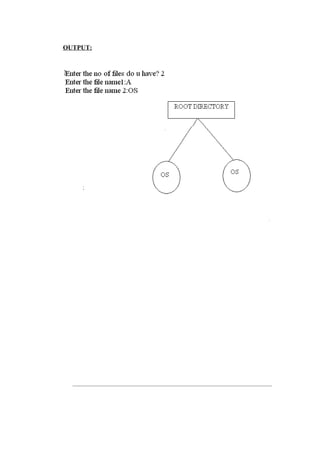
OUTPUT:
b) Two level Directory

//two level directory structure
#include<stdio.h>
#include<conio.h>
#include<graphics.h>
#define SX 250
#define SY 200
#define BL 30
#define BW 15
#define SY1 250
int SX1=100;
int n,m[10];
char a[10][10];
int cols[]={2,5,1,3,4,6,8,7,9};
typedef struct
{
 char name[10];
 struct
 {
  char file[10];
 }k[10];
}file_info;
file_info f[10];
void readfiles()
{
 int i,j;
 printf("nEnter no. of directories:");
 scanf("%d",&n);
 for(i=0;i<n;i++)
 {
  printf("Enter %d directory:",i+1);
  scanf("%s",&f[i].name);
  printf("enter no.of files:");
  scanf("%d",&m[i]);
  for(j=0;j<m[i];j++)
  {
   printf("enter %d file name:",j+1);
   scanf("%s",&f[i].k[j].file);
  }
 }
}
void fillspace()
{
 int x1,y1,i,j;
 outtextxy(70,205,"Directory");
 outtextxy(100,255,"Files");
 for(i=0;i<n;i++)
 {
setfillstyle(1,cols[i]);
  x1=SX+(i%10)*50;
  y1=SY+(i/10)*40;
  bar(x1,y1,x1+BL+20,y1+BW);
  outtextxy(x1+BL/4,y1+BW/4,f[i].name);
  line(x1+BL/2,y1+BW,SX1+50,SY1);
  SX1=SX1+50;
  for(j=0;j<m[i];j++)
  { setfillstyle(1,cols[i]);
  x1=SX1+(j%10)*40;
  y1=SY1+(j/10)*40;
  bar(x1,y1,x1+BL+10,y1+BW);
  outtextxy(x1+BL/4,y1+BW/4,f[i].k[j].file);
  line(x1+BL/2,y1+BW,x1+BL/2,y1+50);
  circle(x1+BL/2,y1+60,7);
  }
  SX1=SX1+100;
 }
}
void main()
{
 int gm,gd=DETECT;
 initgraph(&gd,&gm,"c:tcbgi");
 readfiles();
 cleardevice();
 getch();
 fillspace();
 getch();
 closegraph();
}
5.Interprocess Communication

   a) Pipes

#include<stdio.h>
 #include<string.h>
 #include<stdlib.h>
 #include<error.h>
 #define MAXBUFF 1024
 main()
 {
 int childpid,pipe1[2],pipe2[2];
 if(pipe(pipe1)<0||pipe(pipe2)<0)
 printf("error");
 if((childpid=fork())<0)
  {
 printf("error");
 }
 else if(childpid>0)
 {
 close(pipe1[0]);
 close(pipe2[1]);
 client(pipe2[0],pipe1[1]);
 while(wait((int *)0)!=childpid)
 close(pipe1[1]);
 close(pipe2[0]);
  exit(1);
  }
  else
  {
  close(pipe1[1]);
  close(pipe2[0]);
  server(pipe1[0],pipe2[1]);
  close(pipe1[0]);
  close(pipe2[1]);
  }
  }
  client(readfd,writefd)
  int readfd,writefd;
  {
  char buff[MAXBUFF];
  int n;
  if(fgets(buff,MAXBUFF,stdin)==NULL)
  printf("client filename read error");
  n=strlen(buff);
  if(buff[n-1]=='n')
  n--;
if(write(writefd,buff,n)!=n)
 printf("client filename error");
 while((n=read(readfd,buff,MAXBUFF))>0)
 if(write(1,buff,n)!=n)
 printf("client data write error");
 if(n>0)
 printf("client: data read errror");
 }
 server(readfd,writefd)
 int readfd,writefd;
 {
 char buff[MAXBUFF];
 int n,fd;
 if((n=read(readfd,buff,MAXBUFF))<0)
 printf("srever filename read error");
 buff[n]='0';
 if((fd=open(buff,0))<0)
 {
 n=strlen(buff);
 if(write(writefd,buff,n)!=n)
 printf("server :error msg");
 }
 else
 {
 while((n=read(fd,buff,MAXBUFF))>0)
 if(write(writefd,buff,n)!=n)
 printf("server data write error");
 if(n>0)
 printf("server read error");
 }
 }


OUTPUT:
vi a.txt
      welcome to NP

    ]$ ./a.out
      a.txt
    welcome to NP
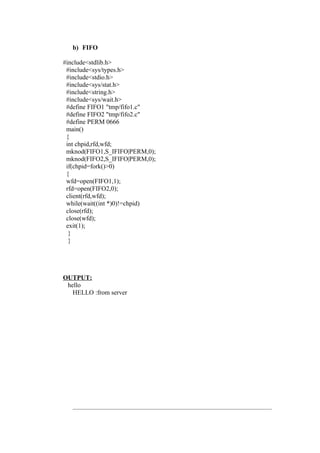
b) FIFO

#include<stdlib.h>
 #include<sys/types.h>
 #include<stdio.h>
 #include<sys/stat.h>
 #include<string.h>
 #include<sys/wait.h>
 #define FIFO1 "tmp/fifo1.c"
 #define FIFO2 "tmp/fifo2.c"
 #define PERM 0666
 main()
 {
 int chpid,rfd,wfd;
 mknod(FIFO1,S_IFIFO|PERM,0);
 mknod(FIFO2,S_IFIFO|PERM,0);
 if(chpid=fork()>0)
 {
 wfd=open(FIFO1,1);
 rfd=open(FIFO2,0);
 client(rfd,wfd);
 while(wait((int *)0)!=chpid)
 close(rfd);
 close(wfd);
 exit(1);
  }
  }


OUTPUT:
 hello
   HELLO :from server
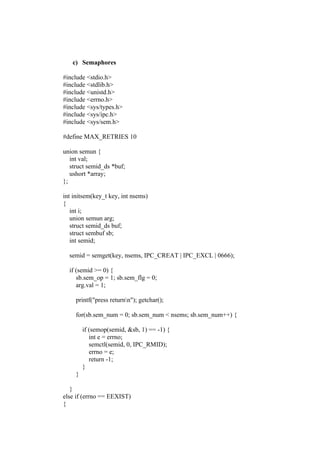
c) Semaphores

#include <stdio.h>
#include <stdlib.h>
#include <unistd.h>
#include <errno.h>
#include <sys/types.h>
#include <sys/ipc.h>
#include <sys/sem.h>

#define MAX_RETRIES 10

union semun {
   int val;
   struct semid_ds *buf;
   ushort *array;
};

int initsem(key_t key, int nsems)
{
   int i;
   union semun arg;
   struct semid_ds buf;
   struct sembuf sb;
   int semid;

  semid = semget(key, nsems, IPC_CREAT | IPC_EXCL | 0666);

  if (semid >= 0) {
     sb.sem_op = 1; sb.sem_flg = 0;
     arg.val = 1;

     printf("press returnn"); getchar();

     for(sb.sem_num = 0; sb.sem_num < nsems; sb.sem_num++) {

         if (semop(semid, &sb, 1) == -1) {
            int e = errno;
            semctl(semid, 0, IPC_RMID);
            errno = e;
            return -1;
         }
     }

   }
else if (errno == EEXIST)
{
int ready = 0;

       semid = semget(key, nsems, 0);
       if (semid < 0) return semid;
        arg.buf = &buf;
       for(i = 0; i < MAX_RETRIES && !ready; i++)
        {
           semctl(semid, nsems-1, IPC_STAT, arg);
           if (arg.buf->sem_otime != 0)
          {
              ready = 1;
           } else {
              sleep(1);
           }
       }
       if (!ready) {
           errno = ETIME;
           return -1;
       }
    } else {
       return semid;
    }

    return semid;
}

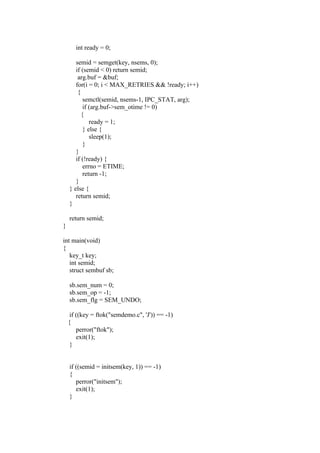
int main(void)
{
   key_t key;
   int semid;
   struct sembuf sb;

    sb.sem_num = 0;
    sb.sem_op = -1;
    sb.sem_flg = SEM_UNDO;

     if ((key = ftok("semdemo.c", 'J')) == -1)
    {
        perror("ftok");
        exit(1);
     }


    if ((semid = initsem(key, 1)) == -1)
    {
       perror("initsem");
       exit(1);
    }
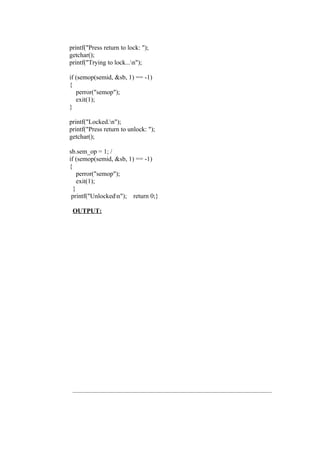
printf("Press return to lock: ");
getchar();
printf("Trying to lock...n");

if (semop(semid, &sb, 1) == -1)
{
   perror("semop");
   exit(1);
}

printf("Locked.n");
printf("Press return to unlock: ");
getchar();

sb.sem_op = 1; /
if (semop(semid, &sb, 1) == -1)
{
    perror("semop");
    exit(1);
  }
 printf("Unlockedn"); return 0;}

 OUTPUT:
d) Message Queues
/*server*/

  #include<sys/types.h>
  #include<sys/ipc.h>
  #include<sys/msg.h>
  #include<stdio.h>
  #include<stdlib.h>
  #include<string.h>
  #define BUFSZ 4096
  struct msg
  { 10 long int type;
  char text[BUFSZ];
 };
 int main()
 {
  struct msg data;
  int msgid;
  char buff[BUFSZ];
  msgid=msgget((key_t)4321,0666|IPC_CREAT);
  while(1)
  { 21 printf("n enter some data:nn");
  fgets(buff,BUFSZ,stdin);
    data.type=1;
   strcpy(data.text,buff);
   msgsnd(msgid,(void *)&data,BUFSZ,0);
   exit(1);
  } 28 }

OUTPUT: enter some data
   hai

/*client*/
 #include<sys/types.h>
 #include<sys/ipc.h>
 #include<sys/msg.h>
 #include<stdio.h>
 #include<stdlib.h>
 #include<string.h>
 #define MSGKEY1 4321L
#define MAX 5700
  typedef struct msgbuf{
 long mtype;
 char mtext[MAX];
 }my_msgbuff;
 main()
{
 my_msgbuff buffer;
 int msgID,myID;
 int temp;
 if((msgID=msgget(MSGKEY1,0666|IPC_CREAT))<0)
 {
perror("error getting msg queue");
 exit(1);
}
 if(msgrcv(msgID,&buffer,sizeof(buffer),0L,0)<0)
 {
 perror("error receiving msg from queue");
 exit(1);
 }
 printf("n msg read from queue:nn");
printf("MESSAGE:%sn",buffer.mtext);
while(msgsnd(msgID,&buffer,sizeof(buffer.mtext),0)>0);
 if(msgctl(msgID,IPC_RMID,0)<0)
{
 perror("error detecting msg queue");
exit(1);
 }
 msgctl(myID,IPC_RMID,0);
 exit(0); }


OUTPUT:
msg read from queue:
    MESSAGE:hai
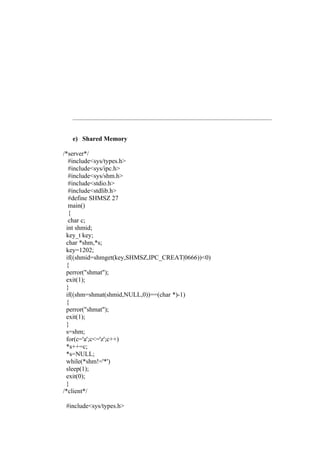
e) Shared Memory

/*server*/
  #include<sys/types.h>
  #include<sys/ipc.h>
  #include<sys/shm.h>
  #include<stdio.h>
  #include<stdlib.h>
  #define SHMSZ 27
  main()
  {
  char c;
 int shmid;
 key_t key;
 char *shm,*s;
 key=1202;
 if((shmid=shmget(key,SHMSZ,IPC_CREAT|0666))<0)
 {
 perror("shmat");
 exit(1);
 }
 if((shm=shmat(shmid,NULL,0))==(char *)-1)
 {
 perror("shmat");
 exit(1);
 }
 s=shm;
 for(c='a';c<='z';c++)
 *s++=c;
 *s=NULL;
 while(*shm!='*')
 sleep(1);
 exit(0);
 }
/*client*/

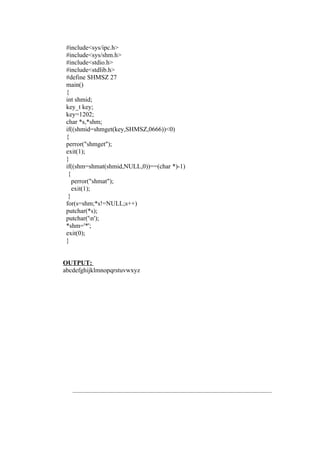
 #include<sys/types.h>
#include<sys/ipc.h>
 #include<sys/shm.h>
 #include<stdio.h>
 #include<stdlib.h>
 #define SHMSZ 27
 main()
 {
 int shmid;
 key_t key;
 key=1202;
 char *s,*shm;
 if((shmid=shmget(key,SHMSZ,0666))<0)
 {
 perror("shmget");
 exit(1);
 }
 if((shm=shmat(shmid,NULL,0))==(char *)-1)
  {
    perror("shmat");
    exit(1);
  }
 for(s=shm;*s!=NULL;s++)
 putchar(*s);
 putchar('n');
 *shm='*';
 exit(0);
 }


OUTPUT:
abcdefghijklmnopqrstuvwxyz
Banker’s Algorithm for Deadlock avoidance and Prevention

#include<stdio.h>
#include<conio.h>
int C[4][3],A[4][3],RQ[4][3],V[3],R[3],K[4],sum=0,np,nr;
main()
{
void fun();
int i,j,count=0,pcount=0;
clrscr();
printf("nEnter the total number of resources : ");
scanf("n%d",&nr);
for(i=0;i<nr;i++)
 {
 printf("nEnter the no of resources int R%d : ",i+1);
 scanf("%d",&R[i]);
 }
printf("nEnter the no of processes to be executed : ");
scanf("%d",&np);
printf("nEnter the claim matrix:n");
for(i=0;i<np;i++)
for(j=0;j<nr;j++)
scanf("%d",&C[i][j]);
printf("nEnter the allocation matrix:n");
for(i=0;i<np;i++)
for(j=0;j<nr;j++)
scanf("%d",&A[i][j]);
for(i=0;i<np;i++)
for(j=0;j<nr;j++)
RQ[i][j] = C[i][j] - A[i][j];
fun();
for(i=0;i<np;i++)
{
count=0;
f(K[i] == i+1)
continue;
 for(j=0;j<nr;j++)
 {
 if(V[j] >= RQ[i][j])
 count++;
   }
  if(count == nr)
 {
  K[i] = i+1;
  for(j=0;j<nr;j++)
         C[i][j] = A[i][j] = RQ[i][j] = 0;
        pcount++;
        count = 0;
        i=-1;
        fun();
      }
    }

 if(pcount == np)
  printf("nThere is no chance of deadlock.nIt is a safe state.");
 else
  printf("nThere is a chance of deadlock.nIt isn't a safe state.");
 getch();
 }

 void fun()
 {
 int i1,j1;
 for(i1=0;i1<nr;i1++)
 {
  for(j1=0;j1<np;j1++)
 {
  sum = sum + A[j1][i1];
  }
  V[i1] = R[i1] - sum;
  sum = 0;
  }
  }


OUTPUT
 Enter the total number of resources
 2
 Enter the total number of resources in R1
4
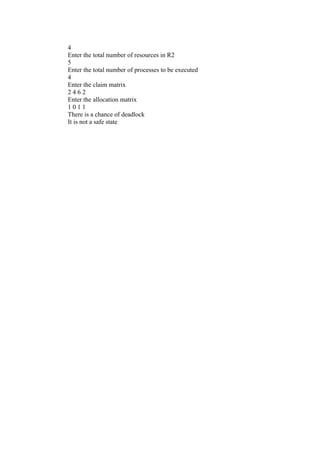
Enter the total number of resources in R2
5
Enter the total number of processes to be executed
4
Enter the claim matrix
2462
Enter the allocation matrix
1011
There is a chance of deadlock
It is not a safe state

Os 2 cycle

  • 1.
    Simulate all PageReplacement Algorithms a) FIFO Page Replacement Algorithm #include<stdio.h> #include<conio.h> int str[30],z,count,fs,p[100],pf=0; main() { int i,j,k,temp; printf("n Enter the No.of frames:"); scanf("%d",&fs); printf("n Enter string (-1 to stop):"); i=0; while(1) { scanf("%d",&temp); if(temp==-1) break; str[i++]=temp; } count=i; for(i=0;i<fs;i++) p[i]=-1; printf("nt Pages t Frames"); i=j=0; while(i<count) { if(!check(str[i])) { pf++; p[j]=str[i]; j=(j+1)%fs; } printf("nt <%d> t",str[i]); for(k=0;k<fs;k++) if(p[k]!=-1) printf("%3d",p[k]); i++; } z=pf-fs; printf("nt Page Faults:%d",z); } check(int key) { int i; for(i=0;i<fs;i++) if(key==p[i]) return 1;
  • 2.
    return 0; } OUTPUT: 1)Enter the No.of frames:3 Enter string (-1 to stop):2 3 2 1 5 2 4 5 3 2 5 2 -1 Pages Frames <2> 2 <3> 2 3 <2> 2 3 <1> 2 3 1 <5> 5 3 1 <2> 5 2 1 <4> 5 2 4 <5> 5 2 4 <3> 3 2 4 <2> 3 2 4 <5> 3 5 4 <2> 3 5 2 Page Faults:6
  • 3.
    b) LRU PageReplacement Algorithm #include<stdio.h> #include<conio.h> int str[30],count,fs,p[100],pf; main() { int i,j,k,z,temp; printf("n Enter the No.of frames:"); scanf("%d",&fs); printf("n Enter string (-1 to stop):"); i=0; while(1) { scanf("%d",&temp); if(temp==-1) break; str[i++]=temp; } count=i; for(i=0;i<fs;i++) p[i]=-1; printf("n Pages tt Frames"); i=0; while(i<count) { if(!check(str[i])) { pf++; j=lru(i); p[j]=str[i]; } printf("n %3d tt",str[i]); for(k=0;k<fs;k++) if(p[k]!=-1) printf("%3d",p[k]); i++; } z=pf-fs; printf("nn Page Faults:%d",z); } check(int key) { int i; for(i=0;i<fs;i++) if(key==p[i]) return 1; return 0;
  • 4.
    } lru(int pos) { int i,j=0,r=0; for(i=0;i<fs;i++) { if(p[i]==-1) returni; if(rec(i,pos)>=r) { j=i; r=rec(i,pos); } } return j; } rec(int fn,int pn) { int i,c=0; for(i=pn-1;i>=0;i--) { c++; if(p[fn]==str[i]) return c; } } OUTPUT 1) Enter the No. of frames: 3 Enter string (-1 to stop):2 3 2 1 5 2 4 5 3 2 5 2 -1 Pages Frames 2 2 3 2 3 2 2 3 1 2 3 1 5 2 5 1 2 2 5 1 4 2 5 4 5 2 5 4 3 3 5 4 2 3 5 2 5 3 5 2 2 3 5 2 Page Faults:4
  • 5.
    c) LFU pagereplacement Algorithm #include<stdio.h> int i,j=1,s,k,l,re[30],p[10],ch,no,nr,c,a1=0,a,line=6,nk; struct { int st,l,ps,pos; }opr; main() { clrscr(); printf("Enter length of reference string:"); scanf("%d",&nr); printf(" Enter reference string:"); for(i=1;i<=nr;i++) scanf("%d",&re[i]); printf("n Enter number of frames:"); scanf("%d",&no); clrscr(); for(i=1;i<=no;i++) p[i]=-1; opr.st=100; for(i=1;i<=nr;i++) { a1=0; opr.st=100; opr.pos=100; for(c=1;c<=no;c++) if(re[i]==p[c]) a1++; if(a1==0) { if(j<=no) { p[j]=re[i]; j++; } else { for(k=1;k<=no;k++) { a=0; for(ch=i-1;ch>0;ch--) { if(p[k]==re[ch]) { a++; nk=ch; }
  • 6.
    } if(a>1) { if(opr.st>a) { opr.st=a; opr.ps=k; } else if(opr.st==a) { if(opr.pos>ch) opr.ps=k; } } else if(a==1) { if(opr.pos>nk) { opr.pos=nk; opr.ps=k; opr.st=a; } } } p[(opr.ps)]=re[i]; } } display(no,p,i); } printf("n"); getch(); } display(int no,int p[],int i) { int k; if(i==1) { printf("ttt"); for(k=1;k<=no;k++) printf("_ _"); } printf("n%d",re[i]); gotoxy(25,line++); for(k=1;k<=no;k++) { printf("|"); printf("_"); if(p[k]!=-1)
  • 7.
    printf("%d",p[k]); else printf(" "); printf("_"); } printf("|"); } OUTPUT: Least frequently used Enter no of frame 3 Enter no of pages 4 Enter page sequence 4 5 8 400F 450F 458F No of page faults 3
  • 8.
    3.Simulate all FileAllocation Strategies a) Sequential file allocation #include<stdio.h> #include<conio.h> #include<stdlib.h> typedef struct { int bno,flag; }block; block b[200]; void main() { int rnum(); int n,p[30],i,j,r,k[20][20],s,s1; printf("n input"); printf("n enter no of files"); scanf("%d",&n); printf("n-------------------------------"); printf("n enter memory requirements"); printf("n------------------------------"); for(i=1;i<=n;i++) { printf("n enter %d file requirements:",i); scanf("%d",&p[i]); } for(i=1;i<=n;i++) { s1=rnum(); j=0; for(s=s1;s<(s1+p[i]);s++) { j=j+1; b[s].bno=s; b[s].flag=1; k[i][j]=s; } } printf("n output"); printf("n ---------------------------------"); printf("n program blocka allocated"); printf("n----------------------------------"); for(i=1;i<=n;i++)
  • 9.
    { printf("%5dt",i); for(j=1;j<=p[i];j++) printf("%5d",k[i][j]); printf("'n"); } printf("n------------------------------------"); printf("n allocated blocks:"); printf("n-----------------------------------"); for(i=1;i<=200;i++) if(b[i].flag==1) printf("%5dt",b[i].bno); } int rnum() { int i,k=0; for(i=1;i<=200;i++) { k=rand()%200; if(k%2==0) k=k+10; if(b[k].flag!=1) break; return k; } } OUTPUT: Enter the no of input files : 3 Input the requirements: Enter the no of blocks needed in file 1: 2 Enter the no of blocks needed in file2 :4 Enter the no of blocks needed in file3: 3 Allocation Allocate for file1: 8386 Allocate for file2: 77159335 Allocate for file3:924921
  • 10.
    b) Indexed Fileallocation #include<stdio.h> #include<conio.h> #include<stdlib.h> struct block { int bno,flag; }; struct block b[100]; int rnum(); void main() { int p[10],r[10][10],ab[10],i,j,n,s; printf("n INPUT"); printf("enter no of files:"); scanf("%d",&n); for(i=1;i<=n;i++) { printf("n enter the size of block %d:",i); scanf("%d",&p[i]); } for(i=1;i<=n;i++) { s=rnum(); ab[i]=s; for(j=0;j<p[i];j++) { s=rnum(); r[i][j]=s; } } printf("n output:"); for(i=1;i<=n;i++) { printf("n file %d n block %d contains:",i,ab[i]); for(j=0;j<p[i];j++) { printf("%6d",r[i][j]); } } } int rnum() { int k=0,i; for(i=1;i<=100;i++) {
  • 11.
    k=rand()%100; if(b[k].flag!=-1) break; } return k; } OUTPUT: Enter the no of files: 3 Enter the memory requirements: Enter the 1 file requirement: 3 Enter the 2 file requirement: 2 Enter the 3 file requirement: 4 Program blocks allocated 1 70 71 72 2 115 116 3 212 213 214 215 Allocated blocks 70 71 72 115 116 212 213 214 215
  • 12.
    c) Linked FileAllocation #include<stdio.h> #include<conio.h> #include<stdlib.h> typedef struct { int bno,flag,bn[20]; }block; block b[100],b1; void main() { int rnum(); int p[30],kk[20],i,n,t,s1,s,r,j,c=1; printf("n enter no of i/p files"); scanf("%d",&n); printf("n input the requirements"); for(i=1;i<=n;i++) { printf("n enter the no of blocks needed for file%d",i); scanf("%d",&p[i]); } t=1; for(i=1;i<=n;i++) { for(j=1;j<=p[i];j++) { s=rnum(); b[s].flag=1; b[c].bno=s; r=p[i]-1; kk[i]=s; t=1; c++; } } while(r!=0) { s1=rnum(); b[s].bn[t]=s1; b[s1].flag=1; b[c].bno=s1; r=r-1; t=t+1; c++; } printf("n allocation:n");
  • 13.
    c=1; for(i=1;i<=n;i++) { printf("n allocated for file%d",i); for(j=1;j<=p[i];j++) { if(j==1) { printf("%3d",b[c].bno); c++; } else { printf("---->%3d",b[c].bno); c++; } } printf("n"); } } int rnum() { int k=0,i; for(i=1;i<=100;i++) { k=rand()%100; if(b[k].flag!=1) break; } return k; } OUTPUT: Enter the no of files 3 Enter the size of block 1 2 3 4 3 2 File 1 Block 83 contains 86 77 15 93 File 2 Block 85 contains 86 92 49 File 3 Block 21 contains 62 27
  • 14.
    4. Simulate allFile Organization Techniques a) Single level directory #include<stdio.h> #include<conio.h> #include<stdlib.h> #include<graphics.h> void main() { int gd,gm,count,i,j,mid,cir_x; char fname[10][20]; gd=DETECT; clrscr(); initgraph(&gd,&gm,"c:/turboc"); cleardevice(); setbkcolor(GREEN); puts("n Enterno.of files do u have?"); scanf("%d",&count); for(i=0;i<count;i++) { cleardevice(); setbkcolor(GREEN); printf("Enter file %d name ",i+1); scanf("%s",fname[i]); setfillstyle(1,MAGENTA); mid=640/count; cir_x=mid/3; bar3d(270,100,370,150,0,0); settextstyle(2,0,4); settextjustify(1,1); outtextxy(320,125,"Root Directory"); setcolor(BLUE); for(j=0;j<=i;j++,cir_x+=mid) { line(320,150,cir_x,250); fillellipse(cir_x,250,30,30); outtextxy(cir_x,250,fname[i]); } getch(); } }
  • 15.
  • 16.
    b) Two levelDirectory //two level directory structure #include<stdio.h> #include<conio.h> #include<graphics.h> #define SX 250 #define SY 200 #define BL 30 #define BW 15 #define SY1 250 int SX1=100; int n,m[10]; char a[10][10]; int cols[]={2,5,1,3,4,6,8,7,9}; typedef struct { char name[10]; struct { char file[10]; }k[10]; }file_info; file_info f[10]; void readfiles() { int i,j; printf("nEnter no. of directories:"); scanf("%d",&n); for(i=0;i<n;i++) { printf("Enter %d directory:",i+1); scanf("%s",&f[i].name); printf("enter no.of files:"); scanf("%d",&m[i]); for(j=0;j<m[i];j++) { printf("enter %d file name:",j+1); scanf("%s",&f[i].k[j].file); } } } void fillspace() { int x1,y1,i,j; outtextxy(70,205,"Directory"); outtextxy(100,255,"Files"); for(i=0;i<n;i++) {
  • 17.
    setfillstyle(1,cols[i]); x1=SX+(i%10)*50; y1=SY+(i/10)*40; bar(x1,y1,x1+BL+20,y1+BW); outtextxy(x1+BL/4,y1+BW/4,f[i].name); line(x1+BL/2,y1+BW,SX1+50,SY1); SX1=SX1+50; for(j=0;j<m[i];j++) { setfillstyle(1,cols[i]); x1=SX1+(j%10)*40; y1=SY1+(j/10)*40; bar(x1,y1,x1+BL+10,y1+BW); outtextxy(x1+BL/4,y1+BW/4,f[i].k[j].file); line(x1+BL/2,y1+BW,x1+BL/2,y1+50); circle(x1+BL/2,y1+60,7); } SX1=SX1+100; } } void main() { int gm,gd=DETECT; initgraph(&gd,&gm,"c:tcbgi"); readfiles(); cleardevice(); getch(); fillspace(); getch(); closegraph(); }
  • 18.
    5.Interprocess Communication a) Pipes #include<stdio.h> #include<string.h> #include<stdlib.h> #include<error.h> #define MAXBUFF 1024 main() { int childpid,pipe1[2],pipe2[2]; if(pipe(pipe1)<0||pipe(pipe2)<0) printf("error"); if((childpid=fork())<0) { printf("error"); } else if(childpid>0) { close(pipe1[0]); close(pipe2[1]); client(pipe2[0],pipe1[1]); while(wait((int *)0)!=childpid) close(pipe1[1]); close(pipe2[0]); exit(1); } else { close(pipe1[1]); close(pipe2[0]); server(pipe1[0],pipe2[1]); close(pipe1[0]); close(pipe2[1]); } } client(readfd,writefd) int readfd,writefd; { char buff[MAXBUFF]; int n; if(fgets(buff,MAXBUFF,stdin)==NULL) printf("client filename read error"); n=strlen(buff); if(buff[n-1]=='n') n--;
  • 19.
    if(write(writefd,buff,n)!=n) printf("client filenameerror"); while((n=read(readfd,buff,MAXBUFF))>0) if(write(1,buff,n)!=n) printf("client data write error"); if(n>0) printf("client: data read errror"); } server(readfd,writefd) int readfd,writefd; { char buff[MAXBUFF]; int n,fd; if((n=read(readfd,buff,MAXBUFF))<0) printf("srever filename read error"); buff[n]='0'; if((fd=open(buff,0))<0) { n=strlen(buff); if(write(writefd,buff,n)!=n) printf("server :error msg"); } else { while((n=read(fd,buff,MAXBUFF))>0) if(write(writefd,buff,n)!=n) printf("server data write error"); if(n>0) printf("server read error"); } } OUTPUT: vi a.txt welcome to NP ]$ ./a.out a.txt welcome to NP
  • 20.
    b) FIFO #include<stdlib.h> #include<sys/types.h> #include<stdio.h> #include<sys/stat.h> #include<string.h> #include<sys/wait.h> #define FIFO1 "tmp/fifo1.c" #define FIFO2 "tmp/fifo2.c" #define PERM 0666 main() { int chpid,rfd,wfd; mknod(FIFO1,S_IFIFO|PERM,0); mknod(FIFO2,S_IFIFO|PERM,0); if(chpid=fork()>0) { wfd=open(FIFO1,1); rfd=open(FIFO2,0); client(rfd,wfd); while(wait((int *)0)!=chpid) close(rfd); close(wfd); exit(1); } } OUTPUT: hello HELLO :from server
  • 21.
    c) Semaphores #include <stdio.h> #include<stdlib.h> #include <unistd.h> #include <errno.h> #include <sys/types.h> #include <sys/ipc.h> #include <sys/sem.h> #define MAX_RETRIES 10 union semun { int val; struct semid_ds *buf; ushort *array; }; int initsem(key_t key, int nsems) { int i; union semun arg; struct semid_ds buf; struct sembuf sb; int semid; semid = semget(key, nsems, IPC_CREAT | IPC_EXCL | 0666); if (semid >= 0) { sb.sem_op = 1; sb.sem_flg = 0; arg.val = 1; printf("press returnn"); getchar(); for(sb.sem_num = 0; sb.sem_num < nsems; sb.sem_num++) { if (semop(semid, &sb, 1) == -1) { int e = errno; semctl(semid, 0, IPC_RMID); errno = e; return -1; } } } else if (errno == EEXIST) {
  • 22.
    int ready =0; semid = semget(key, nsems, 0); if (semid < 0) return semid; arg.buf = &buf; for(i = 0; i < MAX_RETRIES && !ready; i++) { semctl(semid, nsems-1, IPC_STAT, arg); if (arg.buf->sem_otime != 0) { ready = 1; } else { sleep(1); } } if (!ready) { errno = ETIME; return -1; } } else { return semid; } return semid; } int main(void) { key_t key; int semid; struct sembuf sb; sb.sem_num = 0; sb.sem_op = -1; sb.sem_flg = SEM_UNDO; if ((key = ftok("semdemo.c", 'J')) == -1) { perror("ftok"); exit(1); } if ((semid = initsem(key, 1)) == -1) { perror("initsem"); exit(1); }
  • 23.
    printf("Press return tolock: "); getchar(); printf("Trying to lock...n"); if (semop(semid, &sb, 1) == -1) { perror("semop"); exit(1); } printf("Locked.n"); printf("Press return to unlock: "); getchar(); sb.sem_op = 1; / if (semop(semid, &sb, 1) == -1) { perror("semop"); exit(1); } printf("Unlockedn"); return 0;} OUTPUT:
  • 24.
    d) Message Queues /*server*/ #include<sys/types.h> #include<sys/ipc.h> #include<sys/msg.h> #include<stdio.h> #include<stdlib.h> #include<string.h> #define BUFSZ 4096 struct msg { 10 long int type; char text[BUFSZ]; }; int main() { struct msg data; int msgid; char buff[BUFSZ]; msgid=msgget((key_t)4321,0666|IPC_CREAT); while(1) { 21 printf("n enter some data:nn"); fgets(buff,BUFSZ,stdin); data.type=1; strcpy(data.text,buff); msgsnd(msgid,(void *)&data,BUFSZ,0); exit(1); } 28 } OUTPUT: enter some data hai /*client*/ #include<sys/types.h> #include<sys/ipc.h> #include<sys/msg.h> #include<stdio.h> #include<stdlib.h> #include<string.h> #define MSGKEY1 4321L
  • 25.
    #define MAX 5700 typedef struct msgbuf{ long mtype; char mtext[MAX]; }my_msgbuff; main() { my_msgbuff buffer; int msgID,myID; int temp; if((msgID=msgget(MSGKEY1,0666|IPC_CREAT))<0) { perror("error getting msg queue"); exit(1); } if(msgrcv(msgID,&buffer,sizeof(buffer),0L,0)<0) { perror("error receiving msg from queue"); exit(1); } printf("n msg read from queue:nn"); printf("MESSAGE:%sn",buffer.mtext); while(msgsnd(msgID,&buffer,sizeof(buffer.mtext),0)>0); if(msgctl(msgID,IPC_RMID,0)<0) { perror("error detecting msg queue"); exit(1); } msgctl(myID,IPC_RMID,0); exit(0); } OUTPUT: msg read from queue: MESSAGE:hai
  • 26.
    e) Shared Memory /*server*/ #include<sys/types.h> #include<sys/ipc.h> #include<sys/shm.h> #include<stdio.h> #include<stdlib.h> #define SHMSZ 27 main() { char c; int shmid; key_t key; char *shm,*s; key=1202; if((shmid=shmget(key,SHMSZ,IPC_CREAT|0666))<0) { perror("shmat"); exit(1); } if((shm=shmat(shmid,NULL,0))==(char *)-1) { perror("shmat"); exit(1); } s=shm; for(c='a';c<='z';c++) *s++=c; *s=NULL; while(*shm!='*') sleep(1); exit(0); } /*client*/ #include<sys/types.h>
  • 27.
    #include<sys/ipc.h> #include<sys/shm.h> #include<stdio.h> #include<stdlib.h> #define SHMSZ 27 main() { int shmid; key_t key; key=1202; char *s,*shm; if((shmid=shmget(key,SHMSZ,0666))<0) { perror("shmget"); exit(1); } if((shm=shmat(shmid,NULL,0))==(char *)-1) { perror("shmat"); exit(1); } for(s=shm;*s!=NULL;s++) putchar(*s); putchar('n'); *shm='*'; exit(0); } OUTPUT: abcdefghijklmnopqrstuvwxyz
  • 28.
    Banker’s Algorithm forDeadlock avoidance and Prevention #include<stdio.h> #include<conio.h> int C[4][3],A[4][3],RQ[4][3],V[3],R[3],K[4],sum=0,np,nr; main() { void fun(); int i,j,count=0,pcount=0; clrscr(); printf("nEnter the total number of resources : "); scanf("n%d",&nr); for(i=0;i<nr;i++) { printf("nEnter the no of resources int R%d : ",i+1); scanf("%d",&R[i]); } printf("nEnter the no of processes to be executed : "); scanf("%d",&np); printf("nEnter the claim matrix:n"); for(i=0;i<np;i++) for(j=0;j<nr;j++) scanf("%d",&C[i][j]); printf("nEnter the allocation matrix:n"); for(i=0;i<np;i++) for(j=0;j<nr;j++) scanf("%d",&A[i][j]); for(i=0;i<np;i++) for(j=0;j<nr;j++) RQ[i][j] = C[i][j] - A[i][j]; fun(); for(i=0;i<np;i++) { count=0; f(K[i] == i+1)
  • 29.
    continue; for(j=0;j<nr;j++) { if(V[j] >= RQ[i][j]) count++; } if(count == nr) { K[i] = i+1; for(j=0;j<nr;j++) C[i][j] = A[i][j] = RQ[i][j] = 0; pcount++; count = 0; i=-1; fun(); } } if(pcount == np) printf("nThere is no chance of deadlock.nIt is a safe state."); else printf("nThere is a chance of deadlock.nIt isn't a safe state."); getch(); } void fun() { int i1,j1; for(i1=0;i1<nr;i1++) { for(j1=0;j1<np;j1++) { sum = sum + A[j1][i1]; } V[i1] = R[i1] - sum; sum = 0; } } OUTPUT Enter the total number of resources 2 Enter the total number of resources in R1
  • 30.
    4 Enter the totalnumber of resources in R2 5 Enter the total number of processes to be executed 4 Enter the claim matrix 2462 Enter the allocation matrix 1011 There is a chance of deadlock It is not a safe state