
Journal club
Presentation
The
knowhows
Prof (Dr) Viyatprajna Acharya
MBBS, MD, PhD
KIMS, KIIT (DU), Bhubaneswar, Odisha
Journal club-Critically appraising an
article
Historical background-
1835-54 Memoirs of Sir James Paget, Surgeon
1875- Sir William Osler founded official journal club
Why Journal club??
• Critical appraisal skills developed
• Keeping oneself updated with recent trends
• CME needs are met
• Interview skills improved
• Academic debate is stimulated
• Academic publications come out-letter to editor, further
research
• Inter-personal relations improve
• Tea and snacks
How to select an article??
• Recently published
• Which caters to everyone’s interest/ current topic
• Original articles preferred over meta-analysis or review
article
• Select an article from a reputed journal
How do we proceed on this??
• Paper should be circulated beforehand through mail
• Slide 1: Introduction- Reason for selection, research question
• Slide 2: About Author and Journal- Type of journal, any specific feature, target
readers, journal presence
• Slide 3: Hypothesis- Mention the research question/hypothesis
• Summarize the research question in PICOT format:
a. Population: Sample studied
b. Intervention: Intervention or treatment tested
c. Comparison: Reference group or control group of the study
d. Outcome: Outcome tool(s) used in the study to measure the effectiveness of
intervention
e. Time: Duration of the study
• Slide 4: Evidence base- what were the evidence based on which
it has been designed, is it still relevant?
• Slide 5: Study design- Type, study population, randomization,
bias, inclusion and exclusion criteria
• Slide 6: Analysis of the methodology-
• Slide 7: Results- Summerisation, see whether all aspects
covered
• Slide 8: Discussion and Interpretation- strengths and
weaknesses of the article, are the results consistent with
conclusion, analyze the limitations of the study
• Slide 9: Clinical context- Is it going to affect the current practice
Journal jargons- metrics and beyond
METRICS EVERYWHERE!!!
What is a journal??
• Collections of personal writing about or around a topic
or general theme.
• Entries should be made on a regular basis – daily or
frequently - and are usually kept together in a
notebook or folder.
Academic journal
• Also called scholarly journal
• Peer-reviewed or refereed
• Particular academic discipline
• serve as forums for the introduction and presentation for quest
of new research, and the critique of existing research
•Scientific journals
Frequency of journals
• Monthly
• Bimonthly
• Annually
• Biannually
• 10 times/year
• 36 times/ year
• Weekly!
Open access (OA) journals
• Scholarly journal
• Available online
• Research outputs are shared without financial, legal or technical
barriers other than those inseparable from gaining access to the
internet itself
• It is not free!
• Freely downloadable articles
• By Feb 2019- 12,728 OA journals listed in DOAJ (Directory of
open access journals) !!!
Advantages of OA journals
• Open Access enhances visibility and impact of one's own work as Open
Access articles are downloaded and cited more frequently than articles
from non-Open Access journals..
• Free access to scientific knowledge, information and data strengthens
the basis for transfer (education), development (research) and
valorization of knowledge
• Developing countries and small or specialized research institutions
and corporations have access to all Open Access articles.
• Open Access articles are published sooner than articles in non-Open
Access journals.
• Open Access articles reach broader audiences than articles in non-
Open Access journals.
Disadvantages of OA journals
• Quality Open Access journals do not yet have the same established
reputation as traditional journals.
• Open Access publishing is as yet not cheaper than the current costs
of licenses, and therefore may be a costly affair
• Predatory Open Access journals try to mislead and cheat authors.
Predatory journals
• Jeffrey Beall - coined the term; Librarian at University of Colorado
• No clear definition
• Cabell’s blacklist- 4000 predatory journals
• Claim to peer-review but falsely show a list of peer-reviewers who might
not have agreed for the process
Why predatory journals??
• Fast publication
• Quantity over quality
• Selection in interviews based on
number of publications
• Promotion criteria
• Many are PUBMED indexed
too!!!
How do we recognise predatory journals??
• No single editor
• Review board members do not have expertise in the fields
• Insufficient info regarding fees
• No proper indexing
• Name of a journal is unrelated with the journal’s mission
• Name of a journal does not adequately reflect its origin - e.g. Swiss
journal may not be published from Switzerland
• poorly maintained websites, including dead links, prominent misspellings
and grammatical errors on the website
• Makes unauthorised use of licensed images on their website, taken from
the open web, without permission or licensing from the copyright owners
• Re-publish papers
…..Contd.
• Use boastful language claiming to be a ‘leading publisher’
even though the publisher may only be a start-up or a
novice organisation
• Provide minimal or no copyediting or proofreading of
submissions.
• Publish papers that are not academic at all, e.g. essays by
lay people, polemical editorials, or pseudo-science
• Have a ‘contact us’ page that only includes a web form or an
email address, and the publisher hides or does not reveal its
location
• Excessively broad field or combine 2-3 fields together that
are not even much related
Think…. Check…. Submit
1. Do you or your colleagues know the journal?
2. Can you easily identify and contact the publisher?
3. Is the journal clear about the type of peer review it uses?
4. Are articles indexed in services that you use?
5. Is it clear what fees will be charged?
6. Do you recognise the editorial board?
7. Is the publisher a member of a recognised industry
initiative (COPE,DOAJ,OASPA)?
Typesof articles
• Scientific article
• Original article: Where the author presents empirical studies and for the first time describes
the results of research work.
• Review article: They are the conclusions after critical reviews of previously published studies.
• Theoretical article: It aims at developing new theories from existing research.
• Meta-analysis: It is an analysis of different studies of similar concepts.
 Provide an estimate of the unknown common truth,
 Can contrast results from different studies
 Identify patterns among study results, sources of disagreement among those results, or other
interesting relationships that may come to light in the context of multiple studies.
 Meta-analyses are often but not always an essential component of systematic reviews.
Appropriate statistical analysis is applied.
 Involve statistical analyses
ISSN (International Standard Serial
Number)
• Worldwide identification code
• Used by publishers, suppliers, libraries, information
services, bar coding systems, union catalogues
• Needed for citations and retrieval of serials
• International publicity
• HQ-Paris
• India- National Science Library (NSL)
• Print and hard copy ISSN are different!!
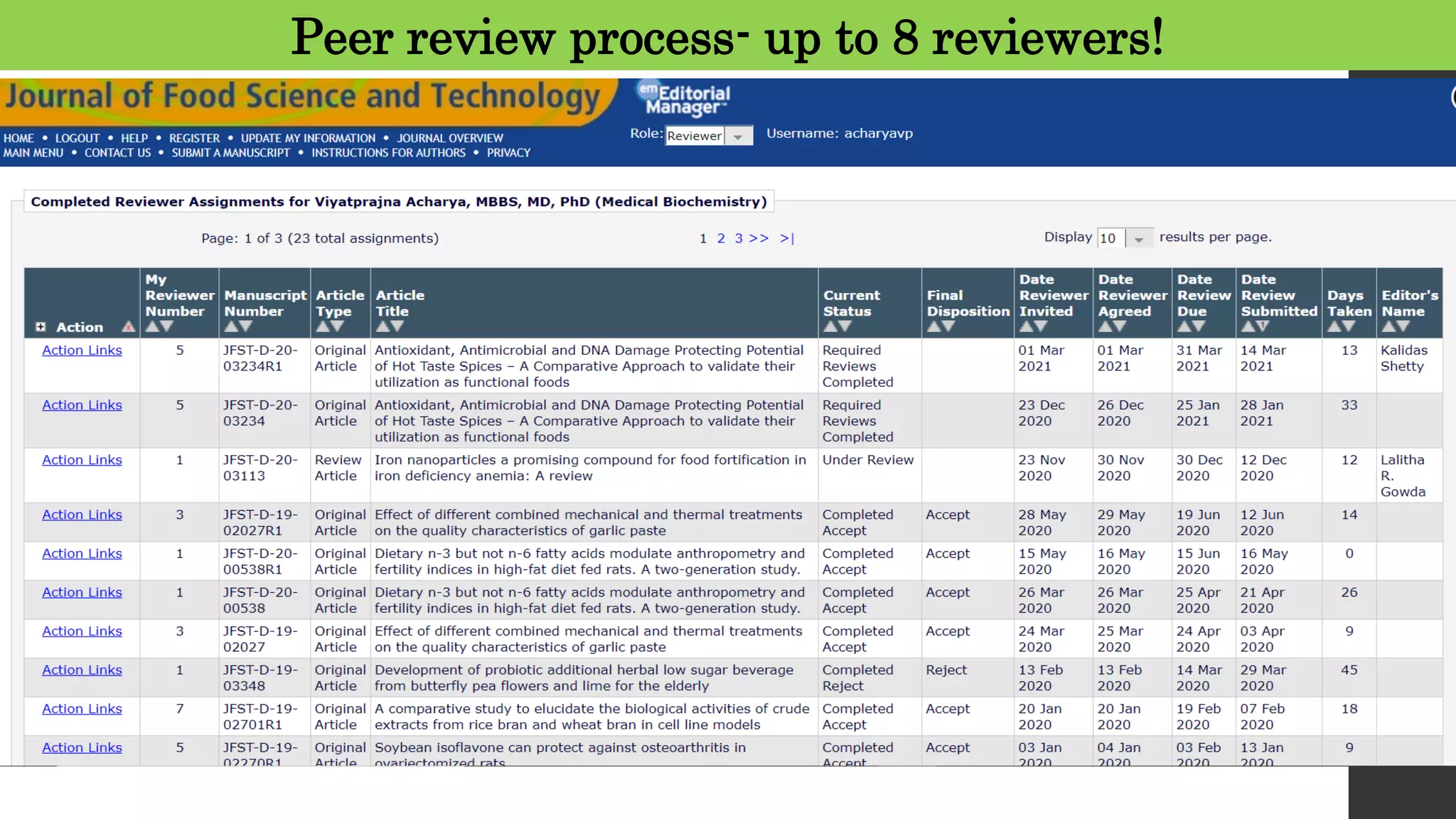
Peer review process- up to 8 reviewers!
How good is your journal???
• Indexing
• Impact factor
• Eigen factor
Indexing agencies
• Index medicus- Most comprehensive one for Medical journals (Since 1879)
• MedLine
• PubMed
• EMBASE
• SCOPUS
• EBSCO Publishing's Electronic Databases
• SCIRUS
• Many national and regional databases also there
Impact factor
• Impact factor
• 5-year impact factor
• Immediacy index
• Impact factor without self-cites
IF Calculation
• Impact factor of the journal J in the year X=A/B
• A = number of total citations in the year X received
by all items published in the journal J in the years (X-1) and (X-2)
• B = total number of all citable items published
in the journal J in the years (X-1) and (X-2).
• Citable items - only papers and reviews and do not include errata,
editorials and abstracts.
• In the counting of A, however, citations to all items published in J are
included
• 5 year IF is similar but calculated over 5 years- slow citation
Immediacy index
• Total number of citations received in the year X by all items
published in the same year X
• High citation
• Self-citation- Published earlier in the same journal
Eigen factor score
• A journal's Eigen factor score is measured as its
importance to the scientific community.
• Scores are scaled so that the sum of all journal scores is
100.
• In 2006, Nature had the highest score of 1.992
• Intended to reflect the influence and prestige of journals
Few more rankings….
• SCImago journal rank (SJR)
• Scopus (Elsevier)
Should IF be used to evaluate research????
• Use of journal impact factors conceals the difference in article
citation rates (articles in the most cited half of articles in a journal
are cited 10 times as often as the least cited half)
• Journals’ impact factors are determined by technicalities
unrelated to the scientific quality of their articles
• Journal impact factors depend on the research field: high impact
factors are likely in journals covering large areas of basic research
with a rapidly expanding but short lived literature that use many
references per article
• Article citation rates determine the journal impact factor, not vice
versa !!!
How good is my article
• How many times cited
• How many reads- ResearchGate
• Metrics to measure RG score too!!!
Improving citation
1. Use A Unique Name Consistently
2. Use a standardized institutional affiliation and address, using no abbreviations
3. Repeat key phrases in the abstract while writing naturally.
4. Assign keyword terms to the manuscript
5. Make a unique phrase that reflects author's research interest and use it
throughout academic life.
6. Publish in journal with high impact factor
7. Self-archive articles. Free online availability increases a paper's impact
8. Keep your professional web pages and published lists up to date
9. Make your research easy to find, especially for online searchers
10. Open Access (OA) increases citation rate
Citation style
• Vancouver style
• APA style
How good am I??
H index
• Scientific productivity and the
scientific impact of an individual
scientist
• Calculated automatically - Web of
Science and Scopus
• Manually in other databases that
provide citation information (e.g.
SciFinder, PsychINFO, Google
Scholar)
Alternatives of H index
1. Complement of h-index- g index, R index etc
2. Based on publication age
3. Based on total number of authors
4. Combination of two indices
5. Based on excess citation count
6. Based on the total number of publications
7. Other types of indices
(a) Based on the core tail ratio
(b) Based on improving h-index to higher values
(c) Based on variants of citation process
(d) Miscellaneous indices
Few More….
• Altmetrics – Rate journals based on scholarly references
added to academic social media sites.
• Diam Score – A measure of scientific influence of academic
journals based on recursive citation weighting and the pair
wise comparisons between journals.
• IPR- Intellectual property rights- Who owns it???
NOTHING IS ENOUGH
• An ever-continuing process
• Metrics and parameters are always changing
• Good research is better than good impact
• Research interest should be towards betterment of the
society and mankind
Thank You!!
www.vpacharya.com

Journal knowhows

  • 1.
    Journal club Presentation The knowhows Prof (Dr)Viyatprajna Acharya MBBS, MD, PhD KIMS, KIIT (DU), Bhubaneswar, Odisha
  • 2.
    Journal club-Critically appraisingan article Historical background- 1835-54 Memoirs of Sir James Paget, Surgeon 1875- Sir William Osler founded official journal club
  • 3.
    Why Journal club?? •Critical appraisal skills developed • Keeping oneself updated with recent trends • CME needs are met • Interview skills improved • Academic debate is stimulated • Academic publications come out-letter to editor, further research • Inter-personal relations improve • Tea and snacks
  • 4.
    How to selectan article?? • Recently published • Which caters to everyone’s interest/ current topic • Original articles preferred over meta-analysis or review article • Select an article from a reputed journal
  • 5.
    How do weproceed on this?? • Paper should be circulated beforehand through mail • Slide 1: Introduction- Reason for selection, research question • Slide 2: About Author and Journal- Type of journal, any specific feature, target readers, journal presence • Slide 3: Hypothesis- Mention the research question/hypothesis • Summarize the research question in PICOT format: a. Population: Sample studied b. Intervention: Intervention or treatment tested c. Comparison: Reference group or control group of the study d. Outcome: Outcome tool(s) used in the study to measure the effectiveness of intervention e. Time: Duration of the study
  • 6.
    • Slide 4:Evidence base- what were the evidence based on which it has been designed, is it still relevant? • Slide 5: Study design- Type, study population, randomization, bias, inclusion and exclusion criteria • Slide 6: Analysis of the methodology- • Slide 7: Results- Summerisation, see whether all aspects covered • Slide 8: Discussion and Interpretation- strengths and weaknesses of the article, are the results consistent with conclusion, analyze the limitations of the study • Slide 9: Clinical context- Is it going to affect the current practice
  • 7.
  • 8.
  • 9.
    What is ajournal?? • Collections of personal writing about or around a topic or general theme. • Entries should be made on a regular basis – daily or frequently - and are usually kept together in a notebook or folder.
  • 10.
    Academic journal • Alsocalled scholarly journal • Peer-reviewed or refereed • Particular academic discipline • serve as forums for the introduction and presentation for quest of new research, and the critique of existing research •Scientific journals
  • 11.
    Frequency of journals •Monthly • Bimonthly • Annually • Biannually • 10 times/year • 36 times/ year • Weekly!
  • 12.
    Open access (OA)journals • Scholarly journal • Available online • Research outputs are shared without financial, legal or technical barriers other than those inseparable from gaining access to the internet itself • It is not free! • Freely downloadable articles • By Feb 2019- 12,728 OA journals listed in DOAJ (Directory of open access journals) !!!
  • 13.
    Advantages of OAjournals • Open Access enhances visibility and impact of one's own work as Open Access articles are downloaded and cited more frequently than articles from non-Open Access journals.. • Free access to scientific knowledge, information and data strengthens the basis for transfer (education), development (research) and valorization of knowledge • Developing countries and small or specialized research institutions and corporations have access to all Open Access articles. • Open Access articles are published sooner than articles in non-Open Access journals. • Open Access articles reach broader audiences than articles in non- Open Access journals.
  • 14.
    Disadvantages of OAjournals • Quality Open Access journals do not yet have the same established reputation as traditional journals. • Open Access publishing is as yet not cheaper than the current costs of licenses, and therefore may be a costly affair • Predatory Open Access journals try to mislead and cheat authors.
  • 15.
    Predatory journals • JeffreyBeall - coined the term; Librarian at University of Colorado • No clear definition • Cabell’s blacklist- 4000 predatory journals • Claim to peer-review but falsely show a list of peer-reviewers who might not have agreed for the process
  • 16.
    Why predatory journals?? •Fast publication • Quantity over quality • Selection in interviews based on number of publications • Promotion criteria • Many are PUBMED indexed too!!!
  • 17.
    How do werecognise predatory journals?? • No single editor • Review board members do not have expertise in the fields • Insufficient info regarding fees • No proper indexing • Name of a journal is unrelated with the journal’s mission • Name of a journal does not adequately reflect its origin - e.g. Swiss journal may not be published from Switzerland • poorly maintained websites, including dead links, prominent misspellings and grammatical errors on the website • Makes unauthorised use of licensed images on their website, taken from the open web, without permission or licensing from the copyright owners • Re-publish papers
  • 18.
    …..Contd. • Use boastfullanguage claiming to be a ‘leading publisher’ even though the publisher may only be a start-up or a novice organisation • Provide minimal or no copyediting or proofreading of submissions. • Publish papers that are not academic at all, e.g. essays by lay people, polemical editorials, or pseudo-science • Have a ‘contact us’ page that only includes a web form or an email address, and the publisher hides or does not reveal its location • Excessively broad field or combine 2-3 fields together that are not even much related
  • 19.
    Think…. Check…. Submit 1.Do you or your colleagues know the journal? 2. Can you easily identify and contact the publisher? 3. Is the journal clear about the type of peer review it uses? 4. Are articles indexed in services that you use? 5. Is it clear what fees will be charged? 6. Do you recognise the editorial board? 7. Is the publisher a member of a recognised industry initiative (COPE,DOAJ,OASPA)?
  • 20.
    Typesof articles • Scientificarticle • Original article: Where the author presents empirical studies and for the first time describes the results of research work. • Review article: They are the conclusions after critical reviews of previously published studies. • Theoretical article: It aims at developing new theories from existing research. • Meta-analysis: It is an analysis of different studies of similar concepts.  Provide an estimate of the unknown common truth,  Can contrast results from different studies  Identify patterns among study results, sources of disagreement among those results, or other interesting relationships that may come to light in the context of multiple studies.  Meta-analyses are often but not always an essential component of systematic reviews. Appropriate statistical analysis is applied.  Involve statistical analyses
  • 21.
    ISSN (International StandardSerial Number) • Worldwide identification code • Used by publishers, suppliers, libraries, information services, bar coding systems, union catalogues • Needed for citations and retrieval of serials • International publicity • HQ-Paris • India- National Science Library (NSL) • Print and hard copy ISSN are different!!
  • 23.
    Peer review process-up to 8 reviewers!
  • 24.
    How good isyour journal??? • Indexing • Impact factor • Eigen factor
  • 25.
    Indexing agencies • Indexmedicus- Most comprehensive one for Medical journals (Since 1879) • MedLine • PubMed • EMBASE • SCOPUS • EBSCO Publishing's Electronic Databases • SCIRUS • Many national and regional databases also there
  • 26.
    Impact factor • Impactfactor • 5-year impact factor • Immediacy index • Impact factor without self-cites
  • 27.
    IF Calculation • Impactfactor of the journal J in the year X=A/B • A = number of total citations in the year X received by all items published in the journal J in the years (X-1) and (X-2) • B = total number of all citable items published in the journal J in the years (X-1) and (X-2). • Citable items - only papers and reviews and do not include errata, editorials and abstracts. • In the counting of A, however, citations to all items published in J are included • 5 year IF is similar but calculated over 5 years- slow citation
  • 28.
    Immediacy index • Totalnumber of citations received in the year X by all items published in the same year X • High citation • Self-citation- Published earlier in the same journal
  • 29.
    Eigen factor score •A journal's Eigen factor score is measured as its importance to the scientific community. • Scores are scaled so that the sum of all journal scores is 100. • In 2006, Nature had the highest score of 1.992 • Intended to reflect the influence and prestige of journals
  • 30.
    Few more rankings…. •SCImago journal rank (SJR) • Scopus (Elsevier)
  • 31.
    Should IF beused to evaluate research???? • Use of journal impact factors conceals the difference in article citation rates (articles in the most cited half of articles in a journal are cited 10 times as often as the least cited half) • Journals’ impact factors are determined by technicalities unrelated to the scientific quality of their articles • Journal impact factors depend on the research field: high impact factors are likely in journals covering large areas of basic research with a rapidly expanding but short lived literature that use many references per article • Article citation rates determine the journal impact factor, not vice versa !!!
  • 32.
    How good ismy article • How many times cited • How many reads- ResearchGate • Metrics to measure RG score too!!!
  • 33.
    Improving citation 1. UseA Unique Name Consistently 2. Use a standardized institutional affiliation and address, using no abbreviations 3. Repeat key phrases in the abstract while writing naturally. 4. Assign keyword terms to the manuscript 5. Make a unique phrase that reflects author's research interest and use it throughout academic life. 6. Publish in journal with high impact factor 7. Self-archive articles. Free online availability increases a paper's impact 8. Keep your professional web pages and published lists up to date 9. Make your research easy to find, especially for online searchers 10. Open Access (OA) increases citation rate
  • 34.
    Citation style • Vancouverstyle • APA style
  • 35.
    How good amI?? H index • Scientific productivity and the scientific impact of an individual scientist • Calculated automatically - Web of Science and Scopus • Manually in other databases that provide citation information (e.g. SciFinder, PsychINFO, Google Scholar)
  • 36.
    Alternatives of Hindex 1. Complement of h-index- g index, R index etc 2. Based on publication age 3. Based on total number of authors 4. Combination of two indices 5. Based on excess citation count 6. Based on the total number of publications 7. Other types of indices (a) Based on the core tail ratio (b) Based on improving h-index to higher values (c) Based on variants of citation process (d) Miscellaneous indices
  • 37.
    Few More…. • Altmetrics– Rate journals based on scholarly references added to academic social media sites. • Diam Score – A measure of scientific influence of academic journals based on recursive citation weighting and the pair wise comparisons between journals. • IPR- Intellectual property rights- Who owns it???
  • 38.
    NOTHING IS ENOUGH •An ever-continuing process • Metrics and parameters are always changing • Good research is better than good impact • Research interest should be towards betterment of the society and mankind
  • 39.

Editor's Notes

  • #37 h-index and its alternative: A Review Anand Bihari Sudhakar Tripathi Akshay Deepak