Publish or perish?
A guide to submitting papers
for peer-reviewed publication
Ian Brown
Louise Savory
Erlend Aasheim
A brief history of scientific publication
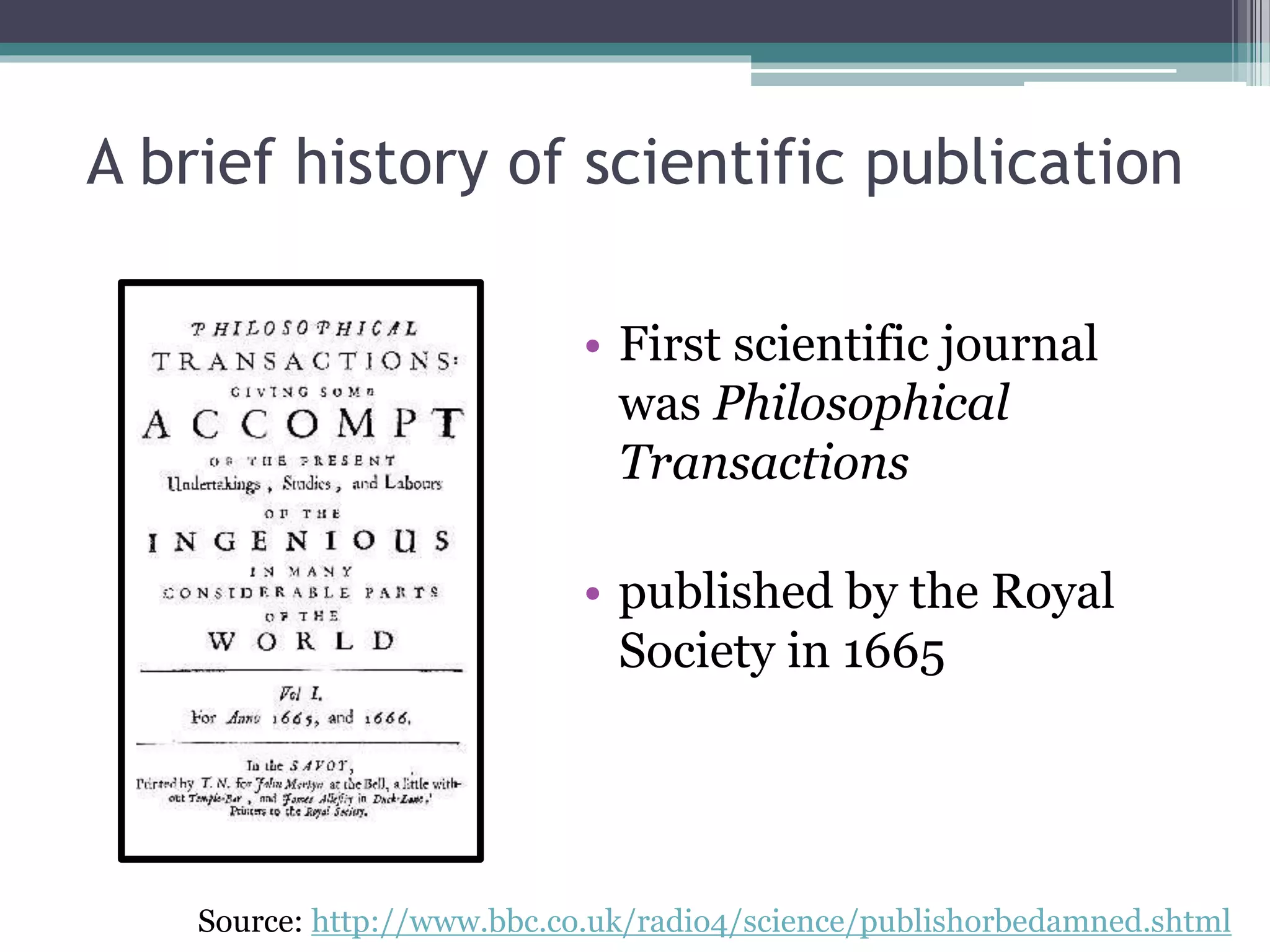
• First scientific journal
was Philosophical
Transactions
• published by the Royal
Society in 1665
Source: http://www.bbc.co.uk/radio4/science/publishorbedamned.shtml
• Now more than 2,000 publishers producing more
than 1.6 million articles in more than 20,000
journals
• Traditionally subscription-based
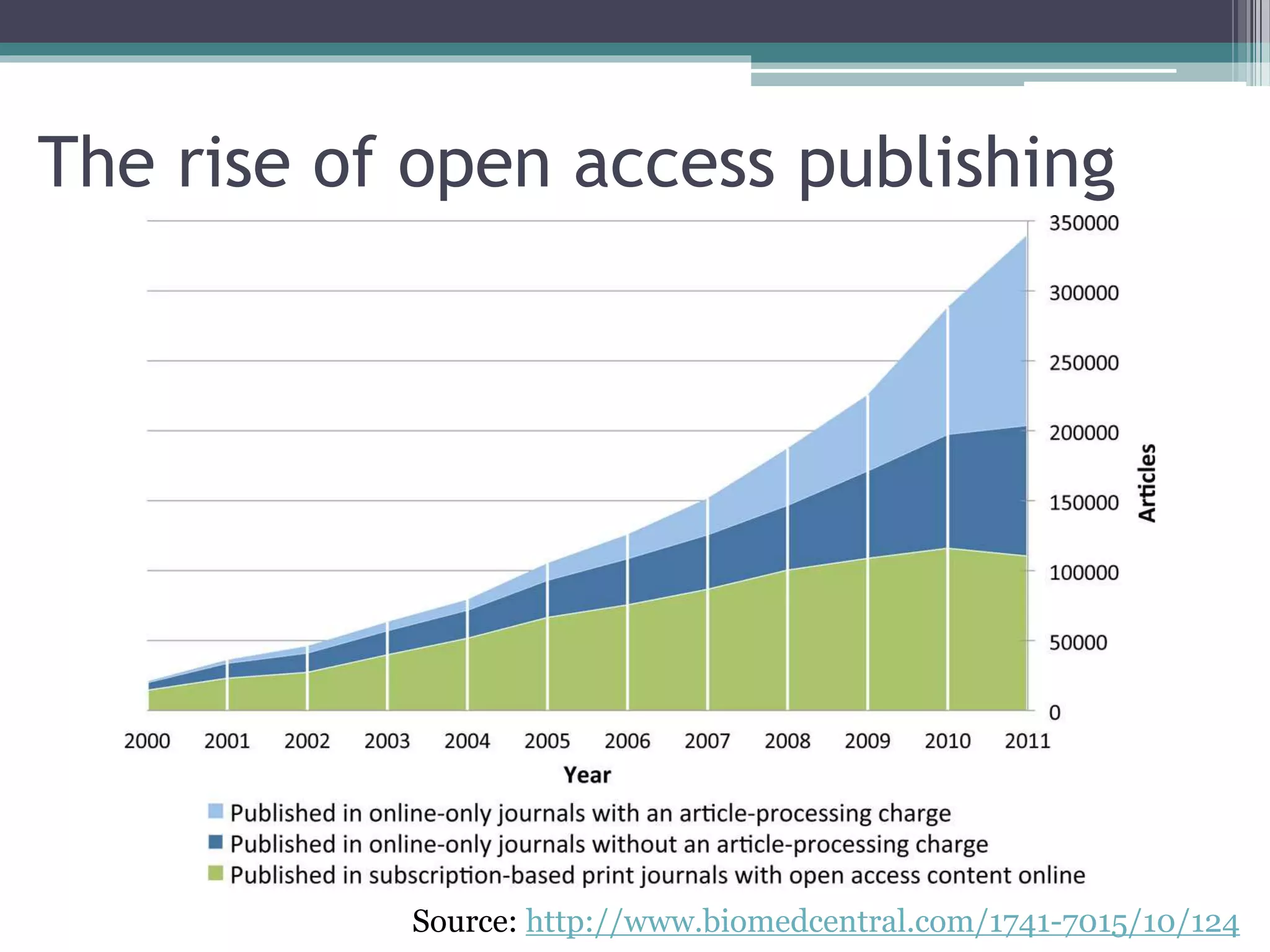
• Rise of open access journals since 2000
Source: http://southernlibrarianship.icaap.org/content/v09n03/mcguigan_g01.html
A brief history of scientific publication
Source: http://www.biomedcentral.com/1741-7015/10/124
The rise of open access publishing
With thanks: http://tinyurl.com/carolinetomes
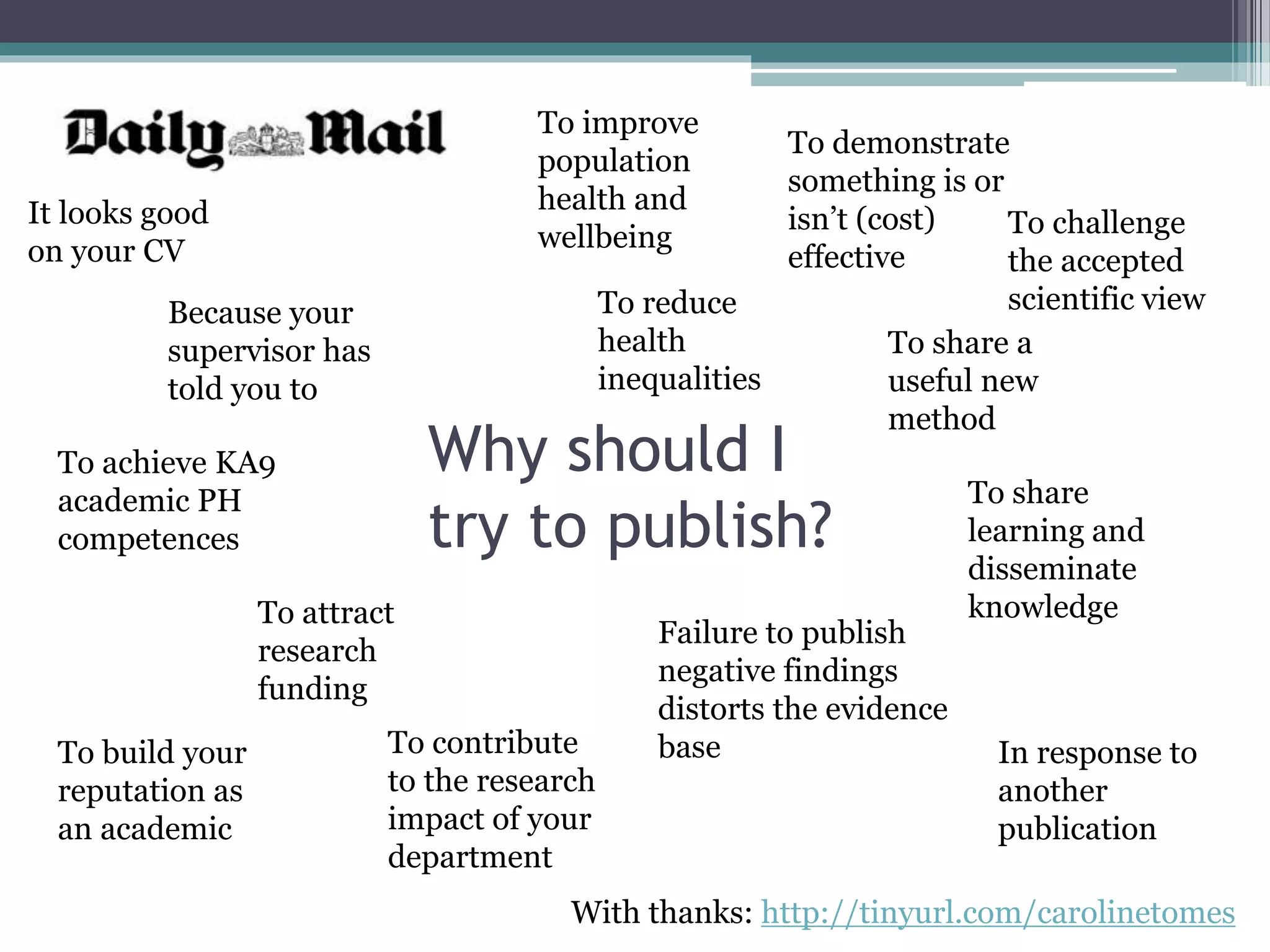
Why should I
try to publish?
To share
learning and
disseminate
knowledge
To build your
reputation as
an academic
To challenge
the accepted
scientific view
In response to
another
publication
To attract
research
funding
To contribute
to the research
impact of your
department
Because your
supervisor has
told you to
To achieve KA9
academic PH
competences
It looks good
on your CV
To improve
population
health and
wellbeing
To reduce
health
inequalities
To demonstrate
something is or
isn’t (cost)
effective
To share a
useful new
method
Failure to publish
negative findings
distorts the evidence
base
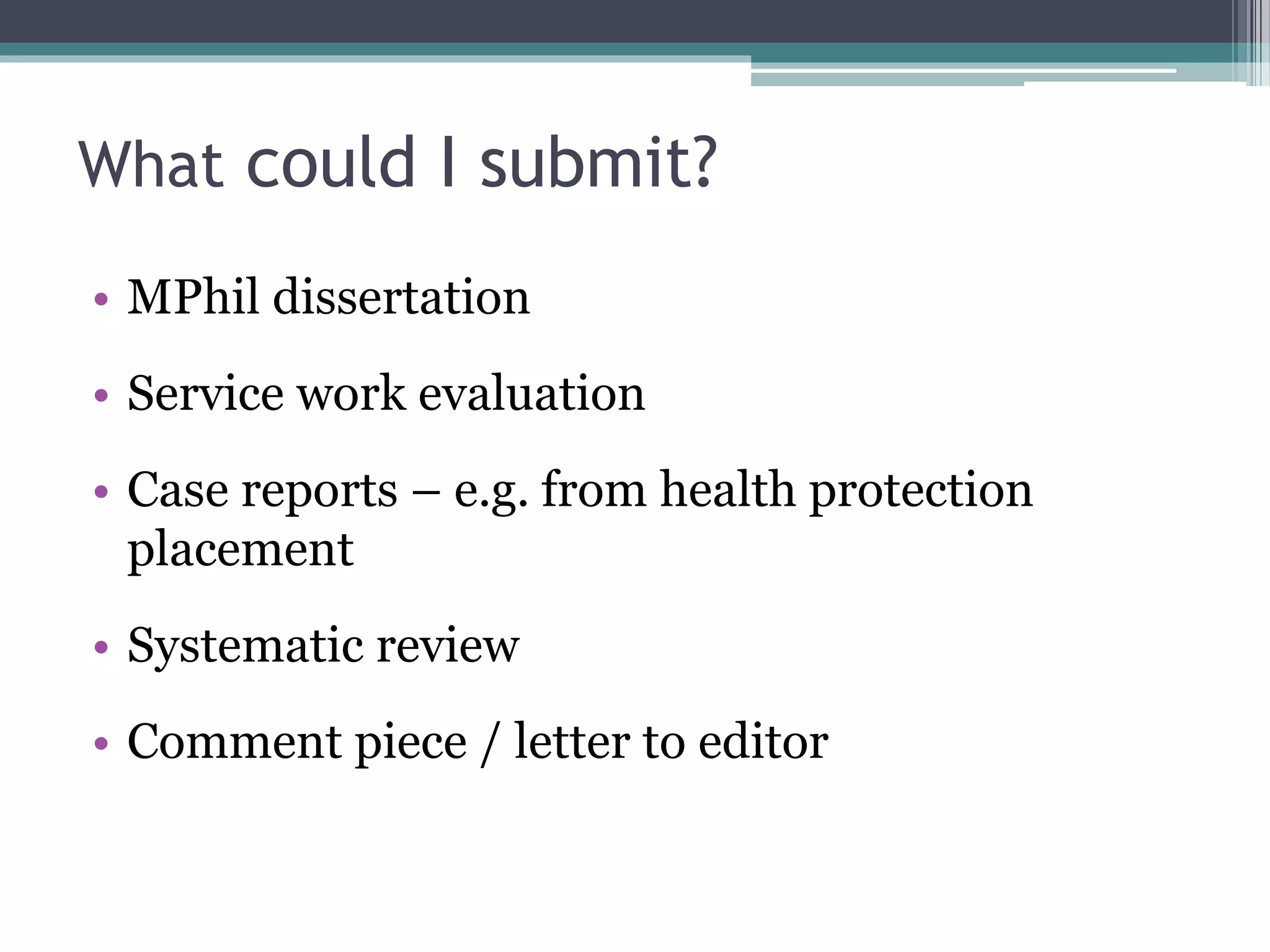
What could I submit?
• MPhil dissertation
• Service work evaluation
• Case reports – e.g. from health protection
placement
• Systematic review
• Comment piece / letter to editor
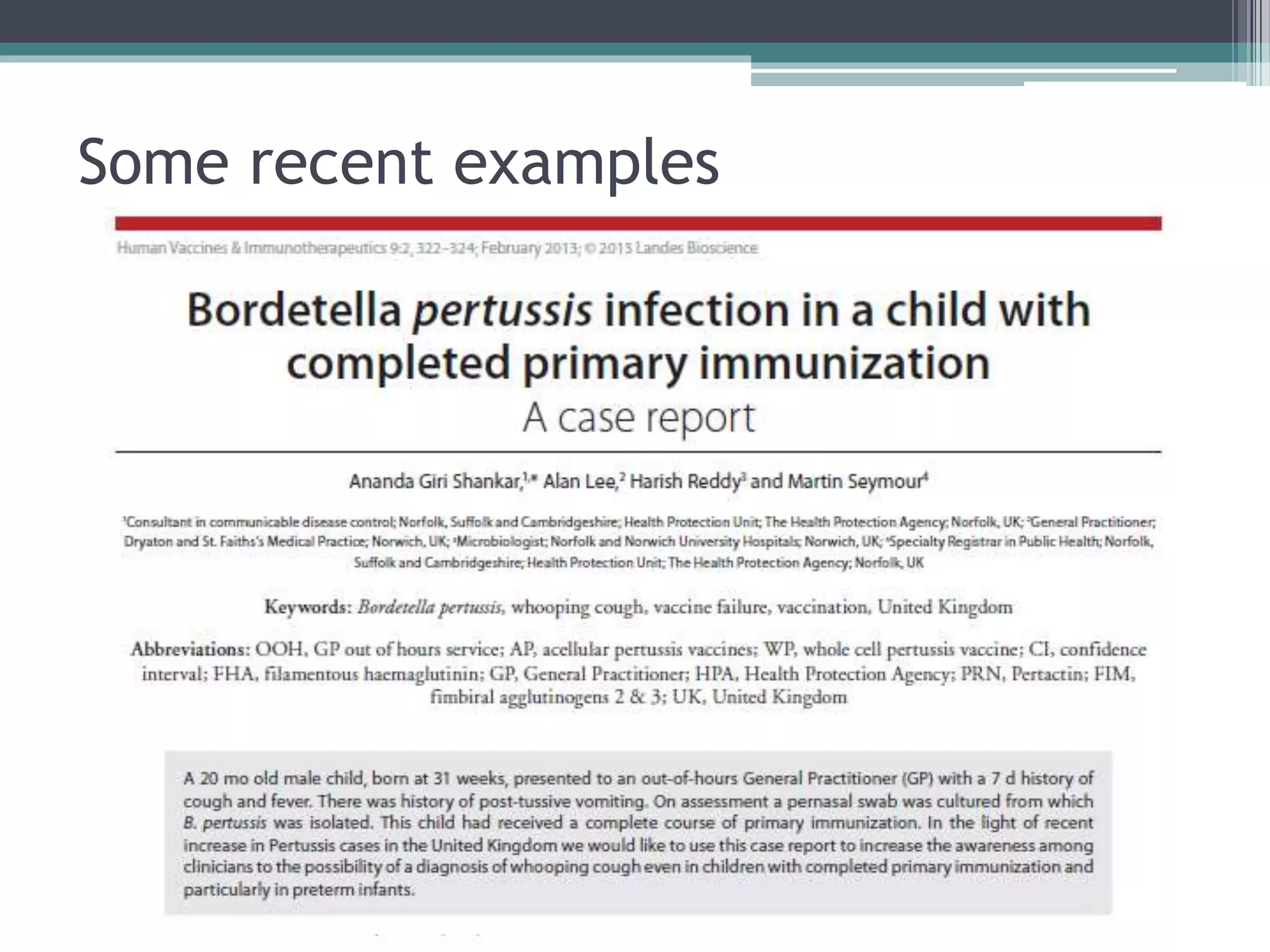
Some recent examples
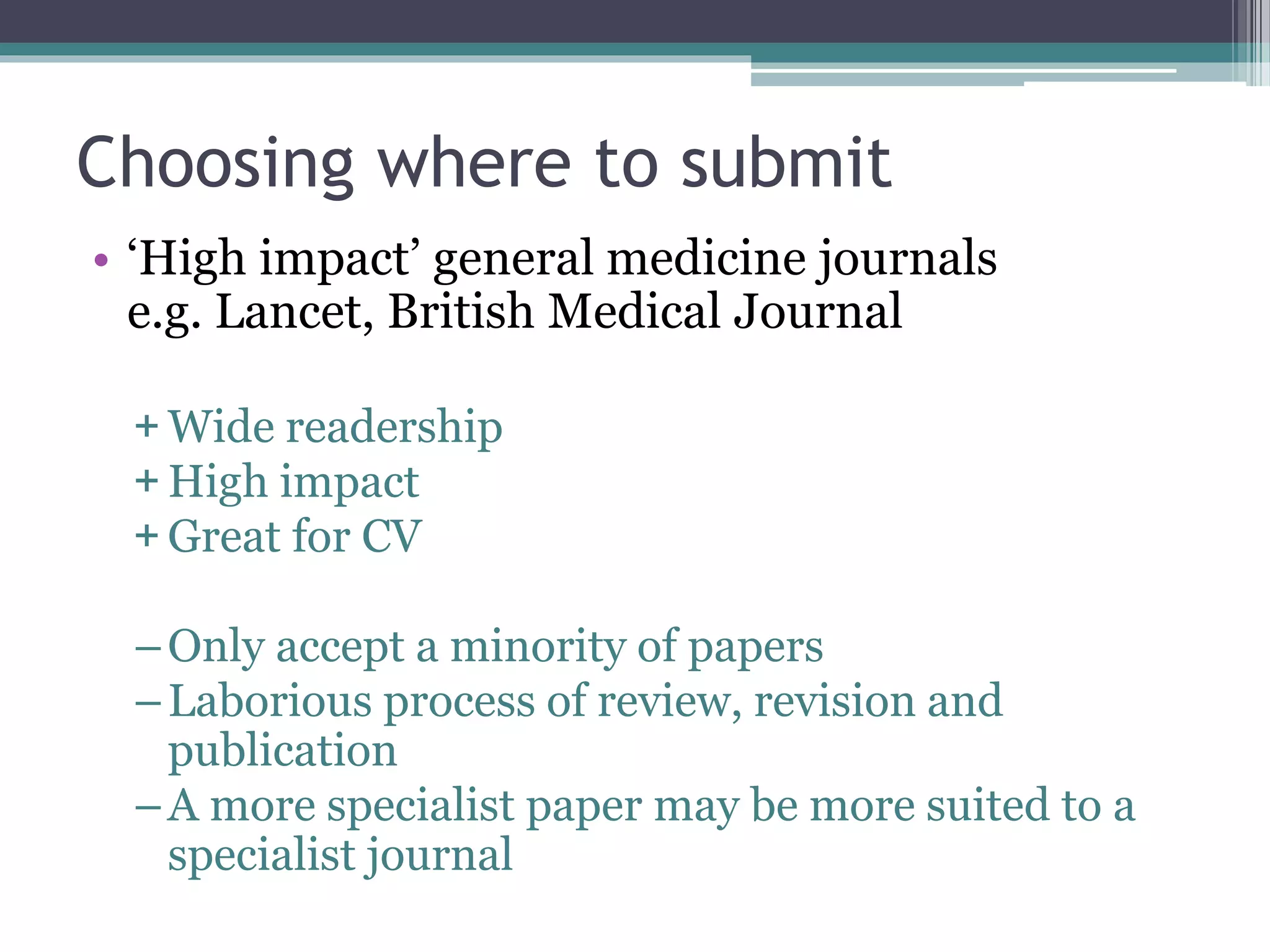
Choosing where to submit
• ‘High impact’ general medicine journals
e.g. Lancet, British Medical Journal
+ Wide readership
+ High impact
+ Great for CV
–Only accept a minority of papers
–Laborious process of review, revision and
publication
–A more specialist paper may be more suited to a
specialist journal
Choosing where to submit
• Specialist public health journals
e.g. Journal of Public Health, Journal of
Epidemiology and Community Health
+ More likely to reach an interested audience
+ Tend to accept a greater proportion of papers
–Lower impact than general medical journals
–Less likely to attract media coverage
–Laborious process of review, revision and
publication
Choosing where to submit
• Open Access journals, e.g. PLOS Medicine, BMC
Public Health, BMJ Open
+ Papers can be published within weeks not months
+ Some OA journals accept all papers so long as they
are methodologically sound
+ Full paper available to everyone
–Many have high fees to cover costs
–Variable quality and impact
Deciding on a journal
• Where were the articles you cited published?
• What journals do you read?
• Who are your target audience?
• Use an online tool like JANE
http://www.biosemantics.org/jane/
• Check the Journal’s website for information
• Send an exploratory e-mail to the editors
• Look out for calls for articles on your topic
• Check impact factors
Journal Impact Factor
• A measure of the frequency with which the
‘average article’ in a journal has been cited in a
particular year
• Helps evaluate a journal’s relative importance,
especially compared to others in the same field
• Impact factor >5 considered very good
• e.g. BMJ - 17, Journal of Public Health - 2, BMC
Public Health - 2
Exercise
• On your tables
• As a table discuss the barriers to paper
submission (5 minutes)
• Then, in pairs discuss a piece of work that you
could turn into a paper
• What would be the key PH message? (5 minutes)
• Share with the table, and choose one barrier
and one idea for a paper to feed back to the
room (5 minutes)
Co-author etiquette
• If it’s your paper, you should be the first author
• Often the main supervisor or principal
investigator is last
• Link those positions in between to relative
contributions made
• Shared 1st authorship is becoming more common
Co-author etiquette
• ICMJE criteria for authorship:
1. Substantial contributions to the conception or
design of the work; or the acquisition, analysis, or
interpretation of data for the work; AND
2. Drafting the work or revising it critically for
important intellectual content; AND
3. Final approval of the version to be published; AND
4. Agreement to be accountable for all aspects of the
work
Source: http://tinyurl.com/ICMJEcriteria
Preparing your manuscript
• Contact your academic supervisor for advice,
contacts, facilities
• Befriend a tame statistician
• Use reference manager software (e.g. Mendeley)
• Read the journal author instructions
• Refer to STROBE or other relevant guidelines
• Base layout on similar articles from the journal
• Be patient. It can take months or years, even
working full-time!
http://www.strobe-statement.org/
Peer review
• Usually two subject experts and a statistician
• Many journals will give authors the opportunity
to recommend or veto potential referees
• Once you have registered to submit your paper,
you may get requests to review future papers
• Contributing to peer review is part of academic
life
• Critical appraisal skills are needed
• Subject expertise helps to put articles in context
What do editors and
peer reviewers look for?
Is the information in your manuscript…
• New? (not published elsewhere)
• True? (conclusions valid)
• Relevant? (to the readership)
Does it have impact, presentation or citation potential?
Is it well-written, conforming to manuscript instructions?
Possible outcomes of submission
• Rejection without peer review
• Rejection with referees’ comments
• Opportunity to submit a revised manuscript
addressing referees’ comments
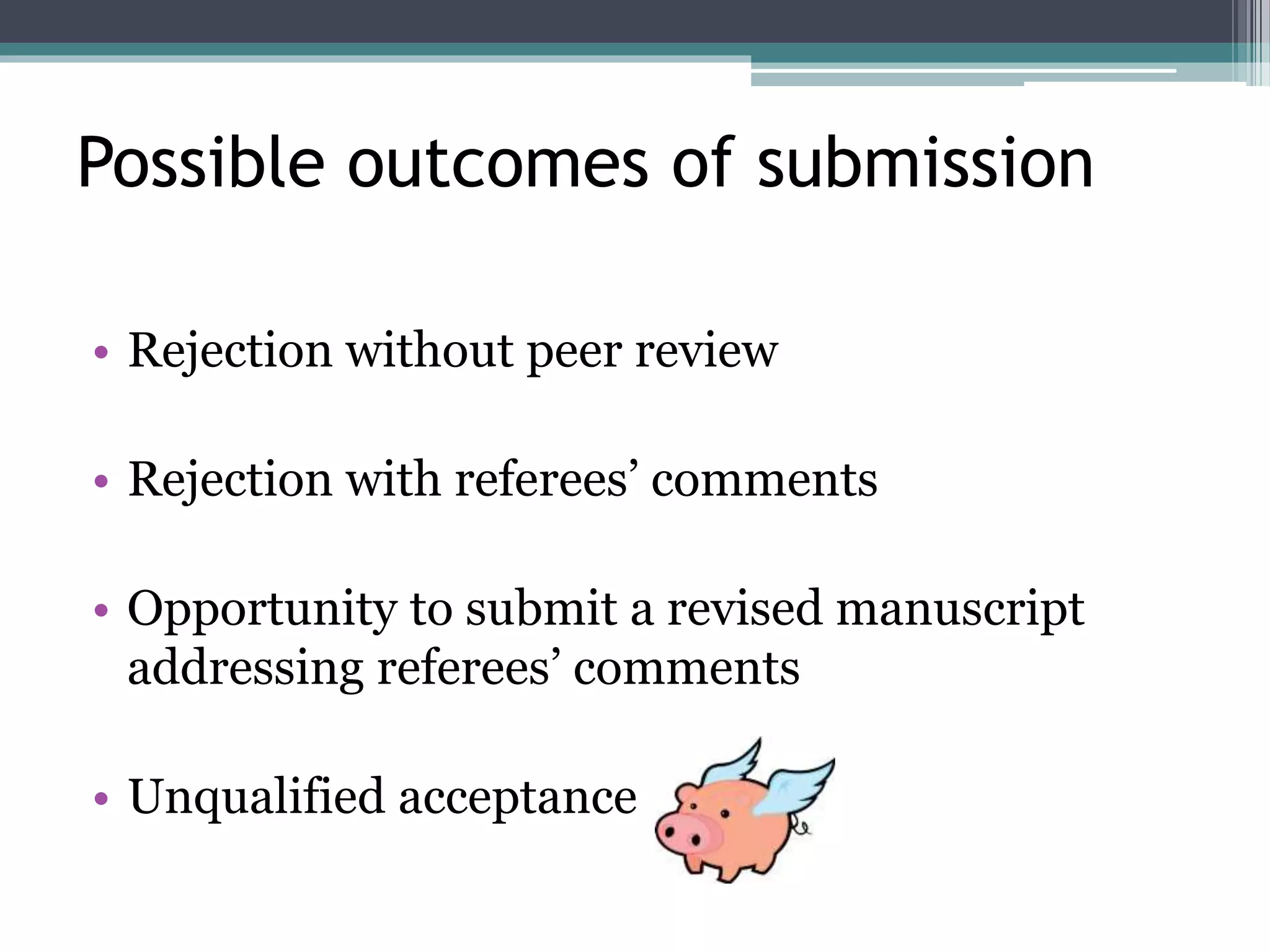
• Unqualified acceptance
A selection of recent StR publications
• Aasheim ET. Fan charts. Tidsskr Nor Legeforen 2013;133:196.
• Aasheim ET, Seymour M et al. Acute hepatitis A in an elderly patient
after care worker travel to high endemicity country . Hum Vaccin
Immunother. 2013;9:2480-2482.
• Savory LA et al. Changes in diet, cardiovascular risk factors and
modelled cardiovascular risk following diagnosis of diabetes: one-year
results from the ADDITION-Cambridge trial cohort. Diabet Med.
2014;31:148-155.
• Shankar AG, Lee A, Reddy H, Seymour M. Bordetella pertussis infection
in a child with completed primary immunization: A case report. Hum
Vaccin Immunother. 2013;9:322-324.
• Yip JL et al. Area deprivation, individual socioeconomic status and low
vision in the EPIC-Norfolk Eye Study. J Epidemiol Community Health.
2014;68:204-10.
Questions?

Publish or Perish - A guide to submitting papers for peer-reviewed publication

  • 1.
    Publish or perish? Aguide to submitting papers for peer-reviewed publication Ian Brown Louise Savory Erlend Aasheim
  • 2.
    A brief historyof scientific publication • First scientific journal was Philosophical Transactions • published by the Royal Society in 1665 Source: http://www.bbc.co.uk/radio4/science/publishorbedamned.shtml
  • 3.
    • Now morethan 2,000 publishers producing more than 1.6 million articles in more than 20,000 journals • Traditionally subscription-based • Rise of open access journals since 2000 Source: http://southernlibrarianship.icaap.org/content/v09n03/mcguigan_g01.html A brief history of scientific publication
  • 4.
  • 5.
    With thanks: http://tinyurl.com/carolinetomes Whyshould I try to publish? To share learning and disseminate knowledge To build your reputation as an academic To challenge the accepted scientific view In response to another publication To attract research funding To contribute to the research impact of your department Because your supervisor has told you to To achieve KA9 academic PH competences It looks good on your CV To improve population health and wellbeing To reduce health inequalities To demonstrate something is or isn’t (cost) effective To share a useful new method Failure to publish negative findings distorts the evidence base
  • 6.
    What could Isubmit? • MPhil dissertation • Service work evaluation • Case reports – e.g. from health protection placement • Systematic review • Comment piece / letter to editor
  • 7.
  • 8.
    Choosing where tosubmit • ‘High impact’ general medicine journals e.g. Lancet, British Medical Journal + Wide readership + High impact + Great for CV –Only accept a minority of papers –Laborious process of review, revision and publication –A more specialist paper may be more suited to a specialist journal
  • 9.
    Choosing where tosubmit • Specialist public health journals e.g. Journal of Public Health, Journal of Epidemiology and Community Health + More likely to reach an interested audience + Tend to accept a greater proportion of papers –Lower impact than general medical journals –Less likely to attract media coverage –Laborious process of review, revision and publication
  • 10.
    Choosing where tosubmit • Open Access journals, e.g. PLOS Medicine, BMC Public Health, BMJ Open + Papers can be published within weeks not months + Some OA journals accept all papers so long as they are methodologically sound + Full paper available to everyone –Many have high fees to cover costs –Variable quality and impact
  • 11.
    Deciding on ajournal • Where were the articles you cited published? • What journals do you read? • Who are your target audience? • Use an online tool like JANE http://www.biosemantics.org/jane/ • Check the Journal’s website for information • Send an exploratory e-mail to the editors • Look out for calls for articles on your topic • Check impact factors
  • 12.
    Journal Impact Factor •A measure of the frequency with which the ‘average article’ in a journal has been cited in a particular year • Helps evaluate a journal’s relative importance, especially compared to others in the same field • Impact factor >5 considered very good • e.g. BMJ - 17, Journal of Public Health - 2, BMC Public Health - 2
  • 13.
    Exercise • On yourtables • As a table discuss the barriers to paper submission (5 minutes) • Then, in pairs discuss a piece of work that you could turn into a paper • What would be the key PH message? (5 minutes) • Share with the table, and choose one barrier and one idea for a paper to feed back to the room (5 minutes)
  • 14.
    Co-author etiquette • Ifit’s your paper, you should be the first author • Often the main supervisor or principal investigator is last • Link those positions in between to relative contributions made • Shared 1st authorship is becoming more common
  • 15.
    Co-author etiquette • ICMJEcriteria for authorship: 1. Substantial contributions to the conception or design of the work; or the acquisition, analysis, or interpretation of data for the work; AND 2. Drafting the work or revising it critically for important intellectual content; AND 3. Final approval of the version to be published; AND 4. Agreement to be accountable for all aspects of the work Source: http://tinyurl.com/ICMJEcriteria
  • 16.
    Preparing your manuscript •Contact your academic supervisor for advice, contacts, facilities • Befriend a tame statistician • Use reference manager software (e.g. Mendeley) • Read the journal author instructions • Refer to STROBE or other relevant guidelines • Base layout on similar articles from the journal • Be patient. It can take months or years, even working full-time! http://www.strobe-statement.org/
  • 17.
    Peer review • Usuallytwo subject experts and a statistician • Many journals will give authors the opportunity to recommend or veto potential referees • Once you have registered to submit your paper, you may get requests to review future papers • Contributing to peer review is part of academic life • Critical appraisal skills are needed • Subject expertise helps to put articles in context
  • 18.
    What do editorsand peer reviewers look for? Is the information in your manuscript… • New? (not published elsewhere) • True? (conclusions valid) • Relevant? (to the readership) Does it have impact, presentation or citation potential? Is it well-written, conforming to manuscript instructions?
  • 19.
    Possible outcomes ofsubmission • Rejection without peer review • Rejection with referees’ comments • Opportunity to submit a revised manuscript addressing referees’ comments • Unqualified acceptance
  • 20.
    A selection ofrecent StR publications • Aasheim ET. Fan charts. Tidsskr Nor Legeforen 2013;133:196. • Aasheim ET, Seymour M et al. Acute hepatitis A in an elderly patient after care worker travel to high endemicity country . Hum Vaccin Immunother. 2013;9:2480-2482. • Savory LA et al. Changes in diet, cardiovascular risk factors and modelled cardiovascular risk following diagnosis of diabetes: one-year results from the ADDITION-Cambridge trial cohort. Diabet Med. 2014;31:148-155. • Shankar AG, Lee A, Reddy H, Seymour M. Bordetella pertussis infection in a child with completed primary immunization: A case report. Hum Vaccin Immunother. 2013;9:322-324. • Yip JL et al. Area deprivation, individual socioeconomic status and low vision in the EPIC-Norfolk Eye Study. J Epidemiol Community Health. 2014;68:204-10.
  • 21.

Editor's Notes

  • #5 Note open access is a complex issue, and definition of “open” varies.
  • #6 Ask for audience suggestions first
  • #7 Note MPhil and service work require conversion to a suitable format. Service work evaluation must be done with sufficient rigour Shall we sprinkle this slide (or create another) with examples of registrar publications (here or as references in an appendix to the presentation)?
  • #8 Note MPhil and service work require conversion to a suitable format. Service work evaluation must be done with sufficient rigour Shall we sprinkle this slide (or create another) with examples of registrar publications (here or as references in an appendix to the presentation)?
  • #9 BMJ publishes 7% of the 7,000 to 8,000 articles they receive annually. Example of what we mean by specialist paper: e.g. communicable disease case report, a methodology paper, a paper with relevance to a specific population group, e.g. geriatric public health
  • #12 Demonstrate Jane tool using a real abstract (TBC). Journals usually publish a mission statement: who there audience is, what they publish and what they don’t publish.
  • #13 Note limitations of Impact Factor: Comparisons across disciplines may not be fair Favours journals with that publish reviews May reflect the large impact of a relatively small proportion of a journal’s output Penalises Open Access journals that are less selective in what they publish (high impact articles “diluted”) Other “impact” metrics are available
  • #15 Note choice of second and second to last is also important.
  • #16 International Committee of Medical Journal Editors
  • #18 Though they may ignore your preference!
  • #19 New: Could also mean a new interpretation or spin on existing knowledge. The more novel, the higher the likely impact but replication or refutation can also be important findings. As can negative (null) results.
  • #20 If your paper is relevant to the journal, and you’ve followed the authorship instructions, then you can expect to fall in the middle. Rejection without peer review suggests you’ve aimed to high, while unqualified acceptance is extremely rare in respected peer-reviewed journals.