Craniopharyngioma:
Conservative Management
“There is perhaps no other primary brain tumor that evokes passion, emotion, and as a
result, controversy than does the craniopharyngioma.”
James Rutka, 2002
Dhaval Shukla
Department of Neurosurgery,
NIMHANS, Bangalore, India
“Perhaps the most important factor governing operative management of
a craniopharyngioma is the surgeon’s attitude toward the tumor. If he
or she regards the tumor as nonresectable, it will be treated as such and
no attempt will be made to remove it. If, on the other hand, the surgeon
feels that the craniopharyngioma can be totally removed, its
management is likely to be successful”
--Harold Hoffman, 1994.
However, the craniopharyngioma is a multifaceted and
unpredictable enemy.
Variability in Treatment of Craniopharyngioma
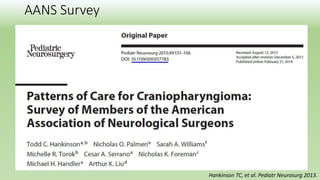
AANS Survey
Hankinson TC, et al. Pediatr Neurosurg 2013.
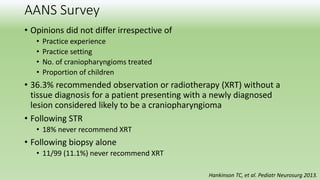
AANS Survey
• Opinions did not differ irrespective of
• Practice experience
• Practice setting
• No. of craniopharyngioms treated
• Proportion of children
• 36.3% recommended observation or radiotherapy (XRT) without a
tissue diagnosis for a patient presenting with a newly diagnosed
lesion considered likely to be a craniopharyngioma
• Following STR
• 18% never recommend XRT
• Following biopsy alone
• 11/99 (11.1%) never recommend XRT
Hankinson TC, et al. Pediatr Neurosurg 2013.
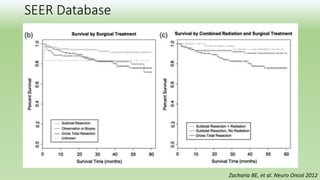
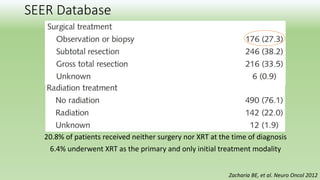
SEER Database
20.8% of patients received neither surgery nor XRT at the time of diagnosis
6.4% underwent XRT as the primary and only initial treatment modality
Zacharia BE, et al. Neuro Oncol 2012
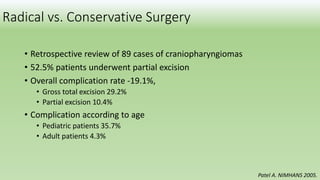
Radical vs. Conservative Surgery
• Retrospective review of 89 cases of craniopharyngiomas
• 52.5% patients underwent partial excision
• Overall complication rate -19.1%,
• Gross total excision 29.2%
• Partial excision 10.4%
• Complication according to age
• Pediatric patients 35.7%
• Adult patients 4.3%
Patel A. NIMHANS 2005.
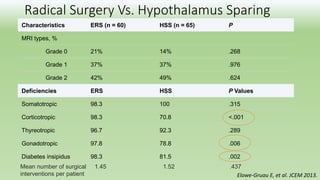
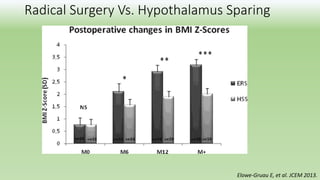
Radical Surgery Vs. Hypothalamus Sparing
MRI types, %
Grade 0 21% 14% .268
Grade 1 37% 37% .976
Grade 2 42% 49% .624
Characteristics ERS (n = 60) HSS (n = 65) P
Deficiencies ERS HSS P Values
Somatotropic 98.3 100 .315
Corticotropic 98.3 70.8 <.001
Thyreotropic 96.7 92.3 .289
Gonadotropic 97.8 78.8 .006
Diabetes insipidus 98.3 81.5 .002
Elowe-Gruau E, et al. JCEM 2013.
Mean number of surgical 1.45 1.52 .437
interventions per patient
Radical Surgery Vs. Hypothalamus Sparing
Elowe-Gruau E, et al. JCEM 2013.
KRANIOPHARYNGEOM
Grade of initial hypothalamic involvement was similar
2000 n=120
2001–2007
2007 n=106
2007–2012
Radical 38% 18% [p=0.01]
Hypothalamus-sparing operations
resulting in no (further)
hypothalamic lesions
35% 13% [p=0.005]
Event-free-survival rates were similar in both cohorts
A trend towards less radical surgical approaches is observed
A reduced rate of severe hypothalamic lesions
Radical surgery is not an appropriate treatment strategy in patients with hypothalamic involvement
Hoffman A, et al. 2014. Klinische Pädiatrie.
SEER Database
Zacharia BE, et al. Neuro Oncol 2012
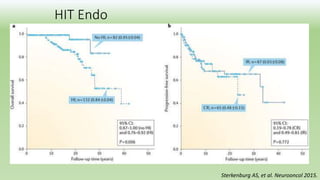
HIT Endo
Sterkenburg AS, et al. Neurooncol 2015.
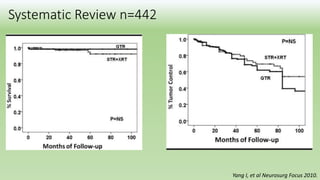
Systematic Review n=442
Yang I, et al Neurosurg Focus 2010.
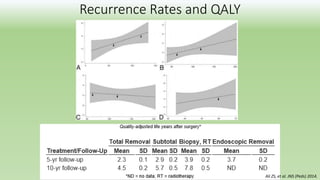
Recurrence Rates and QALY
Ali ZS, et al. JNS (Peds) 2014.
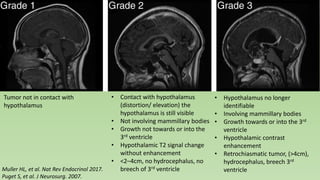
Tumor not in contact with
hypothalamus
• Contact with hypothalamus
(distortion/ elevation) the
hypothalamus is still visible
• Not involving mammillary bodies
• Growth not towards or into the
3rd ventricle
• Hypothalamic T2 signal change
without enhancement
• <2–4cm, no hydrocephalus, no
breech of 3rd ventricle
• Hypothalamus no longer
identifiable
• Involving mammillary bodies
• Growth towards or into the 3rd
ventricle
• Hypothalamic contrast
enhancement
• Retrochiasmatic tumor, (>4cm),
hydrocephalus, breech 3rd
ventricleMuller HL, et al. Nat Rev Endocrinol 2017.
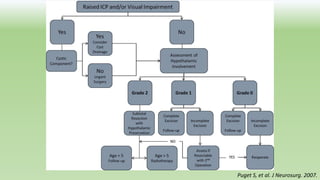
Puget S, et al. J Neurosurg. 2007.
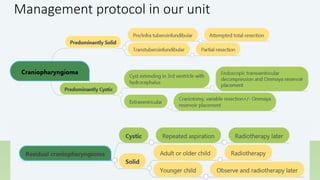
Management protocol in our unit
“The handling of a suprasellar tumor is one of the most difficult problems in
neurosurgery, and no hard and fast rule can be laid down regarding the best way
to deal with these cases.”
Ernest Sachs, 1949
The history of craniopharyngioma surgery may be thought of as a
swinging pendulum.
However, it is our duty to avoid dogmatism, and to balance the swing
of the pendulum.

Craniopharyngioma conservative management

  • 1.
    Craniopharyngioma: Conservative Management “There isperhaps no other primary brain tumor that evokes passion, emotion, and as a result, controversy than does the craniopharyngioma.” James Rutka, 2002 Dhaval Shukla Department of Neurosurgery, NIMHANS, Bangalore, India
  • 2.
    “Perhaps the mostimportant factor governing operative management of a craniopharyngioma is the surgeon’s attitude toward the tumor. If he or she regards the tumor as nonresectable, it will be treated as such and no attempt will be made to remove it. If, on the other hand, the surgeon feels that the craniopharyngioma can be totally removed, its management is likely to be successful” --Harold Hoffman, 1994. However, the craniopharyngioma is a multifaceted and unpredictable enemy.
  • 3.
    Variability in Treatmentof Craniopharyngioma
  • 4.
    AANS Survey Hankinson TC,et al. Pediatr Neurosurg 2013.
  • 5.
    AANS Survey • Opinionsdid not differ irrespective of • Practice experience • Practice setting • No. of craniopharyngioms treated • Proportion of children • 36.3% recommended observation or radiotherapy (XRT) without a tissue diagnosis for a patient presenting with a newly diagnosed lesion considered likely to be a craniopharyngioma • Following STR • 18% never recommend XRT • Following biopsy alone • 11/99 (11.1%) never recommend XRT Hankinson TC, et al. Pediatr Neurosurg 2013.
  • 6.
    SEER Database 20.8% ofpatients received neither surgery nor XRT at the time of diagnosis 6.4% underwent XRT as the primary and only initial treatment modality Zacharia BE, et al. Neuro Oncol 2012
  • 7.
    Radical vs. ConservativeSurgery • Retrospective review of 89 cases of craniopharyngiomas • 52.5% patients underwent partial excision • Overall complication rate -19.1%, • Gross total excision 29.2% • Partial excision 10.4% • Complication according to age • Pediatric patients 35.7% • Adult patients 4.3% Patel A. NIMHANS 2005.
  • 8.
    Radical Surgery Vs.Hypothalamus Sparing MRI types, % Grade 0 21% 14% .268 Grade 1 37% 37% .976 Grade 2 42% 49% .624 Characteristics ERS (n = 60) HSS (n = 65) P Deficiencies ERS HSS P Values Somatotropic 98.3 100 .315 Corticotropic 98.3 70.8 <.001 Thyreotropic 96.7 92.3 .289 Gonadotropic 97.8 78.8 .006 Diabetes insipidus 98.3 81.5 .002 Elowe-Gruau E, et al. JCEM 2013. Mean number of surgical 1.45 1.52 .437 interventions per patient
  • 9.
    Radical Surgery Vs.Hypothalamus Sparing Elowe-Gruau E, et al. JCEM 2013.
  • 10.
    KRANIOPHARYNGEOM Grade of initialhypothalamic involvement was similar 2000 n=120 2001–2007 2007 n=106 2007–2012 Radical 38% 18% [p=0.01] Hypothalamus-sparing operations resulting in no (further) hypothalamic lesions 35% 13% [p=0.005] Event-free-survival rates were similar in both cohorts A trend towards less radical surgical approaches is observed A reduced rate of severe hypothalamic lesions Radical surgery is not an appropriate treatment strategy in patients with hypothalamic involvement Hoffman A, et al. 2014. Klinische Pädiatrie.
  • 11.
    SEER Database Zacharia BE,et al. Neuro Oncol 2012
  • 12.
    HIT Endo Sterkenburg AS,et al. Neurooncol 2015.
  • 13.
    Systematic Review n=442 YangI, et al Neurosurg Focus 2010.
  • 14.
    Recurrence Rates andQALY Ali ZS, et al. JNS (Peds) 2014.
  • 15.
    Tumor not incontact with hypothalamus • Contact with hypothalamus (distortion/ elevation) the hypothalamus is still visible • Not involving mammillary bodies • Growth not towards or into the 3rd ventricle • Hypothalamic T2 signal change without enhancement • <2–4cm, no hydrocephalus, no breech of 3rd ventricle • Hypothalamus no longer identifiable • Involving mammillary bodies • Growth towards or into the 3rd ventricle • Hypothalamic contrast enhancement • Retrochiasmatic tumor, (>4cm), hydrocephalus, breech 3rd ventricleMuller HL, et al. Nat Rev Endocrinol 2017. Puget S, et al. J Neurosurg. 2007.
  • 16.
    Puget S, etal. J Neurosurg. 2007.
  • 17.
  • 18.
    “The handling ofa suprasellar tumor is one of the most difficult problems in neurosurgery, and no hard and fast rule can be laid down regarding the best way to deal with these cases.” Ernest Sachs, 1949 The history of craniopharyngioma surgery may be thought of as a swinging pendulum. However, it is our duty to avoid dogmatism, and to balance the swing of the pendulum.

Editor's Notes

  • #15 Estimated tumor recurrence rate after each surgical strategy. In each figure, the x axis marks the length of follow-up in months; the y axis marks the recurrence rate. The fitted mean rate is marked by the line, and the gray area marks the 95% confidence intervals. The arrowheads mark the recurrence rates at the 5- and 10-year follow-up. A: Attempt at GTR. B: Planned subtotal removal. C: Biopsy. D: Endoscopic removal.