Hussein AL-NATSHEH, CIAPPLE
Jordan Open Source Association
Amman, Aug 22, 2015
Hussein AL-NATSHEH ©2015
 From supervised to unsupervised learning
 Identifying a ML problem?
 Recommended python libraries
 Data preparation
 Case study; Author name disambiguation of CERN digital library (use case)
 References, recommended readings and courses
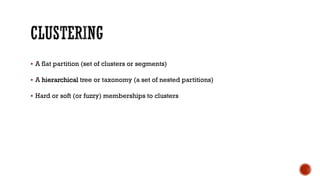
 A flat partition (set of clusters or segments)
 A hierarchical tree or taxonomy (a set of nested partitions)
 Hard or soft (or fuzzy) memberships to clusters
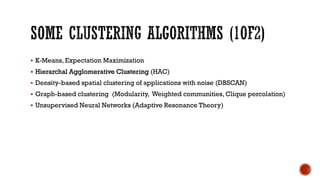
 K-Means, Expectation Maximization
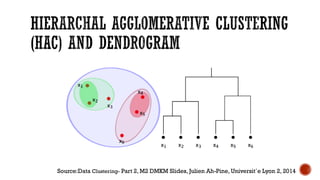
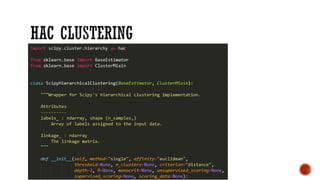
 Hierarchal Agglomerative Clustering (HAC)
 Density-based spatial clustering of applications with noise (DBSCAN)
 Graph-based clustering (Modularity, Weighted communities, Clique percolation)
 Unsupervised Neural Networks (Adaptive Resonance Theory)
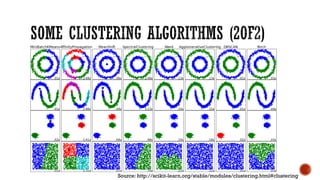
Source: http://scikit-learn.org/stable/modules/clustering.html#clustering
Source:Data Clustering- Part 2, M2 DMKM Slides, Julien Ah-Pine, Universit´e Lyon 2, 2014
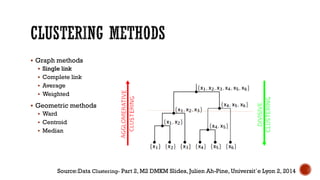
 Graph methods
 Single link
 Complete link
 Average
 Weighted
 Geometric methods
 Ward
 Centroid
 Median
Source:Data Clustering- Part 2, M2 DMKM Slides, Julien Ah-Pine, Universit´e Lyon 2, 2014
 Some distance functions
 Euclidean distance
 Jaccard Similarity
 Cosine Similarity
 Edit distance
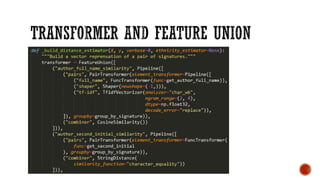
 Distance estimator
 Model an estimator to be used with a predict probability function
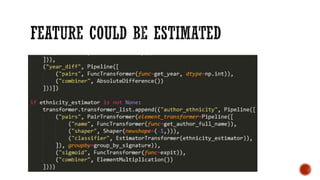
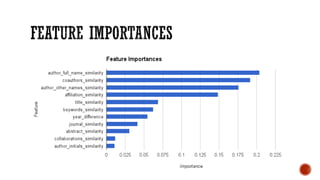
 Better for merging feature importances
 Dissimilarity (affinity) matrix
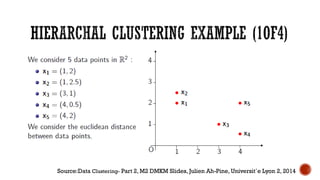
Source:Data Clustering- Part 2, M2 DMKM Slides, Julien Ah-Pine, Universit´e Lyon 2, 2014
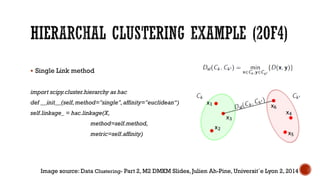
 Single Link method
import scipy.cluster.hierarchy as hac
def __init__(self,method="single",affinity="euclidean“)
self.linkage_ = hac.linkage(X,
method=self.method,
metric=self.affinity)
Image source: Data Clustering- Part 2, M2 DMKM Slides, Julien Ah-Pine, Universit´e Lyon 2, 2014
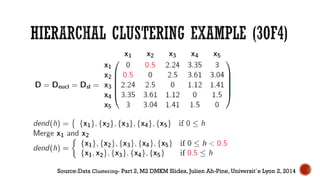
Source:Data Clustering- Part 2, M2 DMKM Slides, Julien Ah-Pine, Universit´e Lyon 2, 2014
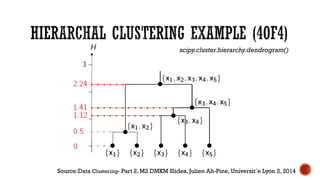
scipy.cluster.hierarchy.dendrogram()
Source:Data Clustering- Part 2, M2 DMKM Slides, Julien Ah-Pine, Universit´e Lyon 2, 2014
 Flat cutting forming partitioned clustering from HAC
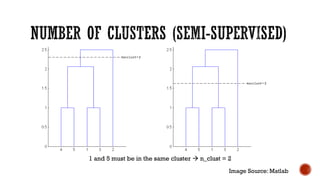
 Semi-supervised clustering
 DBSCAN
labels = hac.fcluster(self.linkage_,threshold)
1 and 5 must be in the same cluster  n_clust = 2
Image Source: Matlab
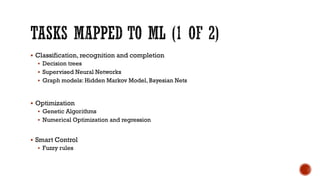
 Classification, recognition and completion
 Decision trees
 Supervised Neural Networks
 Graph models: Hidden Markov Model, Bayesian Nets
 Optimization
 Genetic Algorithms
 Numerical Optimization and regression
 Smart Control
 Fuzzy rules
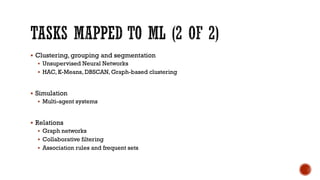
 Clustering, grouping and segmentation
 Unsupervised Neural Networks
 HAC, K-Means, DBSCAN, Graph-based clustering
 Simulation
 Multi-agent systems
 Relations
 Graph networks
 Collaborative filtering
 Association rules and frequent sets
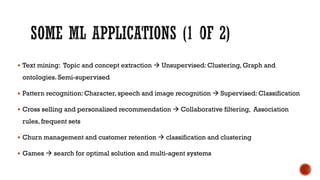
 Text mining: Topic and concept extraction  Unsupervised: Clustering, Graph and
ontologies. Semi-supervised
 Pattern recognition: Character, speech and image recognition  Supervised: Classification
 Cross selling and personalized recommendation  Collaborative filtering, Association
rules, frequent sets
 Churn management and customer retention  classification and clustering
 Games  search for optimal solution and multi-agent systems
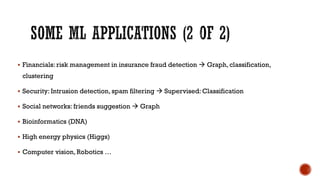
 Financials: risk management in insurance fraud detection  Graph, classification,
clustering
 Security: Intrusion detection, spam filtering  Supervised: Classification
 Social networks: friends suggestion  Graph
 Bioinformatics (DNA)
 High energy physics (Higgs)
 Computer vision, Robotics …
 General statistics
 Correlations
 Plotting
 Understanding the source and the business behind the data
 Well-understanding of the requirements and the goal of the project
 Feature extraction (What is a good feature?)
 Categories vs. continuous features vs. mixed
 Features Correlation
 Dimensionality reduction (the less the better for generalization)
 Missing values
 Normalization
 Outliers
 Feature selection
 Sampling
 Unbalanced dataset
 Scipy
 Numpy (vectorized data operations)
 Matplotlib (plotting)
 Scikit-Learn
 Pandas (data frames)
 NetworkX (Graphs analysis)
 Pylearn2 (deep learning and neural networks)
 BEARD (entity recognition) – to be presented within the use case
 fit
 predict
 fit_transform
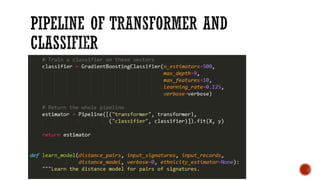
 Transformers
 Pipelines
 Features union
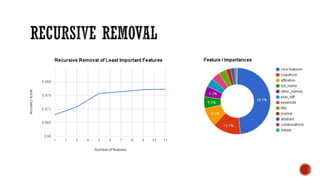
 Feature importances
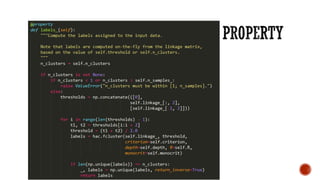
 @property
 Joblib and parallel computing
CERN Digital Library
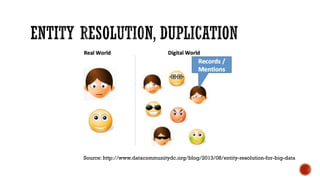
Source: http://www.datacommunitydc.org/blog/2013/08/entity-resolution-for-big-data
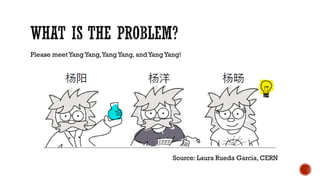
Please meetYangYang,YangYang, andYangYang!
Source: Laura Rueda Garcia, CERN
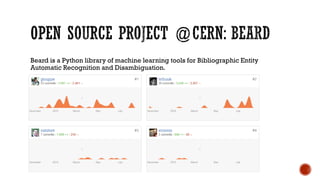
Beard is a Python library of machine learning tools for Bibliographic Entity
Automatic Recognition and Disambiguation.
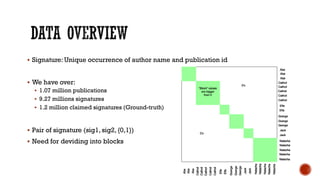
 Signature: Unique occurrence of author name and publication id
 We have over:
 1.07 million publications
 9.27 millions signatures
 1.2 million claimed signatures (Ground-truth)
 Pair of signature (sig1, sig2, {0,1})
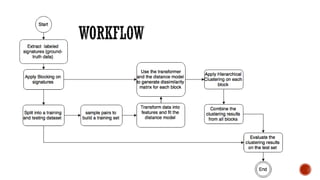
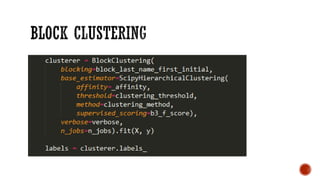
 Need for deviding into blocks
 Data Clustering- Part 2, M2 DMKM Slides, Julien Ah-Pine, Universit´e Lyon 2, 2014
 BEARD: https://github.com/inveniosoftware/beard
 Scikit-learn: http://scikit-learn.org
 Hussein, AL-NATSHEH. "Bibliographic Entity Automatic Recognition and
Disambiguation.“, CERN, 2015
https://preprints.cern.ch/record/2036112/files/CERN-THESIS-2015-098.pdf
 Buitinck, Lars, Gilles Louppe, Mathieu Blondel, Fabian Pedregosa, Andreas Mueller,
Olivier Grisel,Vlad Niculae et al. "API design for machine learning software:
experiences from the scikit-learn project." arXiv preprint arXiv:1309.0238 (2013).
http://arxiv.org/pdf/1309.0238.pdf
Practice on:
 https://ch.linkedin.com/in/natsheh
 https://twitter.com/hnatsheh
 h.natsheh@ciapple.com Thanks for attending!

JOSA TechTalks - Machine Learning in Practice

  • 1.
    Hussein AL-NATSHEH, CIAPPLE JordanOpen Source Association Amman, Aug 22, 2015 Hussein AL-NATSHEH ©2015
  • 2.
     From supervisedto unsupervised learning  Identifying a ML problem?  Recommended python libraries  Data preparation  Case study; Author name disambiguation of CERN digital library (use case)  References, recommended readings and courses
  • 6.
     A flatpartition (set of clusters or segments)  A hierarchical tree or taxonomy (a set of nested partitions)  Hard or soft (or fuzzy) memberships to clusters
  • 7.
     K-Means, ExpectationMaximization  Hierarchal Agglomerative Clustering (HAC)  Density-based spatial clustering of applications with noise (DBSCAN)  Graph-based clustering (Modularity, Weighted communities, Clique percolation)  Unsupervised Neural Networks (Adaptive Resonance Theory)
  • 8.
  • 9.
    Source:Data Clustering- Part2, M2 DMKM Slides, Julien Ah-Pine, Universit´e Lyon 2, 2014
  • 10.
     Graph methods Single link  Complete link  Average  Weighted  Geometric methods  Ward  Centroid  Median Source:Data Clustering- Part 2, M2 DMKM Slides, Julien Ah-Pine, Universit´e Lyon 2, 2014
  • 11.
     Some distancefunctions  Euclidean distance  Jaccard Similarity  Cosine Similarity  Edit distance  Distance estimator  Model an estimator to be used with a predict probability function  Better for merging feature importances  Dissimilarity (affinity) matrix
  • 12.
    Source:Data Clustering- Part2, M2 DMKM Slides, Julien Ah-Pine, Universit´e Lyon 2, 2014
  • 13.
     Single Linkmethod import scipy.cluster.hierarchy as hac def __init__(self,method="single",affinity="euclidean“) self.linkage_ = hac.linkage(X, method=self.method, metric=self.affinity) Image source: Data Clustering- Part 2, M2 DMKM Slides, Julien Ah-Pine, Universit´e Lyon 2, 2014
  • 14.
    Source:Data Clustering- Part2, M2 DMKM Slides, Julien Ah-Pine, Universit´e Lyon 2, 2014
  • 15.
    scipy.cluster.hierarchy.dendrogram() Source:Data Clustering- Part2, M2 DMKM Slides, Julien Ah-Pine, Universit´e Lyon 2, 2014
  • 16.
     Flat cuttingforming partitioned clustering from HAC  Semi-supervised clustering  DBSCAN labels = hac.fcluster(self.linkage_,threshold)
  • 17.
    1 and 5must be in the same cluster  n_clust = 2 Image Source: Matlab
  • 19.
     Classification, recognitionand completion  Decision trees  Supervised Neural Networks  Graph models: Hidden Markov Model, Bayesian Nets  Optimization  Genetic Algorithms  Numerical Optimization and regression  Smart Control  Fuzzy rules
  • 20.
     Clustering, groupingand segmentation  Unsupervised Neural Networks  HAC, K-Means, DBSCAN, Graph-based clustering  Simulation  Multi-agent systems  Relations  Graph networks  Collaborative filtering  Association rules and frequent sets
  • 21.
     Text mining:Topic and concept extraction  Unsupervised: Clustering, Graph and ontologies. Semi-supervised  Pattern recognition: Character, speech and image recognition  Supervised: Classification  Cross selling and personalized recommendation  Collaborative filtering, Association rules, frequent sets  Churn management and customer retention  classification and clustering  Games  search for optimal solution and multi-agent systems
  • 22.
     Financials: riskmanagement in insurance fraud detection  Graph, classification, clustering  Security: Intrusion detection, spam filtering  Supervised: Classification  Social networks: friends suggestion  Graph  Bioinformatics (DNA)  High energy physics (Higgs)  Computer vision, Robotics …
  • 23.
     General statistics Correlations  Plotting  Understanding the source and the business behind the data  Well-understanding of the requirements and the goal of the project
  • 25.
     Feature extraction(What is a good feature?)  Categories vs. continuous features vs. mixed  Features Correlation  Dimensionality reduction (the less the better for generalization)  Missing values  Normalization  Outliers  Feature selection  Sampling  Unbalanced dataset
  • 27.
     Scipy  Numpy(vectorized data operations)  Matplotlib (plotting)  Scikit-Learn  Pandas (data frames)  NetworkX (Graphs analysis)  Pylearn2 (deep learning and neural networks)  BEARD (entity recognition) – to be presented within the use case
  • 28.
     fit  predict fit_transform  Transformers  Pipelines  Features union  Feature importances  @property  Joblib and parallel computing
  • 29.
  • 30.
  • 31.
  • 32.
    Beard is aPython library of machine learning tools for Bibliographic Entity Automatic Recognition and Disambiguation.
  • 33.
     Signature: Uniqueoccurrence of author name and publication id  We have over:  1.07 million publications  9.27 millions signatures  1.2 million claimed signatures (Ground-truth)  Pair of signature (sig1, sig2, {0,1})  Need for deviding into blocks
  • 46.
     Data Clustering-Part 2, M2 DMKM Slides, Julien Ah-Pine, Universit´e Lyon 2, 2014  BEARD: https://github.com/inveniosoftware/beard  Scikit-learn: http://scikit-learn.org  Hussein, AL-NATSHEH. "Bibliographic Entity Automatic Recognition and Disambiguation.“, CERN, 2015 https://preprints.cern.ch/record/2036112/files/CERN-THESIS-2015-098.pdf  Buitinck, Lars, Gilles Louppe, Mathieu Blondel, Fabian Pedregosa, Andreas Mueller, Olivier Grisel,Vlad Niculae et al. "API design for machine learning software: experiences from the scikit-learn project." arXiv preprint arXiv:1309.0238 (2013). http://arxiv.org/pdf/1309.0238.pdf
  • 47.
  • 48.