Deep Learning on Hadoop 
Scale out Deep Learning on YARN
Adam Gibson 
Email : 0@blix.io 
Twitter 
@agibsonccc 
Github 
github.com/agi 
bsonccc 
Slideshare 
slideshare.net/agibsonccc 
Teaching 
zipfianacademy.com 
Press 
wired.com/2014/06/skymind 
-deep-learning
Josh Patterson 
Email: 
josh@pattersonconsultingtn.com 
Twitter: @jpatanooga 
Github: 
github.com 
/jpatanooga 
Past 
Published in IAAI-09: 
“TinyTermite: A Secure Routing Algorithm” 
Grad work in Meta-heuristics, Ant-algorithms 
Tennessee Valley Authority 
(TVA) 
Hadoop and the Smartgrid 
Cloudera 
Principal Solution Architect 
Today: Patterson Consulting
Overview 
• What Is Deep Learning? 
• Neural Nets and Optimization Algorithms 
• Implementation on Hadoop/YARN 
• Results
What is Deep Learning? 
Machine perception, pattern recognition.
What Is Deep Learning? 
Algorithms called neural nets that learn to 
recognize patterns: 
Nodes learn smaller features of larger patterns 
And combine them to recognize feature groups 
Until finally they can classify objects, faces, etc. 
Each node layer in net learns larger groups
Properties of Deep Learning 
Small training sets, they learn unsupervised 
data 
They save data scientists months of work 
Anything you can vectorize, DL nets can learn 
They can handle millions of parameters 
After training, DL models are one, small vector
Chasing Nature 
Learning sparse representations of auditory 
signals 
Leads to filters that correspond to neurons in 
early audio processing in mammals 
When applied to speech 
Learned representations show a resemblance to 
cochlear filters in the auditory cortex.
Yann Lecun on Deep Learning 
DL is the dominant method for acoustic 
modeling in speech recognition 
It is becoming dominant in machine vision for: 
object recognition 
object detection 
semantic segmentation.
Deep Neural Nets 
“Deep” > 1 hidden layer
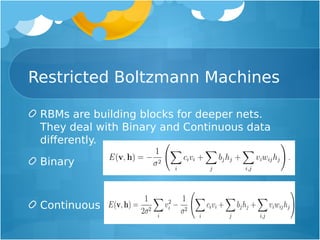
Restricted Boltzmann Machines 
RBMs are building blocks for deeper nets. 
They deal with Binary and Continuous data 
differently. 
Binary 
Continuous
What Is a Deep-Belief Network? 
A stack of restricted Boltzmann machines 
A generative probabilistic model 
1) A visible (input) layer … 
2) Two or more hidden layers that learn more 
& more complex features… 
3) An output layer that classifies the input.
A Recursive Neural Tensor 
Network? 
RNTN’s are top-down; DBN’s are feed-forward 
A tensor is 3d matrix 
RNTN’s handle multiplicity 
Scene and sentence parsing, windows of 
events
A Deep Autoencoder? 
DA’s are good for QA systems like Watson 
They encode lots of data in smaller number 
vectors 
Good for Image Search, Topic Modeling
A Convolutional Net? 
ConvNets slice up features with shared 
weights 
ConvNets learns images in patches from a grid 
Very good at generalization
DeepLearning4J 
The most complete, production-ready open-source 
DL lib 
Written in Java: Uses Akka, Hazelcast and Jblas 
Distributed to run fast, built for non-specialists 
More features than Theano-based tools 
Talks to any data source, expects 1 format
DL4J Serves Industry 
Nonspecialists can rely on its conventions to 
solve computationally intensive problems 
Usability first – DL4J follows ML tool conventions 
DL4J’s nets work equally well with text, image, 
sound and time-series 
DL4J will integrate with Python community 
through SDKs
Vectorized 
Implementation 
Handles lots of data concurrently. 
Any number of examples at once, but the 
code does not change. 
Faster: Allows for native and GPU execution. 
One input format: Everything is a matrix. 
Image, sound, text, time series are vectorized.
DL4J vs Theano vs Torch 
DL4J’s distributed nature means problems can 
be solved by “throwing CPUs at them.” 
Java ecosystem has GPU integration tools. 
Theano is not distributed, and Torch7 has not 
automated its distribution like DL4J. 
DL4J’s matrix multiplication is native w/ Jblas.
What Are Good Applications for 
DL? 
Recommendation engines (e-commerce) 
DL can model consumer and user behavior 
Anomaly detection (fraud, money laundering) 
DL can recognize early signals of bad outcomes 
Signal processing (CRM, ERP) 
DL has predictive capacity with time-series data
DL4J Vectorizes & Analyzes Text 
Sentiment analysis 
Logs 
News articles 
Social media
DL on Hadoop and AWS 
Build Your Own Google Brain …
Past Work: Parallel Iterative Algos on YARN 
Started with 
Parallel linear, logistic regression 
Parallel Neural Networks 
“Metronome” packages DL4J for Hadoop 
100% Java, ASF 2.0 Licensed, on Github
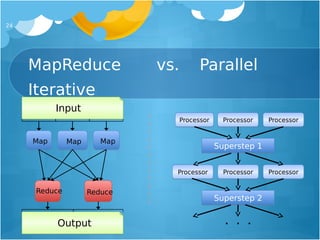
MapReduce vs. Parallel 
Iterative 
24 
Input 
Map Map Map 
Reduce Reduce 
Output 
PPrroocceessssoorr PPrroocceessssoorr PPrroocceessssoorr 
SSuuppeerrsstteepp 11 
PPrroocceessssoorr PPrroocceessssoorr 
SSuuppeerrsstteepp 22 
. . . 
PPrroocceessssoorr
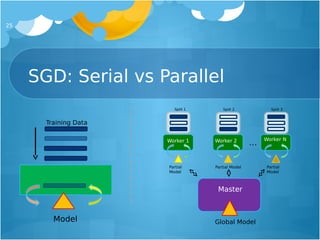
SGD: Serial vs Parallel 
25 
Training Data 
Model 
Split 1 Split 2 Split 3 
Worker 1 
Worker 2 
Partial Model 
Master 
Partial 
Model 
Global Model 
Worker N 
Partial 
Model 
…
Managing Resources 
Running through YARN on Hadoop is important 
Allows for workflow scheduling 
Allows for scheduler oversight 
Allows the jobs to be first-class citizens on 
Hadoop 
And shares resources nicely
Parallelizing Deep-Belief Networks 
Two-phase training 
Pretrain 
Fine-tune 
Each phase can do multiple passes over 
dataset 
Entire network is averaged at master
PreTrain and Lots of Data 
We’re exploring how to better leverage the 
unsupervised aspects of the PreTrain phase 
of Deep-Belief Networks 
Allows for the use of far more unlabeled 
data 
Allows us to more easily model the massive 
amounts of structured data in HDFS
Results 
DL4J on Hadoop is fast and accurate
DBNs on IR Performance 
 Faster to train. 
 Parameter averaging is an automatic form of 
regularization. 
 Adagrad with IR allows for better 
generalization of different features and even 
pacing.
Scale-out Metrics 
Batches of records can be processed by as 
many workers as there are data splits 
Message passing overhead is minimal 
Exhibits linear scaling 
Example: 3x workers, 3x faster learning
Usage From Command 
Line 
Run Deep Learning on Hadoop 
yarn jar iterativereduce-0.1-SNAPSH O T.jar [props file] 
Evaluate model 
./score_m odel.sh [props file]
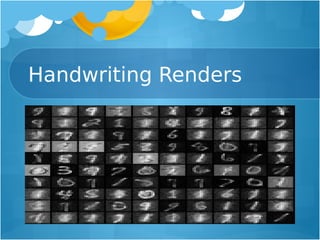
Handwriting Renders
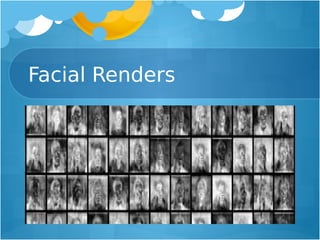
Facial Renders
What’s Next? 
GPU integration in the cloud (AWS) 
Better vectorization tooling & data pipelines 
Move YARN version back over to JBLAS for 
matrices 
Spark
References 
“A Fast-Learning Algorithm for Deep Belief Nets” 
Hinton, G. E., Osindero, S. and Teh, Y. - Neural Computation 
(2006) 
“Large Scale Distributed Deep Networks” 
Dean, Corrado, Monga - NIPS (2012) 
“Visually Debugging Restricted Boltzmann Machine 
Training with a 3D Example” 
Yosinski, Lipson - Representation Learning Workshop (2012)
Parameter Averaging 
McDonald, 2010 
Distributed Training Strategies for the Structured 
Perceptron 
Langford, 2007 
Vowpal Wabbit 
Jeff Dean’s Work on Parallel SGD 
DownPour SGD 
37

Introduction to parallel iterative deep learning on hadoop’s next​ generation yarn framework presentation 2

  • 1.
    Deep Learning onHadoop Scale out Deep Learning on YARN
  • 2.
    Adam Gibson Email: 0@blix.io Twitter @agibsonccc Github github.com/agi bsonccc Slideshare slideshare.net/agibsonccc Teaching zipfianacademy.com Press wired.com/2014/06/skymind -deep-learning
  • 3.
    Josh Patterson Email: josh@pattersonconsultingtn.com Twitter: @jpatanooga Github: github.com /jpatanooga Past Published in IAAI-09: “TinyTermite: A Secure Routing Algorithm” Grad work in Meta-heuristics, Ant-algorithms Tennessee Valley Authority (TVA) Hadoop and the Smartgrid Cloudera Principal Solution Architect Today: Patterson Consulting
  • 4.
    Overview • WhatIs Deep Learning? • Neural Nets and Optimization Algorithms • Implementation on Hadoop/YARN • Results
  • 5.
    What is DeepLearning? Machine perception, pattern recognition.
  • 6.
    What Is DeepLearning? Algorithms called neural nets that learn to recognize patterns: Nodes learn smaller features of larger patterns And combine them to recognize feature groups Until finally they can classify objects, faces, etc. Each node layer in net learns larger groups
  • 7.
    Properties of DeepLearning Small training sets, they learn unsupervised data They save data scientists months of work Anything you can vectorize, DL nets can learn They can handle millions of parameters After training, DL models are one, small vector
  • 8.
    Chasing Nature Learningsparse representations of auditory signals Leads to filters that correspond to neurons in early audio processing in mammals When applied to speech Learned representations show a resemblance to cochlear filters in the auditory cortex.
  • 9.
    Yann Lecun onDeep Learning DL is the dominant method for acoustic modeling in speech recognition It is becoming dominant in machine vision for: object recognition object detection semantic segmentation.
  • 10.
    Deep Neural Nets “Deep” > 1 hidden layer
  • 11.
    Restricted Boltzmann Machines RBMs are building blocks for deeper nets. They deal with Binary and Continuous data differently. Binary Continuous
  • 12.
    What Is aDeep-Belief Network? A stack of restricted Boltzmann machines A generative probabilistic model 1) A visible (input) layer … 2) Two or more hidden layers that learn more & more complex features… 3) An output layer that classifies the input.
  • 13.
    A Recursive NeuralTensor Network? RNTN’s are top-down; DBN’s are feed-forward A tensor is 3d matrix RNTN’s handle multiplicity Scene and sentence parsing, windows of events
  • 14.
    A Deep Autoencoder? DA’s are good for QA systems like Watson They encode lots of data in smaller number vectors Good for Image Search, Topic Modeling
  • 15.
    A Convolutional Net? ConvNets slice up features with shared weights ConvNets learns images in patches from a grid Very good at generalization
  • 16.
    DeepLearning4J The mostcomplete, production-ready open-source DL lib Written in Java: Uses Akka, Hazelcast and Jblas Distributed to run fast, built for non-specialists More features than Theano-based tools Talks to any data source, expects 1 format
  • 17.
    DL4J Serves Industry Nonspecialists can rely on its conventions to solve computationally intensive problems Usability first – DL4J follows ML tool conventions DL4J’s nets work equally well with text, image, sound and time-series DL4J will integrate with Python community through SDKs
  • 18.
    Vectorized Implementation Handleslots of data concurrently. Any number of examples at once, but the code does not change. Faster: Allows for native and GPU execution. One input format: Everything is a matrix. Image, sound, text, time series are vectorized.
  • 19.
    DL4J vs Theanovs Torch DL4J’s distributed nature means problems can be solved by “throwing CPUs at them.” Java ecosystem has GPU integration tools. Theano is not distributed, and Torch7 has not automated its distribution like DL4J. DL4J’s matrix multiplication is native w/ Jblas.
  • 20.
    What Are GoodApplications for DL? Recommendation engines (e-commerce) DL can model consumer and user behavior Anomaly detection (fraud, money laundering) DL can recognize early signals of bad outcomes Signal processing (CRM, ERP) DL has predictive capacity with time-series data
  • 21.
    DL4J Vectorizes &Analyzes Text Sentiment analysis Logs News articles Social media
  • 22.
    DL on Hadoopand AWS Build Your Own Google Brain …
  • 23.
    Past Work: ParallelIterative Algos on YARN Started with Parallel linear, logistic regression Parallel Neural Networks “Metronome” packages DL4J for Hadoop 100% Java, ASF 2.0 Licensed, on Github
  • 24.
    MapReduce vs. Parallel Iterative 24 Input Map Map Map Reduce Reduce Output PPrroocceessssoorr PPrroocceessssoorr PPrroocceessssoorr SSuuppeerrsstteepp 11 PPrroocceessssoorr PPrroocceessssoorr SSuuppeerrsstteepp 22 . . . PPrroocceessssoorr
  • 25.
    SGD: Serial vsParallel 25 Training Data Model Split 1 Split 2 Split 3 Worker 1 Worker 2 Partial Model Master Partial Model Global Model Worker N Partial Model …
  • 26.
    Managing Resources Runningthrough YARN on Hadoop is important Allows for workflow scheduling Allows for scheduler oversight Allows the jobs to be first-class citizens on Hadoop And shares resources nicely
  • 27.
    Parallelizing Deep-Belief Networks Two-phase training Pretrain Fine-tune Each phase can do multiple passes over dataset Entire network is averaged at master
  • 28.
    PreTrain and Lotsof Data We’re exploring how to better leverage the unsupervised aspects of the PreTrain phase of Deep-Belief Networks Allows for the use of far more unlabeled data Allows us to more easily model the massive amounts of structured data in HDFS
  • 29.
    Results DL4J onHadoop is fast and accurate
  • 30.
    DBNs on IRPerformance  Faster to train.  Parameter averaging is an automatic form of regularization.  Adagrad with IR allows for better generalization of different features and even pacing.
  • 31.
    Scale-out Metrics Batchesof records can be processed by as many workers as there are data splits Message passing overhead is minimal Exhibits linear scaling Example: 3x workers, 3x faster learning
  • 32.
    Usage From Command Line Run Deep Learning on Hadoop yarn jar iterativereduce-0.1-SNAPSH O T.jar [props file] Evaluate model ./score_m odel.sh [props file]
  • 33.
  • 34.
  • 35.
    What’s Next? GPUintegration in the cloud (AWS) Better vectorization tooling & data pipelines Move YARN version back over to JBLAS for matrices Spark
  • 36.
    References “A Fast-LearningAlgorithm for Deep Belief Nets” Hinton, G. E., Osindero, S. and Teh, Y. - Neural Computation (2006) “Large Scale Distributed Deep Networks” Dean, Corrado, Monga - NIPS (2012) “Visually Debugging Restricted Boltzmann Machine Training with a 3D Example” Yosinski, Lipson - Representation Learning Workshop (2012)
  • 37.
    Parameter Averaging McDonald,2010 Distributed Training Strategies for the Structured Perceptron Langford, 2007 Vowpal Wabbit Jeff Dean’s Work on Parallel SGD DownPour SGD 37