Building Online CommunitiesJuly 1st 2010Jon Keefe CEO KMP Digitata
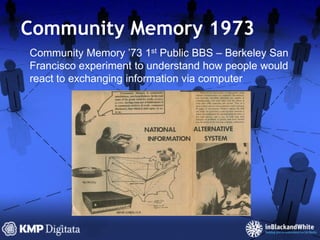
Community Memory 1973Community Memory ’73 1st Public BBS – Berkeley San Francisco experiment to understand how people would react to exchanging information via computer
History of Communities onlineUsenet ‘79 – organised into topical categories called newsgroupsUsenet resembled Bulletin Board Systems (BBS) which were precursors of today’s internet forumsMUD (Multi-User Dungeons)multi-user real-time virtual world represented in textIRC (Internet Relay Chat)a form of real-time Internet text messaging (chat) or synchronous conferencingChat RoomsBBSSysOP home-hosted systemsToday’s Threaded Internet Forumswww.biofind.comCommunity 2.0Web 2.0 technologies plus a community
DefinitionWhen people carry on public discussions long enough, with sufficient human feeling, to form webs of personal relationshipsHoward Rheingold Author- Virtual Communities (1993)
Other Leading LightsMark GranovetterAmerican sociologist at Stanford University Theories on the spread of information in social networks known as "The Strength of Weak Ties" (1973).Malcolm Gladwell“The Tipping Point” where he talks of “the moment of critical mass, the threshold, the boiling point.”
What makes up Online CommunityAn enabling technologyNing, wordpressA core topicPassionate contributorsBackground crowdAn unwritten social contract of trustModerators (sometimes)
Examples of the purpose of online communitiesActivismClan (gaming)Research test bedTechnology Strategy Board 30,000 representative UK onliners www.innovateuk.orgSupport Groups
Examples of the purpose of online communitiesEthnographyHobbieswww.flickr.com - photographywww.redbubble.com - poetryAnswerswww.blurt-it.comA highly networked individual’s social graph
Biofind
Mercedes forum
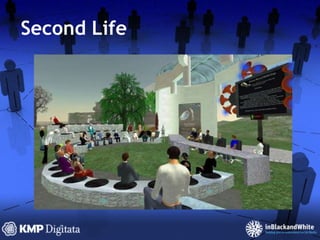
Second Life
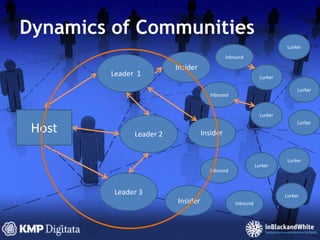
Make up of a communityPeripheral (i.e. Lurker)– An outside, unstructured participationInbound (i.e. Novice)Newcomer is invested in the community and heading towards full participationInsider (i.e. Regular)Full committed community participantLeader (i.e. Champion)A leader, sustains membership participation and brokers interactions
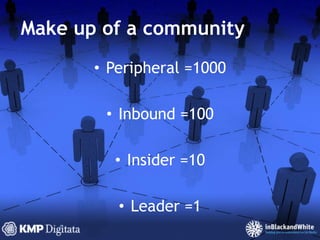
Make up of a communityPeripheral =1000Inbound =100Insider =10Leader =1
Community participationLurkers don’t readily participate because they don’t believe they need to and in not doing so they are being helpfulLeaders participate because they believe that their actions will have positive outcomesMember participation is not based on hierarchical needs or goals-driven theories but desire planning and they environmentIncreasing participation in online communities: A framework forhuman–computer interaction:JonathanBishop
Dynamics of CommunitiesLurkerInboundInsiderLeader  1LurkerLurkerInboundLurkerHostLurkerLeader 2InsiderLurkerLurkerInboundLeader 3LurkerInsiderInbound
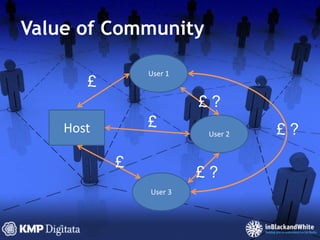
Value of CommunityUser 1££ ?Host£User 2£ ?££ ?User 3
Monetisation summaryGood Old fashioned cpc mechanismsSubscription or freemium modelsRelationship commissions
Other value in communityConversation/dialogueSentimentInfluenceCo-learningCollaboration
Qualitative Signs of successSigns of ownership within the communitySelf-policingRitualsOff-line actions begin
Quantitative success metricsNumber of new membersNumber leaving membersMember satisfactionNumber and type of content items createdNumber of connections / relationships createdTime on siteFrequency of visitsRecommendations & Referrals
Building a communityDon’t let technology drive the communitySeed content with known champions in the topicInaugural members act as roll modelsDefine code of conductBetaKeep participation simpleInitially all content open unless as part of a reward
Building a communityPolitely provoke and reward participationTrack strangers/lurkers and try to promote them through desireBe active and part of the community yourselfSet an exampleIt takes time!
SummaryOnline communities have social structure just like the real world because they comprise real people!Online communities have a voice and an opinionOnline communities can be valued in many ways
SummaryBe careful, you don’t want to be thrown out of your own community.Because the lunatics will take over the asylum
Thank you, any questions?

Jon Keefe - Online Communities

  • 1.
    Building Online CommunitiesJuly1st 2010Jon Keefe CEO KMP Digitata
  • 2.
    Community Memory 1973CommunityMemory ’73 1st Public BBS – Berkeley San Francisco experiment to understand how people would react to exchanging information via computer
  • 3.
    History of CommunitiesonlineUsenet ‘79 – organised into topical categories called newsgroupsUsenet resembled Bulletin Board Systems (BBS) which were precursors of today’s internet forumsMUD (Multi-User Dungeons)multi-user real-time virtual world represented in textIRC (Internet Relay Chat)a form of real-time Internet text messaging (chat) or synchronous conferencingChat RoomsBBSSysOP home-hosted systemsToday’s Threaded Internet Forumswww.biofind.comCommunity 2.0Web 2.0 technologies plus a community
  • 4.
    DefinitionWhen people carryon public discussions long enough, with sufficient human feeling, to form webs of personal relationshipsHoward Rheingold Author- Virtual Communities (1993)
  • 5.
    Other Leading LightsMarkGranovetterAmerican sociologist at Stanford University Theories on the spread of information in social networks known as "The Strength of Weak Ties" (1973).Malcolm Gladwell“The Tipping Point” where he talks of “the moment of critical mass, the threshold, the boiling point.”
  • 6.
    What makes upOnline CommunityAn enabling technologyNing, wordpressA core topicPassionate contributorsBackground crowdAn unwritten social contract of trustModerators (sometimes)
  • 7.
    Examples of thepurpose of online communitiesActivismClan (gaming)Research test bedTechnology Strategy Board 30,000 representative UK onliners www.innovateuk.orgSupport Groups
  • 8.
    Examples of thepurpose of online communitiesEthnographyHobbieswww.flickr.com - photographywww.redbubble.com - poetryAnswerswww.blurt-it.comA highly networked individual’s social graph
  • 9.
  • 10.
  • 11.
  • 12.
    Make up ofa communityPeripheral (i.e. Lurker)– An outside, unstructured participationInbound (i.e. Novice)Newcomer is invested in the community and heading towards full participationInsider (i.e. Regular)Full committed community participantLeader (i.e. Champion)A leader, sustains membership participation and brokers interactions
  • 13.
    Make up ofa communityPeripheral =1000Inbound =100Insider =10Leader =1
  • 14.
    Community participationLurkers don’treadily participate because they don’t believe they need to and in not doing so they are being helpfulLeaders participate because they believe that their actions will have positive outcomesMember participation is not based on hierarchical needs or goals-driven theories but desire planning and they environmentIncreasing participation in online communities: A framework forhuman–computer interaction:JonathanBishop
  • 15.
    Dynamics of CommunitiesLurkerInboundInsiderLeader 1LurkerLurkerInboundLurkerHostLurkerLeader 2InsiderLurkerLurkerInboundLeader 3LurkerInsiderInbound
  • 16.
    Value of CommunityUser1££ ?Host£User 2£ ?££ ?User 3
  • 17.
    Monetisation summaryGood Oldfashioned cpc mechanismsSubscription or freemium modelsRelationship commissions
  • 18.
    Other value incommunityConversation/dialogueSentimentInfluenceCo-learningCollaboration
  • 19.
    Qualitative Signs ofsuccessSigns of ownership within the communitySelf-policingRitualsOff-line actions begin
  • 20.
    Quantitative success metricsNumberof new membersNumber leaving membersMember satisfactionNumber and type of content items createdNumber of connections / relationships createdTime on siteFrequency of visitsRecommendations & Referrals
  • 21.
    Building a communityDon’tlet technology drive the communitySeed content with known champions in the topicInaugural members act as roll modelsDefine code of conductBetaKeep participation simpleInitially all content open unless as part of a reward
  • 22.
    Building a communityPolitelyprovoke and reward participationTrack strangers/lurkers and try to promote them through desireBe active and part of the community yourselfSet an exampleIt takes time!
  • 23.
    SummaryOnline communities havesocial structure just like the real world because they comprise real people!Online communities have a voice and an opinionOnline communities can be valued in many ways
  • 24.
    SummaryBe careful, youdon’t want to be thrown out of your own community.Because the lunatics will take over the asylum
  • 25.
    Thank you, anyquestions?