unfollowing on twitter
Funda Kivran-Swaine, Priya Govindan, Mor Naaman

Rutgers University | School Media Information Lab


Article: The Impact of Network Structure on Breaking Ties in Online
Social Networks: Unfollowing on Twitter. To Appear, CHI 2011.
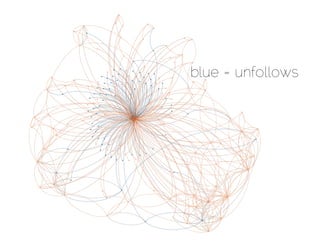
blue = unfollows
big story
online social networks – large proportion of
activity on the Web.

generate a better understanding of the
dynamics

validate theories from social sciences in
these new and important settings
what structural properties of the
 social network of nodes and
 dyads predict the breaking of
 ties (unfollows) on Twitter?
theory background
tie strength
embeddedness within networks
power & status
data
user data set (911 users) from Naaman, Boase, Lai
(2010); social network data from Kwak et al. (2010)
     715   seed nodes
 245,586 “following” connections to seed nodes
  30.6% dropped between 07/2009 & 04/2010
analysis
* independent variables (computed)
   seed properties
      follower-count, follower-to-followee ratio, network
     density, reciprocity rate, follow-back rate
   follower properties
       follower-count, follower-to-followee ratio
   dyad properties
      reciprocity, common neighbors, common followers,
     common friends, right transitivity, left transitivity, mutual
     transitivity, prestige ratio
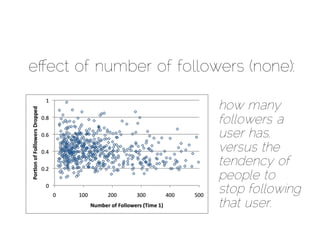
effect of number of followers (none):

                         how many
                         followers a
                         user has,
                         versus the
                         tendency of
                         people to
                         stop following
                         that user.
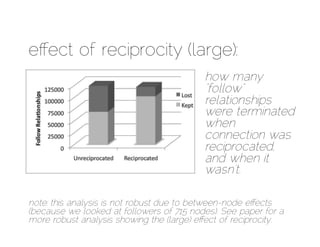
effect of reciprocity (large):
                                          how many
                                          “follow”
                                          relationships
                                          were terminated
                                          when
                                          connection was
                                          reciprocated,
                                          and when it
                                          wasn’t.

note: this analysis is not robust due to between-node e!ects
(because we looked at followers of 715 nodes). See paper for a
more robust analysis showing the (large) e!ect of reciprocity.
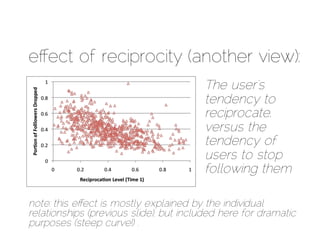
effect of reciprocity (another view):
                                        The user’s
                                        tendency to
                                        reciprocate,
                                        versus the
                                        tendency of
                                        users to stop
                                        following them

note: this e!ect is mostly explained by the individual
relationships (previous slide), but included here for dramatic
purposes (steep curve!) .
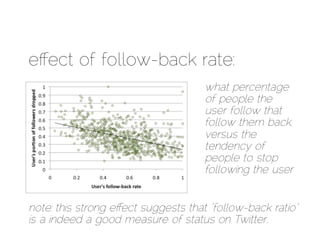
effect of follow-back rate:
                                     what percentage
                                     of people the
                                     user follow that
                                     follow them back,
                                     versus the
                                     tendency of
                                     people to stop
                                     following the user


note: this strong e!ect suggests that “follow-back ratio”
is a indeed a good measure of status on Twitter.
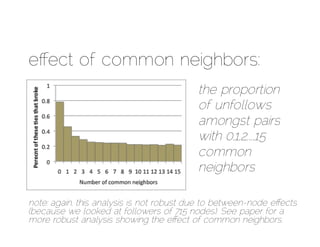
effect of common neighbors:
                                          the proportion
                                          of unfollows
                                          amongst pairs
                                          with 0,1,2,…,15
                                          common
                                          neighbors

note: again, this analysis is not robust due to between-node e!ects
(because we looked at followers of 715 nodes). See paper for a
more robust analysis showing the e!ect of common neighbors.
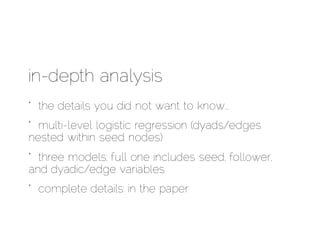
in-depth analysis
* the details you did not want to know…
* multi-level logistic regression (dyads/edges
nested within seed nodes)
* three models; full one includes seed, follower,
and dyadic/edge variables
* complete details: in the paper
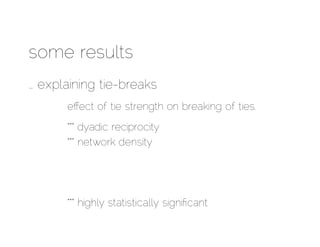
some results
… explaining tie-breaks
      effect of tie strength on breaking of ties.
      *** dyadic reciprocity
      *** network density


      *** highly statistically significant
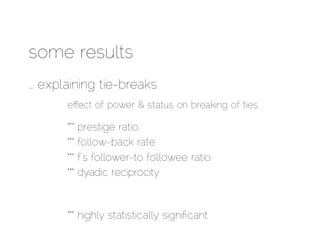
some results
… explaining tie-breaks
      effect of power & status on breaking of ties.

      ***   prestige ratio
      ***   follow-back rate
      ***   f’s follower-to followee ratio
      ***   dyadic reciprocity


      *** highly statistically significant
some results
… explaining tie-breaks
      effect of embeddedness on breaking of ties.

      *** common neighbors


      *** highly statistically significant
limitations & future work
only two snapshots: add more
additional (non-structural) variables
(frequency of posting?)
for more details

http://www.ayman-naaman.net/?p=667


Funda Kivran-Swaine, Priya Govindan and
Mor Naaman (2011). The Impact of Network
Structure on Breaking Ties in Online Social
Networks: Unfollowing on Twitter. In
Proceedings, CHI 2011.
thank you
            mornaaman.com
            @informor


            Rutgers SC&I
            Social Media Information Lab

Unfollowing on twitter

  • 1.
    unfollowing on twitter FundaKivran-Swaine, Priya Govindan, Mor Naaman Rutgers University | School Media Information Lab Article: The Impact of Network Structure on Breaking Ties in Online Social Networks: Unfollowing on Twitter. To Appear, CHI 2011.
  • 2.
  • 3.
    big story online socialnetworks – large proportion of activity on the Web. generate a better understanding of the dynamics validate theories from social sciences in these new and important settings
  • 4.
    what structural propertiesof the social network of nodes and dyads predict the breaking of ties (unfollows) on Twitter?
  • 5.
    theory background tie strength embeddednesswithin networks power & status
  • 6.
    data user data set(911 users) from Naaman, Boase, Lai (2010); social network data from Kwak et al. (2010) 715 seed nodes 245,586 “following” connections to seed nodes 30.6% dropped between 07/2009 & 04/2010
  • 7.
    analysis * independent variables(computed) seed properties follower-count, follower-to-followee ratio, network density, reciprocity rate, follow-back rate follower properties follower-count, follower-to-followee ratio dyad properties reciprocity, common neighbors, common followers, common friends, right transitivity, left transitivity, mutual transitivity, prestige ratio
  • 8.
    effect of numberof followers (none): how many followers a user has, versus the tendency of people to stop following that user.
  • 9.
    effect of reciprocity(large): how many “follow” relationships were terminated when connection was reciprocated, and when it wasn’t. note: this analysis is not robust due to between-node e!ects (because we looked at followers of 715 nodes). See paper for a more robust analysis showing the (large) e!ect of reciprocity.
  • 10.
    effect of reciprocity(another view): The user’s tendency to reciprocate, versus the tendency of users to stop following them note: this e!ect is mostly explained by the individual relationships (previous slide), but included here for dramatic purposes (steep curve!) .
  • 11.
    effect of follow-backrate: what percentage of people the user follow that follow them back, versus the tendency of people to stop following the user note: this strong e!ect suggests that “follow-back ratio” is a indeed a good measure of status on Twitter.
  • 12.
    effect of commonneighbors: the proportion of unfollows amongst pairs with 0,1,2,…,15 common neighbors note: again, this analysis is not robust due to between-node e!ects (because we looked at followers of 715 nodes). See paper for a more robust analysis showing the e!ect of common neighbors.
  • 13.
    in-depth analysis * thedetails you did not want to know… * multi-level logistic regression (dyads/edges nested within seed nodes) * three models; full one includes seed, follower, and dyadic/edge variables * complete details: in the paper
  • 14.
    some results … explainingtie-breaks effect of tie strength on breaking of ties. *** dyadic reciprocity *** network density *** highly statistically significant
  • 15.
    some results … explainingtie-breaks effect of power & status on breaking of ties. *** prestige ratio *** follow-back rate *** f’s follower-to followee ratio *** dyadic reciprocity *** highly statistically significant
  • 16.
    some results … explainingtie-breaks effect of embeddedness on breaking of ties. *** common neighbors *** highly statistically significant
  • 17.
    limitations & futurework only two snapshots: add more additional (non-structural) variables (frequency of posting?)
  • 18.
    for more details http://www.ayman-naaman.net/?p=667 FundaKivran-Swaine, Priya Govindan and Mor Naaman (2011). The Impact of Network Structure on Breaking Ties in Online Social Networks: Unfollowing on Twitter. In Proceedings, CHI 2011.
  • 19.
    thank you mornaaman.com @informor Rutgers SC&I Social Media Information Lab