This document presents an overview of netnography, the use of eFieldnotes for data collection, and ethical considerations for digital research. Netnography is defined as an adapted form of ethnography for studying computer-mediated social worlds. Key aspects of netnography include reflexivity, praxis, resonance, verisimilitude, and rigor. eFieldnotes are a method for qualitative data collection that combines notes from social media with standard fieldnotes. As researchers encounter participants online, the boundaries between field and home blur. Finally, ethical issues in digital research include informed consent, participant identification and anonymity, and how power dynamics may shift with participants able to respond to research findings.
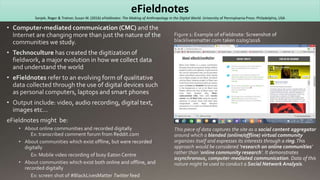
![Netnography: Definition and Quality Criterion
Reflexivity Judges the extent to which the role of the researcher is
acknowledged and is open to alternative interpretations
Praxis Judges the extent to which the netnography inspires and
empowers social action
Resonance Judges to what extent personalized and sensitizing connection
with the cultural phenomenon is gained
Verisimilitude Judges the extent to which a believable and lifelike sense of
cultural and communal contact is achieved
Rigour Judges the extent to which netnography recognizes and
adheres to the procedural standards of netnographic research
[adapted from adapted from Kozinets, 2010: p. 1 – 8 & p. 1 – 20, 189 – 195]
The practice of ‘netnography’ is a useful method for researchers interested in revealing, analyzing and
understanding “the self-presentation strategies individuals use to construct a digital self” (Kozinets, 2010: p.2)
Criterion for quality netnography include reflexivity, praxis, resonance, verisimilitude and rigour [Kozinets, 2010]
Netnography Definition
“A specialized form of ethnography
adapted to the unique computer-
mediated contingencies of today’s social
world’s” (Kozinets 2010: p. 1)](https://image.slidesharecdn.com/finalslideshareppt-160310025904/85/EDRD-6000-Netnography-eFieldnotes-3-320.jpg)
![• When researchers encounter the field through social media, the local-global divide shrinks - the distinction
between being ‘in the field’ and ‘out of the field’ can blur
“Digital communication technologies do not dissolve boundaries between field and home, but they can bring
disparate worlds into close proximity”
[Jordan Kramer p. 123]
• eFieldnotes are widening the complexity of qualitative data collection and analysis
• New methods for combining eFieldnotes with standard fieldnotes is a necessary evolution
Encountering the Field Through Social Media
Sanjek, Roger &Tratner,Susan W. (2016) eFieldnotes:The Making of Anthropology in the DigitalWorld. University of Pennsylvania Press: Philadelphia, USA](https://image.slidesharecdn.com/finalslideshareppt-160310025904/85/EDRD-6000-Netnography-eFieldnotes-5-320.jpg)
![Ethical Considerations for Netnographic Research
“Social media is affecting researcher’s efforts to recruit participants, gain informed consent, collect data, leave the field, and
disseminate results because participants have greater ability to respond to those findings. [This] points to shifts of power between
participants and researchers…suggests that this might promise greater equity between participants and researchers, while also
potentially introducing new pitfalls.” [Reich, 2015. p. 395]](https://image.slidesharecdn.com/finalslideshareppt-160310025904/85/EDRD-6000-Netnography-eFieldnotes-6-320.jpg)
![More Ethical Considerations
Consideration: How do parameters of ‘informed consent’ change across privately/publically accessed information?
[Sin, Harng Luh (2015)]](https://image.slidesharecdn.com/finalslideshareppt-160310025904/85/EDRD-6000-Netnography-eFieldnotes-7-320.jpg)
![Consent, Identification and Anonymity
Purpose Procedures Risks Benefits Compensation Confidentiality Costs Participant rights
[Sin, Harng Luh (2015)]](https://image.slidesharecdn.com/finalslideshareppt-160310025904/85/EDRD-6000-Netnography-eFieldnotes-8-320.jpg)
![GLOSSARY [adapted from adapted from Kozinets, 2010: p. 189 – 195]
Asynchronous
Communication
Communications that are staggered in time, such as billboards, web-pages, forum postings, emails; spread over days,
weeks, months; contrasted with synchronous “real-time” communication
Blended netnography Combines collection of online data/interactions with face-to-face data/interactions. Contrasted to ‘pure’ netnography
Computer-mediated
communication (CMC)
Communication that takes place through a computer or network; forums, postings, instant messaging, e-mails, chat rooms,
texting etc…
Cyberculture Distinct type of culture; developed along with digital information, communication technologies & the Internet: learned systems of
meaning, which include beliefs, values, practices, roles & languages that organize online social formations
Online community
research
Examines some phenomenon directly related to online communities and online culture itself, its manifestations and/or elements
Research on online
communities
Examines general social phenomenon whose social existence extends beyond the Internet and online interactions, where online
communication plays an important, but not exclusive, role in the group membership
Rings organizations of related web-pages, linked together & structured by interest
SocialContentAggregators Sites/services designed to facilitate communal discovery & sharing of Internet content, vote on it, and comment upon it; a
potential sit of online community and culture. Ex: Reddit, Buzzfeed etc…
Social NetworkingAnalysis determining structural relationships among and between communities
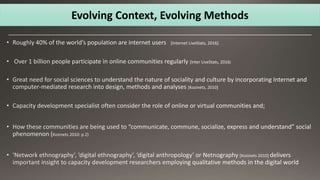
Technoculture Term to represent that technology does not determine culture and culture does not determine technology; they are co-evolving
Online (orVirtual)
Communities
Terms popularized by Howard Rheingold (1993: p.5): “social aggregations that emerge from the Internet when enough people
carry on… public discussions long enough, with sufficient human feelings, to form webs of personal relationships in cyber space.”](https://image.slidesharecdn.com/finalslideshareppt-160310025904/85/EDRD-6000-Netnography-eFieldnotes-10-320.jpg)


![제 23회 보아즈(BOAZ) 빅데이터 컨퍼런스 - [MBOAX] : ABSA를 활용한 소비자 반응 분석 기반 운영 효율화 대시보드 설계](https://cdn.slidesharecdn.com/ss_thumbnails/3-1boaz23rdconferencemboax-260203102709-9d519923-thumbnail.jpg?width=640&height=640&fit=bounds)


