Job Satisfaction  Presented by: ARUN JAPANI ADITI CHATURVEDI IRA SAXENA NEHA YADAV NIYATI AGARWAL
WHAT  IS JOB SATISFACTION? Job satisfaction is in regard to one's feelings or state-of-mind regarding the nature of their work. Job satisfaction can be influenced by a variety of factors,  The quality of one's relationship with their supervisor,  The quality of the physical environment in which they work, degree of fulfillment in their work, etc.
Case study: Barry Niland  Barry niland,supervisor of a small sales department noticed one of his sales representative,Hunter had problem Hunter’s sale had declined in last six months Other sales representtives reularly exceeded their quotas Niland decides to boost his sales representative’s preformance
Approaches for increasing Hunter’ Job  satisfaction Job performance Job involvement Organisational commitment
Why study job satisfaction  By taking collective feedback , organizations  can address such issues .  Otherwise  it has to go be perception of few who are near to the management . Such feedback be motivated by personal likes and  dislikes . There is also a danger that employees  would not like to give honest feedback  due to some fears of repercussions .
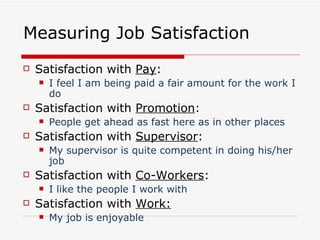
Measuring Job Satisfaction Satisfaction with  Pay : I feel I am being paid a fair amount for the work I do Satisfaction with  Promotion : People get ahead as fast here as in other places Satisfaction with  Supervisor : My supervisor is quite competent in doing his/her job Satisfaction with  Co-Workers : I like the people I work with Satisfaction with  Work: My job is enjoyable
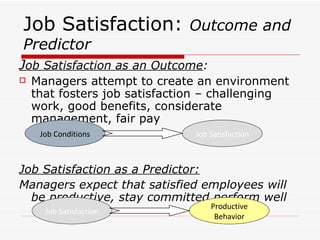
Job Satisfaction:  Outcome and Predictor J ob Satisfaction as an Outcome : Managers attempt to create an environment that fosters job satisfaction – challenging work, good benefits, considerate management, fair pay Job Satisfaction as a Predictor: Managers expect that satisfied employees will be productive, stay committed,perform well Job Conditions Job Satisfaction Job Satisfaction Productive Behavior
Employee attitude and cosequences When attitude of employees  are positive about company , one finds  various symptoms like  Low turnover  High productivity  Fast acceptance of new changes  More support among teams . Willing to  give extra  when needed . When it becomes negative attitudes , the reverse occurs
 
Attitude towards organization It is  an issue of  how mind  feels /perceives  the organization .That becomes the dominant attitude . Hence it becomes necessary to capture the  /perceptions of employees  which can give us an idea of their attitude Attitudes are the feelings and beliefs that determine how employee would work  Apart  from organization policies ,the  immediate manager controls many of the factors relating to employee satisfaction , it is  also necessary  to capture the satisfaction due to all factors . There  may be some people with who are pessimistic and some are pessimistic . The response would be different from them. But still it gives  some indications that can be captured , analyzed for actions .
Job Satisfaction & performance  There is no strong acceptance among many researchers, etc., that increased job satisfaction produces improve job performance -- in fact, improved job satisfaction can sometimes decrease job performance if organization is not able to create ownership of long vision an d goals of the organization . For example, you could let sometime sit around all day and do nothing. That may make them more satisfied with their "work" in the short run, but their performance certainly didn't improve.
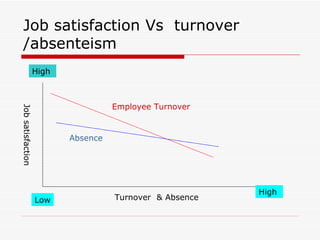
Job satisfaction Vs  turnover /absenteism  Turnover  & Absence Job satisfaction  Absence Employee Turnover  Low High  High
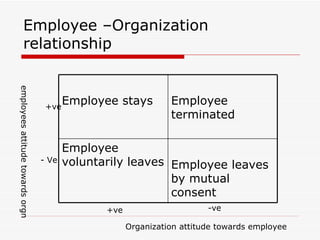
Employee –Organization relationship - Ve +ve +ve -ve Organization attitude towards employee employees attitude towards orgn Employee leaves by mutual consent  Employee voluntarily leaves Employee terminated Employee stays
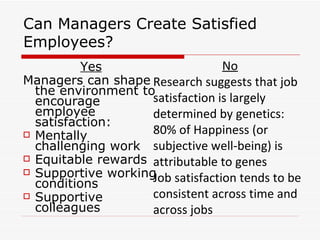
Can Managers Create Satisfied Employees? Yes Managers can shape the environment to encourage employee satisfaction: Mentally challenging work Equitable rewards Supportive working conditions Supportive colleagues No Research suggests that job satisfaction is largely determined by genetics: 80% of Happiness (or subjective well-being) is attributable to genes Job satisfaction tends to be consistent across time and across jobs
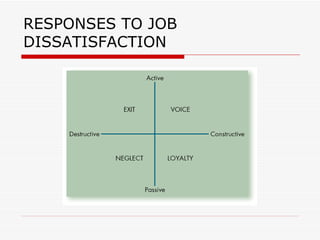
RESPONSES TO JOB DISSATISFACTION
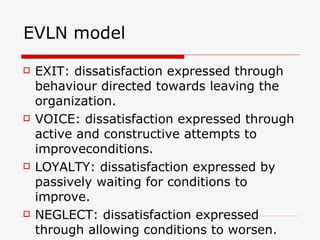
EVLN model EXIT: dissatisfaction expressed through behaviour directed towards leaving the organization. VOICE: dissatisfaction expressed through active and constructive attempts to improveconditions. LOYALTY: dissatisfaction expressed by passively waiting for conditions to improve. NEGLECT: dissatisfaction expressed  through allowing conditions to worsen.
 
What are other methods of capturing job satisfaction  Daily Contacts  Participation in voluntary activities  Red Book complaints  Employee turnover  Exit Interviews  Training Records  Performance records  SURVEY METHOD
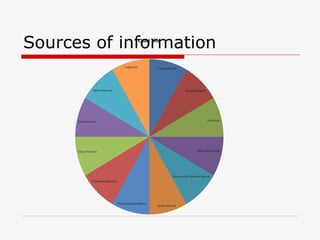
Sources of information
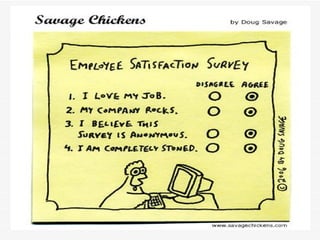
Benefits of Job Satisfaction surveys  Monitoring attitudes  Specific areas of services  How  they feel about their job Department  Organization  Policies  Feelings towards supervisors  Two way communication  Let their feelings out
Ideal  survey conditions Top Management involvement  Employees are communicated about the purpose and how it would be implemented  Ensuring that past surveys have been acted on. It is conducted in  way that it ensures confidentiality of respondents  The questionnaire is easy to understand  The questionnaire has a validity and reliability  Entire plan and time frame for implementation is committed
 
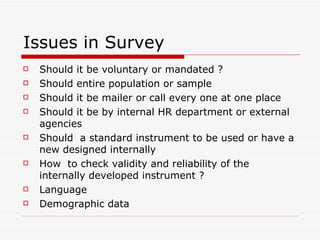
Issues in Survey Should it be voluntary or mandated ? Should entire population or sample  Should it be mailer or call every one at one place  Should it be by internal HR department or external agencies  Should  a standard instrument to be used or have a new designed internally  How  to check validity and reliability of the internally developed instrument ? Language  Demographic data
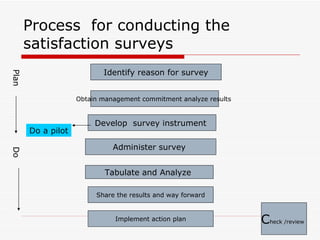
Process  for conducting the satisfaction surveys  Identify reason for survey Obtain management commitment analyze results  Develop  survey instrument  Do a pilot Administer survey  Tabulate and Analyze  Share the results and way forward Implement action plan C heck /review   Plan  Do
ORGANISATIONAL COMMITMENT The emplyees emotional attachment to,identification with,and involvement in a particular organisation.
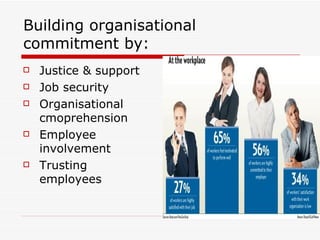
Building organisational commitment by: Justice & support Job security Organisational cmoprehension Employee involvement Trusting  employees
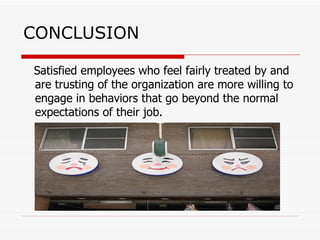
CONCLUSION Satisfied employees who feel fairly treated by and are trusting of the organization are more willing to engage in behaviors that go beyond the normal expectations of their job.
Thank you

19104889 Job Satisfaction

  • 1.
    Job Satisfaction Presented by: ARUN JAPANI ADITI CHATURVEDI IRA SAXENA NEHA YADAV NIYATI AGARWAL
  • 2.
    WHAT ISJOB SATISFACTION? Job satisfaction is in regard to one's feelings or state-of-mind regarding the nature of their work. Job satisfaction can be influenced by a variety of factors, The quality of one's relationship with their supervisor, The quality of the physical environment in which they work, degree of fulfillment in their work, etc.
  • 3.
    Case study: BarryNiland Barry niland,supervisor of a small sales department noticed one of his sales representative,Hunter had problem Hunter’s sale had declined in last six months Other sales representtives reularly exceeded their quotas Niland decides to boost his sales representative’s preformance
  • 4.
    Approaches for increasingHunter’ Job satisfaction Job performance Job involvement Organisational commitment
  • 5.
    Why study jobsatisfaction By taking collective feedback , organizations can address such issues . Otherwise it has to go be perception of few who are near to the management . Such feedback be motivated by personal likes and dislikes . There is also a danger that employees would not like to give honest feedback due to some fears of repercussions .
  • 6.
    Measuring Job SatisfactionSatisfaction with Pay : I feel I am being paid a fair amount for the work I do Satisfaction with Promotion : People get ahead as fast here as in other places Satisfaction with Supervisor : My supervisor is quite competent in doing his/her job Satisfaction with Co-Workers : I like the people I work with Satisfaction with Work: My job is enjoyable
  • 7.
    Job Satisfaction: Outcome and Predictor J ob Satisfaction as an Outcome : Managers attempt to create an environment that fosters job satisfaction – challenging work, good benefits, considerate management, fair pay Job Satisfaction as a Predictor: Managers expect that satisfied employees will be productive, stay committed,perform well Job Conditions Job Satisfaction Job Satisfaction Productive Behavior
  • 8.
    Employee attitude andcosequences When attitude of employees are positive about company , one finds various symptoms like Low turnover High productivity Fast acceptance of new changes More support among teams . Willing to give extra when needed . When it becomes negative attitudes , the reverse occurs
  • 9.
  • 10.
    Attitude towards organizationIt is an issue of how mind feels /perceives the organization .That becomes the dominant attitude . Hence it becomes necessary to capture the /perceptions of employees which can give us an idea of their attitude Attitudes are the feelings and beliefs that determine how employee would work Apart from organization policies ,the immediate manager controls many of the factors relating to employee satisfaction , it is also necessary to capture the satisfaction due to all factors . There may be some people with who are pessimistic and some are pessimistic . The response would be different from them. But still it gives some indications that can be captured , analyzed for actions .
  • 11.
    Job Satisfaction &performance There is no strong acceptance among many researchers, etc., that increased job satisfaction produces improve job performance -- in fact, improved job satisfaction can sometimes decrease job performance if organization is not able to create ownership of long vision an d goals of the organization . For example, you could let sometime sit around all day and do nothing. That may make them more satisfied with their "work" in the short run, but their performance certainly didn't improve.
  • 12.
    Job satisfaction Vs turnover /absenteism Turnover & Absence Job satisfaction Absence Employee Turnover Low High High
  • 13.
    Employee –Organization relationship- Ve +ve +ve -ve Organization attitude towards employee employees attitude towards orgn Employee leaves by mutual consent Employee voluntarily leaves Employee terminated Employee stays
  • 14.
    Can Managers CreateSatisfied Employees? Yes Managers can shape the environment to encourage employee satisfaction: Mentally challenging work Equitable rewards Supportive working conditions Supportive colleagues No Research suggests that job satisfaction is largely determined by genetics: 80% of Happiness (or subjective well-being) is attributable to genes Job satisfaction tends to be consistent across time and across jobs
  • 15.
    RESPONSES TO JOBDISSATISFACTION
  • 16.
    EVLN model EXIT:dissatisfaction expressed through behaviour directed towards leaving the organization. VOICE: dissatisfaction expressed through active and constructive attempts to improveconditions. LOYALTY: dissatisfaction expressed by passively waiting for conditions to improve. NEGLECT: dissatisfaction expressed through allowing conditions to worsen.
  • 17.
  • 18.
    What are othermethods of capturing job satisfaction Daily Contacts Participation in voluntary activities Red Book complaints Employee turnover Exit Interviews Training Records Performance records SURVEY METHOD
  • 19.
  • 20.
    Benefits of JobSatisfaction surveys Monitoring attitudes Specific areas of services How they feel about their job Department Organization Policies Feelings towards supervisors Two way communication Let their feelings out
  • 21.
    Ideal surveyconditions Top Management involvement Employees are communicated about the purpose and how it would be implemented Ensuring that past surveys have been acted on. It is conducted in way that it ensures confidentiality of respondents The questionnaire is easy to understand The questionnaire has a validity and reliability Entire plan and time frame for implementation is committed
  • 22.
  • 23.
    Issues in SurveyShould it be voluntary or mandated ? Should entire population or sample Should it be mailer or call every one at one place Should it be by internal HR department or external agencies Should a standard instrument to be used or have a new designed internally How to check validity and reliability of the internally developed instrument ? Language Demographic data
  • 24.
    Process forconducting the satisfaction surveys Identify reason for survey Obtain management commitment analyze results Develop survey instrument Do a pilot Administer survey Tabulate and Analyze Share the results and way forward Implement action plan C heck /review Plan Do
  • 25.
    ORGANISATIONAL COMMITMENT Theemplyees emotional attachment to,identification with,and involvement in a particular organisation.
  • 26.
    Building organisational commitmentby: Justice & support Job security Organisational cmoprehension Employee involvement Trusting employees
  • 27.
    CONCLUSION Satisfied employeeswho feel fairly treated by and are trusting of the organization are more willing to engage in behaviors that go beyond the normal expectations of their job.
  • 28.