LANE 462


          STEPS FOR JOB APPLICATIONS
              IV. JOB INTERVIEWS
                V. JOB LETTERS
              By:             http://SBANJAR.kau.edu.sa/
   Dr. Shadia Yousef Banjar   http://wwwdrshadiabanjar.blogspot.com


Dr. Shadia Yousef Banjar             1                       7/25/2010
STEPS FOR JOB APPLICATIONS
  I.      CV/ RESUME WRITING
  II.     THE BASICS OF FORMATTING OF A CV/RESUME
  III.    WRITING A CV/RESUME FOR GRADUATES
  IV.     JOB INTERVIEWS
  V.      JOB LETTERS


Dr. Shadia Yousef Banjar     2                  7/25/2010
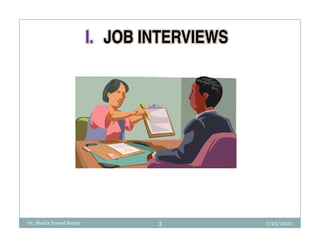
I. JOB INTERVIEWS


Dr. Shadia Yousef Banjar           3           7/25/2010
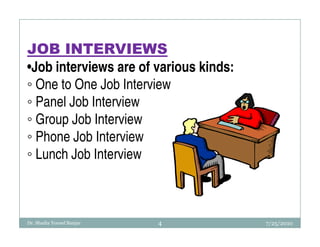
JOB INTERVIEWS
•Job interviews are of various kinds:
◦ One to One Job Interview
◦ Panel Job Interview
◦ Group Job Interview
◦ Phone Job Interview
◦ Lunch Job Interview


Dr. Shadia Yousef Banjar   4            7/25/2010
•Whatever the kind is, candidates have general
  tips of what to do and what to wear in their
  interviews.
  •After the interview, the candidate may write an
  “interview thank you letter” to the interviewer.


Dr. Shadia Yousef Banjar   5                  7/25/2010
GENERAL JOB INTERVIEW TIPS

•Do not smoke, chew gum, or eat garlic beforehand.
•Wear suitable interview cloths
•Take copies of your CV with you
•Arrive on time for your job interview
•Any applications handed before the interview begins, are to be filled in as
accurately as possible, make sure they match the information in your CV
and the Cover Letter.
•Always greet the interviewers by his/her last name and try to pronounce it
correctly.
•Have a good firm handshake.
•Look alert and interested. Scan the room once then keep your eye on the
interviewers.


Dr. Shadia Yousef Banjar               6                              7/25/2010
Cont…   GENERAL JOB INTERVIEW TIPS

•Wait until you are offered a chair before you sit down.
•Stress your achievements.
•Always conduct yourself professionally and if something beyond your
control occurs, show a sense of humor.
•Be enthusiastic and show it in your replies and body language.
•Answer the interview question by more than a simple yes or no but try to
go over 60 second limit.
•Avoid at all cost complaining about your current or former employer
•Do not answer questions about politics or religion if the job is completely
unrelated.
•Do not raise salary discussions on your first interview – this is usually
done on the second.


Dr. Shadia Yousef Banjar              7                               7/25/2010
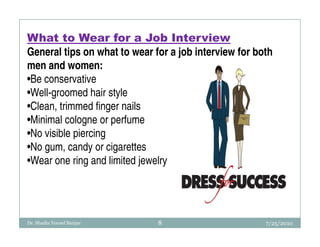
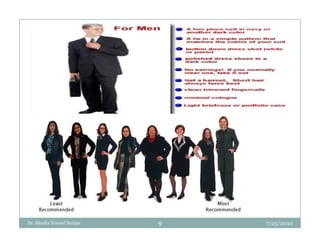
What to Wear for a Job Interview
General tips on what to wear for a job interview for both
men and women:
•Be conservative
•Well-groomed hair style
•Clean, trimmed finger nails
•Minimal cologne or perfume
•No visible piercing
•No gum, candy or cigarettes
•Wear one ring and limited jewelry


Dr. Shadia Yousef Banjar      8                        7/25/2010
Dr. Shadia Yousef Banjar   9   7/25/2010
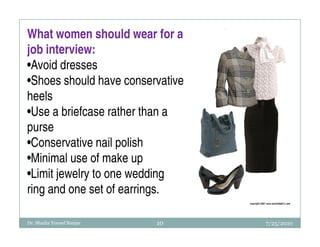
What women should wear for a
job interview:
•Avoid dresses
•Shoes should have conservative
heels
•Use a briefcase rather than a
purse
•Conservative nail polish
•Minimal use of make up
•Limit jewelry to one wedding
ring and one set of earrings.

Dr. Shadia Yousef Banjar   10     7/25/2010
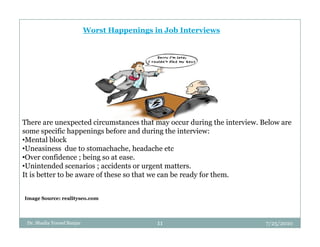
Worst Happenings in Job Interviews


There are unexpected circumstances that may occur during the interview. Below are
some specific happenings before and during the interview:
•Mental block
•Uneasiness due to stomachache, headache etc
•Over confidence ; being so at ease.
•Unintended scenarios ; accidents or urgent matters.
It is better to be aware of these so that we can be ready for them.


Image Source: realityseo.com


 Dr. Shadia Yousef Banjar                     11                         7/25/2010
Job Letters
Types Of Letters:
•Never underestimate the power of correspondence in your job
search process.
•Because there is no single formula or model of job application
applicable for all occasions, we describe and provide examples and
templates of letters you may use in your international job search:
•Job Cover letters (Letter of inquiry),
•Thank you letters,
•Job Acceptance letters,
•Job Reference letters,
•Job Reference lists,
•Job Rejection letters.


Dr. Shadia Yousef Banjar         12                          7/25/2010
BASIC PRINCIPLES:
Experienced job letter's writers follow these basic principles:
•Job letters should be brief, demonstrating that you understand the value of the reader's
time.
•Avoid lengthy job letters exceeding 1 page.
•Ensure that you include your contact address, e-mail and phone/fax numbers.
•Place the most important items first, supported by facts.
•In your job letters be positive in tone, content and expectations.
•Do not add to your letters details about yourself or your past experience that may call
attention to your weaknesses.
•Use active voice and powerful action verbs in your writing to hold the reader's interest and
convey a sense of energy.
•Group similar items together in a paragraph.
•Organize paragraphs so that they relate to each other logically.
•Always back up general statements with facts or examples.
•Documentation creates credibility, reduces uncertainty and abstraction for the reader.
•Avoid jargon and clichés.
•Check the spelling and grammar in all correspondence. If you are not confident of your
ability to detect grammatical, punctuation or English usage errors or if you need help in
organizing your letters, bring your correspondence to a professional for assistance.
Dr. Shadia Yousef Banjar                     13                                   7/25/2010
Formatting Notes:
•Never send any photocopied matter or handwritten materials.
•Be precise in addressing your letters to a specific person using ’Dear
Sir/Madam’ when the name is not known and never ‘To whom it may
concern’ which will likely ensure that you never get the job.
•It is acceptable to send your resume to more than one person in the same
organization, but you must inform both officers by adding a ‘cc’ at the end
of the letter; for example, ‘cc. Mr. Steve Brown, Manager, International
Marketing.’
•Be observant and use titles such as Dr., when the recruiting officer is a
PhD or President, when addressing the head of the organization.
•Avoid using abbreviated terms such as P. O., St., Ave., etc in international
addresses.
•Always make a notation of the items enclosed, using the abbreviation
‘Encl’; for example; ‘Encl.: Resume, application form, two reference
letters.’
Dr. Shadia Yousef Banjar              14                             7/25/2010
COVER LETTER (LETTER OF INQUIRY)
•A letter of inquiry can help you uncover the hidden job market.
•Sometimes these cover letters are called marketing letters.
•A letter of inquiry should be followed up with a phone call as
this will increase your chance of getting your “foot in the door”.
Such a phone call may lead to a meeting or interview.


Dr. Shadia Yousef Banjar         15                         7/25/2010
Cover Letter
For you as a graduate, a cover letter should be attached with your
CV. The following points are to be considered whilst writing the cover
letter:
•A cover letter is sent with your CV. It can make the difference between
being successful in your job search or not.
•Cover letters are generally not read during the first candidate selection,
but usually they will be read when the candidates have been short listed.
•Always include a cover letter even if the job ad does not specify that one
is needed. Occasionally, job ads also specify a hand written cover letter.
•Your covering letter should not be a copy of your CV. Specify some of
your cover letter achievements.
•A cover letter is a way of showing your writing and reporting skills
•Your cover letter should be customized per employer.
•Do not mention salary in your cover letter.

Dr. Shadia Yousef Banjar             16                             7/25/2010
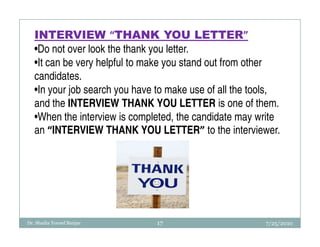
INTERVIEW “THANK YOU LETTER”
   •Do not over look the thank you letter.
   •It can be very helpful to make you stand out from other
   candidates.
   •In your job search you have to make use of all the tools,
   and the INTERVIEW THANK YOU LETTER is one of them.
   •When the interview is completed, the candidate may write
   an “INTERVIEW THANK YOU LETTER” to the interviewer.


Dr. Shadia Yousef Banjar       17                        7/25/2010
General guidelines for interview “Thank You Letter”
•The letter has to be sent before the decision to hire a particular candidate has
been made.
•It is your last opportunity to mention any information you missed to mention in
your CV, Cover Letter or Interview.
•Clean up any misunderstandings.
•You can use some things you learnt during your interview to your advantage.
•This shows you are professional.
•Your last opportunity to leave a good impression.
•Send it within one day of the interview.


  Dr. Shadia Yousef Banjar              18                              7/25/2010
When to use a “Thank You Letter”
•After an employment interview
•To a person or contract who referred to a particular
job.


Dr. Shadia Yousef Banjar    19                      7/25/2010
“Thank You Letter” Structure
•Short and Simple is the key
•Mention Specific points discussed
•Follow the how to write a cover letter guide lines
•1st Part Thank Interviewer, for time and interest
•2nd Part Emphasis skills, enthusiasm and why you
are fit for the job. Mention also any new things you
have learnt about the organization
•3rd Part Provide your contact details, and any follow
up action.


 Dr. Shadia Yousef Banjar   20                     7/25/2010
[Date]

Sample         [Address]
“Thank         [Phone Number]
You
Letter”
Letter”        [Employer’s Name and Title]
               [Employer’s Address]


               Dear [Name of HR manager],
               I would like to thank you for the opportunity you have given me for an interview for the
               [Position title and reverence number]. I have learned a lot of new thinks about
               [Organization Name]
               This vacancy is right for me as I am qualified and experienced to fulfill the duties
               required by the position. The [info you learnt during your interview] is also very
               interesting because I [have experience qualification in info you learnt]
               If you need any more information on my career history please do not hesitate to contact
               me.
               Thank you for your time and look forward to hear from you.
               Sincerely, [Sign your name]
               [Type your name]


Dr. Shadia Yousef Banjar                                  21                                              7/25/2010
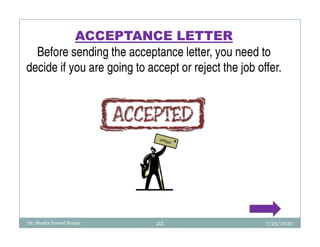
ACCEPTANCE LETTER
  Before sending the acceptance letter, you need to
decide if you are going to accept or reject the job offer.


Dr. Shadia Yousef Banjar     22                       7/25/2010
MAKE SURE YOU:
 •Know the length of the notice period from your
 current job.
 •Understand in which job category you will start.
 •Have an idea of the organizational structure.
 •Are aware or have agreed on benefits, performance
 reviews, moving expenses.
 •Acknowledge the employment offer.
 •Express your gratitude.


Dr. Shadia Yousef Banjar   23                  7/25/2010
ADD
    IF YOU ARE SURE:
    •Inform your employer that you have accepted their offer.
    •Inform your employer of the notice period of your current
    job.
    •Let the employer know when you are able to start work.
    IF YOU ARE SURE AND YOU NEED MORE
    TIME:
    •Notify the employer when you will be able to take the
    decision.


Dr. Shadia Yousef Banjar       24                      7/25/2010
Dr. Shadia Yousef Banjar   25   7/25/2010

Job interviews & job letters.pptx

  • 1.
    LANE 462 STEPS FOR JOB APPLICATIONS IV. JOB INTERVIEWS V. JOB LETTERS By: http://SBANJAR.kau.edu.sa/ Dr. Shadia Yousef Banjar http://wwwdrshadiabanjar.blogspot.com Dr. Shadia Yousef Banjar 1 7/25/2010
  • 2.
    STEPS FOR JOBAPPLICATIONS I. CV/ RESUME WRITING II. THE BASICS OF FORMATTING OF A CV/RESUME III. WRITING A CV/RESUME FOR GRADUATES IV. JOB INTERVIEWS V. JOB LETTERS Dr. Shadia Yousef Banjar 2 7/25/2010
  • 3.
    I. JOB INTERVIEWS Dr.Shadia Yousef Banjar 3 7/25/2010
  • 4.
    JOB INTERVIEWS •Job interviewsare of various kinds: ◦ One to One Job Interview ◦ Panel Job Interview ◦ Group Job Interview ◦ Phone Job Interview ◦ Lunch Job Interview Dr. Shadia Yousef Banjar 4 7/25/2010
  • 5.
    •Whatever the kindis, candidates have general tips of what to do and what to wear in their interviews. •After the interview, the candidate may write an “interview thank you letter” to the interviewer. Dr. Shadia Yousef Banjar 5 7/25/2010
  • 6.
    GENERAL JOB INTERVIEWTIPS •Do not smoke, chew gum, or eat garlic beforehand. •Wear suitable interview cloths •Take copies of your CV with you •Arrive on time for your job interview •Any applications handed before the interview begins, are to be filled in as accurately as possible, make sure they match the information in your CV and the Cover Letter. •Always greet the interviewers by his/her last name and try to pronounce it correctly. •Have a good firm handshake. •Look alert and interested. Scan the room once then keep your eye on the interviewers. Dr. Shadia Yousef Banjar 6 7/25/2010
  • 7.
    Cont… GENERAL JOB INTERVIEW TIPS •Wait until you are offered a chair before you sit down. •Stress your achievements. •Always conduct yourself professionally and if something beyond your control occurs, show a sense of humor. •Be enthusiastic and show it in your replies and body language. •Answer the interview question by more than a simple yes or no but try to go over 60 second limit. •Avoid at all cost complaining about your current or former employer •Do not answer questions about politics or religion if the job is completely unrelated. •Do not raise salary discussions on your first interview – this is usually done on the second. Dr. Shadia Yousef Banjar 7 7/25/2010
  • 8.
    What to Wearfor a Job Interview General tips on what to wear for a job interview for both men and women: •Be conservative •Well-groomed hair style •Clean, trimmed finger nails •Minimal cologne or perfume •No visible piercing •No gum, candy or cigarettes •Wear one ring and limited jewelry Dr. Shadia Yousef Banjar 8 7/25/2010
  • 9.
    Dr. Shadia YousefBanjar 9 7/25/2010
  • 10.
    What women shouldwear for a job interview: •Avoid dresses •Shoes should have conservative heels •Use a briefcase rather than a purse •Conservative nail polish •Minimal use of make up •Limit jewelry to one wedding ring and one set of earrings. Dr. Shadia Yousef Banjar 10 7/25/2010
  • 11.
    Worst Happenings inJob Interviews There are unexpected circumstances that may occur during the interview. Below are some specific happenings before and during the interview: •Mental block •Uneasiness due to stomachache, headache etc •Over confidence ; being so at ease. •Unintended scenarios ; accidents or urgent matters. It is better to be aware of these so that we can be ready for them. Image Source: realityseo.com Dr. Shadia Yousef Banjar 11 7/25/2010
  • 12.
    Job Letters Types OfLetters: •Never underestimate the power of correspondence in your job search process. •Because there is no single formula or model of job application applicable for all occasions, we describe and provide examples and templates of letters you may use in your international job search: •Job Cover letters (Letter of inquiry), •Thank you letters, •Job Acceptance letters, •Job Reference letters, •Job Reference lists, •Job Rejection letters. Dr. Shadia Yousef Banjar 12 7/25/2010
  • 13.
    BASIC PRINCIPLES: Experienced jobletter's writers follow these basic principles: •Job letters should be brief, demonstrating that you understand the value of the reader's time. •Avoid lengthy job letters exceeding 1 page. •Ensure that you include your contact address, e-mail and phone/fax numbers. •Place the most important items first, supported by facts. •In your job letters be positive in tone, content and expectations. •Do not add to your letters details about yourself or your past experience that may call attention to your weaknesses. •Use active voice and powerful action verbs in your writing to hold the reader's interest and convey a sense of energy. •Group similar items together in a paragraph. •Organize paragraphs so that they relate to each other logically. •Always back up general statements with facts or examples. •Documentation creates credibility, reduces uncertainty and abstraction for the reader. •Avoid jargon and clichés. •Check the spelling and grammar in all correspondence. If you are not confident of your ability to detect grammatical, punctuation or English usage errors or if you need help in organizing your letters, bring your correspondence to a professional for assistance. Dr. Shadia Yousef Banjar 13 7/25/2010
  • 14.
    Formatting Notes: •Never sendany photocopied matter or handwritten materials. •Be precise in addressing your letters to a specific person using ’Dear Sir/Madam’ when the name is not known and never ‘To whom it may concern’ which will likely ensure that you never get the job. •It is acceptable to send your resume to more than one person in the same organization, but you must inform both officers by adding a ‘cc’ at the end of the letter; for example, ‘cc. Mr. Steve Brown, Manager, International Marketing.’ •Be observant and use titles such as Dr., when the recruiting officer is a PhD or President, when addressing the head of the organization. •Avoid using abbreviated terms such as P. O., St., Ave., etc in international addresses. •Always make a notation of the items enclosed, using the abbreviation ‘Encl’; for example; ‘Encl.: Resume, application form, two reference letters.’ Dr. Shadia Yousef Banjar 14 7/25/2010
  • 15.
    COVER LETTER (LETTEROF INQUIRY) •A letter of inquiry can help you uncover the hidden job market. •Sometimes these cover letters are called marketing letters. •A letter of inquiry should be followed up with a phone call as this will increase your chance of getting your “foot in the door”. Such a phone call may lead to a meeting or interview. Dr. Shadia Yousef Banjar 15 7/25/2010
  • 16.
    Cover Letter For youas a graduate, a cover letter should be attached with your CV. The following points are to be considered whilst writing the cover letter: •A cover letter is sent with your CV. It can make the difference between being successful in your job search or not. •Cover letters are generally not read during the first candidate selection, but usually they will be read when the candidates have been short listed. •Always include a cover letter even if the job ad does not specify that one is needed. Occasionally, job ads also specify a hand written cover letter. •Your covering letter should not be a copy of your CV. Specify some of your cover letter achievements. •A cover letter is a way of showing your writing and reporting skills •Your cover letter should be customized per employer. •Do not mention salary in your cover letter. Dr. Shadia Yousef Banjar 16 7/25/2010
  • 17.
    INTERVIEW “THANK YOULETTER” •Do not over look the thank you letter. •It can be very helpful to make you stand out from other candidates. •In your job search you have to make use of all the tools, and the INTERVIEW THANK YOU LETTER is one of them. •When the interview is completed, the candidate may write an “INTERVIEW THANK YOU LETTER” to the interviewer. Dr. Shadia Yousef Banjar 17 7/25/2010
  • 18.
    General guidelines forinterview “Thank You Letter” •The letter has to be sent before the decision to hire a particular candidate has been made. •It is your last opportunity to mention any information you missed to mention in your CV, Cover Letter or Interview. •Clean up any misunderstandings. •You can use some things you learnt during your interview to your advantage. •This shows you are professional. •Your last opportunity to leave a good impression. •Send it within one day of the interview. Dr. Shadia Yousef Banjar 18 7/25/2010
  • 19.
    When to usea “Thank You Letter” •After an employment interview •To a person or contract who referred to a particular job. Dr. Shadia Yousef Banjar 19 7/25/2010
  • 20.
    “Thank You Letter”Structure •Short and Simple is the key •Mention Specific points discussed •Follow the how to write a cover letter guide lines •1st Part Thank Interviewer, for time and interest •2nd Part Emphasis skills, enthusiasm and why you are fit for the job. Mention also any new things you have learnt about the organization •3rd Part Provide your contact details, and any follow up action. Dr. Shadia Yousef Banjar 20 7/25/2010
  • 21.
    [Date] Sample [Address] “Thank [Phone Number] You Letter” Letter” [Employer’s Name and Title] [Employer’s Address] Dear [Name of HR manager], I would like to thank you for the opportunity you have given me for an interview for the [Position title and reverence number]. I have learned a lot of new thinks about [Organization Name] This vacancy is right for me as I am qualified and experienced to fulfill the duties required by the position. The [info you learnt during your interview] is also very interesting because I [have experience qualification in info you learnt] If you need any more information on my career history please do not hesitate to contact me. Thank you for your time and look forward to hear from you. Sincerely, [Sign your name] [Type your name] Dr. Shadia Yousef Banjar 21 7/25/2010
  • 22.
    ACCEPTANCE LETTER Before sending the acceptance letter, you need to decide if you are going to accept or reject the job offer. Dr. Shadia Yousef Banjar 22 7/25/2010
  • 23.
    MAKE SURE YOU: •Know the length of the notice period from your current job. •Understand in which job category you will start. •Have an idea of the organizational structure. •Are aware or have agreed on benefits, performance reviews, moving expenses. •Acknowledge the employment offer. •Express your gratitude. Dr. Shadia Yousef Banjar 23 7/25/2010
  • 24.
    ADD IF YOU ARE SURE: •Inform your employer that you have accepted their offer. •Inform your employer of the notice period of your current job. •Let the employer know when you are able to start work. IF YOU ARE SURE AND YOU NEED MORE TIME: •Notify the employer when you will be able to take the decision. Dr. Shadia Yousef Banjar 24 7/25/2010
  • 25.
    Dr. Shadia YousefBanjar 25 7/25/2010