

Dr. RAVINDRA V. KSHIRSAGAR
 Prof. Ramkrishna More College Akurdi, pune-44
          Kshirsagar_99@yahoo.co.in
                 DR. R. V. KSHIRSAGAR            PROF.RAM
The purpose of the interview from the
      employer’s point of view is to
assess/evaluate your suitability, relative to
            other applicants.


                 DR. R. V. KSHIRSAGAR     PROF.RAM
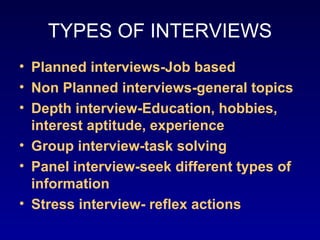
TYPES OF INTERVIEWS
• Planned interviews-Job based
• Non Planned interviews-general topics
• Depth interview-Education, hobbies,
  interest aptitude, experience
• Group interview-task solving
• Panel interview-seek different types of
  information
• Stress interview- reflex actions
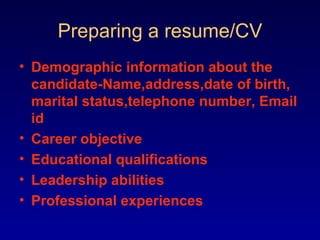
Preparing a resume/CV
• Demographic information about the
  candidate-Name,address,date of birth,
  marital status,telephone number, Email
  id
• Career objective
• Educational qualifications
• Leadership abilities
• Professional experiences
Prepare yourself with effective interview
 strategies before you actually go to an
      organization and meet with the
  interviewer. Increase your chances of
   success by using these tips from the
                  experts.
• FIND OUT DETAILS OF THE INTERVIEW
• When you are invited for an interview find out
  who will be interviewing you (name and title) and
  what style/format the interview will take. Ask if
  you are required to bring anything in particular
  such as an additional resume, portfolio of past
  work etc. Determine if you will need to arrive
  early in order to complete an application form or
  testing.
• GET GOOD DIRECTIONS
• Be sure you know exactly where to go, how to
  get there, and expected travel time. If possible,
  do a practice run before your appointment
                     DR. R. V. KSHIRSAGAR       PROF.RAM
• PREPARE YOUR INTERVIEW
  MATERIALS
• These would include extra copies of your
  resume, your reference list, letters of
  reference, copies of degrees, certificates,
  credentials/registration, etc. Organize
  these in a folder or document keeper
  which you can present neatly. As well,
  bring a copy of your cover letter and, if
  applicable, the job advertisement. Bring a
  good pen to complete an application form,
  and your prepared list of questions
                   DR. R. V. KSHIRSAGAR    PROF.RAM
• DRESS IN A MANNER THAT SUITS THE
  JOB
• Strive for a business-like appearance.
  Most dress mistakes are those being
  under-dressed or too casual.
• PAY ATTENTION TO DETAILS IN YOUR
  APPEARANCE
• Ensure that buttons are done up, your
  shoes are polished, your nails are clean.
  Avoid wearing heavy fragrances. Again,
  be job-appropriate

                  DR. R. V. KSHIRSAGAR   PROF.RAM
Researchers tell us that over 55% of the impact we have in a personal
 meeting is our nonverbal presentation. This means the way we look in
total. It includes dress, grooming, body language and facial expression.
                         Dress Professionally
 Like you would if you were working in the position for which you’re
 being considered. In your employer research, observe the dress code.
Dress includes your whole appearance from your shoes to your hair, and
                        everything in between.
HENCE- SOMETIMES YOUR SHOES TELLS MORE THAN YOUR
                      FACE
                    CAUTION
     Wearing a new outfit for the first time to an interview is not
 “YOU NEVER GET A SECOND CHANCE TO a test run.
                 recommended. Give it MAKE A FIRST IMPRESSION”
                               DR. R. V. KSHIRSAGAR               PROF.RA
This refers to the way we carry ourselves and the nonverbal messages
         that are transmitted by our gestures or mannerisms.
• Shake hands. Do not hesitate about taking the lead by offering your
hand first.

• Walk and stand straight – head erect and sitting squarely on your
shoulders.

• Sit upright (avoid slouching), feet flat on the floor or crossed at the
ankles, whichever is most comfortable.

• Sitting up and leaning forward shows interest and enthusiasm.

• Make eye contact with all interviewers.
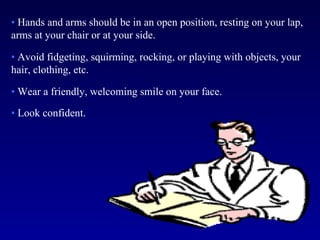
• Hands and arms should be in an open position, resting on your lap,
arms at your chair or at your side.

• Avoid fidgeting, squirming, rocking, or playing with objects, your
hair, clothing, etc.

• Wear a friendly, welcoming smile on your face.

• Look confident.
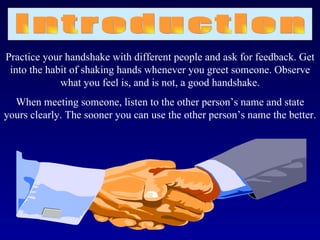
Practice your handshake with different people and ask for feedback. Get
 into the habit of shaking hands whenever you greet someone. Observe
             what you feel is, and is not, a good handshake.
  When meeting someone, listen to the other person’s name and state
yours clearly. The sooner you can use the other person’s name the better.
Visualize yourself in the interview.
  See yourself- how you are dressed, how you are looking (confident,
                      professional, enthusiastic).
Watch yourself shake hands as you meet the interview panel, take your
chair and poise and sit in a comfortable position eager to experience
                             the meeting.
 Observe how well you are responding to the questions; questions you
     anticipated they would ask and have given some thought to.
     Notice how you are feeling as you have the opportunity to
 demonstrate that you’ve done your homework by analyzing what you
            have to offer and how it matches their needs.
• HAVE PLENTY OF TIME TO GET TO
  THE INTERVIEW
• Never be late. Ideally, you should arrive
  15 minutes early in order to have time for
  one last check in the washroom mirror,
  and to feel relaxed.
YOU ARE “ON” THE MINUTE YOU ENTER THE BUILDING
 Managers are influenced by the impressions of their assistants and support
staff. If you are rude to the receptionist, that information will be relayed to the
                                   interviewer.
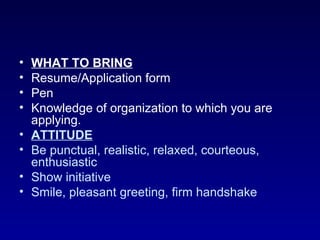
WHAT TO BRING
• GROOMING
                             Resume/Application form
• Shower                               Pen
• Hair shampooed         Knowledge of organization to which
                                 you are applying
• Clothes – clean, neat, appropriate for a job
  interview
• Shoes are cleaned and shined
•   WHAT TO BRING
•   Resume/Application form
•   Pen
•   Knowledge of organization to which you are
    applying.
•   ATTITUDE
•   Be punctual, realistic, relaxed, courteous,
    enthusiastic
•   Show initiative
•   Smile, pleasant greeting, firm handshake
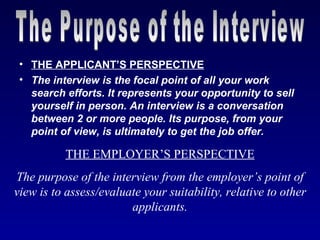
• THE APPLICANT’S PERSPECTIVE
 • The interview is the focal point of all your work
   search efforts. It represents your opportunity to sell
   yourself in person. An interview is a conversation
   between 2 or more people. Its purpose, from your
   point of view, is ultimately to get the job offer.

          THE EMPLOYER’S PERSPECTIVE
The purpose of the interview from the employer’s point of
view is to assess/evaluate your suitability, relative to other
                        applicants.
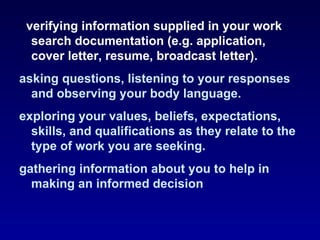
· verifying information supplied in your work
   search documentation (e.g. application,
   cover letter, resume, broadcast letter).
asking questions, listening to your responses
  and observing your body language.
exploring your values, beliefs, expectations,
  skills, and qualifications as they relate to the
  type of work you are seeking.
gathering information about you to help in
  making an informed decision
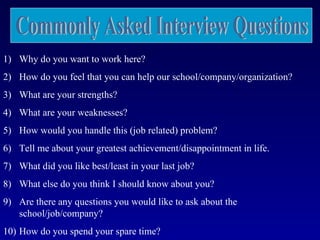
1) Why do you want to work here?
2) How do you feel that you can help our school/company/organization?
3) What are your strengths?
4) What are your weaknesses?
5) How would you handle this (job related) problem?
6) Tell me about your greatest achievement/disappointment in life.
7) What did you like best/least in your last job?
8) What else do you think I should know about you?
9) Are there any questions you would like to ask about the
   school/job/company?
10) How do you spend your spare time?
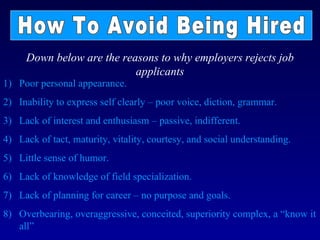
Down below are the reasons to why employers rejects job
                           applicants
1) Poor personal appearance.
2) Inability to express self clearly – poor voice, diction, grammar.
3) Lack of interest and enthusiasm – passive, indifferent.
4) Lack of tact, maturity, vitality, courtesy, and social understanding.
5) Little sense of humor.
6) Lack of knowledge of field specialization.
7) Lack of planning for career – no purpose and goals.
8) Overbearing, overaggressive, conceited, superiority complex, a “know it
   all”
IF ALL IS WELL
THEN
•Congratulations
• you are the most suitable
  candidate for this position
•BEST OF LUCK!!
• BEST OF LUCK!!
• Don’t do different things do things
  differently

Interview tips by Dr.R.V.Kshirsagar

  • 1.
    Dr. RAVINDRA V.KSHIRSAGAR Prof. Ramkrishna More College Akurdi, pune-44 Kshirsagar_99@yahoo.co.in DR. R. V. KSHIRSAGAR PROF.RAM
  • 2.
    The purpose ofthe interview from the employer’s point of view is to assess/evaluate your suitability, relative to other applicants. DR. R. V. KSHIRSAGAR PROF.RAM
  • 3.
    TYPES OF INTERVIEWS •Planned interviews-Job based • Non Planned interviews-general topics • Depth interview-Education, hobbies, interest aptitude, experience • Group interview-task solving • Panel interview-seek different types of information • Stress interview- reflex actions
  • 4.
    Preparing a resume/CV •Demographic information about the candidate-Name,address,date of birth, marital status,telephone number, Email id • Career objective • Educational qualifications • Leadership abilities • Professional experiences
  • 5.
    Prepare yourself witheffective interview strategies before you actually go to an organization and meet with the interviewer. Increase your chances of success by using these tips from the experts.
  • 6.
    • FIND OUTDETAILS OF THE INTERVIEW • When you are invited for an interview find out who will be interviewing you (name and title) and what style/format the interview will take. Ask if you are required to bring anything in particular such as an additional resume, portfolio of past work etc. Determine if you will need to arrive early in order to complete an application form or testing. • GET GOOD DIRECTIONS • Be sure you know exactly where to go, how to get there, and expected travel time. If possible, do a practice run before your appointment DR. R. V. KSHIRSAGAR PROF.RAM
  • 7.
    • PREPARE YOURINTERVIEW MATERIALS • These would include extra copies of your resume, your reference list, letters of reference, copies of degrees, certificates, credentials/registration, etc. Organize these in a folder or document keeper which you can present neatly. As well, bring a copy of your cover letter and, if applicable, the job advertisement. Bring a good pen to complete an application form, and your prepared list of questions DR. R. V. KSHIRSAGAR PROF.RAM
  • 8.
    • DRESS INA MANNER THAT SUITS THE JOB • Strive for a business-like appearance. Most dress mistakes are those being under-dressed or too casual. • PAY ATTENTION TO DETAILS IN YOUR APPEARANCE • Ensure that buttons are done up, your shoes are polished, your nails are clean. Avoid wearing heavy fragrances. Again, be job-appropriate DR. R. V. KSHIRSAGAR PROF.RAM
  • 9.
    Researchers tell usthat over 55% of the impact we have in a personal meeting is our nonverbal presentation. This means the way we look in total. It includes dress, grooming, body language and facial expression. Dress Professionally Like you would if you were working in the position for which you’re being considered. In your employer research, observe the dress code. Dress includes your whole appearance from your shoes to your hair, and everything in between. HENCE- SOMETIMES YOUR SHOES TELLS MORE THAN YOUR FACE CAUTION Wearing a new outfit for the first time to an interview is not “YOU NEVER GET A SECOND CHANCE TO a test run. recommended. Give it MAKE A FIRST IMPRESSION” DR. R. V. KSHIRSAGAR PROF.RA
  • 10.
    This refers tothe way we carry ourselves and the nonverbal messages that are transmitted by our gestures or mannerisms. • Shake hands. Do not hesitate about taking the lead by offering your hand first. • Walk and stand straight – head erect and sitting squarely on your shoulders. • Sit upright (avoid slouching), feet flat on the floor or crossed at the ankles, whichever is most comfortable. • Sitting up and leaning forward shows interest and enthusiasm. • Make eye contact with all interviewers.
  • 11.
    • Hands andarms should be in an open position, resting on your lap, arms at your chair or at your side. • Avoid fidgeting, squirming, rocking, or playing with objects, your hair, clothing, etc. • Wear a friendly, welcoming smile on your face. • Look confident.
  • 12.
    Practice your handshakewith different people and ask for feedback. Get into the habit of shaking hands whenever you greet someone. Observe what you feel is, and is not, a good handshake. When meeting someone, listen to the other person’s name and state yours clearly. The sooner you can use the other person’s name the better.
  • 13.
    Visualize yourself inthe interview. See yourself- how you are dressed, how you are looking (confident, professional, enthusiastic). Watch yourself shake hands as you meet the interview panel, take your chair and poise and sit in a comfortable position eager to experience the meeting. Observe how well you are responding to the questions; questions you anticipated they would ask and have given some thought to. Notice how you are feeling as you have the opportunity to demonstrate that you’ve done your homework by analyzing what you have to offer and how it matches their needs.
  • 14.
    • HAVE PLENTYOF TIME TO GET TO THE INTERVIEW • Never be late. Ideally, you should arrive 15 minutes early in order to have time for one last check in the washroom mirror, and to feel relaxed.
  • 15.
    YOU ARE “ON”THE MINUTE YOU ENTER THE BUILDING Managers are influenced by the impressions of their assistants and support staff. If you are rude to the receptionist, that information will be relayed to the interviewer.
  • 16.
    WHAT TO BRING •GROOMING Resume/Application form • Shower Pen • Hair shampooed Knowledge of organization to which you are applying • Clothes – clean, neat, appropriate for a job interview • Shoes are cleaned and shined
  • 17.
    WHAT TO BRING • Resume/Application form • Pen • Knowledge of organization to which you are applying. • ATTITUDE • Be punctual, realistic, relaxed, courteous, enthusiastic • Show initiative • Smile, pleasant greeting, firm handshake
  • 18.
    • THE APPLICANT’SPERSPECTIVE • The interview is the focal point of all your work search efforts. It represents your opportunity to sell yourself in person. An interview is a conversation between 2 or more people. Its purpose, from your point of view, is ultimately to get the job offer. THE EMPLOYER’S PERSPECTIVE The purpose of the interview from the employer’s point of view is to assess/evaluate your suitability, relative to other applicants.
  • 19.
    · verifying informationsupplied in your work search documentation (e.g. application, cover letter, resume, broadcast letter). asking questions, listening to your responses and observing your body language. exploring your values, beliefs, expectations, skills, and qualifications as they relate to the type of work you are seeking. gathering information about you to help in making an informed decision
  • 20.
    1) Why doyou want to work here? 2) How do you feel that you can help our school/company/organization? 3) What are your strengths? 4) What are your weaknesses? 5) How would you handle this (job related) problem? 6) Tell me about your greatest achievement/disappointment in life. 7) What did you like best/least in your last job? 8) What else do you think I should know about you? 9) Are there any questions you would like to ask about the school/job/company? 10) How do you spend your spare time?
  • 21.
    Down below arethe reasons to why employers rejects job applicants 1) Poor personal appearance. 2) Inability to express self clearly – poor voice, diction, grammar. 3) Lack of interest and enthusiasm – passive, indifferent. 4) Lack of tact, maturity, vitality, courtesy, and social understanding. 5) Little sense of humor. 6) Lack of knowledge of field specialization. 7) Lack of planning for career – no purpose and goals. 8) Overbearing, overaggressive, conceited, superiority complex, a “know it all”
  • 22.
    IF ALL ISWELL THEN •Congratulations • you are the most suitable candidate for this position
  • 23.
  • 25.
    • BEST OFLUCK!! • Don’t do different things do things differently