Interview SkillsWith Maree Herath
IntroductionMareeHarvest Recruitment
ObjectivesYour experience (recruitment/interviewing) and the challenges you have found?What do you seek from the session?
ObjectivesBy the end of this workshop you will:Understand the role interviews play in the hiring processGain the tools to effectively plan and undertake interviewsUse interview techniques appropriate for the role being recruitedHave a greater understanding of body languageConfidently make a hiring decision
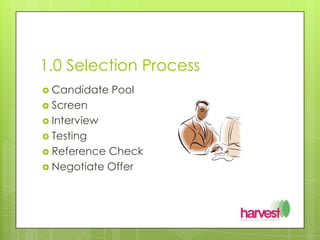
1.0 Selection Process Candidate PoolScreenInterviewTestingReference CheckNegotiate Offer
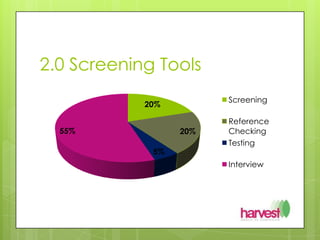
2.0 Screening Tools
3.0 Importance of a Good InterviewBenefitsPitfalls
4.0 Why Interview?4.1 Benefits for the Company/EmployerMake a selection decision
4.0 Why Interview?4.1 Benefits for the Company/EmployerGet to know the candidate
4.0 Why Interview?4.1 Benefits for the Company/EmployerCheck against resume – does it stack up?
4.0 Why Interview?4.1 Benefits for the Company/EmployerFill in Gaps in Resume or Gain clarification
4.1 Benefits for the Company/EmployerTo understand what your competing against (what else is happening)
4.1 Benefits for the Company/EmployerTo get a feel for how your brand is perceived (market information)
4.1 Benefits for the Company/EmployerBrand your company, communicate the brand and latest developments
4.1 Benefits for the Company/EmployerDetermine the key drivers of the candidate
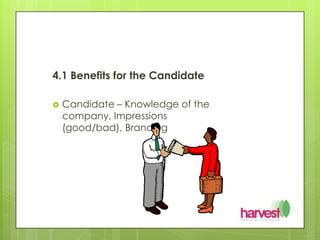
4.1 Benefits for the CandidateCandidate – Knowledge of the company, Impressions (good/bad), Branding
4.1 Benefits for the CandidateChance to showcase their skills
4.1 Benefits for the CandidateTo add to their resume
4.1 Benefits for the CandidateTo sell their value
5.0 Road blocksBefore you launch ... be aware of5.1 Legislations – privacy, discrimination (age, sex, race)
5.0 Road blocksBefore you launch ... be aware of5.2 Halo Affect
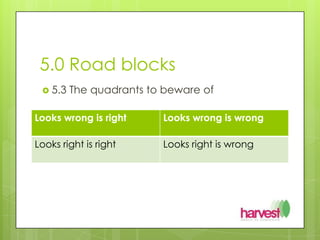
5.0 Road blocks5.3 The quadrants to beware of
5.0 Road blocks5.4 Have a sound interview structure, inform the candidate and stick to it
5.0 Road blocksDon’t have judgement cast in stone based on the resume, keep an open mind.
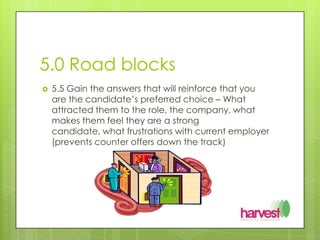
5.0 Road blocks5.5 Gain the answers that will reinforce that you are the candidate’s preferred choice – What attracted them to the role, the company, what makes them feel they are a strong candidate, what frustrations with current employer (prevents counter offers down the track)
5.0 Road blocks5.6 The Tough Interview - does it work?
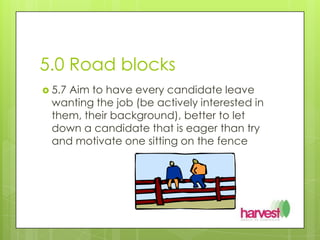
5.0 Road blocks5.7 Aim to have every candidate leave wanting the job (be actively interested in them, their background), better to let down a candidate that is eager than try and motivate one sitting on the fence
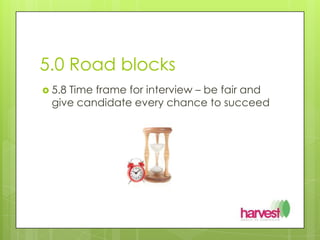
5.0 Road blocks5.8 Time frame for interview – be fair and give candidate every chance to succeed
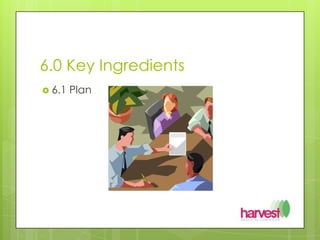
6.0 Key Ingredients 6.1 Plan
6.0 Key Ingredients 6.1.1 Role and Questions
6.0 Key Ingredients 6.1.2 What are you looking for (technical, education, skills/experience, cultural fit)
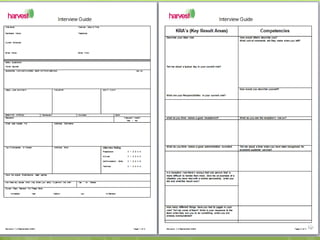
6.0 Key Ingredients 6.1.3 Standardise – use a form, develop an interview form that can be used to cover standard elements with flexibility for notes on the specific role.
6.0 Key Ingredients 6.1.4 Ratings – how will you rate answers
6.0 Key Ingredients 6.1.4 Who(alone or more than one), What (Icebreaker – general chit chat, style formal/informal, preference, skills, behaviours, attitudes), Where(quiet no distractions), When(timing from anticipated start date),  How? Confidentiality/Timing/Structure (put into segments)/Explain the process
6.2 Interview Techniques6.2.1 – Open QuestionsThese are questions designed to open up discussion.Usually start with “Who” “What” “Where” “When” “Why” or “Tell me ...” or “Describe”Activity
6.2 Interview Techniques6.2.2 – PreferenceWhat is your preferred ... job/job content/industry/company/location/salary?What don’t you want? What don’t you like?Activity
6.2 Interview Techniques6.2.2 – PreferenceWhy use Preference Based Interviews?
6.2 Interview Techniques6.2.2 – Preference	(i) Gives a framework to the 	candidate and their desires(ii) Know very quickly if talking the 	same language
6.2 Interview Techniques6.2.3 – Competency based/ Behavioural Interviews
6.2 Interview Techniques6.2.3 – Competency based/ Behavioural InterviewsQuestions that will reveal the way a candidate behaves.
6.2 Interview Techniques6.2.3 – Competency based/ Behavioural InterviewsPrevious performance being a measure of future performance.
6.2 Interview Techniques6.2.3 – Competency based/ Behavioural InterviewsStart looking at the style and cultural fit of the candidate for the business
6.2 Interview Techniques6.2.4 Technical Questions (based on your industry and the essentials required in the role)Bringing it all together – Role Play
6.3 Body LanguageBody LanguageBody Language is the use of gestures, postures, position and distance which conveys a certain message
6.3 Body LanguageJob Seeker Body Language - 1Arm, hand or actual barriers  - used when a person is amongst strangers or anywhere a person feels uncertain and insecure Interpretation  “The candidate is Nervous”
6.3 Body LanguageJob Seeker Body Language - 1Action – take some steps back to lighten the mood/discussion, until barriers open
6.3 Body LanguageJob Seeker Body Language - 2Leg BarriersParticularly the “ankle lock” – the gesture is one of holding back negative attitude, emotion, nervousness or fearInterpretation – “The Candidate is Nervous” or Does Not Agree
6.3 Body LanguageJob Seeker Body Language - 2Action – again reduce the stress level if possible or ask how they feel (especially if the action is taken as a result of a comment or question that has been made)
6.3 Body LanguageJob Seeker Body Language - 3Hand Clasping Can be at different levels – eg. On lap, on table, in front of face. The gesture shows an element of hostility or holding back a negative attitude
6.3 Body LanguageJob Seeker Body Language – 3Interpretation – The candidate doesn’t necessarily agree with what was said. The interviewer has said something that disappoints the candidateAction – ask the candidate what they think/feel about what was said. Work towards opening the palms.
6.3 Body LanguageJob Seeker Body Language - 4Body positionLeaning forward can be interpreted as being engaged. Too far forward and they want to wrap up/leave.
6.3 Body LanguageJob Seeker Body Language – 4Leaning Back – can be interpreted as uninterested but may also be the person’s comfortable position. Leaning back with hands behind head is a power positionLeaning Back with arms and or legs crossed is a defensive position.
6.3 Body LanguageJob Seeker Body Language – 5 The EyesSideways Glance – interest, collecting thoughts or hostile? Look at accompanying facial signals
6.3 Body LanguageJob Seeker Body Language – 5 The EyesEyeblock (prolonged blink) – the person may be trying to block you out. Interpretation – Nerves or feels superior
6.3 Body LanguageAre they lying???Common deceitful gestures include:Hand to face gestures; Ear, nose or eye rub; Hand over mouth; Neck Scratch; Collar pullShoulder ShrugsLooking away
6.3 Body LanguageOverriding FactorsLook for congruence – do other expressions support the gesture?Address gestures in context – situation, circumstance and environment
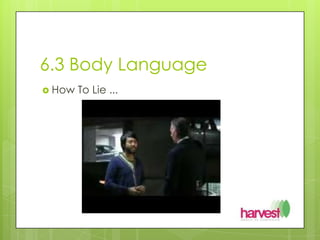
6.3 Body LanguageHow To Lie ...
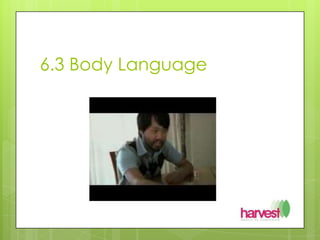
6.3 Body Language
7.0 Next Steps7.1 Review – notes to remember candidateDebrief with OthersOverall ratingRating on Answers to Questions
7.0 Next Steps7.2 Communication (so important)
7.0 Next Steps7.3 Further testing, reference checking
7.0 Next Steps7.4 Negotiation of Offer
7.0 Next Steps7.5 One, Three and 12 Month Reviews
7.0 Next Steps7.6 Training and Development Plan
Interview Guide
Thank You

Interview Skills For Employers

  • 1.
  • 2.
  • 3.
    ObjectivesYour experience (recruitment/interviewing)and the challenges you have found?What do you seek from the session?
  • 4.
    ObjectivesBy the endof this workshop you will:Understand the role interviews play in the hiring processGain the tools to effectively plan and undertake interviewsUse interview techniques appropriate for the role being recruitedHave a greater understanding of body languageConfidently make a hiring decision
  • 5.
    1.0 Selection ProcessCandidate PoolScreenInterviewTestingReference CheckNegotiate Offer
  • 6.
  • 7.
    3.0 Importance ofa Good InterviewBenefitsPitfalls
  • 8.
    4.0 Why Interview?4.1Benefits for the Company/EmployerMake a selection decision
  • 9.
    4.0 Why Interview?4.1Benefits for the Company/EmployerGet to know the candidate
  • 10.
    4.0 Why Interview?4.1Benefits for the Company/EmployerCheck against resume – does it stack up?
  • 11.
    4.0 Why Interview?4.1Benefits for the Company/EmployerFill in Gaps in Resume or Gain clarification
  • 12.
    4.1 Benefits forthe Company/EmployerTo understand what your competing against (what else is happening)
  • 13.
    4.1 Benefits forthe Company/EmployerTo get a feel for how your brand is perceived (market information)
  • 14.
    4.1 Benefits forthe Company/EmployerBrand your company, communicate the brand and latest developments
  • 15.
    4.1 Benefits forthe Company/EmployerDetermine the key drivers of the candidate
  • 16.
    4.1 Benefits forthe CandidateCandidate – Knowledge of the company, Impressions (good/bad), Branding
  • 17.
    4.1 Benefits forthe CandidateChance to showcase their skills
  • 18.
    4.1 Benefits forthe CandidateTo add to their resume
  • 19.
    4.1 Benefits forthe CandidateTo sell their value
  • 20.
    5.0 Road blocksBeforeyou launch ... be aware of5.1 Legislations – privacy, discrimination (age, sex, race)
  • 21.
    5.0 Road blocksBeforeyou launch ... be aware of5.2 Halo Affect
  • 22.
    5.0 Road blocks5.3The quadrants to beware of
  • 23.
    5.0 Road blocks5.4Have a sound interview structure, inform the candidate and stick to it
  • 24.
    5.0 Road blocksDon’thave judgement cast in stone based on the resume, keep an open mind.
  • 25.
    5.0 Road blocks5.5Gain the answers that will reinforce that you are the candidate’s preferred choice – What attracted them to the role, the company, what makes them feel they are a strong candidate, what frustrations with current employer (prevents counter offers down the track)
  • 26.
    5.0 Road blocks5.6The Tough Interview - does it work?
  • 27.
    5.0 Road blocks5.7Aim to have every candidate leave wanting the job (be actively interested in them, their background), better to let down a candidate that is eager than try and motivate one sitting on the fence
  • 28.
    5.0 Road blocks5.8Time frame for interview – be fair and give candidate every chance to succeed
  • 29.
  • 30.
    6.0 Key Ingredients6.1.1 Role and Questions
  • 31.
    6.0 Key Ingredients6.1.2 What are you looking for (technical, education, skills/experience, cultural fit)
  • 32.
    6.0 Key Ingredients6.1.3 Standardise – use a form, develop an interview form that can be used to cover standard elements with flexibility for notes on the specific role.
  • 34.
    6.0 Key Ingredients6.1.4 Ratings – how will you rate answers
  • 35.
    6.0 Key Ingredients6.1.4 Who(alone or more than one), What (Icebreaker – general chit chat, style formal/informal, preference, skills, behaviours, attitudes), Where(quiet no distractions), When(timing from anticipated start date), How? Confidentiality/Timing/Structure (put into segments)/Explain the process
  • 36.
    6.2 Interview Techniques6.2.1– Open QuestionsThese are questions designed to open up discussion.Usually start with “Who” “What” “Where” “When” “Why” or “Tell me ...” or “Describe”Activity
  • 37.
    6.2 Interview Techniques6.2.2– PreferenceWhat is your preferred ... job/job content/industry/company/location/salary?What don’t you want? What don’t you like?Activity
  • 38.
    6.2 Interview Techniques6.2.2– PreferenceWhy use Preference Based Interviews?
  • 39.
    6.2 Interview Techniques6.2.2– Preference (i) Gives a framework to the candidate and their desires(ii) Know very quickly if talking the same language
  • 40.
    6.2 Interview Techniques6.2.3– Competency based/ Behavioural Interviews
  • 41.
    6.2 Interview Techniques6.2.3– Competency based/ Behavioural InterviewsQuestions that will reveal the way a candidate behaves.
  • 42.
    6.2 Interview Techniques6.2.3– Competency based/ Behavioural InterviewsPrevious performance being a measure of future performance.
  • 43.
    6.2 Interview Techniques6.2.3– Competency based/ Behavioural InterviewsStart looking at the style and cultural fit of the candidate for the business
  • 44.
    6.2 Interview Techniques6.2.4Technical Questions (based on your industry and the essentials required in the role)Bringing it all together – Role Play
  • 45.
    6.3 Body LanguageBodyLanguageBody Language is the use of gestures, postures, position and distance which conveys a certain message
  • 46.
    6.3 Body LanguageJobSeeker Body Language - 1Arm, hand or actual barriers - used when a person is amongst strangers or anywhere a person feels uncertain and insecure Interpretation “The candidate is Nervous”
  • 47.
    6.3 Body LanguageJobSeeker Body Language - 1Action – take some steps back to lighten the mood/discussion, until barriers open
  • 48.
    6.3 Body LanguageJobSeeker Body Language - 2Leg BarriersParticularly the “ankle lock” – the gesture is one of holding back negative attitude, emotion, nervousness or fearInterpretation – “The Candidate is Nervous” or Does Not Agree
  • 49.
    6.3 Body LanguageJobSeeker Body Language - 2Action – again reduce the stress level if possible or ask how they feel (especially if the action is taken as a result of a comment or question that has been made)
  • 50.
    6.3 Body LanguageJobSeeker Body Language - 3Hand Clasping Can be at different levels – eg. On lap, on table, in front of face. The gesture shows an element of hostility or holding back a negative attitude
  • 51.
    6.3 Body LanguageJobSeeker Body Language – 3Interpretation – The candidate doesn’t necessarily agree with what was said. The interviewer has said something that disappoints the candidateAction – ask the candidate what they think/feel about what was said. Work towards opening the palms.
  • 52.
    6.3 Body LanguageJobSeeker Body Language - 4Body positionLeaning forward can be interpreted as being engaged. Too far forward and they want to wrap up/leave.
  • 53.
    6.3 Body LanguageJobSeeker Body Language – 4Leaning Back – can be interpreted as uninterested but may also be the person’s comfortable position. Leaning back with hands behind head is a power positionLeaning Back with arms and or legs crossed is a defensive position.
  • 54.
    6.3 Body LanguageJobSeeker Body Language – 5 The EyesSideways Glance – interest, collecting thoughts or hostile? Look at accompanying facial signals
  • 55.
    6.3 Body LanguageJobSeeker Body Language – 5 The EyesEyeblock (prolonged blink) – the person may be trying to block you out. Interpretation – Nerves or feels superior
  • 56.
    6.3 Body LanguageArethey lying???Common deceitful gestures include:Hand to face gestures; Ear, nose or eye rub; Hand over mouth; Neck Scratch; Collar pullShoulder ShrugsLooking away
  • 57.
    6.3 Body LanguageOverridingFactorsLook for congruence – do other expressions support the gesture?Address gestures in context – situation, circumstance and environment
  • 58.
  • 59.
  • 60.
    7.0 Next Steps7.1Review – notes to remember candidateDebrief with OthersOverall ratingRating on Answers to Questions
  • 61.
    7.0 Next Steps7.2Communication (so important)
  • 62.
    7.0 Next Steps7.3Further testing, reference checking
  • 63.
    7.0 Next Steps7.4Negotiation of Offer
  • 64.
    7.0 Next Steps7.5One, Three and 12 Month Reviews
  • 65.
    7.0 Next Steps7.6Training and Development Plan
  • 66.
  • 67.