Interviewing Skills
Training Objectives

   What is an interview?

   What is an interviewer seeking?

   What is a candidate seeking?

   Types of interviews.

   Forms of interviews.

   Job Interview Strategies.
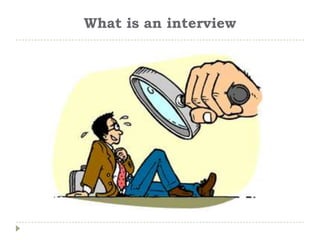
What is an interview


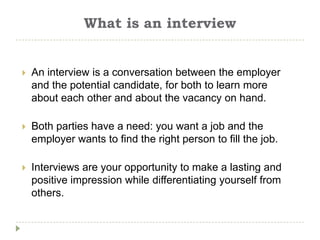
   An interview is a conversation between the employer
    and the potential candidate, for both to learn more
    about each other and about the vacancy on hand.

   Both parties have a need: you want a job and the
    employer wants to find the right person to fill the job.

   Interviews are your opportunity to make a lasting and
    positive impression while differentiating yourself from
    others.
What is an interviewer seeking
    Three main areas employers look at in the selection
     process:

1.    What can you do for us?
      This can be demonstrated through your educational background, prior
      experience, special skills and knowledge.

2.    Why do you want to work with us?
      As a candidate you should understand the company’s goal before applying,
      and if it fits your long term –as well as your short term goals, then go for it and
      be sure you’ll be one of the team soon.

3.    What are you like once we’ve gotten to know
      you?
      Employers are looking at areas such as your motivation, creativity, problem-
      solving abilities, and team work skills, and how these skills will continuo once
      you are hired.
What is a candidate seeking

    Many candidates have a false idea that the interviews are
     only one-way process.
    You can use the same criteria as the employer to get a
     better understanding of the position and about the
     organization.

1.    What can you do for me?
      Ask about the career path, and how can you develop.

2.    Why do I want to work for you?
      Will working in this organization/industry fit my short-term/ long-term goals?

3.    What are you like once I have gotten to know you?
      Make sure that the working environment is suitable for you, as you’ll spend
      minimum of 8 hrs/day working in the company.
Types of Interviews

1)   Stress Interviews:

    A stress interview is an
     interview in which the
     interviewer tries to
     discomfort the candidate in
     different ways by observing
     how he reacts to different
     situations.
    It is considered as a test of
     the candidate’s behavior,
     logic and emotional control
     under pressure.
Types of Interviews

2)   Funny Interviews:

    Funny job interview stories are good for more
     than just a laugh. They illustrate the mistakes
     that many job candidates make.
    You feel at ease, and you start making funny
     comments, without realizing that every word you
     say is being assessed.
Types of Interviews

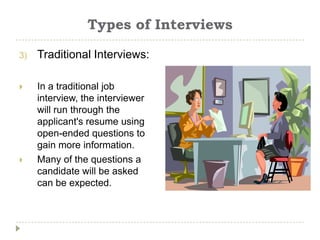
3)   Traditional Interviews:

    In a traditional job
     interview, the interviewer
     will run through the
     applicant's resume using
     open-ended questions to
     gain more information.
    Many of the questions a
     candidate will be asked
     can be expected.
Forms of interviews

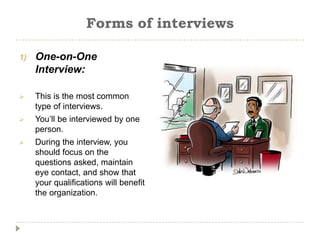
1)   One-on-One
     Interview:

    This is the most common
     type of interviews.
    You’ll be interviewed by one
     person.
    During the interview, you
     should focus on the
     questions asked, maintain
     eye contact, and show that
     your qualifications will benefit
     the organization.
Forms of interviews

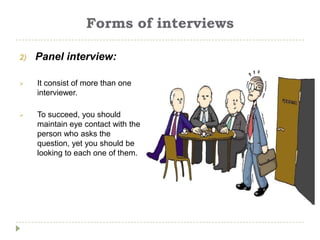
2)   Panel interview:

    It consist of more than one
     interviewer.

    To succeed, you should
     maintain eye contact with the
     person who asks the
     question, yet you should be
     looking to each one of them.
Forms of interviews

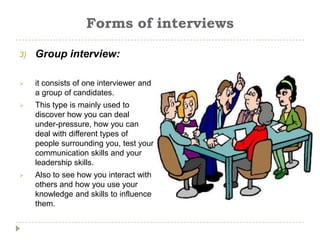
3)   Group interview:

    it consists of one interviewer and
     a group of candidates.
    This type is mainly used to
     discover how you can deal
     under-pressure, how you can
     deal with different types of
     people surrounding you, test your
     communication skills and your
     leadership skills.
    Also to see how you interact with
     others and how you use your
     knowledge and skills to influence
     them.
Forms of interviews
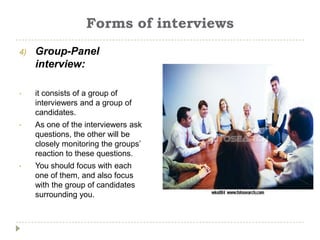
4)   Group-Panel
     interview:

•    it consists of a group of
     interviewers and a group of
     candidates.
•    As one of the interviewers ask
     questions, the other will be
     closely monitoring the groups’
     reaction to these questions.
•    You should focus with each
     one of them, and also focus
     with the group of candidates
     surrounding you.
Job interviews strategies


    Job interview strategies that focus only on the interview is
     not enough.
    You must use strategies that cover the entire process.
     They can be divided into three phases:

1.    Actions you should take before the interview.
2.    Actions you should take during the interview.
3.    Actions you should take after the interview.
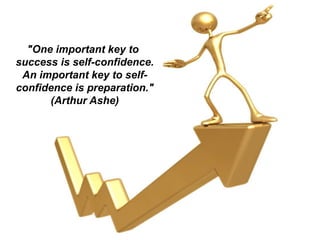
"One important key to
success is self-confidence.
 An important key to self-
confidence is preparation."
      (Arthur Ashe)
Pre-interview Strategies
1.   Research the company.
2.   Study the job description carefully and make
     sure your CV is suitable for what the company is
     looking for.
3.   Prepare for questions that will be asked during
     the interview.
4.   Prepare questions you will ask during the
     interview.
5.   Visit the interview location a day or so before
     your interview.
6.   Plan what to wear to your interview.
7.   Take good care of your nutrition.
During-interview Strategies


   Job interviews can be intimidating and unpleasant, but
    only if you are unprepared.
   Because you followed the Pre-interview Strategies, you
    will be more confident, professional, and less nervous
    than the other candidates.
   During your job interviews, you will be enthusiastic,
    likeable, determined, and knowledgeable.
   These traits are all more important than your job
    qualifications. As most of the employers hire for
    personality and train for skills.
During-interview Strategies

1.   Arrive early.
2.   Make your introduction and greeting
     memorable.
3.   Use body language that shows you are
     enthusiastic, confident, and comfortable with
     the interview process.
4.   Be yourself, but only up to a point.
5.   Answer questions clearly and confidently.
6.   After answering their questions, ask some
     yourself.
7.   Exit gracefully.
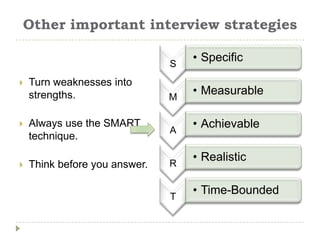
Other important interview strategies

                               S
                                   • Specific

   Turn weaknesses into
    strengths.                 M
                                   • Measurable

   Always use the SMART
                               A
                                   • Achievable
    technique.

                               R
                                   • Realistic
   Think before you answer.


                               T
                                   • Time-Bounded
Tips on how to stay calm in the interview


    Don’t be negative.
    The more realistic you are, the better.
    Don’t provoke aggression or create conflict.
    Behave normally.
    Maintain eye contact, and keep your answers short in
     order not to get interrupted.
    If the interviewer stresses you purposely, slow down and
     try to speak as calmly and softly as you can.
Tips on how to stay calm in the interview


     Remember it’s not the interviewer’s question that is important but
      the quality of your answers. Therefore take a breath and focus
      on the question.
     Sometimes questions don’t have a correct or wrong answer.
      Remember that the interviewer might just want to see how you
      are dealing with the situation.
     Don’t look too serious or irritated at the interviewer. If the
      interviewer tries to provoke you, you should not erase the smile
      on your face.
     If the interviewer asks you the same question over and over again,
      then please be clear on what you say and stick to that. Don’t
      change your answers.
Post-interview Strategies

1.   Send a Thank-You e-mail.

2.   Don't be shy about making follow-
     up calls.

3.   DONT worry, BE happy.

4.   If you got the job, go celebrate! If
     you didn't, don't despair, just start
     again.
Suggestions / Questions

Best Regards       Nasef Sayed Mohamed

Interviewing+skills+for+interviewees

  • 1.
  • 2.
    Training Objectives  What is an interview?  What is an interviewer seeking?  What is a candidate seeking?  Types of interviews.  Forms of interviews.  Job Interview Strategies.
  • 3.
    What is aninterview
  • 4.
    What is aninterview  An interview is a conversation between the employer and the potential candidate, for both to learn more about each other and about the vacancy on hand.  Both parties have a need: you want a job and the employer wants to find the right person to fill the job.  Interviews are your opportunity to make a lasting and positive impression while differentiating yourself from others.
  • 5.
    What is aninterviewer seeking  Three main areas employers look at in the selection process: 1. What can you do for us? This can be demonstrated through your educational background, prior experience, special skills and knowledge. 2. Why do you want to work with us? As a candidate you should understand the company’s goal before applying, and if it fits your long term –as well as your short term goals, then go for it and be sure you’ll be one of the team soon. 3. What are you like once we’ve gotten to know you? Employers are looking at areas such as your motivation, creativity, problem- solving abilities, and team work skills, and how these skills will continuo once you are hired.
  • 6.
    What is acandidate seeking  Many candidates have a false idea that the interviews are only one-way process.  You can use the same criteria as the employer to get a better understanding of the position and about the organization. 1. What can you do for me? Ask about the career path, and how can you develop. 2. Why do I want to work for you? Will working in this organization/industry fit my short-term/ long-term goals? 3. What are you like once I have gotten to know you? Make sure that the working environment is suitable for you, as you’ll spend minimum of 8 hrs/day working in the company.
  • 7.
    Types of Interviews 1) Stress Interviews:  A stress interview is an interview in which the interviewer tries to discomfort the candidate in different ways by observing how he reacts to different situations.  It is considered as a test of the candidate’s behavior, logic and emotional control under pressure.
  • 8.
    Types of Interviews 2) Funny Interviews:  Funny job interview stories are good for more than just a laugh. They illustrate the mistakes that many job candidates make.  You feel at ease, and you start making funny comments, without realizing that every word you say is being assessed.
  • 9.
    Types of Interviews 3) Traditional Interviews:  In a traditional job interview, the interviewer will run through the applicant's resume using open-ended questions to gain more information.  Many of the questions a candidate will be asked can be expected.
  • 10.
    Forms of interviews 1) One-on-One Interview:  This is the most common type of interviews.  You’ll be interviewed by one person.  During the interview, you should focus on the questions asked, maintain eye contact, and show that your qualifications will benefit the organization.
  • 11.
    Forms of interviews 2) Panel interview:  It consist of more than one interviewer.  To succeed, you should maintain eye contact with the person who asks the question, yet you should be looking to each one of them.
  • 12.
    Forms of interviews 3) Group interview:  it consists of one interviewer and a group of candidates.  This type is mainly used to discover how you can deal under-pressure, how you can deal with different types of people surrounding you, test your communication skills and your leadership skills.  Also to see how you interact with others and how you use your knowledge and skills to influence them.
  • 13.
    Forms of interviews 4) Group-Panel interview: • it consists of a group of interviewers and a group of candidates. • As one of the interviewers ask questions, the other will be closely monitoring the groups’ reaction to these questions. • You should focus with each one of them, and also focus with the group of candidates surrounding you.
  • 14.
    Job interviews strategies  Job interview strategies that focus only on the interview is not enough.  You must use strategies that cover the entire process. They can be divided into three phases: 1. Actions you should take before the interview. 2. Actions you should take during the interview. 3. Actions you should take after the interview.
  • 15.
    "One important keyto success is self-confidence. An important key to self- confidence is preparation." (Arthur Ashe)
  • 16.
    Pre-interview Strategies 1. Research the company. 2. Study the job description carefully and make sure your CV is suitable for what the company is looking for. 3. Prepare for questions that will be asked during the interview. 4. Prepare questions you will ask during the interview. 5. Visit the interview location a day or so before your interview. 6. Plan what to wear to your interview. 7. Take good care of your nutrition.
  • 17.
    During-interview Strategies  Job interviews can be intimidating and unpleasant, but only if you are unprepared.  Because you followed the Pre-interview Strategies, you will be more confident, professional, and less nervous than the other candidates.  During your job interviews, you will be enthusiastic, likeable, determined, and knowledgeable.  These traits are all more important than your job qualifications. As most of the employers hire for personality and train for skills.
  • 18.
    During-interview Strategies 1. Arrive early. 2. Make your introduction and greeting memorable. 3. Use body language that shows you are enthusiastic, confident, and comfortable with the interview process. 4. Be yourself, but only up to a point. 5. Answer questions clearly and confidently. 6. After answering their questions, ask some yourself. 7. Exit gracefully.
  • 19.
    Other important interviewstrategies S • Specific  Turn weaknesses into strengths. M • Measurable  Always use the SMART A • Achievable technique. R • Realistic  Think before you answer. T • Time-Bounded
  • 20.
    Tips on howto stay calm in the interview  Don’t be negative.  The more realistic you are, the better.  Don’t provoke aggression or create conflict.  Behave normally.  Maintain eye contact, and keep your answers short in order not to get interrupted.  If the interviewer stresses you purposely, slow down and try to speak as calmly and softly as you can.
  • 21.
    Tips on howto stay calm in the interview  Remember it’s not the interviewer’s question that is important but the quality of your answers. Therefore take a breath and focus on the question.  Sometimes questions don’t have a correct or wrong answer. Remember that the interviewer might just want to see how you are dealing with the situation.  Don’t look too serious or irritated at the interviewer. If the interviewer tries to provoke you, you should not erase the smile on your face.  If the interviewer asks you the same question over and over again, then please be clear on what you say and stick to that. Don’t change your answers.
  • 22.
    Post-interview Strategies 1. Send a Thank-You e-mail. 2. Don't be shy about making follow- up calls. 3. DONT worry, BE happy. 4. If you got the job, go celebrate! If you didn't, don't despair, just start again.
  • 23.
    Suggestions / Questions BestRegards Nasef Sayed Mohamed