Can public-private partnership
deliver better infrastructure
services?
Position paper 1, JINXIN OUYANG, 322407
CONTEXT
 Background
 Arguments about the effects of PPP
 Case study
 Conclusion
Background
The term ‘PPP’ was first used in the USA by the federal government
in the 1960s as a tool for stimulating private investments in regional
economic development and inner-city infrastructure (Fosler &
Berger, 1982; Beauregard, 1997; Linder, 1999). From here, the
concept has spread throughout the world both as an alternative
procurement option for the public sector and a good investment
opportunity for private investors; thus diminishing the government’s
tasks and responsibilities (Pierre, 1997).
Argument about the effects of PPP
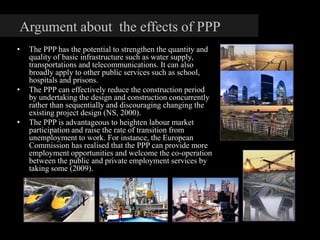
• The PPP has the potential to strengthen the quantity and
quality of basic infrastructure such as water supply,
transportations and telecommunications. It can also
broadly apply to other public services such as school,
hospitals and prisons.
• The PPP can effectively reduce the construction period
by undertaking the design and construction concurrently
rather than sequentially and discouraging changing the
existing project design (NS, 2000).
• The PPP is advantageous to heighten labour market
participation and raise the rate of transition from
unemployment to work. For instance, the European
Commission has realised that the PPP can provide more
employment opportunities and welcome the co-operation
between the public and private employment services by
taking some (2009).
Case study: Hong Kong
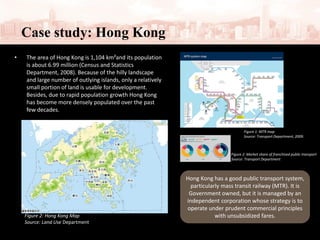
• The area of Hong Kong is 1,104 km²and its population
is about 6.99 million (Census and Statistics
Department, 2008). Because of the hilly landscape
and large number of outlying islands, only a relatively
small portion of land is usable for development.
Besides, due to rapid population growth Hong Kong
has become more densely populated over the past
few decades.
Hong Kong has a good public transport system,
particularly mass transit railway (MTR). It is
Government owned, but it is managed by an
independent corporation whose strategy is to
operate under prudent commercial principles
with unsubsidized fares.
Figure 2: Market share of franchised public transport
Source: Transport Department
Figure 1: MTR map
Source: Transport Department, 2009.
Figure 2: Hong Kong Map
Source: Land Use Department
Counter argument against PPP
• The enhancement of value for money and innovation via
the PPP is questionable because low costs are always
considered as the primary selection criterion so that it is
hard to achieve the best value between costs and
performance (Gansler, 2003; Dewulf er al., 2004).
• Public interest may be endangered due to the conflict
between the private sector’s profit-seeking goals and
public values. Besides, at the beginning of a project, it is
difficult to determine a universal public interest that
includes feasible performance indicators for the end
result.
• The partnership and the private or public sector may
suffer from the disharmony.
On balance, PPP is regarded as a viable and
necessary option based on the combination of
the skills, expertise, and experience of both the
public and private sectors to deliver higher
standard of services to customers or citizens.
References
Fosler, R. S. & Berger, R. A. (1982). Public-private partnership in American Cities. Lexington: Lexington Books.
Beauregard, R. A. (1997). Public-private partnerships as historical chameleons: the case of the United States. London:
Macmillan.
Crump, S. J. & Slee, R. (2005). Robbing public to pay private: two cases of refinancing education infrastructure in Australia. Journal
of Education Policy, 20 (2), 249-264.
English, L.M. & Guthrie , J. (2003). Driving privately financed projects in Australia: what makes them tick? Accounting, Auditing
and Accountability Journal, 16 (3), 392-511.
Stainback, J. (2000). Public/Private Finance and Development: Methodology, Deal Structuring, Developer Solicitation. New York:
John Wiley & Sons.
HM Treasury, (2000). Public Private Partnerships-Government’s Approach. HMSO, London.
Hambros, S. (1999). Public-Private Partnerships for Highways: Experience, Structure, Financing, Applicability and Comparative
Assessment. Council of Deputy Ministers Responsible for Transport and Highway Safety, Canada.
NS, (2000). Review of Public Private Partnership Process. Retrieved August 29, 2010, from
http://www.gov.ns.ca/finance/index.htm
Hambros, S. (1999). Public-Private Partnerships for Highways: Experience, Structure, Financing, Applicability and Comparative
Assessment. Council of Deputy Ministers Responsible for Transport and Highway Safety, Canada.
Peter, B. G. (1997). With a little help from our friends: public-private partnerships as institutions and instruments. London,
Macmillan.

Jinxin ouyang

  • 1.
    Can public-private partnership deliverbetter infrastructure services? Position paper 1, JINXIN OUYANG, 322407
  • 2.
    CONTEXT  Background  Argumentsabout the effects of PPP  Case study  Conclusion Background The term ‘PPP’ was first used in the USA by the federal government in the 1960s as a tool for stimulating private investments in regional economic development and inner-city infrastructure (Fosler & Berger, 1982; Beauregard, 1997; Linder, 1999). From here, the concept has spread throughout the world both as an alternative procurement option for the public sector and a good investment opportunity for private investors; thus diminishing the government’s tasks and responsibilities (Pierre, 1997).
  • 3.
    Argument about theeffects of PPP • The PPP has the potential to strengthen the quantity and quality of basic infrastructure such as water supply, transportations and telecommunications. It can also broadly apply to other public services such as school, hospitals and prisons. • The PPP can effectively reduce the construction period by undertaking the design and construction concurrently rather than sequentially and discouraging changing the existing project design (NS, 2000). • The PPP is advantageous to heighten labour market participation and raise the rate of transition from unemployment to work. For instance, the European Commission has realised that the PPP can provide more employment opportunities and welcome the co-operation between the public and private employment services by taking some (2009).
  • 4.
    Case study: HongKong • The area of Hong Kong is 1,104 km²and its population is about 6.99 million (Census and Statistics Department, 2008). Because of the hilly landscape and large number of outlying islands, only a relatively small portion of land is usable for development. Besides, due to rapid population growth Hong Kong has become more densely populated over the past few decades. Hong Kong has a good public transport system, particularly mass transit railway (MTR). It is Government owned, but it is managed by an independent corporation whose strategy is to operate under prudent commercial principles with unsubsidized fares. Figure 2: Market share of franchised public transport Source: Transport Department Figure 1: MTR map Source: Transport Department, 2009. Figure 2: Hong Kong Map Source: Land Use Department
  • 5.
    Counter argument againstPPP • The enhancement of value for money and innovation via the PPP is questionable because low costs are always considered as the primary selection criterion so that it is hard to achieve the best value between costs and performance (Gansler, 2003; Dewulf er al., 2004). • Public interest may be endangered due to the conflict between the private sector’s profit-seeking goals and public values. Besides, at the beginning of a project, it is difficult to determine a universal public interest that includes feasible performance indicators for the end result. • The partnership and the private or public sector may suffer from the disharmony. On balance, PPP is regarded as a viable and necessary option based on the combination of the skills, expertise, and experience of both the public and private sectors to deliver higher standard of services to customers or citizens.
  • 6.
    References Fosler, R. S.& Berger, R. A. (1982). Public-private partnership in American Cities. Lexington: Lexington Books. Beauregard, R. A. (1997). Public-private partnerships as historical chameleons: the case of the United States. London: Macmillan. Crump, S. J. & Slee, R. (2005). Robbing public to pay private: two cases of refinancing education infrastructure in Australia. Journal of Education Policy, 20 (2), 249-264. English, L.M. & Guthrie , J. (2003). Driving privately financed projects in Australia: what makes them tick? Accounting, Auditing and Accountability Journal, 16 (3), 392-511. Stainback, J. (2000). Public/Private Finance and Development: Methodology, Deal Structuring, Developer Solicitation. New York: John Wiley & Sons. HM Treasury, (2000). Public Private Partnerships-Government’s Approach. HMSO, London. Hambros, S. (1999). Public-Private Partnerships for Highways: Experience, Structure, Financing, Applicability and Comparative Assessment. Council of Deputy Ministers Responsible for Transport and Highway Safety, Canada. NS, (2000). Review of Public Private Partnership Process. Retrieved August 29, 2010, from http://www.gov.ns.ca/finance/index.htm Hambros, S. (1999). Public-Private Partnerships for Highways: Experience, Structure, Financing, Applicability and Comparative Assessment. Council of Deputy Ministers Responsible for Transport and Highway Safety, Canada. Peter, B. G. (1997). With a little help from our friends: public-private partnerships as institutions and instruments. London, Macmillan.