WHAT IS SPRAWL?
BY OLIVER GILLHAM
Organised summary for the subject of Urban
Design with Mr. Szabo Arpad
Alina Garkoucha
Introduction
The studied text, written by Oliver
Gillham in the book The limitless city: a
Primer on urban sprawl debate, is
speaking about the meaning of the
word « sprawl » in the United States of
America.
This word, which have a lot of
significations, traduce a contreverse :
« it is a world that Americans have
brought upon themselves willingly »
Oliver Gillham said.
2
Characteristics and definition
A lot of definitions exist to define the « sprawl ». Even if not all of the people agrees on
the meaning, a common principle shows up: sprawl is a suburban phenomenon.
According to the Professor Reid Ewing of the Florida International University, the term of
sprawl can be recognized with these characteristics:
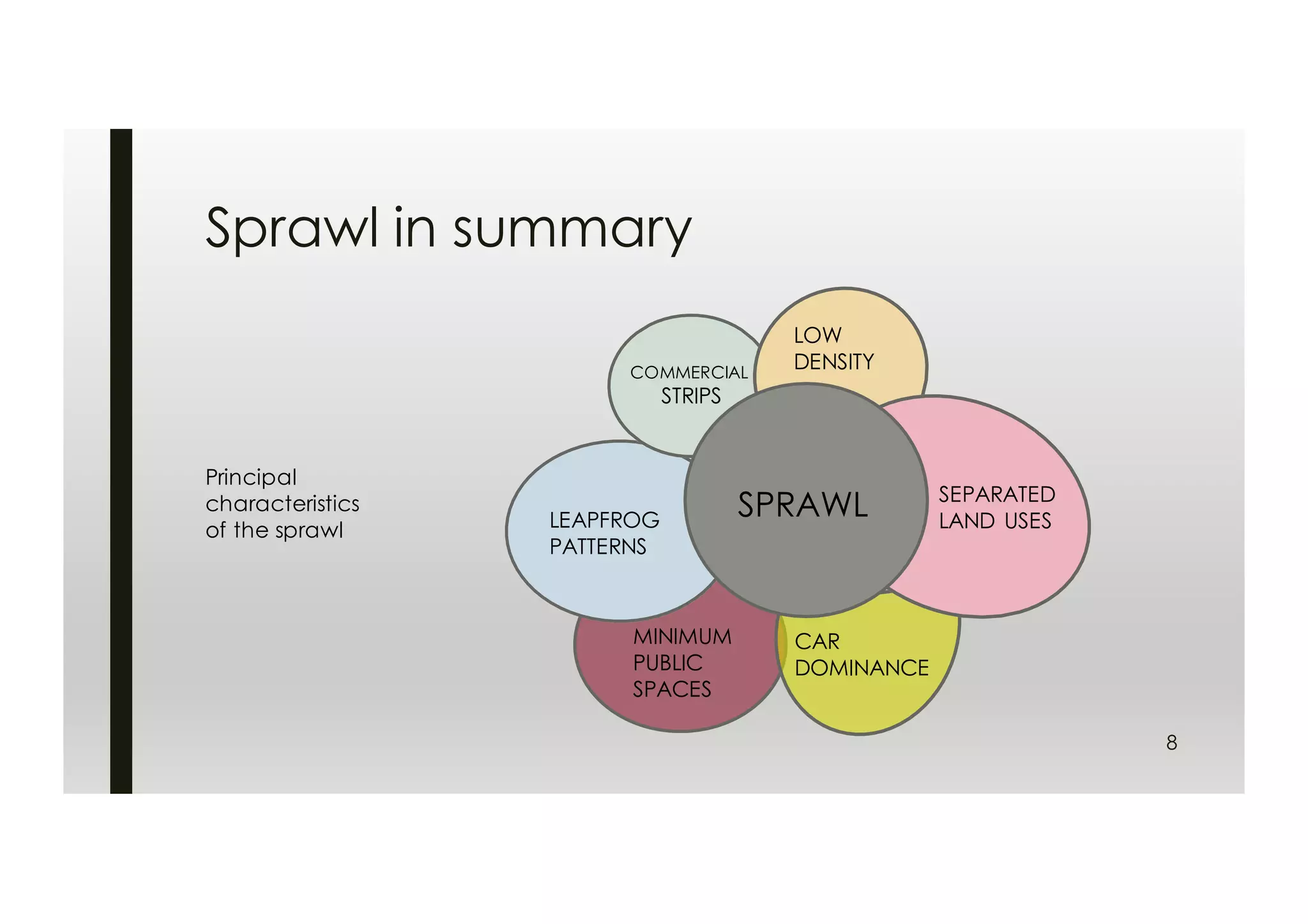
• Leapfrog or scattered development, which is developing suburban and exurban area and
consume more land than it has to
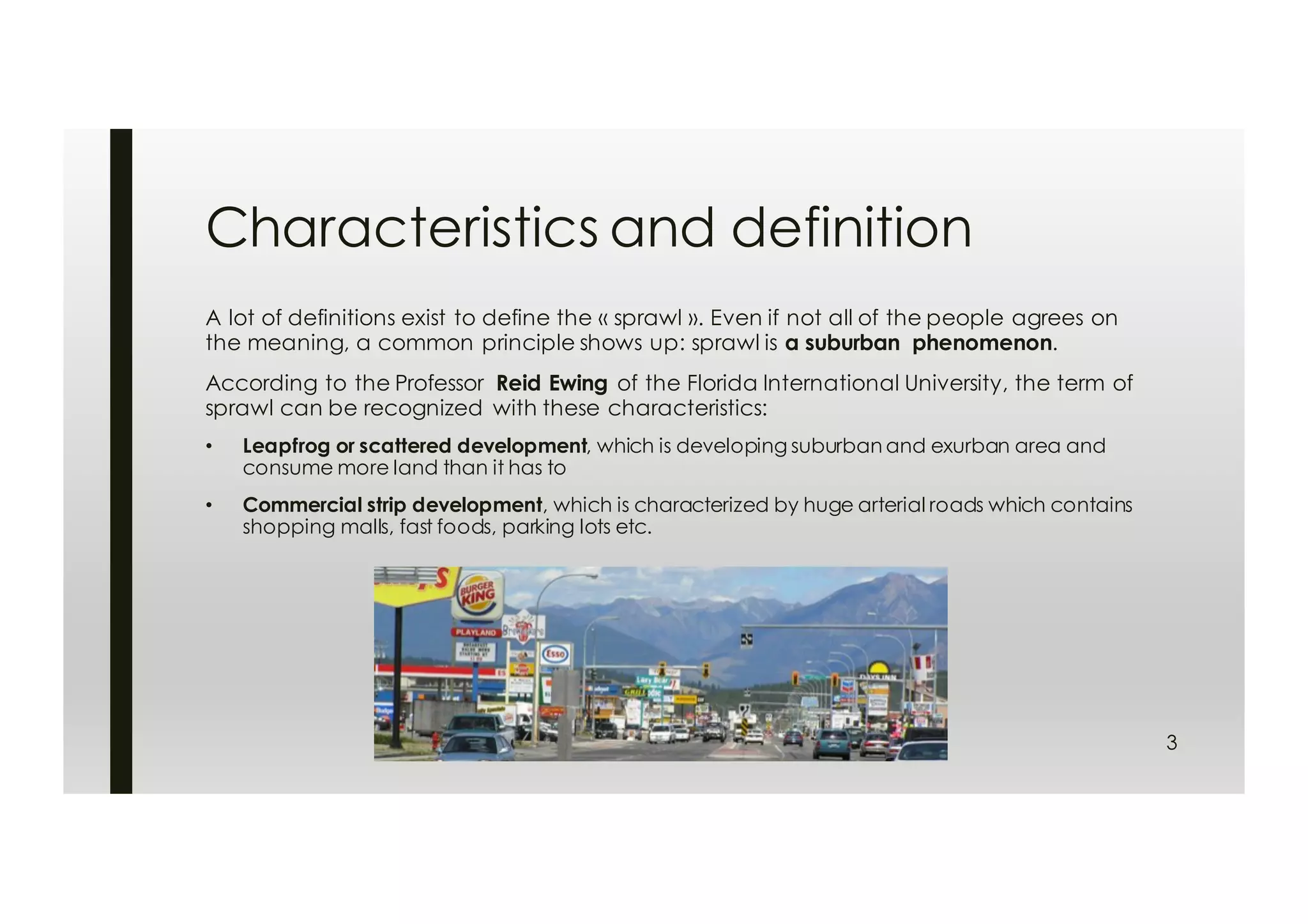
• Commercial strip development, which is characterized by huge arterial roads which contains
shopping malls, fast foods, parking lots etc.
3
Characteristics and definition
• Low density, very different, quite the opposite of the old town. The buildings are widely spaced
and are often composed of one floor.
• Single use function, whether for the houses or for the shops, a single building has just a single
function. And because of the widely spread, the functions can be separated by long
distances.
• Poor accessibility and automobile dominance. One of the other consequences of a wide
spread is the obligation to use a car to go fromone point to another.
• Lack of public open spaces, which often belongs to homeowners and are privatized. The
other public open spaces are taken over by parking areas. So, the only public space which
belongs to the whole community of inhabitants are the public roads.
For a definition, we can admit that sprawl is a form of urbanization distinguished by
these characteristics. These spaces are a typical form of most types of nowadays
suburban development.
4
What makes sprawl?
• Land ownership. This concept, brought from
Europe, is very important for the Americans:
buying a home is the biggest investment of their
lives. Real estate industry has to respond to this
demand and, at the same time, has to make
profit. This profit can also explain the repetitivness
of the suburban model.
• The cost of land, is an argument to create such
areas. The higher cost of land comes from a big
density. This cost come from clustering and
access. More clustering do we have, more
businesses can be developed and more money
can circulate. Nowadays, people can easily
access to any place thanks to the transportation
and the network, so a land far from the city
becomes accessible to anyone of us.
5
What makes sprawl?
• Transportation patterns. Basically, in this kind of suburbanization, the car is the most choosen way
to move out. Whether for working, for shopping or for travelling, American people prefer to use
the automobile, certainly because of the low density and the horizontal separation of uses.
• Telecommunications technology. Electricity permit to everyone to be located (to live or to work)
wherever they want and to be assured of a power source. The computers allowed the
decentralisation wherever the land or the labor cost less. Also with the internet, employees can
now work at their homes without the need to be located in the city center.
• Regulation and standards provide to the suburban area a building code concerning the type of
the building, the size and the location. These standards are no more permitting to do some crazy
things in these places. Furthermore, all the houses of a suburban area belongs to the banks and
the insurances who dictate the whole project.
6
The Limitless City
The metropolitan region consists in two parts: CITY + SUBURB
The suburbs, with the sprawl effect, grows faster and faster insomuch they leapfrog the
borders. New limits mean new rules. Many people from there think themselves as residents
of a small and autonomous town, but it doen’t work like that, and that’s why may tensions
appears between local and regional government.
Some metropolitan area can be a patchwork of urbanized area and undeveloped lands.
Like Lewis Mumford said: « the coastal strip (…) might coalesce into an almost
undifferentiated conurbation ».
7
Sprawl in summary
8
LEAPFROG
PATTERNS
COMMERCIAL
STRIPS
Principal
characteristics
of the sprawl
LOW
DENSITY
SEPARATED
LAND USES
CAR
DOMINANCE
MINIMUM
PUBLIC
SPACES
SPRAWL
Sprawl in summary
9
PRECONDITIONS
CAUSE
FACTS
WISH FOR A
PRIVATE
OWNERSHIP OF
LAND
MARKET FORCES
+
LARGE
INDUSTRY IN
CONSTRUCTION
INEXPENSIVE
LAND
PEOPLE ARE SCATTER WIDELY
+ SINGLE USE DEVELOPMENT PATTERNS
=
LOW DENSITY
With proliferation of cars and
roads
+ Pervasive telecom. network
Investment
CITY WITHOUT LIMIT
Indefinetely extension
encompassing the different
political juridictions
CONSEQUENCES
REGULATORY ENVIRONMENT
OF CODES AND STANDARDS
TENSIONS BETWEENHOME RULES
AND REGIONAL INTERESTS

What is sprawl summary ud - alina garkoucha

  • 1.
    WHAT IS SPRAWL? BYOLIVER GILLHAM Organised summary for the subject of Urban Design with Mr. Szabo Arpad Alina Garkoucha
  • 2.
    Introduction The studied text,written by Oliver Gillham in the book The limitless city: a Primer on urban sprawl debate, is speaking about the meaning of the word « sprawl » in the United States of America. This word, which have a lot of significations, traduce a contreverse : « it is a world that Americans have brought upon themselves willingly » Oliver Gillham said. 2
  • 3.
    Characteristics and definition Alot of definitions exist to define the « sprawl ». Even if not all of the people agrees on the meaning, a common principle shows up: sprawl is a suburban phenomenon. According to the Professor Reid Ewing of the Florida International University, the term of sprawl can be recognized with these characteristics: • Leapfrog or scattered development, which is developing suburban and exurban area and consume more land than it has to • Commercial strip development, which is characterized by huge arterial roads which contains shopping malls, fast foods, parking lots etc. 3
  • 4.
    Characteristics and definition •Low density, very different, quite the opposite of the old town. The buildings are widely spaced and are often composed of one floor. • Single use function, whether for the houses or for the shops, a single building has just a single function. And because of the widely spread, the functions can be separated by long distances. • Poor accessibility and automobile dominance. One of the other consequences of a wide spread is the obligation to use a car to go fromone point to another. • Lack of public open spaces, which often belongs to homeowners and are privatized. The other public open spaces are taken over by parking areas. So, the only public space which belongs to the whole community of inhabitants are the public roads. For a definition, we can admit that sprawl is a form of urbanization distinguished by these characteristics. These spaces are a typical form of most types of nowadays suburban development. 4
  • 5.
    What makes sprawl? •Land ownership. This concept, brought from Europe, is very important for the Americans: buying a home is the biggest investment of their lives. Real estate industry has to respond to this demand and, at the same time, has to make profit. This profit can also explain the repetitivness of the suburban model. • The cost of land, is an argument to create such areas. The higher cost of land comes from a big density. This cost come from clustering and access. More clustering do we have, more businesses can be developed and more money can circulate. Nowadays, people can easily access to any place thanks to the transportation and the network, so a land far from the city becomes accessible to anyone of us. 5
  • 6.
    What makes sprawl? •Transportation patterns. Basically, in this kind of suburbanization, the car is the most choosen way to move out. Whether for working, for shopping or for travelling, American people prefer to use the automobile, certainly because of the low density and the horizontal separation of uses. • Telecommunications technology. Electricity permit to everyone to be located (to live or to work) wherever they want and to be assured of a power source. The computers allowed the decentralisation wherever the land or the labor cost less. Also with the internet, employees can now work at their homes without the need to be located in the city center. • Regulation and standards provide to the suburban area a building code concerning the type of the building, the size and the location. These standards are no more permitting to do some crazy things in these places. Furthermore, all the houses of a suburban area belongs to the banks and the insurances who dictate the whole project. 6
  • 7.
    The Limitless City Themetropolitan region consists in two parts: CITY + SUBURB The suburbs, with the sprawl effect, grows faster and faster insomuch they leapfrog the borders. New limits mean new rules. Many people from there think themselves as residents of a small and autonomous town, but it doen’t work like that, and that’s why may tensions appears between local and regional government. Some metropolitan area can be a patchwork of urbanized area and undeveloped lands. Like Lewis Mumford said: « the coastal strip (…) might coalesce into an almost undifferentiated conurbation ». 7
  • 8.
    Sprawl in summary 8 LEAPFROG PATTERNS COMMERCIAL STRIPS Principal characteristics ofthe sprawl LOW DENSITY SEPARATED LAND USES CAR DOMINANCE MINIMUM PUBLIC SPACES SPRAWL
  • 9.
    Sprawl in summary 9 PRECONDITIONS CAUSE FACTS WISHFOR A PRIVATE OWNERSHIP OF LAND MARKET FORCES + LARGE INDUSTRY IN CONSTRUCTION INEXPENSIVE LAND PEOPLE ARE SCATTER WIDELY + SINGLE USE DEVELOPMENT PATTERNS = LOW DENSITY With proliferation of cars and roads + Pervasive telecom. network Investment CITY WITHOUT LIMIT Indefinetely extension encompassing the different political juridictions CONSEQUENCES REGULATORY ENVIRONMENT OF CODES AND STANDARDS TENSIONS BETWEENHOME RULES AND REGIONAL INTERESTS