Serving the
Community
By Using the Private Sector
An introductory guide to
Public Private Partnerships (PPPs)
August 2003
An Introductory Guide to Public Private Partnerships


The Efficiency Unit welcomes comments from readers and users of this Introductory
Guide. Comments may be addressed to:

            Head, Efficiency Unit
            (Attn: Assistant Director (Efficiency Unit))
            14/F Hennessy Centre
            500 Hennessy Road
            Causeway Bay
            Hong Kong

            E-mail:   helpdesk@eu.gov.hk
            Tel:      2165 7255
            Fax:      2881 8447
Foreword


                            Foreword
                            The Government is facing a conundrum; on the one hand,
                            we are experiencing major budgetary pressures yet, on the
                            other hand, we remain subject to demands for more and
                            better public services. A key part of the solution is to enhance
                            radically the use of the private sector in delivering
                            government services.


                             Since promoting our Private Sector Involvement programme
                             a couple of years ago, we have seen a significant increase
in the value and quality of government outsourcing contracts.

We now wish to secure similar improvements from Public Private Partnerships (PPPs).
This Introductory Guide presents the basic concepts and addresses the major issues
relating to PPPs. It seeks to encourage both civil servants and the private sector to
explore the use of PPPs for both traditional and innovative projects.


The major benefits of PPPs are that they -

    Deliver, cost-effectively, major long-term projects whilst spreading out the significant
    upfront investment that the government would normally have to make;
    Harness the flexibility, innovation, skills and resources of the private sector as well
    as encouraging them to enhance the range and calibre of the services made available
    to the community
    Improve value for money for Government (focusing on whole life costs) whilst creating
    long-term job and business opportunities for the private sector
    Share risks and rewards of public projects between the public and private sectors
    whilst encouraging long-term delivery of high quality services to the community.

Implementing PPPs takes time, effort and innovative thinking. But experience elsewhere
shows that well-researched, planned and implemented projects provide real benefits:
for the private sector, for government and, most of all, for the community we serve. I
urge you to explore the opportunities that exist, and implement suitable projects with
vigour.


Donald Tsang
Chief Secretary for Administration
Contents


Contents
                                                           Page

Introduction                                                1

Chapter 1 Advantages of PPPs                                2

Chapter 2 Common Elements of PPPs                           4

Chapter 3 Comparison of PPPs and Conventional Approaches    5

Chapter 4 Policy Support Issues                             9

Chapter 5 Procedures                                       13

Chapter 6 Maximising Benefits and Managing Risks           20

Chapter 7 Financial Issues                                 26

Chapter 8 The Public Sector Comparator (PSC)               31

Chapter 9 Selecting the Right Private Partner              35

Chapter 10 Changes of Circumstances                        37

Chapter 11 Managing Performance                            41

Chapter 12 Staffing Issues                                 45

Chapter 13 Legal Issues                                    47

Chapter 14 Land Issues                                     49

Chapter 15 Probity and Process Governance                  53

Chapter 16 Managing Corruption Risks                       55

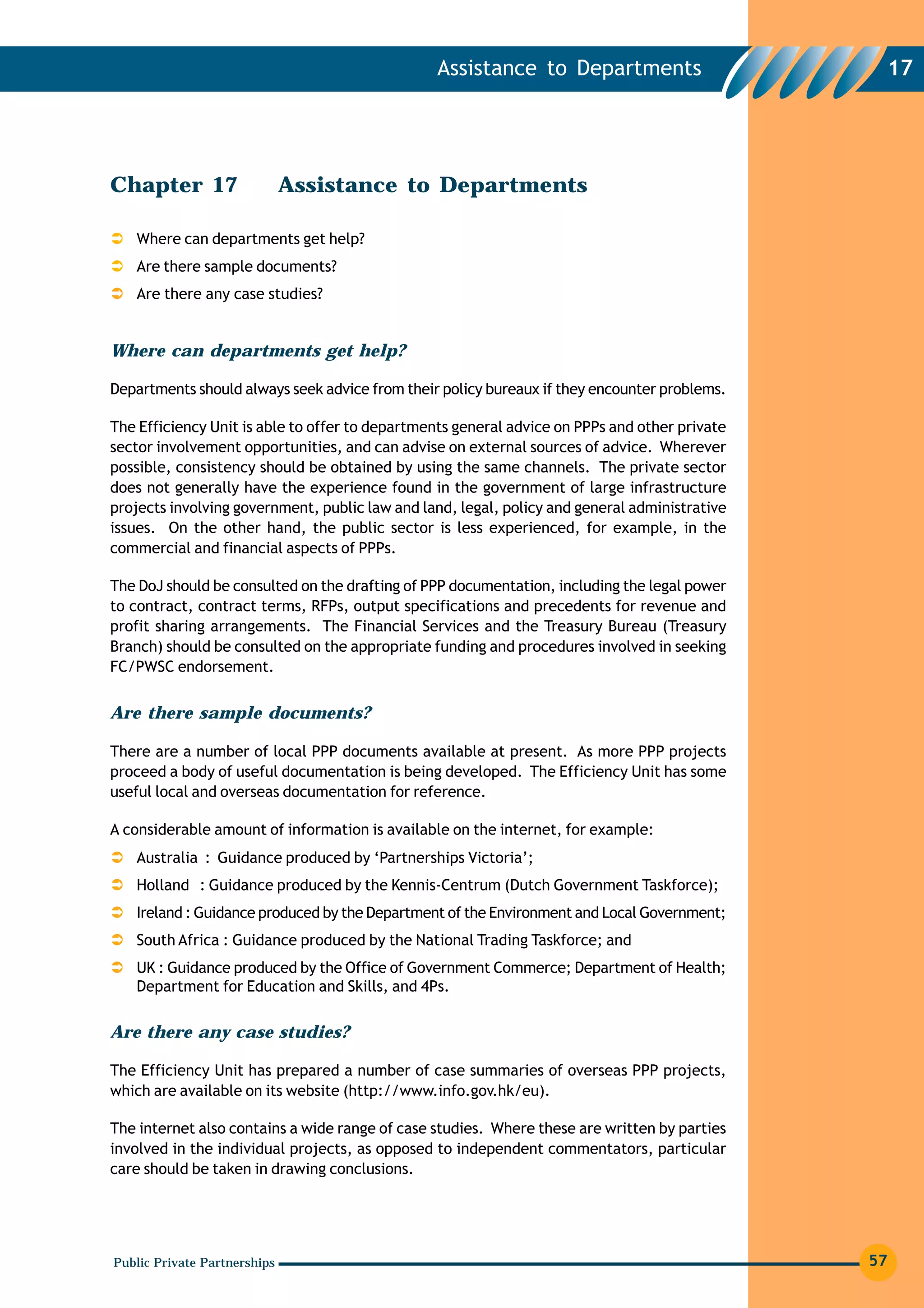
Chapter 17 Assistance to Departments                       57


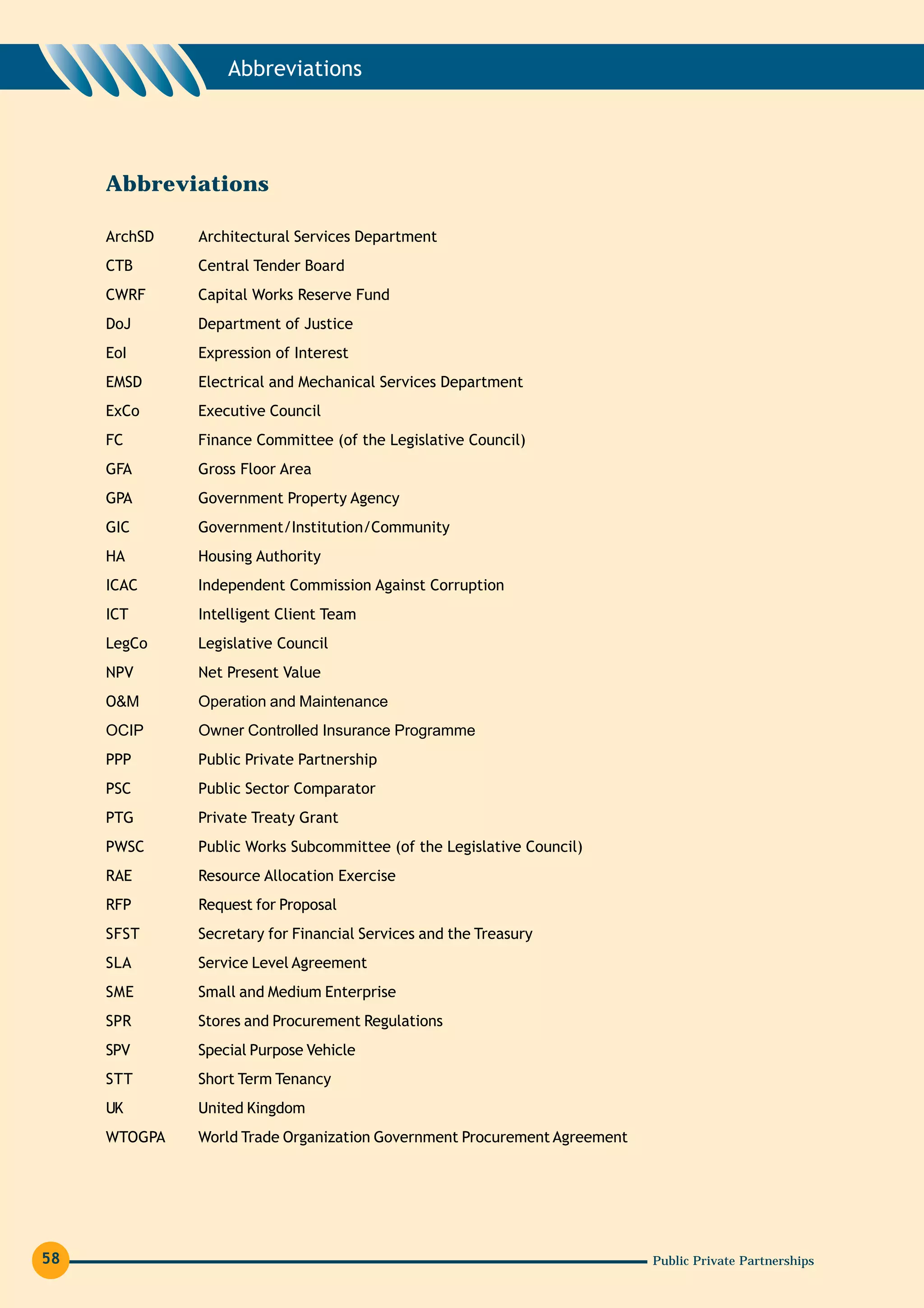
Abbreviations                                              58

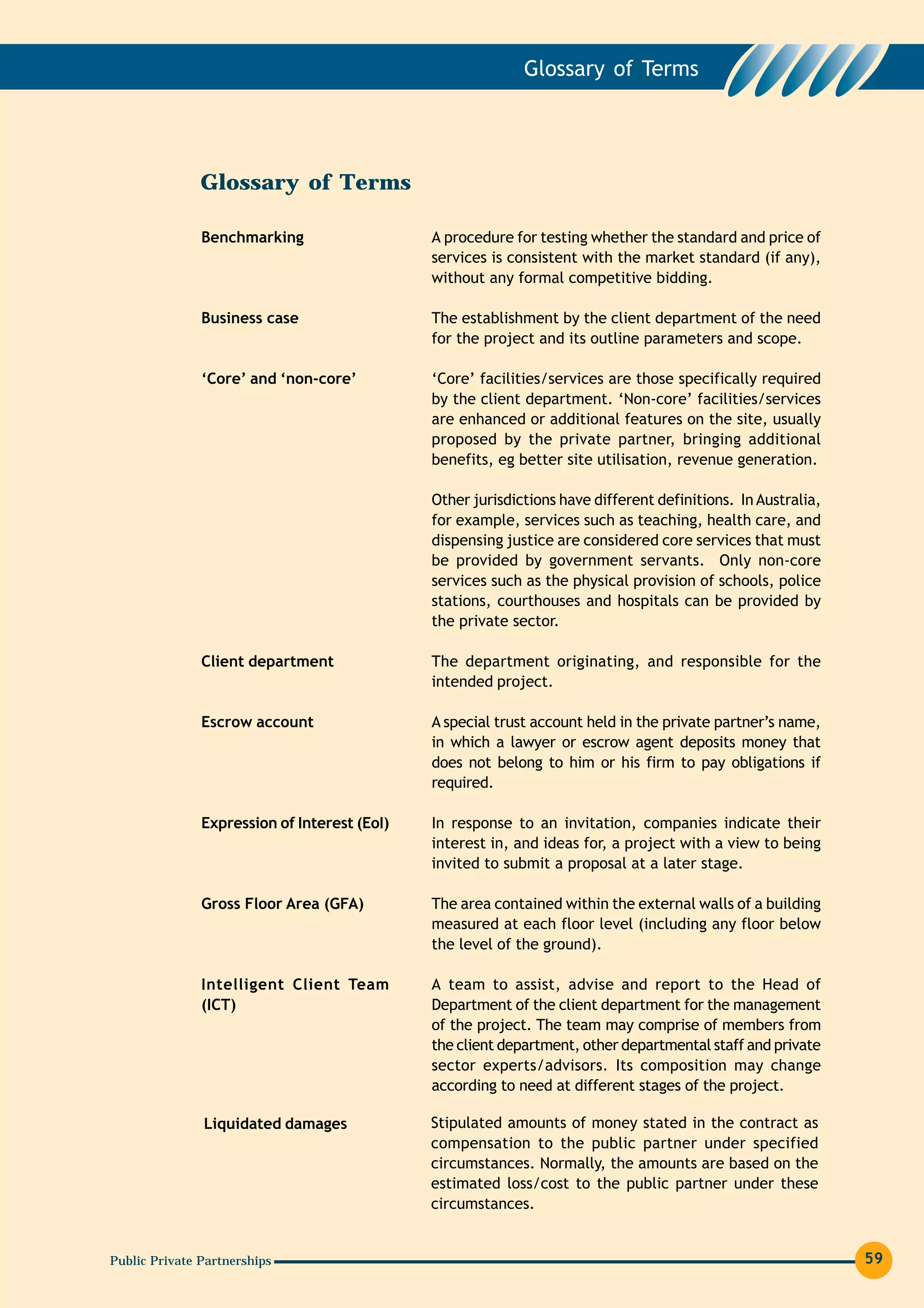
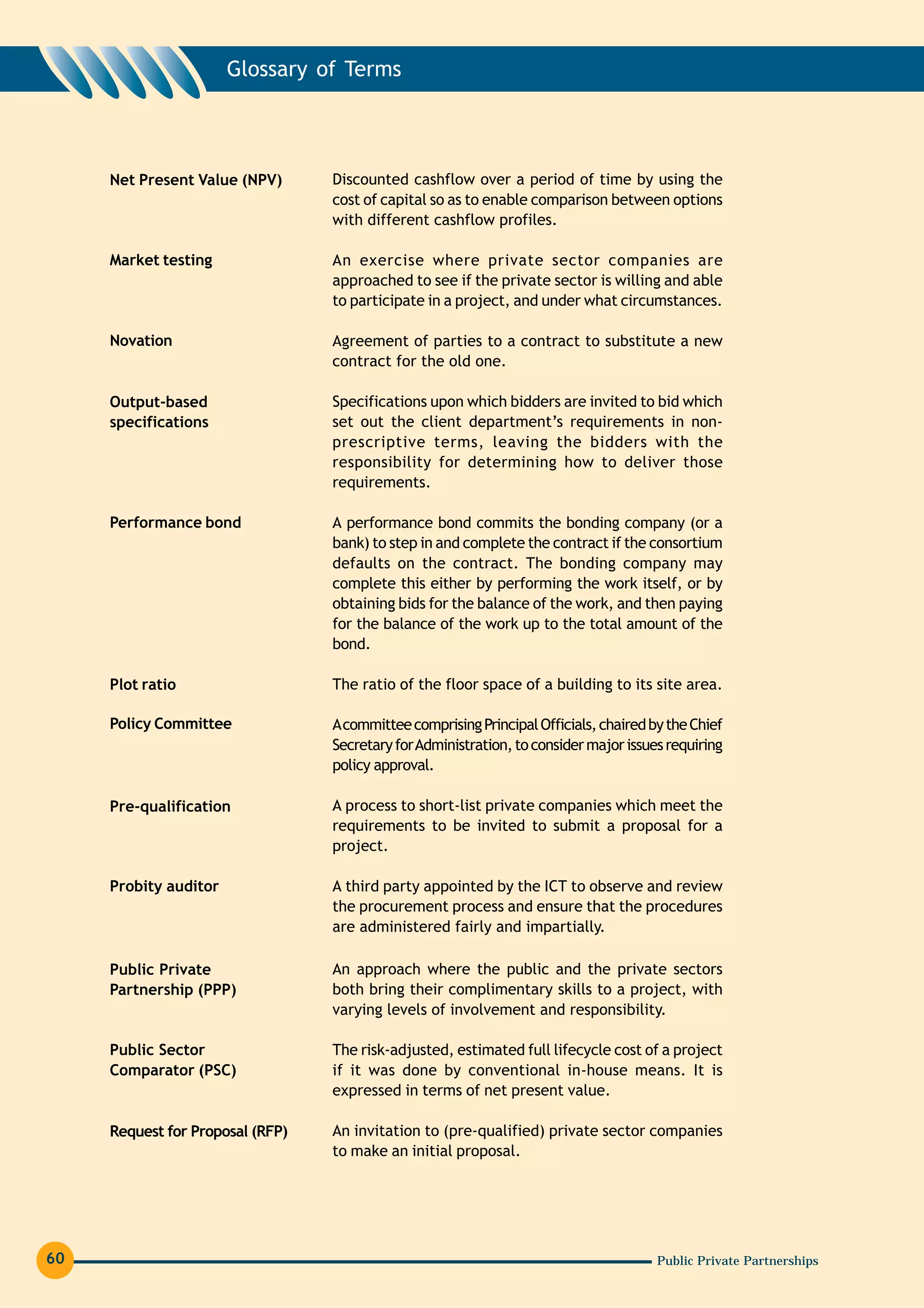
Glossary of Terms                                          59

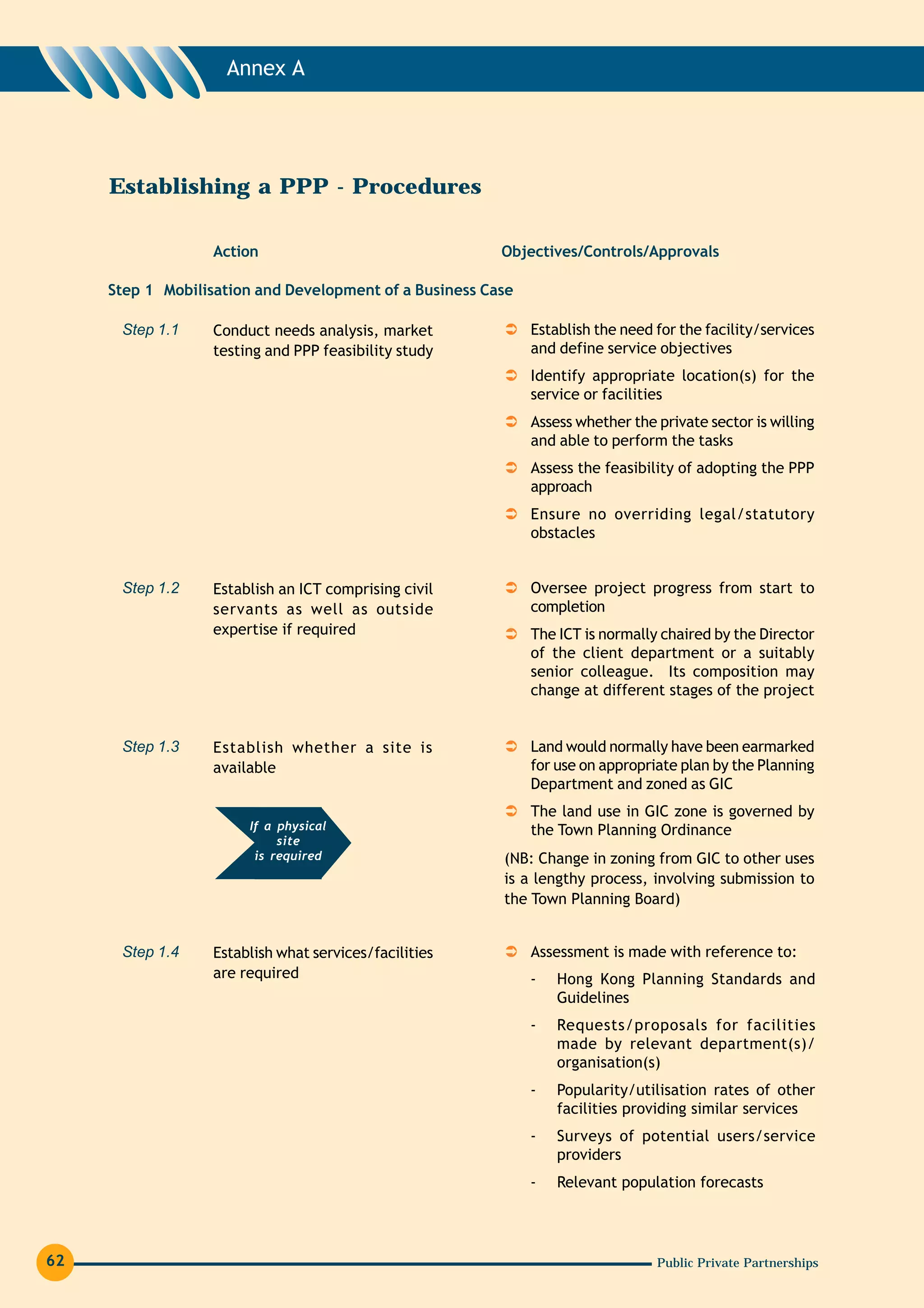
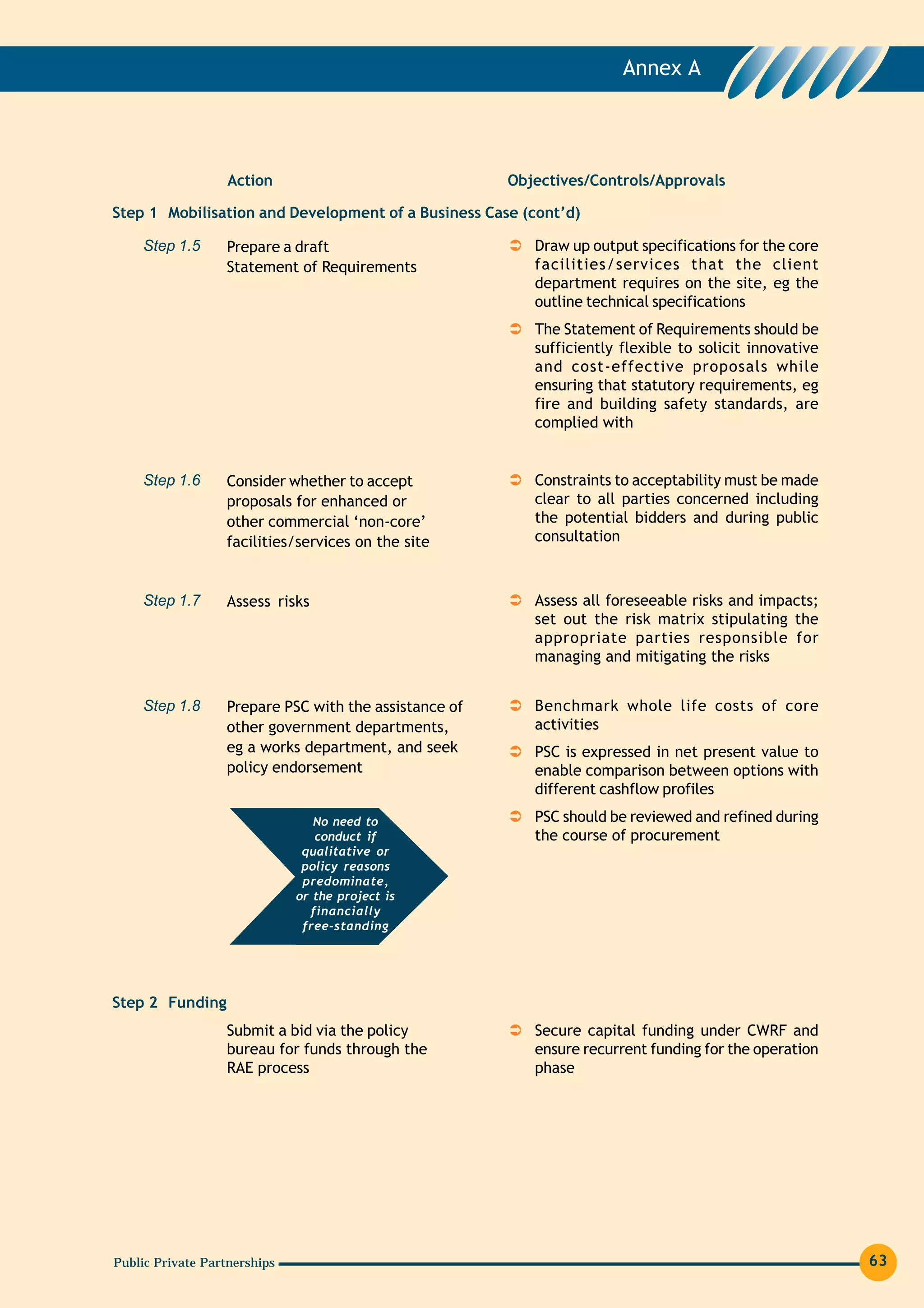
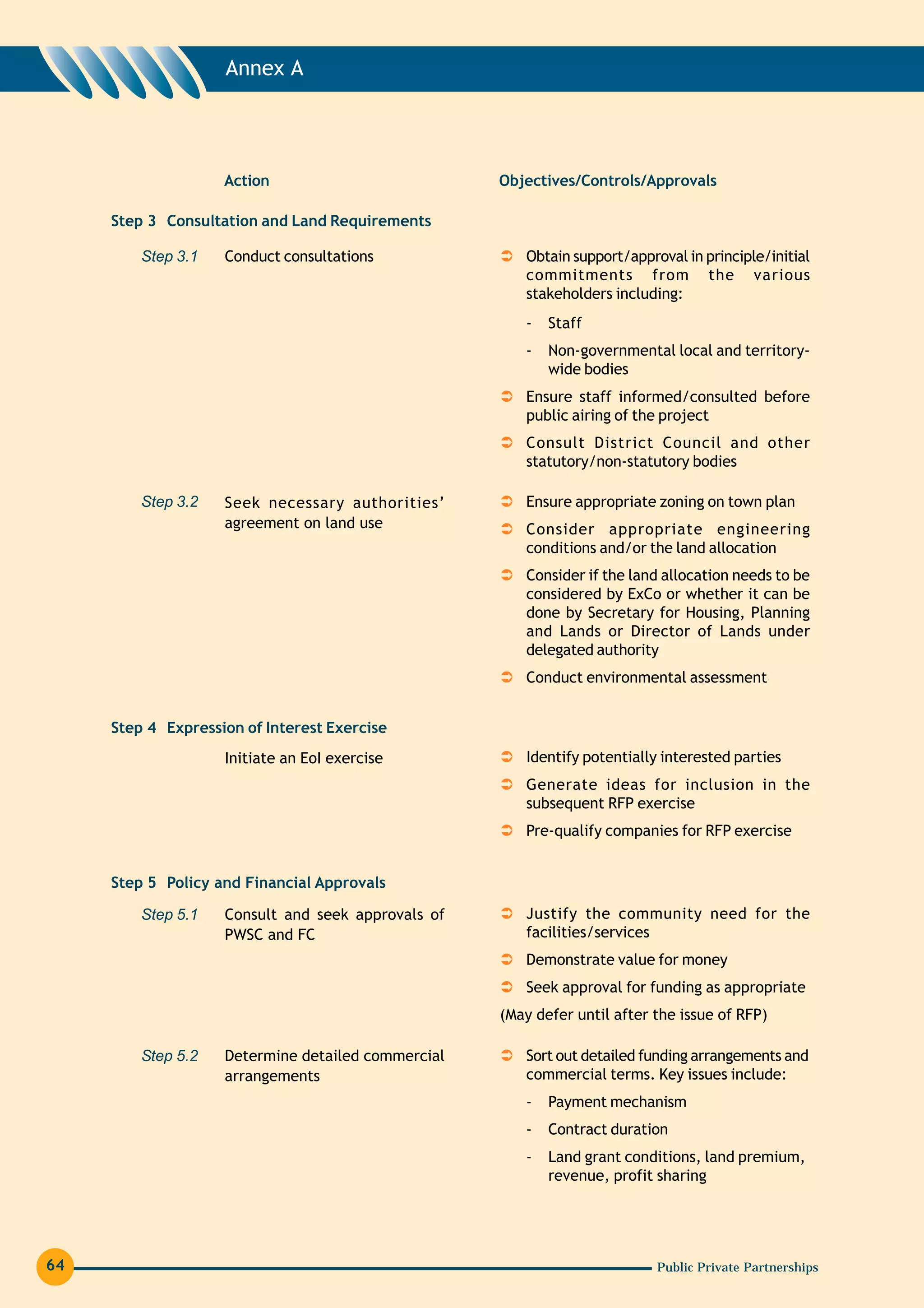
Annex A:    Establishing a PPP - Procedures                62

Annex B:    Establishing a PPP - Flowchart                 68
Introduction


Introduction
Background

Public Private Partnerships (PPPs) provide a number of alternative ways of involving the
private sector in the delivery of public services. As the name suggests, they are based on a
partnership approach, where the responsibility for the delivery of services is shared between
the public and private sectors, both of which bring their complementary skills to the enterprise.
Examples of the government’s contribution to the partnership might be the grant of land
rights or the use of existing government assets, the construction of associated infrastructure,
the sharing of certain risks and/or a commitment to purchase the services that meet a
specified standard for the concession period. A PPP may take one of several forms, which
are explained in the ‘Serving the Community by Using the Private Sector’ document, also
issued by the Efficiency Unit in June 2001.

This guide focuses on PPPs which involve the use of private financing to fund the
construction of facilities and/or the purchase of assets, for the purpose of providing services.
There are differences between these types of PPPs, depending on the means by which the
private partner receives a return on his investment:
    At one end of the spectrum are financially free-standing projects where the services are
    provided for the use of the public which pays the private partner direct. Examples of
    this are toll-charging road bridges and tunnels.
    At the other end of the spectrum, the services are provided direct to the government
    sector which pays the private partner for those services. Overseas examples of this
    include the provision of prisons, government office accommodation and hospitals.
    In between the two ends of the spectrum are projects which provide services to the
    public, but the payments to the private partner involve a mix of public subsidy from the
    government and end-user charges imposed on consumers of the services. Examples of
    such services are sports centres, where the consumer pays a subsidised fee for the use
    or hire of facilities and equipment.

It is important to remember that the detailed arrangements for PPPs can and should be
crafted individually to suit the particular circumstances that are encountered in each instance.
For example, if a new prison is required, the client department would need to consider
carefully whether the private partner should be invited to provide all services - including
custodial duties - or be limited to non-custodial tasks.

Using this guide
This document introduces the use of the PPP approach to procurement in Hong Kong by
posing and answering a number of questions. It has been developed mainly for use by the
civil service but is made available to the private sector to enhance their understanding of
the government approach. Users of the Guide should recognise that it is not definitive and
central departments, including FSTB, DoJ and EU, should be consulted in individual cases.

Throughout the guide the term department is used generically for all types of government
organisations. Other terms and abbreviations used are explained on pages 58 to 61.

Amendments will be made in the light of experience. Please check the version posted on
the Efficiency Unit website at http://www.info.gov.hk/eu for changes before making use of
the guide.


Public Private Partnerships                                                                         1
1                     Advantages of PPPs


                      Chapter 1                 Advantages of PPPs

Exploit the best      PPPs bring together the public and private sectors in a long-term relationship. The
commercial skills,    private sector becomes a long-term service provider rather than a simple upfront asset
                      builder. As a result, government departments become more involved as regulators and
practices and
                      procurers of services rather than direct providers of services to the public.
disciplines to
deliver high          Despite its dedication, experience and skills, the public sector is, in many circumstances,
quality public        unlikely to match the innovation, creativity and efficiency of the private sector. This is
                      often because the public sector faces constraints such as budgetary and borrowing
services
                      restrictions. At times, PPPs may be attractive to the government because they can
                      provide private funds in place of public sector capital to develop facilities and/or services.

                      The private sector’s usual incentives coupled with the competitive pressures of the
                      marketplace can lead to better quality services delivered earlier and for lower cost than
                      under traditional means of public sector procurement. The bottom line incentives that
                      motivate the private sector are a more powerful management tool than mere public
                      sector controls, irrespective of how hard the public sector tries to replicate those same
                      incentives in its own approach.

                      The introduction of private sector management is an effective way of bringing commercial
                      disciplines into the provision of public services. Even where the government wishes
                      public services to be delivered below cost, this can be achieved through using the
                      private sector but the government will have to continue to provide a subsidy.

                      The PPP approach is an alternative to conventional methods of procuring projects and
                      will not be suitable in every case. Care must be taken in selecting appropriate projects.
                      The specific benefits will depend on the specific project. The benefits that may be
                      achieved include:
                          Allowing the government to concentrate on what it is good at, eg policy decision
                          making, determining the outcomes it seeks, looking for best solutions, and overall
                          regulatory review;
                          Better exploitation of government assets, data (consistent with data protection
                          law) and intellectual property;
                          Unity of responsibility leading to improved delivery of public services;
                          Reduced lifecycle costs of a project;
                          Quantifying more accurately the costs of service delivery;
                          Reduced risk of cost overruns;
                          Increased revenues;

Identify the              Accelerated completion of capital works projects;
benefits you would        Substantial improvement in the quality and durability of construction;
like to achieve and       More efficient and effective allocation of risks;
craft your PPP            Defining the scope and standards of service required, with timescales for
approach                  development;
accordingly               New or expanded business opportunities for the private sector;


    2                                                                                     Public Private Partnerships
Advantages of PPPs                       1


   Maintaining a small government and a lean civil service;
   Creating growth opportunities for the private sector;
   Spreading the government’s capital works expenditure over the life of a project;
   Encouraging Hong Kong’s development as a financial centre;
   Invoking private sector skills, experience, access to technology, and innovation;
   Defining constraints, eg staff, health-related, environmental, financial/tariff, legal and
   commercial issues; and
   Benchmarking projects that remain inside the public sector against PPP projects.


Public Private Partnerships                                                                     3
2                        Common Elements of PPPs


                       Chapter 2              Common Elements of PPPs

                         What are the common elements found in most PPPs?
                         What is the government’s fundamental role in PPPs?
                         What is the fundamental role of the private sector in PPPs?

                       What are the common elements found in most PPPs?
If a project does        The government retains political responsibility/accountability to secure services for the
not contain certain      community;
common elements,         The government defines the timeframe in which the services must be delivered; and
                         the quality and quantity of services needed;
it is unlikely to be
a PPP                    The private sector delivers the services and finances or part finances the project;
                         A long-term relationship is established, typically between 10 years and 30 years, depending
                         on the nature of the facilities, assets or services to be delivered;
                         The different functions of design, construction, maintenance and operation are integrated
                         to release the synergies between them and discourage low-capital/high-operating
                         expenditure solutions;
                         Risks are allocated between the public and private sectors;
                         There is an emphasis on output-based specifications; and
                         A whole life approach to cost is taken.

Output                 What is the government’s fundamental role in PPPs?
specifications are       Set policy, identify opportunities, and define objectives;
essential to
                         Decide amongst competing priorities for public resources;
effective PPPs,
                         Ensure transparency and probity in the procurement process;
although input
                         Identify needs in terms of output specifications that encourage flexibility and innovation
elements are             in the manner of performance;
sometimes
                         Set and ensure the achievement of standards for health, safety, and the environment;
unavoidable
                         Establish, monitor and enforce the levels of service;
                         Ensure value for money is achieved;
                         Determine and manage reward mechanisms and tariff structures;
                         Identify and propose the allocation of risks;
                         Provide a clear regulatory framework and perform regulatory functions; and
                         Safeguard the interests of customers and the general public.


The private            What is the private sector’s fundamental role in PPPs?
sector’s role is to      Achieve defined levels of performance in service delivery;
deliver high             Provide expertise and innovation;
quality services         Provide access to private financing, as appropriate; and
efficiently
                         Provide a sufficient return to investors and other stakeholders.


    4                                                                                     Public Private Partnerships
Comparison of PPPs and Conventional Approaches                                       3


Chapter 3                     Comparison of PPPs and
                              Conventional Approaches

    How in general does the PPP approach compare with conventional procurement?
    How does the procurement of a facility compare?
    How does the procurement of a service compare?
    How does the funding of a facility/service differ?
    How in each case will the whole life costs be assessed?
    Are PPPs more or less adversarial in nature than conventional procurement?


How in general does the PPP approach compare with conventional
procurement?

Both approaches require the client department to start by:
    Establishing the need for a service, a facility or a set of facilities; in some instances
    ‘bundling’ of a number of smaller projects may be used to secure economies of scale;
    Identifying a likely location or locations for the service or facilities;
    Establishing whether there is general budgetary cover for any associated government
    expenditures. Many projects will not be entirely self-financing; and
    Considering affordability and value for money issues.

Thereafter, the two approaches may diverge considerably, particularly with respect to the
sequence of events. Procurement activities, which are generally dealt with separately under
the conventional approach, tend to be grouped under the PPP approach. The PPP approach
also tends to shift some responsibilities from works departments such as Architectural
Services Department (ArchSD) to the client department and/or the private partner.


How does the procurement of a facility compare?

Conventional approach                               PPP approach
    The client department would seek the                The client department would form an
    assistance of one of the works                      Intelligent Client Team (ICT)
    departments in designing the facility               incorporating its own and other
    or in the case of design and build                  departmental staff, as well as outside
    contracts, to prepare performance                   expertise, if required, to oversee the
    specifications for the facility.                    project.
    Once pre-contract planning is completed             The ICT would prepare documents,
    and resource allocation approvals are               including output-based performance
    obtained, works departments would call              specifications, to request proposals
    for tenders from private contractors to             for a private sector consortium to
    construct or to design and build the                design, build, finance, operate and
    facility in accordance with its                     maintain the facility for a specified
    specifications.                                     period, eg between 10 -30 years.


Public Private Partnerships                                                                      5
3         Comparison of PPPs and Conventional Approaches


          Separate specialist contracts might be       Following internal approval, the client
          let to different private contractors for     department would seek approval of the
          specialist equipment and facilities.         Policy Committee before obtaining
                                                       endorsement of the Finance
          During construction of the facility, the
                                                       Committee (FC) of the Legislative
          works department would monitor all
                                                       Council (LegCo).
          aspects of the construction including
          process, quality and cost, on terms that     The successful consortium bidder would
          provide best value.                          be the one that satisfies the minimum
                                                       requirements specified with respect to
          Upon completion of construction of the
                                                       quality of design, construction and
          facility, the works department would
                                                       operation and on terms which provide
          inspect the works and, when
                                                       best value.
          appropriate, certify that the works
          have been completed.                         In assessing the conforming proposals
                                                       received, the ICT will benchmark them
                                                       against a Public Sector Comparator
                                                       (PSC) prepared by the ICT in advance
                                                       of the Request for Proposal (RFP). The
                                                       PSC is the risk-adjusted, estimated full
                                                       lifecycle cost of the project if it was
                                                       done by the conventional in-house
                                                       approach.
                                                       Where a firm decision has been made
                                                       that a PPP approach is required for
                                                       qualitative or policy reasons, or the
                                                       project is financially free-standing, a
                                                       PSC need not be constructed.
                                                       However, the client department will
                                                       still wish to be able to demonstrate
                                                       that the project provides value for
                                                       money.


        How does the procurement of a service compare?

        Conventional approach                        PPP approach
          The client department would make             A service will often be procured together
          arrangements for the operational             with a facility as described above.
          aspects of the facility. This would
                                                       Sometimes there will be a separate
          include cleaning and security, and the
                                                       ‘Operation and Maintenance (O&M)’
          maintenance and repair of the facility.
                                                       contract, which may include mid-life
          This may involve a mixture of                capital expenditure. Services such as
          permanent and contract staff in the          operation of water supply/sewerage
          client department, Government                services, office cleaning, or road
          Property Agency (GPA), Electrical and        maintenance could be covered under
          Mechanical Services Department               these types of contract.
          (EMSD) and works departments, and a
          mix of different outsourcing contracts.


    6                                                                 Public Private Partnerships
Comparison of PPPs and Conventional Approaches                                        3


How does the funding of a facility/service differ?

Conventional approach                              PPP approach
    The funding of the capital and recurrent         The government would normally pay the
    costs would normally come from a range           winning bidder only after the facility
    of different sources within the                  was operational, and then payments
    government.                                      would be only for services provided
                                                     according to the contractual
    The capital costs of construction works
                                                     specifications.
    would be met from the Capital Works
    Reserve Fund (CWRF).                             Payments would incorporate elements
                                                     of amortised capital costs paid out of
    The costs of the preparatory design and
                                                     the CWRF and monthly recurrent costs.
    supervisory work for the construction
    contracts would normally be met by the           Payments would be subject to
    project vote.                                    satisfactory performance in the
                                                     provision of services on the part of the
    The operational costs would be met
                                                     private partner.
    from the client department’s Recurrent
    Account.                                         Payments could include incentive
                                                     elements where performance targets
    Occasional       expenditure  on
                                                     are set.
    replacement plant and equipment
    would come under the department’s                If the private partner fails to meet
    Capital Account.                                 performance standards by delivering
                                                     the services as specified in the contract,
    Similarly, in works departments and
                                                     or fails to rectify defects at its own
    GPA, expenditure under various
                                                     expense within specified timeframes,
    departmental subheads would take
                                                     the payments will be reduced,
    place over the life of the facility.
                                                     deferred, or halted in accordance with
                                                     the terms of the contract.

How in each case will the whole life costs be assessed?

Conventional approach                              PPP approach
    Usually only direct incremental costs            Estimates of the whole life costs of the
    are assessed.                                    facility/service will be developed for
                                                     both the PSC and by the private sector
    The government does not always have
                                                     using the same period of time to ensure
    an accurate assessment of the likely
                                                     a common comparison basis.
    full costs of providing services over the
    lifecycle of a facility.                         The bidder’s price will normally
                                                     incorporate a formula to take account
    In any event, the estimated cost is only
                                                     of inflation/deflation.
    an estimate, and cannot be assured
    unless a binding contract for its                Costs are expressed on a Net Present
    provision has been let.                          Value (NPV) basis to enable comparison
                                                     between options with different cashflow
    Subject to budgetary and management
                                                     profiles.
    control, the costs of a new facility/service
    are open-ended.                                  The PPP partner is committed to the
                                                     costs he submits in his bid, which are
                                                     then included in the signed contract.


Public Private Partnerships                                                                       7
3          Comparison of PPPs and Conventional Approaches


        Are PPPs more or less adversarial in nature than conventional
        procurement?

        PPP projects are premised on long-term relationships where a successful outcome is best
        achieved through partnership. It is essential that government departments and contractors
        work together closely to achieve successful outcomes. The main elements of a successful
        relationship between the public and private sectors are to:
           Select a partner that shares similar attitudes/approaches to key issues;
           Adopt a partnership attitude supported by the right contractual framework;
           Have the right skills mix present at the right time; and
           Have the desire to make partnership work in practice.

        A PPP contract may become adversarial if these principles are not followed.

        Partnership does not mean the client department accepting poor performance - it means
        ensuring the private partner achieves its performance goals as specified in the contract.


    8                                                                    Public Private Partnerships
Policy Support Issues                                         4


Chapter 4                     Policy Support Issues                                                 There is solid
                                                                                                    policy support for
    Does the PPP approach have policy support?                                                      PPPs

    At what point does the client department decide to use the PPP approach?
    Do we need community endorsement of a PPP project proposal?
    Is it necessary to seek LegCo approval for a financially free-standing PPP project?
    Can the private sector bring projects to the government on an unsolicited basis?
    Can we negotiate detailed contracts with more than one bidder?
    Should the client department allow ‘non-core’ services to be provided in the facility?


Does the PPP approach have policy support?

There is broad policy support for the principles underlying PPPs:

The Chief Secretary for Administration wrote* “…we have a responsibility to make the best
use of both the public and private sectors… to encourage outsourcing and other modes of
involving the private sector in delivering public services. We need to… fully utilise the skills
and resources available in the private sector… Share risks with the private sector… seize
on the opportunities that private sector involvement presents and pursue vigorously ways
that creatively provide top quality services to the public.”

                                 *‘Serving the Community by Using the Private Sector’ June 2001

The Financial Secretary said+ “…the market can allocate and utilise resources more effectively
and has greater capacity to foster creativity, provide economic impetus and create
employment opportunities… we will make use of market forces and strengthen our cooperation
with the private sector to provide better and more effective services to the public…”

                                                                   +
                                                                   Budget Speech 6 March 2002

The Financial Secretary said#“…the format for private sector participation may cover design,
build and operate, or other options involving private financing.”

                                                                   #
                                                                       Budget Speech 5 March 2003


At what point does the client department decide to use the PPP
approach?

Once the client department has identified a project or a service that is required, and is
considered to have potential as a PPP, a feasibility study including an initial assessment of
the business case should be conducted. A decision to proceed with the PPP approach would
usually follow from the feasibility study recommendations.


Public Private Partnerships                                                                                          9
4                         Policy Support Issues


Good practice         Do we need community endorsement of a PPP project proposal?
requires similar
                      In general the level of consultation for a PPP project should be the same as that for a
public consultation   conventional procurement. The principles of transparency and accountability mean that it
for PPP projects as   is normal for the client department to at least explain the project to interested and affected
for conventional      parties. Where the use of a PPP will result in transfer of existing services to a private
projects              service provider, all the stakeholders need to be consulted.


                      Is it necessary to seek LegCo approval for a financially free-standing
                      project?

                      It is possible that a financially free-standing project would require no formal legislative or
                      financial approvals from the LegCo. However, it should be borne in mind that most PPP
                      contracts are likely to be lengthy and of relatively high value. Client departments are
                      advised to seek LegCo support (eg by consulting the appropriate LegCo Panel) in line with
                      policies on accountability and transparency.

                      Potential bidders, and their financiers, would take into account the degree of political support
                      for a project when considering whether to bid, and how to price their bid.

                      A project where the government intends to grant land for less than the paid-up market value
                      would normally require consultation with the LegCo.


                      Can the private sector bring projects to the government on an
                      unsolicited basis?

                      It may but, usually, a competitive bidding procedure would still be required to demonstrate
                      value for money and to guarantee probity.

                      In certain limited circumstances, the government may grant a private party an exclusive
                      mandate to fully develop a proposal, on a non-competitive basis, that it has brought to the
                      government on an unsolicited basis. Such circumstances would be rare, eg where the
                      intellectual property in the proposal is of such outstanding value that a competitive market
                      for the service would not exist. The client department would still have to satisfy itself that
                      good value for money would be achieved and alternative means to deliver the same end
                      product did not exist.


Negotiation with      Can we negotiate detailed contracts with more than one bidder?
PPP bidders is an
                      The key objective of the procurement process is to select the right partner for the project.
international norm
                      The bidding and negotiation process must be carefully managed. Negotiating with more
                      than one bidder should generally be used to secure the most favourable terms. Overseas,
                      some governments carry out very detailed negotiations, sometimes even to the point of
                      fully negotiated contract documents with two or three preferred bidders. The aim is to
                      maintain the competitive environment as long as possible, to find the right pricing structures
                      and risk allocations and therefore to achieve the best terms. From the government’s
                      perspective this achieves a balance between certainty and competition, though care will be
                      needed to guard against compensation claims from losing bidders. In some jurisdictions,
                      compensation packages for short-listed bidders are set, or agreed, in advance to encourage
                      full participation. This is not Hong Kong Government practice.


    10                                                                                      Public Private Partnerships
Policy Support Issues                                         4


Care should be taken to ensure that any decision regarding how many bidders to negotiate
with meets, where appropriate, the World Trade Organization Government Procurement
Agreement (WTOGPA) requirements. Legal advice should be sought in the light of the
circumstances prevailing.

Negotiating on the detailed terms of the project will only be possible if the government
avoids setting out overly detailed terms/requirements in the procurement documents in the
first place, ie if the government only sets out minimum mandatory requirements in the
documents and leaves the detailed terms to be negotiated with the bidders. This flexible
approach can encourage innovative solutions by inviting the private sector to come up with
proposals but it departs from traditional practice in relation to procurement through invitation
to tender. For PPPs, the government does not issue an ‘invitation to tender’ but a ‘request
for proposals’ (RFP). Accordingly, the words ‘tender’ and ‘tenderers’ should be avoided in
the RFP documents. The government may wish to reserve the power to devise and amend
the marking scheme from time to time. This will give the government more flexibility. An
appropriate balance needs to be drawn between flexibility and certainty and the need to
conduct the selection exercise fairly and transparently.

The cost of the procurement process - particularly the negotiation phase - can be extremely
high, both for the private sector and the government. If the costs are too high, taking the
chance of success into account, many potential bidders will be discouraged from participation
with the consequent loss of competition, innovation etc. An appropriate balance needs to
be achieved. Normally, client departments would engage in full negotiations with only one -
at most two bidders. But circumstances might require negotiations with a greater number.
Client departments should provide themselves with as much flexibility as possible.

If it is decided to conduct detailed negotiations with more than one bidder, it is necessary to
decide whether to negotiate with each bidder on the basis of a set of common terms or not.
Doing so ensures greater simplicity for the public partner in terms of its comparison of bids.
It also carries some risk of loss of innovation and achieving optimum pricing proposals.
Allowing both conforming and alternative bids may be a solution.

It is very important that the government communicates the process to bidders at an early
stage and does not deviate from it.


Should the client department allow ‘non-core’ services to be provided                              Sensible addition
in the facility?                                                                                   of ‘non-core’
                                                                                                   services to a project
The ICT should consider whether it would be prepared to accept proposals for enhanced
facilities/services or other commercial facilities on the site. The benefits of permitting the     can greatly
provision of facilities/services not required by the client department include:                    enhance site
    Better site utilisation;                                                                       utilisation,
    The provision of additional facilities/services for the community;                             financial viability

    Additional revenue for the private partner/government; and                                     and the range of
                                                                                                   services offered to
    Cheaper public facilities/services.
                                                                                                   the public


Public Private Partnerships                                                                                        11
4           Policy Support Issues


         If the ICT is prepared to accept other facilities, it should ensure that any constraints to their
         acceptability should be made clear to all concerned in the process of developing the project
         during public consultations etc, and should be made clear in the RFP documentation. The
         constraints might include:
             Compatibility with the zoning on the town plan;
             Restrictions on the development parameters permitted for the site such as the gross
             floor area (GFA), plot ratio, building height and site coverage;
             Objections to sensitive issues such as gambling-related or immoral activities;
             The ratio of core to non-core activities; and
             Other policy considerations.

         If the private partner is allowed to keep income from the provision of additional facilities/
         services, then sufficient control must be provided to ensure that the private partner will not
         be distracted from the delivery of core services which may be less profitable than the non-
         core services.

         The client department may wish to provide sufficient flexibility for the private partner to
         introduce or change non-core activities after the award of contract, subject to the client
         department’s agreement where appropriate. The client department will also wish to satisfy
         itself concerning sharing the benefits arising from the non-core services, and the fees
         charged to the public.

         Client departments should note that insofar as land sale is concerned, there is a policy
         regarding an administrative ban for major modifications within 5 years of the land sale.
         These refer to modification proposals for substantial changes/relaxation in respect of the
         user restriction or development parameters as specified in the land sale conditions. This is
         to safeguard against possible criticism from other developers ie those who were not successful
         could complain that they would have put in a much higher bid for the site if they had known
         that the government was prepared to grant such modifications. Similar complaints might
         also be made by other developers who had not submitted any bids previously.


    12                                                                          Public Private Partnerships
Procedures                                  5


Chapter 5                     Procedures

    What funding approvals are required for a PPP to operate?
    Who will be accountable if things go wrong?
    What should be the duration of a PPP contract?
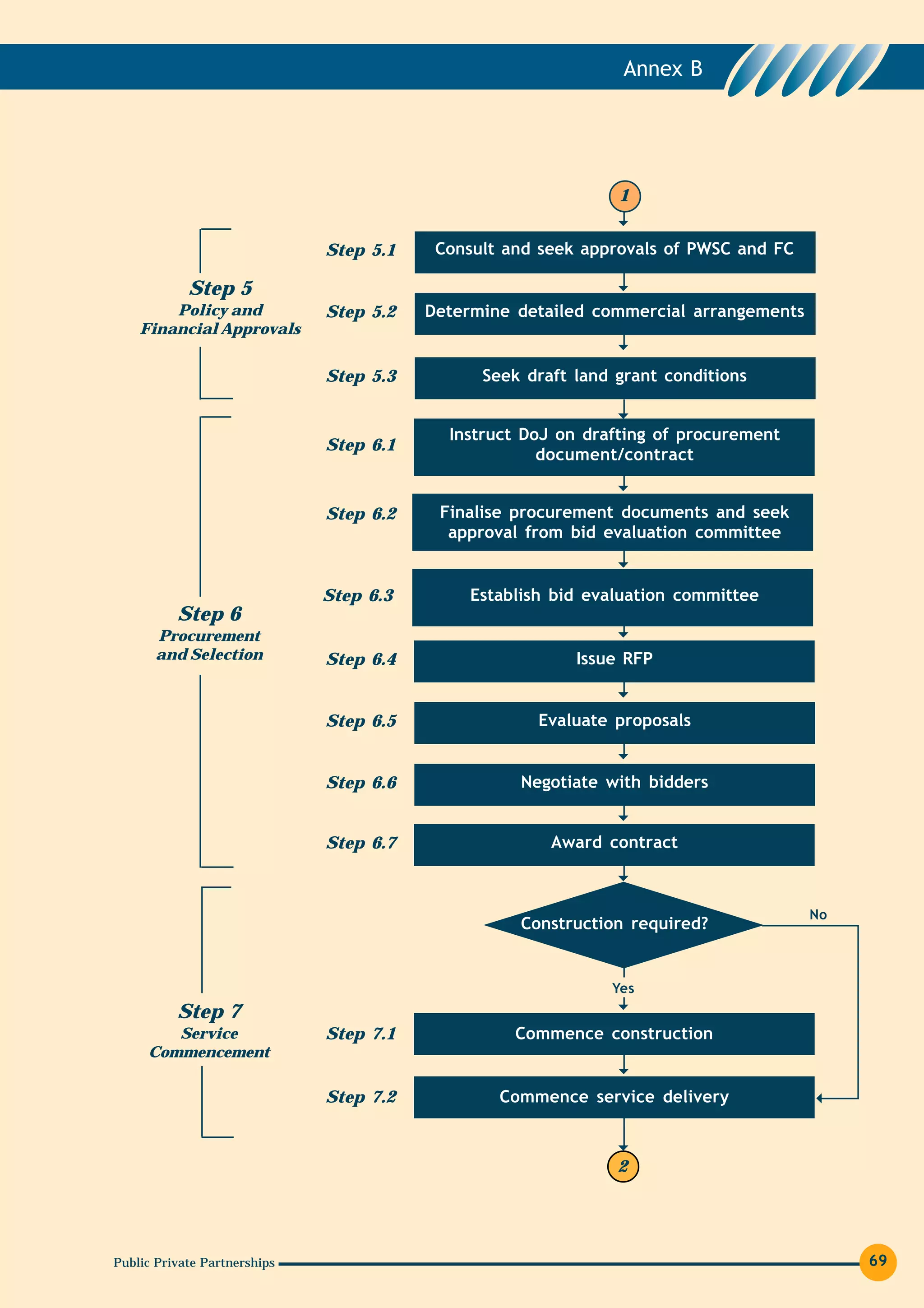
    What are the key procedural steps to take in selecting a PPP partner?
    Will the bid preparation and contract management be onerous and time-consuming?
    Who does the client department deal with in the private consortium?
    Should the client department conduct environmental, traffic or other assessments prior
    to inviting proposals?
    Do we need to conduct EoI and pre-qualification exercises?
    Can the client department select more than one successful bidder?
    What information should be given to potential bidders at the pre-qualification and/or
    bidding stages?
    Are there disadvantages in providing too much information?
    What is the Intelligent Client Team (ICT)?
    Is there a role for the works departments on the ICT?
    Why appoint outside advisors to the ICT?
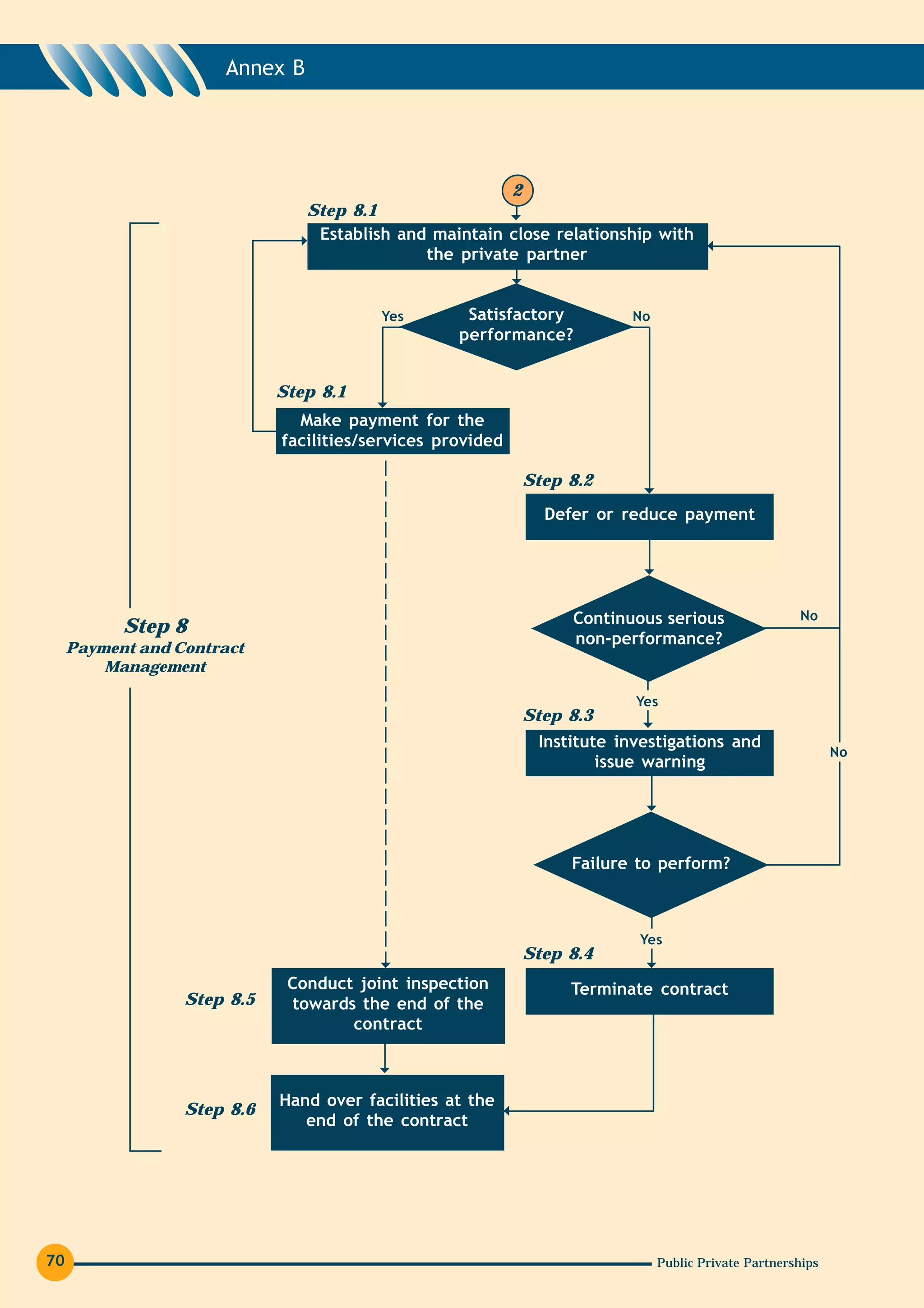
    What happens at the end of the contract?


What funding approvals are required for a PPP to operate?

After constructing a PSC, the client department should submit via its policy bureau a bid for
funds through the Resource Allocation Exercise (RAE) process. For capital costs, the bureau
will need to secure capital funding under the CWRF. For other costs required during the
operation phase, the bureau will need to confirm whether it can absorb the recurrent funding
or whether it needs topping up from the centre.

The bureau will need to invite the Policy Committee, or the Executive Council (ExCo) where
appropriate, to approve the PPP proposal, having regard to the staff, land and financial
implications. Specifically, the Policy Committee/ExCo paper will need to set out not only the
costs involved but also in consultation with the Financial Services and the Treasury Bureau
(Treasury Branch), an assessment of whether and how the proposal will affect the budgetary
expenditure guidelines, and whether revenue will be diverted to the private sector or otherwise
hypothecated.

In respect of the LegCo, the client department would normally present the project first to        A clear and
the relevant LegCo Panel. Thereafter, the department will need to seek the Public Works           identifiable
Subcommittee (PWSC) and FC’s approval for the CWRF funding required for the construction
                                                                                                  distinction
element, and FC’s approval for the remaining long-term recurrent commitments. This may
be done at the same FC meeting.                                                                   between capital
                                                                                                  and recurrent
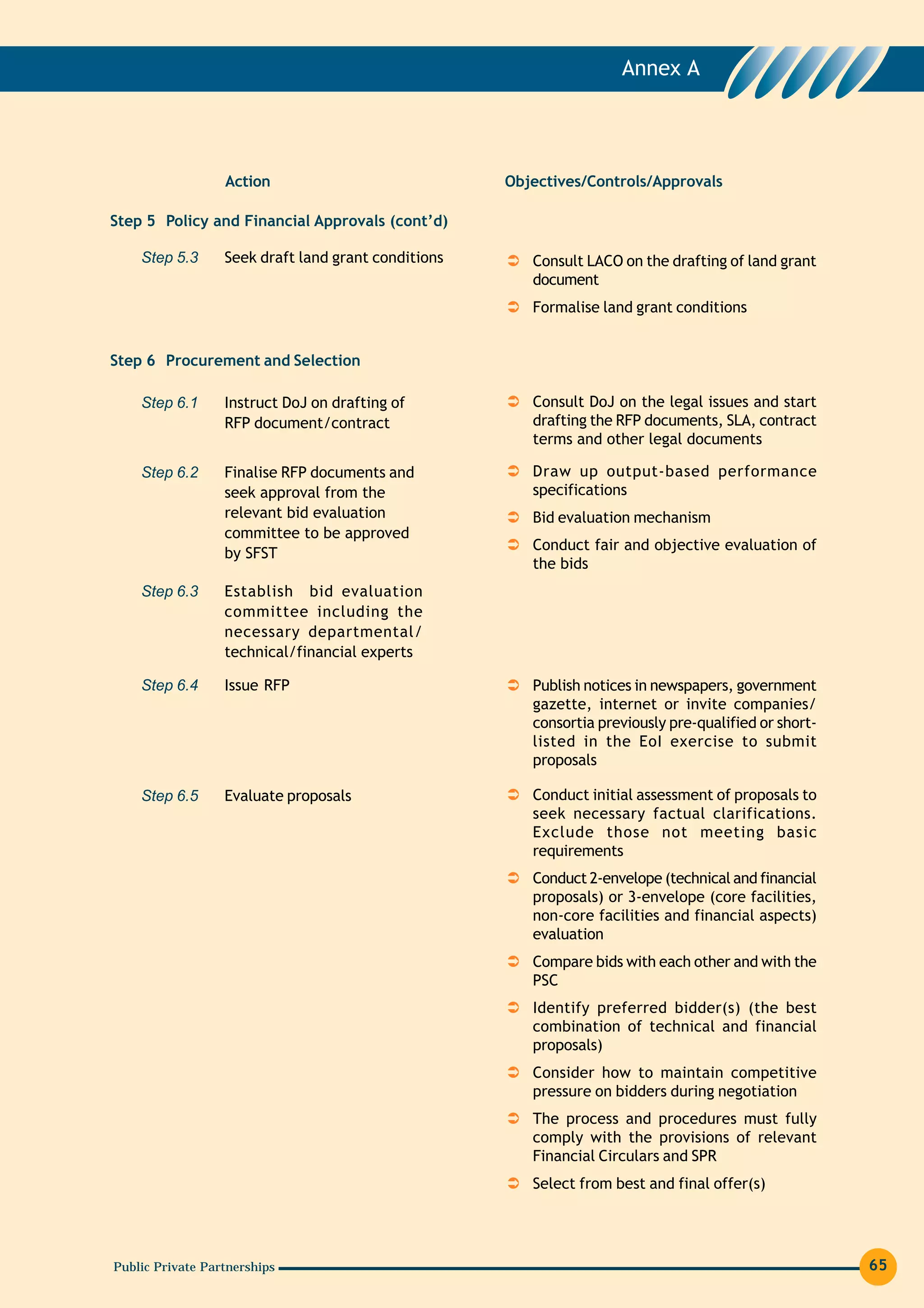
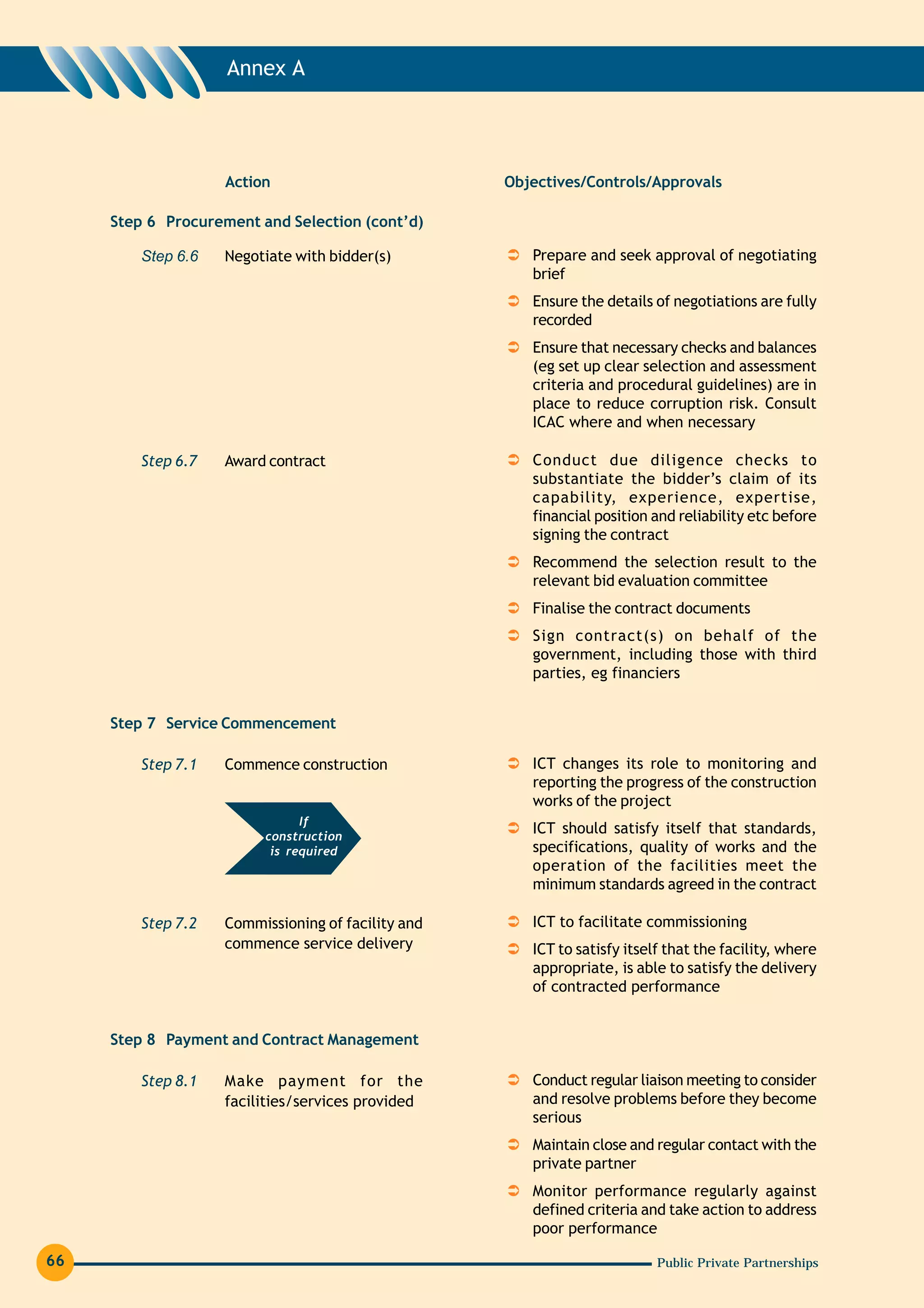
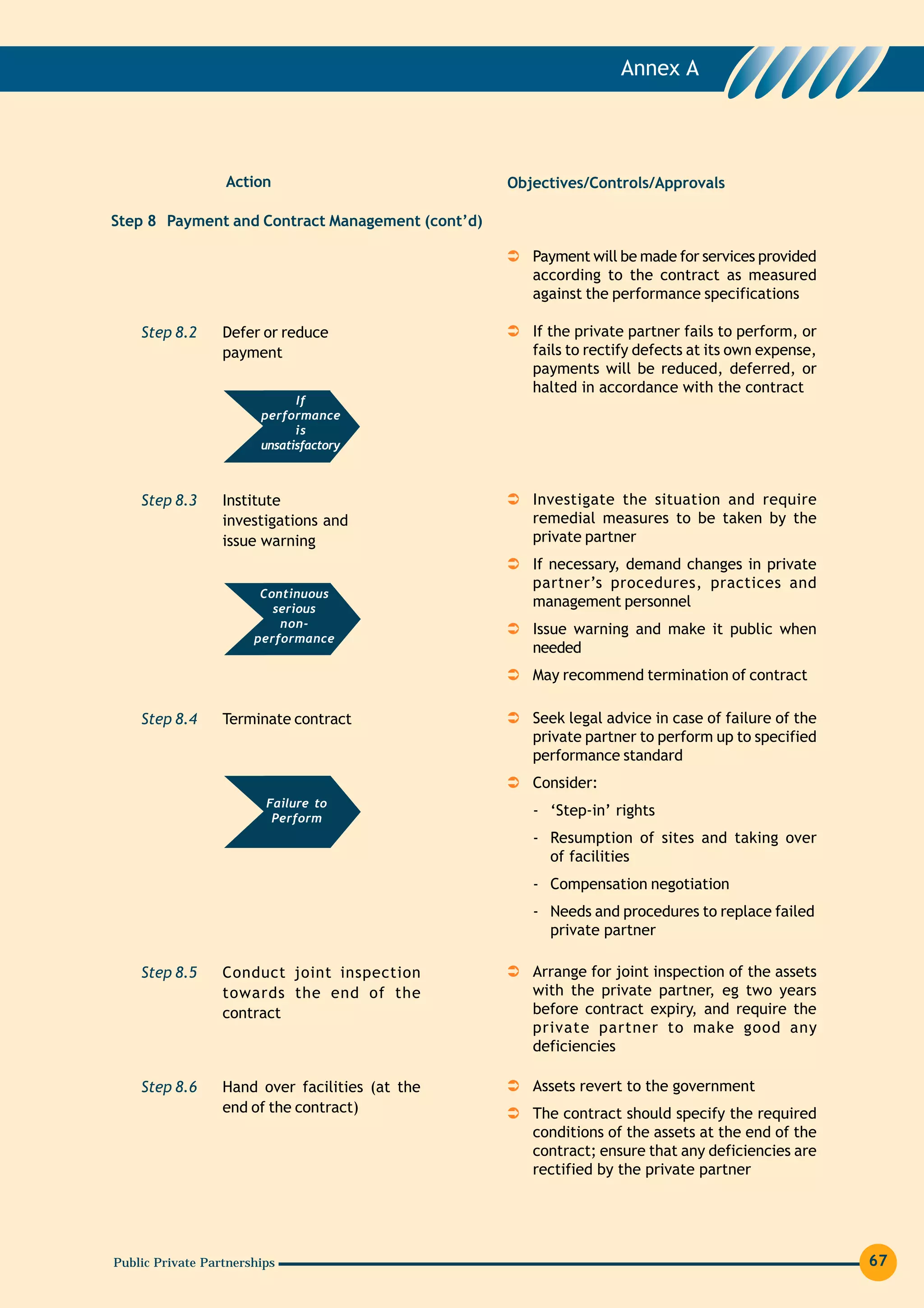
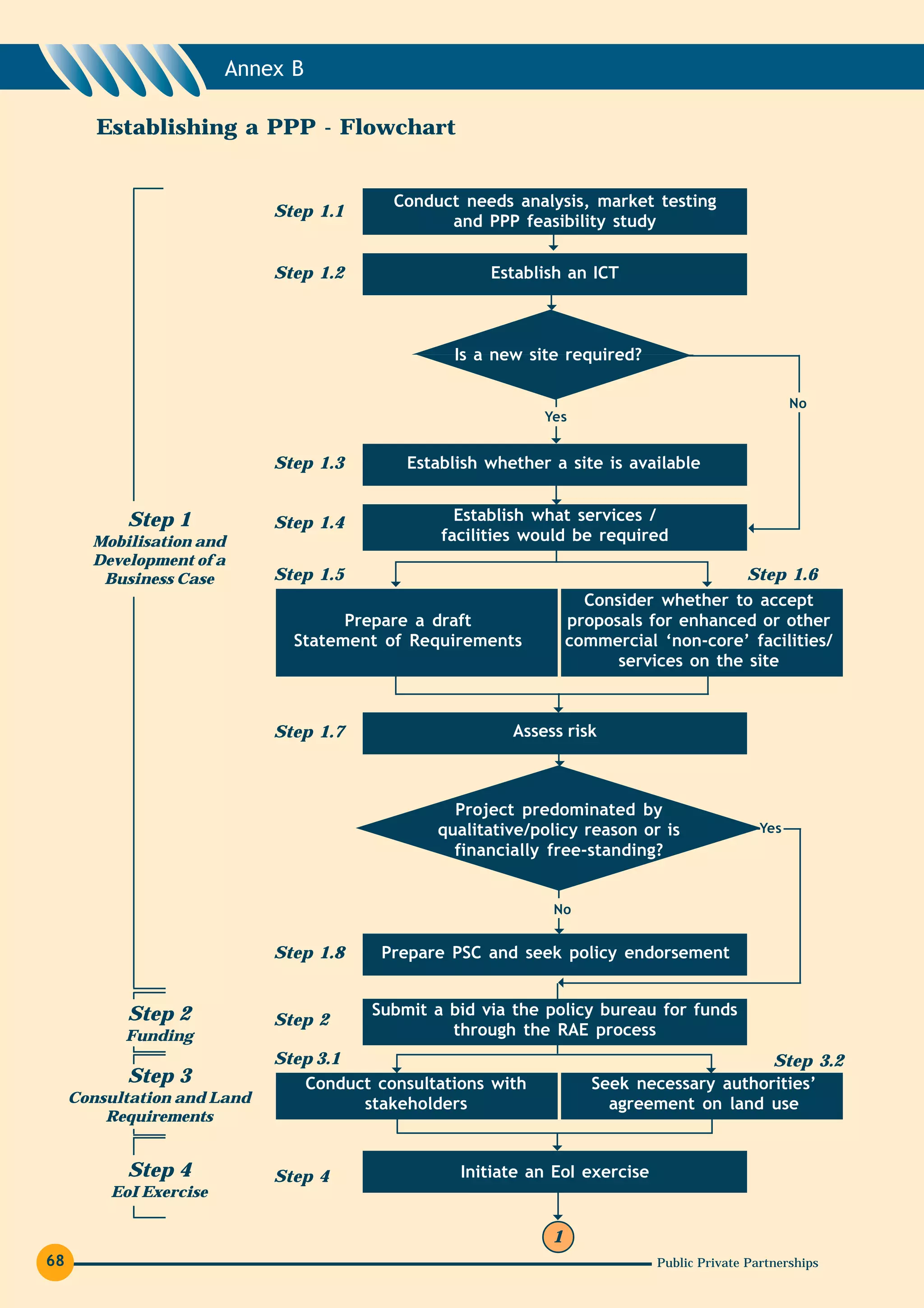
A set of procedures and a procurement flowchart are at Annexes A and B respectively.              costs is required


Public Private Partnerships                                                                                      13
5                        Procedures


The government       Who will be accountable if things go wrong?
cannot avoid
                     There are different levels of accountability in PPP projects, as there are in other procurement
accountability
                     methods. The client department is responsible for establishing the levels of service required,
                     mainly by means of output specifications; for conducting a fair and transparent contracting
                     exercise; and monitoring the performance of the selected private partner. The private
                     partner is accountable to the client department for performing up to the standards specified
                     in the contract. Ultimately, the project involves the delivery of public services and the
                     government remains accountable to the public.

Contracts should     What should be the duration of a PPP contract?
be long enough to
                     The underlying principle is that the duration selected should result in best value for money.
achieve best value
                     Subject to circumstances, it is generally most efficient if the contract length is somewhere
for money            between a half and the whole of the useful life of the main assets. Factors such as service
                     requirements of the client department and the likely terms of debt obtained by the private
                     partner will also be relevant. A shorter contract duration might require debt to be paid off
                     and equity returns to be earned over an artificially short period, putting upward pressure on
                     the payments to be made by the client department. A longer duration would allow a longer
                     debt service period.

                     In many overseas PPP projects, contract periods are shorter than the design life of the
                     asset. The rationale is to ensure that a valuable residual interest in the asset is available to
                     the government at the end of the contract. The transfer conditions in the contract need to
                     be crafted to this end. A positive aspect for the public, private and financial community in
                     this scenario is that the asset (and its residual value) could then be used for redevelopment.
                     The attraction from a financing point of view is that the shorter timeframe effectively
                     leaves a useful ‘tail’ after maturity of the senior debt to secure the development.

                     If the client department’s period of service requirement is significantly shorter than the life
                     of the main assets, the department would be advised to reconsider the whole project, not
                     just the PPP approach.

PPP contracts are    What are the key procedural steps to take in selecting a PPP partner?
long-term: getting
                     The answer depends to an extent on the nature, size and value of the PPP project. The
the right partner
                     following are the usual steps, although for relatively simple projects some may be omitted:
for a lengthy
                         Request for EoI from the private sector;
relationship is
essential                Pre-qualification of private sector companies that have submitted an EoI;
                         RFP - an invitation to pre-qualified private sector companies to make an initial proposal;
                         Conduct initial assessment of initial proposals and seek necessary factual clarifications;
                         Proposals not meeting requirements excluded;
                         Negotiate with conforming bidders to achieve improvements to bids whilst under
                         competitive pressure. Client departments should note that it is not normal government
                         practice to negotiate the land premium;
                         Select a preferred bidder(s) to enter into detailed, fully negotiated contract documents
                         (reserve the right to revert to an alternative(s) bidders if contract negotiations break
                         down);


    14                                                                                     Public Private Partnerships
Procedures                                  5


    Request best and final offer; and
    Recommend the preferred bidder to the relevant bid evaluation committee.

Will the bid preparation and contract management be onerous and                                  PPPs require a
time-consuming?                                                                                  serious and long-
                                                                                                 term commitment
Structuring, bidding for, awarding and implementing a PPP contract will be a challenging
process. Client departments will need a strong in-house team and appropriate external
advisory support - this is known as the Intelligent Client Team (ICT). As listed above, the
bidding process may involve inviting initial proposals from the private sector, evaluation of
those proposals, discussion and negotiation with individual bidders in order to obtain best
and final offers, and finally selection of the proposal offering the greatest value. Once the
facility is in operation, the client department will focus on monitoring performance against
defined criteria.


Who does the client department deal with in the private consortium?

There should be a single point of responsibility within the private partner’s consortium for
the client department to deal with. This will be a clearer and simpler position than the
conventional arrangements, where the client department has to liaise with a number of
different departments and contractors. Similarly, the client department - or its ICT - should
designate an officer as its point of contact with the PPP partner/bidder.


Should the client department conduct environmental, traffic or other
assessments prior to inviting proposals?

Client departments will need to ensure that the relevant legislation, eg the Environmental       The client
Impact Assessment Ordinance, is complied with in respect of designated projects.                 department will
                                                                                                 need sufficient
Client departments should conduct preliminary environmental, traffic and engineering
feasibility assessments, and socio-economic studies, as appropriate, before inviting proposals   information to
in order to assess the practicability, viability and justification of the desired facility or    satisfy the LegCo
service. The information derived from these will help potential bidders in the preparation       to obtain funding
of realistic proposals, as well as guiding the client department on the standards that can be
                                                                                                 approval
expected of bidders. It will also give comfort to potential bidders about the risks that they
will have to bear, and will tend to lead to lower bid prices if those risks are identified and
capable of quantification at an early stage.

The time required for any studies that the successful bidder will have to conduct should be
factored into the project timetable.


Public Private Partnerships                                                                                   15
5                         Procedures


Consider whether      Do we need to conduct EoI and pre-qualification exercises?
EoI and pre-
                      The proposal and selection processes for substantial PPP projects can be very costly, both
qualification
                      for bidders and the client department. Bidders will be sensitive to costs, especially in the
exercises should      early days of PPP, and should not be compelled to incur excessive costs as a result of
be held               unnecessary bid requirements.
separately. This
                      EoI exercises enable client departments to tap the experience and expertise of interested
might not always      parties before finalising the scope of core and non-core services. They are not usually used
be required           to restrict future bidders.

                      The number of bidders can be reduced to a manageable number through a pre-qualification
                      process. Best practice suggests that a short-list of three to four bidders is sufficient to
                      create adequate competition and cover the risk of a party withdrawing, so long as there is
                      adequate confidence in the capability and motivation of the bidders. A short-list of more
                      than four is likely to lead to some bidders losing interest, as their chance of success (20% or
                      less) may not warrant the significant investment of time and resources in preparing a bid.

                      For some projects, the EoI and pre-qualification exercises may be conducted in one go, if it
                      can save, time and effort all round. Care will need to be taken to ensure that sufficiently
                      detailed information can be obtained to achieve the purpose of the exercise(s).

                      The ICT should recommend to the Head of Department, in the light of submissions received,
                      which of those expressing an interest and/or pre-qualifying are to be invited to submit
                      proposals.


One winner is the     Can the client department select more than one successful bidder?
norm, but there
                      There may be circumstances where the client department is prepared to accept, or prefers,
are circumstances     more than one party to provide the required facilities/services. This might be to ensure
where more than       that existing competition continues; to prevent the replacement of a public monopoly by a
one bidder can be     private monopoly; or to reduce the risk of service disruption in the event of staff disputes,
                      bankruptcy etc. In such circumstances, the client department should make clear in the RFP
selected
                      that it is prepared to consider engaging with more than one partner; explain what those
                      circumstances are; and request bidders to put in separate proposals for these different
                      circumstances.

The client            The successful bidders would have well-defined service areas so that they were not required
department            to compete directly with each other after the competitive bidding process. For example,
                      the Hong Kong Hospital Authority is considering replacing its in-house catering with PPP
should allow itself
                      arrangements. The Authority divides itself administratively into five geographical ‘clusters’
as much flexibility   of hospitals. For its PPP caterers, it may limit any one partner to serving no more than
as possible in the    three clusters. Similarly, the Marine Department is exploring the feasibility of using the PPP
RFP documents         approach for clearing floating refuse in Hong Kong waters. One issue to resolve is whether
                      to use one PPP contractor for all of Hong Kong waters, or whether to divide the work
                      geographically into two or more PPP contracts.


    16                                                                                     Public Private Partnerships
Procedures                                  5


What information should be given to potential bidders at the                                     The more early,
pre-qualification and/or bidding stages?                                                         accurate and
                                                                                                 pertinent the
The objective must be to give potential partners as much accurate and pertinent information
about the client department’s intentions as early as possible. This is to enable potential       provision of
tenderers to put together coherent, sound and innovative proposals, in the full knowledge        information the
of the requirements and risks involved, and reduce the likelihood of misunderstandings,          better
withdrawals of bids etc.

The information to be given to potential bidders may include:
    A preliminary timeframe for delivery of the service/facility and whether early completion/
    delivery is desired or not;
    The land status (ie ownership) of the relevant site(s);
    The zoning on the statutory town plan(s);
    Information on whether a planning application under the Town Planning Ordinance or
    rezoning of the site(s) is required;
    The environmental, traffic or other assessments already done, or to be conducted by
    successful bidders;
    Carefully designed draft output-focused specifications;
    A draft Service Level Agreement (SLA);
    A draft contract (but see discussion below);
    The proposed performance indicators;
    The client department’s proposed payment mechanism(s) (including rewards and
    deductions);
    An opportunity for bidders to comment/suggest amendments to the payment mechanism;
    The proposed step-in and termination provisions;
    Any avenues of redress/appeal on the part of the private partner;
    A matrix showing a proposed risk allocation;
    The preliminary/final estimate of the PSC;
    Advice on affordability constraints;
    The bid evaluation criteria;
    A requirement to demonstrate a commitment to ethical practices;
    Whether bidders may be allowed to provide non-core services;
    Whether a lump sum premium or other income/revenue is expected by the government;
    Where a land lease is involved, the Tender Notice and the Conditions of Sale;
    The insurance cover that the private partner will be required to obtain;
    Whether bidders are required/encouraged to employ serving civil servants; and
    Whether more than one successful bidder is envisaged or desired.

Clearly, the information to be provided at the pre-qualification stage may be less precise
and comprehensive than that provided at the proposal stage.


Public Private Partnerships                                                                                     17
5                        Procedures


                     Information provided by the department must be carefully scrutinised prior to its issue.
                     Client departments should take steps to protect themselves from liability for negligence by
                     using appropriate disclaimer clauses.


In providing         Are there disadvantages in providing too much information?
information, care
                     There may be drawbacks in providing a draft SLA and/or a detailed draft contract at the pre-
must be taken to     qualification and/or the initial competitive bidding stages. If we inform bidders of the
conform to           detailed contractual terms too early, the scope for negotiating will be limited, and the
WTOGPA               government may be disadvantaged. We may not get the best out of what is intended to be
                     an innovative process.
requirements
where applicable     A bidding exercise must be conducted in accordance with the principle of non-discrimination.
                     If a bidder does not comply with an essential requirement set out in the documents the
                     government cannot negotiate with a non-conforming bidder with a view to modifying or
                     waiving essential requirements. Otherwise, it would be unfair to other bidders and potential
                     bidders.

                     Depending on the nature of the particular PPP in question, the rules of the WTOGPA do not
                     apply to a concession or franchise. However, it is still necessary for the government to act
                     fairly even in the situation where the rules of the WTOGPA do not apply. Accordingly, the
                     government is not free to modify or waive the essential requirements or contractual terms
                     after the closing of the tender exercise without regard to the principle of non-discrimination.
                     For that reason the minimum mandatory requirements specified should be limited to those
                     that are truly essential.

PPP projects are     What is the Intelligent Client Team (ICT)?
overseen by the
                     This is similar to the ‘Project Steering Committee’ used in the management of multi-
ICT on behalf of
                     disciplinary projects by works departments. The role of the ICT would be to oversee the
the client           progress of the project from start to finish. The ICT should contain the necessary authority,
department           experience and expertise appropriate to its needs. In addition to the client department’s
                     own staff, it might include, for example, architects, engineers with various specialisations,
                     lawyers, and financial advisors; it may contain individuals from both within and outside the
                     government; and its composition may change according to need at different stages of the
                     project.

                     Where advisors to the ICT are employed from outside of the government, the client department
                     will need to ensure against any conflict of interest arising. They should contractually prohibit
                     advisors working on the same project for private sector bidders where this might risk the
                     tailoring of advice or the use of inside information.


Use private sector   Is there a role for the works departments on the ICT?
to fill skill and
                     Heads of Department should generally invite staff from works departments to join the ICT,
experience gaps
                     where they can act as technical advisors and assist in drawing up the output specifications,
                     setting performance standards and advising on work practices. Works departments may
                     also assist in a regulatory and monitoring role throughout the contract period.


    18                                                                                     Public Private Partnerships
Procedures                                  5


Why appoint outside advisors to the ICT?

The public sector has limited experience and expertise in delivering PPP projects. External
advisors can often offer a wider range of skills and commercial perspectives and experience
than is available in-house, eg writing output specifications; negotiating complex
infrastructure contracts that underpin PPP transactions; and understanding the financial
products that investment bankers promote to underwrite such transactions. Appointing the
right consultants and making sensible use of them will help to address this skills deficit.
Heads of Department should seek to transfer such skills to in-house staff wherever practicable,
for example, by teaming up in-house staff with outside consultants. The appointment of
external advisors should follow appropriate competitive procedures.


What happens at the end of the contract?                                                          Ensure that
                                                                                                  transitional
The assets will normally revert to the government at zero value or market rate. The contract
                                                                                                  arrangements are
should specify the required condition of the assets at the end of the contract. There should
be arrangements for joint inspection of the assets, say, two years before the end of the          included in the
contract, with the private partner being required to make good any deficiencies. The client       contract
department will also be entitled to require part of the payments in the final years of the
contract to be put into a sinking fund in an escrow account to protect against the possibility
of non-performance of the rectification works.

If a land lease is involved, the usual arrangement is that the grantee will be required to
maintain all the structures and buildings on site in good and substantial repair condition
with the same to be handed over to the government upon expiration of the lease term. If it
is considered necessary that a vacant site must be returned to the government, then specific
provision will have to be made in the contract to oblige the private partner to demolish the
facility before returning the site to the government.

Overseas, the assets are sometimes left with the private sector although this may not be
appropriate in Hong Kong.


Public Private Partnerships                                                                                      19
6                      Maximising Benefits and Managing Risks


                    Chapter 6                Maximising Benefits and Managing Risks

                        What are the benefits of output/outcome performance specifications?
                        What problems may arise in the course of a PPP?
                        What are ‘force majeure’, ‘compensation events’ and ‘relief events’?
                        The PPP approach addresses the management of risks. What are risks in this context?
                        Which party should carry the risks associated with the project?
                        Why transfer risk?
                        Can all the risks be passed to the private partner?
                        How can a monetary value be placed on risk?
                        How can a client department be protected from project transition risk, particularly
                        arising from late completion?
                        How can a client department minimise the network and interface risks regarding technical
                        equipment?
                        Can insurance be used to manage risk?
                        What is an ‘Owner Controlled Insurance Programme (OCIP)’?
                        What risks cannot be transferred?


Use output/         What are the benefits of output/outcome performance specifications?
outcome-based
                    Output/outcome-based performance specifications should be used in all types of private
performance         sector involvement projects. They allow the private sector as much flexibility as possible
specifications      to produce innovative, cost-effective designs of services and infrastructure, on a whole-
whenever possible   life cost basis, taking advantage of new and labour-saving technologies and techniques.
                    For example, in a community facility project, instead of input specifications requiring the
                    installation of permanent seating for 1000 people, the output specifications might require
                    that seating for 1000 people shall be provided when required. This allows the use of
                    temporary seating. At other times the space could be utilised for other purposes.
                    Nonetheless, the means of escape and fire services requirements for the 1000 people would
                    have to be permanent features.

                    Despite the desire to maximise flexibility, it is difficult to achieve 100% use of output
                    specifications and it will usually be necessary to use some input-based specifications or
                    even an outline design for reference or to ensure a specific need is met, where the facility
                    interfaces with other facilities or there is an interaction with surroundings.

                    Consideration should be given to the need for contracts to contain defined inputs so as to
                    protect the government’s interests in the event of disputes. For example, an ‘output’ to
                    provide an Olympic size swimming pool could contain the usual construction schedules and
                    contracts requiring a certain aggregate mix, sand quality and prohibited use of open bags
                    etc. If cracks appear later in the pool walls there are likely to be arguments advanced by the
                    private sector on relief events (and possibly even force majeure and compensation events).
                    The government will wish to point to and rely upon a breach of the ‘input’ requirements as
                    to aggregate mix, sand quality and use of open bags etc. Once the cause of breach has
                    been established to the government’s satisfaction, government may wish to take action
                    against either the SPV or the contractor, or both.


    20                                                                                   Public Private Partnerships
Maximising Benefits and Managing Risks                                                  6


What problems may arise in the course of a PPP?                                                     Well prepared and
                                                                                                    drafted PPP
Hong Kong is fortunate in being able to learn from the decade or so of recent PPP experience
                                                                                                    contracts and
elsewhere in order to minimise the likelihood of suffering some potential problems.
                                                                                                    performance
Nonetheless, any project that is not well prepared and implemented will have a higher               specifications may
chance of things going wrong. Experience demonstrates that for both conventional and PPP
                                                                                                    avoid many
procurements poor drafting of the contract/performance requirements and/or poor contract
monitoring can lead to problems downstream. For PPPs these may include:                             potential problems

    Loss of control;
    Increased costs;
    Inadequate accountability;
    Unreliable levels of service;
    Lack of competition;
    Bottom line considerations assuming disproportionate importance;
    Business culture co-existing uncomfortably with culture of service;
    Lack of flexibility, especially over the longer term;
    Disruption of service, and costs incurred by the government when step-in rights
    exercised;
    Inappropriate allocation of risks between the government and the private sector;
    The government being ‘locked-in’ for the life of the project with need to compensate
    the private partner if it wants to exercise a ‘break clause’;
    The private sector escaping liability through liquidation and use of limited liability
    companies;
    Bias in the contracting process;
    Large buy-out payments by the government to replace a poor performing operator;
    Higher costs due to limited competition if suitably experienced/qualified PPP contractors
    are not available;
    Greater difficulty and higher cost in removing an unsatisfactory contractor;
    Higher financing costs; and
    Greater secrecy and lack of transparency resulting in benefits not being shared with the
    government.

What are ‘force majeure’, ‘compensation events’ and ‘relief events’?

The government can minimise the likelihood of repeating the above mistakes by reference
to what are known as force majeure, compensation events and relief events. Events of
force majeure should be very narrowly defined (as they usually are in these cases and not
co-extensively with uninsurable risks). Compensation events apply to variations required
by the government and discriminatory changes in the law. Relief events need to be extremely
narrowly drafted and qualified by requiring the private sector to have taken all possible
steps to have prevented or mitigated the accident (such as fire, loss or damage, failure by
statutory undertakers, utilities companies etc). Similarly, general strikes only of the workforce
(not site or project specific) should qualify as a relief event.


Public Private Partnerships                                                                                       21
6                        Maximising Benefits and Managing Risks


Risks exist in all   The PPP approach addresses the management of risks. What are risks
projects. The key    in this context?
to success is
                     Risks relate to the exposure to a peril, the occurrence of events and their consequences
managing them        that differ, either positively or negatively, from those that were assumed (or not, as the
optimally            case may be) in establishing a project. Risks are often categorised as strategic, financial,
                     operational and hazard risks. Exposure to risks arises in all projects, whatever the approach.
                     PPPs provide opportunities for the better management of such risks by allocating them
                     appropriately between the public and the private sectors. It is important that the allocation
                     of risks is defined in a clear, unambiguous contract that sets out the risks, who takes them
                     and what are the consequences of and actions to be taken when the risk event actually
                     occurs.


The party best       Which party should carry the risks associated with the project?
able to manage
                     The golden rule is that the party best able to manage each risk should carry that risk. In
each risk should
                     most projects this will mean that the client department retains some risks, the private
carry that risk      partner carries other risks, and some risks are shared. Generally the client department
                     would be expected to bear any risk arising from variations required by the government, or
                     discriminatory or specific changes in the law. The private partner would be expected to
                     carry all other risks including general business risks.


                     Why transfer risk?

                     The main benefit is that the private partner is given a strong incentive to supply cost-
                     effective and higher quality services on time. Reward should always be commensurate with
                     risk. Private partners only start to receive their payments when the services start to be
                     delivered, and continued payment depends on meeting agreed performance criteria.

Risks should be      Can all the risks be passed to the private partner?
properly
                     Appropriate allocation of risk between the public and private sectors is a key requirement
allocated
                     for the achievement of value for money in PPP projects. Experience elsewhere indicates
                     that risk transfer should be optimal, not maximum. If the government seeks to impose
                     excessive risk transfer to the private sector this will result in the private sector charging an
                     excessively high premium; simply refusing to accept the risk altogether (ie they will not put
                     in a bid); or failing to meet contract obligations.

Private sector       How can a monetary value be placed on risk?
expertise is
                     Risk is a possibility, not a certainty, which makes it difficult to clearly identify and estimate
available to
                     its costs. Conventionally, government departments have not identified or managed risks in
evaluate risks       a sophisticated way. In contrast, the private sector has long included risk considerations
                     and costings in project work.

                     The appropriate method for quantifying risks will depend on the availability of relevant
                     information. The best approach is to use empirical evidence. Analytical procedures based
                     on expertise and experience may also be used. When neither is available, common sense
                     estimates may be used. Some risks will be difficult to quantify. They should not, however,
                     be ignored, but reconsidered and refined over time.


    22                                                                                      Public Private Partnerships
Maximising Benefits and Managing Risks                                  6


The general methodological principles are:
    Assess the likelihood of a risk crystallising;
    Assess the cost if it does occur;
    Assess the range of cost impacts (in the form of a frequency distribution, if possible);
    and
    Assess the expected value of the risk.

External advisors can advise departments on financial evaluation of risk.


How can a client department be protected from project transition risks,
particularly arising from late completion?

Where a PPP contract involves transition from an existing facility or service provider, whether
public or private, the transition is likely to be best managed by contracting with a single
party with responsibility for the migration as well as the design, construction and operation.
Any liquidated damages for late completion may be based upon the ‘throw away’ costs of
the client department in preparing itself for transition, eg labour hire, removal costs incurred
etc. In addition, the liquidated damages should compensate for the government being
delayed in providing a seamless service, including claims against the government.

Another option is to transfer responsibility for the service elements well in advance of the
move so that relationships can be developed and the service operation can be introduced
and bedded down.


How can a client department minimise the network and interface risks
regarding technical equipment?

There will be several sets of interface risks to be managed: between existing and new
equipment; and between the equipment and the physical structure and systems in the new
facility. The approach likely to work best is for the department to appoint a single private
party - the PPP consortium - to manage these risks. Otherwise the client department itself
will, by default, have to manage them.

The parties should identify and assess the special interface risks that may arise throughout
the project and - irrespective of the underlying risk allocation position - acknowledge and
agree that the provision of all services needs to be fully integrated. An effective management
communications strategy should be implemented in respect of day-to-day delivery of the
two sets of services.


Can insurance be used to manage risk?

Generally, risk is best managed by a party able to influence relevant events. However, there
may be occasions where neither the government nor the private partner is comfortable
carrying a particular risk. In these circumstances, insuring against the risk can be considered.
Insurance also helps cost a risk.

The private partner can generally be expected to insure in accordance with good industry
practice. The client department will generally require that the private partner takes out
adequate insurance to cover all types of insurable events which are considered to be ‘usual’


Public Private Partnerships                                                                        23
6            Maximising Benefits and Managing Risks


         in accordance with standard commercial practice and that the government is a co-insured
         for these claims. This is primarily because the client department will want to be satisfied
         that continuity of service supply is maintained. These required insurances usually include
         third-party liability claims, construction all risks, material damage claims and employer’s
         liability insurance.

         The client department should seek professional insurance advice on what requirements
         should be imposed on the private partner at an early stage in the procurement process and
         during negotiations as bidders will reflect the cost of insurance in their bids. Where the
         project asset is destroyed and/or provision of the contracted services ceases during the
         contract term, owing to an insurable event, the private party must reinstate the project
         facility and/or the provision of the contracted services (unless otherwise agreed by the
         government). Any insurance proceeds must be used for this purpose.

         The contract should also address the issue of a risk becoming uninsurable. As a result of
         increasing risk of damage through terrorism after 11 September 2001, insurance companies
         are demanding considerably higher premiums or ceasing to provide such coverage totally.


         What is an ‘Owner Controlled Insurance Programme (OCIP)’?

         This is where the private partner takes out a single insurance contract covering all of the
         risks that need to be insured for one or more major construction projects. The adoption of
         an OCIP is advantageous to major construction projects which are being implemented in
         about the same time span, as different contracts relating to the projects can be insured
         under tailor-made insurance packages resulting in economies of scale. Apart from that, the
         insurance coverage can be tailor-made to suit individual project needs and avoid overlaps,
         gaps or conflicts between the terms of individual insurance policies.

         To implement an OCIP the owner and contractor may need to engage a consultant insurance
                               ,
         broker to formulate strategy; design the insurance proposal; incorporate its requirements
         into the relevant construction contract documents; and advise on the selection of insurer
         and the placement of insurance. During the construction phase of the projects, the consultant
         broker will advise on all insurance matters.

         An OCIP was used successfully in the Airport Core Programme projects and recently in Kowloon-
         Canton Railway Corporation’s and MTR Corporation Limited’s major railway projects.
         Highways Department is using OCIPs for major projects including Route 9, Route 10 and the
         Deep Bay Link.

         With the approval of the Secretary for Financial Services and the Treasury (SFST), an insurance
         broker may be engaged to advise the government on the placement of necessary insurances
         for the projects to suit the programme of tendering. If the client department wants the
         private sector to follow this practice, it should be encouraged to engage an insurance broker
         at an early stage in the procurement process.


    24                                                                         Public Private Partnerships
Maximising Benefits and Managing Risks                                              6


What risks cannot be transferred?                                                               Political risks
                                                                                                cannot be
Political risks cannot be transferred. This does not mean that you cannot transfer the
delivery of services with a high political risk to the private sector. It does, however, mean   transferred
that if high risk, high visibility services are being considered for delivery using the PPP
approach, particular attention must be given to:
    Maximising transparency so as to maintain public confidence, eg evidence of risk
    assessment, control and mitigation;
    Risk management plans;
    Contingency plans;
    A shared government/private approach to testing, monitoring etc;
    Provision for periodic re-assessment of risks; and
    Opportunities for public participation in the monitoring/review processes.


Public Private Partnerships                                                                                   25
7                       Financial Issues


                     Chapter 7                Financial Issues

                         Where do the government funds come from in the case of a PPP project?
                         How will a PPP be paid for?
                         Should the client department impose a ‘performance bond’ on the private partner in
                         the contract?
                         Should the government require additional security?
                         How accurate are claims that PPPs provide good value for money?
                         Since private sector borrowing costs are higher than public sector borrowing, how can
                         PPPs be more cost-effective?
                         What is the benefit of using third-party private funding?
                         Will the PPP approach commit the government to long-term recurrent expenditure?
                         Can private partners retain revenue received from the public using the facility/service?
                         Are there any standard mechanisms for profit sharing?


Clearly identify     Where do the government funds come from in the case of a PPP project?
and separate
                     For both a PPP and the conventional approach, the capital cost of a public works project is
capital and
                     in effect met from the CWRF, and the recurrent costs are met from the client department’s
recurrent costs      head of expenditure.

                     The client department, via its policy bureau, will need to secure funding via the RAE process.
                     This will normally take place after the initial PSC (see page 31) has been constructed, and
                     before any public consultation or EoI takes place. The capital funding requirement needs to
                     be secured from the CWRF. The relevant bureau will need to confirm whether any other
                     costs required for the operational phase of the project can be absorbed by the bureau or
                     needs topping up from the centre.

                     The capital funding drawn from the CWRF may be paid out in regular instalments over the
                     life of the contract (as part of the unified payment) instead of one or more lump sums at
                     the construction phase. It will be necessary to ensure that the capital element of payments
                     is clearly identified so that only the construction related element is paid out of the CWRF.
                     The CWRF must not be used to fund services of a recurrent nature.

                     For those PPP projects that create long-term financial commitments for the government,
                     the proposing bureaux would need to secure approval from the PWSC and the FC for the
                     capital funding commitment, and FC’s approval for the remaining long-term recurrent
                     commitments.

Consider carefully   In the past, the Treasury Branch has normally advised departments to seek FC’s funding
when to seek PWSC    approval before inviting bids, since the government would not wish to pre-empt LegCo’s
                     decisions. Recently, however, in the interests of time and in an effort to secure the best
and FC approval
                     estimates before approaching the FC, departments have increasingly been allowed to invite
                     proposals prior to funding being secured. There are pros and cons to both approaches.
                     Potential bidders want assurances that the government is committed to a PPP project before
                     embarking on an expensive and time-consuming bidding and negotiation process. Equally,
                     however, the FC will wish to know exactly what it is approving before agreeing to pay the


    26                                                                                    Public Private Partnerships
Financial Issues                                    7


bill, remembering that different bidders could put in considerably different ideas for both
core and non-core services, and that negotiations with the preferred bidder could result in
more changes to the details of the project. Client departments and proposing bureaux will
have to take a view on a case-by-case basis which approach would be most appropriate.


How will a PPP be paid for?                                                                         Payments should
                                                                                                    be closely linked
There are a number of different payment options, or combinations of options, depending
on the nature of the specific project. The payment mechanism will normally be proposed by           to performance
the government, although it is common to give bidders an opportunity to comment on the
mechanism, and there should be a facility for bidders to do so in the RFP documents.
Payment will normally consist of a single regular amount (eg monthly or annual) sum
comprising one or more of the following components:
    Amortised capital costs. In the conventional approach, the government usually pays
    contractors for the capital works (eg construction) at pre-arranged stages during the
    course of construction. Under a PPP the client department does not pay anything to the
                                       ,
    private partner until the works are certified as being completed and the services
    delivered; at this time regular payments will commence that include the amortised
    capital cost.
    Service delivery. The contract will specify that the private partner delivers a range of
    services, and these will be measured by an agreed set of criteria (eg opening hours,
    standards of cleanliness, lighting levels, customer service standards, employment of
    appropriately qualified staff).
    Headcount/shadow toll/throughput. The monthly payment could reflect the number of
    users of the facility, eg the number of swimmers using a swimming pool, or the vehicles
    using a bridge/tunnel;
    Revenues received. The private partner could be paid a percentage or multiple of fees
    received from users. A multiple could apply where the government intends to subsidise
    the service in excess of half the cost;
    Retention of other revenues. The private partner may, in some circumstances, be                 Examples of
    allowed/encouraged to perform other fee-generating services in the facility. This income        ‘profit-rents’ and
    might cross-subsidise the services that the government requires on the site. Alternatively,
    the client department might demand a revenue/profit sharing/turnover sharing                    ‘turnover-rents’
    arrangement, or might require a lump sum premium.                                               exist

The client department will be entitled to defer, reduce or withhold specified amounts of the
payment if the private partner fails to perform as required, eg the roof leaks, or specified
services are not performed as required. These must reflect genuine estimates of loss/
costs/damages incurred by the client department in rectifying the deficiency. This gives
the private partner a powerful incentive to design and construct the facility to a high standard,
to undertake repairs/maintenance quickly if problems arise, and to ensure that specified
services are delivered. The deferral, reduction or withdrawal of payments should be
proportionate to the performance failure. In some cases, client departments may wish to
provide for increased payments, or bonuses, for exceeding certain targets.

Different payment bases place differing degrees of risk upon the private partner. These
different levels of revenue risk will be reflected in the bid prices received or, indeed,
ultimately whether any bids are submitted.


Public Private Partnerships                                                                                       27
7                        Financial Issues


                     Should the client department impose a ‘performance bond’ on the
                     private partner in the contract?

                     The private partner will normally use a Special Purpose Vehicle (SPV) to front a consortium
                     or joint venture of private sector participants and their respective shareholders and finance
                     suppliers. The government will require copper-bottomed assurances that the SPV - a ‘man
                     of straw’ in view of its extremely modest share capital - has and maintains parent company
                     guarantees, bank performance bonds and suitable backing for liquidated damages. Insurance
                     will also be required as mentioned earlier.


                     Should the government require additional security?

                     In some PPP projects, the government will be contracting with a private partner which is a
                     lowly capitalised SPV with its service delivery reliant on its consortium members and whose
                     main asset will be its interest under the project documents. The government may therefore
                     require comfort that the private partner and its subcontractors will be able to meet their
                     contractual obligations. The government may also wish to ensure that continuity of service
                     is maintained even if the private partner becomes insolvent. It may be prudent in some
                     circumstances to require that the private partner provides additional security, such as a
                     fixed and floating charge over its assets. Such security will generally rank behind the
                     security held by the financiers. The first ranking priority, however, may be negotiated for
                     specific amounts owing to the government, eg costs incurred by the government in the
                     exercise of ‘step-in’ rights. Sponsor guarantees may also be desirable in some instances.


                     How accurate are claims that PPPs provide good value for money?

                     There is a substantial and growing pool of data - mainly derived from reviews carried out by
                     independent third parties, including government auditors - on which to base assessments
                     of the value for money achieved by optimal risk allocation and other efficiency measures.
                     One review in the United Kingdom (UK) found that on average savings of 17% were achieved
                     over a range of sectors compared to the public sector alternatives. The Institute of Public
                     Policy report published in 2002, however, indicated savings in the range of just 2 to 3%.
                     Nonetheless, this and other studies concluded that value for money was being realised in a
                     wider range of ways. For instance, the Institute of Public Policy report ‘Building Better
                     Partnerships’ concluded that high quality facilities were being delivered on time and on
                     budget; innovation in design was apparent; working environments had improved; and risk
                     transfer to the private sector had been real.

Overseas,            According to the UK National Audit Office 2001, most public bodies in the UK (81%) believe
independent third-   they are achieving satisfactory or better value for money. Over 70% of authorities and
                     contractors view their relationship as being good or very good, with only 4% of contractors
party assessments
                     feeling their relationship with authorities is poor. For departments, the initial test will be
report that PPPs     a comparison between the bids actually received for the project in due course and the PSC.
are achieving        Beyond that, client departments need to ensure that the value for money anticipated at the
value for money      time of contract letting is delivered in practice. To do so requires careful project
                     management and close attention to managing the relationship with contractors during the
                     life of the project.


    28                                                                                    Public Private Partnerships
Financial Issues                                  7


Since private sector borrowing costs are higher than public sector                               Private sector
borrowing, how can PPPs be more cost-effective?                                                  efficiencies
                                                                                                 outweigh the
Since most governments borrow at cheaper rates than the private sector, it seems curious
that projects involving the sale of services to the private sector are viable as PPP projects.   higher costs of
However, when financing a project, it is the total risks of the project that determine the       borrowing
true cost of finance. The difference between the private and public sectors is that private
sector capital markets explicitly price the risk of a project into the sources of finances. In
the public sector, the risk of cost overruns, time delays or performance failures are not
priced into the government borrowing rate. It is now becoming commonly accepted that the
government must put a value on the transfer of risks to the private sector.

The cost difference between private and public sector borrowing is relatively small; and the
cost of capital accounts on average for only 20-25% of the full costs of a PPP project. PPPs
can represent good value for money to the taxpayer as the efficiencies and productivity that
the private sector can achieve over the life of the project more than compensate for any
higher cost of borrowing.


What is the benefit of using third-party private funding?                                        Third-party
                                                                                                 scrutiny is
There is evidence from the UK that projects using third-party funding, ie not equity injected
by the consortium members, have a higher degree of success. This is put down to the              valuable
intense scrutiny of projects by the third-party financiers.

On the other hand, client departments should be aware that the infrastructure and assets
of, and revenue from, the project will be subject to a charge in favour of the financier.


Will the PPP approach commit the government to long-term recurrent
expenditure?

Most government assets and infrastructure projects effectively commit the government to
a ‘lifetime’ of expenditure. Governments tend to focus on the cost of construction with
only limited regard to lifetime expenditure implications. An important benefit of the PPP
approach is that it forces client departments to adopt a strategic approach to procurement.
Being long-term, PPP contracts encourage departments to carefully consider their future
plans and make an informed decision before making contractual commitments.

Certain elements of operational services may not be procured for the full contract term, eg
mid-life costs associated with the replacement of key assets may be evaluated differently
depending on the depreciation methods used and the timing; locking in insurance costs for
30 years is currently problematical.


Public Private Partnerships                                                                                     29
7                           Financial Issues


Avoid                   Can private partners retain revenue received from the public using
hypothecation,          the facility/service?
unless suitable
                        The Public Finance Ordinance (Cap 2) provides that any money raised or received for the
legislation exists or   government shall form part of the General Revenue, unless provided for under other
is planned              legislation. There should be no hypothecation of government revenue and no ‘netting off’
                        payments unless specifically provided for in legislation. The question of hypothecation can
                        be avoided if the payment to the private partner is calculated according to a formula based
                        on the amount of revenue rather than the revenue itself. For example, part of the
                        government’s payment to the private sector may be a percentage, or a multiple, of the
                        revenues collected. A multiple is most likely to apply where a fee for a service is subsidised
                        by the government by 50% or more.

                        Monies received by private partners in their capacity as a principal, ie not an agent for the
                        government, are not ‘public monies’ and are therefore not covered by the Public Finance
                        Ordinance. Legal advice should be sought as to whether the particular circumstances of a
                        PPP lead to the collection of public monies by the private partners.

                        The merits of individual cases would dictate whether it would be desirable to legislate for
                        hypothecation.


                        Are there any standard mechanisms for profit sharing?

                        Revenue and profit sharing arrangements have been used in Hong Kong, eg Housing Authority
                        retail premises. Precedents are available from the Commercial Unit of the Department of
                        Justice (DoJ).


    30                                                                                       Public Private Partnerships
The Public Sector Comparator (PSC)                                                     8


Chapter 8                     The Public Sector Comparator (PSC)                                      A PSC helps to
                                                                                                      forecast whole

    What is the PSC?                                                                                  life project costs,
                                                                                                      and test the
    When do we construct the PSC?
                                                                                                      value for money
    How accurate are calculations of the PSC?
                                                                                                      of private sector
    Is it advisable to disclose the preliminary/final PSC to bidders?
                                                                                                      bids
    Must we always construct a PSC?
    Can a project proceed if the lowest price conforming bid exceeds the PSC?
    If no PPP proposal is judged to provide value for money the department might revert to
    the conventional approach. Won’t this lead to several years’ delay in the implementation
    of the project?
    What if the successful bid is too expensive?
    How can the client department be sure that it will get value for money from PPPs?
    How do we guard against artificially low bids?

What is the PSC?

The PSC is the hypothetical, risk-adjusted, cost of the government itself delivering the
project output. The PSC is expressed in terms of the net present cost to the government of
providing the output under a public procurement, using a discounted cashflow analysis that
adjusts the future value of the expected cashflow to a common reference date. This enables
comparison with bids and makes allowance for the imputed cost of government borrowing.

The PSC provides a means of testing private party bids for value for money. It has four core
components:
    Raw PSC (the base cost of delivering the services specified in the project brief under
    the public procurement method where the underlying asset or service is owned by the
    public sector);
    Competitive neutrality adjustment (this removes any net advantages or disadvantages
    that accrue to a government business by virtue of its public ownership, eg tax
    advantages);
    Transferable risk (the value of those risks which the government would bear under a
    public procurement but is likely to transfer to the private sector); and
    Retained risk (the value of those risks that are likely to be retained by the government
    and are reflected in the PSC) is added to each private sector bid.

When do we construct the PSC?

It is advisable to construct an initial PSC as early as possible. This allows the client department
to ascertain the expected full cost of pursuing the project by traditional means. Second, it
allows the client department to inform potential private partners of the scale of the project
at an early stage.


Public Private Partnerships                                                                                          31
8                         The Public Sector Comparator (PSC)


                      It is likely that the PSC will be reviewed and refined during the course of the procurement.
                      The process should be as open and transparent as possible, so that potential partners can
                      ascertain what factors/costs have been attributed to the PSC. It also enables omissions to
                      be identified and raised with the client department. This will help engender the greatest
                      possible confidence in the process.


                      How accurate are calculations of the PSC?

                      Experience overseas indicates that the PSC cannot be calculated exactly. For projects
                      envisaged to last for, say, 30 years it is not possible to derive an exact estimate of the PSC.
                      Examples are now found of PSCs being quoted as a range.


                      Is it advisable to disclose the preliminary/final PSC to bidders?

                      The final PSC will be public knowledge by the time of the RFP as it will have normally been
                      disclosed to LegCo’s FC in the course of obtaining approval to proceed with the project.
                      Providing it to bidders will discourage them from submitting bids that are higher than what
                      is in effect the project’s financial ceiling.


If no PSC is          Must we always construct a PSC?
constructed, client
                      Where no public money is involved because the project is financially free-standing (ie the
departments will
                      private partner recovers all costs through charges to the ultimate consumers), or where a
still wish to         firm decision has been made that the PPP approach is to be followed for policy or qualitative
establish value for   reasons, a PSC need not be constructed. Nonetheless, client departments will still wish to
money                 establish value for money, especially if public land has been provided at less than full market
                      value.


                      Can a project proceed if the lowest price conforming bid exceeds the
                      PSC?

                      As indicated above a PSC may be a range rather than an absolute number. If the lowest
                      conforming bid exceeds the PSC the client department would need to ascertain whether
                      there were any other value for money justifications, apart from the price, that would warrant
                      the project proceeding. If, for example, the lowest conforming bid fell within the range of
                      costs for the PSC, and there were other benefits in terms of quality of service, additional
                      non-core services etc, then the client department would likely feel comfortable to proceed.


                      If no PPP proposal is judged to provide value for money the department
                      might revert to the conventional approach. Won’t this lead to several
                      years’ delay in the implementation of the project?

                      In the absence of receiving a value for money PPP bid, the department should reconsider
                      whether to continue with the PPP approach. If so, much of the preparatory work for the PPP
                      procurement, eg outcome specifications and designs submitted by PPP bidders may be used
                      for the conventional approach. It is appropriate to put in PPP procurement documents a
                      clause to the effect that the client department can use submitted architectural and other
                      designs even though the PPP approach itself was not accepted or the bid by that particular
                      private sector proponent was not accepted. It should be noted that the government must


    32                                                                                      Public Private Partnerships
The Public Sector Comparator (PSC)                                 8


exercise good faith in this respect. Careless or reckless use of this contingency could easily
damage the reputation of the government’s PPP programme in the eyes of the business
community. It should be noted that in other countries, bidders sometimes submit outline
designs only (because of time and cost constraints) in response to the RFP. These are then
developed into detailed designs during the negotiating phase. Departments would need to
ensure that the issue of liability in case of design failure is addressed.


What if the successful bid is too expensive?

Any successful bid must be better value for money than the other competing bids and compare
favourably to that of the PSC. If it passes these two tests, there is no basis for saying that
it is too expensive. If, for example, the client department’s expected budget is reduced it
could always renegotiate the contract. But, the contractor is unlikely to drop the price
without competitive pressures from other bidders and perhaps other contract conditions
also being changed.


How can the client department be sure that it will get value for money
from PPPs?

There is no guarantee that a client department will get good value for money from a PPP
approach to every type of project. However, many projects in other countries have been
judged by third-party auditors to have offered better value for money than they would have
done under a conventionally funded approach.

The keys to realising this potential value for money gain will be by:
    Ensuring that the client department and bidders have a common, comprehensive and
    clear understanding of the requirements and constraints of the project;
    Defining output requirements in a way which gives bidders the opportunity to innovate;
    Allocating project risks optimally;
    Running the bid process robustly, transparently, fairly and competitively;
    Appropriate reporting, liaison and supervision of the contract throughout its life; and
    Providing good contract documentation.

A comparison between the bids received and a fully developed PSC will enable the client
department to confirm that the PPP offers better value for money before it enters into
contractual commitments.


Public Private Partnerships                                                                      33
8                     The Public Sector Comparator (PSC)


Avoid post-        How do we guard against artificially low bids?
contract signing
                   A PPP approach should discourage the practice sometimes seen in conventional procurement
changes -          whereby companies bid an artificially low price in order to win the contract - hoping to
whether for PPPs   make money later through add-ons such as contract variations. This is because a well
or for             constructed PPP contract will commit the successful bidder to an agreed price for the provision
                   of specified services over a fixed time period. Resolving design flaws or poor construction
conventional
                   will be the private partner’s responsibility - at its own cost. If such problems lead to the
contracts          contracted performance service standards not being met, the private partner will face cuts,
                   deferral, or withholding of payments. The contractor’s ability to make claims will be very
                   limited (unless the client department requests changes after the signing of the contract). A
                   properly designed and executed PSC will be useful in alerting a client department to the
                   submission of unreasonably low bids.


    34                                                                                  Public Private Partnerships
Selecting the Right Private Partner                                             9


Chapter 9                     Selecting the Right Private Partner                                   Look for a
                                                                                                    reliable, long-
    How do departments get the right private partner?                                               term partner

    Will PPPs restrict the opportunities for Small and Medium Enterprises (SMEs)?
    Will local service providers suffer from the introduction of PPPs?
    What types of project have been completed using the PPP approach?


How do departments get the right private partner?

As with all private sector involvement exercises, you need to:
    Conduct market testing to ensure that the private sector is willing and able to perform
    the tasks you have in mind;
    Give potential partners the opportunity to comment on details of the proposed scheme;
    Give sufficient publicity and time for potential bidders to prepare;
    Ensure you have output/outcome performance specifications that clearly identify the
    results you are seeking;
    Look for good alignment of the private partner with your own values and beliefs;
    Put in place an objective and fair bid assessment process;
    Conduct thorough due diligence to substantiate the preferred bidders’ claims (capability,
    experience, expertise, financial position etc); and
    Select a private partner that you will be able to work well with throughout the life of the
    project.

The government wants to ensure the building up of a quality market for public services.
This requires that a competitive selection process be used which insists in quality services,
socially-responsible terms and conditions and high safety standards. If the government lays
down reasonable expectations and abides by them over time, quality firms will be attracted
to the market for its level playing field. This will make it difficult for socially-irresponsible
service providers to survive. Experience shows that it is competition that delivers the
benefits from PPPs, not private provision per se.


Will PPPs restrict the opportunities for Small and Medium Enterprises
(SMEs)?

Many PPP projects will require skills and resources not available to one company. Much will
depend on the details of each individual project. Thus bidders are likely to be consortia.
Whilst the equity might be invested by some of the entities interested in securing the major
contractual roles in the project, much of it is likely to come from third-party financiers.
While SMEs are unlikely to feature as consortium members in larger projects, they will have
opportunities to participate at the subcontractor level. This is little different from the
picture under conventional procurement where major construction companies would be likely
to take the leading contractual roles.


Public Private Partnerships                                                                                      35
9            Selecting the Right Private Partner


         Will local service providers suffer from the introduction of PPPs?

         Local players with local knowledge would be well placed to participate in bidding consortia,
         or act as subcontractors. Whilst there should not be any unfair competition between a local
         service provider and an overseas company, a minimum local content might be specified in
         the procurement documents. Care should be taken that this does not preclude service
         solutions that would increase the value for money to the government.


         What types of project have been completed using the PPP approach?

         Because we are still at the early stage in Hong Kong there are few local examples of completed
         PPP projects, except for major infrastructure facilities such as the cross-harbour and other
         tunnels developed using the Build, Operate, Transfer approach.

         Nonetheless, a considerable number of projects are at different stages of development, or
         have, for example, had feasibility studies conducted. These include:
             Hospital Authority catering;
             Route 3;
             West Kowloon Cultural District;
             Sports and recreation facilities; and
             Floating refuse collection.

         Overseas, there are successful examples of a wide range of economic and social infrastructure
         facilities built and public services delivered using PPP approaches including:
             Airport management;
             Court buildings and facilities;
             Defence;
             Education (schools, police/military colleges, universities);
             Fleet management services (land, sea and air);
             Food, laundry and other support services for hospitals/prisons/elderly homes;
             Hospitals;
             Information technology services;
             Office and residential accommodation;
             Police stations;
             Prisons and prisoner escort;
             Railways/roads/bridges/tunnels;
             Scientific, and research and development facilities;
             Solid waste management facilities;
             Sports, leisure and recreation centres;
             Street lighting;
             Urban regeneration; and
             Water and waste water treatment plants.


    36                                                                        Public Private Partnerships
Changes of Circumstances                                          10


Chapter 10                    Changes of Circumstances                                             Acknowledge that
                                                                                                   circumstances will
                                                                                                   change over the
    Can we ensure long-term successful performance?
                                                                                                   life of a long-term
    How, during the contract, can the client department seek changes to the size of facilities;
    the level or nature of services; or the technical standards?                                   contract, and

    Can the client department ensure that it benefits from technical upgrades?                     make provision to
                                                                                                   handle the
    What if the contracting department no longer retains responsibility for the service/
    contract?                                                                                      changes
    Can the client department ensure that ownership of the consortium does not pass into
    the wrong hands?
    What if the client department is corporatised/privatised?
    If an equipment provider is part of the consortium will the client department be locked
    into using its equipment after the end of the contract or in replacement/upgrade
    exercises?
    What if the private partner makes ‘windfall profits’?
    What if there are unforeseen increases or decreases in the private partner’s operating
    costs, eg change of law?


Can we ensure long-term successful performance?

Long-term successful performance depends upon:
    Getting the contract right in the first place. Departments should properly define
    performance requirements and not seek to impose unrealistic standards;
    Putting in place procedures to accommodate change. Service needs will inevitably change
    over a 10-30 year life span and the contract should contain a clear, unambiguous basis
    for agreeing and paying for such changes; and
    Departments, whilst making sure that service requirements are met, should seek to
    avoid an adversarial approach. They should stress the sharing of risks and rewards and
    establish clear lines of communication between themselves and the private partner.

How, during the contract, can the client department seek changes to                                Include
the size of facilities; the level or nature of services; or the technical                          approaches to
standards?
                                                                                                   address changes
Client departments should, as far as possible, structure their contracts, both in terms of         in the contract
capacity and technical standards on the basis of foreseeable, stable expectations. However,
in the case of lengthy contracts it will not necessarily be possible to do this and the contract
needs to address these issues. Measures could include:
    Formulae to take account of deflation/inflation and other price-related variables ensuring
    the service charges the government has agreed to pay in future years will not be in
    excess of future market prices for such services; some form of benchmarking or market
    testing may be required for this purpose;
    Break clauses after a period of time;
    Renegotiation clauses;
    Periodic review mechanisms; and
    Referrals to mediation or arbitration.

Public Private Partnerships                                                                                      37
10                     Changes of Circumstances


                   In particular, the contract should provide whether the department or the private partner
                   assumes the risk of certain classes of change. For example, changes in economic conditions,
                   costs of labour and materials, as well as taxation and changes in general law may be met by
                   the private partner; whereas discriminatory specific legislation affecting the project may
                   be met by the department.

                   Agreement between the department and the private partner may be required on :
                       The amended method of services delivery;
                       The adjusted price for the services;
                       Whether there are capital payment implications; and
                       Changes to the performance measurement system.


Share technical    Can the client department ensure that it benefits from technical
upgrade benefits   upgrades?

                   The department will specify the outputs that it requires from technical equipment/facilities,
                   and the performance standards to be met, on the basis of known technologies and established
                   standards. These standards will be set for a period for which the department is confident
                   that they will remain valid - for example 10 years. Successive generations of equipment are
                   likely to be developed which produce these outputs and meet these standards more efficiently
                   and at a lower cost. Where the consortium believes that replacing equipment will lead to
                   lower whole life costs, it will do so. It will not replace equipment that is functioning effectively
                   and producing the required outputs where there is no economic justification for doing so -
                   any more than the department would replace equipment in these circumstances. The
                   department may make it a requirement of the contract that it shares in any costs savings
                   from technology changes or which might reasonably be expected from upgrades that could
                   have been implemented. Whether such a provision is appropriate will depend on value for
                   money considerations.

The government -   What if the contracting department no longer retains responsibility
not the client     for the service/contract?
department - is
                   The government, rather than the client department, normally enters into an agreement
the formal party   with the contractor. If the client department’s functions were carried on by a different party
to the contract    within the government the contract could continue undisturbed. If the department’s functions
with the private   were transferred to a quasi or non-government entity it may be necessary for the government
                   to ensure the credit worthiness of the successor entity.
partner
                   If a function were discontinued altogether, the government would be faced with a service
                   that it no longer needed. A break clause could be included in the contract to deal with this
                   eventuality. If this had the effect of passing the risk of the service continuation to the
                   private partner, it would be reflected in the contract price.

                   In order for the contract to obtain financing any break clause for the benefit of the government
                   would only be exercisable subject to compensating the private partner appropriately for the
                   loss of the contract.


     38                                                                                     Public Private Partnerships
Changes of Circumstances                                           10


Can the client department ensure that ownership of the consortium                                  The client
does not pass into the wrong hands?                                                                department
                                                                                                   should reserve
PPP contracts typically contain provisions requiring the agreement of the client department
to any changes in control of the consortium company – with such agreement not to be                the right to veto
unreasonably withheld. The approach generally adopted is that the client department should         changes in
be able to prevent ownership changes which would undermine the ability of the consortium           control
to deliver the required services reliably over the life of the contract, but not otherwise
restrict the commercial freedom of the investors in the consortium company.

A right to consent to a change in control is appropriate where the department takes comfort
from the original sponsors maintaining their stake throughout the life of the project. It
should invariably be the case that the client department will want to prevent entities whom
they regard as ‘undesirable’ from having an economic interest in the project, eg entities
which had previously engaged in improper dealing or which have criminal associations or
findings of having acted with a lack of candour or in breach of trust. Such conditions should
be clearly stipulated in the RFP as well as in the contract.

On the other hand, if the concern is primarily over the ability of the project company to
perform the contract after a change in its shareholding, other provisions in the contract, eg
payment mechanism and termination trigger, should be capable of addressing this.

In permitting any change of shareholders, it will normally be necessary to appraise and
review any performance bonds; ensure consent of bondholders and guarantors; and confirm
the continuing strength of commitments from other shareholders and consortium members.


What if the client department is corporatised/privatised?

If the client department is not a legal entity, it will not be a legal party to the PPP contract
- the contract should be made with the government. The corporatisation/privatisation of
the client department may result in the assignment or novation by statute or contract of the
government’s rights and obligations.


If an equipment provider is part of the consortium will the client
department be locked into using its equipment after the end of the
contract or in replacement/upgrade exercises?

The client department can require in the output specifications that the equipment should
be interoperable with other equipment meeting the prevailing industry standards. An
important part of the technical assessment of bids will be to assess to what extent any
proprietary systems or software are proposed. It is at this stage that the risk of any ‘lock-
in’ can be mitigated. It must be recognised, however, that in some specialist areas effective
technical ‘lock-in’ may have to be tolerated even under a conventional procurement.


What if the private partner makes ‘windfall profits’?                                              Arrangements can
                                                                                                   be made to share
Given the prolonged duration of most PPP projects, client departments will need to anticipate
the likely occurrence of any refinancing. There has been public criticism in some other            ‘windfall profits’
countries where private partners have made ‘windfall profits’, particularly as a result of
project refinancing. Provision can be made in the contract for these gains to be shared
with the government. The government’s share of any refinancing gain could be taken as a
cash lump sum at the time of the refinancing and/or as reduced service charges.

Public Private Partnerships                                                                                     39
10                        Changes of Circumstances


Ensure that           What if there are unforeseen increases or decreases in the private
critical issues are   partner’s operating costs, eg change of law?
addressed
                      This needs to be dealt with in the context of allocating risk. Consideration needs to be
upfront               given as to what business risks should be allocated to the private partner, and what risks
                      should be retained by the client department. For example, the effect of change of law
                      during the life of the project. From the private partner’s perspective, the risk is that
                      change of law will increase the cost of complying with its obligations. As most projects are
                      contracted on a fixed price basis, the private partner is unable to pass on the additional
                      cost to the government. The issue is thus the extent to which payments to the private
                      partner should be adjusted to reflect its increased or decreased costs.

                      The government’s starting point should be to require the private partner to bear the risk of
                      all legislative changes unless they are discriminatory or specific to the project. All businesses
                      and persons are subject to changes of law and it is commonplace for businesses to take
                      legislative risk.


     40                                                                                      Public Private Partnerships
Managing Performance                                           11


Chapter 11                    Managing Performance

    What happens if the facility/service is not commissioned/commenced on schedule?
    Should early commissioning be allowed/encouraged?
    How can the client department monitor operational performance?
    Which members of the private partner’s consortium should the client department approach
    to make complaints, seek information, propose suggestions etc?
    How can the client department protect itself from serious or persistent performance
    failures?
    Are there established guidelines for dispute resolution?
    What happens if a consortium collapses?
    What happens if one of the consortium’s main contractors collapses?
    What happens if there is failure in performance entitling the government to terminate
    the contract and/or sue for damages?


What happens if the facility/service is not commissioned/commenced                                Availability-based
on schedule?                                                                                      payments
                                                                                                  discourage project
The private partner will face a delay in the start of its payments from the client department.
In practice, this will exert strong pressure – typically stronger than under conventional         delays
contracts – for on-time completion. PPP projects which are predicated upon availability-
based payments must carefully define in the project documentation what is meant by
‘available’ for this purpose.

Where a land lease is involved, a bring-into-operation covenant will normally be included
thereby imposing a positive obligation onto the grantee such that the specified core facilities
will be brought into operation by a specified date and on a scale and in a manner to the
satisfaction of the client department.


Should early commissioning be allowed/encouraged?

PPPs generally act as an incentive to complete a facility earlier than scheduled. Care should
be taken that this does not cause problems for the client department if it is not able to start
making early payments, or if there is no demand for early delivery of the facility’s services.
If early completion is not wanted, this should be clearly stated.


How can the client department monitor operational performance?                                    Utilise self-
                                                                                                  monitoring/
The service provisions will be based largely on output/outcome-based performance
specifications contained in a SLA. The contract should also allow for the production and          reporting by the
monitoring of suitable performance indicators, which should be provided on a regular basis        private partner to
to the client department by the private partner. In addition, the contract provisions should      minimise the
permit the department to:                                                                         departmental
    Have physical access to the facility at all reasonable times;                                 resources
    Have access to the accounts and other records;                                                required


Public Private Partnerships                                                                                       41
11                      Managing Performance


                        Require user-satisfaction surveys to be conducted;
                        Require the publication of regular reports on contractual performance; and
                        Audit performance.

                    In some cases, various licences may be required for the private partner to operate.
                    Consideration of licence applications, and their renewal/revocation may provide further
                    opportunities to monitor operational performance.

The private         Which members of the private partner’s consortium should the client
partner should      department approach to make complaints, seek information, propose
provide a single    suggestions etc?
point of contact    The consortium should be required to nominate one single point of contact for all dealings
                    with the client department. This individual should have sufficient seniority and authority to
                    have access to, and influence over, consortium members. The department itself should also
                    nominate a suitably senior single point of contact with the private partner.


                    How can the client department protect itself from serious or persistent
                    performance failures?

                    The client department should maintain close and regular contact with the private partner
                    throughout the life of the contract. Potential problems should be identified early and acted
                    upon. If problems appear to be serious and/or persistent, and if the private partner’s
                    single point of contact cannot deal with them, the issue should be elevated to a more senior
                    level. If problems persist, the matter may need to be brought to the attention of the
                    private partner’s lenders.

                    In the majority of cases, the government will wish to include a number of measures commonly
                    found to ensure performance, or compensate for a lack of it, such as performance bonds,
                    bank or parent company guarantees or warrantees with subcontractors and a liquidated
                    damages clause in the contract. Liquidated damages must be a genuine pre-estimate of
                    the innocent party’s losses. Where appropriate, the client department will be entitled to
                    make deductions from the payments to the private partner in the event of poor performance
                    or non-availability of the facilities. This should act as a strong incentive on the consortium
                    to deal quickly with any shortfall in performance.

Problems should     There should also be provisions enabling the department to terminate the contract in the
be nipped in the    event of prolonged, persistent or very serious performance failures – though the consortium’s
                    lenders will first be given an opportunity to step in and rectify the problems. If appropriate,
bud to avoid them
                    it may appoint (with the client department’s consent) a substitute consortium, or member
becoming serious    of the consortium.

                    When serious problems arise the client department should take the following steps:
                        Request information for clarification;
                        Institute an investigation;
                        Require specific remedial measures;
                        Require changes in the private partner’s procedures and practices;
                        Require changes in the private partner’s management personnel;


     42                                                                                   Public Private Partnerships
Managing Performance                                           11


    Formally warn the private partner of unsatisfactory performance;
    Issue a final, public warning; and
    If the situation remains uncorrected, recommend termination of the contract.

Are there established guidelines for dispute resolution?                                             Partnership does
                                                                                                     not mean avoiding
The experience of other jurisdictions confirms that there will be disputes, as with other
contracts. Dispute resolution in PPPs takes many forms and should reflect the specific               disputes - it means
requirements of the project and the nature of the parties’ relationship. In practice, many           addressing
PPPs provide for ‘staged’ or ramped dispute resolution procedures, eg starting with conciliation     problems with a
which provides flexibility to the parties and respects the need to maintain their commercial         common aim of
relationship in the face of their dispute. There will not only be the possibility of disputes
                                                                                                     resolving them to
that could end the project, but countless other smaller disputes that will require resolution.
Appropriate models need to be considered and chosen for each type. This is particularly so           mutual
in respect of technical and financial issues which need some form of resolution, eg expert           satisfaction
determination, that is speedy and not too confrontational.


What happens if a consortium collapses?

The consortium SPV will typically transfer all major consortium risks to its contractors –
construction, operating, maintenance and so on. This means that the SPV is unlikely to
collapse just because one of its contractors comes under commercial pressure. Its
performance (operational as well as financial) will in any case be closely monitored by its
lenders. If they consider one or more of the consortium members, or a contractor, is in a
vulnerable state they are likely to step in and – subject to the client department’s consent –
replace the under performer with an alternative party better able to perform. This drastic
step will likely have adverse implications for the delivery of services, at least for a period of
time.

To protect against the event that the consortium company itself does collapse the PPP
project would need to be structured so that the assets would revert to the government.


What happens if one of the consortium’s main contractors collapses?

The consortium SPV will still have the responsibility to deliver the services specified if one
of its contractors collapses. It will be obliged to replace the contractor, and to absorb any
additional costs which may arise. If the consortium fails to do so, it risks contract termination,
with the reversion of the assets to the government.

Before signing the PPP contract, the client department will have sought to satisfy itself - by
conducting due diligence checks - about the strength and reliability of the consortium’s
contractors; and the lenders will insist on doing so too. Any subsequent change in a main
contractor will require the client department’s approval.


Public Private Partnerships                                                                                         43
11        Managing Performance


      What happens if there is failure in performance entitling the
      government to terminate the contract and/or sue for damages?

      In the case of serious failure to perform, the contract may be terminated and the private
      partner moved off the site. This would be subject to any ‘step-in’ rights agreed between
      the client department and the consortium’s lenders for the lender to rectify the problems
      and/or to replace all, or part of the consortium. Upon termination the asset is not usually
      forfeited - a termination payment, varying subject to the cause of termination, is usually
      paid.

      The government would have to proceed with legal action, as appropriate, to recover from
      the defaulting private partner the costs incurred in rectifying defects, and in the maintenance
      and management of the facility.


 44                                                                         Public Private Partnerships
Staffing Issues                                 12


Chapter 12                    Staffing Issues

    Will a PPP project pose any industrial relations concerns to the civil service?
    When should staff be informed/consulted?
    How will staffing implications be tackled?
    Should civil servants in the client department be allowed to work for a PPP partner?
    How have staffing issues been dealt with in other jurisdictions?


Will a PPP project pose any industrial relations concerns to the civil
service?

Addressing the staff related issues can often be one of the most challenging tasks associated
with a PPP project. Much will depend on the details of the individual PPP project, eg whether
it affects existing services or new services? Care should be taken to draw up a manpower
strategy which is most appropriate for the project in question.

For example, if the PPP project involves building a replacement facility or affects existing
services, it may be possible to redeploy staff or for some of them to be transferred to the
project company. In many cases, the private partner is likely to want to employ government
personnel due to their particular knowledge and skills. Clearly, the extent to which bidders
are willing to employ staff, and the terms of their employment, will be relevant to the
evaluation of bids. In principle, an employer has no automatic right to require an employee
to work for another employer, whether permanently or temporarily, unless the terms of his
contract of employment provide for this. If the contract of employment does not contain
such provision, there should be mutual agreement before a transfer of employment to the
private partner can occur.


When should staff be informed/consulted?                                                         Existing staff can
                                                                                                 offer much
A comprehensive communication strategy should be drawn up from the beginning and reviewed
                                                                                                 practical advice
along with the PPP process. Experience has suggested a number of useful common approaches:
                                                                                                 on how best to
    Management should consider staffing issues at an early stage;
                                                                                                 develop and
    Management should inform staff early and regularly of developments; and
                                                                                                 structure a PPP
    Staff should be offered the opportunity to contribute to the development of PPP proposals.
                                                                                                 project
It is likely that staff will need to be informed and consulted on different aspects of a PPP
proposal at a number of different stages. Senior management will need to carefully consider
the details of these issues. Nonetheless, it goes without saying that staff should be informed
of proposals before the first public airing of the subject.


How will staffing implications be tackled?

In evaluating the cost-benefit analysis of any PPP projects, the government will have to
take into account all implications, including those on serving staff.


Public Private Partnerships                                                                                    45
12                       Staffing Issues


Overseas             Should civil servants in the client department be allowed to work for
experience           a PPP partner?
indicates that
                     Any civil servant is entitled to resign or retire and work for a private company, provided that
private sector       he/she has followed prevailing rules governing post-service employment.
partners actively
seek to employ       Departments should consider whether serving civil servants should be encouraged to transfer
                     from the civil service to the private partner in accordance with the prevailing civil service
civil servants,
                     regulations. This can be done in a number of ways including:
especially in
                         Secondments to the private sector provider (with an option to stay or to revert to the
areas where              civil service);
there had been a
                         Introducing a voluntary departure scheme with adequate severance terms;
government
                         Requiring the private partner to employ minimum numbers of serving departmental
monopoly in the          staff; and
provision of a
                         Giving bidders higher bid assessment scores for proposals involving the employment of
particular service       serving departmental staff.

                     How have staffing issues been dealt with in other jurisdictions?

                     Elsewhere, including the UK and Ireland, this has been addressed using a combination of
                     legislation (the Transfer of Undertakings (Protection of Employment) (TUPE) regulations)
                     and with other contractual assurances. The TUPE regulations have helped to overcome
                     staff concerns about PPPs.


     46                                                                                   Public Private Partnerships
Legal Issues                               13


Chapter 13                    Legal Issues                                                        Seek early legal
                                                                                                  advice from DoJ
    What is the legal basis for PPP approaches?
    Are the government’s constitutional or common law powers qualified by legislation?
    Can the government’s enforcement powers be delegated to people other than public
    officers?
    What if there are enforcement powers that cannot be delegated to the private partner’s
    staff?
    Is there any general statutory enabling legislation within Hong Kong similar to that
    found in the UK?
    Are there any other legal constraints on a PPP?


What is the legal basis for PPP approaches?

Subject to the proper construction and interpretation of any relevant legislation in any
particular situation, the government has extensive constitutional and common law powers
to make commercial contracts including PPP contracts.


Are the government’s constitutional or common law powers qualified
by legislation?

Some ordinances contain provisions that may enlarge or restrict ‘the Authority’ to do acts
that would be incorporated in many PPP contracts. The client department should seek legal
advice at an early stage as to whether there are any ‘vires’ constraints on its proposed
course of action.


Can the government’s enforcement powers be delegated to people other
than public officers?

Where an ordinance confers a power or a duty on a particular public officer, that public
officer must consider the exercise of the power or performance of the duty independently
and judicially to the best of his/her ability. In other words the policy decision of a bureau
whether or not to contract is not accepted in substitution for the consideration of the
exercise of the power or duty by the holder of the particular office for the time being.

In addition to the need for the personal independent exercise of the power or duty, the
nominated holder of the power or duty must have compelling reasons not to exercise; that
is, to displace his statutory powers or duties which the legislature has expressly conferred
on him and intended him to exercise according to the legislation. The non-exercise of any
statutory power and a fortiori statutory duty in the manner and by the person intended by
legislation must be supported by good reasons. Whether a financial advantage by itself is
sufficient is moot and depends on all the circumstances including statutory interpretation
and whether the objects of the ordinance can be better attained otherwise. Despite the
wide constitutional and common law powers of the government, where legislation has intended
that functions, powers or duties be carried out by a public officer and charged and regulated
in a statutory manner, it may not be lawful or permissible without amending legislation for
those functions, powers or duties to be carried out outside the legislative framework.
Everything turns on the interpretation of the particular legislation and its application to the
particular facts of the case.

Public Private Partnerships                                                                                   47
13           Legal Issues


          What if there are enforcement powers that cannot be delegated to the
          private partner’s staff?

          The private sector may be able to manage many government PPP facilities without the
          delegation of legal enforcement powers. The private sector already operates a wide range
          of facilities (office and shopping complexes, factories, bars and restaurants, hotels, sports
          and recreation facilities etc) without the benefit of public behaviour enforcement powers
          given to departments under many ordinances. Potential PPP partners would consider the
          risks involved before submitting proposals and may wish to discuss with the government
          how necessary such powers are to the successful provision of the services.


          Is there any statutory enabling legislation within Hong Kong similar
          to that found in the UK?

          There is no such enabling legislation in Hong Kong. The government’s constitutional power
          to contract is considered to be sufficiently extensive and flexible in most cases. Client
          departments should always seek legal advice on whether particular legislation enhances or
          restricts their powers to contract.


          Are there any other legal constraints on a PPP?

          Each project will involve many forms of activity on the part of a PPP partner. Before a
          request for proposals is issued an assessment will be needed as to whether the activities
          involved can be carried out - and carried out efficiently - within the framework of existing
          legislation. Legal advice should be sought.


     48                                                                       Public Private Partnerships
Land Issues                                14


Chapter 14                    Land Issues                                                         Consult Lands
                                                                                                  Department and

    How do we deal with land issues?                                                              DoJ at an early
                                                                                                  stage
    Can departments issue licences of land?
    Can Short Term Tenancies (STTs) be used for PPPs?
    Will there be one contract that relates to both the land issues and the other PPP issues?
    Can a PPP project share a site with other Government/Institution/Community (GIC)
    facilities?
    Who owns the land/facilities?
    Can the private partner dispose of or otherwise benefit from the land granted for the
    purposes of a PPP?
    What zoning is appropriate for a PPP site?
    Should the private partner be charged a lump sum premium?
    Should the client department prescribe the land or premises to be used to deliver services?


How do we deal with land issues?

The treatment of land as an asset should be dealt with on a case-by-case basis. Depending
on the length of tenure and nature of the service involved in a PPP project, the disposal of
land can be by way of a Licence; Short Term Tenancy (STT); long lease in the form of a
Private Treaty Grant (PTG); or an enabling Ordinance. Client departments should consult
the Lands Department and the DoJ at an early stage when considering a PPP An indication
                                                                            .
of possible responses is given in the following questions and answers.


Can departments issue licences of land?

Departments entering into PPP contracts may consider obtaining delegation from the Director
of Lands under section 5 of the Land (Miscellaneous Provisions) Ordinance (Cap 28) to issue
licences of land. This authority is delegated by virtue of section 18A of Cap 28 for public
officers. However, there are a number of significant disadvantages to this approach:
    Although section 5 confers a power on the Authority to issue a licence, that will be a
    licence to occupy unleased land on payment of the ‘prescribed fee’. In most cases the
    ‘prescribed fee’ (in the Regulations under Cap 28) will be wholly inadequate;
    The Buildings Ordinance will not apply to licences of unleased land as it exempts ‘unleased
    land’ within the meaning given by section 2 of Cap 28. In other words, although the
    statutory requirements of the Buildings Ordinance could be applied under the contract
    between the parties, enforcement would be more problematical; and
    A 30-50 year ‘licence’ is untenable because a licence would not pass title, which would
    cause problems for the private, partner in terms of obtaining loans and, possibly
    assignment. The private sector will almost certainly need exclusive possession and
    quiet enjoyment both physically and in terms of title. The nomenclature ‘licence’ does
    not determine the legal position. It is likely to be a lease whatever called.


Public Private Partnerships                                                                                    49
14            Land Issues


          Can Short Term Tenancies (STTs) be used for PPPs?

          The government sometimes grants STTs for the construction phase of a project so as to
          bring the Buildings Ordinance into operation. The Project Agreement can be drafted to
          provide that upon successful completion of the construction, the government will accept a
          surrender of the STT and replace it with the grant of a long lease.


          Will there be one contract that relates to both the land issues and the
          other PPP issues?

          There are differences of opinion on whether it is best to have one unified contract, or two
          separate contracts that are cross-referenced to each other (one contract conferring the
          right to use the land/facilities and the other relating to the other PPP issues).

          Those in favour of a unified document argue that there is no need for a ‘separate’ service
          agreement, and that the private sector commonly dispenses with a service agreement. The
          Housing Authority (HA) for example has also done this in procuring retail shopping services
          by two department stores on HA premises. The detailed terms of the service agreement
          relating to the management and operation of the facility were incorporated in the land
          lease. The advantage of incorporating all the rights and obligations in one document is that
          there should be a consistency of drafting, and less chances of inconsistencies and omissions
          arising.

          Those in favour of keeping separate documentation argue that:
              The land disposal document can be kept reasonably lean and simple, focusing on the
              development and use of government land;
              The commercial arrangements in a complex PPP project can be very intricate and are
              best dealt with independent of the land documentation. Otherwise, preparation of the
              land document will take much longer and will still involve more than one drafter; and
              PPP issues such as profit-sharing are commercially sensitive and should not be incorporated
              into the land grant, which will be subject to public scrutiny through the Land Registry
              search facilities.

          Can a PPP project share a site with other Government/Institution/
          Community (GIC) facilities?

          Given the shortage of land in Hong Kong, and its high value, it makes sense to maximise
          land utilisation. There is no general objection in principle to the sharing of land by PPP and
          other GIC facilities. Each case should be examined on its own merits, taking into account
          the zoning of the site, related restrictions on development intensity, and the type(s) of user
          under the PPP. Legal advice should be obtained on the issue of the best way to ensure that
          necessary government control and/or access is maintained. One possible approach would
          be by means of entrustment.


     50                                                                         Public Private Partnerships
Land Issues                                    14


Who owns the land/facilities?

Depending on the intention, the government can form wholly-owned companies to hold the
land and enter into partnership with private enterprise through SPVs for the delivery of
service. Where a PPP partner has been granted a lease of land he will not only have the right
to use the land/facilities for the duration of the PPP contract, but can also be said to ‘own’
the land. If a PPP partner is granted ownership of land, provision should be incorporated in
the grant for reversion of the land to the government upon expiry or early termination of
the PPP contract, or in the event of cessation or diminution of purpose for which the land is
granted.


Can the private partner dispose of or otherwise benefit from the land
granted for the purposes of a PPP?

Client departments must ensure that the private partner is not permitted to sell, sublet or
otherwise dispose of the land, or reduce its economic value without the approval of the
government. If land has been granted by means of a concessionary grant, the government
should impose a resumption provision in the grant so that the PPP partner will not benefit
from a statutory compensation on resumption of the land.

In the case of PTGs made on a concessionary basis, it is normal policy that alienation will be
prohibited. On the other hand, where the land lease is disposed of through a competitive
bidding process, it may be appropriate to allow alienation on the following basis:
    No alienation will be allowed until after the lapse of a certain specified period and, in
    any event, until the required facilities have been brought into operation in accordance
    with the requirements as specified in the land sale conditions;
    Any alienation of the lot or any interest in the lot will not be allowed ‘except as whole’ ie
    no partitioning or subdivision of the lot will be allowed nor any assignment by way of
    undivided shares in the lot will be allowed; and
    Any disposal on the above basis will also be subject to the prior approval of the
    government and, in the event that approval is given, the new operator will be required
    to enter into a new SLA with the client department.

What zoning is appropriate for a PPP site?                                                          Changes to
                                                                                                    zoning are
Most sites identified for government use are designated as GIC use. GIC use might continue
to be appropriate for some PPP projects. However, in other cases the private partner might          lengthy tasks and
have proposed the provision of other ‘non-core’ services on the site that are not merely            should not be left
‘ancillary’ to the principal use. In these cases, a change of zoning may be appropriate. It         to the private
is important to check the land use zoning of the site and the provision in the ‘Notes’ for the      partner unless
respective land use zone to see if the ‘non-core’ services are permitted as of right or may
                                                                                                    unavoidable
be permitted upon application under section 16 of the Town Planning Ordinance to the Town
Planning Board.


Public Private Partnerships                                                                                          51
14            Land Issues


          Should the private partner be charged a lump sum premium?

          This will depend on the circumstances of each case. If the client department invites private
          partners to provide no more than the department would otherwise have provided, there is
          little point in charging a lump sum premium as this will artificially inflate the contract price.
          If however, the PPP partner is allowed or encouraged to provide revenue-generating services,
          the client department needs to consider how to ensure that the public purse receives its fair
          share. This might involve a lump sum premium, revenue sharing, profit sharing, or the
          cross-subsidy of loss making services that the private partner must provide. As a general
          point, these arrangements should be as transparent as possible. If there are to be cross-
          subsidies, for example, it should be made possible for the extent of the subsidy to be
          determined.


          Should the client department prescribe the land or premises to be used
          to deliver services?

          The answer to this will vary from case to case. Where the feasibility of the project does not
          depend on the location of the site concerned, bidders should be encouraged to offer innovative
          solutions in respect of land/premises. Departments may wish to consider whether solutions
          involving the location of facilities/staff outside of Hong Kong would be acceptable. This will
          involve issues such as employment, competition, ethics, pricing, accounting and regulatory
          aspects. Further, departments will wish to consider legal safeguards on monitoring the
          supply of goods and services, international supply contracts, exemption clauses, arbitration
          and practical issues, eg enforcement.


     52                                                                          Public Private Partnerships
Probity and Process Governance                                                15


Chapter 15                    Probity and Process Governance                                        ICAC is willing
                                                                                                    and able to help
    How can the government ensure the transparency and fairness of the procurement
    process?
    What procedures should be established for handling commercially sensitive bid
    information?
    How can the private partner’s probity be encouraged?


How can the government ensure the transparency and fairness of the
procurement process?

The government should ensure that the procurement process is transparent and accountable
and that all bidders are treated fairly. The PPP process should be underpinned by probity
practices that ensure the procedural integrity of the process is maintained. Client
departments should have in place systems, policies and procedures able to withstand public
scrutiny. A probity plan establishing the probity guidelines and procedures to be followed
should be prepared prior to the commencement of the procurement process.

Given the comprehensive controls and regulations concerning civil service behaviour, Heads          Probity auditors
of Department may not wish to appoint a probity auditor.                                            might not be

The probity plan should deal with the following issues:                                             required for the
                                                                                                    civil service
    The role of the independent probity auditor (if appointed);
    The parties/committees responsible for making decisions and communicating with
    bidders;
    Membership of government committees and their terms of reference;
    Practices regarding documentation of communications with bidders;
    Procedures for responding to probity problems and queries;
    Procedures for evaluation of bids; and
    Procedures for identifying and addressing conflicts of interest.

What procedures should be established for handling commercially
sensitive bid information?

While the government is committed to an open and transparent process for PPP procurement,
it is important to ensure that confidential information and intellectual property of private
sector bidders is protected. Recipients of confidential information should sign a confidentiality
agreement and clear security procedures should be established for handling procurement-
related documents. These will be similar to existing practices which are in accordance with
provisions under the Stores and Procurement Regulations (SPR), Security Regulations,
Financial Circulars, Independent Commission Against Corruption (ICAC) guidelines etc.


Public Private Partnerships                                                                                         53
15            Probity and Process Governance


          How can the private partner’s probity be encouraged?

          The private partner should be required to appoint a probity auditor, who will be required to
          audit the consortium’s own probity plan. For the successful bidder, the probity auditor
          should audit the consortium’s probity for the life of the contract. Furthermore, the contracts
          appointing the private partner should include restrictions such as on:
              Accepting advantages (because section 3 of the Prevention of Bribery Ordinance does
              not apply to the private sector);
              Misuse of confidential, official and secret information; and
              Remuneration levels for unskilled workers below those commonly paid in the industry.


     54                                                                         Public Private Partnerships
Managing Corruption Risks                                     16


Chapter 16                    Managing Corruption Risks                                            ICAC can advise


    What are the major corruption risks?
    Is it acceptable to negotiate with bidders?
    Are there any ‘negotiating procedures’?
    Should a contract won by corrupt means be terminated?
    Are any staff at particular risk?
    What about the private sector partner?
    Are there any other government regulations/guidelines concerning procurement/contract
    negotiations?
    Should the consortium winning a contract be included in the Schedule to the Prevention
    of Bribery Ordinance (Cap 201)?


What are the major corruption risks?

Many of the corruption risks for which safeguards are required will lie with the private
partner for the life of the project. Nonetheless, there are still areas of concern for the civil
service. These are the selection of the bidder at the evaluation stage, valuation of contract
variations and monitoring the performance of the contractor at the operation stage. To
reduce these corruption risks, clear selection and assessment criteria and procedural
guidelines will be needed. The Corruption Prevention Department of the ICAC can advise the
government departments involved. Transparent and open processes minimise the opportunity
for, and the risk of, fraud and corruption.


Is it acceptable to negotiate with bidders?

In many PPP projects it is necessary to negotiate before the preferred bidder is finalised in
order to ensure that the client department obtains the best outcome possible both in
financial and service respects. Negotiations should be used to pin down the commercial
terms of the contract, with a view to ensuring that the contracted outputs will be delivered.
To minimise corruption risks, any negotiation should be conducted in accordance with the
principle of non-discrimination and the provision of SPRs and WTO GPA, as in the conventional
procurement process.


Are there any ‘negotiating procedures’?

The ICT should establish and promulgate appropriate procedures to ensure that checks and
balances are in place. A negotiating brief and associated negotiation procedures approved
by the appropriate bid evaluation committee will have to be prepared. Negotiating teams
need a clear negotiating strategy before negotiations begin, including the intended timetable.
Negotiation meetings should be fully minuted.


Public Private Partnerships                                                                                    55
16            Managing Corruption Risks


          Should a contract won by corrupt means be terminated?

          Client departments should include in the RFP documentation and the contract itself clauses
          to the effect that contracts won by means of corruption and/or performed in a corrupt
          manner are liable to termination.


          Are any staff at particular risk?

          Members of the ICT and the bid evaluation committee should be selected with due care. As
          far as possible, there should be independent oversight of officers involved in critical activities
          such as the drawing up of the procurement documents and the criteria for evaluation,
          negotiation with bidders, bid assessment and monitoring the performance of the private
          partner.


          What about the private partner?

          To focus the attention of bidders on the need to adopt ethical practices, consideration
          should be given to require them to demonstrate their commitment to ethical practices as
          part of their bid submission.


          Are there any other government regulations/guidelines concerning
          procurement/contract negotiations?

          SPR 385 ‘Tender Negotiations’ and the SPR Appendix III(k) ‘Guidelines for Tender and Contract
          Negotiations’ are relevant.


          Should the consortium winning a contract be included in the Schedule
          to the Prevention of Bribery Ordinance (Cap 201)?

          A body providing public services should be added to the Schedule of Cap 201, thus designating
          it as a ‘public body’ for the purposes of the Ordinance. The Chief Executive-in-Council may
          by order amend the Schedule. The employee of a public body comes within the provisions
          dealing with bribery and offering, soliciting and accepting advantages.


     56                                                                           Public Private Partnerships
Assistance to Departments                       17


Chapter 17                    Assistance to Departments

   Where can departments get help?
   Are there sample documents?
   Are there any case studies?


Where can departments get help?

Departments should always seek advice from their policy bureaux if they encounter problems.

The Efficiency Unit is able to offer to departments general advice on PPPs and other private
sector involvement opportunities, and can advise on external sources of advice. Wherever
possible, consistency should be obtained by using the same channels. The private sector
does not generally have the experience found in the government of large infrastructure
projects involving government, public law and land, legal, policy and general administrative
issues. On the other hand, the public sector is less experienced, for example, in the
commercial and financial aspects of PPPs.

The DoJ should be consulted on the drafting of PPP documentation, including the legal power
to contract, contract terms, RFPs, output specifications and precedents for revenue and
profit sharing arrangements. The Financial Services and the Treasury Bureau (Treasury
Branch) should be consulted on the appropriate funding and procedures involved in seeking
FC/PWSC endorsement.


Are there sample documents?

There are a number of local PPP documents available at present. As more PPP projects
proceed a body of useful documentation is being developed. The Efficiency Unit has some
useful local and overseas documentation for reference.

A considerable amount of information is available on the internet, for example:
   Australia : Guidance produced by ‘Partnerships Victoria’;
   Holland : Guidance produced by the Kennis-Centrum (Dutch Government Taskforce);
   Ireland : Guidance produced by the Department of the Environment and Local Government;
   South Africa : Guidance produced by the National Trading Taskforce; and
   UK : Guidance produced by the Office of Government Commerce; Department of Health;
   Department for Education and Skills, and 4Ps.

Are there any case studies?

The Efficiency Unit has prepared a number of case summaries of overseas PPP projects,
which are available on its website (http://www.info.gov.hk/eu).

The internet also contains a wide range of case studies. Where these are written by parties
involved in the individual projects, as opposed to independent commentators, particular
care should be taken in drawing conclusions.


Public Private Partnerships                                                                    57
Abbreviations


     Abbreviations

     ArchSD   Architectural Services Department
     CTB      Central Tender Board
     CWRF     Capital Works Reserve Fund
     DoJ      Department of Justice
     EoI      Expression of Interest
     EMSD     Electrical and Mechanical Services Department
     ExCo     Executive Council
     FC       Finance Committee (of the Legislative Council)
     GFA      Gross Floor Area
     GPA      Government Property Agency
     GIC      Government/Institution/Community
     HA       Housing Authority
     ICAC     Independent Commission Against Corruption
     ICT      Intelligent Client Team
     LegCo    Legislative Council
     NPV      Net Present Value
     O&M      Operation and Maintenance
     OCIP     Owner Controlled Insurance Programme
     PPP      Public Private Partnership
     PSC      Public Sector Comparator
     PTG      Private Treaty Grant
     PWSC     Public Works Subcommittee (of the Legislative Council)
     RAE      Resource Allocation Exercise
     RFP      Request for Proposal
     SFST     Secretary for Financial Services and the Treasury
     SLA      Service Level Agreement
     SME      Small and Medium Enterprise
     SPR      Stores and Procurement Regulations
     SPV      Special Purpose Vehicle
     STT      Short Term Tenancy
     UK       United Kingdom
     WTOGPA   World Trade Organization Government Procurement Agreement


58                                                                        Public Private Partnerships
Glossary of Terms


               Glossary of Terms

               Benchmarking                   A procedure for testing whether the standard and price of
                                              services is consistent with the market standard (if any),
                                              without any formal competitive bidding.

               Business case                  The establishment by the client department of the need
                                              for the project and its outline parameters and scope.

               ‘Core’ and ‘non-core’          ‘Core’ facilities/services are those specifically required
                                              by the client department. ‘Non-core’ facilities/services
                                              are enhanced or additional features on the site, usually
                                              proposed by the private partner, bringing additional
                                              benefits, eg better site utilisation, revenue generation.

                                              Other jurisdictions have different definitions. In Australia,
                                              for example, services such as teaching, health care, and
                                              dispensing justice are considered core services that must
                                              be provided by government servants. Only non-core
                                              services such as the physical provision of schools, police
                                              stations, courthouses and hospitals can be provided by
                                              the private sector.

               Client department              The department originating, and responsible for the
                                              intended project.

               Escrow account                 A special trust account held in the private partner’s name,
                                              in which a lawyer or escrow agent deposits money that
                                              does not belong to him or his firm to pay obligations if
                                              required.

               Expression of Interest (EoI)   In response to an invitation, companies indicate their
                                              interest in, and ideas for, a project with a view to being
                                              invited to submit a proposal at a later stage.

               Gross Floor Area (GFA)         The area contained within the external walls of a building
                                              measured at each floor level (including any floor below
                                              the level of the ground).

               Intelligent Client Team        A team to assist, advise and report to the Head of
               (ICT)                          Department of the client department for the management
                                              of the project. The team may comprise of members from
                                              the client department, other departmental staff and private
                                              sector experts/advisors. Its composition may change
                                              according to need at different stages of the project.

               Liquidated damages             Stipulated amounts of money stated in the contract as
                                              compensation to the public partner under specified
                                              circumstances. Normally, the amounts are based on the
                                              estimated loss/cost to the public partner under these
                                              circumstances.


Public Private Partnerships                                                                                   59
Glossary of Terms


     Net Present Value (NPV)      Discounted cashflow over a period of time by using the
                                  cost of capital so as to enable comparison between options
                                  with different cashflow profiles.

     Market testing               An exercise where private sector companies are
                                  approached to see if the private sector is willing and able
                                  to participate in a project, and under what circumstances.

     Novation                     Agreement of parties to a contract to substitute a new
                                  contract for the old one.

     Output-based                 Specifications upon which bidders are invited to bid which
     specifications               set out the client department’s requirements in non-
                                  prescriptive terms, leaving the bidders with the
                                  responsibility for determining how to deliver those
                                  requirements.

     Performance bond             A performance bond commits the bonding company (or a
                                  bank) to step in and complete the contract if the consortium
                                  defaults on the contract. The bonding company may
                                  complete this either by performing the work itself, or by
                                  obtaining bids for the balance of the work, and then paying
                                  for the balance of the work up to the total amount of the
                                  bond.

     Plot ratio                   The ratio of the floor space of a building to its site area.

     Policy Committee             A committee comprising Principal Officials, chaired by the Chief
                                  Secretary for Administration, to consider major issues requiring
                                  policy approval.

     Pre-qualification            A process to short-list private companies which meet the
                                  requirements to be invited to submit a proposal for a
                                  project.

     Probity auditor              A third party appointed by the ICT to observe and review
                                  the procurement process and ensure that the procedures
                                  are administered fairly and impartially.

     Public Private               An approach where the public and the private sectors
     Partnership (PPP)            both bring their complimentary skills to a project, with
                                  varying levels of involvement and responsibility.

     Public Sector                The risk-adjusted, estimated full lifecycle cost of a project
     Comparator (PSC)             if it was done by conventional in-house means. It is
                                  expressed in terms of net present value.

     Request for Proposal (RFP)   An invitation to (pre-qualified) private sector companies
                                  to make an initial proposal.


60                                                                                     Public Private Partnerships
Glossary of Terms


              Risk                      Risks relate to the exposure to a peril, the occurrence of
                                        events and their consequences that differ, either
                                        positively or negatively, from those that were assumed
                                        (or not, as the case may be) in establishing a project.
                                        Risks are often categorised as strategic, financial,
                                        operational and hazard risks. They arise in all projects,
                                        irrespective of the approach adopted.

              Risk allocation           The sharing of risk between the private and the public
                                        sectors for a project so that the risks are borne by the
                                        parties best able to manage them.

              Service Level Agreement   An agreement setting out the standards to which the
              (SLA)                     services in a contract must be delivered, often
                                        accompanied by an agreed performance monitoring
                                        regime.

              Shadow toll               The payment of a notional toll to the private partner by
                                        the public partner for each user using the PPP facility.

              Sinking fund              A fund into which the public partner sets aside part of
                                        the contract payment over time. The lump sum will be
                                        released to the private partner if certain requirements
                                        are met at the end of the contract.

              Site coverage             The proportion of a site which is covered by a building.

              Special Purpose Vehicle   A project company established by the bidders which has
              (SPV)                     as its sole purpose the delivery of a specific project,
                                        often referred to as the consortium.

              Step-in rights            Rights relevant to both the private and the public sectors.
                                        In the case of the private sector, step-in rights will be a
                                        matter for the direct agreement between funders, the
                                        client department and the consortium.

                                        Step-in rights for the public sector may be provided,
                                        entitling the client department, as a long-term or
                                        temporary ‘self-help’ remedy, to perform or get a third
                                        party to perform the consortium’s obligations under the
                                        project agreement in certain circumstances.

              Town plan                 A means to guide and control the development and use
                                        of land with the aim of promoting the health, safety,
                                        convenience and general welfare of the community.

              Whole life costs          The full costs of a project including those incurred during
                                        the design, construction, operation and maintenance of
                                        the facility.


Public Private Partnerships                                                                           61
Annex A


     Establishing a PPP - Procedures

                   Action                                Objectives/Controls/Approvals

     Step 1 Mobilisation and Development of a Business Case

      Step 1.1     Conduct needs analysis, market             Establish the need for the facility/services
                   testing and PPP feasibility study          and define service objectives
                                                              Identify appropriate location(s) for the
                                                              service or facilities
                                                              Assess whether the private sector is willing
                                                              and able to perform the tasks
                                                              Assess the feasibility of adopting the PPP
                                                              approach
                                                              Ensure no overriding legal/statutory
                                                              obstacles


      Step 1.2     Establish an ICT comprising civil          Oversee project progress from start to
                   servants as well as outside                completion
                   expertise if required                      The ICT is normally chaired by the Director
                                                              of the client department or a suitably
                                                              senior colleague. Its composition may
                                                              change at different stages of the project


      Step 1.3     Establish whether a site is                Land would normally have been earmarked
                   available                                  for use on appropriate plan by the Planning
                                                              Department and zoned as GIC
                                                              The land use in GIC zone is governed by
                        If a physical                         the Town Planning Ordinance
                             site
                         is required                     (NB: Change in zoning from GIC to other uses
                                                         is a lengthy process, involving submission to
                                                         the Town Planning Board)


      Step 1.4     Establish what services/facilities         Assessment is made with reference to:
                   are required                               -   Hong Kong Planning Standards and
                                                                  Guidelines
                                                              -   Requests/proposals for facilities
                                                                  made by relevant department(s)/
                                                                  organisation(s)
                                                              -   Popularity/utilisation rates of other
                                                                  facilities providing similar services
                                                              -   Surveys of potential users/service
                                                                  providers
                                                              -   Relevant population forecasts


62                                                                               Public Private Partnerships
Annex A


                   Action                              Objectives/Controls/Approvals

Step 1 Mobilisation and Development of a Business Case (cont’d)

    Step 1.5      Prepare a draft                         Draw up output specifications for the core
                  Statement of Requirements               facilities/services that the client
                                                          department requires on the site, eg the
                                                          outline technical specifications
                                                          The Statement of Requirements should be
                                                          sufficiently flexible to solicit innovative
                                                          and cost-effective proposals while
                                                          ensuring that statutory requirements, eg
                                                          fire and building safety standards, are
                                                          complied with


    Step 1.6      Consider whether to accept              Constraints to acceptability must be made
                  proposals for enhanced or               clear to all parties concerned including
                  other commercial ‘non-core’             the potential bidders and during public
                  facilities/services on the site         consultation


    Step 1.7      Assess risks                            Assess all foreseeable risks and impacts;
                                                          set out the risk matrix stipulating the
                                                          appropriate parties responsible for
                                                          managing and mitigating the risks


    Step 1.8      Prepare PSC with the assistance of      Benchmark whole life costs of core
                  other government departments,           activities
                  eg a works department, and seek         PSC is expressed in net present value to
                  policy endorsement                      enable comparison between options with
                                                          different cashflow profiles

                                 No need to               PSC should be reviewed and refined during
                                 conduct if               the course of procurement
                               qualitative or
                               policy reasons
                               predominate,
                              or the project is
                                financially
                               free-standing


Step 2 Funding
                  Submit a bid via the policy             Secure capital funding under CWRF and
                  bureau for funds through the            ensure recurrent funding for the operation
                  RAE process                             phase


Public Private Partnerships                                                                             63
Annex A


                    Action                          Objectives/Controls/Approvals

     Step 3 Consultation and Land Requirements

         Step 3.1   Conduct consultations              Obtain support/approval in principle/initial
                                                       commitments from the various
                                                       stakeholders including:
                                                       -   Staff
                                                       -   Non-governmental local and territory-
                                                           wide bodies
                                                       Ensure staff informed/consulted before
                                                       public airing of the project
                                                       Consult District Council and other
                                                       statutory/non-statutory bodies

         Step 3.2   Seek necessary authorities’        Ensure appropriate zoning on town plan
                    agreement on land use              Consider appropriate engineering
                                                       conditions and/or the land allocation
                                                       Consider if the land allocation needs to be
                                                       considered by ExCo or whether it can be
                                                       done by Secretary for Housing, Planning
                                                       and Lands or Director of Lands under
                                                       delegated authority
                                                       Conduct environmental assessment


     Step 4 Expression of Interest Exercise
                    Initiate an EoI exercise           Identify potentially interested parties
                                                       Generate ideas for inclusion in the
                                                       subsequent RFP exercise
                                                       Pre-qualify companies for RFP exercise


     Step 5 Policy and Financial Approvals

         Step 5.1   Consult and seek approvals of      Justify the community need for the
                    PWSC and FC                        facilities/services
                                                       Demonstrate value for money
                                                       Seek approval for funding as appropriate
                                                    (May defer until after the issue of RFP)

         Step 5.2   Determine detailed commercial      Sort out detailed funding arrangements and
                    arrangements                       commercial terms. Key issues include:
                                                       -   Payment mechanism
                                                       -   Contract duration
                                                       -   Land grant conditions, land premium,
                                                           revenue, profit sharing


64                                                                         Public Private Partnerships
Annex A


                  Action                             Objectives/Controls/Approvals

Step 5 Policy and Financial Approvals (cont’d)

    Step 5.3      Seek draft land grant conditions      Consult LACO on the drafting of land grant
                                                        document
                                                        Formalise land grant conditions


Step 6 Procurement and Selection

    Step 6.1      Instruct DoJ on drafting of           Consult DoJ on the legal issues and start
                  RFP document/contract                 drafting the RFP documents, SLA, contract
                                                        terms and other legal documents

    Step 6.2      Finalise RFP documents and            Draw up output-based performance
                  seek approval from the                specifications
                  relevant bid evaluation               Bid evaluation mechanism
                  committee to be approved
                                                        Conduct fair and objective evaluation of
                  by SFST
                                                        the bids
    Step 6.3      Establish bid evaluation
                  committee including the
                  necessary departmental/
                  technical/financial experts

    Step 6.4      Issue RFP                             Publish notices in newspapers, government
                                                        gazette, internet or invite companies/
                                                        consortia previously pre-qualified or short-
                                                        listed in the EoI exercise to submit
                                                        proposals

    Step 6.5      Evaluate proposals                    Conduct initial assessment of proposals to
                                                        seek necessary factual clarifications.
                                                        Exclude those not meeting basic
                                                        requirements
                                                        Conduct 2-envelope (technical and financial
                                                        proposals) or 3-envelope (core facilities,
                                                        non-core facilities and financial aspects)
                                                        evaluation
                                                        Compare bids with each other and with the
                                                        PSC
                                                        Identify preferred bidder(s) (the best
                                                        combination of technical and financial
                                                        proposals)
                                                        Consider how to maintain competitive
                                                        pressure on bidders during negotiation
                                                        The process and procedures must fully
                                                        comply with the provisions of relevant
                                                        Financial Circulars and SPR
                                                        Select from best and final offer(s)


Public Private Partnerships                                                                            65
Annex A


                    Action                          Objectives/Controls/Approvals

     Step 6 Procurement and Selection (cont’d)

         Step 6.6   Negotiate with bidder(s)           Prepare and seek approval of negotiating
                                                       brief
                                                       Ensure the details of negotiations are fully
                                                       recorded
                                                       Ensure that necessary checks and balances
                                                       (eg set up clear selection and assessment
                                                       criteria and procedural guidelines) are in
                                                       place to reduce corruption risk. Consult
                                                       ICAC where and when necessary

         Step 6.7   Award contract                     Conduct due diligence checks to
                                                       substantiate the bidder’s claim of its
                                                       capability, experience, expertise,
                                                       financial position and reliability etc before
                                                       signing the contract
                                                       Recommend the selection result to the
                                                       relevant bid evaluation committee
                                                       Finalise the contract documents
                                                       Sign contract(s) on behalf of the
                                                       government, including those with third
                                                       parties, eg financiers


     Step 7 Service Commencement

         Step 7.1   Commence construction              ICT changes its role to monitoring and
                                                       reporting the progress of the construction
                                                       works of the project
                               If
                         construction
                                                       ICT should satisfy itself that standards,
                          is required                  specifications, quality of works and the
                                                       operation of the facilities meet the
                                                       minimum standards agreed in the contract

         Step 7.2   Commissioning of facility and      ICT to facilitate commissioning
                    commence service delivery          ICT to satisfy itself that the facility, where
                                                       appropriate, is able to satisfy the delivery
                                                       of contracted performance


     Step 8 Payment and Contract Management

         Step 8.1   Make payment for the               Conduct regular liaison meeting to consider
                    facilities/services provided       and resolve problems before they become
                                                       serious
                                                       Maintain close and regular contact with the
                                                       private partner
                                                       Monitor performance regularly against
                                                       defined criteria and take action to address
                                                       poor performance

66                                                                         Public Private Partnerships
Annex A


                  Action                          Objectives/Controls/Approvals

Step 8 Payment and Contract Management (cont’d)

                                                     Payment will be made for services provided
                                                     according to the contract as measured
                                                     against the performance specifications

    Step 8.2      Defer or reduce                    If the private partner fails to perform, or
                  payment                            fails to rectify defects at its own expense,
                                                     payments will be reduced, deferred, or
                                                     halted in accordance with the contract
                              If
                        performance
                              is
                        unsatisfactory


    Step 8.3      Institute                          Investigate the situation and require
                  investigations and                 remedial measures to be taken by the
                  issue warning                      private partner
                                                     If necessary, demand changes in private
                                                     partner’s procedures, practices and
                        Continuous
                          serious
                                                     management personnel
                           non-
                                                     Issue warning and make it public when
                       performance
                                                     needed
                                                     May recommend termination of contract

    Step 8.4      Terminate contract                 Seek legal advice in case of failure of the
                                                     private partner to perform up to specified
                                                     performance standard
                                                     Consider:
                         Failure to
                          Perform
                                                     - ‘Step-in’ rights
                                                     - Resumption of sites and taking over
                                                       of facilities
                                                     - Compensation negotiation
                                                     - Needs and procedures to replace failed
                                                       private partner

    Step 8.5      Conduct joint inspection           Arrange for joint inspection of the assets
                  towards the end of the             with the private partner, eg two years
                  contract                           before contract expiry, and require the
                                                     private partner to make good any
                                                     deficiencies

    Step 8.6      Hand over facilities (at the       Assets revert to the government
                  end of the contract)               The contract should specify the required
                                                     conditions of the assets at the end of the
                                                     contract; ensure that any deficiencies are
                                                     rectified by the private partner


Public Private Partnerships                                                                         67
Annex B

        Establishing a PPP - Flowchart


                                          Conduct needs analysis, market testing
                             Step 1.1
                                                and PPP feasibility study


                             Step 1.2                 Establish an ICT


                                                 Is a new site required?

                                                                                                    No
                                                             Yes


                             Step 1.3       Establish whether a site is available


           Step 1            Step 1.4             Establish what services /
       Mobilisation and                         facilities would be required
       Development of a
        Business Case        Step 1.5                                                       Step 1.6
                                                                    Consider whether to accept
                                     Prepare a draft              proposals for enhanced or other
                               Statement of Requirements          commercial ‘non-core’ facilities/
                                                                        services on the site


                             Step 1.7                    Assess risk


                                                 Project predominated by
                                               qualitative/policy reason or is                Yes
                                                 financially free-standing?


                                                              No


                             Step 1.8    Prepare PSC and seek policy endorsement


           Step 2                       Submit a bid via the policy bureau for funds
                             Step 2
           Funding                               through the RAE process
                             Step 3.1                                                     Step 3.2
           Step 3               Conduct consultations with           Seek necessary authorities’
     Consultation and Land            stakeholders                     agreement on land use
         Requirements


           Step 4            Step 4               Initiate an EoI exercise
         EoI Exercise

                                                              1
68                                                                           Public Private Partnerships
Annex B


                                                               1


                              Step 5.1    Consult and seek approvals of PWSC and FC

            Step 5
        Policy and            Step 5.2   Determine detailed commercial arrangements
    Financial Approvals


                              Step 5.3         Seek draft land grant conditions


                                           Instruct DoJ on drafting of procurement
                              Step 6.1
                                                      document/contract


                              Step 6.2    Finalise procurement documents and seek
                                           approval from bid evaluation committee


                              Step 6.3        Establish bid evaluation committee
          Step 6
       Procurement
       and Selection          Step 6.4                    Issue RFP


                              Step 6.5                Evaluate proposals


                              Step 6.6             Negotiate with bidders


                              Step 6.7                 Award contract


                                                                                      No
                                                   Construction required?


                                                              Yes
          Step 7
        Service               Step 7.1             Commence construction
     Commencement

                              Step 7.2           Commence service delivery


                                                               2


Public Private Partnerships                                                                69
Annex B


                                                        2
                                Step 8.1
                                 Establish and maintain close relationship with
                                              the private partner


                                         Yes        Satisfactory        No
                                                   performance?


                             Step 8.1
                               Make payment for the
                             facilities/services provided

                                                            Step 8.2
                                                              Defer or reduce payment


                                                                 Continuous serious                 No
           Step 8
                                                                 non-performance?
     Payment and Contract
         Management

                                                                         Yes
                                                            Step 8.3
                                                             Institute investigations and
                                                                                                           No
                                                                     issue warning


                                                                 Failure to perform?


                                                                         Yes
                                                            Step 8.4
                              Conduct joint inspection           Terminate contract
                  Step 8.5    towards the end of the
                                     contract


                             Hand over facilities at the
                  Step 8.6
                                end of the contract


70                                                                           Public Private Partnerships
This Introductory Guide has been prepared by the Efficiency Unit.
It has been posted on the Internet and may be accessed via http://www.info.gov.hk/eu. For copies of this Introductory Guide
and advice on PPPs, please contact the Efficiency Unit Help Desk (Tel: 2165 7255).
Other documents in this series are:
  - Serving the Community By Using the Private Sector (June 2001); and
  - A General Guide to Outsourcing (November 2001).


THE GOVERNMENT OF THE HONG KONG SPECIAL ADMINISTRATIVE REGION

Ppp Guide

  • 1.
    Serving the Community By Usingthe Private Sector An introductory guide to Public Private Partnerships (PPPs) August 2003
  • 2.
    An Introductory Guideto Public Private Partnerships The Efficiency Unit welcomes comments from readers and users of this Introductory Guide. Comments may be addressed to: Head, Efficiency Unit (Attn: Assistant Director (Efficiency Unit)) 14/F Hennessy Centre 500 Hennessy Road Causeway Bay Hong Kong E-mail: helpdesk@eu.gov.hk Tel: 2165 7255 Fax: 2881 8447
  • 3.
    Foreword Foreword The Government is facing a conundrum; on the one hand, we are experiencing major budgetary pressures yet, on the other hand, we remain subject to demands for more and better public services. A key part of the solution is to enhance radically the use of the private sector in delivering government services. Since promoting our Private Sector Involvement programme a couple of years ago, we have seen a significant increase in the value and quality of government outsourcing contracts. We now wish to secure similar improvements from Public Private Partnerships (PPPs). This Introductory Guide presents the basic concepts and addresses the major issues relating to PPPs. It seeks to encourage both civil servants and the private sector to explore the use of PPPs for both traditional and innovative projects. The major benefits of PPPs are that they - Deliver, cost-effectively, major long-term projects whilst spreading out the significant upfront investment that the government would normally have to make; Harness the flexibility, innovation, skills and resources of the private sector as well as encouraging them to enhance the range and calibre of the services made available to the community Improve value for money for Government (focusing on whole life costs) whilst creating long-term job and business opportunities for the private sector Share risks and rewards of public projects between the public and private sectors whilst encouraging long-term delivery of high quality services to the community. Implementing PPPs takes time, effort and innovative thinking. But experience elsewhere shows that well-researched, planned and implemented projects provide real benefits: for the private sector, for government and, most of all, for the community we serve. I urge you to explore the opportunities that exist, and implement suitable projects with vigour. Donald Tsang Chief Secretary for Administration
  • 4.
    Contents Contents Page Introduction 1 Chapter 1 Advantages of PPPs 2 Chapter 2 Common Elements of PPPs 4 Chapter 3 Comparison of PPPs and Conventional Approaches 5 Chapter 4 Policy Support Issues 9 Chapter 5 Procedures 13 Chapter 6 Maximising Benefits and Managing Risks 20 Chapter 7 Financial Issues 26 Chapter 8 The Public Sector Comparator (PSC) 31 Chapter 9 Selecting the Right Private Partner 35 Chapter 10 Changes of Circumstances 37 Chapter 11 Managing Performance 41 Chapter 12 Staffing Issues 45 Chapter 13 Legal Issues 47 Chapter 14 Land Issues 49 Chapter 15 Probity and Process Governance 53 Chapter 16 Managing Corruption Risks 55 Chapter 17 Assistance to Departments 57 Abbreviations 58 Glossary of Terms 59 Annex A: Establishing a PPP - Procedures 62 Annex B: Establishing a PPP - Flowchart 68
  • 5.
    Introduction Introduction Background Public Private Partnerships(PPPs) provide a number of alternative ways of involving the private sector in the delivery of public services. As the name suggests, they are based on a partnership approach, where the responsibility for the delivery of services is shared between the public and private sectors, both of which bring their complementary skills to the enterprise. Examples of the government’s contribution to the partnership might be the grant of land rights or the use of existing government assets, the construction of associated infrastructure, the sharing of certain risks and/or a commitment to purchase the services that meet a specified standard for the concession period. A PPP may take one of several forms, which are explained in the ‘Serving the Community by Using the Private Sector’ document, also issued by the Efficiency Unit in June 2001. This guide focuses on PPPs which involve the use of private financing to fund the construction of facilities and/or the purchase of assets, for the purpose of providing services. There are differences between these types of PPPs, depending on the means by which the private partner receives a return on his investment: At one end of the spectrum are financially free-standing projects where the services are provided for the use of the public which pays the private partner direct. Examples of this are toll-charging road bridges and tunnels. At the other end of the spectrum, the services are provided direct to the government sector which pays the private partner for those services. Overseas examples of this include the provision of prisons, government office accommodation and hospitals. In between the two ends of the spectrum are projects which provide services to the public, but the payments to the private partner involve a mix of public subsidy from the government and end-user charges imposed on consumers of the services. Examples of such services are sports centres, where the consumer pays a subsidised fee for the use or hire of facilities and equipment. It is important to remember that the detailed arrangements for PPPs can and should be crafted individually to suit the particular circumstances that are encountered in each instance. For example, if a new prison is required, the client department would need to consider carefully whether the private partner should be invited to provide all services - including custodial duties - or be limited to non-custodial tasks. Using this guide This document introduces the use of the PPP approach to procurement in Hong Kong by posing and answering a number of questions. It has been developed mainly for use by the civil service but is made available to the private sector to enhance their understanding of the government approach. Users of the Guide should recognise that it is not definitive and central departments, including FSTB, DoJ and EU, should be consulted in individual cases. Throughout the guide the term department is used generically for all types of government organisations. Other terms and abbreviations used are explained on pages 58 to 61. Amendments will be made in the light of experience. Please check the version posted on the Efficiency Unit website at http://www.info.gov.hk/eu for changes before making use of the guide. Public Private Partnerships 1
  • 6.
    1 Advantages of PPPs Chapter 1 Advantages of PPPs Exploit the best PPPs bring together the public and private sectors in a long-term relationship. The commercial skills, private sector becomes a long-term service provider rather than a simple upfront asset builder. As a result, government departments become more involved as regulators and practices and procurers of services rather than direct providers of services to the public. disciplines to deliver high Despite its dedication, experience and skills, the public sector is, in many circumstances, quality public unlikely to match the innovation, creativity and efficiency of the private sector. This is often because the public sector faces constraints such as budgetary and borrowing services restrictions. At times, PPPs may be attractive to the government because they can provide private funds in place of public sector capital to develop facilities and/or services. The private sector’s usual incentives coupled with the competitive pressures of the marketplace can lead to better quality services delivered earlier and for lower cost than under traditional means of public sector procurement. The bottom line incentives that motivate the private sector are a more powerful management tool than mere public sector controls, irrespective of how hard the public sector tries to replicate those same incentives in its own approach. The introduction of private sector management is an effective way of bringing commercial disciplines into the provision of public services. Even where the government wishes public services to be delivered below cost, this can be achieved through using the private sector but the government will have to continue to provide a subsidy. The PPP approach is an alternative to conventional methods of procuring projects and will not be suitable in every case. Care must be taken in selecting appropriate projects. The specific benefits will depend on the specific project. The benefits that may be achieved include: Allowing the government to concentrate on what it is good at, eg policy decision making, determining the outcomes it seeks, looking for best solutions, and overall regulatory review; Better exploitation of government assets, data (consistent with data protection law) and intellectual property; Unity of responsibility leading to improved delivery of public services; Reduced lifecycle costs of a project; Quantifying more accurately the costs of service delivery; Reduced risk of cost overruns; Increased revenues; Identify the Accelerated completion of capital works projects; benefits you would Substantial improvement in the quality and durability of construction; like to achieve and More efficient and effective allocation of risks; craft your PPP Defining the scope and standards of service required, with timescales for approach development; accordingly New or expanded business opportunities for the private sector; 2 Public Private Partnerships
  • 7.
    Advantages of PPPs 1 Maintaining a small government and a lean civil service; Creating growth opportunities for the private sector; Spreading the government’s capital works expenditure over the life of a project; Encouraging Hong Kong’s development as a financial centre; Invoking private sector skills, experience, access to technology, and innovation; Defining constraints, eg staff, health-related, environmental, financial/tariff, legal and commercial issues; and Benchmarking projects that remain inside the public sector against PPP projects. Public Private Partnerships 3
  • 8.
    2 Common Elements of PPPs Chapter 2 Common Elements of PPPs What are the common elements found in most PPPs? What is the government’s fundamental role in PPPs? What is the fundamental role of the private sector in PPPs? What are the common elements found in most PPPs? If a project does The government retains political responsibility/accountability to secure services for the not contain certain community; common elements, The government defines the timeframe in which the services must be delivered; and the quality and quantity of services needed; it is unlikely to be a PPP The private sector delivers the services and finances or part finances the project; A long-term relationship is established, typically between 10 years and 30 years, depending on the nature of the facilities, assets or services to be delivered; The different functions of design, construction, maintenance and operation are integrated to release the synergies between them and discourage low-capital/high-operating expenditure solutions; Risks are allocated between the public and private sectors; There is an emphasis on output-based specifications; and A whole life approach to cost is taken. Output What is the government’s fundamental role in PPPs? specifications are Set policy, identify opportunities, and define objectives; essential to Decide amongst competing priorities for public resources; effective PPPs, Ensure transparency and probity in the procurement process; although input Identify needs in terms of output specifications that encourage flexibility and innovation elements are in the manner of performance; sometimes Set and ensure the achievement of standards for health, safety, and the environment; unavoidable Establish, monitor and enforce the levels of service; Ensure value for money is achieved; Determine and manage reward mechanisms and tariff structures; Identify and propose the allocation of risks; Provide a clear regulatory framework and perform regulatory functions; and Safeguard the interests of customers and the general public. The private What is the private sector’s fundamental role in PPPs? sector’s role is to Achieve defined levels of performance in service delivery; deliver high Provide expertise and innovation; quality services Provide access to private financing, as appropriate; and efficiently Provide a sufficient return to investors and other stakeholders. 4 Public Private Partnerships
  • 9.
    Comparison of PPPsand Conventional Approaches 3 Chapter 3 Comparison of PPPs and Conventional Approaches How in general does the PPP approach compare with conventional procurement? How does the procurement of a facility compare? How does the procurement of a service compare? How does the funding of a facility/service differ? How in each case will the whole life costs be assessed? Are PPPs more or less adversarial in nature than conventional procurement? How in general does the PPP approach compare with conventional procurement? Both approaches require the client department to start by: Establishing the need for a service, a facility or a set of facilities; in some instances ‘bundling’ of a number of smaller projects may be used to secure economies of scale; Identifying a likely location or locations for the service or facilities; Establishing whether there is general budgetary cover for any associated government expenditures. Many projects will not be entirely self-financing; and Considering affordability and value for money issues. Thereafter, the two approaches may diverge considerably, particularly with respect to the sequence of events. Procurement activities, which are generally dealt with separately under the conventional approach, tend to be grouped under the PPP approach. The PPP approach also tends to shift some responsibilities from works departments such as Architectural Services Department (ArchSD) to the client department and/or the private partner. How does the procurement of a facility compare? Conventional approach PPP approach The client department would seek the The client department would form an assistance of one of the works Intelligent Client Team (ICT) departments in designing the facility incorporating its own and other or in the case of design and build departmental staff, as well as outside contracts, to prepare performance expertise, if required, to oversee the specifications for the facility. project. Once pre-contract planning is completed The ICT would prepare documents, and resource allocation approvals are including output-based performance obtained, works departments would call specifications, to request proposals for tenders from private contractors to for a private sector consortium to construct or to design and build the design, build, finance, operate and facility in accordance with its maintain the facility for a specified specifications. period, eg between 10 -30 years. Public Private Partnerships 5
  • 10.
    3 Comparison of PPPs and Conventional Approaches Separate specialist contracts might be Following internal approval, the client let to different private contractors for department would seek approval of the specialist equipment and facilities. Policy Committee before obtaining endorsement of the Finance During construction of the facility, the Committee (FC) of the Legislative works department would monitor all Council (LegCo). aspects of the construction including process, quality and cost, on terms that The successful consortium bidder would provide best value. be the one that satisfies the minimum requirements specified with respect to Upon completion of construction of the quality of design, construction and facility, the works department would operation and on terms which provide inspect the works and, when best value. appropriate, certify that the works have been completed. In assessing the conforming proposals received, the ICT will benchmark them against a Public Sector Comparator (PSC) prepared by the ICT in advance of the Request for Proposal (RFP). The PSC is the risk-adjusted, estimated full lifecycle cost of the project if it was done by the conventional in-house approach. Where a firm decision has been made that a PPP approach is required for qualitative or policy reasons, or the project is financially free-standing, a PSC need not be constructed. However, the client department will still wish to be able to demonstrate that the project provides value for money. How does the procurement of a service compare? Conventional approach PPP approach The client department would make A service will often be procured together arrangements for the operational with a facility as described above. aspects of the facility. This would Sometimes there will be a separate include cleaning and security, and the ‘Operation and Maintenance (O&M)’ maintenance and repair of the facility. contract, which may include mid-life This may involve a mixture of capital expenditure. Services such as permanent and contract staff in the operation of water supply/sewerage client department, Government services, office cleaning, or road Property Agency (GPA), Electrical and maintenance could be covered under Mechanical Services Department these types of contract. (EMSD) and works departments, and a mix of different outsourcing contracts. 6 Public Private Partnerships
  • 11.
    Comparison of PPPsand Conventional Approaches 3 How does the funding of a facility/service differ? Conventional approach PPP approach The funding of the capital and recurrent The government would normally pay the costs would normally come from a range winning bidder only after the facility of different sources within the was operational, and then payments government. would be only for services provided according to the contractual The capital costs of construction works specifications. would be met from the Capital Works Reserve Fund (CWRF). Payments would incorporate elements of amortised capital costs paid out of The costs of the preparatory design and the CWRF and monthly recurrent costs. supervisory work for the construction contracts would normally be met by the Payments would be subject to project vote. satisfactory performance in the provision of services on the part of the The operational costs would be met private partner. from the client department’s Recurrent Account. Payments could include incentive elements where performance targets Occasional expenditure on are set. replacement plant and equipment would come under the department’s If the private partner fails to meet Capital Account. performance standards by delivering the services as specified in the contract, Similarly, in works departments and or fails to rectify defects at its own GPA, expenditure under various expense within specified timeframes, departmental subheads would take the payments will be reduced, place over the life of the facility. deferred, or halted in accordance with the terms of the contract. How in each case will the whole life costs be assessed? Conventional approach PPP approach Usually only direct incremental costs Estimates of the whole life costs of the are assessed. facility/service will be developed for both the PSC and by the private sector The government does not always have using the same period of time to ensure an accurate assessment of the likely a common comparison basis. full costs of providing services over the lifecycle of a facility. The bidder’s price will normally incorporate a formula to take account In any event, the estimated cost is only of inflation/deflation. an estimate, and cannot be assured unless a binding contract for its Costs are expressed on a Net Present provision has been let. Value (NPV) basis to enable comparison between options with different cashflow Subject to budgetary and management profiles. control, the costs of a new facility/service are open-ended. The PPP partner is committed to the costs he submits in his bid, which are then included in the signed contract. Public Private Partnerships 7
  • 12.
    3 Comparison of PPPs and Conventional Approaches Are PPPs more or less adversarial in nature than conventional procurement? PPP projects are premised on long-term relationships where a successful outcome is best achieved through partnership. It is essential that government departments and contractors work together closely to achieve successful outcomes. The main elements of a successful relationship between the public and private sectors are to: Select a partner that shares similar attitudes/approaches to key issues; Adopt a partnership attitude supported by the right contractual framework; Have the right skills mix present at the right time; and Have the desire to make partnership work in practice. A PPP contract may become adversarial if these principles are not followed. Partnership does not mean the client department accepting poor performance - it means ensuring the private partner achieves its performance goals as specified in the contract. 8 Public Private Partnerships
  • 13.
    Policy Support Issues 4 Chapter 4 Policy Support Issues There is solid policy support for Does the PPP approach have policy support? PPPs At what point does the client department decide to use the PPP approach? Do we need community endorsement of a PPP project proposal? Is it necessary to seek LegCo approval for a financially free-standing PPP project? Can the private sector bring projects to the government on an unsolicited basis? Can we negotiate detailed contracts with more than one bidder? Should the client department allow ‘non-core’ services to be provided in the facility? Does the PPP approach have policy support? There is broad policy support for the principles underlying PPPs: The Chief Secretary for Administration wrote* “…we have a responsibility to make the best use of both the public and private sectors… to encourage outsourcing and other modes of involving the private sector in delivering public services. We need to… fully utilise the skills and resources available in the private sector… Share risks with the private sector… seize on the opportunities that private sector involvement presents and pursue vigorously ways that creatively provide top quality services to the public.” *‘Serving the Community by Using the Private Sector’ June 2001 The Financial Secretary said+ “…the market can allocate and utilise resources more effectively and has greater capacity to foster creativity, provide economic impetus and create employment opportunities… we will make use of market forces and strengthen our cooperation with the private sector to provide better and more effective services to the public…” + Budget Speech 6 March 2002 The Financial Secretary said#“…the format for private sector participation may cover design, build and operate, or other options involving private financing.” # Budget Speech 5 March 2003 At what point does the client department decide to use the PPP approach? Once the client department has identified a project or a service that is required, and is considered to have potential as a PPP, a feasibility study including an initial assessment of the business case should be conducted. A decision to proceed with the PPP approach would usually follow from the feasibility study recommendations. Public Private Partnerships 9
  • 14.
    4 Policy Support Issues Good practice Do we need community endorsement of a PPP project proposal? requires similar In general the level of consultation for a PPP project should be the same as that for a public consultation conventional procurement. The principles of transparency and accountability mean that it for PPP projects as is normal for the client department to at least explain the project to interested and affected for conventional parties. Where the use of a PPP will result in transfer of existing services to a private projects service provider, all the stakeholders need to be consulted. Is it necessary to seek LegCo approval for a financially free-standing project? It is possible that a financially free-standing project would require no formal legislative or financial approvals from the LegCo. However, it should be borne in mind that most PPP contracts are likely to be lengthy and of relatively high value. Client departments are advised to seek LegCo support (eg by consulting the appropriate LegCo Panel) in line with policies on accountability and transparency. Potential bidders, and their financiers, would take into account the degree of political support for a project when considering whether to bid, and how to price their bid. A project where the government intends to grant land for less than the paid-up market value would normally require consultation with the LegCo. Can the private sector bring projects to the government on an unsolicited basis? It may but, usually, a competitive bidding procedure would still be required to demonstrate value for money and to guarantee probity. In certain limited circumstances, the government may grant a private party an exclusive mandate to fully develop a proposal, on a non-competitive basis, that it has brought to the government on an unsolicited basis. Such circumstances would be rare, eg where the intellectual property in the proposal is of such outstanding value that a competitive market for the service would not exist. The client department would still have to satisfy itself that good value for money would be achieved and alternative means to deliver the same end product did not exist. Negotiation with Can we negotiate detailed contracts with more than one bidder? PPP bidders is an The key objective of the procurement process is to select the right partner for the project. international norm The bidding and negotiation process must be carefully managed. Negotiating with more than one bidder should generally be used to secure the most favourable terms. Overseas, some governments carry out very detailed negotiations, sometimes even to the point of fully negotiated contract documents with two or three preferred bidders. The aim is to maintain the competitive environment as long as possible, to find the right pricing structures and risk allocations and therefore to achieve the best terms. From the government’s perspective this achieves a balance between certainty and competition, though care will be needed to guard against compensation claims from losing bidders. In some jurisdictions, compensation packages for short-listed bidders are set, or agreed, in advance to encourage full participation. This is not Hong Kong Government practice. 10 Public Private Partnerships
  • 15.
    Policy Support Issues 4 Care should be taken to ensure that any decision regarding how many bidders to negotiate with meets, where appropriate, the World Trade Organization Government Procurement Agreement (WTOGPA) requirements. Legal advice should be sought in the light of the circumstances prevailing. Negotiating on the detailed terms of the project will only be possible if the government avoids setting out overly detailed terms/requirements in the procurement documents in the first place, ie if the government only sets out minimum mandatory requirements in the documents and leaves the detailed terms to be negotiated with the bidders. This flexible approach can encourage innovative solutions by inviting the private sector to come up with proposals but it departs from traditional practice in relation to procurement through invitation to tender. For PPPs, the government does not issue an ‘invitation to tender’ but a ‘request for proposals’ (RFP). Accordingly, the words ‘tender’ and ‘tenderers’ should be avoided in the RFP documents. The government may wish to reserve the power to devise and amend the marking scheme from time to time. This will give the government more flexibility. An appropriate balance needs to be drawn between flexibility and certainty and the need to conduct the selection exercise fairly and transparently. The cost of the procurement process - particularly the negotiation phase - can be extremely high, both for the private sector and the government. If the costs are too high, taking the chance of success into account, many potential bidders will be discouraged from participation with the consequent loss of competition, innovation etc. An appropriate balance needs to be achieved. Normally, client departments would engage in full negotiations with only one - at most two bidders. But circumstances might require negotiations with a greater number. Client departments should provide themselves with as much flexibility as possible. If it is decided to conduct detailed negotiations with more than one bidder, it is necessary to decide whether to negotiate with each bidder on the basis of a set of common terms or not. Doing so ensures greater simplicity for the public partner in terms of its comparison of bids. It also carries some risk of loss of innovation and achieving optimum pricing proposals. Allowing both conforming and alternative bids may be a solution. It is very important that the government communicates the process to bidders at an early stage and does not deviate from it. Should the client department allow ‘non-core’ services to be provided Sensible addition in the facility? of ‘non-core’ services to a project The ICT should consider whether it would be prepared to accept proposals for enhanced facilities/services or other commercial facilities on the site. The benefits of permitting the can greatly provision of facilities/services not required by the client department include: enhance site Better site utilisation; utilisation, The provision of additional facilities/services for the community; financial viability Additional revenue for the private partner/government; and and the range of services offered to Cheaper public facilities/services. the public Public Private Partnerships 11
  • 16.
    4 Policy Support Issues If the ICT is prepared to accept other facilities, it should ensure that any constraints to their acceptability should be made clear to all concerned in the process of developing the project during public consultations etc, and should be made clear in the RFP documentation. The constraints might include: Compatibility with the zoning on the town plan; Restrictions on the development parameters permitted for the site such as the gross floor area (GFA), plot ratio, building height and site coverage; Objections to sensitive issues such as gambling-related or immoral activities; The ratio of core to non-core activities; and Other policy considerations. If the private partner is allowed to keep income from the provision of additional facilities/ services, then sufficient control must be provided to ensure that the private partner will not be distracted from the delivery of core services which may be less profitable than the non- core services. The client department may wish to provide sufficient flexibility for the private partner to introduce or change non-core activities after the award of contract, subject to the client department’s agreement where appropriate. The client department will also wish to satisfy itself concerning sharing the benefits arising from the non-core services, and the fees charged to the public. Client departments should note that insofar as land sale is concerned, there is a policy regarding an administrative ban for major modifications within 5 years of the land sale. These refer to modification proposals for substantial changes/relaxation in respect of the user restriction or development parameters as specified in the land sale conditions. This is to safeguard against possible criticism from other developers ie those who were not successful could complain that they would have put in a much higher bid for the site if they had known that the government was prepared to grant such modifications. Similar complaints might also be made by other developers who had not submitted any bids previously. 12 Public Private Partnerships
  • 17.
    Procedures 5 Chapter 5 Procedures What funding approvals are required for a PPP to operate? Who will be accountable if things go wrong? What should be the duration of a PPP contract? What are the key procedural steps to take in selecting a PPP partner? Will the bid preparation and contract management be onerous and time-consuming? Who does the client department deal with in the private consortium? Should the client department conduct environmental, traffic or other assessments prior to inviting proposals? Do we need to conduct EoI and pre-qualification exercises? Can the client department select more than one successful bidder? What information should be given to potential bidders at the pre-qualification and/or bidding stages? Are there disadvantages in providing too much information? What is the Intelligent Client Team (ICT)? Is there a role for the works departments on the ICT? Why appoint outside advisors to the ICT? What happens at the end of the contract? What funding approvals are required for a PPP to operate? After constructing a PSC, the client department should submit via its policy bureau a bid for funds through the Resource Allocation Exercise (RAE) process. For capital costs, the bureau will need to secure capital funding under the CWRF. For other costs required during the operation phase, the bureau will need to confirm whether it can absorb the recurrent funding or whether it needs topping up from the centre. The bureau will need to invite the Policy Committee, or the Executive Council (ExCo) where appropriate, to approve the PPP proposal, having regard to the staff, land and financial implications. Specifically, the Policy Committee/ExCo paper will need to set out not only the costs involved but also in consultation with the Financial Services and the Treasury Bureau (Treasury Branch), an assessment of whether and how the proposal will affect the budgetary expenditure guidelines, and whether revenue will be diverted to the private sector or otherwise hypothecated. In respect of the LegCo, the client department would normally present the project first to A clear and the relevant LegCo Panel. Thereafter, the department will need to seek the Public Works identifiable Subcommittee (PWSC) and FC’s approval for the CWRF funding required for the construction distinction element, and FC’s approval for the remaining long-term recurrent commitments. This may be done at the same FC meeting. between capital and recurrent A set of procedures and a procurement flowchart are at Annexes A and B respectively. costs is required Public Private Partnerships 13
  • 18.
    5 Procedures The government Who will be accountable if things go wrong? cannot avoid There are different levels of accountability in PPP projects, as there are in other procurement accountability methods. The client department is responsible for establishing the levels of service required, mainly by means of output specifications; for conducting a fair and transparent contracting exercise; and monitoring the performance of the selected private partner. The private partner is accountable to the client department for performing up to the standards specified in the contract. Ultimately, the project involves the delivery of public services and the government remains accountable to the public. Contracts should What should be the duration of a PPP contract? be long enough to The underlying principle is that the duration selected should result in best value for money. achieve best value Subject to circumstances, it is generally most efficient if the contract length is somewhere for money between a half and the whole of the useful life of the main assets. Factors such as service requirements of the client department and the likely terms of debt obtained by the private partner will also be relevant. A shorter contract duration might require debt to be paid off and equity returns to be earned over an artificially short period, putting upward pressure on the payments to be made by the client department. A longer duration would allow a longer debt service period. In many overseas PPP projects, contract periods are shorter than the design life of the asset. The rationale is to ensure that a valuable residual interest in the asset is available to the government at the end of the contract. The transfer conditions in the contract need to be crafted to this end. A positive aspect for the public, private and financial community in this scenario is that the asset (and its residual value) could then be used for redevelopment. The attraction from a financing point of view is that the shorter timeframe effectively leaves a useful ‘tail’ after maturity of the senior debt to secure the development. If the client department’s period of service requirement is significantly shorter than the life of the main assets, the department would be advised to reconsider the whole project, not just the PPP approach. PPP contracts are What are the key procedural steps to take in selecting a PPP partner? long-term: getting The answer depends to an extent on the nature, size and value of the PPP project. The the right partner following are the usual steps, although for relatively simple projects some may be omitted: for a lengthy Request for EoI from the private sector; relationship is essential Pre-qualification of private sector companies that have submitted an EoI; RFP - an invitation to pre-qualified private sector companies to make an initial proposal; Conduct initial assessment of initial proposals and seek necessary factual clarifications; Proposals not meeting requirements excluded; Negotiate with conforming bidders to achieve improvements to bids whilst under competitive pressure. Client departments should note that it is not normal government practice to negotiate the land premium; Select a preferred bidder(s) to enter into detailed, fully negotiated contract documents (reserve the right to revert to an alternative(s) bidders if contract negotiations break down); 14 Public Private Partnerships
  • 19.
    Procedures 5 Request best and final offer; and Recommend the preferred bidder to the relevant bid evaluation committee. Will the bid preparation and contract management be onerous and PPPs require a time-consuming? serious and long- term commitment Structuring, bidding for, awarding and implementing a PPP contract will be a challenging process. Client departments will need a strong in-house team and appropriate external advisory support - this is known as the Intelligent Client Team (ICT). As listed above, the bidding process may involve inviting initial proposals from the private sector, evaluation of those proposals, discussion and negotiation with individual bidders in order to obtain best and final offers, and finally selection of the proposal offering the greatest value. Once the facility is in operation, the client department will focus on monitoring performance against defined criteria. Who does the client department deal with in the private consortium? There should be a single point of responsibility within the private partner’s consortium for the client department to deal with. This will be a clearer and simpler position than the conventional arrangements, where the client department has to liaise with a number of different departments and contractors. Similarly, the client department - or its ICT - should designate an officer as its point of contact with the PPP partner/bidder. Should the client department conduct environmental, traffic or other assessments prior to inviting proposals? Client departments will need to ensure that the relevant legislation, eg the Environmental The client Impact Assessment Ordinance, is complied with in respect of designated projects. department will need sufficient Client departments should conduct preliminary environmental, traffic and engineering feasibility assessments, and socio-economic studies, as appropriate, before inviting proposals information to in order to assess the practicability, viability and justification of the desired facility or satisfy the LegCo service. The information derived from these will help potential bidders in the preparation to obtain funding of realistic proposals, as well as guiding the client department on the standards that can be approval expected of bidders. It will also give comfort to potential bidders about the risks that they will have to bear, and will tend to lead to lower bid prices if those risks are identified and capable of quantification at an early stage. The time required for any studies that the successful bidder will have to conduct should be factored into the project timetable. Public Private Partnerships 15
  • 20.
    5 Procedures Consider whether Do we need to conduct EoI and pre-qualification exercises? EoI and pre- The proposal and selection processes for substantial PPP projects can be very costly, both qualification for bidders and the client department. Bidders will be sensitive to costs, especially in the exercises should early days of PPP, and should not be compelled to incur excessive costs as a result of be held unnecessary bid requirements. separately. This EoI exercises enable client departments to tap the experience and expertise of interested might not always parties before finalising the scope of core and non-core services. They are not usually used be required to restrict future bidders. The number of bidders can be reduced to a manageable number through a pre-qualification process. Best practice suggests that a short-list of three to four bidders is sufficient to create adequate competition and cover the risk of a party withdrawing, so long as there is adequate confidence in the capability and motivation of the bidders. A short-list of more than four is likely to lead to some bidders losing interest, as their chance of success (20% or less) may not warrant the significant investment of time and resources in preparing a bid. For some projects, the EoI and pre-qualification exercises may be conducted in one go, if it can save, time and effort all round. Care will need to be taken to ensure that sufficiently detailed information can be obtained to achieve the purpose of the exercise(s). The ICT should recommend to the Head of Department, in the light of submissions received, which of those expressing an interest and/or pre-qualifying are to be invited to submit proposals. One winner is the Can the client department select more than one successful bidder? norm, but there There may be circumstances where the client department is prepared to accept, or prefers, are circumstances more than one party to provide the required facilities/services. This might be to ensure where more than that existing competition continues; to prevent the replacement of a public monopoly by a one bidder can be private monopoly; or to reduce the risk of service disruption in the event of staff disputes, bankruptcy etc. In such circumstances, the client department should make clear in the RFP selected that it is prepared to consider engaging with more than one partner; explain what those circumstances are; and request bidders to put in separate proposals for these different circumstances. The client The successful bidders would have well-defined service areas so that they were not required department to compete directly with each other after the competitive bidding process. For example, the Hong Kong Hospital Authority is considering replacing its in-house catering with PPP should allow itself arrangements. The Authority divides itself administratively into five geographical ‘clusters’ as much flexibility of hospitals. For its PPP caterers, it may limit any one partner to serving no more than as possible in the three clusters. Similarly, the Marine Department is exploring the feasibility of using the PPP RFP documents approach for clearing floating refuse in Hong Kong waters. One issue to resolve is whether to use one PPP contractor for all of Hong Kong waters, or whether to divide the work geographically into two or more PPP contracts. 16 Public Private Partnerships
  • 21.
    Procedures 5 What information should be given to potential bidders at the The more early, pre-qualification and/or bidding stages? accurate and pertinent the The objective must be to give potential partners as much accurate and pertinent information about the client department’s intentions as early as possible. This is to enable potential provision of tenderers to put together coherent, sound and innovative proposals, in the full knowledge information the of the requirements and risks involved, and reduce the likelihood of misunderstandings, better withdrawals of bids etc. The information to be given to potential bidders may include: A preliminary timeframe for delivery of the service/facility and whether early completion/ delivery is desired or not; The land status (ie ownership) of the relevant site(s); The zoning on the statutory town plan(s); Information on whether a planning application under the Town Planning Ordinance or rezoning of the site(s) is required; The environmental, traffic or other assessments already done, or to be conducted by successful bidders; Carefully designed draft output-focused specifications; A draft Service Level Agreement (SLA); A draft contract (but see discussion below); The proposed performance indicators; The client department’s proposed payment mechanism(s) (including rewards and deductions); An opportunity for bidders to comment/suggest amendments to the payment mechanism; The proposed step-in and termination provisions; Any avenues of redress/appeal on the part of the private partner; A matrix showing a proposed risk allocation; The preliminary/final estimate of the PSC; Advice on affordability constraints; The bid evaluation criteria; A requirement to demonstrate a commitment to ethical practices; Whether bidders may be allowed to provide non-core services; Whether a lump sum premium or other income/revenue is expected by the government; Where a land lease is involved, the Tender Notice and the Conditions of Sale; The insurance cover that the private partner will be required to obtain; Whether bidders are required/encouraged to employ serving civil servants; and Whether more than one successful bidder is envisaged or desired. Clearly, the information to be provided at the pre-qualification stage may be less precise and comprehensive than that provided at the proposal stage. Public Private Partnerships 17
  • 22.
    5 Procedures Information provided by the department must be carefully scrutinised prior to its issue. Client departments should take steps to protect themselves from liability for negligence by using appropriate disclaimer clauses. In providing Are there disadvantages in providing too much information? information, care There may be drawbacks in providing a draft SLA and/or a detailed draft contract at the pre- must be taken to qualification and/or the initial competitive bidding stages. If we inform bidders of the conform to detailed contractual terms too early, the scope for negotiating will be limited, and the WTOGPA government may be disadvantaged. We may not get the best out of what is intended to be an innovative process. requirements where applicable A bidding exercise must be conducted in accordance with the principle of non-discrimination. If a bidder does not comply with an essential requirement set out in the documents the government cannot negotiate with a non-conforming bidder with a view to modifying or waiving essential requirements. Otherwise, it would be unfair to other bidders and potential bidders. Depending on the nature of the particular PPP in question, the rules of the WTOGPA do not apply to a concession or franchise. However, it is still necessary for the government to act fairly even in the situation where the rules of the WTOGPA do not apply. Accordingly, the government is not free to modify or waive the essential requirements or contractual terms after the closing of the tender exercise without regard to the principle of non-discrimination. For that reason the minimum mandatory requirements specified should be limited to those that are truly essential. PPP projects are What is the Intelligent Client Team (ICT)? overseen by the This is similar to the ‘Project Steering Committee’ used in the management of multi- ICT on behalf of disciplinary projects by works departments. The role of the ICT would be to oversee the the client progress of the project from start to finish. The ICT should contain the necessary authority, department experience and expertise appropriate to its needs. In addition to the client department’s own staff, it might include, for example, architects, engineers with various specialisations, lawyers, and financial advisors; it may contain individuals from both within and outside the government; and its composition may change according to need at different stages of the project. Where advisors to the ICT are employed from outside of the government, the client department will need to ensure against any conflict of interest arising. They should contractually prohibit advisors working on the same project for private sector bidders where this might risk the tailoring of advice or the use of inside information. Use private sector Is there a role for the works departments on the ICT? to fill skill and Heads of Department should generally invite staff from works departments to join the ICT, experience gaps where they can act as technical advisors and assist in drawing up the output specifications, setting performance standards and advising on work practices. Works departments may also assist in a regulatory and monitoring role throughout the contract period. 18 Public Private Partnerships
  • 23.
    Procedures 5 Why appoint outside advisors to the ICT? The public sector has limited experience and expertise in delivering PPP projects. External advisors can often offer a wider range of skills and commercial perspectives and experience than is available in-house, eg writing output specifications; negotiating complex infrastructure contracts that underpin PPP transactions; and understanding the financial products that investment bankers promote to underwrite such transactions. Appointing the right consultants and making sensible use of them will help to address this skills deficit. Heads of Department should seek to transfer such skills to in-house staff wherever practicable, for example, by teaming up in-house staff with outside consultants. The appointment of external advisors should follow appropriate competitive procedures. What happens at the end of the contract? Ensure that transitional The assets will normally revert to the government at zero value or market rate. The contract arrangements are should specify the required condition of the assets at the end of the contract. There should be arrangements for joint inspection of the assets, say, two years before the end of the included in the contract, with the private partner being required to make good any deficiencies. The client contract department will also be entitled to require part of the payments in the final years of the contract to be put into a sinking fund in an escrow account to protect against the possibility of non-performance of the rectification works. If a land lease is involved, the usual arrangement is that the grantee will be required to maintain all the structures and buildings on site in good and substantial repair condition with the same to be handed over to the government upon expiration of the lease term. If it is considered necessary that a vacant site must be returned to the government, then specific provision will have to be made in the contract to oblige the private partner to demolish the facility before returning the site to the government. Overseas, the assets are sometimes left with the private sector although this may not be appropriate in Hong Kong. Public Private Partnerships 19
  • 24.
    6 Maximising Benefits and Managing Risks Chapter 6 Maximising Benefits and Managing Risks What are the benefits of output/outcome performance specifications? What problems may arise in the course of a PPP? What are ‘force majeure’, ‘compensation events’ and ‘relief events’? The PPP approach addresses the management of risks. What are risks in this context? Which party should carry the risks associated with the project? Why transfer risk? Can all the risks be passed to the private partner? How can a monetary value be placed on risk? How can a client department be protected from project transition risk, particularly arising from late completion? How can a client department minimise the network and interface risks regarding technical equipment? Can insurance be used to manage risk? What is an ‘Owner Controlled Insurance Programme (OCIP)’? What risks cannot be transferred? Use output/ What are the benefits of output/outcome performance specifications? outcome-based Output/outcome-based performance specifications should be used in all types of private performance sector involvement projects. They allow the private sector as much flexibility as possible specifications to produce innovative, cost-effective designs of services and infrastructure, on a whole- whenever possible life cost basis, taking advantage of new and labour-saving technologies and techniques. For example, in a community facility project, instead of input specifications requiring the installation of permanent seating for 1000 people, the output specifications might require that seating for 1000 people shall be provided when required. This allows the use of temporary seating. At other times the space could be utilised for other purposes. Nonetheless, the means of escape and fire services requirements for the 1000 people would have to be permanent features. Despite the desire to maximise flexibility, it is difficult to achieve 100% use of output specifications and it will usually be necessary to use some input-based specifications or even an outline design for reference or to ensure a specific need is met, where the facility interfaces with other facilities or there is an interaction with surroundings. Consideration should be given to the need for contracts to contain defined inputs so as to protect the government’s interests in the event of disputes. For example, an ‘output’ to provide an Olympic size swimming pool could contain the usual construction schedules and contracts requiring a certain aggregate mix, sand quality and prohibited use of open bags etc. If cracks appear later in the pool walls there are likely to be arguments advanced by the private sector on relief events (and possibly even force majeure and compensation events). The government will wish to point to and rely upon a breach of the ‘input’ requirements as to aggregate mix, sand quality and use of open bags etc. Once the cause of breach has been established to the government’s satisfaction, government may wish to take action against either the SPV or the contractor, or both. 20 Public Private Partnerships
  • 25.
    Maximising Benefits andManaging Risks 6 What problems may arise in the course of a PPP? Well prepared and drafted PPP Hong Kong is fortunate in being able to learn from the decade or so of recent PPP experience contracts and elsewhere in order to minimise the likelihood of suffering some potential problems. performance Nonetheless, any project that is not well prepared and implemented will have a higher specifications may chance of things going wrong. Experience demonstrates that for both conventional and PPP avoid many procurements poor drafting of the contract/performance requirements and/or poor contract monitoring can lead to problems downstream. For PPPs these may include: potential problems Loss of control; Increased costs; Inadequate accountability; Unreliable levels of service; Lack of competition; Bottom line considerations assuming disproportionate importance; Business culture co-existing uncomfortably with culture of service; Lack of flexibility, especially over the longer term; Disruption of service, and costs incurred by the government when step-in rights exercised; Inappropriate allocation of risks between the government and the private sector; The government being ‘locked-in’ for the life of the project with need to compensate the private partner if it wants to exercise a ‘break clause’; The private sector escaping liability through liquidation and use of limited liability companies; Bias in the contracting process; Large buy-out payments by the government to replace a poor performing operator; Higher costs due to limited competition if suitably experienced/qualified PPP contractors are not available; Greater difficulty and higher cost in removing an unsatisfactory contractor; Higher financing costs; and Greater secrecy and lack of transparency resulting in benefits not being shared with the government. What are ‘force majeure’, ‘compensation events’ and ‘relief events’? The government can minimise the likelihood of repeating the above mistakes by reference to what are known as force majeure, compensation events and relief events. Events of force majeure should be very narrowly defined (as they usually are in these cases and not co-extensively with uninsurable risks). Compensation events apply to variations required by the government and discriminatory changes in the law. Relief events need to be extremely narrowly drafted and qualified by requiring the private sector to have taken all possible steps to have prevented or mitigated the accident (such as fire, loss or damage, failure by statutory undertakers, utilities companies etc). Similarly, general strikes only of the workforce (not site or project specific) should qualify as a relief event. Public Private Partnerships 21
  • 26.
    6 Maximising Benefits and Managing Risks Risks exist in all The PPP approach addresses the management of risks. What are risks projects. The key in this context? to success is Risks relate to the exposure to a peril, the occurrence of events and their consequences managing them that differ, either positively or negatively, from those that were assumed (or not, as the optimally case may be) in establishing a project. Risks are often categorised as strategic, financial, operational and hazard risks. Exposure to risks arises in all projects, whatever the approach. PPPs provide opportunities for the better management of such risks by allocating them appropriately between the public and the private sectors. It is important that the allocation of risks is defined in a clear, unambiguous contract that sets out the risks, who takes them and what are the consequences of and actions to be taken when the risk event actually occurs. The party best Which party should carry the risks associated with the project? able to manage The golden rule is that the party best able to manage each risk should carry that risk. In each risk should most projects this will mean that the client department retains some risks, the private carry that risk partner carries other risks, and some risks are shared. Generally the client department would be expected to bear any risk arising from variations required by the government, or discriminatory or specific changes in the law. The private partner would be expected to carry all other risks including general business risks. Why transfer risk? The main benefit is that the private partner is given a strong incentive to supply cost- effective and higher quality services on time. Reward should always be commensurate with risk. Private partners only start to receive their payments when the services start to be delivered, and continued payment depends on meeting agreed performance criteria. Risks should be Can all the risks be passed to the private partner? properly Appropriate allocation of risk between the public and private sectors is a key requirement allocated for the achievement of value for money in PPP projects. Experience elsewhere indicates that risk transfer should be optimal, not maximum. If the government seeks to impose excessive risk transfer to the private sector this will result in the private sector charging an excessively high premium; simply refusing to accept the risk altogether (ie they will not put in a bid); or failing to meet contract obligations. Private sector How can a monetary value be placed on risk? expertise is Risk is a possibility, not a certainty, which makes it difficult to clearly identify and estimate available to its costs. Conventionally, government departments have not identified or managed risks in evaluate risks a sophisticated way. In contrast, the private sector has long included risk considerations and costings in project work. The appropriate method for quantifying risks will depend on the availability of relevant information. The best approach is to use empirical evidence. Analytical procedures based on expertise and experience may also be used. When neither is available, common sense estimates may be used. Some risks will be difficult to quantify. They should not, however, be ignored, but reconsidered and refined over time. 22 Public Private Partnerships
  • 27.
    Maximising Benefits andManaging Risks 6 The general methodological principles are: Assess the likelihood of a risk crystallising; Assess the cost if it does occur; Assess the range of cost impacts (in the form of a frequency distribution, if possible); and Assess the expected value of the risk. External advisors can advise departments on financial evaluation of risk. How can a client department be protected from project transition risks, particularly arising from late completion? Where a PPP contract involves transition from an existing facility or service provider, whether public or private, the transition is likely to be best managed by contracting with a single party with responsibility for the migration as well as the design, construction and operation. Any liquidated damages for late completion may be based upon the ‘throw away’ costs of the client department in preparing itself for transition, eg labour hire, removal costs incurred etc. In addition, the liquidated damages should compensate for the government being delayed in providing a seamless service, including claims against the government. Another option is to transfer responsibility for the service elements well in advance of the move so that relationships can be developed and the service operation can be introduced and bedded down. How can a client department minimise the network and interface risks regarding technical equipment? There will be several sets of interface risks to be managed: between existing and new equipment; and between the equipment and the physical structure and systems in the new facility. The approach likely to work best is for the department to appoint a single private party - the PPP consortium - to manage these risks. Otherwise the client department itself will, by default, have to manage them. The parties should identify and assess the special interface risks that may arise throughout the project and - irrespective of the underlying risk allocation position - acknowledge and agree that the provision of all services needs to be fully integrated. An effective management communications strategy should be implemented in respect of day-to-day delivery of the two sets of services. Can insurance be used to manage risk? Generally, risk is best managed by a party able to influence relevant events. However, there may be occasions where neither the government nor the private partner is comfortable carrying a particular risk. In these circumstances, insuring against the risk can be considered. Insurance also helps cost a risk. The private partner can generally be expected to insure in accordance with good industry practice. The client department will generally require that the private partner takes out adequate insurance to cover all types of insurable events which are considered to be ‘usual’ Public Private Partnerships 23
  • 28.
    6 Maximising Benefits and Managing Risks in accordance with standard commercial practice and that the government is a co-insured for these claims. This is primarily because the client department will want to be satisfied that continuity of service supply is maintained. These required insurances usually include third-party liability claims, construction all risks, material damage claims and employer’s liability insurance. The client department should seek professional insurance advice on what requirements should be imposed on the private partner at an early stage in the procurement process and during negotiations as bidders will reflect the cost of insurance in their bids. Where the project asset is destroyed and/or provision of the contracted services ceases during the contract term, owing to an insurable event, the private party must reinstate the project facility and/or the provision of the contracted services (unless otherwise agreed by the government). Any insurance proceeds must be used for this purpose. The contract should also address the issue of a risk becoming uninsurable. As a result of increasing risk of damage through terrorism after 11 September 2001, insurance companies are demanding considerably higher premiums or ceasing to provide such coverage totally. What is an ‘Owner Controlled Insurance Programme (OCIP)’? This is where the private partner takes out a single insurance contract covering all of the risks that need to be insured for one or more major construction projects. The adoption of an OCIP is advantageous to major construction projects which are being implemented in about the same time span, as different contracts relating to the projects can be insured under tailor-made insurance packages resulting in economies of scale. Apart from that, the insurance coverage can be tailor-made to suit individual project needs and avoid overlaps, gaps or conflicts between the terms of individual insurance policies. To implement an OCIP the owner and contractor may need to engage a consultant insurance , broker to formulate strategy; design the insurance proposal; incorporate its requirements into the relevant construction contract documents; and advise on the selection of insurer and the placement of insurance. During the construction phase of the projects, the consultant broker will advise on all insurance matters. An OCIP was used successfully in the Airport Core Programme projects and recently in Kowloon- Canton Railway Corporation’s and MTR Corporation Limited’s major railway projects. Highways Department is using OCIPs for major projects including Route 9, Route 10 and the Deep Bay Link. With the approval of the Secretary for Financial Services and the Treasury (SFST), an insurance broker may be engaged to advise the government on the placement of necessary insurances for the projects to suit the programme of tendering. If the client department wants the private sector to follow this practice, it should be encouraged to engage an insurance broker at an early stage in the procurement process. 24 Public Private Partnerships
  • 29.
    Maximising Benefits andManaging Risks 6 What risks cannot be transferred? Political risks cannot be Political risks cannot be transferred. This does not mean that you cannot transfer the delivery of services with a high political risk to the private sector. It does, however, mean transferred that if high risk, high visibility services are being considered for delivery using the PPP approach, particular attention must be given to: Maximising transparency so as to maintain public confidence, eg evidence of risk assessment, control and mitigation; Risk management plans; Contingency plans; A shared government/private approach to testing, monitoring etc; Provision for periodic re-assessment of risks; and Opportunities for public participation in the monitoring/review processes. Public Private Partnerships 25
  • 30.
    7 Financial Issues Chapter 7 Financial Issues Where do the government funds come from in the case of a PPP project? How will a PPP be paid for? Should the client department impose a ‘performance bond’ on the private partner in the contract? Should the government require additional security? How accurate are claims that PPPs provide good value for money? Since private sector borrowing costs are higher than public sector borrowing, how can PPPs be more cost-effective? What is the benefit of using third-party private funding? Will the PPP approach commit the government to long-term recurrent expenditure? Can private partners retain revenue received from the public using the facility/service? Are there any standard mechanisms for profit sharing? Clearly identify Where do the government funds come from in the case of a PPP project? and separate For both a PPP and the conventional approach, the capital cost of a public works project is capital and in effect met from the CWRF, and the recurrent costs are met from the client department’s recurrent costs head of expenditure. The client department, via its policy bureau, will need to secure funding via the RAE process. This will normally take place after the initial PSC (see page 31) has been constructed, and before any public consultation or EoI takes place. The capital funding requirement needs to be secured from the CWRF. The relevant bureau will need to confirm whether any other costs required for the operational phase of the project can be absorbed by the bureau or needs topping up from the centre. The capital funding drawn from the CWRF may be paid out in regular instalments over the life of the contract (as part of the unified payment) instead of one or more lump sums at the construction phase. It will be necessary to ensure that the capital element of payments is clearly identified so that only the construction related element is paid out of the CWRF. The CWRF must not be used to fund services of a recurrent nature. For those PPP projects that create long-term financial commitments for the government, the proposing bureaux would need to secure approval from the PWSC and the FC for the capital funding commitment, and FC’s approval for the remaining long-term recurrent commitments. Consider carefully In the past, the Treasury Branch has normally advised departments to seek FC’s funding when to seek PWSC approval before inviting bids, since the government would not wish to pre-empt LegCo’s decisions. Recently, however, in the interests of time and in an effort to secure the best and FC approval estimates before approaching the FC, departments have increasingly been allowed to invite proposals prior to funding being secured. There are pros and cons to both approaches. Potential bidders want assurances that the government is committed to a PPP project before embarking on an expensive and time-consuming bidding and negotiation process. Equally, however, the FC will wish to know exactly what it is approving before agreeing to pay the 26 Public Private Partnerships
  • 31.
    Financial Issues 7 bill, remembering that different bidders could put in considerably different ideas for both core and non-core services, and that negotiations with the preferred bidder could result in more changes to the details of the project. Client departments and proposing bureaux will have to take a view on a case-by-case basis which approach would be most appropriate. How will a PPP be paid for? Payments should be closely linked There are a number of different payment options, or combinations of options, depending on the nature of the specific project. The payment mechanism will normally be proposed by to performance the government, although it is common to give bidders an opportunity to comment on the mechanism, and there should be a facility for bidders to do so in the RFP documents. Payment will normally consist of a single regular amount (eg monthly or annual) sum comprising one or more of the following components: Amortised capital costs. In the conventional approach, the government usually pays contractors for the capital works (eg construction) at pre-arranged stages during the course of construction. Under a PPP the client department does not pay anything to the , private partner until the works are certified as being completed and the services delivered; at this time regular payments will commence that include the amortised capital cost. Service delivery. The contract will specify that the private partner delivers a range of services, and these will be measured by an agreed set of criteria (eg opening hours, standards of cleanliness, lighting levels, customer service standards, employment of appropriately qualified staff). Headcount/shadow toll/throughput. The monthly payment could reflect the number of users of the facility, eg the number of swimmers using a swimming pool, or the vehicles using a bridge/tunnel; Revenues received. The private partner could be paid a percentage or multiple of fees received from users. A multiple could apply where the government intends to subsidise the service in excess of half the cost; Retention of other revenues. The private partner may, in some circumstances, be Examples of allowed/encouraged to perform other fee-generating services in the facility. This income ‘profit-rents’ and might cross-subsidise the services that the government requires on the site. Alternatively, the client department might demand a revenue/profit sharing/turnover sharing ‘turnover-rents’ arrangement, or might require a lump sum premium. exist The client department will be entitled to defer, reduce or withhold specified amounts of the payment if the private partner fails to perform as required, eg the roof leaks, or specified services are not performed as required. These must reflect genuine estimates of loss/ costs/damages incurred by the client department in rectifying the deficiency. This gives the private partner a powerful incentive to design and construct the facility to a high standard, to undertake repairs/maintenance quickly if problems arise, and to ensure that specified services are delivered. The deferral, reduction or withdrawal of payments should be proportionate to the performance failure. In some cases, client departments may wish to provide for increased payments, or bonuses, for exceeding certain targets. Different payment bases place differing degrees of risk upon the private partner. These different levels of revenue risk will be reflected in the bid prices received or, indeed, ultimately whether any bids are submitted. Public Private Partnerships 27
  • 32.
    7 Financial Issues Should the client department impose a ‘performance bond’ on the private partner in the contract? The private partner will normally use a Special Purpose Vehicle (SPV) to front a consortium or joint venture of private sector participants and their respective shareholders and finance suppliers. The government will require copper-bottomed assurances that the SPV - a ‘man of straw’ in view of its extremely modest share capital - has and maintains parent company guarantees, bank performance bonds and suitable backing for liquidated damages. Insurance will also be required as mentioned earlier. Should the government require additional security? In some PPP projects, the government will be contracting with a private partner which is a lowly capitalised SPV with its service delivery reliant on its consortium members and whose main asset will be its interest under the project documents. The government may therefore require comfort that the private partner and its subcontractors will be able to meet their contractual obligations. The government may also wish to ensure that continuity of service is maintained even if the private partner becomes insolvent. It may be prudent in some circumstances to require that the private partner provides additional security, such as a fixed and floating charge over its assets. Such security will generally rank behind the security held by the financiers. The first ranking priority, however, may be negotiated for specific amounts owing to the government, eg costs incurred by the government in the exercise of ‘step-in’ rights. Sponsor guarantees may also be desirable in some instances. How accurate are claims that PPPs provide good value for money? There is a substantial and growing pool of data - mainly derived from reviews carried out by independent third parties, including government auditors - on which to base assessments of the value for money achieved by optimal risk allocation and other efficiency measures. One review in the United Kingdom (UK) found that on average savings of 17% were achieved over a range of sectors compared to the public sector alternatives. The Institute of Public Policy report published in 2002, however, indicated savings in the range of just 2 to 3%. Nonetheless, this and other studies concluded that value for money was being realised in a wider range of ways. For instance, the Institute of Public Policy report ‘Building Better Partnerships’ concluded that high quality facilities were being delivered on time and on budget; innovation in design was apparent; working environments had improved; and risk transfer to the private sector had been real. Overseas, According to the UK National Audit Office 2001, most public bodies in the UK (81%) believe independent third- they are achieving satisfactory or better value for money. Over 70% of authorities and contractors view their relationship as being good or very good, with only 4% of contractors party assessments feeling their relationship with authorities is poor. For departments, the initial test will be report that PPPs a comparison between the bids actually received for the project in due course and the PSC. are achieving Beyond that, client departments need to ensure that the value for money anticipated at the value for money time of contract letting is delivered in practice. To do so requires careful project management and close attention to managing the relationship with contractors during the life of the project. 28 Public Private Partnerships
  • 33.
    Financial Issues 7 Since private sector borrowing costs are higher than public sector Private sector borrowing, how can PPPs be more cost-effective? efficiencies outweigh the Since most governments borrow at cheaper rates than the private sector, it seems curious that projects involving the sale of services to the private sector are viable as PPP projects. higher costs of However, when financing a project, it is the total risks of the project that determine the borrowing true cost of finance. The difference between the private and public sectors is that private sector capital markets explicitly price the risk of a project into the sources of finances. In the public sector, the risk of cost overruns, time delays or performance failures are not priced into the government borrowing rate. It is now becoming commonly accepted that the government must put a value on the transfer of risks to the private sector. The cost difference between private and public sector borrowing is relatively small; and the cost of capital accounts on average for only 20-25% of the full costs of a PPP project. PPPs can represent good value for money to the taxpayer as the efficiencies and productivity that the private sector can achieve over the life of the project more than compensate for any higher cost of borrowing. What is the benefit of using third-party private funding? Third-party scrutiny is There is evidence from the UK that projects using third-party funding, ie not equity injected by the consortium members, have a higher degree of success. This is put down to the valuable intense scrutiny of projects by the third-party financiers. On the other hand, client departments should be aware that the infrastructure and assets of, and revenue from, the project will be subject to a charge in favour of the financier. Will the PPP approach commit the government to long-term recurrent expenditure? Most government assets and infrastructure projects effectively commit the government to a ‘lifetime’ of expenditure. Governments tend to focus on the cost of construction with only limited regard to lifetime expenditure implications. An important benefit of the PPP approach is that it forces client departments to adopt a strategic approach to procurement. Being long-term, PPP contracts encourage departments to carefully consider their future plans and make an informed decision before making contractual commitments. Certain elements of operational services may not be procured for the full contract term, eg mid-life costs associated with the replacement of key assets may be evaluated differently depending on the depreciation methods used and the timing; locking in insurance costs for 30 years is currently problematical. Public Private Partnerships 29
  • 34.
    7 Financial Issues Avoid Can private partners retain revenue received from the public using hypothecation, the facility/service? unless suitable The Public Finance Ordinance (Cap 2) provides that any money raised or received for the legislation exists or government shall form part of the General Revenue, unless provided for under other is planned legislation. There should be no hypothecation of government revenue and no ‘netting off’ payments unless specifically provided for in legislation. The question of hypothecation can be avoided if the payment to the private partner is calculated according to a formula based on the amount of revenue rather than the revenue itself. For example, part of the government’s payment to the private sector may be a percentage, or a multiple, of the revenues collected. A multiple is most likely to apply where a fee for a service is subsidised by the government by 50% or more. Monies received by private partners in their capacity as a principal, ie not an agent for the government, are not ‘public monies’ and are therefore not covered by the Public Finance Ordinance. Legal advice should be sought as to whether the particular circumstances of a PPP lead to the collection of public monies by the private partners. The merits of individual cases would dictate whether it would be desirable to legislate for hypothecation. Are there any standard mechanisms for profit sharing? Revenue and profit sharing arrangements have been used in Hong Kong, eg Housing Authority retail premises. Precedents are available from the Commercial Unit of the Department of Justice (DoJ). 30 Public Private Partnerships
  • 35.
    The Public SectorComparator (PSC) 8 Chapter 8 The Public Sector Comparator (PSC) A PSC helps to forecast whole What is the PSC? life project costs, and test the When do we construct the PSC? value for money How accurate are calculations of the PSC? of private sector Is it advisable to disclose the preliminary/final PSC to bidders? bids Must we always construct a PSC? Can a project proceed if the lowest price conforming bid exceeds the PSC? If no PPP proposal is judged to provide value for money the department might revert to the conventional approach. Won’t this lead to several years’ delay in the implementation of the project? What if the successful bid is too expensive? How can the client department be sure that it will get value for money from PPPs? How do we guard against artificially low bids? What is the PSC? The PSC is the hypothetical, risk-adjusted, cost of the government itself delivering the project output. The PSC is expressed in terms of the net present cost to the government of providing the output under a public procurement, using a discounted cashflow analysis that adjusts the future value of the expected cashflow to a common reference date. This enables comparison with bids and makes allowance for the imputed cost of government borrowing. The PSC provides a means of testing private party bids for value for money. It has four core components: Raw PSC (the base cost of delivering the services specified in the project brief under the public procurement method where the underlying asset or service is owned by the public sector); Competitive neutrality adjustment (this removes any net advantages or disadvantages that accrue to a government business by virtue of its public ownership, eg tax advantages); Transferable risk (the value of those risks which the government would bear under a public procurement but is likely to transfer to the private sector); and Retained risk (the value of those risks that are likely to be retained by the government and are reflected in the PSC) is added to each private sector bid. When do we construct the PSC? It is advisable to construct an initial PSC as early as possible. This allows the client department to ascertain the expected full cost of pursuing the project by traditional means. Second, it allows the client department to inform potential private partners of the scale of the project at an early stage. Public Private Partnerships 31
  • 36.
    8 The Public Sector Comparator (PSC) It is likely that the PSC will be reviewed and refined during the course of the procurement. The process should be as open and transparent as possible, so that potential partners can ascertain what factors/costs have been attributed to the PSC. It also enables omissions to be identified and raised with the client department. This will help engender the greatest possible confidence in the process. How accurate are calculations of the PSC? Experience overseas indicates that the PSC cannot be calculated exactly. For projects envisaged to last for, say, 30 years it is not possible to derive an exact estimate of the PSC. Examples are now found of PSCs being quoted as a range. Is it advisable to disclose the preliminary/final PSC to bidders? The final PSC will be public knowledge by the time of the RFP as it will have normally been disclosed to LegCo’s FC in the course of obtaining approval to proceed with the project. Providing it to bidders will discourage them from submitting bids that are higher than what is in effect the project’s financial ceiling. If no PSC is Must we always construct a PSC? constructed, client Where no public money is involved because the project is financially free-standing (ie the departments will private partner recovers all costs through charges to the ultimate consumers), or where a still wish to firm decision has been made that the PPP approach is to be followed for policy or qualitative establish value for reasons, a PSC need not be constructed. Nonetheless, client departments will still wish to money establish value for money, especially if public land has been provided at less than full market value. Can a project proceed if the lowest price conforming bid exceeds the PSC? As indicated above a PSC may be a range rather than an absolute number. If the lowest conforming bid exceeds the PSC the client department would need to ascertain whether there were any other value for money justifications, apart from the price, that would warrant the project proceeding. If, for example, the lowest conforming bid fell within the range of costs for the PSC, and there were other benefits in terms of quality of service, additional non-core services etc, then the client department would likely feel comfortable to proceed. If no PPP proposal is judged to provide value for money the department might revert to the conventional approach. Won’t this lead to several years’ delay in the implementation of the project? In the absence of receiving a value for money PPP bid, the department should reconsider whether to continue with the PPP approach. If so, much of the preparatory work for the PPP procurement, eg outcome specifications and designs submitted by PPP bidders may be used for the conventional approach. It is appropriate to put in PPP procurement documents a clause to the effect that the client department can use submitted architectural and other designs even though the PPP approach itself was not accepted or the bid by that particular private sector proponent was not accepted. It should be noted that the government must 32 Public Private Partnerships
  • 37.
    The Public SectorComparator (PSC) 8 exercise good faith in this respect. Careless or reckless use of this contingency could easily damage the reputation of the government’s PPP programme in the eyes of the business community. It should be noted that in other countries, bidders sometimes submit outline designs only (because of time and cost constraints) in response to the RFP. These are then developed into detailed designs during the negotiating phase. Departments would need to ensure that the issue of liability in case of design failure is addressed. What if the successful bid is too expensive? Any successful bid must be better value for money than the other competing bids and compare favourably to that of the PSC. If it passes these two tests, there is no basis for saying that it is too expensive. If, for example, the client department’s expected budget is reduced it could always renegotiate the contract. But, the contractor is unlikely to drop the price without competitive pressures from other bidders and perhaps other contract conditions also being changed. How can the client department be sure that it will get value for money from PPPs? There is no guarantee that a client department will get good value for money from a PPP approach to every type of project. However, many projects in other countries have been judged by third-party auditors to have offered better value for money than they would have done under a conventionally funded approach. The keys to realising this potential value for money gain will be by: Ensuring that the client department and bidders have a common, comprehensive and clear understanding of the requirements and constraints of the project; Defining output requirements in a way which gives bidders the opportunity to innovate; Allocating project risks optimally; Running the bid process robustly, transparently, fairly and competitively; Appropriate reporting, liaison and supervision of the contract throughout its life; and Providing good contract documentation. A comparison between the bids received and a fully developed PSC will enable the client department to confirm that the PPP offers better value for money before it enters into contractual commitments. Public Private Partnerships 33
  • 38.
    8 The Public Sector Comparator (PSC) Avoid post- How do we guard against artificially low bids? contract signing A PPP approach should discourage the practice sometimes seen in conventional procurement changes - whereby companies bid an artificially low price in order to win the contract - hoping to whether for PPPs make money later through add-ons such as contract variations. This is because a well or for constructed PPP contract will commit the successful bidder to an agreed price for the provision of specified services over a fixed time period. Resolving design flaws or poor construction conventional will be the private partner’s responsibility - at its own cost. If such problems lead to the contracts contracted performance service standards not being met, the private partner will face cuts, deferral, or withholding of payments. The contractor’s ability to make claims will be very limited (unless the client department requests changes after the signing of the contract). A properly designed and executed PSC will be useful in alerting a client department to the submission of unreasonably low bids. 34 Public Private Partnerships
  • 39.
    Selecting the RightPrivate Partner 9 Chapter 9 Selecting the Right Private Partner Look for a reliable, long- How do departments get the right private partner? term partner Will PPPs restrict the opportunities for Small and Medium Enterprises (SMEs)? Will local service providers suffer from the introduction of PPPs? What types of project have been completed using the PPP approach? How do departments get the right private partner? As with all private sector involvement exercises, you need to: Conduct market testing to ensure that the private sector is willing and able to perform the tasks you have in mind; Give potential partners the opportunity to comment on details of the proposed scheme; Give sufficient publicity and time for potential bidders to prepare; Ensure you have output/outcome performance specifications that clearly identify the results you are seeking; Look for good alignment of the private partner with your own values and beliefs; Put in place an objective and fair bid assessment process; Conduct thorough due diligence to substantiate the preferred bidders’ claims (capability, experience, expertise, financial position etc); and Select a private partner that you will be able to work well with throughout the life of the project. The government wants to ensure the building up of a quality market for public services. This requires that a competitive selection process be used which insists in quality services, socially-responsible terms and conditions and high safety standards. If the government lays down reasonable expectations and abides by them over time, quality firms will be attracted to the market for its level playing field. This will make it difficult for socially-irresponsible service providers to survive. Experience shows that it is competition that delivers the benefits from PPPs, not private provision per se. Will PPPs restrict the opportunities for Small and Medium Enterprises (SMEs)? Many PPP projects will require skills and resources not available to one company. Much will depend on the details of each individual project. Thus bidders are likely to be consortia. Whilst the equity might be invested by some of the entities interested in securing the major contractual roles in the project, much of it is likely to come from third-party financiers. While SMEs are unlikely to feature as consortium members in larger projects, they will have opportunities to participate at the subcontractor level. This is little different from the picture under conventional procurement where major construction companies would be likely to take the leading contractual roles. Public Private Partnerships 35
  • 40.
    9 Selecting the Right Private Partner Will local service providers suffer from the introduction of PPPs? Local players with local knowledge would be well placed to participate in bidding consortia, or act as subcontractors. Whilst there should not be any unfair competition between a local service provider and an overseas company, a minimum local content might be specified in the procurement documents. Care should be taken that this does not preclude service solutions that would increase the value for money to the government. What types of project have been completed using the PPP approach? Because we are still at the early stage in Hong Kong there are few local examples of completed PPP projects, except for major infrastructure facilities such as the cross-harbour and other tunnels developed using the Build, Operate, Transfer approach. Nonetheless, a considerable number of projects are at different stages of development, or have, for example, had feasibility studies conducted. These include: Hospital Authority catering; Route 3; West Kowloon Cultural District; Sports and recreation facilities; and Floating refuse collection. Overseas, there are successful examples of a wide range of economic and social infrastructure facilities built and public services delivered using PPP approaches including: Airport management; Court buildings and facilities; Defence; Education (schools, police/military colleges, universities); Fleet management services (land, sea and air); Food, laundry and other support services for hospitals/prisons/elderly homes; Hospitals; Information technology services; Office and residential accommodation; Police stations; Prisons and prisoner escort; Railways/roads/bridges/tunnels; Scientific, and research and development facilities; Solid waste management facilities; Sports, leisure and recreation centres; Street lighting; Urban regeneration; and Water and waste water treatment plants. 36 Public Private Partnerships
  • 41.
    Changes of Circumstances 10 Chapter 10 Changes of Circumstances Acknowledge that circumstances will change over the Can we ensure long-term successful performance? life of a long-term How, during the contract, can the client department seek changes to the size of facilities; the level or nature of services; or the technical standards? contract, and Can the client department ensure that it benefits from technical upgrades? make provision to handle the What if the contracting department no longer retains responsibility for the service/ contract? changes Can the client department ensure that ownership of the consortium does not pass into the wrong hands? What if the client department is corporatised/privatised? If an equipment provider is part of the consortium will the client department be locked into using its equipment after the end of the contract or in replacement/upgrade exercises? What if the private partner makes ‘windfall profits’? What if there are unforeseen increases or decreases in the private partner’s operating costs, eg change of law? Can we ensure long-term successful performance? Long-term successful performance depends upon: Getting the contract right in the first place. Departments should properly define performance requirements and not seek to impose unrealistic standards; Putting in place procedures to accommodate change. Service needs will inevitably change over a 10-30 year life span and the contract should contain a clear, unambiguous basis for agreeing and paying for such changes; and Departments, whilst making sure that service requirements are met, should seek to avoid an adversarial approach. They should stress the sharing of risks and rewards and establish clear lines of communication between themselves and the private partner. How, during the contract, can the client department seek changes to Include the size of facilities; the level or nature of services; or the technical approaches to standards? address changes Client departments should, as far as possible, structure their contracts, both in terms of in the contract capacity and technical standards on the basis of foreseeable, stable expectations. However, in the case of lengthy contracts it will not necessarily be possible to do this and the contract needs to address these issues. Measures could include: Formulae to take account of deflation/inflation and other price-related variables ensuring the service charges the government has agreed to pay in future years will not be in excess of future market prices for such services; some form of benchmarking or market testing may be required for this purpose; Break clauses after a period of time; Renegotiation clauses; Periodic review mechanisms; and Referrals to mediation or arbitration. Public Private Partnerships 37
  • 42.
    10 Changes of Circumstances In particular, the contract should provide whether the department or the private partner assumes the risk of certain classes of change. For example, changes in economic conditions, costs of labour and materials, as well as taxation and changes in general law may be met by the private partner; whereas discriminatory specific legislation affecting the project may be met by the department. Agreement between the department and the private partner may be required on : The amended method of services delivery; The adjusted price for the services; Whether there are capital payment implications; and Changes to the performance measurement system. Share technical Can the client department ensure that it benefits from technical upgrade benefits upgrades? The department will specify the outputs that it requires from technical equipment/facilities, and the performance standards to be met, on the basis of known technologies and established standards. These standards will be set for a period for which the department is confident that they will remain valid - for example 10 years. Successive generations of equipment are likely to be developed which produce these outputs and meet these standards more efficiently and at a lower cost. Where the consortium believes that replacing equipment will lead to lower whole life costs, it will do so. It will not replace equipment that is functioning effectively and producing the required outputs where there is no economic justification for doing so - any more than the department would replace equipment in these circumstances. The department may make it a requirement of the contract that it shares in any costs savings from technology changes or which might reasonably be expected from upgrades that could have been implemented. Whether such a provision is appropriate will depend on value for money considerations. The government - What if the contracting department no longer retains responsibility not the client for the service/contract? department - is The government, rather than the client department, normally enters into an agreement the formal party with the contractor. If the client department’s functions were carried on by a different party to the contract within the government the contract could continue undisturbed. If the department’s functions with the private were transferred to a quasi or non-government entity it may be necessary for the government to ensure the credit worthiness of the successor entity. partner If a function were discontinued altogether, the government would be faced with a service that it no longer needed. A break clause could be included in the contract to deal with this eventuality. If this had the effect of passing the risk of the service continuation to the private partner, it would be reflected in the contract price. In order for the contract to obtain financing any break clause for the benefit of the government would only be exercisable subject to compensating the private partner appropriately for the loss of the contract. 38 Public Private Partnerships
  • 43.
    Changes of Circumstances 10 Can the client department ensure that ownership of the consortium The client does not pass into the wrong hands? department should reserve PPP contracts typically contain provisions requiring the agreement of the client department to any changes in control of the consortium company – with such agreement not to be the right to veto unreasonably withheld. The approach generally adopted is that the client department should changes in be able to prevent ownership changes which would undermine the ability of the consortium control to deliver the required services reliably over the life of the contract, but not otherwise restrict the commercial freedom of the investors in the consortium company. A right to consent to a change in control is appropriate where the department takes comfort from the original sponsors maintaining their stake throughout the life of the project. It should invariably be the case that the client department will want to prevent entities whom they regard as ‘undesirable’ from having an economic interest in the project, eg entities which had previously engaged in improper dealing or which have criminal associations or findings of having acted with a lack of candour or in breach of trust. Such conditions should be clearly stipulated in the RFP as well as in the contract. On the other hand, if the concern is primarily over the ability of the project company to perform the contract after a change in its shareholding, other provisions in the contract, eg payment mechanism and termination trigger, should be capable of addressing this. In permitting any change of shareholders, it will normally be necessary to appraise and review any performance bonds; ensure consent of bondholders and guarantors; and confirm the continuing strength of commitments from other shareholders and consortium members. What if the client department is corporatised/privatised? If the client department is not a legal entity, it will not be a legal party to the PPP contract - the contract should be made with the government. The corporatisation/privatisation of the client department may result in the assignment or novation by statute or contract of the government’s rights and obligations. If an equipment provider is part of the consortium will the client department be locked into using its equipment after the end of the contract or in replacement/upgrade exercises? The client department can require in the output specifications that the equipment should be interoperable with other equipment meeting the prevailing industry standards. An important part of the technical assessment of bids will be to assess to what extent any proprietary systems or software are proposed. It is at this stage that the risk of any ‘lock- in’ can be mitigated. It must be recognised, however, that in some specialist areas effective technical ‘lock-in’ may have to be tolerated even under a conventional procurement. What if the private partner makes ‘windfall profits’? Arrangements can be made to share Given the prolonged duration of most PPP projects, client departments will need to anticipate the likely occurrence of any refinancing. There has been public criticism in some other ‘windfall profits’ countries where private partners have made ‘windfall profits’, particularly as a result of project refinancing. Provision can be made in the contract for these gains to be shared with the government. The government’s share of any refinancing gain could be taken as a cash lump sum at the time of the refinancing and/or as reduced service charges. Public Private Partnerships 39
  • 44.
    10 Changes of Circumstances Ensure that What if there are unforeseen increases or decreases in the private critical issues are partner’s operating costs, eg change of law? addressed This needs to be dealt with in the context of allocating risk. Consideration needs to be upfront given as to what business risks should be allocated to the private partner, and what risks should be retained by the client department. For example, the effect of change of law during the life of the project. From the private partner’s perspective, the risk is that change of law will increase the cost of complying with its obligations. As most projects are contracted on a fixed price basis, the private partner is unable to pass on the additional cost to the government. The issue is thus the extent to which payments to the private partner should be adjusted to reflect its increased or decreased costs. The government’s starting point should be to require the private partner to bear the risk of all legislative changes unless they are discriminatory or specific to the project. All businesses and persons are subject to changes of law and it is commonplace for businesses to take legislative risk. 40 Public Private Partnerships
  • 45.
    Managing Performance 11 Chapter 11 Managing Performance What happens if the facility/service is not commissioned/commenced on schedule? Should early commissioning be allowed/encouraged? How can the client department monitor operational performance? Which members of the private partner’s consortium should the client department approach to make complaints, seek information, propose suggestions etc? How can the client department protect itself from serious or persistent performance failures? Are there established guidelines for dispute resolution? What happens if a consortium collapses? What happens if one of the consortium’s main contractors collapses? What happens if there is failure in performance entitling the government to terminate the contract and/or sue for damages? What happens if the facility/service is not commissioned/commenced Availability-based on schedule? payments discourage project The private partner will face a delay in the start of its payments from the client department. In practice, this will exert strong pressure – typically stronger than under conventional delays contracts – for on-time completion. PPP projects which are predicated upon availability- based payments must carefully define in the project documentation what is meant by ‘available’ for this purpose. Where a land lease is involved, a bring-into-operation covenant will normally be included thereby imposing a positive obligation onto the grantee such that the specified core facilities will be brought into operation by a specified date and on a scale and in a manner to the satisfaction of the client department. Should early commissioning be allowed/encouraged? PPPs generally act as an incentive to complete a facility earlier than scheduled. Care should be taken that this does not cause problems for the client department if it is not able to start making early payments, or if there is no demand for early delivery of the facility’s services. If early completion is not wanted, this should be clearly stated. How can the client department monitor operational performance? Utilise self- monitoring/ The service provisions will be based largely on output/outcome-based performance specifications contained in a SLA. The contract should also allow for the production and reporting by the monitoring of suitable performance indicators, which should be provided on a regular basis private partner to to the client department by the private partner. In addition, the contract provisions should minimise the permit the department to: departmental Have physical access to the facility at all reasonable times; resources Have access to the accounts and other records; required Public Private Partnerships 41
  • 46.
    11 Managing Performance Require user-satisfaction surveys to be conducted; Require the publication of regular reports on contractual performance; and Audit performance. In some cases, various licences may be required for the private partner to operate. Consideration of licence applications, and their renewal/revocation may provide further opportunities to monitor operational performance. The private Which members of the private partner’s consortium should the client partner should department approach to make complaints, seek information, propose provide a single suggestions etc? point of contact The consortium should be required to nominate one single point of contact for all dealings with the client department. This individual should have sufficient seniority and authority to have access to, and influence over, consortium members. The department itself should also nominate a suitably senior single point of contact with the private partner. How can the client department protect itself from serious or persistent performance failures? The client department should maintain close and regular contact with the private partner throughout the life of the contract. Potential problems should be identified early and acted upon. If problems appear to be serious and/or persistent, and if the private partner’s single point of contact cannot deal with them, the issue should be elevated to a more senior level. If problems persist, the matter may need to be brought to the attention of the private partner’s lenders. In the majority of cases, the government will wish to include a number of measures commonly found to ensure performance, or compensate for a lack of it, such as performance bonds, bank or parent company guarantees or warrantees with subcontractors and a liquidated damages clause in the contract. Liquidated damages must be a genuine pre-estimate of the innocent party’s losses. Where appropriate, the client department will be entitled to make deductions from the payments to the private partner in the event of poor performance or non-availability of the facilities. This should act as a strong incentive on the consortium to deal quickly with any shortfall in performance. Problems should There should also be provisions enabling the department to terminate the contract in the be nipped in the event of prolonged, persistent or very serious performance failures – though the consortium’s lenders will first be given an opportunity to step in and rectify the problems. If appropriate, bud to avoid them it may appoint (with the client department’s consent) a substitute consortium, or member becoming serious of the consortium. When serious problems arise the client department should take the following steps: Request information for clarification; Institute an investigation; Require specific remedial measures; Require changes in the private partner’s procedures and practices; Require changes in the private partner’s management personnel; 42 Public Private Partnerships
  • 47.
    Managing Performance 11 Formally warn the private partner of unsatisfactory performance; Issue a final, public warning; and If the situation remains uncorrected, recommend termination of the contract. Are there established guidelines for dispute resolution? Partnership does not mean avoiding The experience of other jurisdictions confirms that there will be disputes, as with other contracts. Dispute resolution in PPPs takes many forms and should reflect the specific disputes - it means requirements of the project and the nature of the parties’ relationship. In practice, many addressing PPPs provide for ‘staged’ or ramped dispute resolution procedures, eg starting with conciliation problems with a which provides flexibility to the parties and respects the need to maintain their commercial common aim of relationship in the face of their dispute. There will not only be the possibility of disputes resolving them to that could end the project, but countless other smaller disputes that will require resolution. Appropriate models need to be considered and chosen for each type. This is particularly so mutual in respect of technical and financial issues which need some form of resolution, eg expert satisfaction determination, that is speedy and not too confrontational. What happens if a consortium collapses? The consortium SPV will typically transfer all major consortium risks to its contractors – construction, operating, maintenance and so on. This means that the SPV is unlikely to collapse just because one of its contractors comes under commercial pressure. Its performance (operational as well as financial) will in any case be closely monitored by its lenders. If they consider one or more of the consortium members, or a contractor, is in a vulnerable state they are likely to step in and – subject to the client department’s consent – replace the under performer with an alternative party better able to perform. This drastic step will likely have adverse implications for the delivery of services, at least for a period of time. To protect against the event that the consortium company itself does collapse the PPP project would need to be structured so that the assets would revert to the government. What happens if one of the consortium’s main contractors collapses? The consortium SPV will still have the responsibility to deliver the services specified if one of its contractors collapses. It will be obliged to replace the contractor, and to absorb any additional costs which may arise. If the consortium fails to do so, it risks contract termination, with the reversion of the assets to the government. Before signing the PPP contract, the client department will have sought to satisfy itself - by conducting due diligence checks - about the strength and reliability of the consortium’s contractors; and the lenders will insist on doing so too. Any subsequent change in a main contractor will require the client department’s approval. Public Private Partnerships 43
  • 48.
    11 Managing Performance What happens if there is failure in performance entitling the government to terminate the contract and/or sue for damages? In the case of serious failure to perform, the contract may be terminated and the private partner moved off the site. This would be subject to any ‘step-in’ rights agreed between the client department and the consortium’s lenders for the lender to rectify the problems and/or to replace all, or part of the consortium. Upon termination the asset is not usually forfeited - a termination payment, varying subject to the cause of termination, is usually paid. The government would have to proceed with legal action, as appropriate, to recover from the defaulting private partner the costs incurred in rectifying defects, and in the maintenance and management of the facility. 44 Public Private Partnerships
  • 49.
    Staffing Issues 12 Chapter 12 Staffing Issues Will a PPP project pose any industrial relations concerns to the civil service? When should staff be informed/consulted? How will staffing implications be tackled? Should civil servants in the client department be allowed to work for a PPP partner? How have staffing issues been dealt with in other jurisdictions? Will a PPP project pose any industrial relations concerns to the civil service? Addressing the staff related issues can often be one of the most challenging tasks associated with a PPP project. Much will depend on the details of the individual PPP project, eg whether it affects existing services or new services? Care should be taken to draw up a manpower strategy which is most appropriate for the project in question. For example, if the PPP project involves building a replacement facility or affects existing services, it may be possible to redeploy staff or for some of them to be transferred to the project company. In many cases, the private partner is likely to want to employ government personnel due to their particular knowledge and skills. Clearly, the extent to which bidders are willing to employ staff, and the terms of their employment, will be relevant to the evaluation of bids. In principle, an employer has no automatic right to require an employee to work for another employer, whether permanently or temporarily, unless the terms of his contract of employment provide for this. If the contract of employment does not contain such provision, there should be mutual agreement before a transfer of employment to the private partner can occur. When should staff be informed/consulted? Existing staff can offer much A comprehensive communication strategy should be drawn up from the beginning and reviewed practical advice along with the PPP process. Experience has suggested a number of useful common approaches: on how best to Management should consider staffing issues at an early stage; develop and Management should inform staff early and regularly of developments; and structure a PPP Staff should be offered the opportunity to contribute to the development of PPP proposals. project It is likely that staff will need to be informed and consulted on different aspects of a PPP proposal at a number of different stages. Senior management will need to carefully consider the details of these issues. Nonetheless, it goes without saying that staff should be informed of proposals before the first public airing of the subject. How will staffing implications be tackled? In evaluating the cost-benefit analysis of any PPP projects, the government will have to take into account all implications, including those on serving staff. Public Private Partnerships 45
  • 50.
    12 Staffing Issues Overseas Should civil servants in the client department be allowed to work for experience a PPP partner? indicates that Any civil servant is entitled to resign or retire and work for a private company, provided that private sector he/she has followed prevailing rules governing post-service employment. partners actively seek to employ Departments should consider whether serving civil servants should be encouraged to transfer from the civil service to the private partner in accordance with the prevailing civil service civil servants, regulations. This can be done in a number of ways including: especially in Secondments to the private sector provider (with an option to stay or to revert to the areas where civil service); there had been a Introducing a voluntary departure scheme with adequate severance terms; government Requiring the private partner to employ minimum numbers of serving departmental monopoly in the staff; and provision of a Giving bidders higher bid assessment scores for proposals involving the employment of particular service serving departmental staff. How have staffing issues been dealt with in other jurisdictions? Elsewhere, including the UK and Ireland, this has been addressed using a combination of legislation (the Transfer of Undertakings (Protection of Employment) (TUPE) regulations) and with other contractual assurances. The TUPE regulations have helped to overcome staff concerns about PPPs. 46 Public Private Partnerships
  • 51.
    Legal Issues 13 Chapter 13 Legal Issues Seek early legal advice from DoJ What is the legal basis for PPP approaches? Are the government’s constitutional or common law powers qualified by legislation? Can the government’s enforcement powers be delegated to people other than public officers? What if there are enforcement powers that cannot be delegated to the private partner’s staff? Is there any general statutory enabling legislation within Hong Kong similar to that found in the UK? Are there any other legal constraints on a PPP? What is the legal basis for PPP approaches? Subject to the proper construction and interpretation of any relevant legislation in any particular situation, the government has extensive constitutional and common law powers to make commercial contracts including PPP contracts. Are the government’s constitutional or common law powers qualified by legislation? Some ordinances contain provisions that may enlarge or restrict ‘the Authority’ to do acts that would be incorporated in many PPP contracts. The client department should seek legal advice at an early stage as to whether there are any ‘vires’ constraints on its proposed course of action. Can the government’s enforcement powers be delegated to people other than public officers? Where an ordinance confers a power or a duty on a particular public officer, that public officer must consider the exercise of the power or performance of the duty independently and judicially to the best of his/her ability. In other words the policy decision of a bureau whether or not to contract is not accepted in substitution for the consideration of the exercise of the power or duty by the holder of the particular office for the time being. In addition to the need for the personal independent exercise of the power or duty, the nominated holder of the power or duty must have compelling reasons not to exercise; that is, to displace his statutory powers or duties which the legislature has expressly conferred on him and intended him to exercise according to the legislation. The non-exercise of any statutory power and a fortiori statutory duty in the manner and by the person intended by legislation must be supported by good reasons. Whether a financial advantage by itself is sufficient is moot and depends on all the circumstances including statutory interpretation and whether the objects of the ordinance can be better attained otherwise. Despite the wide constitutional and common law powers of the government, where legislation has intended that functions, powers or duties be carried out by a public officer and charged and regulated in a statutory manner, it may not be lawful or permissible without amending legislation for those functions, powers or duties to be carried out outside the legislative framework. Everything turns on the interpretation of the particular legislation and its application to the particular facts of the case. Public Private Partnerships 47
  • 52.
    13 Legal Issues What if there are enforcement powers that cannot be delegated to the private partner’s staff? The private sector may be able to manage many government PPP facilities without the delegation of legal enforcement powers. The private sector already operates a wide range of facilities (office and shopping complexes, factories, bars and restaurants, hotels, sports and recreation facilities etc) without the benefit of public behaviour enforcement powers given to departments under many ordinances. Potential PPP partners would consider the risks involved before submitting proposals and may wish to discuss with the government how necessary such powers are to the successful provision of the services. Is there any statutory enabling legislation within Hong Kong similar to that found in the UK? There is no such enabling legislation in Hong Kong. The government’s constitutional power to contract is considered to be sufficiently extensive and flexible in most cases. Client departments should always seek legal advice on whether particular legislation enhances or restricts their powers to contract. Are there any other legal constraints on a PPP? Each project will involve many forms of activity on the part of a PPP partner. Before a request for proposals is issued an assessment will be needed as to whether the activities involved can be carried out - and carried out efficiently - within the framework of existing legislation. Legal advice should be sought. 48 Public Private Partnerships
  • 53.
    Land Issues 14 Chapter 14 Land Issues Consult Lands Department and How do we deal with land issues? DoJ at an early stage Can departments issue licences of land? Can Short Term Tenancies (STTs) be used for PPPs? Will there be one contract that relates to both the land issues and the other PPP issues? Can a PPP project share a site with other Government/Institution/Community (GIC) facilities? Who owns the land/facilities? Can the private partner dispose of or otherwise benefit from the land granted for the purposes of a PPP? What zoning is appropriate for a PPP site? Should the private partner be charged a lump sum premium? Should the client department prescribe the land or premises to be used to deliver services? How do we deal with land issues? The treatment of land as an asset should be dealt with on a case-by-case basis. Depending on the length of tenure and nature of the service involved in a PPP project, the disposal of land can be by way of a Licence; Short Term Tenancy (STT); long lease in the form of a Private Treaty Grant (PTG); or an enabling Ordinance. Client departments should consult the Lands Department and the DoJ at an early stage when considering a PPP An indication . of possible responses is given in the following questions and answers. Can departments issue licences of land? Departments entering into PPP contracts may consider obtaining delegation from the Director of Lands under section 5 of the Land (Miscellaneous Provisions) Ordinance (Cap 28) to issue licences of land. This authority is delegated by virtue of section 18A of Cap 28 for public officers. However, there are a number of significant disadvantages to this approach: Although section 5 confers a power on the Authority to issue a licence, that will be a licence to occupy unleased land on payment of the ‘prescribed fee’. In most cases the ‘prescribed fee’ (in the Regulations under Cap 28) will be wholly inadequate; The Buildings Ordinance will not apply to licences of unleased land as it exempts ‘unleased land’ within the meaning given by section 2 of Cap 28. In other words, although the statutory requirements of the Buildings Ordinance could be applied under the contract between the parties, enforcement would be more problematical; and A 30-50 year ‘licence’ is untenable because a licence would not pass title, which would cause problems for the private, partner in terms of obtaining loans and, possibly assignment. The private sector will almost certainly need exclusive possession and quiet enjoyment both physically and in terms of title. The nomenclature ‘licence’ does not determine the legal position. It is likely to be a lease whatever called. Public Private Partnerships 49
  • 54.
    14 Land Issues Can Short Term Tenancies (STTs) be used for PPPs? The government sometimes grants STTs for the construction phase of a project so as to bring the Buildings Ordinance into operation. The Project Agreement can be drafted to provide that upon successful completion of the construction, the government will accept a surrender of the STT and replace it with the grant of a long lease. Will there be one contract that relates to both the land issues and the other PPP issues? There are differences of opinion on whether it is best to have one unified contract, or two separate contracts that are cross-referenced to each other (one contract conferring the right to use the land/facilities and the other relating to the other PPP issues). Those in favour of a unified document argue that there is no need for a ‘separate’ service agreement, and that the private sector commonly dispenses with a service agreement. The Housing Authority (HA) for example has also done this in procuring retail shopping services by two department stores on HA premises. The detailed terms of the service agreement relating to the management and operation of the facility were incorporated in the land lease. The advantage of incorporating all the rights and obligations in one document is that there should be a consistency of drafting, and less chances of inconsistencies and omissions arising. Those in favour of keeping separate documentation argue that: The land disposal document can be kept reasonably lean and simple, focusing on the development and use of government land; The commercial arrangements in a complex PPP project can be very intricate and are best dealt with independent of the land documentation. Otherwise, preparation of the land document will take much longer and will still involve more than one drafter; and PPP issues such as profit-sharing are commercially sensitive and should not be incorporated into the land grant, which will be subject to public scrutiny through the Land Registry search facilities. Can a PPP project share a site with other Government/Institution/ Community (GIC) facilities? Given the shortage of land in Hong Kong, and its high value, it makes sense to maximise land utilisation. There is no general objection in principle to the sharing of land by PPP and other GIC facilities. Each case should be examined on its own merits, taking into account the zoning of the site, related restrictions on development intensity, and the type(s) of user under the PPP. Legal advice should be obtained on the issue of the best way to ensure that necessary government control and/or access is maintained. One possible approach would be by means of entrustment. 50 Public Private Partnerships
  • 55.
    Land Issues 14 Who owns the land/facilities? Depending on the intention, the government can form wholly-owned companies to hold the land and enter into partnership with private enterprise through SPVs for the delivery of service. Where a PPP partner has been granted a lease of land he will not only have the right to use the land/facilities for the duration of the PPP contract, but can also be said to ‘own’ the land. If a PPP partner is granted ownership of land, provision should be incorporated in the grant for reversion of the land to the government upon expiry or early termination of the PPP contract, or in the event of cessation or diminution of purpose for which the land is granted. Can the private partner dispose of or otherwise benefit from the land granted for the purposes of a PPP? Client departments must ensure that the private partner is not permitted to sell, sublet or otherwise dispose of the land, or reduce its economic value without the approval of the government. If land has been granted by means of a concessionary grant, the government should impose a resumption provision in the grant so that the PPP partner will not benefit from a statutory compensation on resumption of the land. In the case of PTGs made on a concessionary basis, it is normal policy that alienation will be prohibited. On the other hand, where the land lease is disposed of through a competitive bidding process, it may be appropriate to allow alienation on the following basis: No alienation will be allowed until after the lapse of a certain specified period and, in any event, until the required facilities have been brought into operation in accordance with the requirements as specified in the land sale conditions; Any alienation of the lot or any interest in the lot will not be allowed ‘except as whole’ ie no partitioning or subdivision of the lot will be allowed nor any assignment by way of undivided shares in the lot will be allowed; and Any disposal on the above basis will also be subject to the prior approval of the government and, in the event that approval is given, the new operator will be required to enter into a new SLA with the client department. What zoning is appropriate for a PPP site? Changes to zoning are Most sites identified for government use are designated as GIC use. GIC use might continue to be appropriate for some PPP projects. However, in other cases the private partner might lengthy tasks and have proposed the provision of other ‘non-core’ services on the site that are not merely should not be left ‘ancillary’ to the principal use. In these cases, a change of zoning may be appropriate. It to the private is important to check the land use zoning of the site and the provision in the ‘Notes’ for the partner unless respective land use zone to see if the ‘non-core’ services are permitted as of right or may unavoidable be permitted upon application under section 16 of the Town Planning Ordinance to the Town Planning Board. Public Private Partnerships 51
  • 56.
    14 Land Issues Should the private partner be charged a lump sum premium? This will depend on the circumstances of each case. If the client department invites private partners to provide no more than the department would otherwise have provided, there is little point in charging a lump sum premium as this will artificially inflate the contract price. If however, the PPP partner is allowed or encouraged to provide revenue-generating services, the client department needs to consider how to ensure that the public purse receives its fair share. This might involve a lump sum premium, revenue sharing, profit sharing, or the cross-subsidy of loss making services that the private partner must provide. As a general point, these arrangements should be as transparent as possible. If there are to be cross- subsidies, for example, it should be made possible for the extent of the subsidy to be determined. Should the client department prescribe the land or premises to be used to deliver services? The answer to this will vary from case to case. Where the feasibility of the project does not depend on the location of the site concerned, bidders should be encouraged to offer innovative solutions in respect of land/premises. Departments may wish to consider whether solutions involving the location of facilities/staff outside of Hong Kong would be acceptable. This will involve issues such as employment, competition, ethics, pricing, accounting and regulatory aspects. Further, departments will wish to consider legal safeguards on monitoring the supply of goods and services, international supply contracts, exemption clauses, arbitration and practical issues, eg enforcement. 52 Public Private Partnerships
  • 57.
    Probity and ProcessGovernance 15 Chapter 15 Probity and Process Governance ICAC is willing and able to help How can the government ensure the transparency and fairness of the procurement process? What procedures should be established for handling commercially sensitive bid information? How can the private partner’s probity be encouraged? How can the government ensure the transparency and fairness of the procurement process? The government should ensure that the procurement process is transparent and accountable and that all bidders are treated fairly. The PPP process should be underpinned by probity practices that ensure the procedural integrity of the process is maintained. Client departments should have in place systems, policies and procedures able to withstand public scrutiny. A probity plan establishing the probity guidelines and procedures to be followed should be prepared prior to the commencement of the procurement process. Given the comprehensive controls and regulations concerning civil service behaviour, Heads Probity auditors of Department may not wish to appoint a probity auditor. might not be The probity plan should deal with the following issues: required for the civil service The role of the independent probity auditor (if appointed); The parties/committees responsible for making decisions and communicating with bidders; Membership of government committees and their terms of reference; Practices regarding documentation of communications with bidders; Procedures for responding to probity problems and queries; Procedures for evaluation of bids; and Procedures for identifying and addressing conflicts of interest. What procedures should be established for handling commercially sensitive bid information? While the government is committed to an open and transparent process for PPP procurement, it is important to ensure that confidential information and intellectual property of private sector bidders is protected. Recipients of confidential information should sign a confidentiality agreement and clear security procedures should be established for handling procurement- related documents. These will be similar to existing practices which are in accordance with provisions under the Stores and Procurement Regulations (SPR), Security Regulations, Financial Circulars, Independent Commission Against Corruption (ICAC) guidelines etc. Public Private Partnerships 53
  • 58.
    15 Probity and Process Governance How can the private partner’s probity be encouraged? The private partner should be required to appoint a probity auditor, who will be required to audit the consortium’s own probity plan. For the successful bidder, the probity auditor should audit the consortium’s probity for the life of the contract. Furthermore, the contracts appointing the private partner should include restrictions such as on: Accepting advantages (because section 3 of the Prevention of Bribery Ordinance does not apply to the private sector); Misuse of confidential, official and secret information; and Remuneration levels for unskilled workers below those commonly paid in the industry. 54 Public Private Partnerships
  • 59.
    Managing Corruption Risks 16 Chapter 16 Managing Corruption Risks ICAC can advise What are the major corruption risks? Is it acceptable to negotiate with bidders? Are there any ‘negotiating procedures’? Should a contract won by corrupt means be terminated? Are any staff at particular risk? What about the private sector partner? Are there any other government regulations/guidelines concerning procurement/contract negotiations? Should the consortium winning a contract be included in the Schedule to the Prevention of Bribery Ordinance (Cap 201)? What are the major corruption risks? Many of the corruption risks for which safeguards are required will lie with the private partner for the life of the project. Nonetheless, there are still areas of concern for the civil service. These are the selection of the bidder at the evaluation stage, valuation of contract variations and monitoring the performance of the contractor at the operation stage. To reduce these corruption risks, clear selection and assessment criteria and procedural guidelines will be needed. The Corruption Prevention Department of the ICAC can advise the government departments involved. Transparent and open processes minimise the opportunity for, and the risk of, fraud and corruption. Is it acceptable to negotiate with bidders? In many PPP projects it is necessary to negotiate before the preferred bidder is finalised in order to ensure that the client department obtains the best outcome possible both in financial and service respects. Negotiations should be used to pin down the commercial terms of the contract, with a view to ensuring that the contracted outputs will be delivered. To minimise corruption risks, any negotiation should be conducted in accordance with the principle of non-discrimination and the provision of SPRs and WTO GPA, as in the conventional procurement process. Are there any ‘negotiating procedures’? The ICT should establish and promulgate appropriate procedures to ensure that checks and balances are in place. A negotiating brief and associated negotiation procedures approved by the appropriate bid evaluation committee will have to be prepared. Negotiating teams need a clear negotiating strategy before negotiations begin, including the intended timetable. Negotiation meetings should be fully minuted. Public Private Partnerships 55
  • 60.
    16 Managing Corruption Risks Should a contract won by corrupt means be terminated? Client departments should include in the RFP documentation and the contract itself clauses to the effect that contracts won by means of corruption and/or performed in a corrupt manner are liable to termination. Are any staff at particular risk? Members of the ICT and the bid evaluation committee should be selected with due care. As far as possible, there should be independent oversight of officers involved in critical activities such as the drawing up of the procurement documents and the criteria for evaluation, negotiation with bidders, bid assessment and monitoring the performance of the private partner. What about the private partner? To focus the attention of bidders on the need to adopt ethical practices, consideration should be given to require them to demonstrate their commitment to ethical practices as part of their bid submission. Are there any other government regulations/guidelines concerning procurement/contract negotiations? SPR 385 ‘Tender Negotiations’ and the SPR Appendix III(k) ‘Guidelines for Tender and Contract Negotiations’ are relevant. Should the consortium winning a contract be included in the Schedule to the Prevention of Bribery Ordinance (Cap 201)? A body providing public services should be added to the Schedule of Cap 201, thus designating it as a ‘public body’ for the purposes of the Ordinance. The Chief Executive-in-Council may by order amend the Schedule. The employee of a public body comes within the provisions dealing with bribery and offering, soliciting and accepting advantages. 56 Public Private Partnerships
  • 61.
    Assistance to Departments 17 Chapter 17 Assistance to Departments Where can departments get help? Are there sample documents? Are there any case studies? Where can departments get help? Departments should always seek advice from their policy bureaux if they encounter problems. The Efficiency Unit is able to offer to departments general advice on PPPs and other private sector involvement opportunities, and can advise on external sources of advice. Wherever possible, consistency should be obtained by using the same channels. The private sector does not generally have the experience found in the government of large infrastructure projects involving government, public law and land, legal, policy and general administrative issues. On the other hand, the public sector is less experienced, for example, in the commercial and financial aspects of PPPs. The DoJ should be consulted on the drafting of PPP documentation, including the legal power to contract, contract terms, RFPs, output specifications and precedents for revenue and profit sharing arrangements. The Financial Services and the Treasury Bureau (Treasury Branch) should be consulted on the appropriate funding and procedures involved in seeking FC/PWSC endorsement. Are there sample documents? There are a number of local PPP documents available at present. As more PPP projects proceed a body of useful documentation is being developed. The Efficiency Unit has some useful local and overseas documentation for reference. A considerable amount of information is available on the internet, for example: Australia : Guidance produced by ‘Partnerships Victoria’; Holland : Guidance produced by the Kennis-Centrum (Dutch Government Taskforce); Ireland : Guidance produced by the Department of the Environment and Local Government; South Africa : Guidance produced by the National Trading Taskforce; and UK : Guidance produced by the Office of Government Commerce; Department of Health; Department for Education and Skills, and 4Ps. Are there any case studies? The Efficiency Unit has prepared a number of case summaries of overseas PPP projects, which are available on its website (http://www.info.gov.hk/eu). The internet also contains a wide range of case studies. Where these are written by parties involved in the individual projects, as opposed to independent commentators, particular care should be taken in drawing conclusions. Public Private Partnerships 57
  • 62.
    Abbreviations Abbreviations ArchSD Architectural Services Department CTB Central Tender Board CWRF Capital Works Reserve Fund DoJ Department of Justice EoI Expression of Interest EMSD Electrical and Mechanical Services Department ExCo Executive Council FC Finance Committee (of the Legislative Council) GFA Gross Floor Area GPA Government Property Agency GIC Government/Institution/Community HA Housing Authority ICAC Independent Commission Against Corruption ICT Intelligent Client Team LegCo Legislative Council NPV Net Present Value O&M Operation and Maintenance OCIP Owner Controlled Insurance Programme PPP Public Private Partnership PSC Public Sector Comparator PTG Private Treaty Grant PWSC Public Works Subcommittee (of the Legislative Council) RAE Resource Allocation Exercise RFP Request for Proposal SFST Secretary for Financial Services and the Treasury SLA Service Level Agreement SME Small and Medium Enterprise SPR Stores and Procurement Regulations SPV Special Purpose Vehicle STT Short Term Tenancy UK United Kingdom WTOGPA World Trade Organization Government Procurement Agreement 58 Public Private Partnerships
  • 63.
    Glossary of Terms Glossary of Terms Benchmarking A procedure for testing whether the standard and price of services is consistent with the market standard (if any), without any formal competitive bidding. Business case The establishment by the client department of the need for the project and its outline parameters and scope. ‘Core’ and ‘non-core’ ‘Core’ facilities/services are those specifically required by the client department. ‘Non-core’ facilities/services are enhanced or additional features on the site, usually proposed by the private partner, bringing additional benefits, eg better site utilisation, revenue generation. Other jurisdictions have different definitions. In Australia, for example, services such as teaching, health care, and dispensing justice are considered core services that must be provided by government servants. Only non-core services such as the physical provision of schools, police stations, courthouses and hospitals can be provided by the private sector. Client department The department originating, and responsible for the intended project. Escrow account A special trust account held in the private partner’s name, in which a lawyer or escrow agent deposits money that does not belong to him or his firm to pay obligations if required. Expression of Interest (EoI) In response to an invitation, companies indicate their interest in, and ideas for, a project with a view to being invited to submit a proposal at a later stage. Gross Floor Area (GFA) The area contained within the external walls of a building measured at each floor level (including any floor below the level of the ground). Intelligent Client Team A team to assist, advise and report to the Head of (ICT) Department of the client department for the management of the project. The team may comprise of members from the client department, other departmental staff and private sector experts/advisors. Its composition may change according to need at different stages of the project. Liquidated damages Stipulated amounts of money stated in the contract as compensation to the public partner under specified circumstances. Normally, the amounts are based on the estimated loss/cost to the public partner under these circumstances. Public Private Partnerships 59
  • 64.
    Glossary of Terms Net Present Value (NPV) Discounted cashflow over a period of time by using the cost of capital so as to enable comparison between options with different cashflow profiles. Market testing An exercise where private sector companies are approached to see if the private sector is willing and able to participate in a project, and under what circumstances. Novation Agreement of parties to a contract to substitute a new contract for the old one. Output-based Specifications upon which bidders are invited to bid which specifications set out the client department’s requirements in non- prescriptive terms, leaving the bidders with the responsibility for determining how to deliver those requirements. Performance bond A performance bond commits the bonding company (or a bank) to step in and complete the contract if the consortium defaults on the contract. The bonding company may complete this either by performing the work itself, or by obtaining bids for the balance of the work, and then paying for the balance of the work up to the total amount of the bond. Plot ratio The ratio of the floor space of a building to its site area. Policy Committee A committee comprising Principal Officials, chaired by the Chief Secretary for Administration, to consider major issues requiring policy approval. Pre-qualification A process to short-list private companies which meet the requirements to be invited to submit a proposal for a project. Probity auditor A third party appointed by the ICT to observe and review the procurement process and ensure that the procedures are administered fairly and impartially. Public Private An approach where the public and the private sectors Partnership (PPP) both bring their complimentary skills to a project, with varying levels of involvement and responsibility. Public Sector The risk-adjusted, estimated full lifecycle cost of a project Comparator (PSC) if it was done by conventional in-house means. It is expressed in terms of net present value. Request for Proposal (RFP) An invitation to (pre-qualified) private sector companies to make an initial proposal. 60 Public Private Partnerships
  • 65.
    Glossary of Terms Risk Risks relate to the exposure to a peril, the occurrence of events and their consequences that differ, either positively or negatively, from those that were assumed (or not, as the case may be) in establishing a project. Risks are often categorised as strategic, financial, operational and hazard risks. They arise in all projects, irrespective of the approach adopted. Risk allocation The sharing of risk between the private and the public sectors for a project so that the risks are borne by the parties best able to manage them. Service Level Agreement An agreement setting out the standards to which the (SLA) services in a contract must be delivered, often accompanied by an agreed performance monitoring regime. Shadow toll The payment of a notional toll to the private partner by the public partner for each user using the PPP facility. Sinking fund A fund into which the public partner sets aside part of the contract payment over time. The lump sum will be released to the private partner if certain requirements are met at the end of the contract. Site coverage The proportion of a site which is covered by a building. Special Purpose Vehicle A project company established by the bidders which has (SPV) as its sole purpose the delivery of a specific project, often referred to as the consortium. Step-in rights Rights relevant to both the private and the public sectors. In the case of the private sector, step-in rights will be a matter for the direct agreement between funders, the client department and the consortium. Step-in rights for the public sector may be provided, entitling the client department, as a long-term or temporary ‘self-help’ remedy, to perform or get a third party to perform the consortium’s obligations under the project agreement in certain circumstances. Town plan A means to guide and control the development and use of land with the aim of promoting the health, safety, convenience and general welfare of the community. Whole life costs The full costs of a project including those incurred during the design, construction, operation and maintenance of the facility. Public Private Partnerships 61
  • 66.
    Annex A Establishing a PPP - Procedures Action Objectives/Controls/Approvals Step 1 Mobilisation and Development of a Business Case Step 1.1 Conduct needs analysis, market Establish the need for the facility/services testing and PPP feasibility study and define service objectives Identify appropriate location(s) for the service or facilities Assess whether the private sector is willing and able to perform the tasks Assess the feasibility of adopting the PPP approach Ensure no overriding legal/statutory obstacles Step 1.2 Establish an ICT comprising civil Oversee project progress from start to servants as well as outside completion expertise if required The ICT is normally chaired by the Director of the client department or a suitably senior colleague. Its composition may change at different stages of the project Step 1.3 Establish whether a site is Land would normally have been earmarked available for use on appropriate plan by the Planning Department and zoned as GIC The land use in GIC zone is governed by If a physical the Town Planning Ordinance site is required (NB: Change in zoning from GIC to other uses is a lengthy process, involving submission to the Town Planning Board) Step 1.4 Establish what services/facilities Assessment is made with reference to: are required - Hong Kong Planning Standards and Guidelines - Requests/proposals for facilities made by relevant department(s)/ organisation(s) - Popularity/utilisation rates of other facilities providing similar services - Surveys of potential users/service providers - Relevant population forecasts 62 Public Private Partnerships
  • 67.
    Annex A Action Objectives/Controls/Approvals Step 1 Mobilisation and Development of a Business Case (cont’d) Step 1.5 Prepare a draft Draw up output specifications for the core Statement of Requirements facilities/services that the client department requires on the site, eg the outline technical specifications The Statement of Requirements should be sufficiently flexible to solicit innovative and cost-effective proposals while ensuring that statutory requirements, eg fire and building safety standards, are complied with Step 1.6 Consider whether to accept Constraints to acceptability must be made proposals for enhanced or clear to all parties concerned including other commercial ‘non-core’ the potential bidders and during public facilities/services on the site consultation Step 1.7 Assess risks Assess all foreseeable risks and impacts; set out the risk matrix stipulating the appropriate parties responsible for managing and mitigating the risks Step 1.8 Prepare PSC with the assistance of Benchmark whole life costs of core other government departments, activities eg a works department, and seek PSC is expressed in net present value to policy endorsement enable comparison between options with different cashflow profiles No need to PSC should be reviewed and refined during conduct if the course of procurement qualitative or policy reasons predominate, or the project is financially free-standing Step 2 Funding Submit a bid via the policy Secure capital funding under CWRF and bureau for funds through the ensure recurrent funding for the operation RAE process phase Public Private Partnerships 63
  • 68.
    Annex A Action Objectives/Controls/Approvals Step 3 Consultation and Land Requirements Step 3.1 Conduct consultations Obtain support/approval in principle/initial commitments from the various stakeholders including: - Staff - Non-governmental local and territory- wide bodies Ensure staff informed/consulted before public airing of the project Consult District Council and other statutory/non-statutory bodies Step 3.2 Seek necessary authorities’ Ensure appropriate zoning on town plan agreement on land use Consider appropriate engineering conditions and/or the land allocation Consider if the land allocation needs to be considered by ExCo or whether it can be done by Secretary for Housing, Planning and Lands or Director of Lands under delegated authority Conduct environmental assessment Step 4 Expression of Interest Exercise Initiate an EoI exercise Identify potentially interested parties Generate ideas for inclusion in the subsequent RFP exercise Pre-qualify companies for RFP exercise Step 5 Policy and Financial Approvals Step 5.1 Consult and seek approvals of Justify the community need for the PWSC and FC facilities/services Demonstrate value for money Seek approval for funding as appropriate (May defer until after the issue of RFP) Step 5.2 Determine detailed commercial Sort out detailed funding arrangements and arrangements commercial terms. Key issues include: - Payment mechanism - Contract duration - Land grant conditions, land premium, revenue, profit sharing 64 Public Private Partnerships
  • 69.
    Annex A Action Objectives/Controls/Approvals Step 5 Policy and Financial Approvals (cont’d) Step 5.3 Seek draft land grant conditions Consult LACO on the drafting of land grant document Formalise land grant conditions Step 6 Procurement and Selection Step 6.1 Instruct DoJ on drafting of Consult DoJ on the legal issues and start RFP document/contract drafting the RFP documents, SLA, contract terms and other legal documents Step 6.2 Finalise RFP documents and Draw up output-based performance seek approval from the specifications relevant bid evaluation Bid evaluation mechanism committee to be approved Conduct fair and objective evaluation of by SFST the bids Step 6.3 Establish bid evaluation committee including the necessary departmental/ technical/financial experts Step 6.4 Issue RFP Publish notices in newspapers, government gazette, internet or invite companies/ consortia previously pre-qualified or short- listed in the EoI exercise to submit proposals Step 6.5 Evaluate proposals Conduct initial assessment of proposals to seek necessary factual clarifications. Exclude those not meeting basic requirements Conduct 2-envelope (technical and financial proposals) or 3-envelope (core facilities, non-core facilities and financial aspects) evaluation Compare bids with each other and with the PSC Identify preferred bidder(s) (the best combination of technical and financial proposals) Consider how to maintain competitive pressure on bidders during negotiation The process and procedures must fully comply with the provisions of relevant Financial Circulars and SPR Select from best and final offer(s) Public Private Partnerships 65
  • 70.
    Annex A Action Objectives/Controls/Approvals Step 6 Procurement and Selection (cont’d) Step 6.6 Negotiate with bidder(s) Prepare and seek approval of negotiating brief Ensure the details of negotiations are fully recorded Ensure that necessary checks and balances (eg set up clear selection and assessment criteria and procedural guidelines) are in place to reduce corruption risk. Consult ICAC where and when necessary Step 6.7 Award contract Conduct due diligence checks to substantiate the bidder’s claim of its capability, experience, expertise, financial position and reliability etc before signing the contract Recommend the selection result to the relevant bid evaluation committee Finalise the contract documents Sign contract(s) on behalf of the government, including those with third parties, eg financiers Step 7 Service Commencement Step 7.1 Commence construction ICT changes its role to monitoring and reporting the progress of the construction works of the project If construction ICT should satisfy itself that standards, is required specifications, quality of works and the operation of the facilities meet the minimum standards agreed in the contract Step 7.2 Commissioning of facility and ICT to facilitate commissioning commence service delivery ICT to satisfy itself that the facility, where appropriate, is able to satisfy the delivery of contracted performance Step 8 Payment and Contract Management Step 8.1 Make payment for the Conduct regular liaison meeting to consider facilities/services provided and resolve problems before they become serious Maintain close and regular contact with the private partner Monitor performance regularly against defined criteria and take action to address poor performance 66 Public Private Partnerships
  • 71.
    Annex A Action Objectives/Controls/Approvals Step 8 Payment and Contract Management (cont’d) Payment will be made for services provided according to the contract as measured against the performance specifications Step 8.2 Defer or reduce If the private partner fails to perform, or payment fails to rectify defects at its own expense, payments will be reduced, deferred, or halted in accordance with the contract If performance is unsatisfactory Step 8.3 Institute Investigate the situation and require investigations and remedial measures to be taken by the issue warning private partner If necessary, demand changes in private partner’s procedures, practices and Continuous serious management personnel non- Issue warning and make it public when performance needed May recommend termination of contract Step 8.4 Terminate contract Seek legal advice in case of failure of the private partner to perform up to specified performance standard Consider: Failure to Perform - ‘Step-in’ rights - Resumption of sites and taking over of facilities - Compensation negotiation - Needs and procedures to replace failed private partner Step 8.5 Conduct joint inspection Arrange for joint inspection of the assets towards the end of the with the private partner, eg two years contract before contract expiry, and require the private partner to make good any deficiencies Step 8.6 Hand over facilities (at the Assets revert to the government end of the contract) The contract should specify the required conditions of the assets at the end of the contract; ensure that any deficiencies are rectified by the private partner Public Private Partnerships 67
  • 72.
    Annex B Establishing a PPP - Flowchart Conduct needs analysis, market testing Step 1.1 and PPP feasibility study Step 1.2 Establish an ICT Is a new site required? No Yes Step 1.3 Establish whether a site is available Step 1 Step 1.4 Establish what services / Mobilisation and facilities would be required Development of a Business Case Step 1.5 Step 1.6 Consider whether to accept Prepare a draft proposals for enhanced or other Statement of Requirements commercial ‘non-core’ facilities/ services on the site Step 1.7 Assess risk Project predominated by qualitative/policy reason or is Yes financially free-standing? No Step 1.8 Prepare PSC and seek policy endorsement Step 2 Submit a bid via the policy bureau for funds Step 2 Funding through the RAE process Step 3.1 Step 3.2 Step 3 Conduct consultations with Seek necessary authorities’ Consultation and Land stakeholders agreement on land use Requirements Step 4 Step 4 Initiate an EoI exercise EoI Exercise 1 68 Public Private Partnerships
  • 73.
    Annex B 1 Step 5.1 Consult and seek approvals of PWSC and FC Step 5 Policy and Step 5.2 Determine detailed commercial arrangements Financial Approvals Step 5.3 Seek draft land grant conditions Instruct DoJ on drafting of procurement Step 6.1 document/contract Step 6.2 Finalise procurement documents and seek approval from bid evaluation committee Step 6.3 Establish bid evaluation committee Step 6 Procurement and Selection Step 6.4 Issue RFP Step 6.5 Evaluate proposals Step 6.6 Negotiate with bidders Step 6.7 Award contract No Construction required? Yes Step 7 Service Step 7.1 Commence construction Commencement Step 7.2 Commence service delivery 2 Public Private Partnerships 69
  • 74.
    Annex B 2 Step 8.1 Establish and maintain close relationship with the private partner Yes Satisfactory No performance? Step 8.1 Make payment for the facilities/services provided Step 8.2 Defer or reduce payment Continuous serious No Step 8 non-performance? Payment and Contract Management Yes Step 8.3 Institute investigations and No issue warning Failure to perform? Yes Step 8.4 Conduct joint inspection Terminate contract Step 8.5 towards the end of the contract Hand over facilities at the Step 8.6 end of the contract 70 Public Private Partnerships
  • 75.
    This Introductory Guidehas been prepared by the Efficiency Unit. It has been posted on the Internet and may be accessed via http://www.info.gov.hk/eu. For copies of this Introductory Guide and advice on PPPs, please contact the Efficiency Unit Help Desk (Tel: 2165 7255). Other documents in this series are: - Serving the Community By Using the Private Sector (June 2001); and - A General Guide to Outsourcing (November 2001). THE GOVERNMENT OF THE HONG KONG SPECIAL ADMINISTRATIVE REGION