Is Privatisation the Right Tool to Solve Water
Utility Management Issue of PDAM Tirta
Daroy in Banda Aceh?
Issana Meria Burhan - 397193
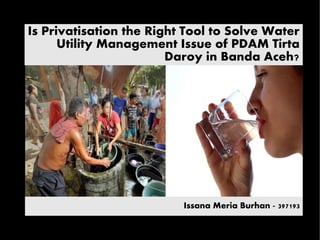
Irony...
1. Indonesia is listed as
one of the richest
water resource in the
world
2. Banda Aceh is
classified as an area
with the highest level
of rainfall in Indonesia
(Department of Public
Works, 2009).
Debt acquisition into equity = privatisation
PDAM is facing complex problems.
● Poor quality management
● Inadequate water services – only
covers 13.27% of total population
● Operational loss – IDR 2.5 billion/month
● Debt entanglement – total debt
reaching AUD 3.4 million to ADB &
French Aid through Subsidiary Loan
● Agreement (SLA) scheme.
Foreign debts > total assets =
reduce bargaining position of
PDAM
Through the Water Resources Sector Adjustment Loan
(WATSAL), WB has given out 300 million USD for the
Indonesian government to reform national policy through
UU No.7/2004 (Law in Water Resource) which includes the
regulation and institutional framework, allowing
privatisation in this sector (Kurniasih, 2008).
Water Privatisation (Blackburn & Dowall, 1991; Ramanadham 1994)
- relieve financial and administrative burden of government
- improve efficiency and productivity
- facilitate economic growth
- maximise consumer choice
- reduce the size and presence of the public sector in the economy
Does Water Privatisation Provide Efficiency?
Hypothesis :
Privatisation was expected to increase labour activity and to reduce per unit costs and prices,
which would bring economic efficiency and good productivity.
Assumption :
Competition = the more competitive the more productive = public buying power
ACEH
● Low number of investments
● High level of imports
● 16.6% of poverty rate – one of
the highest in Indonesia
Water = Capital Intensive
● Foreign Investor
(multinational
companies)
● No competition
(economic
inefficiency)
Reality:
Commercial objectives the commitment to expanding→
service to poor communities is limited (Pankajan (2006).
Contra argument:
In the longer term, water price would eventually become
more efficient as market gets larger and more people have
access to water (Dinavo, 1995)
Strong markets and government
regulatory should first be put in place
to implement this model successfully
(Larbi, 1998).
Theory :
Private sector is considered to have better managerial capacity, more firm in financial capacity,
and more improved technological capacity to solve problems (Ramanadham, 1994)
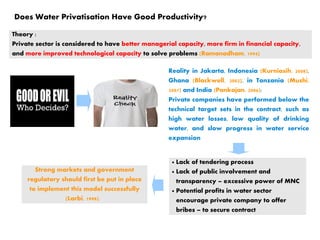
Reality in Jakarta, Indonesia (Kurniasih, 2008),
Ghana (Blackwell, 2002), in Tanzania (Mushi,
2007) and India (Pankajan, 2006):
Private companies have performed below the
technical target sets in the contract, such as
high water losses, low quality of drinking
water, and slow progress in water service
expansion
● Lack of tendering process
● Lack of public involvement and
transparency – excessive power of MNC
● Potential profits in water sector
encourage private company to offer
bribes – to secure contract
Does Water Privatisation Have Good Productivity?
Does Water Privatisation Provide Profits?
Water enterprises can earn a return
of equity of between 8 and 14 %
(Rubeinstein, 2000).
By running drinking water
distribution networks in at least 56
countries (Marsden, 2003) --> GDF
Suez and RWE group, are classified
as the top 50 companies with largest
revenue (Forbes, 2010)
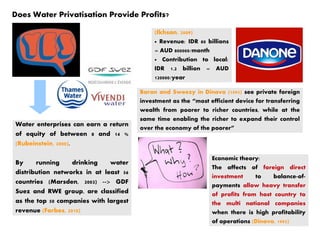
(Ikhsan, 2009)
● Revenue: IDR 80 billions
= AUD 800000/month
● Contribution to local:
IDR 1.2 billion = AUD
120000/year
Baran and Sweezy in Dinavo (1995) see private foreign
investment as the “most efficient device for transferring
wealth from poorer to richer countries, while at the
same time enabling the richer to expand their control
over the economy of the poorer”
Economic theory:
The affects of foreign direct
investment to balance-of-
payments allow heavy transfer
of profits from host country to
the multi national companies
when there is high profitability
of operations (Dinavo, 1995)
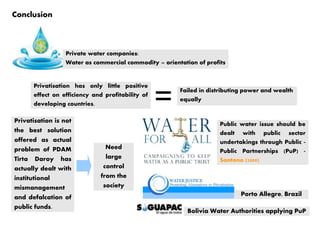
Conclusion
Privatisation has only little positive
effect on efficiency and profitability of
developing countries.
Failed in distributing power and wealth
equally
Private water companies:
Water as commercial commodity = orientation of profits
Privatisation is not
the best solution
offered as actual
problem of PDAM
Tirta Daroy has
actually dealt with
institutional
mismanagement
and defalcation of
public funds.
Need
large
control
from the
society
Public water issue should be
dealt with public sector
undertakings through Public -
Public Partnerships (PuP) -
Santono (2009)
Porto Allegre, Brazil
Bolivia Water Authorities applying PuP
Issana burhan

Issana burhan

  • 1.
    Is Privatisation theRight Tool to Solve Water Utility Management Issue of PDAM Tirta Daroy in Banda Aceh? Issana Meria Burhan - 397193
  • 2.
    Irony... 1. Indonesia islisted as one of the richest water resource in the world 2. Banda Aceh is classified as an area with the highest level of rainfall in Indonesia (Department of Public Works, 2009). Debt acquisition into equity = privatisation PDAM is facing complex problems. ● Poor quality management ● Inadequate water services – only covers 13.27% of total population ● Operational loss – IDR 2.5 billion/month ● Debt entanglement – total debt reaching AUD 3.4 million to ADB & French Aid through Subsidiary Loan ● Agreement (SLA) scheme. Foreign debts > total assets = reduce bargaining position of PDAM
  • 3.
    Through the WaterResources Sector Adjustment Loan (WATSAL), WB has given out 300 million USD for the Indonesian government to reform national policy through UU No.7/2004 (Law in Water Resource) which includes the regulation and institutional framework, allowing privatisation in this sector (Kurniasih, 2008). Water Privatisation (Blackburn & Dowall, 1991; Ramanadham 1994) - relieve financial and administrative burden of government - improve efficiency and productivity - facilitate economic growth - maximise consumer choice - reduce the size and presence of the public sector in the economy
  • 5.
    Does Water PrivatisationProvide Efficiency? Hypothesis : Privatisation was expected to increase labour activity and to reduce per unit costs and prices, which would bring economic efficiency and good productivity. Assumption : Competition = the more competitive the more productive = public buying power ACEH ● Low number of investments ● High level of imports ● 16.6% of poverty rate – one of the highest in Indonesia Water = Capital Intensive ● Foreign Investor (multinational companies) ● No competition (economic inefficiency) Reality: Commercial objectives the commitment to expanding→ service to poor communities is limited (Pankajan (2006). Contra argument: In the longer term, water price would eventually become more efficient as market gets larger and more people have access to water (Dinavo, 1995)
  • 6.
    Strong markets andgovernment regulatory should first be put in place to implement this model successfully (Larbi, 1998). Theory : Private sector is considered to have better managerial capacity, more firm in financial capacity, and more improved technological capacity to solve problems (Ramanadham, 1994) Reality in Jakarta, Indonesia (Kurniasih, 2008), Ghana (Blackwell, 2002), in Tanzania (Mushi, 2007) and India (Pankajan, 2006): Private companies have performed below the technical target sets in the contract, such as high water losses, low quality of drinking water, and slow progress in water service expansion ● Lack of tendering process ● Lack of public involvement and transparency – excessive power of MNC ● Potential profits in water sector encourage private company to offer bribes – to secure contract Does Water Privatisation Have Good Productivity?
  • 7.
    Does Water PrivatisationProvide Profits? Water enterprises can earn a return of equity of between 8 and 14 % (Rubeinstein, 2000). By running drinking water distribution networks in at least 56 countries (Marsden, 2003) --> GDF Suez and RWE group, are classified as the top 50 companies with largest revenue (Forbes, 2010) (Ikhsan, 2009) ● Revenue: IDR 80 billions = AUD 800000/month ● Contribution to local: IDR 1.2 billion = AUD 120000/year Baran and Sweezy in Dinavo (1995) see private foreign investment as the “most efficient device for transferring wealth from poorer to richer countries, while at the same time enabling the richer to expand their control over the economy of the poorer” Economic theory: The affects of foreign direct investment to balance-of- payments allow heavy transfer of profits from host country to the multi national companies when there is high profitability of operations (Dinavo, 1995)
  • 8.
    Conclusion Privatisation has onlylittle positive effect on efficiency and profitability of developing countries. Failed in distributing power and wealth equally Private water companies: Water as commercial commodity = orientation of profits Privatisation is not the best solution offered as actual problem of PDAM Tirta Daroy has actually dealt with institutional mismanagement and defalcation of public funds. Need large control from the society Public water issue should be dealt with public sector undertakings through Public - Public Partnerships (PuP) - Santono (2009) Porto Allegre, Brazil Bolivia Water Authorities applying PuP