208-Geopolitics & World
Economic Systems
UNIT3:
3. Public Private Partnerships: The Rationale for
Public Private Partnerships, Different Kinds of
Public Private Partnerships with a special
emphasis on the Build Operate and Transfer
Model (BOT), Issues in Regulation that come
about with privatization, Pricing mechanisms
available to a regulator to ensure universal
access and efficiency, Discussion of the
privatization experience in different sectors,
water, electricity, telecommunication, and
railways with a special emphasis on India.
PUBLIC PRIVATE PARTNERSHIP (PPP)
PPP means an enterprise in which a project or service is
financed or operated through a partnership of Government
and Private enterprises .PPP is a long term partnership
between Public and Private Sectors .
Introduction
PPPs broadly refers to long term, the contractual partnership
between the public and private sector agencies specially
targeted towards financing, designing, implementing and
operating infrastructure facilities and services that were
traditionally provided by the government or its agencies. These
collaboration ventures are built around the expertise and
capacity of the project planners and are based on a contractual
agreement, which ensures appropriate mutually agreed
allocation of resources, risks, and returns. This approach and
developing public utilities and infrastructure by the private sector
under terms and conditions agreeable to both the government
and the private sector is called PPP.
DEFINING PUBLIC-PRIVATE PARTNERSHIP
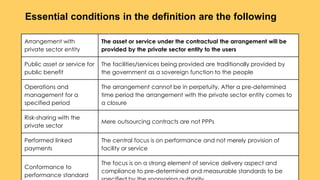
Essential conditions in the definition are the following
Arrangement with
private sector entity
The asset or service under the contractual the arrangement will be
provided by the private sector entity to the users
Public asset or service for
public benefit
The facilities/services being provided are traditionally provided by
the government as a sovereign function to the people
Operations and
management for a
specified period
The arrangement cannot be in perpetuity. After a pre-determined
time period the arrangement with the private sector entity comes to
a closure
Risk-sharing with the
private sector
Mere outsourcing contracts are not PPPs
Performed linked
payments
The central focus is on performance and not merely provision of
facility or service
Conformance to
performance standard
The focus is on a strong element of service delivery aspect and
compliance to pre-determined and measurable standards to be
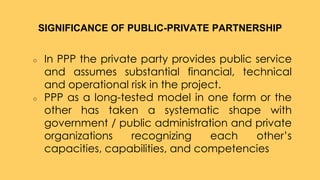
○ In PPP the private party provides public service
and assumes substantial financial, technical
and operational risk in the project.
○ PPP as a long-tested model in one form or the
other has taken a systematic shape with
government / public administration and private
organizations recognizing each other’s
capacities, capabilities, and competencies
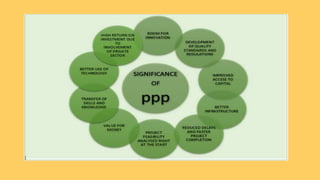
SIGNIFICANCE OF PUBLIC-PRIVATE PARTNERSHIP
○ A public-private partnership can be a means of leveraging public
and private resources to enhance local
entrepreneurship especially among potential entrepreneurs.
○ Given the nature and diversity of public-private partnership, there is
potential for accomplishing both the public-private partnership
process while strategically stimulating small enterprises.
○ A public-private partnership would typically improve efficiency in
the public sector and increase capacity development for local
business.
○ Taking a public-private partnership strategy in the rural sector does
not only encourage efficient allocation of public and private
resources through leverage and long term capacity development
but it also provides an opportunity for innovation, competitiveness
and subsequent reduction in poverty levels.
ADVANTAGE OF PUBLIC-PRIVATE PARTNERSHIP
○ Small enterprises in rural small towns of developing countries do
not usually get opportunities to subcontract with large
organizations which often are foreign-owned and keen on
subcontracting with other foreign firms or developing their own
subsidiaries in the host country, without such opportunities for
experience and investments, the enterprises fail to develop
strong track records for growth and potential competition.
Strategic government policy and regulatory mechanisms that
encourage a variety of public-private partnership in these
areas would strengthen small-town enterprises while at the
same time stimulating entrepreneurial interest.
ADVANTAGE OF PUBLIC-PRIVATE PARTNERSHIP
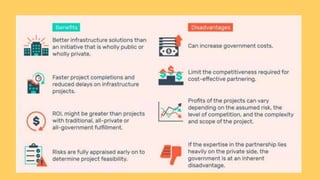
○ Every public-private partnership involves risks for the
private participant, who reasonably expects to be
compensated for accepting those risks. This can
increase government costs.
○ When there are only a limited number of private
entities that have the capability to complete a project,
such as constructing a high-speed rail system,
the relatively small field of bidders might mean less
competition and thus less cost-effective partnering.
Public-Private Partnership Disadvantages
 Profits of the projects can vary depending on the
assumed risk, the level of competition, and the
complexity and scope of the project.
 If the expertise in the partnership lies heavily on
the private side, the government is at an inherent
disadvantage. For example, it might be unable to
accurately assess the proposed costs.
Public-Private Partnership Disadvantages
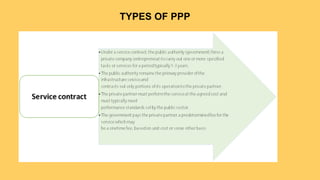
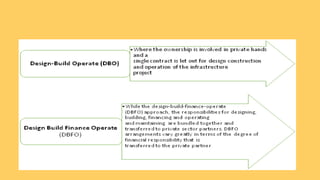
TYPES OF PPP
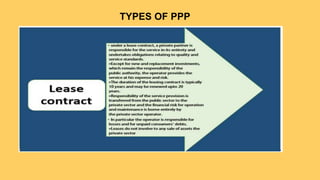
TYPES OF PPP
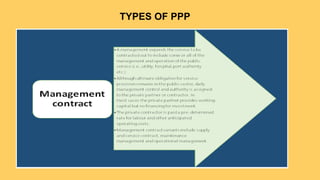
TYPES OF PPP
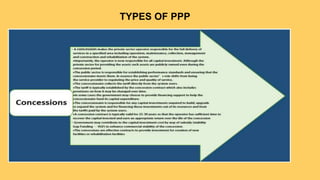
TYPES OF PPP
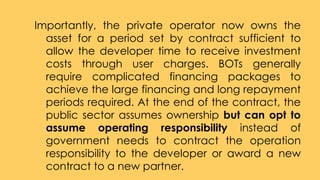
BOT and similar arrangements are a kind of
specialized concession in which a private firm
finances and develops a new infrastructure
project or a major component according to
performance standards set by the government.
·Under BOTs, the private partner provides the
capital required to build the new facility,
Operate & Maintain (O&M) for the contract
period and then return the facility governments
as per agreed terms.
Build Operate Transfer (BOT)
Importantly, the private operator now owns the
asset for a period set by contract sufficient to
allow the developer time to receive investment
costs through user charges. BOTs generally
require complicated financing packages to
achieve the large financing and long repayment
periods required. At the end of the contract, the
public sector assumes ownership but can opt to
assume operating responsibility instead of
government needs to contract the operation
responsibility to the developer or award a new
contract to a new partner.
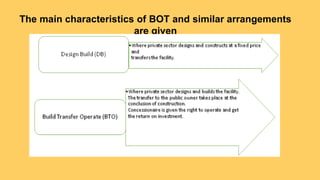
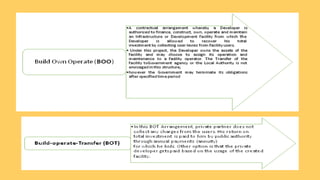
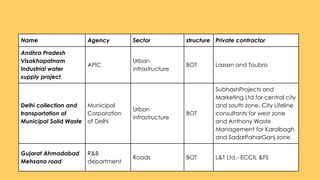
The main characteristics of BOT and similar arrangements
are given
Name Agency Sector structure Private contractor
Andhra Pradesh
Visakhapatnam
Industrial water
supply project
APIC
Urban
infrastructure
BOT Lassen and Toubro
Delhi collection and
transportation of
Municipal Solid Waste
Municipal
Corporation
of Delhi
Urban
infrastructure
BOT
SubhashProjects and
Marketing Ltd for central city
and south zone, City Lifeline
consultants for west zone
and Anthony Waste
Management for Karolbagh
and SadarPaharGanj zone
Gujarat Ahmadabad
Mehsana road
R&B
department
Roads BOT L&T Ltd.- ECCIL &FS

208 - Geopolitics & World Economic Systems unit3

  • 1.
    208-Geopolitics & World EconomicSystems UNIT3: 3. Public Private Partnerships: The Rationale for Public Private Partnerships, Different Kinds of Public Private Partnerships with a special emphasis on the Build Operate and Transfer Model (BOT), Issues in Regulation that come about with privatization, Pricing mechanisms available to a regulator to ensure universal access and efficiency, Discussion of the privatization experience in different sectors, water, electricity, telecommunication, and railways with a special emphasis on India.
  • 2.
    PUBLIC PRIVATE PARTNERSHIP(PPP) PPP means an enterprise in which a project or service is financed or operated through a partnership of Government and Private enterprises .PPP is a long term partnership between Public and Private Sectors . Introduction
  • 3.
    PPPs broadly refersto long term, the contractual partnership between the public and private sector agencies specially targeted towards financing, designing, implementing and operating infrastructure facilities and services that were traditionally provided by the government or its agencies. These collaboration ventures are built around the expertise and capacity of the project planners and are based on a contractual agreement, which ensures appropriate mutually agreed allocation of resources, risks, and returns. This approach and developing public utilities and infrastructure by the private sector under terms and conditions agreeable to both the government and the private sector is called PPP. DEFINING PUBLIC-PRIVATE PARTNERSHIP
  • 4.
    Essential conditions inthe definition are the following Arrangement with private sector entity The asset or service under the contractual the arrangement will be provided by the private sector entity to the users Public asset or service for public benefit The facilities/services being provided are traditionally provided by the government as a sovereign function to the people Operations and management for a specified period The arrangement cannot be in perpetuity. After a pre-determined time period the arrangement with the private sector entity comes to a closure Risk-sharing with the private sector Mere outsourcing contracts are not PPPs Performed linked payments The central focus is on performance and not merely provision of facility or service Conformance to performance standard The focus is on a strong element of service delivery aspect and compliance to pre-determined and measurable standards to be
  • 5.
    ○ In PPPthe private party provides public service and assumes substantial financial, technical and operational risk in the project. ○ PPP as a long-tested model in one form or the other has taken a systematic shape with government / public administration and private organizations recognizing each other’s capacities, capabilities, and competencies SIGNIFICANCE OF PUBLIC-PRIVATE PARTNERSHIP
  • 8.
    ○ A public-privatepartnership can be a means of leveraging public and private resources to enhance local entrepreneurship especially among potential entrepreneurs. ○ Given the nature and diversity of public-private partnership, there is potential for accomplishing both the public-private partnership process while strategically stimulating small enterprises. ○ A public-private partnership would typically improve efficiency in the public sector and increase capacity development for local business. ○ Taking a public-private partnership strategy in the rural sector does not only encourage efficient allocation of public and private resources through leverage and long term capacity development but it also provides an opportunity for innovation, competitiveness and subsequent reduction in poverty levels. ADVANTAGE OF PUBLIC-PRIVATE PARTNERSHIP
  • 9.
    ○ Small enterprisesin rural small towns of developing countries do not usually get opportunities to subcontract with large organizations which often are foreign-owned and keen on subcontracting with other foreign firms or developing their own subsidiaries in the host country, without such opportunities for experience and investments, the enterprises fail to develop strong track records for growth and potential competition. Strategic government policy and regulatory mechanisms that encourage a variety of public-private partnership in these areas would strengthen small-town enterprises while at the same time stimulating entrepreneurial interest. ADVANTAGE OF PUBLIC-PRIVATE PARTNERSHIP
  • 10.
    ○ Every public-privatepartnership involves risks for the private participant, who reasonably expects to be compensated for accepting those risks. This can increase government costs. ○ When there are only a limited number of private entities that have the capability to complete a project, such as constructing a high-speed rail system, the relatively small field of bidders might mean less competition and thus less cost-effective partnering. Public-Private Partnership Disadvantages
  • 11.
     Profits ofthe projects can vary depending on the assumed risk, the level of competition, and the complexity and scope of the project.  If the expertise in the partnership lies heavily on the private side, the government is at an inherent disadvantage. For example, it might be unable to accurately assess the proposed costs. Public-Private Partnership Disadvantages
  • 12.
  • 13.
  • 14.
  • 15.
  • 16.
    BOT and similararrangements are a kind of specialized concession in which a private firm finances and develops a new infrastructure project or a major component according to performance standards set by the government. ·Under BOTs, the private partner provides the capital required to build the new facility, Operate & Maintain (O&M) for the contract period and then return the facility governments as per agreed terms. Build Operate Transfer (BOT)
  • 17.
    Importantly, the privateoperator now owns the asset for a period set by contract sufficient to allow the developer time to receive investment costs through user charges. BOTs generally require complicated financing packages to achieve the large financing and long repayment periods required. At the end of the contract, the public sector assumes ownership but can opt to assume operating responsibility instead of government needs to contract the operation responsibility to the developer or award a new contract to a new partner.
  • 18.
    The main characteristicsof BOT and similar arrangements are given
  • 21.
    Name Agency Sectorstructure Private contractor Andhra Pradesh Visakhapatnam Industrial water supply project APIC Urban infrastructure BOT Lassen and Toubro Delhi collection and transportation of Municipal Solid Waste Municipal Corporation of Delhi Urban infrastructure BOT SubhashProjects and Marketing Ltd for central city and south zone, City Lifeline consultants for west zone and Anthony Waste Management for Karolbagh and SadarPaharGanj zone Gujarat Ahmadabad Mehsana road R&B department Roads BOT L&T Ltd.- ECCIL &FS