The impact of continued expansion of
Melbourne’s Urban Growth Boundary
on future food security.
Shelley Bennett (133623)
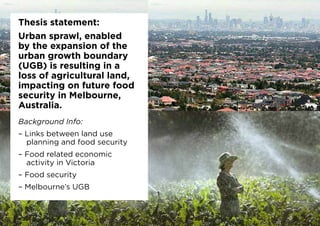
Thesis statement:
Urban sprawl, enabled
by the expansion of the
urban growth boundary
(UGB) is resulting in a
loss of agricultural land,
impacting on future food
security in Melbourne,
Australia.
Background Info:
– Links between land use
planning and food security
– Food related economic
activity in Victoria
– Food security
– Melbourne’s UGB
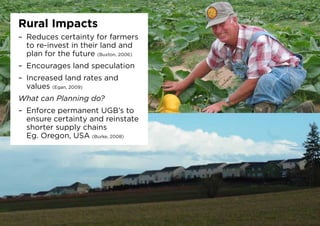
Rural Impacts
–	 Reduces certainty for farmers
to re-invest in their land and
plan for the future (Buxton, 2006)
–	 Encourages land speculation
–	 Increased land rates and
values (Egan, 2009)
What can Planning do?
–	 Enforce permanent UGB’s to
ensure certainty and reinstate
shorter supply chains
Eg. Oregon, USA (Burke, 2008)
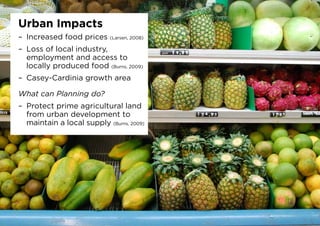
Urban Impacts
–	 Increased food prices (Larsen, 2008)
–	 Loss of local industry,
employment and access to
locally produced food (Burns, 2009)
–	 Casey-Cardinia growth area
What can Planning do?
–	 Protect prime agricultural land
from urban development to
maintain a local supply (Burns, 2009)
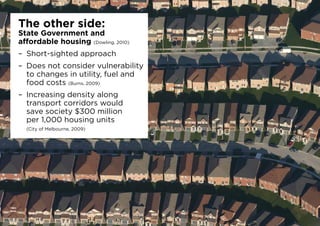
The other side:
State Government and
affordable housing (Dowling, 2010)
–	 Short-sighted approach
–	 Does not consider vulnerability
to changes in utility, fuel and
food costs (Burns, 2009)
–	 Increasing density along
transport corridors would
save society $300 million
per 1,000 housing units
(City of Melbourne, 2009)
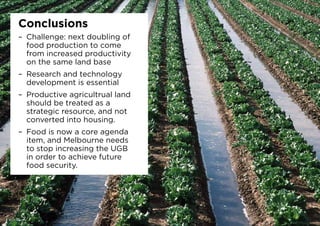
Conclusions
–	 Challenge: next doubling of
food production to come
from increased productivity
on the same land base
–	 Research and technology
development is essential
–	 Productive agricultrual land
should be treated as a
strategic resource, and not
converted into housing.
–	 Food is now a core agenda
item, and Melbourne needs
to stop increasing the UGB
in order to achieve future
food security.

Shelley bennett

  • 1.
    The impact ofcontinued expansion of Melbourne’s Urban Growth Boundary on future food security. Shelley Bennett (133623)
  • 2.
    Thesis statement: Urban sprawl,enabled by the expansion of the urban growth boundary (UGB) is resulting in a loss of agricultural land, impacting on future food security in Melbourne, Australia. Background Info: – Links between land use planning and food security – Food related economic activity in Victoria – Food security – Melbourne’s UGB
  • 3.
    Rural Impacts – Reducescertainty for farmers to re-invest in their land and plan for the future (Buxton, 2006) – Encourages land speculation – Increased land rates and values (Egan, 2009) What can Planning do? – Enforce permanent UGB’s to ensure certainty and reinstate shorter supply chains Eg. Oregon, USA (Burke, 2008)
  • 4.
    Urban Impacts – Increasedfood prices (Larsen, 2008) – Loss of local industry, employment and access to locally produced food (Burns, 2009) – Casey-Cardinia growth area What can Planning do? – Protect prime agricultural land from urban development to maintain a local supply (Burns, 2009)
  • 5.
    The other side: StateGovernment and affordable housing (Dowling, 2010) – Short-sighted approach – Does not consider vulnerability to changes in utility, fuel and food costs (Burns, 2009) – Increasing density along transport corridors would save society $300 million per 1,000 housing units (City of Melbourne, 2009)
  • 6.
    Conclusions – Challenge: nextdoubling of food production to come from increased productivity on the same land base – Research and technology development is essential – Productive agricultrual land should be treated as a strategic resource, and not converted into housing. – Food is now a core agenda item, and Melbourne needs to stop increasing the UGB in order to achieve future food security.