1
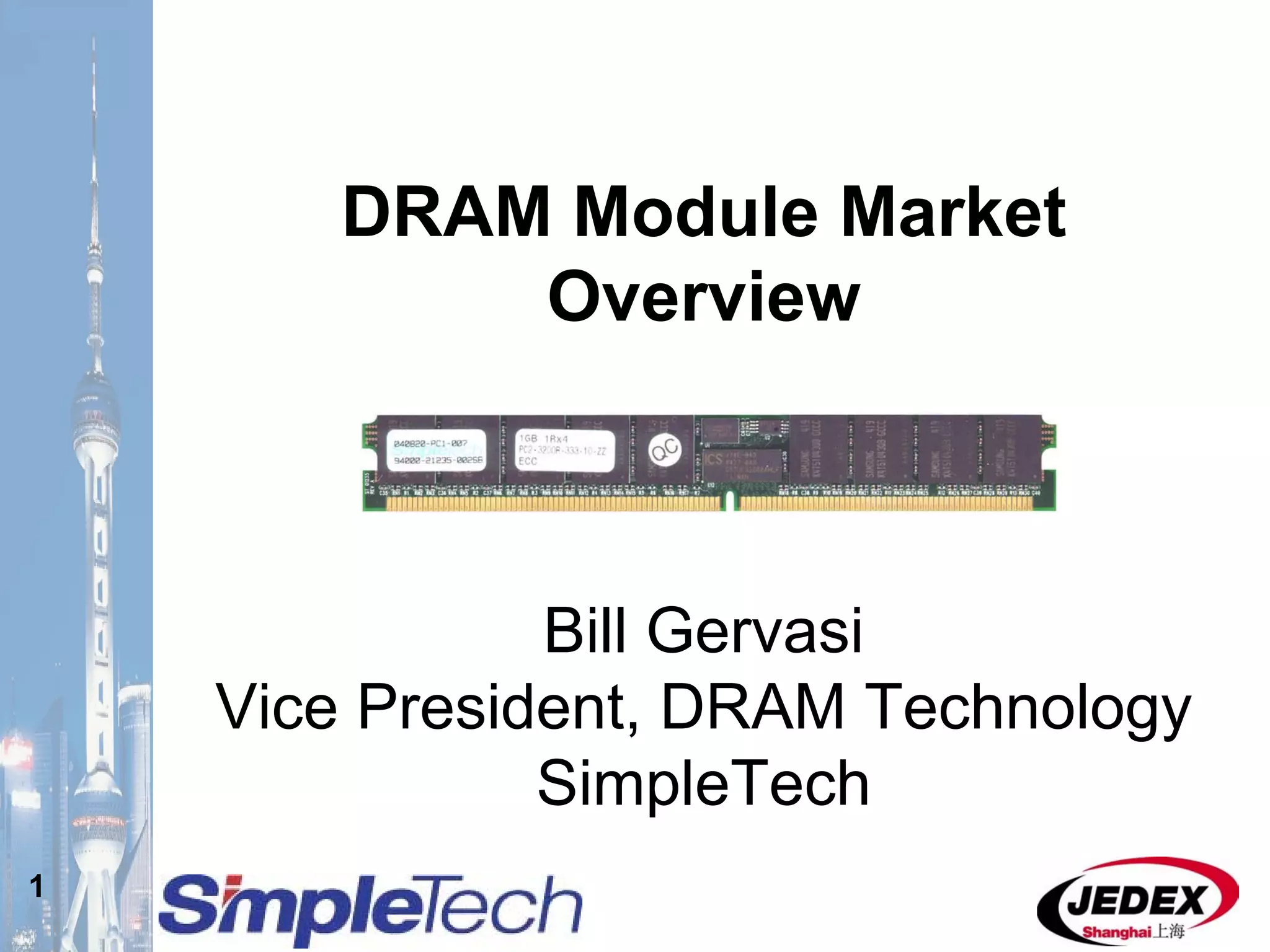
DRAM Module Market
Overview
Bill Gervasi
Vice President, DRAM Technology
SimpleTech
2
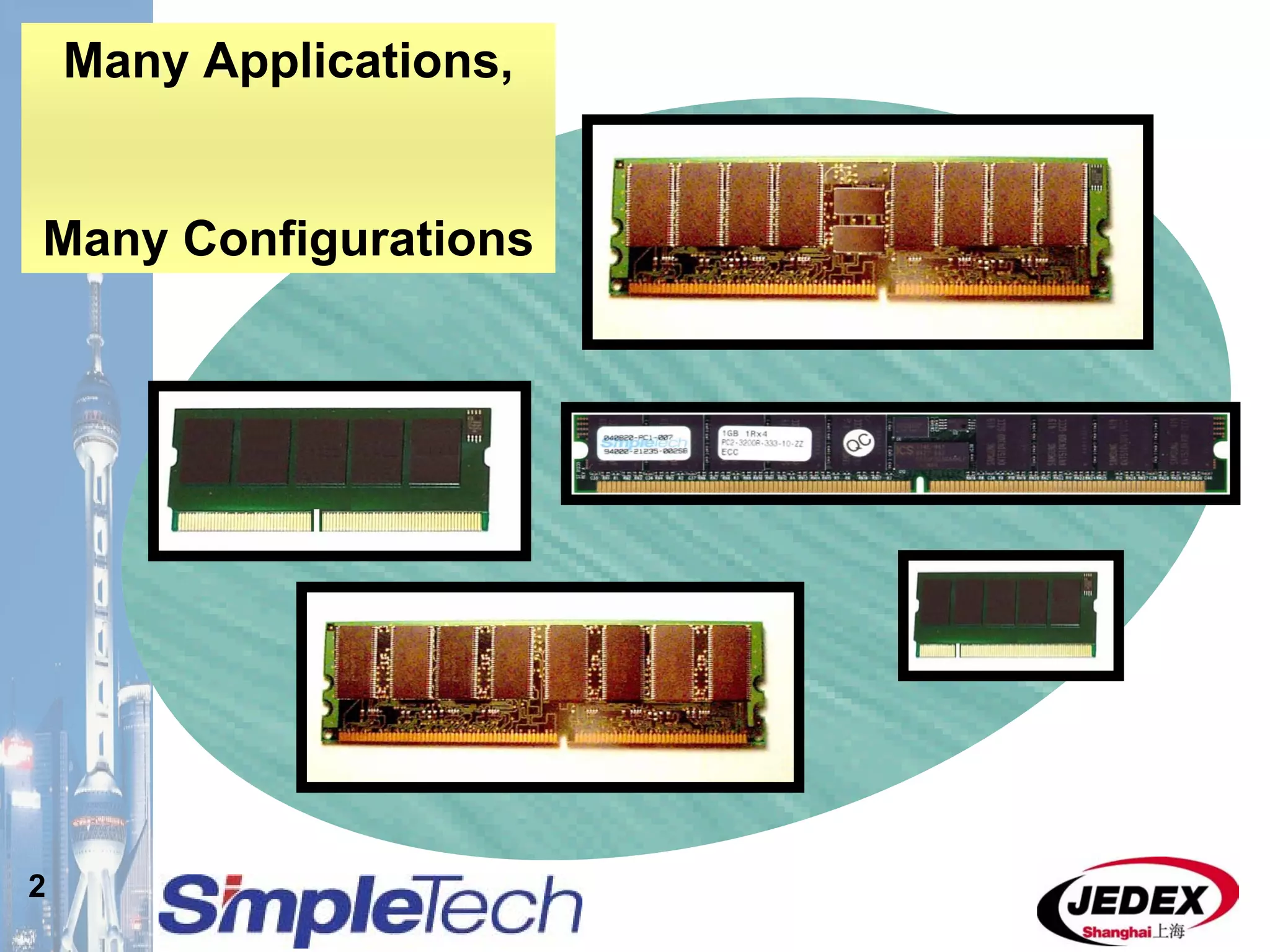
Many Applications,
Many Configurations
3
Agenda
• Terminology review
• DRAM Market Factors
• Market: Personal Computers
• Market: Servers & Workstations
– FB-DIMM or RDIMM?
• Market: Routers & Communications
• Market: Peripherals
4
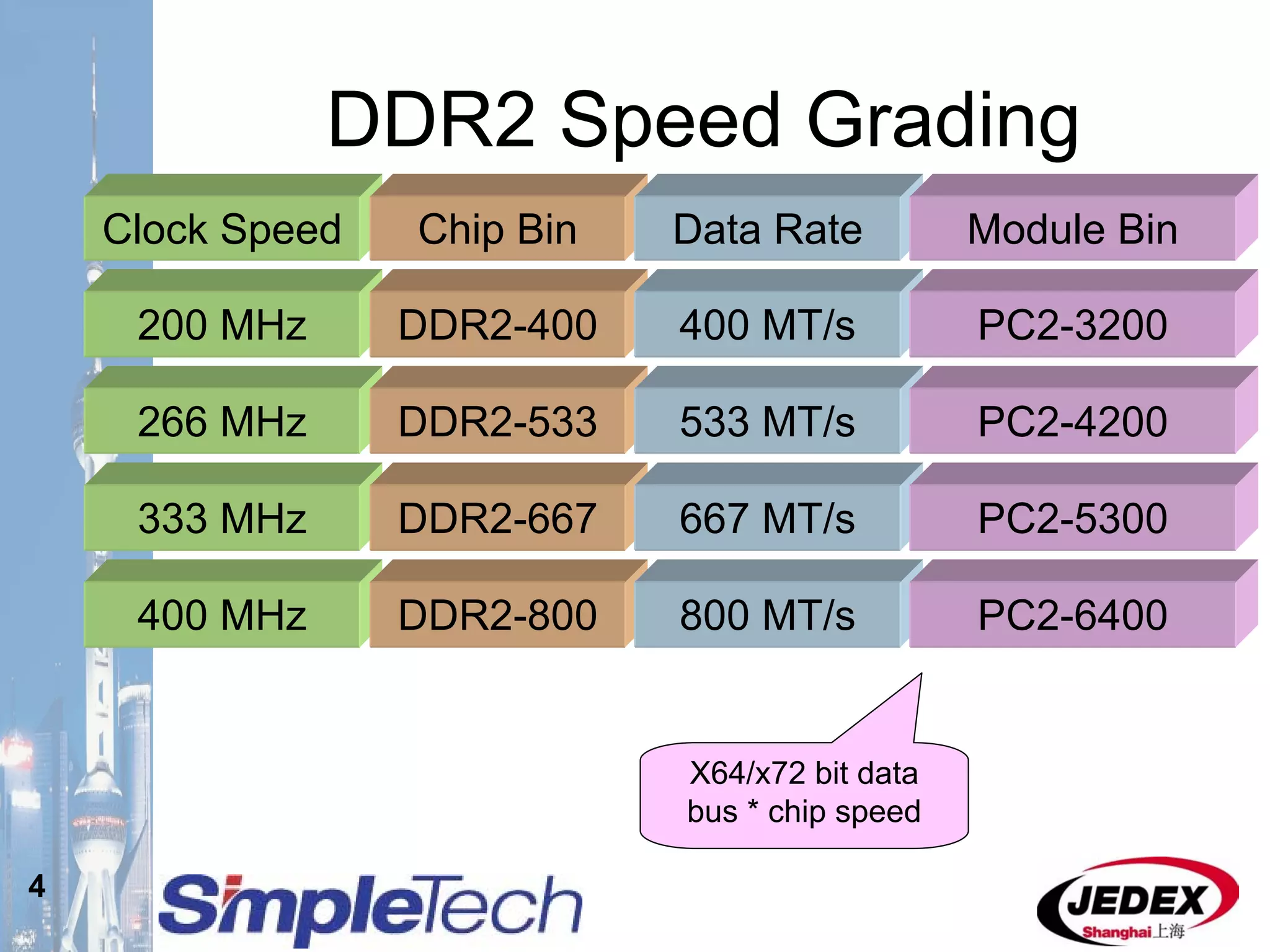
DDR2 Speed Grading
X64/x72 bit data
bus * chip speed
200 MHz DDR2-400
266 MHz DDR2-533
333 MHz DDR2-667
400 MHz DDR2-800
Clock Speed Chip Bin
400 MT/s
533 MT/s
667 MT/s
800 MT/s
Data Rate
PC2-3200
PC2-4200
PC2-5300
PC2-6400
Module Bin
5
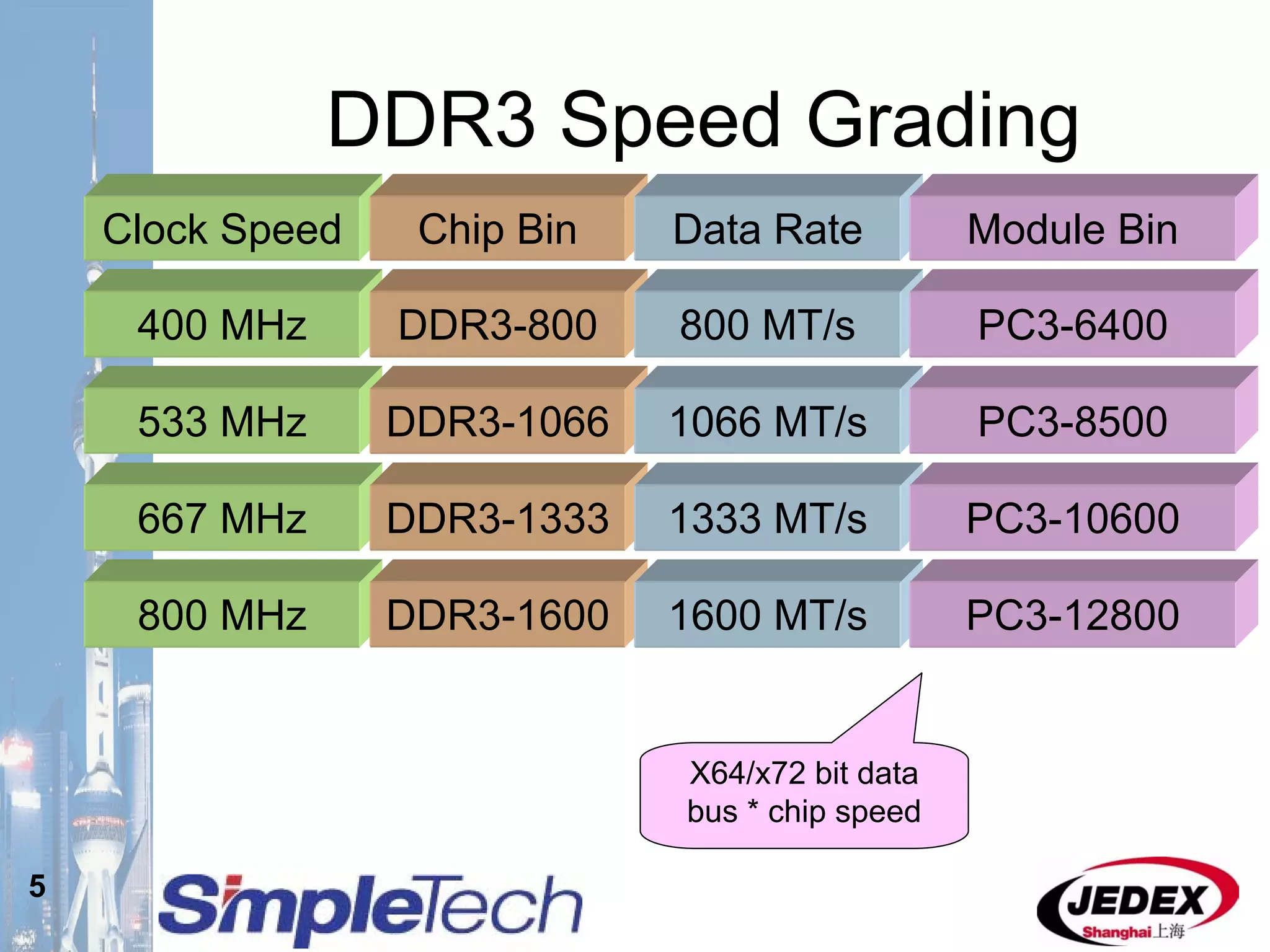
DDR3 Speed Grading
X64/x72 bit data
bus * chip speed
400 MHz DDR3-800
533 MHz DDR3-1066
667 MHz DDR3-1333
800 MHz DDR3-1600
Clock Speed Chip Bin
800 MT/s
1066 MT/s
1333 MT/s
1600 MT/s
Data Rate
PC3-6400
PC3-8500
PC3-10600
PC3-12800
Module Bin
6
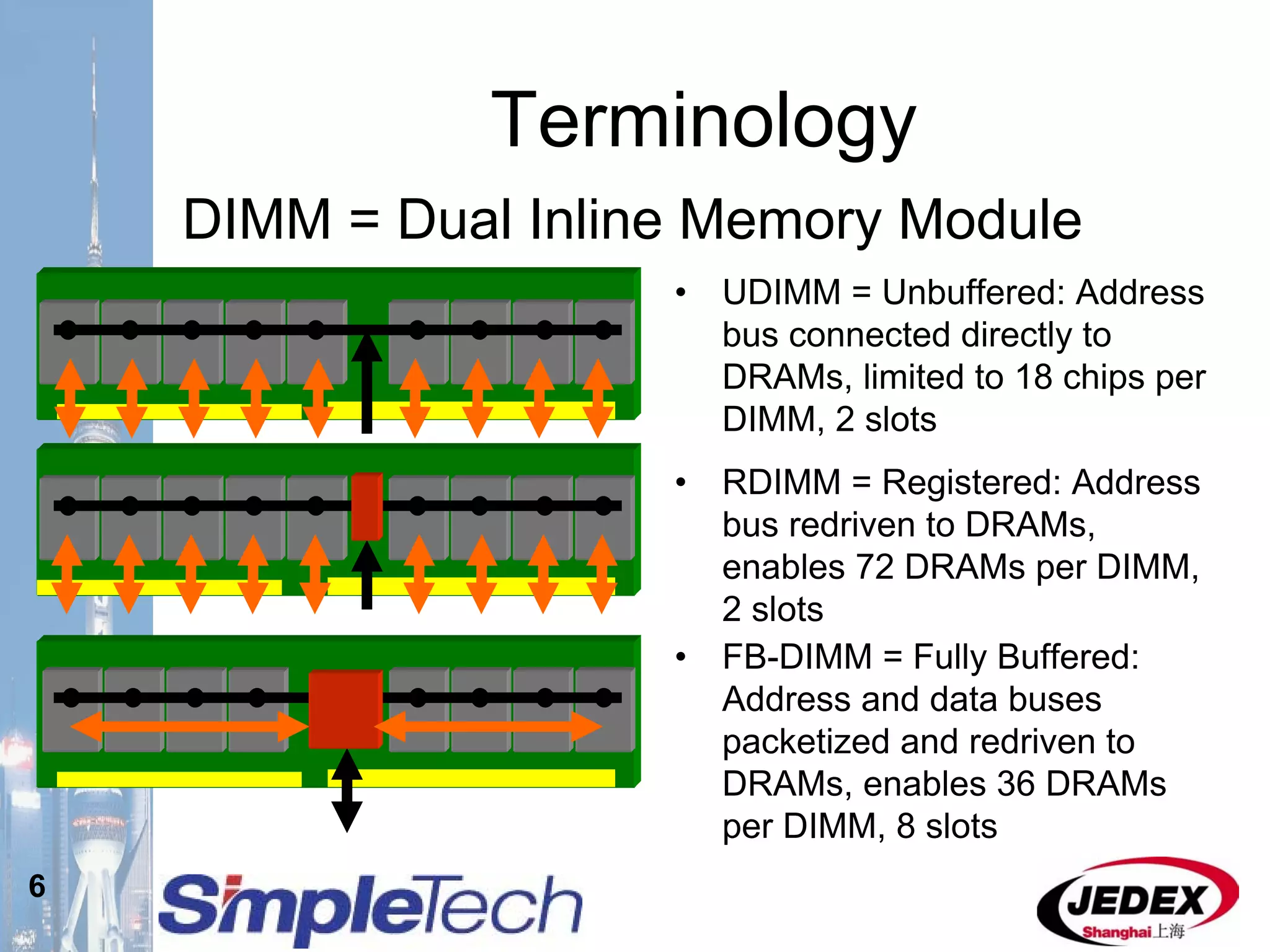
Terminology
DIMM = Dual Inline Memory Module
• UDIMM = Unbuffered: Address
bus connected directly to
DRAMs, limited to 18 chips per
DIMM, 2 slots
• RDIMM = Registered: Address
bus redriven to DRAMs,
enables 72 DRAMs per DIMM,
2 slots
• FB-DIMM = Fully Buffered:
Address and data buses
packetized and redriven to
DRAMs, enables 36 DRAMs
per DIMM, 8 slots
7
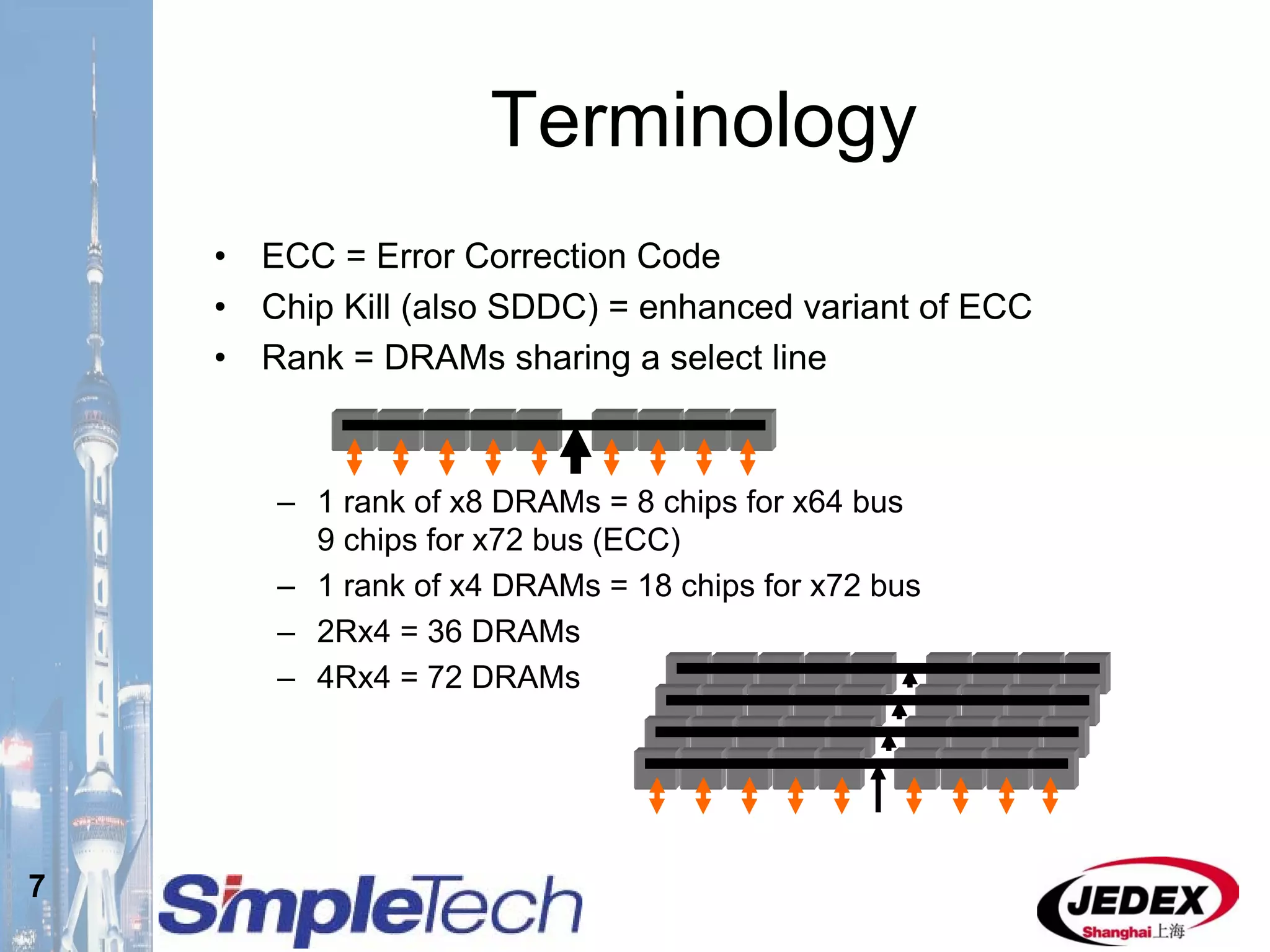
Terminology
• ECC = Error Correction Code
• Chip Kill (also SDDC) = enhanced variant of ECC
• Rank = DRAMs sharing a select line
– 1 rank of x8 DRAMs = 8 chips for x64 bus
9 chips for x72 bus (ECC)
– 1 rank of x4 DRAMs = 18 chips for x72 bus
– 2Rx4 = 36 DRAMs
– 4Rx4 = 72 DRAMs
8
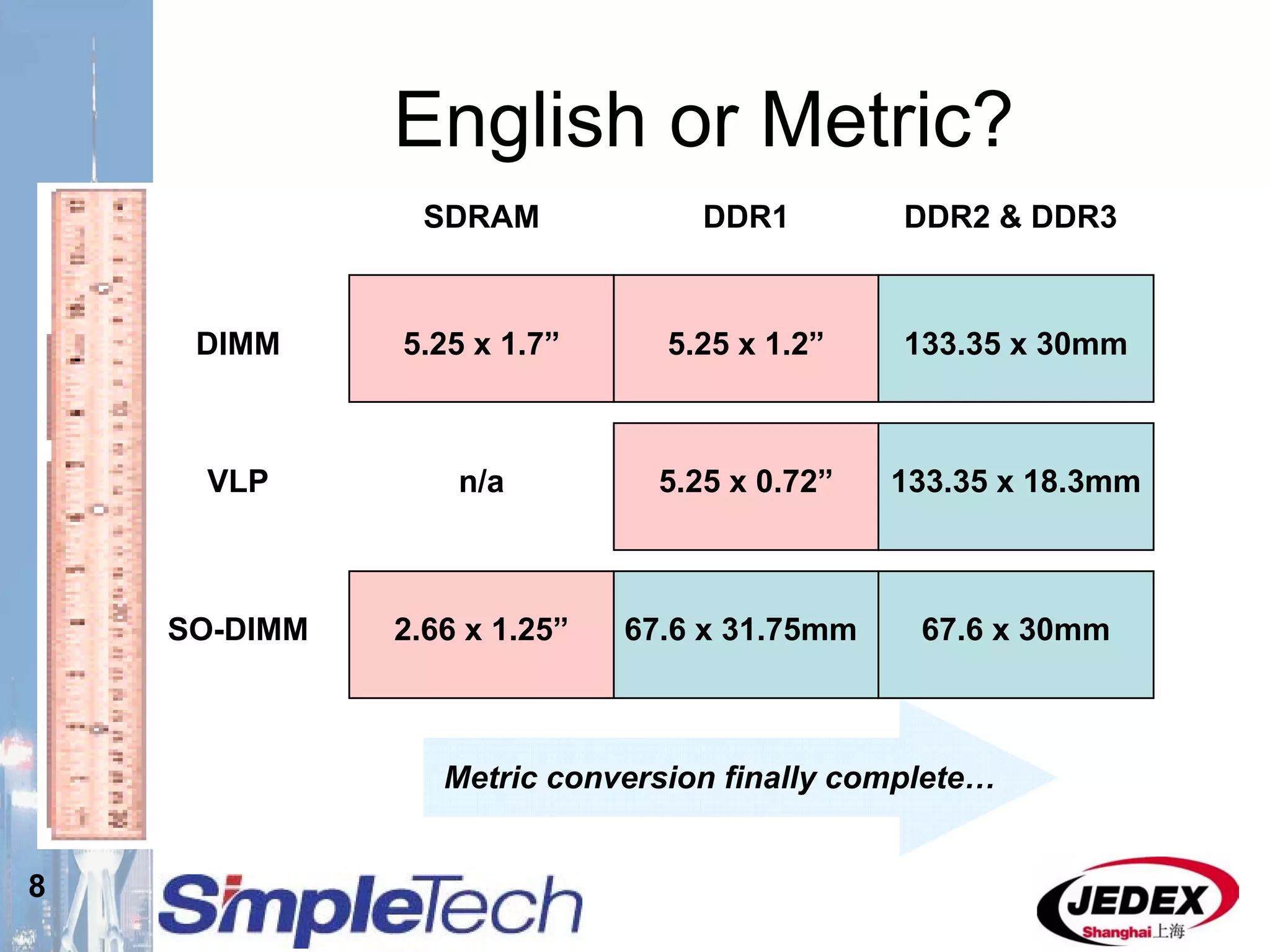
English or Metric?
SDRAM DDR1 DDR2 & DDR3
5.25 x 1.7”
2.66 x 1.25” 67.6 x 31.75mm 67.6 x 30mm
5.25 x 1.2” 133.35 x 30mm
133.35 x 18.3mm5.25 x 0.72”
DIMM
VLP
SO-DIMM
n/a
Metric conversion finally complete…
9
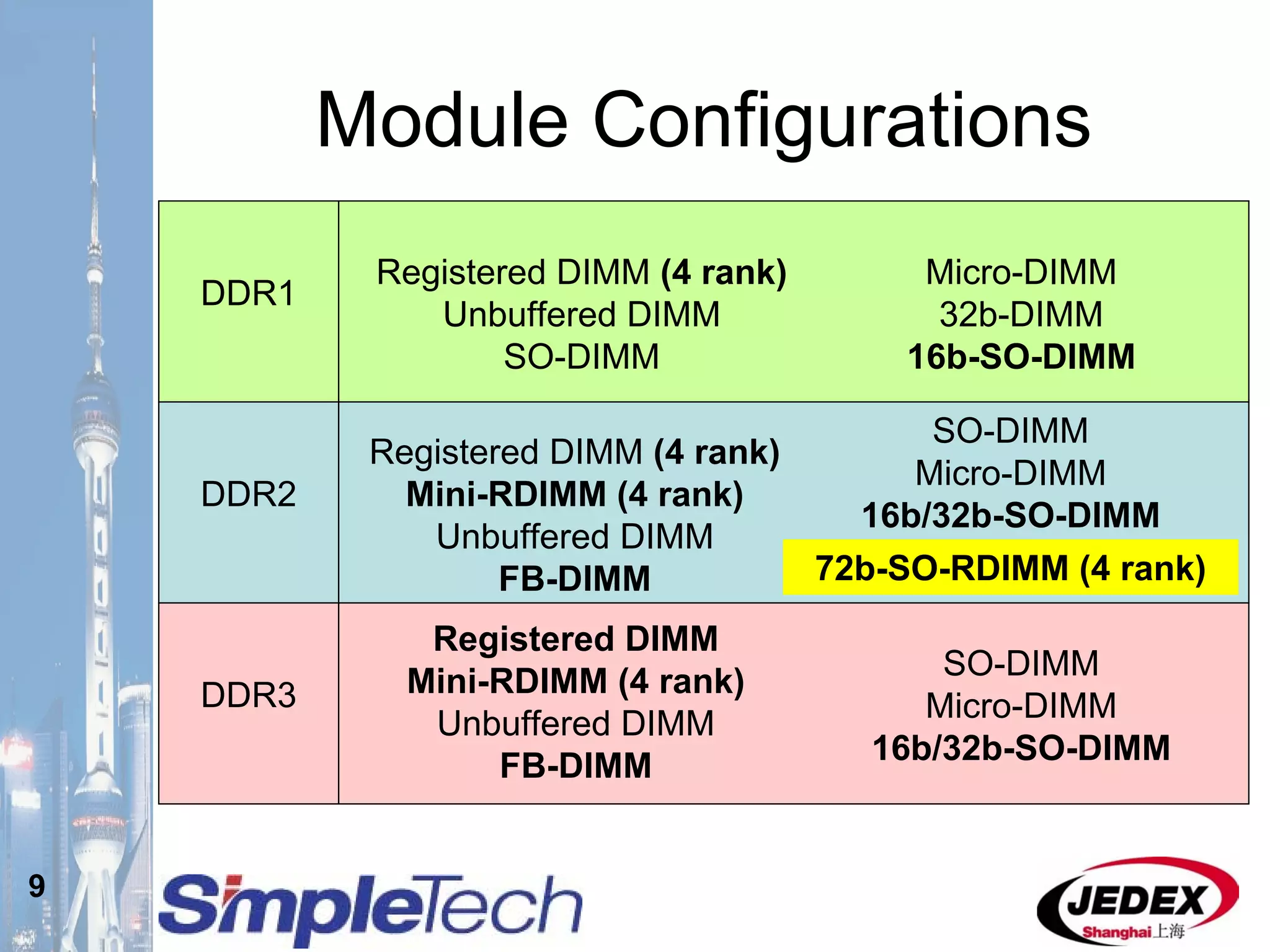
Module Configurations
Registered DIMM (4 rank)
Unbuffered DIMM
SO-DIMM
Micro-DIMM
32b-DIMM
16b-SO-DIMM
Registered DIMM (4 rank)
Mini-RDIMM (4 rank)
Unbuffered DIMM
FB-DIMM
SO-DIMM
Micro-DIMM
16b/32b-SO-DIMM
Registered DIMM
Mini-RDIMM (4 rank)
Unbuffered DIMM
FB-DIMM
SO-DIMM
Micro-DIMM
16b/32b-SO-DIMM
DDR2
DDR1
DDR3
72b-SO-RDIMM (4 rank)
10
DRAM Market Overview
& Impact on Memory Modules
11
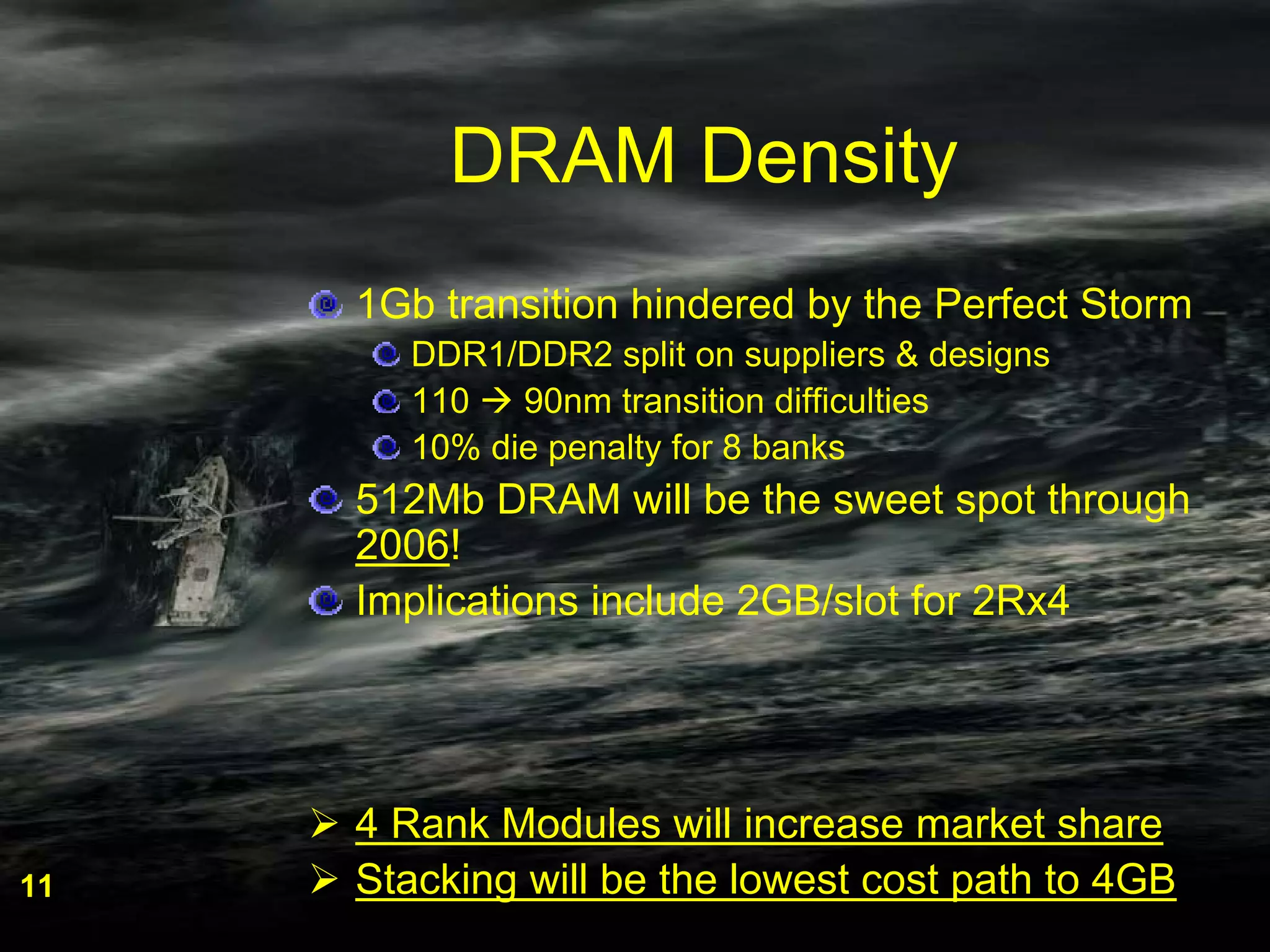
DRAM Density
1Gb transition hindered by the Perfect Storm
DDR1/DDR2 split on suppliers & designs
110 90nm transition difficulties
10% die penalty for 8 banks
512Mb DRAM will be the sweet spot through
2006!
Implications include 2GB/slot for 2Rx4
4 Rank Modules will increase market share
Stacking will be the lowest cost path to 4GB11
12
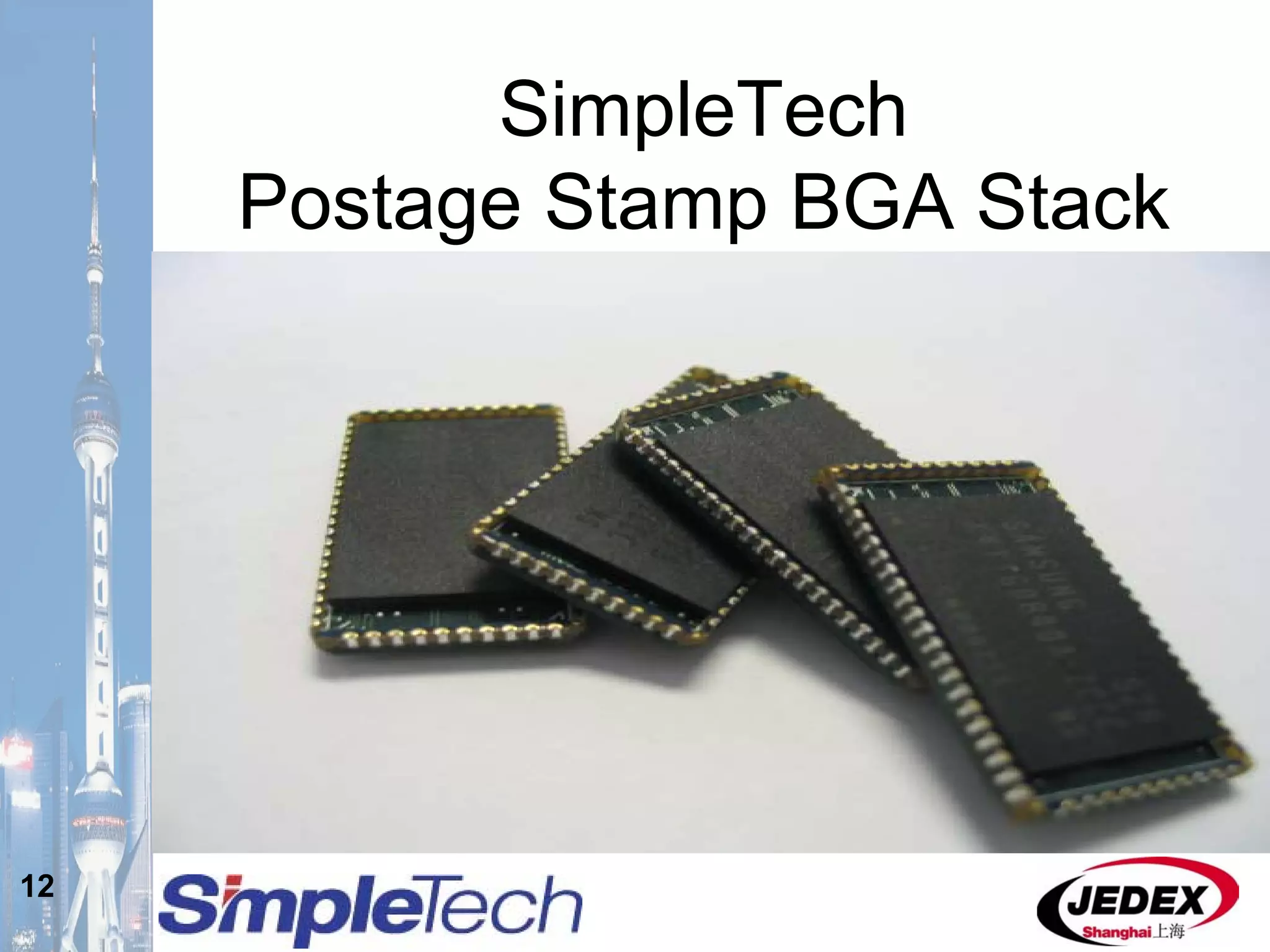
SimpleTech
Postage Stamp BGA Stack
13
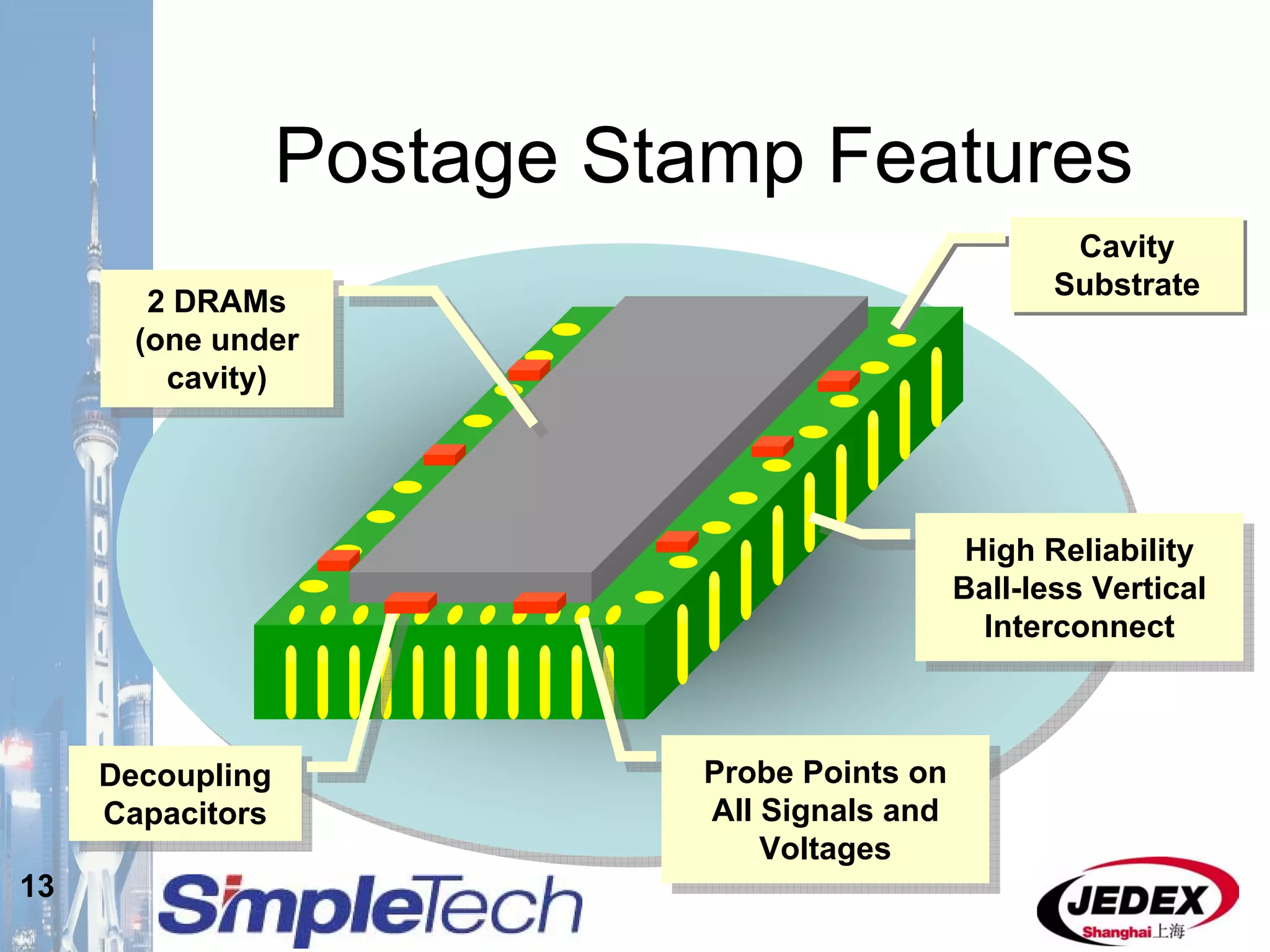
Postage Stamp Features
Cavity
Substrate
Cavity
Substrate
High Reliability
Ball-less Vertical
Interconnect
High Reliability
Ball-less Vertical
Interconnect
Decoupling
Capacitors
Decoupling
Capacitors
Probe Points on
All Signals and
Voltages
Probe Points on
All Signals and
Voltages
2 DRAMs
(one under
cavity)
2 DRAMs
(one under
cavity)
14
Postage Stamp
Thermal Improvements
Thermal path to all ground planes then to
surface copper flood – entire DIMM becomes a
heat spreader
15
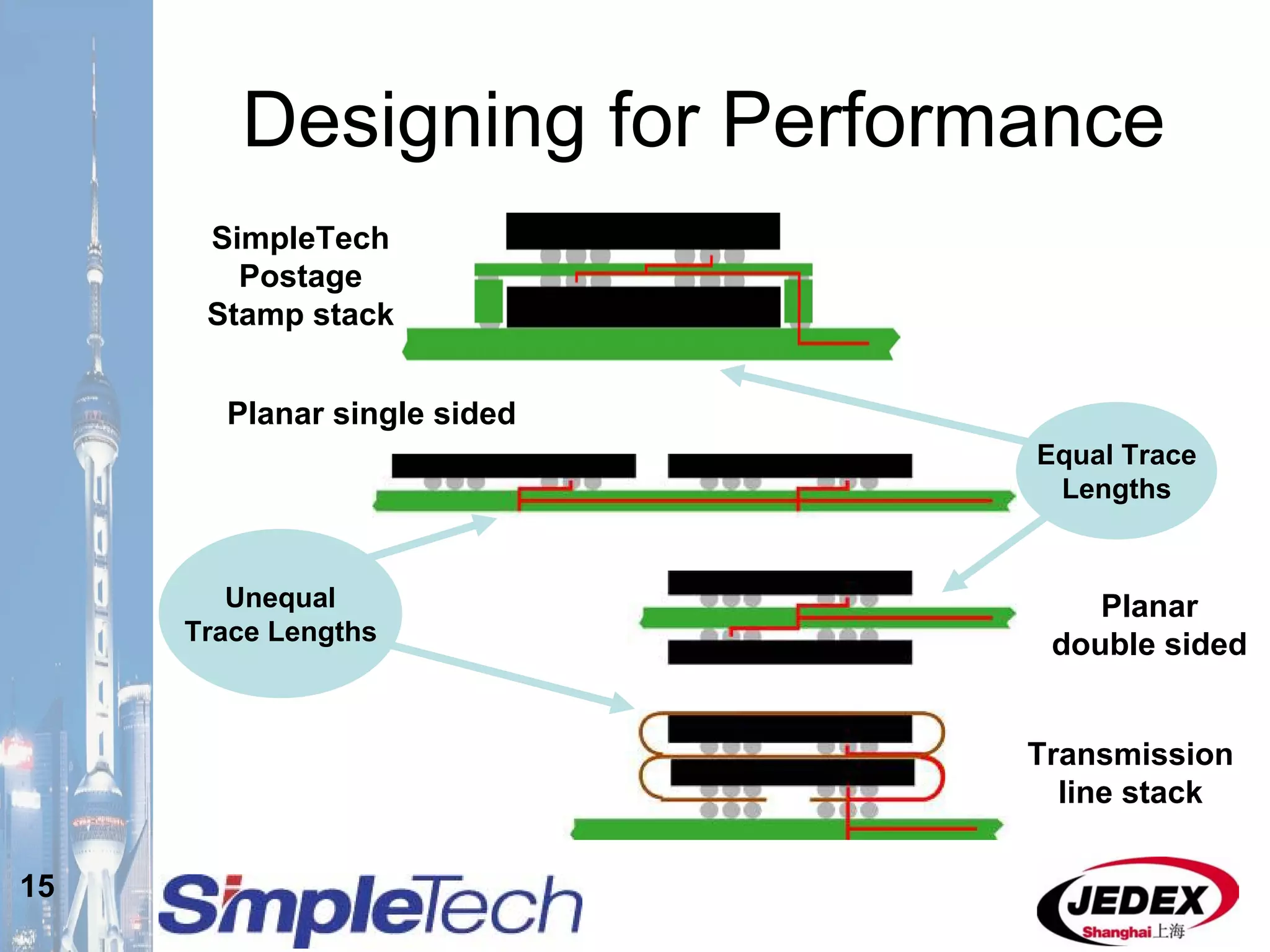
Designing for Performance
Planar single sided
SimpleTech
Postage
Stamp stack
Transmission
line stack
Planar
double sided
Unequal
Trace Lengths
Equal Trace
Lengths
16
Module Markets:
Desktop & Mobile
17
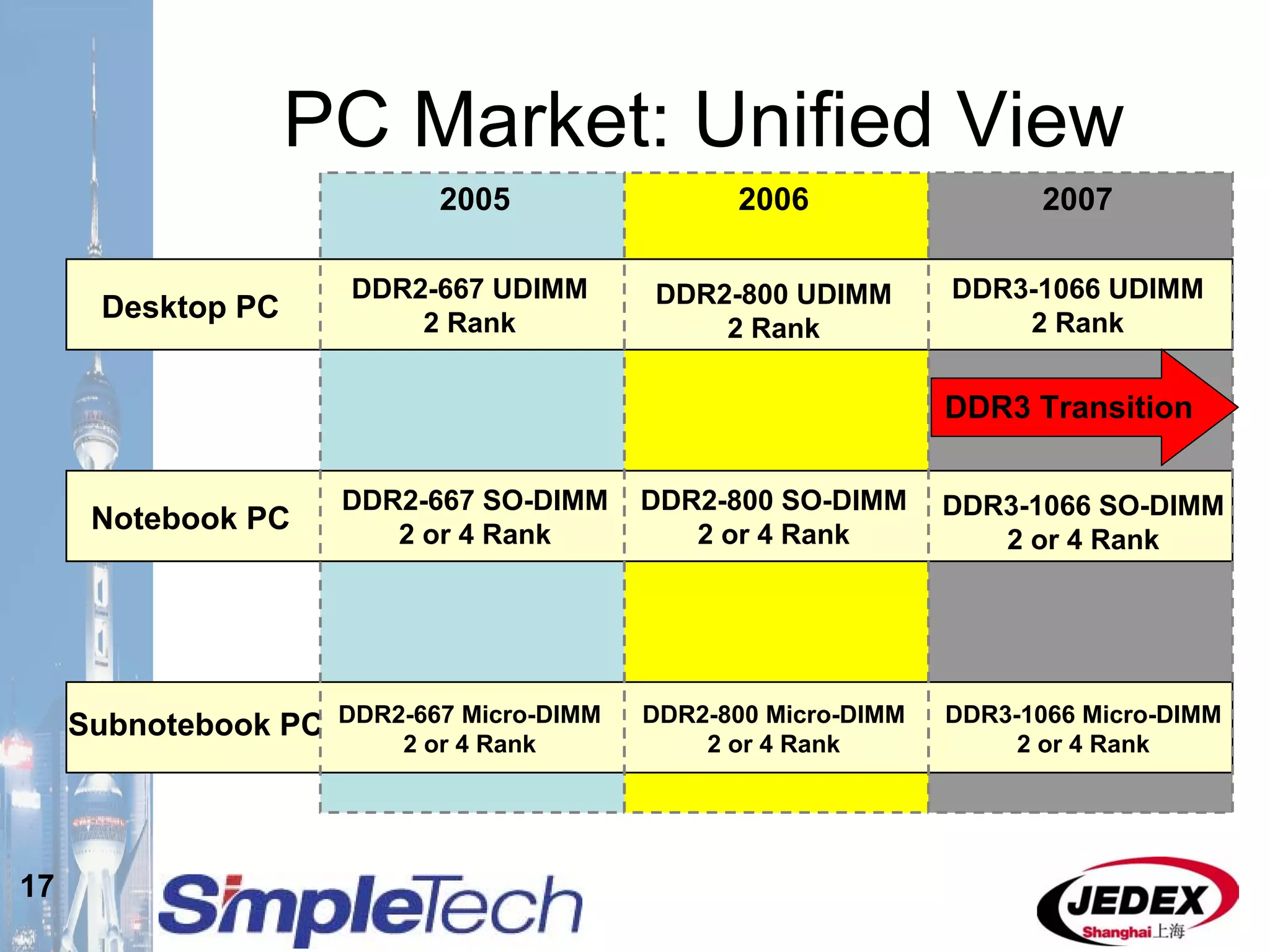
PC Market: Unified View
2005 2006 2007
Desktop PC
Notebook PC
Subnotebook PC
DDR2-667 UDIMM
2 Rank
DDR2-667 SO-DIMM
2 or 4 Rank
DDR2-667 Micro-DIMM
2 or 4 Rank
DDR2-800 UDIMM
2 Rank
DDR2-800 SO-DIMM
2 or 4 Rank
DDR2-800 Micro-DIMM
2 or 4 Rank
DDR3-1066 UDIMM
2 Rank
DDR3-1066 SO-DIMM
2 or 4 Rank
DDR3-1066 Micro-DIMM
2 or 4 Rank
DDR3 Transition
18
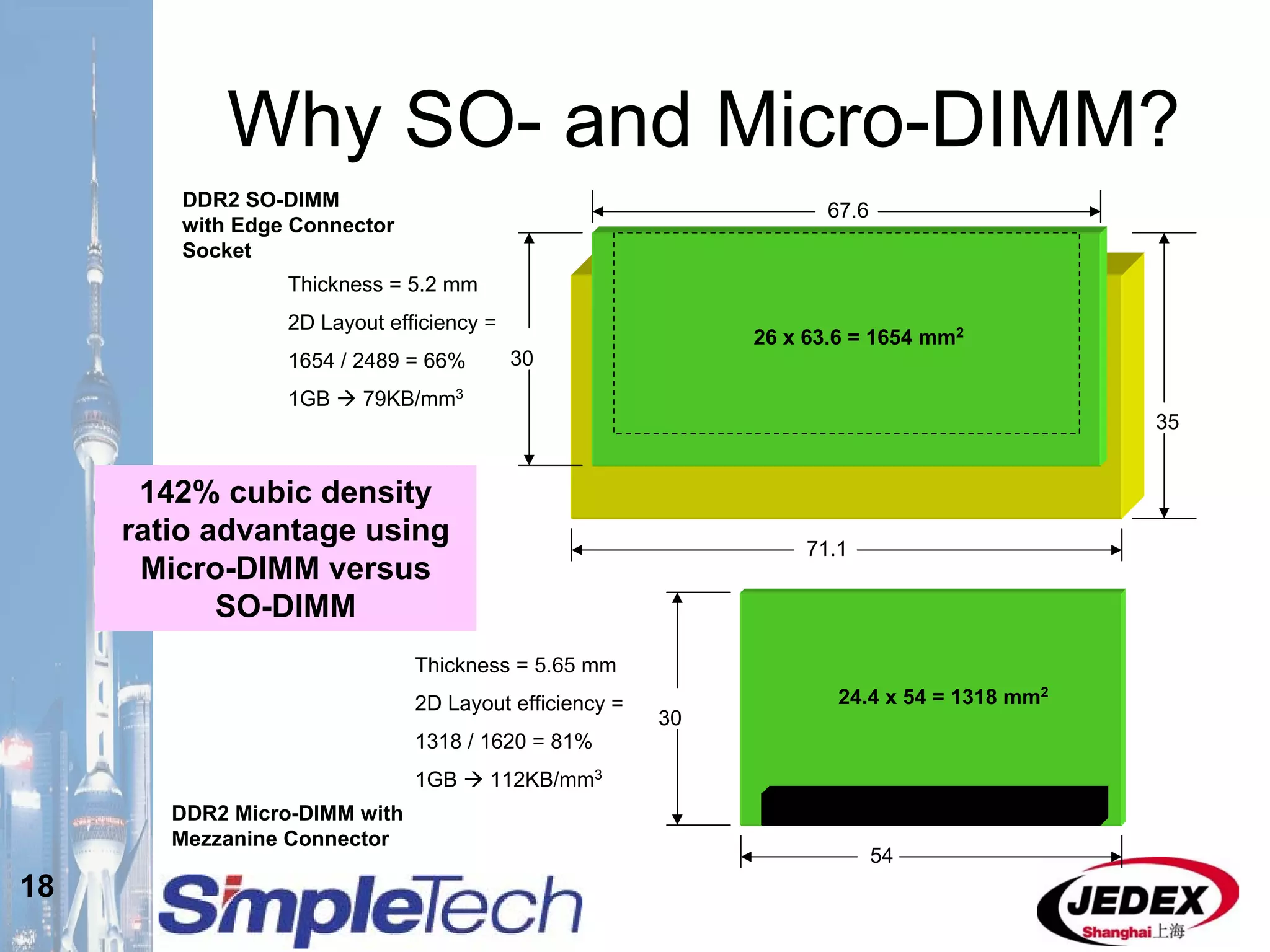
Why SO- and Micro-DIMM?
DDR2 SO-DIMM
with Edge Connector
Socket
DDR2 Micro-DIMM with
Mezzanine Connector
30
67.6
71.1
35
24.4 x 54 = 1318 mm2
26 x 63.6 = 1654 mm2
54
30
Thickness = 5.2 mm
2D Layout efficiency =
1654 / 2489 = 66%
1GB 79KB/mm3
Thickness = 5.65 mm
2D Layout efficiency =
1318 / 1620 = 81%
1GB 112KB/mm3
142% cubic density
ratio advantage using
Micro-DIMM versus
SO-DIMM
19
Module Markets:
Servers & Workstations
20
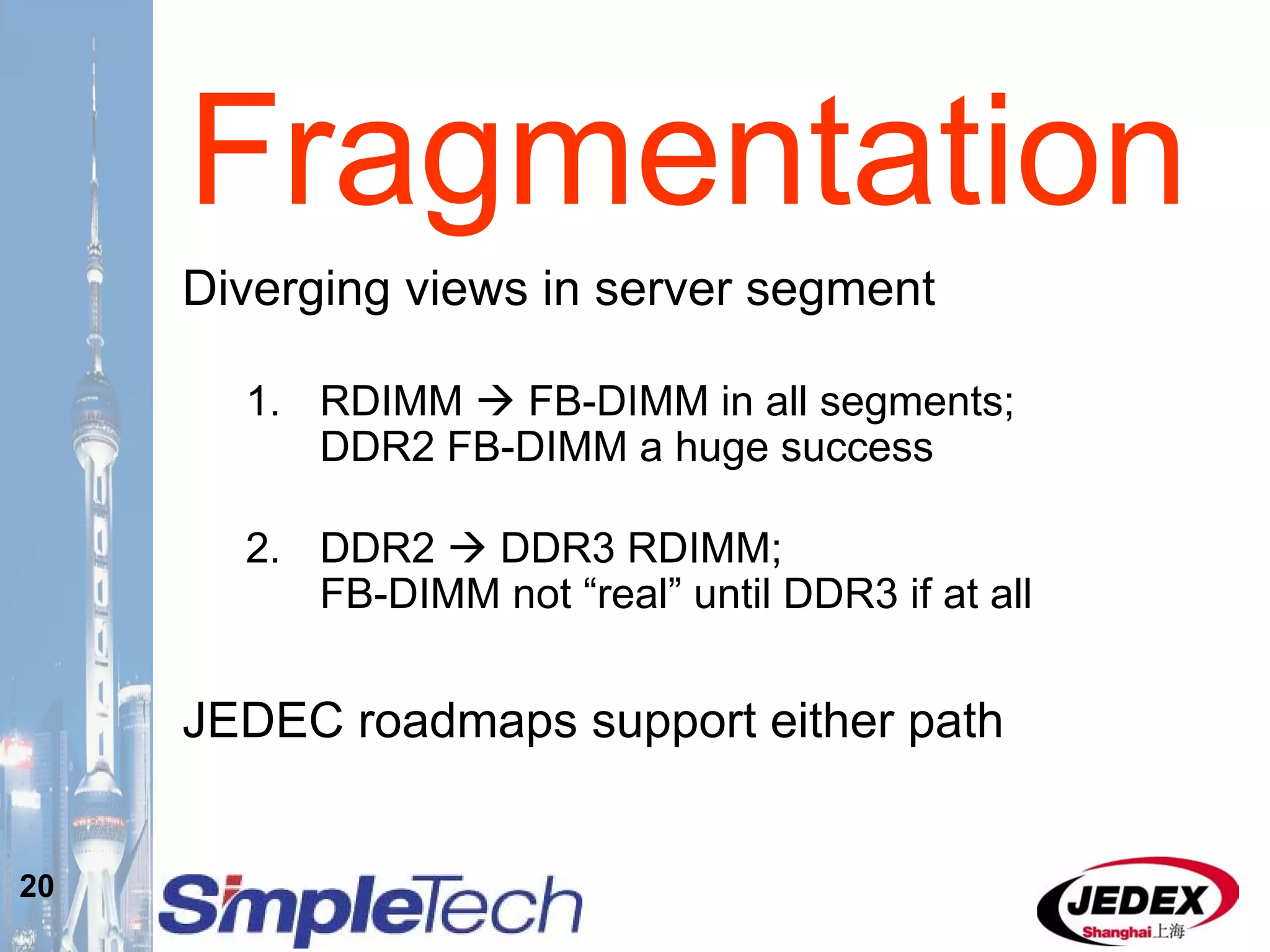
Fragmentation
Diverging views in server segment
1. RDIMM FB-DIMM in all segments;
DDR2 FB-DIMM a huge success
2. DDR2 DDR3 RDIMM;
FB-DIMM not “real” until DDR3 if at all
JEDEC roadmaps support either path
21
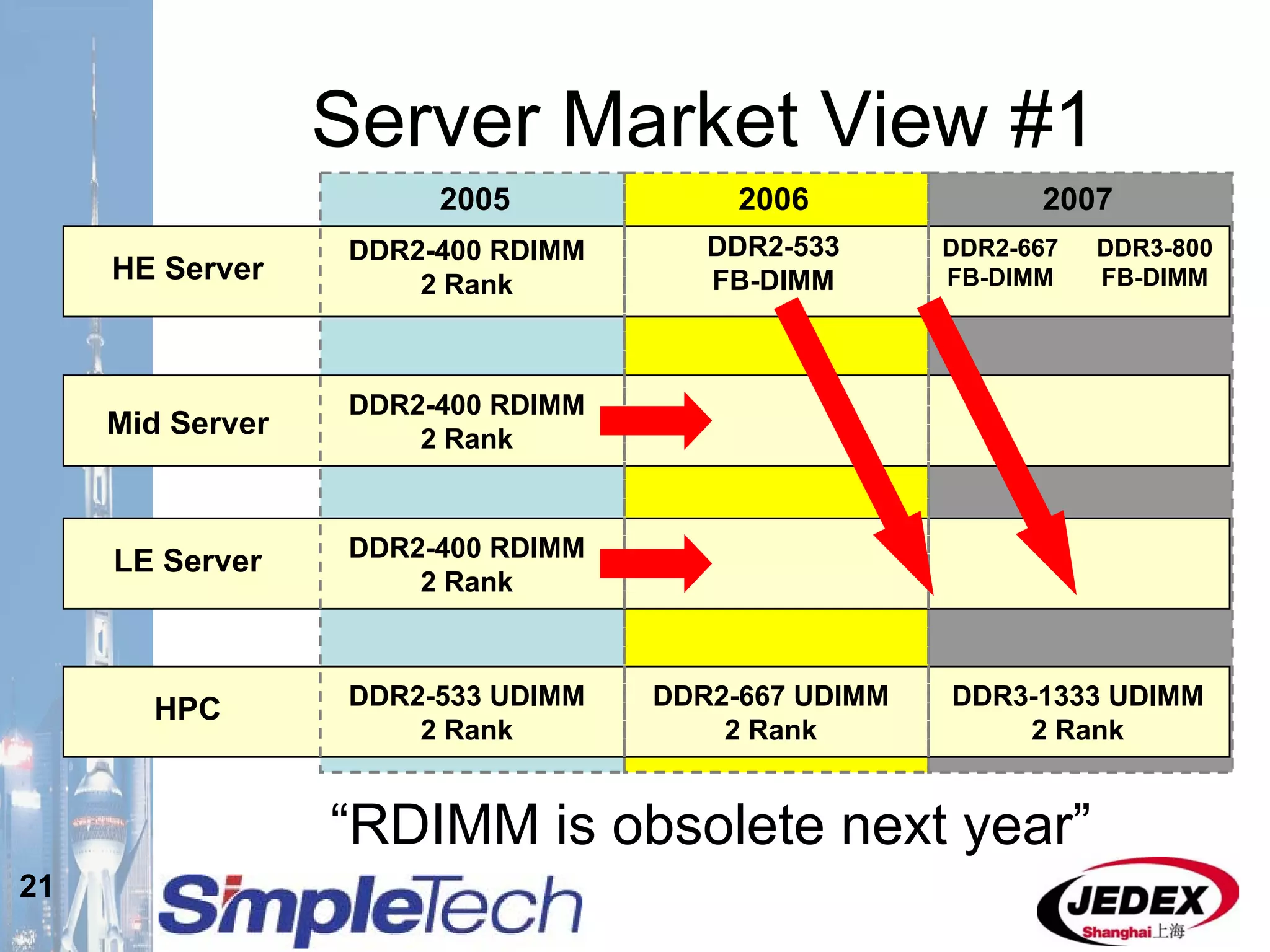
2005 2006 2007
HE Server
Mid Server
LE Server
DDR2-400 RDIMM
2 Rank
DDR2-400 RDIMM
2 Rank
DDR2-400 RDIMM
2 Rank
DDR2-533
FB-DIMM
DDR2-667
FB-DIMM
DDR3-800
FB-DIMM
Server Market View #1
“RDIMM is obsolete next year”
HPC DDR2-533 UDIMM
2 Rank
DDR2-667 UDIMM
2 Rank
DDR3-1333 UDIMM
2 Rank
22
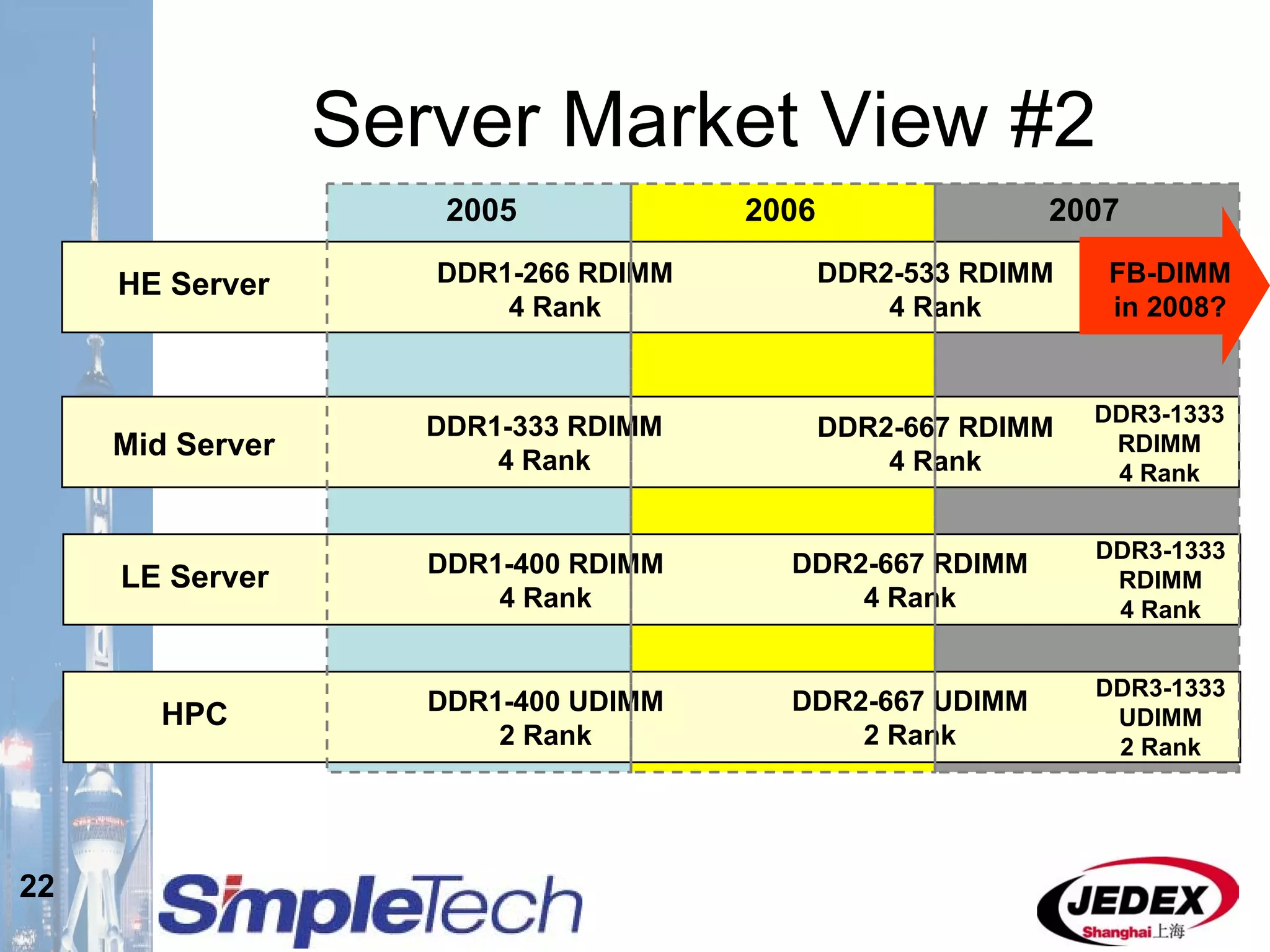
2005 2006 2007
HE Server
Mid Server
LE Server
DDR1-266 RDIMM
4 Rank
DDR1-333 RDIMM
4 Rank
DDR1-400 RDIMM
4 Rank
DDR2-533 RDIMM
4 Rank
DDR2-667 RDIMM
4 Rank
DDR2-667 RDIMM
4 Rank
Server Market View #2
DDR3-1333
RDIMM
4 Rank
DDR3-1333
RDIMM
4 Rank
HPC DDR1-400 UDIMM
2 Rank
DDR2-667 UDIMM
2 Rank
DDR3-1333
UDIMM
2 Rank
FB-DIMM
in 2008?
23
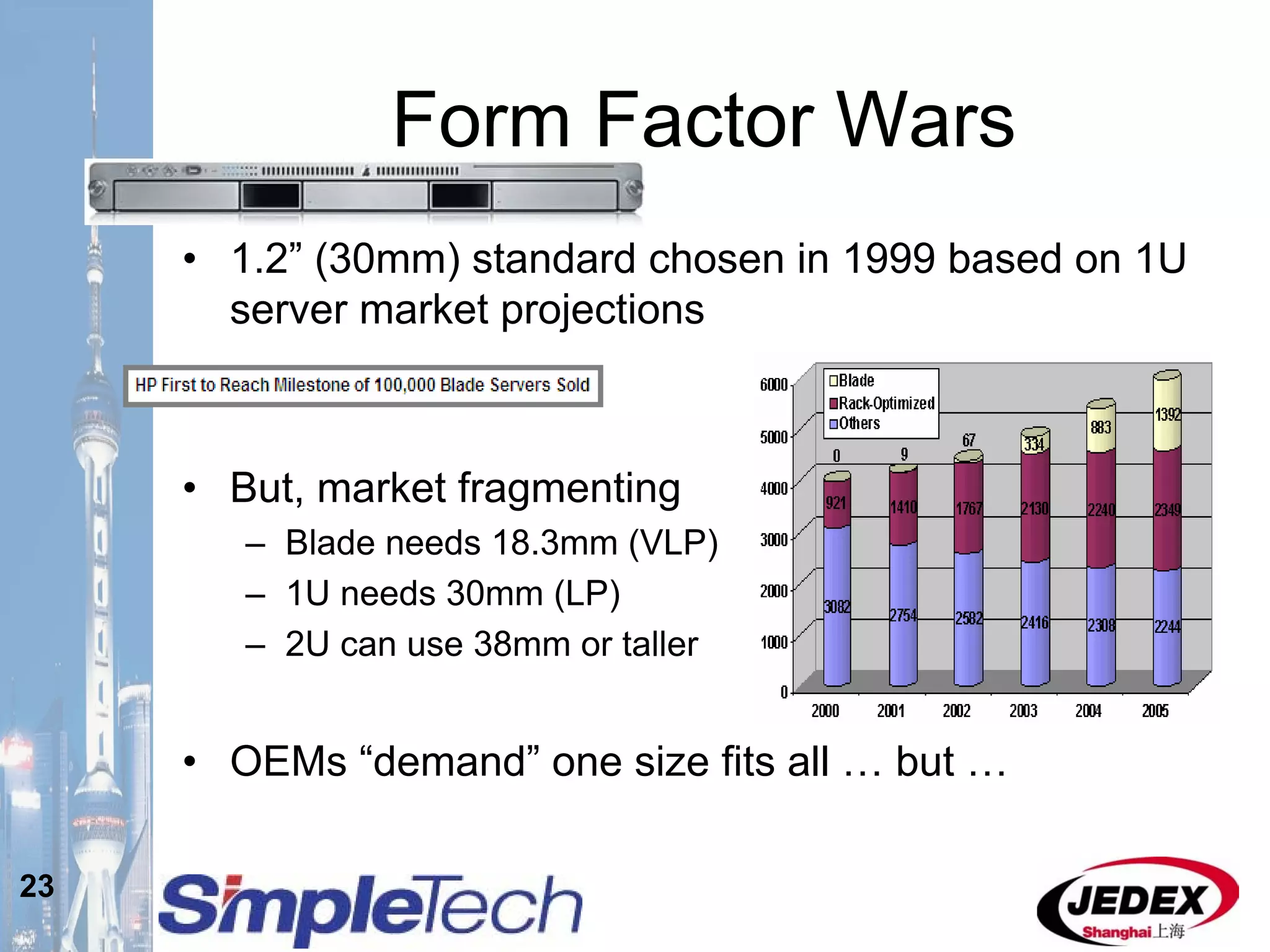
Form Factor Wars
• 1.2” (30mm) standard chosen in 1999 based on 1U
server market projections
• But, market fragmenting
– Blade needs 18.3mm (VLP)
– 1U needs 30mm (LP)
– 2U can use 38mm or taller
• OEMs “demand” one size fits all … but …
24
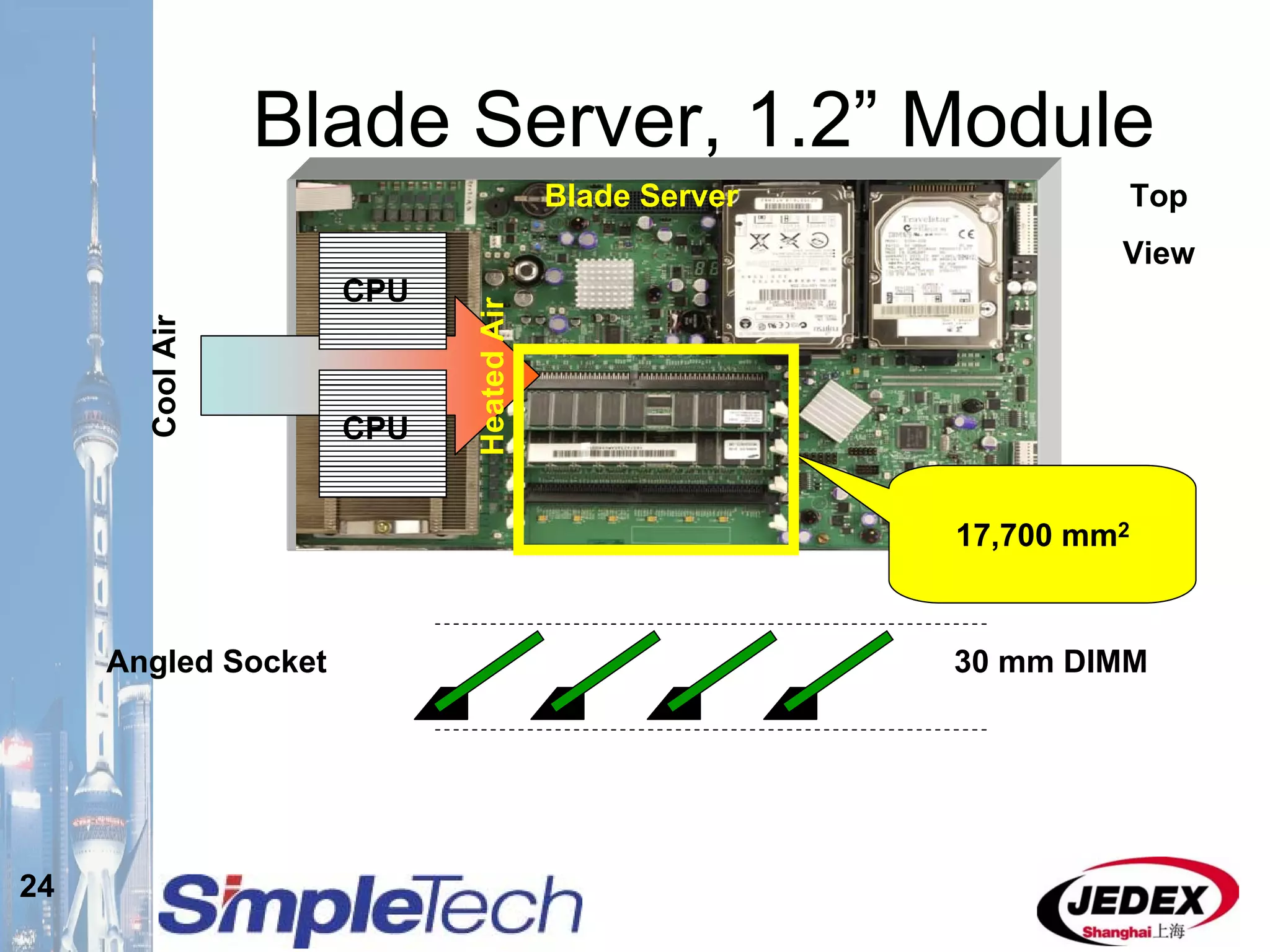
Blade Server, 1.2” Module
Angled Socket
17,700 mm2
CoolAir
HeatedAir
Top
View
CPU
CPU
30 mm DIMM
Blade Server
25
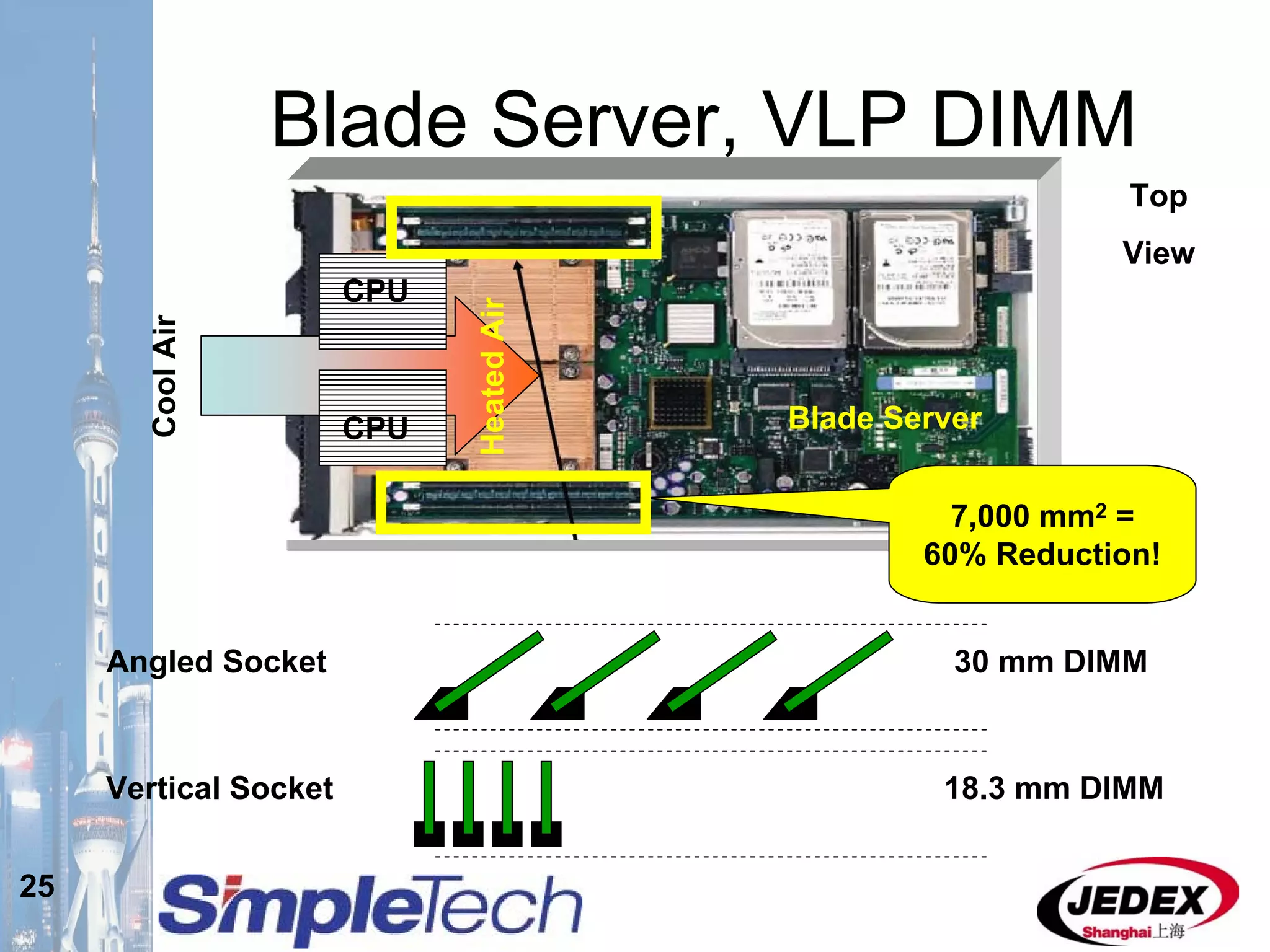
Blade Server, VLP DIMM
Angled Socket
Vertical Socket
7,000 mm2 =
60% Reduction!
CoolAir
HeatedAir
30 mm DIMM
18.3 mm DIMM
Top
View
CPU
CPU
Blade Server
26
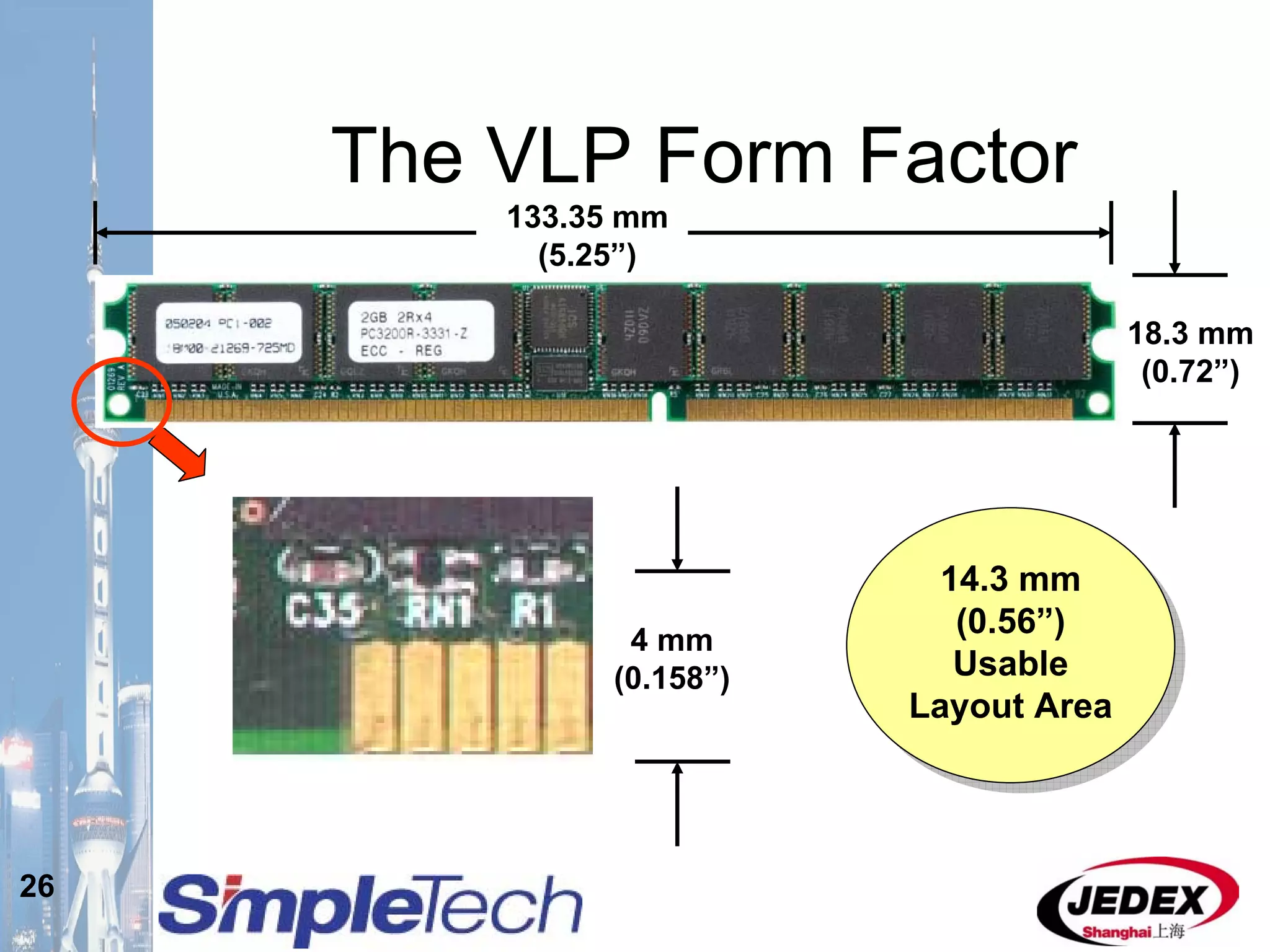
The VLP Form Factor
133.35 mm
(5.25”)
4 mm
(0.158”)
14.3 mm
(0.56”)
Usable
Layout Area
18.3 mm
(0.72”)
27
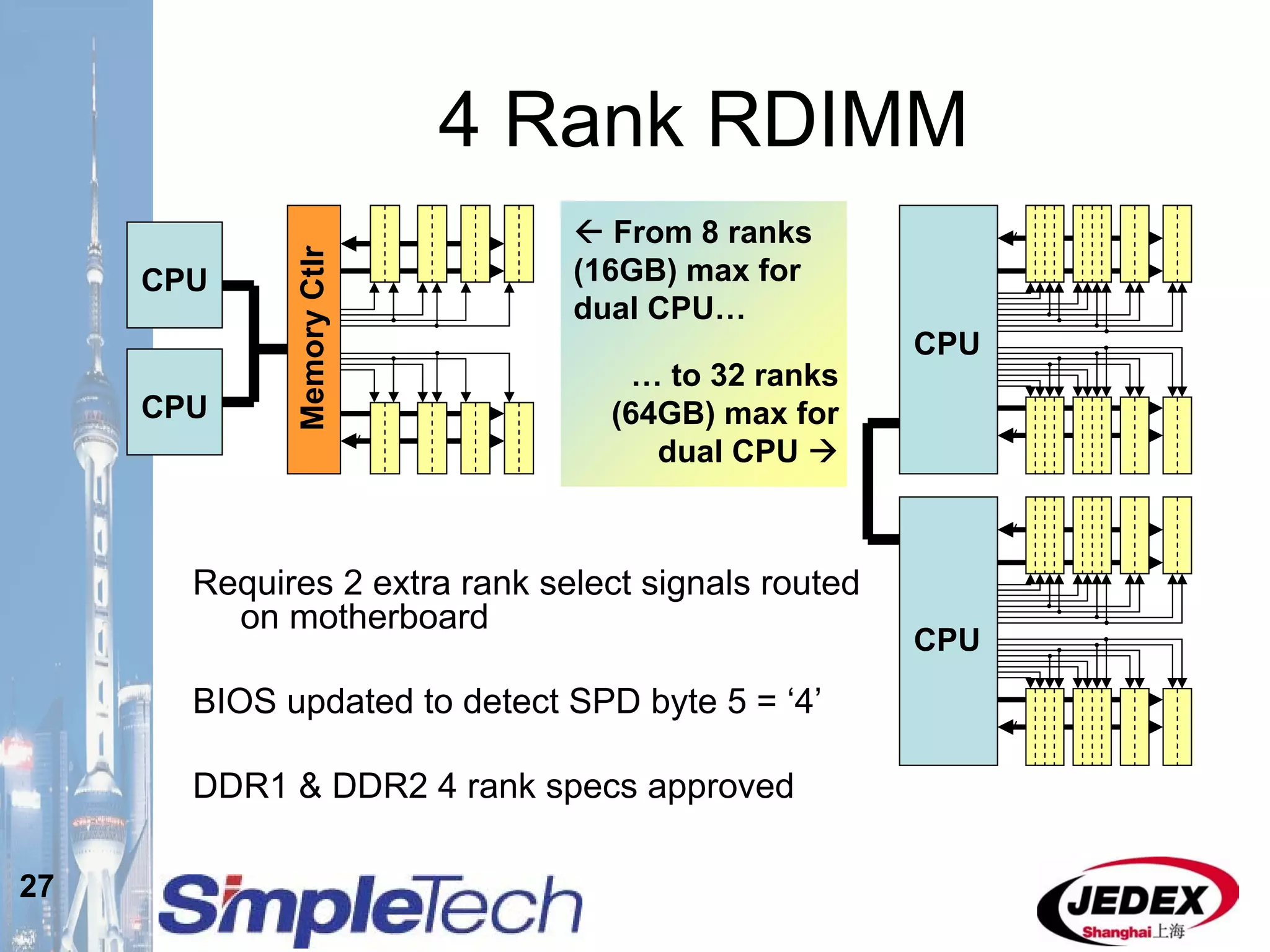
4 Rank RDIMM
Requires 2 extra rank select signals routed
on motherboard
BIOS updated to detect SPD byte 5 = ‘4’
DDR1 & DDR2 4 rank specs approved
From 8 ranks
(16GB) max for
dual CPU…
… to 32 ranks
(64GB) max for
dual CPU
CPU
CPU
CPU
CPU
MemoryCtlr
28
Fully Buffered DIMM
29
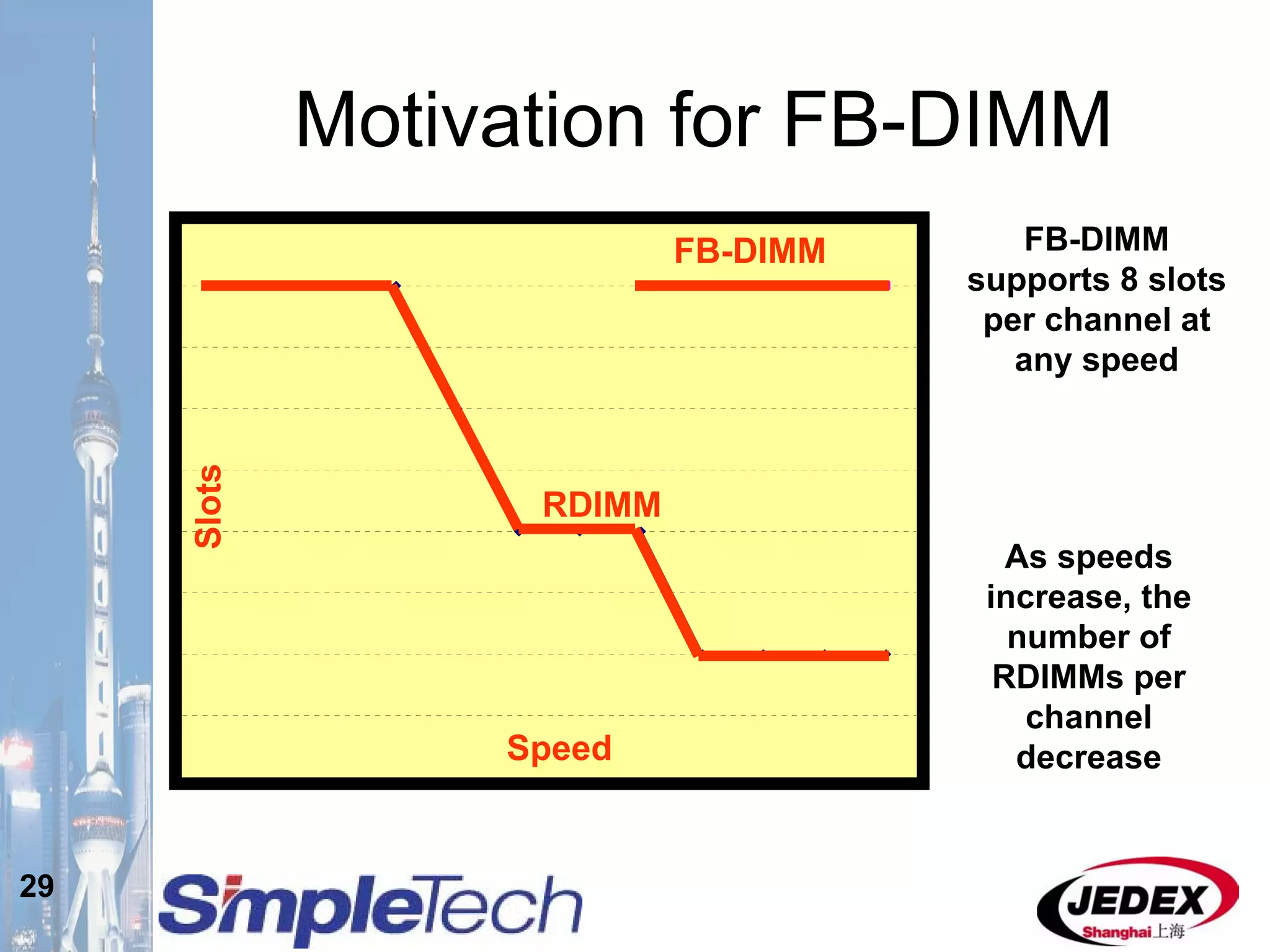
Motivation for FB-DIMM
As speeds
increase, the
number of
RDIMMs per
channel
decreaseSpeed
Slots
RDIMM
FB-DIMM FB-DIMM
supports 8 slots
per channel at
any speed
30
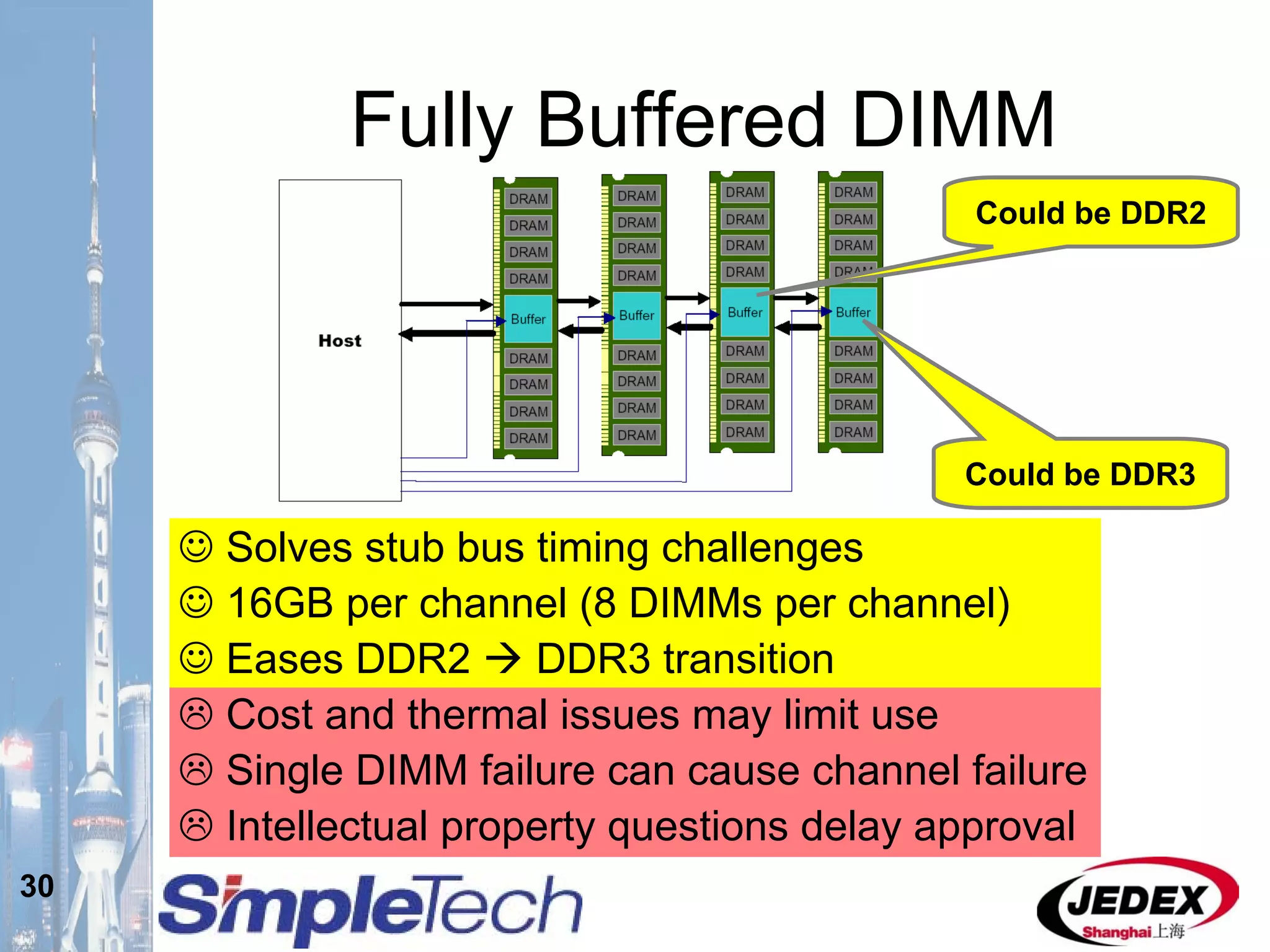
Fully Buffered DIMM
☺ Solves stub bus timing challenges
☺ 16GB per channel (8 DIMMs per channel)
☺ Eases DDR2 DDR3 transition
Cost and thermal issues may limit use
Single DIMM failure can cause channel failure
Intellectual property questions delay approval
Could be DDR2
Could be DDR3
31
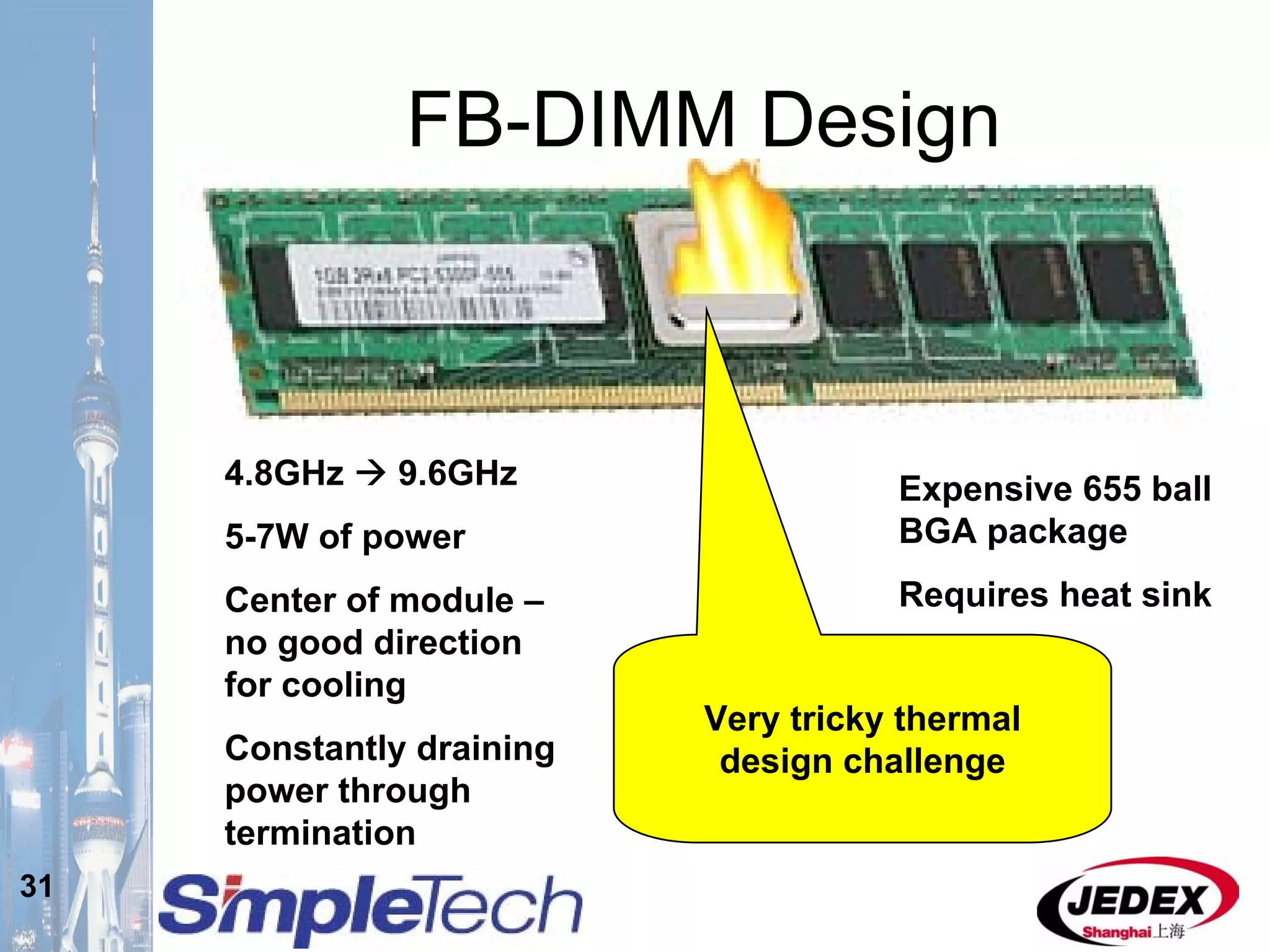
4.8GHz 9.6GHz
5-7W of power
Center of module –
no good direction
for cooling
Constantly draining
power through
termination
Expensive 655 ball
BGA package
Requires heat sink
Very tricky thermal
design challenge
FB-DIMM Design
32
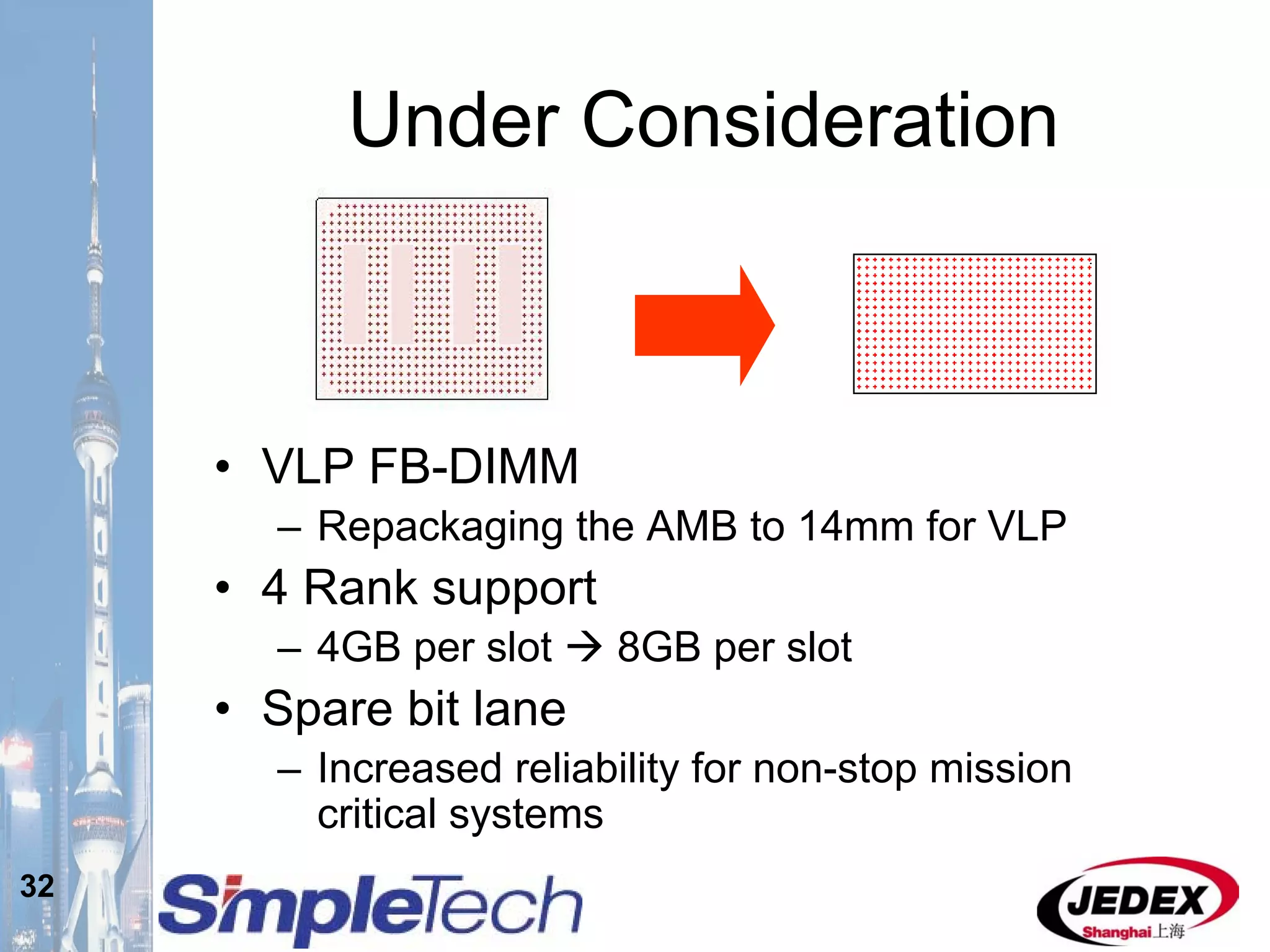
Under Consideration
• VLP FB-DIMM
– Repackaging the AMB to 14mm for VLP
• 4 Rank support
– 4GB per slot 8GB per slot
• Spare bit lane
– Increased reliability for non-stop mission
critical systems
33
Unbuffered & Registered
DIMMs
34
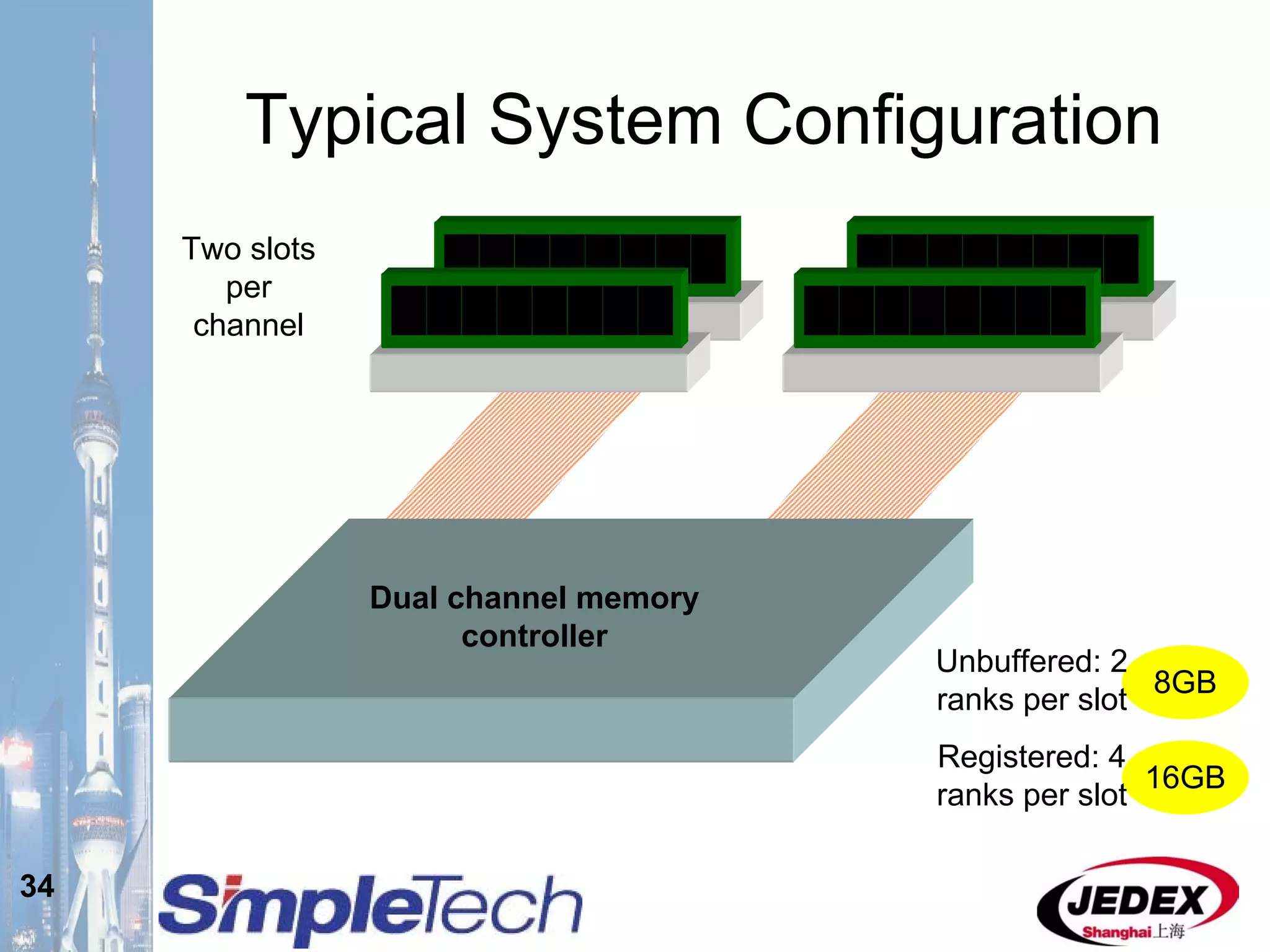
Typical System Configuration
Two slots
per
channel
Dual channel memory
controller
Unbuffered: 2
ranks per slot
Registered: 4
ranks per slot
8GB
16GB
35
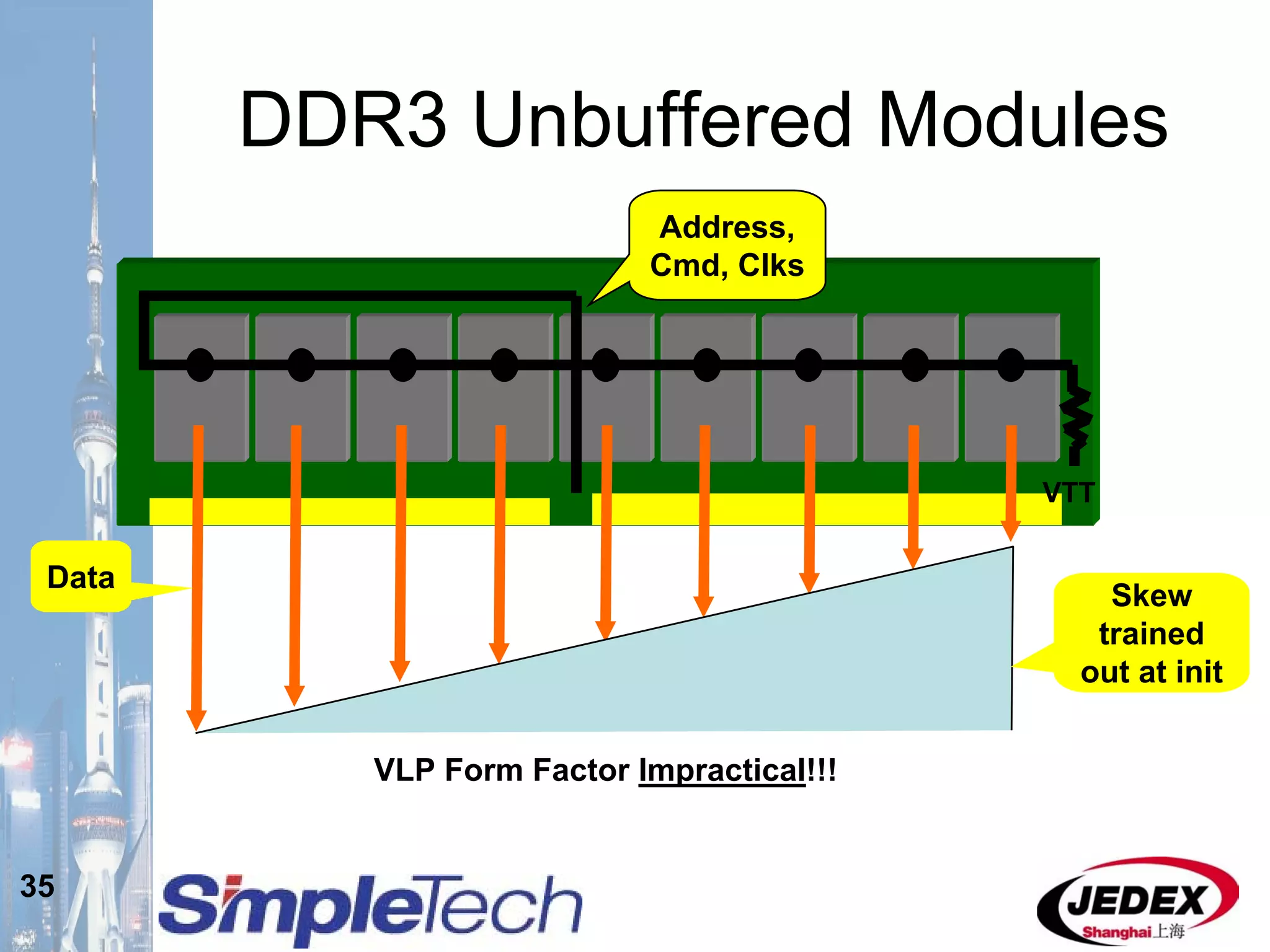
DDR3 Unbuffered Modules
VTT
Skew
trained
out at init
Address,
Cmd, Clks
Data
VLP Form Factor Impractical!!!
36
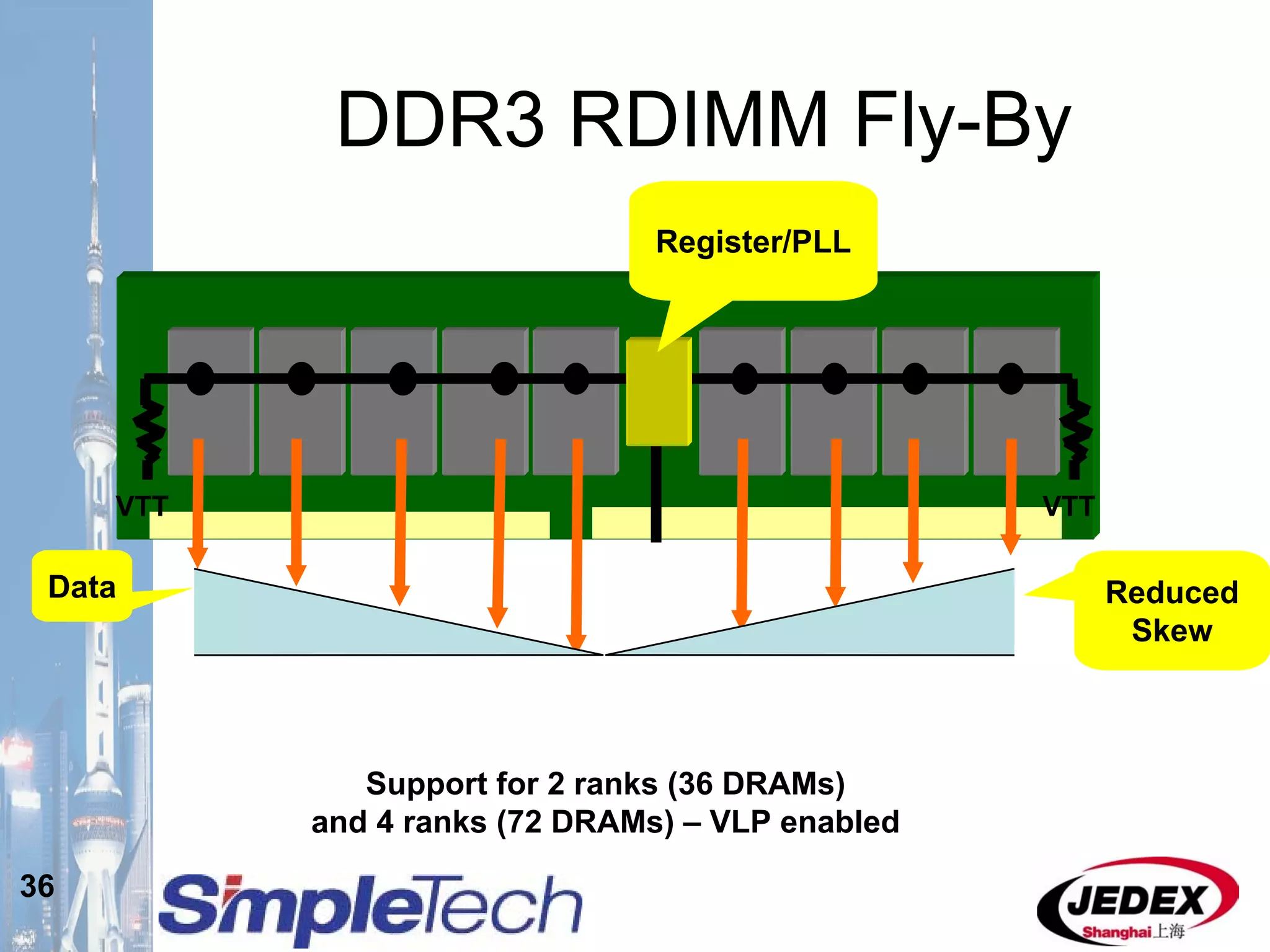
DDR3 RDIMM Fly-By
VTTVTT
Support for 2 ranks (36 DRAMs)
and 4 ranks (72 DRAMs) – VLP enabled
Register/PLL
Reduced
Skew
Data
37
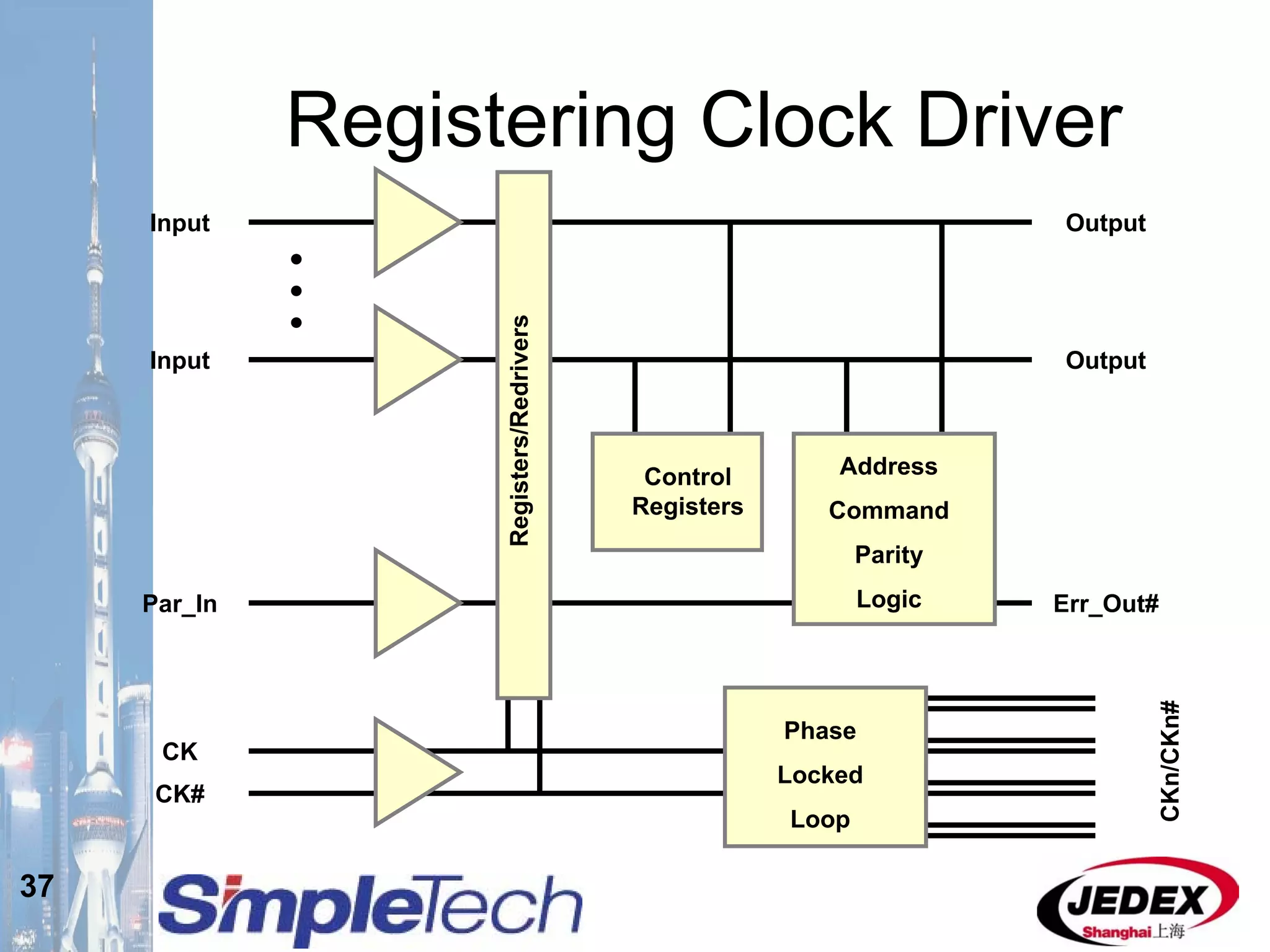
Registering Clock Driver
Address
Command
Parity
Logic
Registers/Redrivers
Input Output
OutputInput
Par_In Err_Out#
CK
CK#
CKn/CKn#
Phase
Locked
Loop
Control
Registers
38
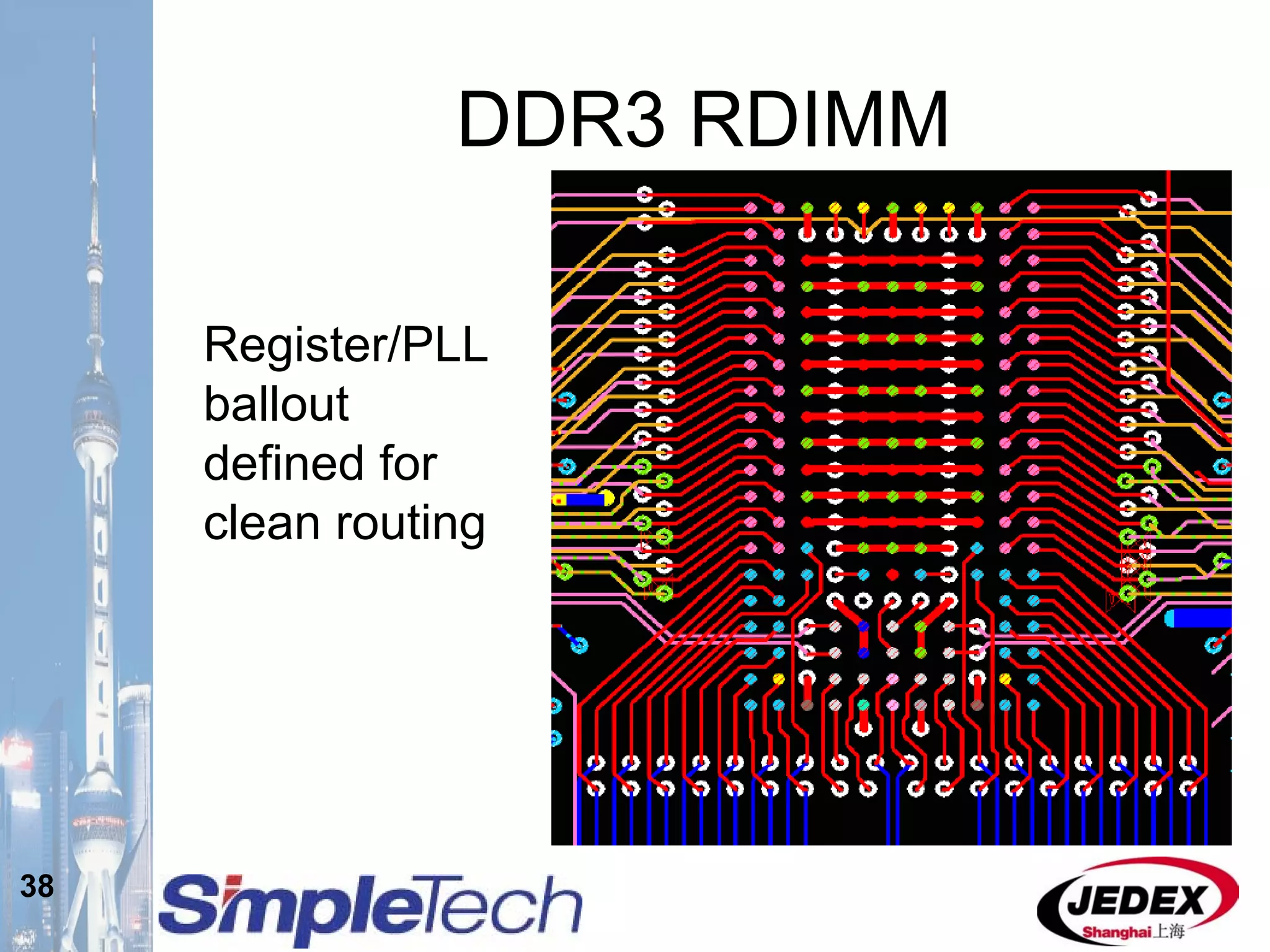
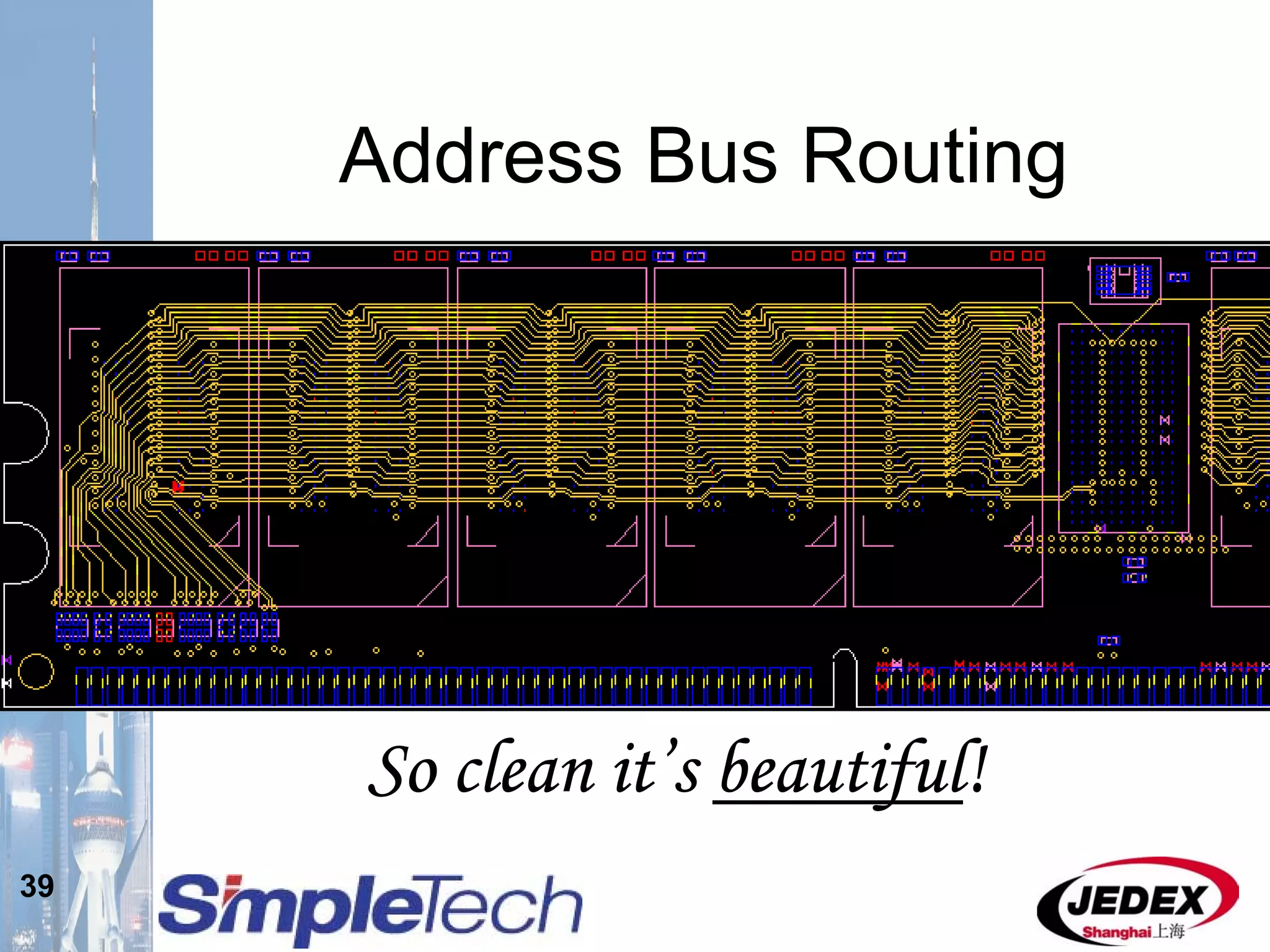
DDR3 RDIMM
Register/PLL
ballout
defined for
clean routing
39
Address Bus Routing
So clean it’s beautiful!
40
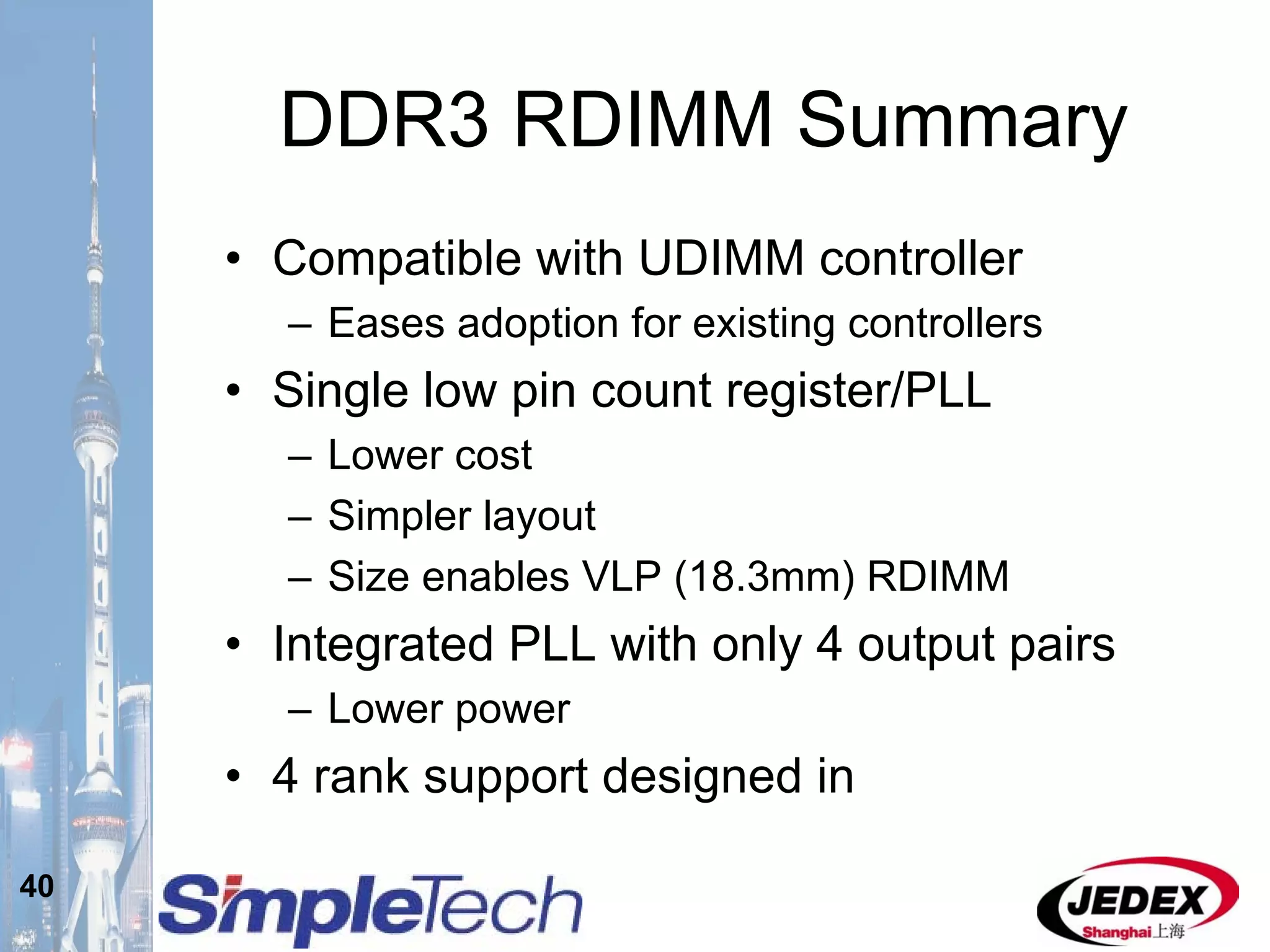
DDR3 RDIMM Summary
• Compatible with UDIMM controller
– Eases adoption for existing controllers
• Single low pin count register/PLL
– Lower cost
– Simpler layout
– Size enables VLP (18.3mm) RDIMM
• Integrated PLL with only 4 output pairs
– Lower power
• 4 rank support designed in
41
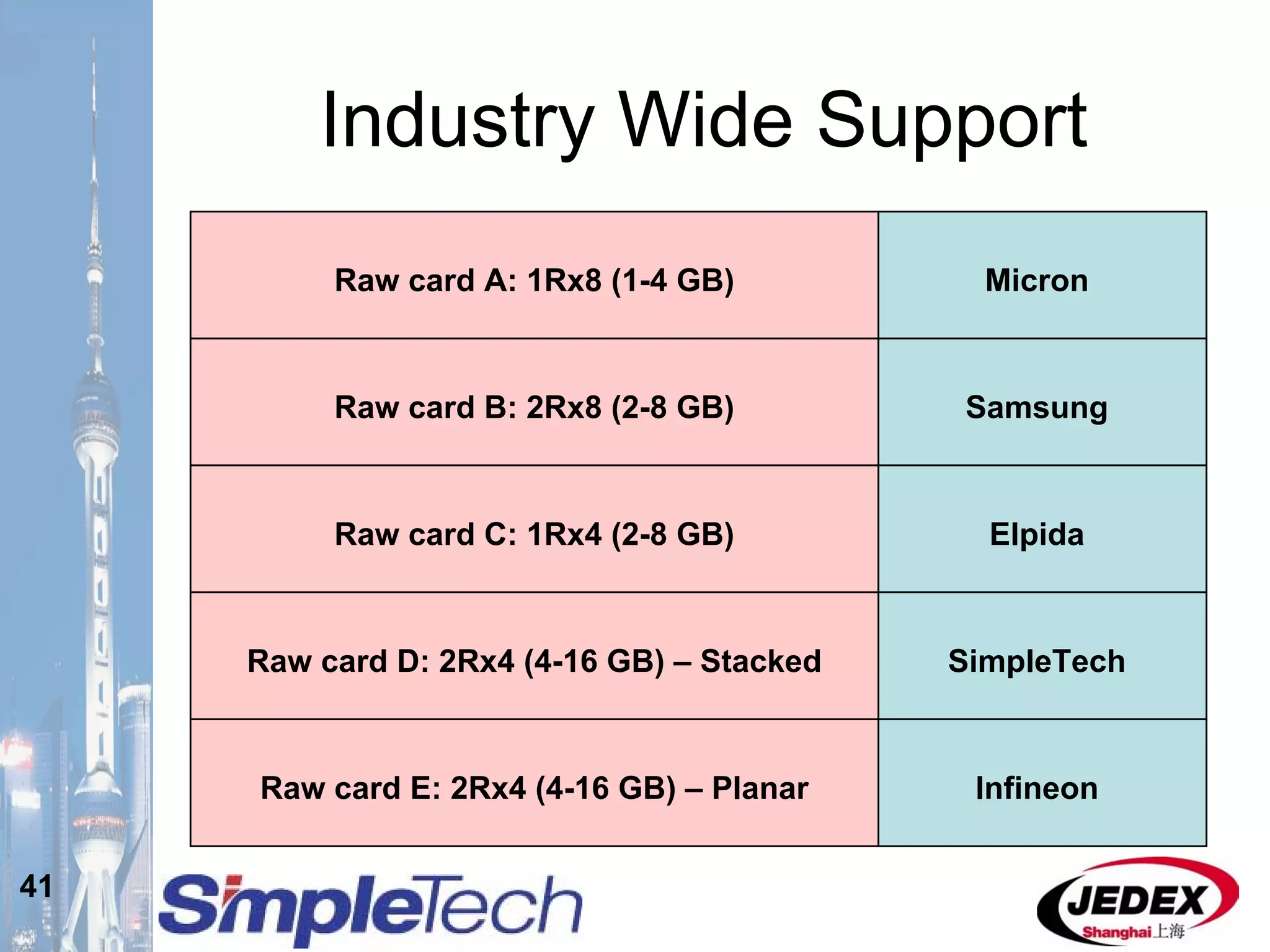
Industry Wide Support
Raw card A: 1Rx8 (1-4 GB) Micron
Raw card B: 2Rx8 (2-8 GB) Samsung
Raw card C: 1Rx4 (2-8 GB) Elpida
Raw card D: 2Rx4 (4-16 GB) – Stacked SimpleTech
Raw card E: 2Rx4 (4-16 GB) – Planar Infineon
42
What Happens in Server &
Workstation Market?
43
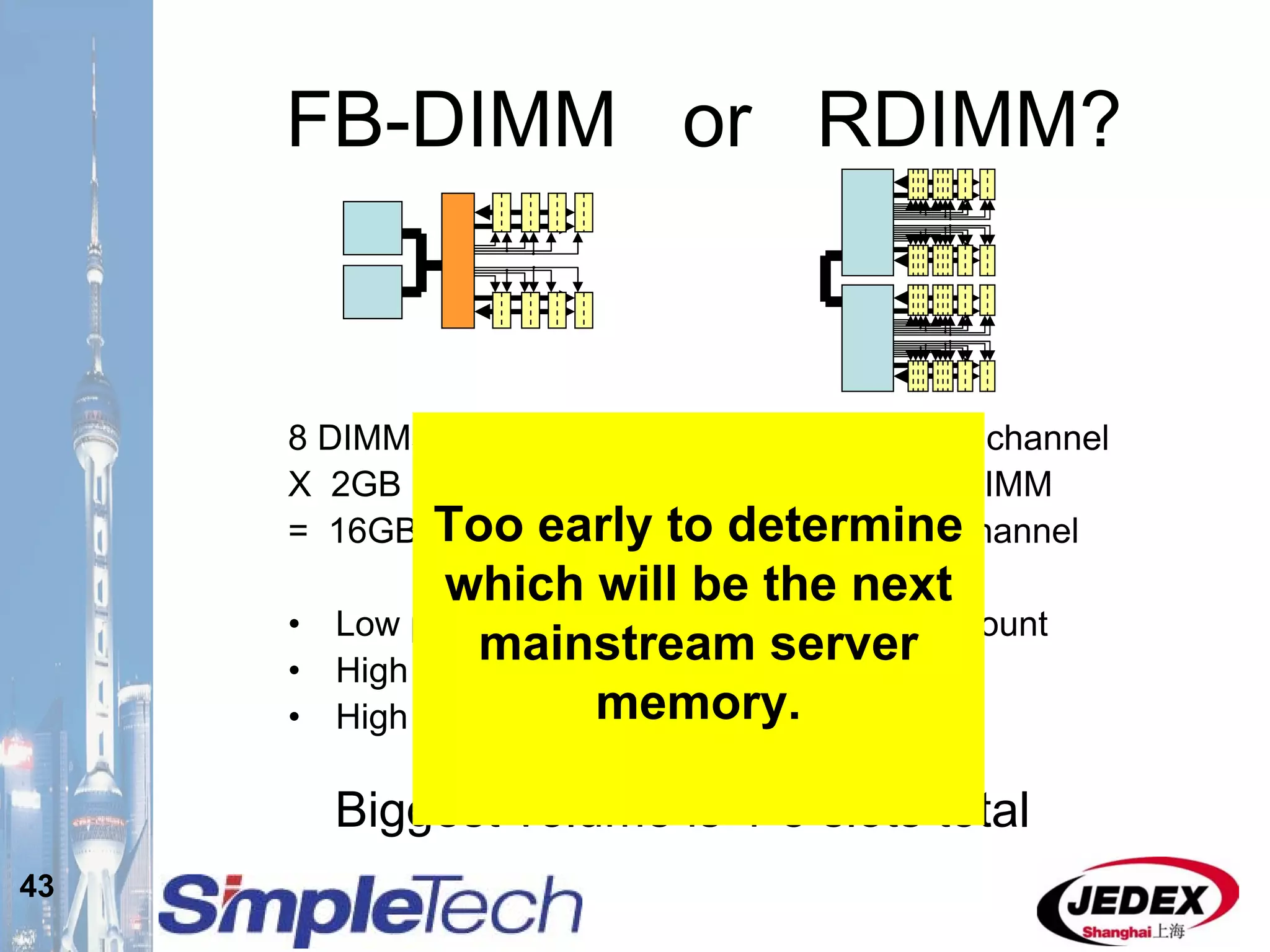
FB-DIMM or RDIMM?
8 DIMMs per channel
X 2GB per DIMM
= 16GB per channel
• Low pin count
• High cost
• High heat
2 DIMMs per channel
X 4GB per DIMM
= 8GB per channel
• High pin count
• Low cost
• Low heat
Biggest volume is 4-8 slots total
Too early to determine
which will be the next
mainstream server
memory.
44
Router/Networking Markets
45
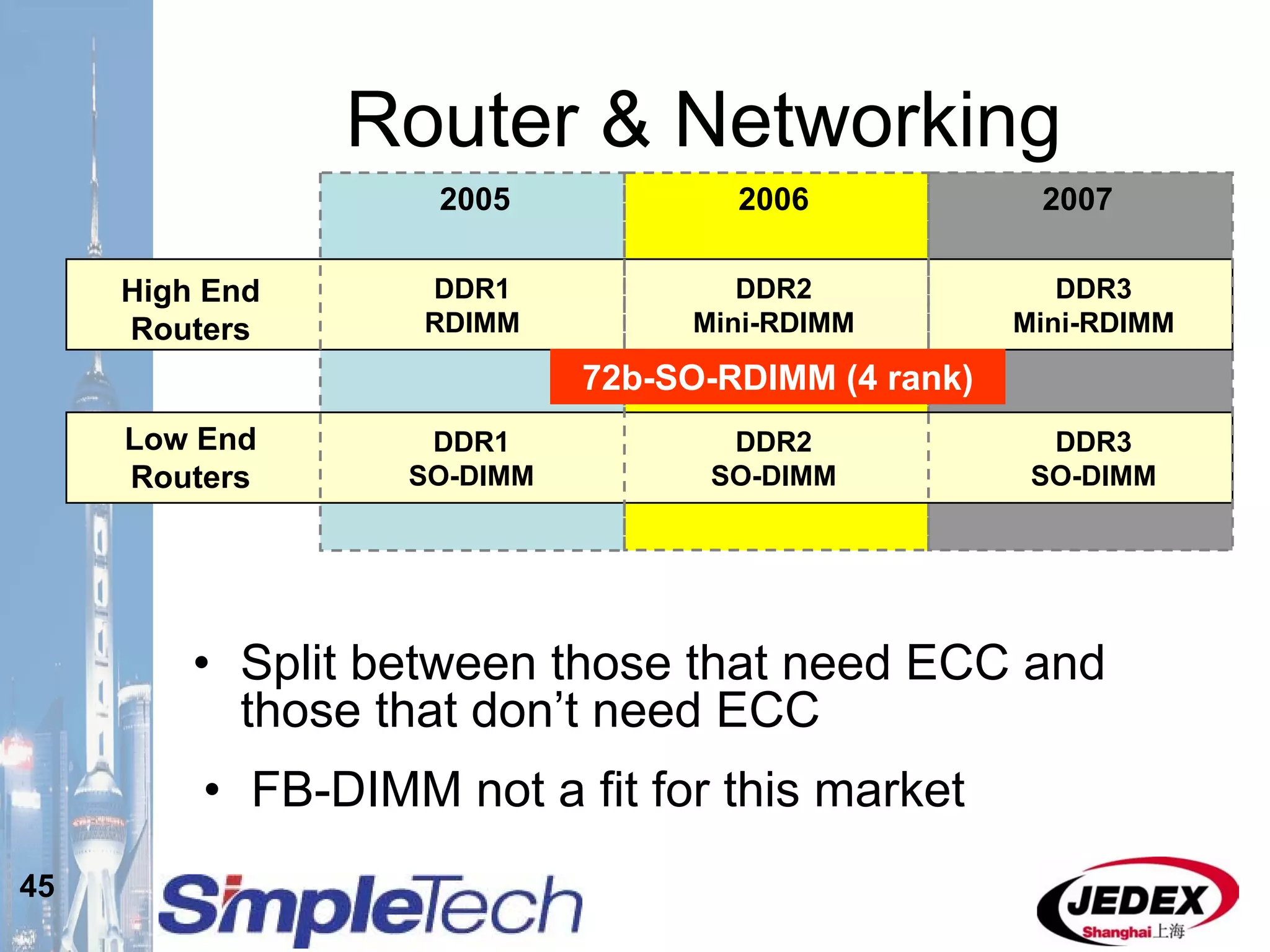
Router & Networking
2005 2006 2007
High End
Routers
DDR1
RDIMM
DDR2
Mini-RDIMM
• Split between those that need ECC and
those that don’t need ECC
DDR3
Mini-RDIMM
Low End
Routers
DDR1
SO-DIMM
DDR2
SO-DIMM
DDR3
SO-DIMM
• FB-DIMM not a fit for this market
72b-SO-RDIMM (4 rank)
46
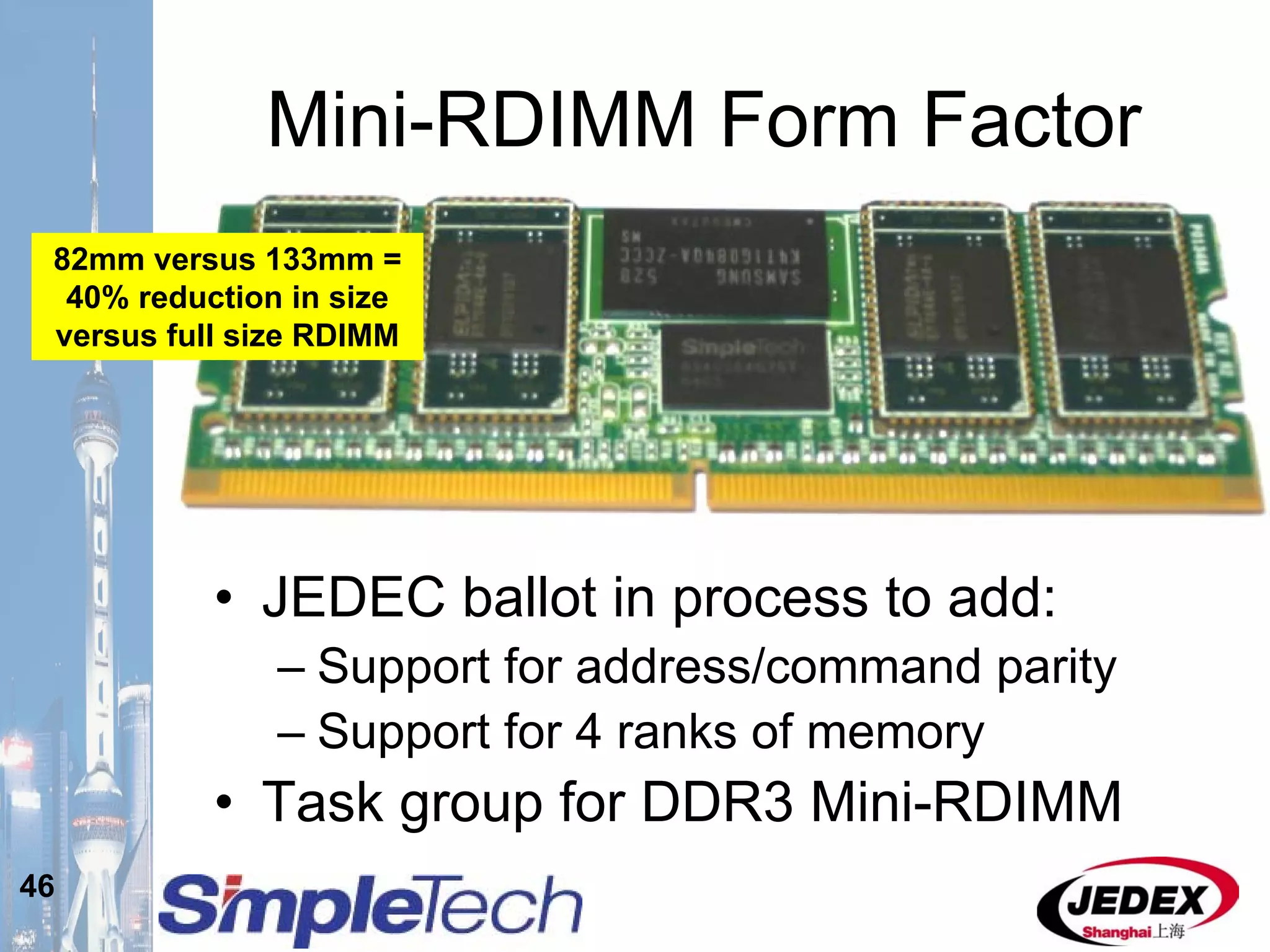
Mini-RDIMM Form Factor
• JEDEC ballot in process to add:
– Support for address/command parity
– Support for 4 ranks of memory
• Task group for DDR3 Mini-RDIMM
82mm versus 133mm =
40% reduction in size
versus full size RDIMM
47
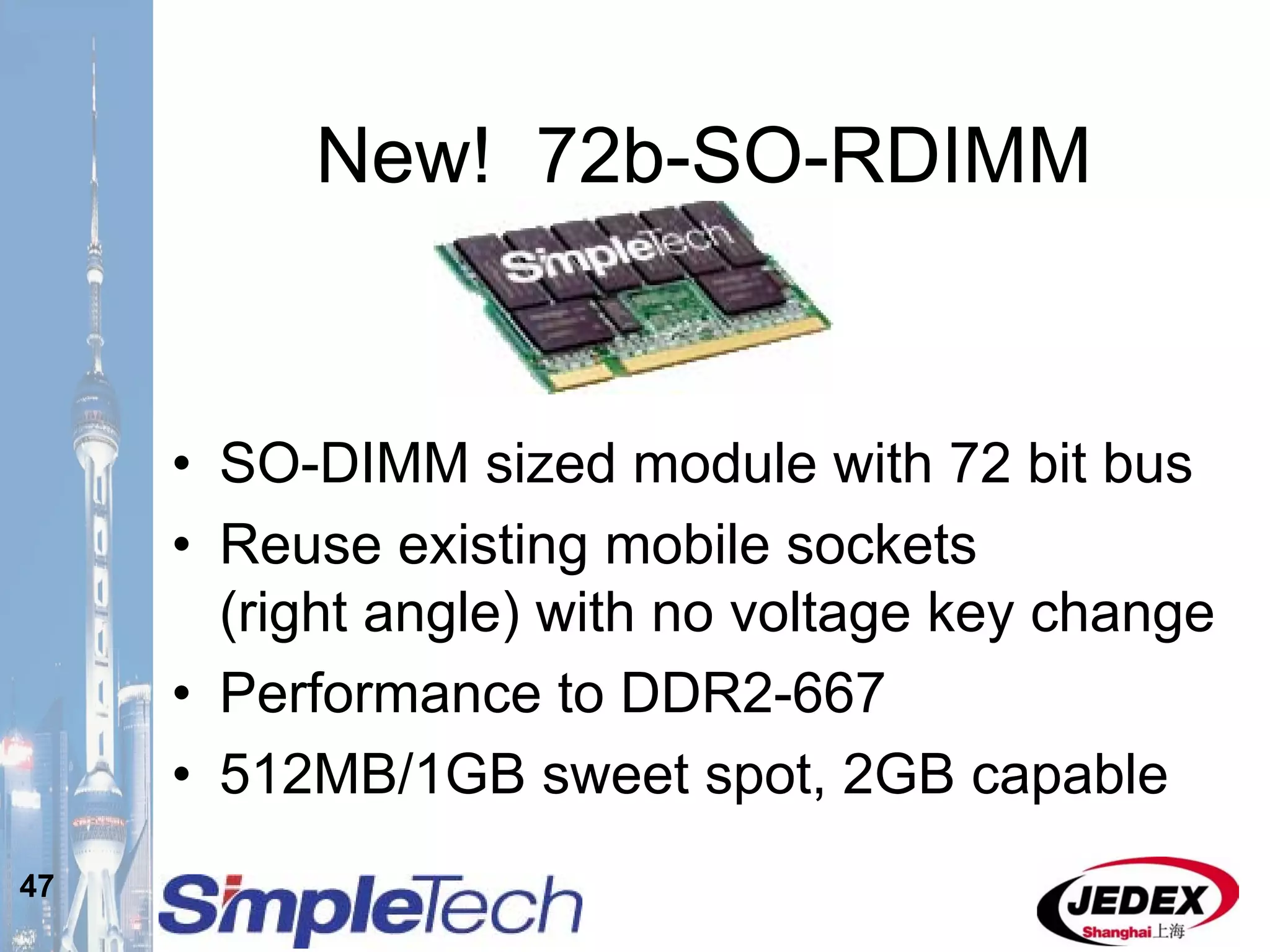
New! 72b-SO-RDIMM
• SO-DIMM sized module with 72 bit bus
• Reuse existing mobile sockets
(right angle) with no voltage key change
• Performance to DDR2-667
• 512MB/1GB sweet spot, 2GB capable
48
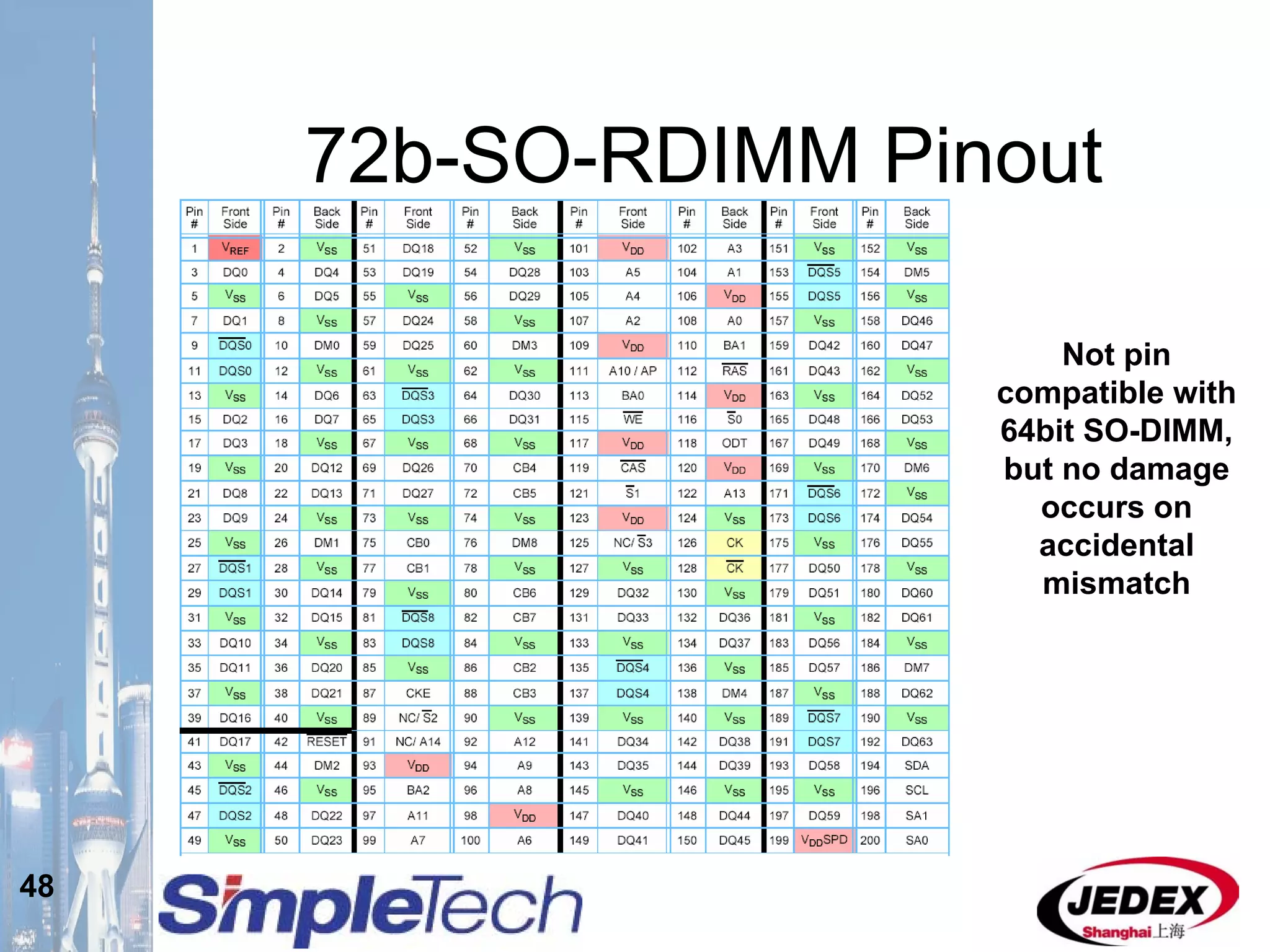
72b-SO-RDIMM Pinout
Not pin
compatible with
64bit SO-DIMM,
but no damage
occurs on
accidental
mismatch
49
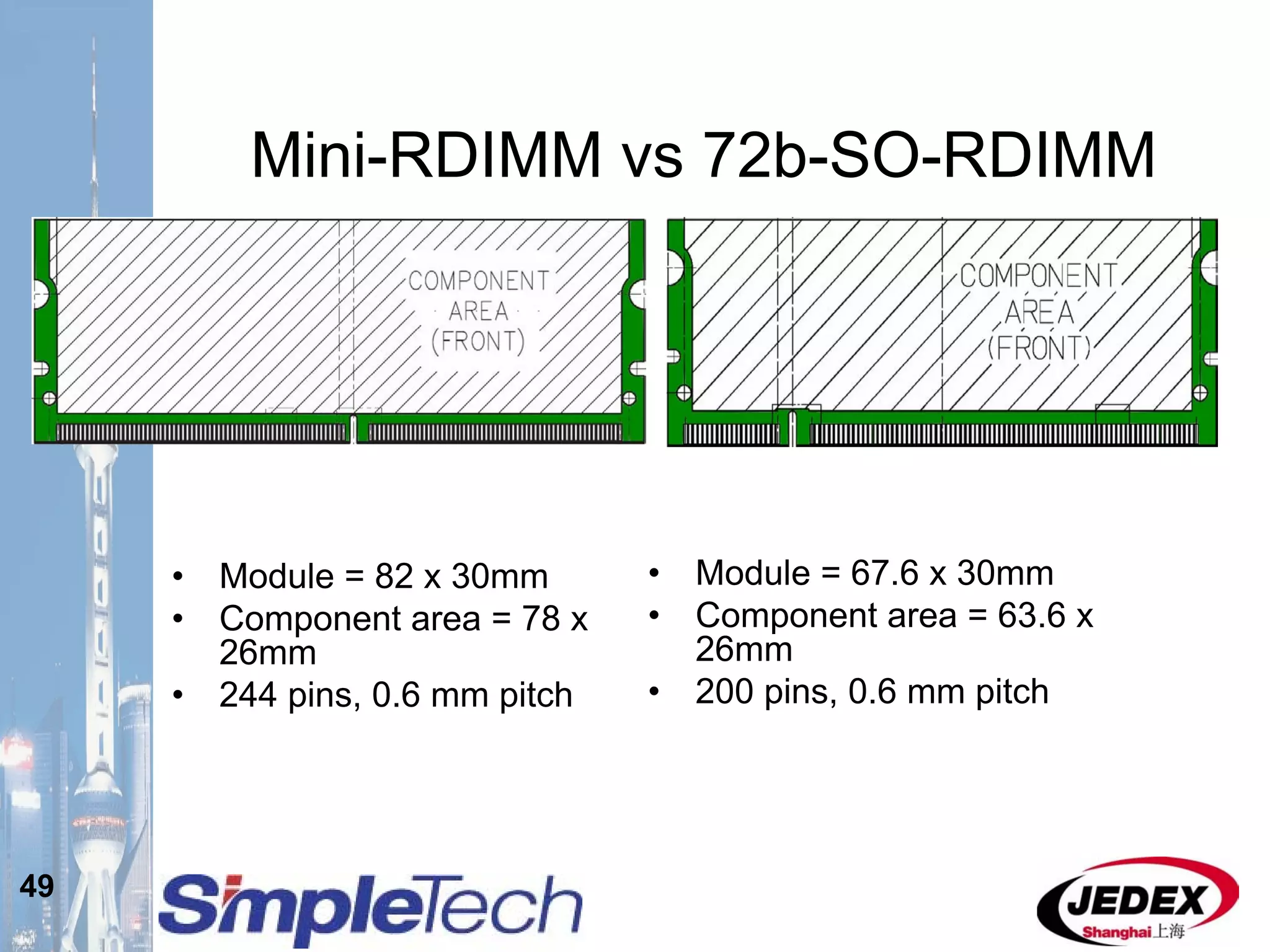
Mini-RDIMM vs 72b-SO-RDIMM
• Module = 82 x 30mm
• Component area = 78 x
26mm
• 244 pins, 0.6 mm pitch
• Module = 67.6 x 30mm
• Component area = 63.6 x
26mm
• 200 pins, 0.6 mm pitch
50
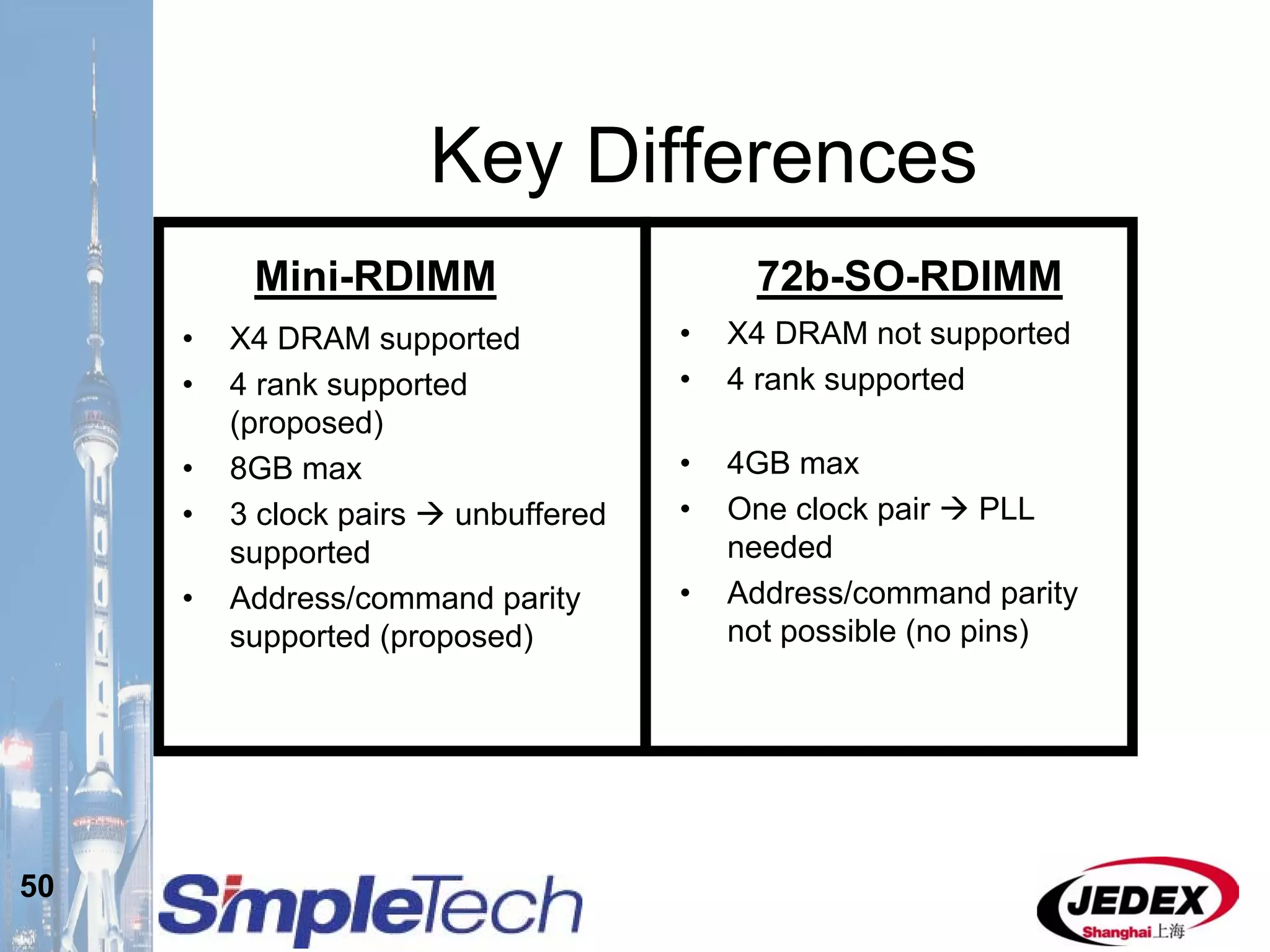
Key Differences
• X4 DRAM supported
• 4 rank supported
(proposed)
• 8GB max
• 3 clock pairs unbuffered
supported
• Address/command parity
supported (proposed)
• X4 DRAM not supported
• 4 rank supported
• 4GB max
• One clock pair PLL
needed
• Address/command parity
not possible (no pins)
Mini-RDIMM 72b-SO-RDIMM
51
Peripheral Markets
52
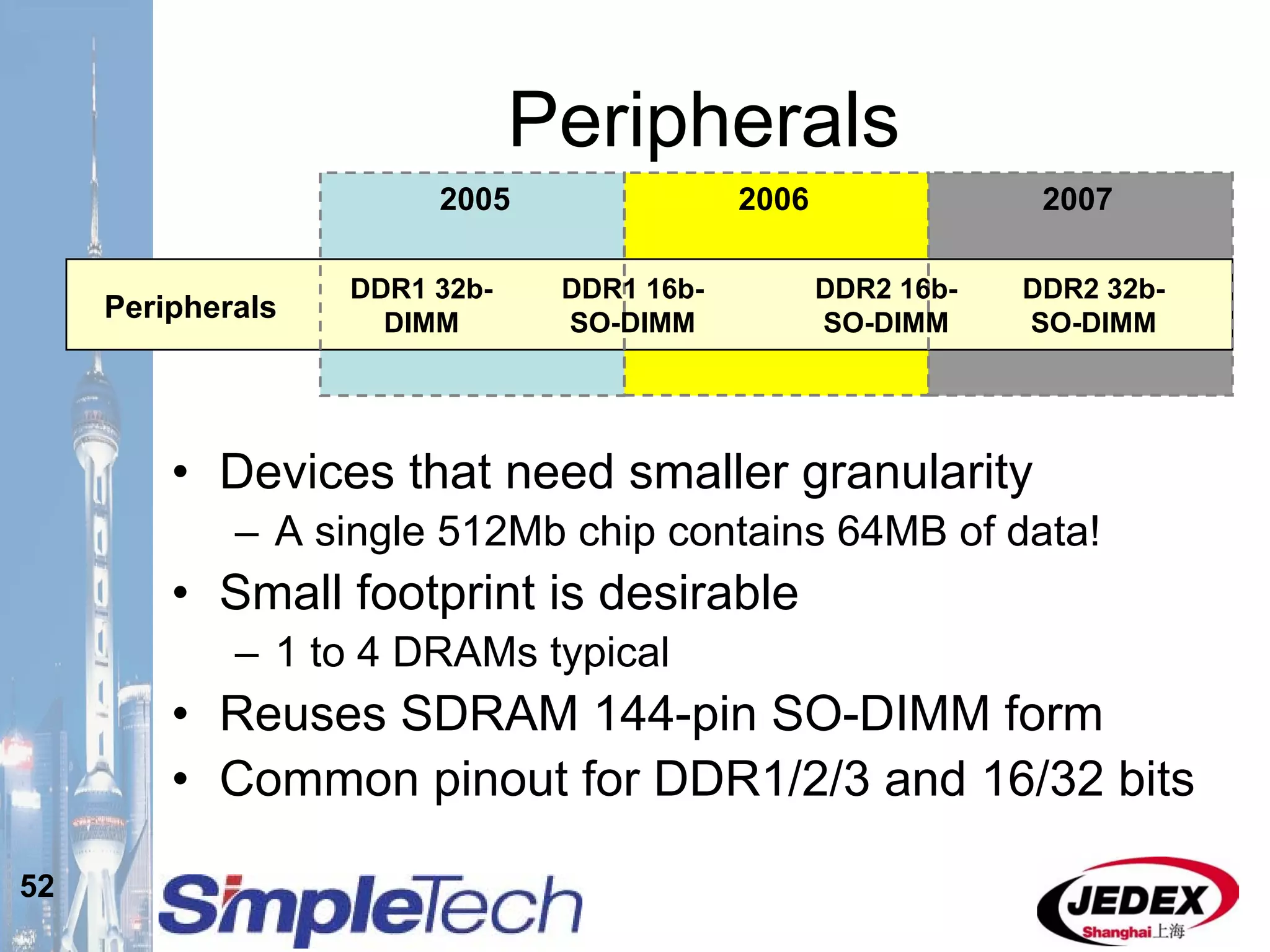
Peripherals
2005 2006 2007
Peripherals
DDR1 32b-
DIMM
DDR1 16b-
SO-DIMM
DDR2 16b-
SO-DIMM
• Devices that need smaller granularity
– A single 512Mb chip contains 64MB of data!
• Small footprint is desirable
– 1 to 4 DRAMs typical
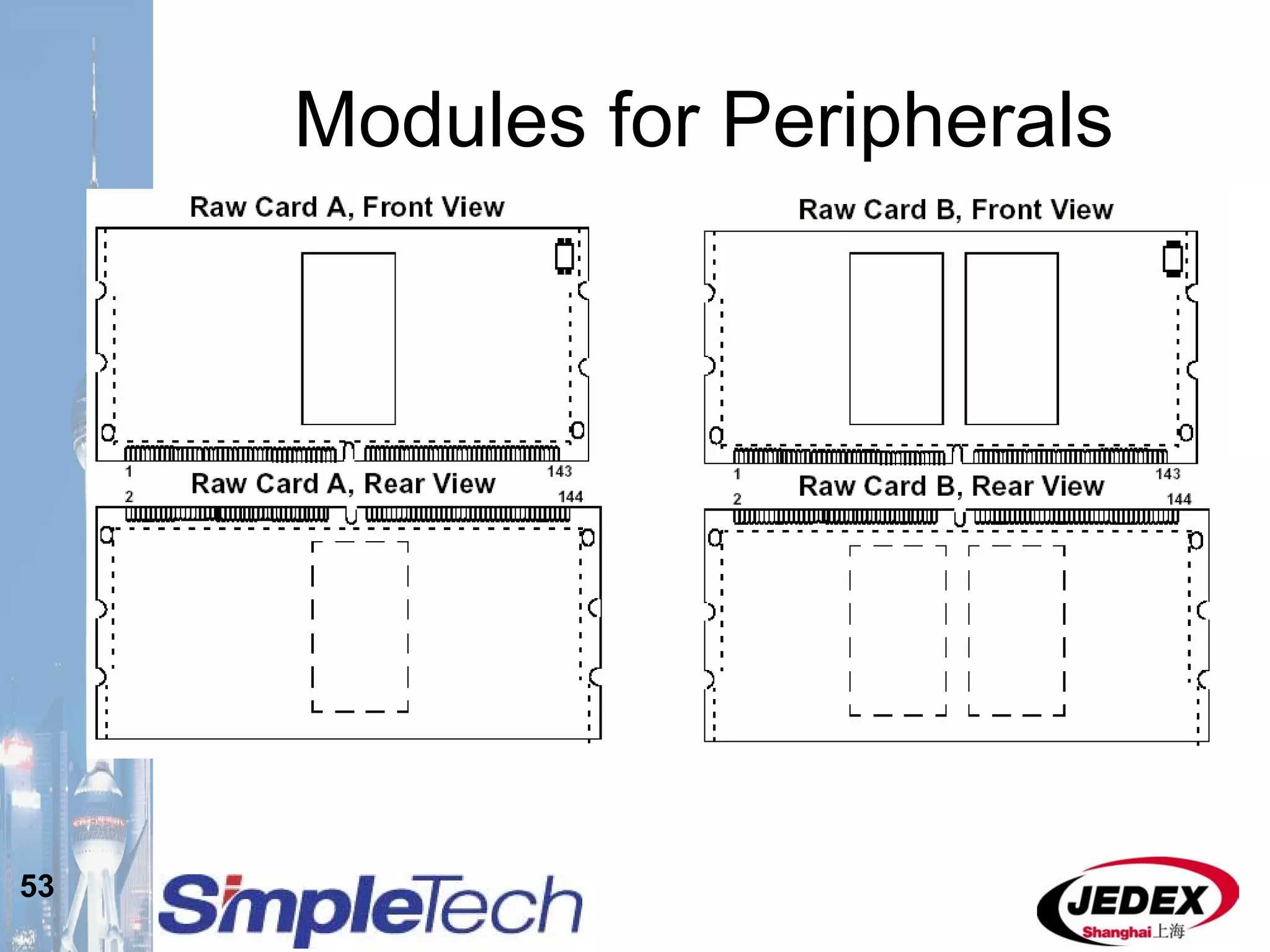
• Reuses SDRAM 144-pin SO-DIMM form
• Common pinout for DDR1/2/3 and 16/32 bits
DDR2 32b-
SO-DIMM
53
Modules for Peripherals
54
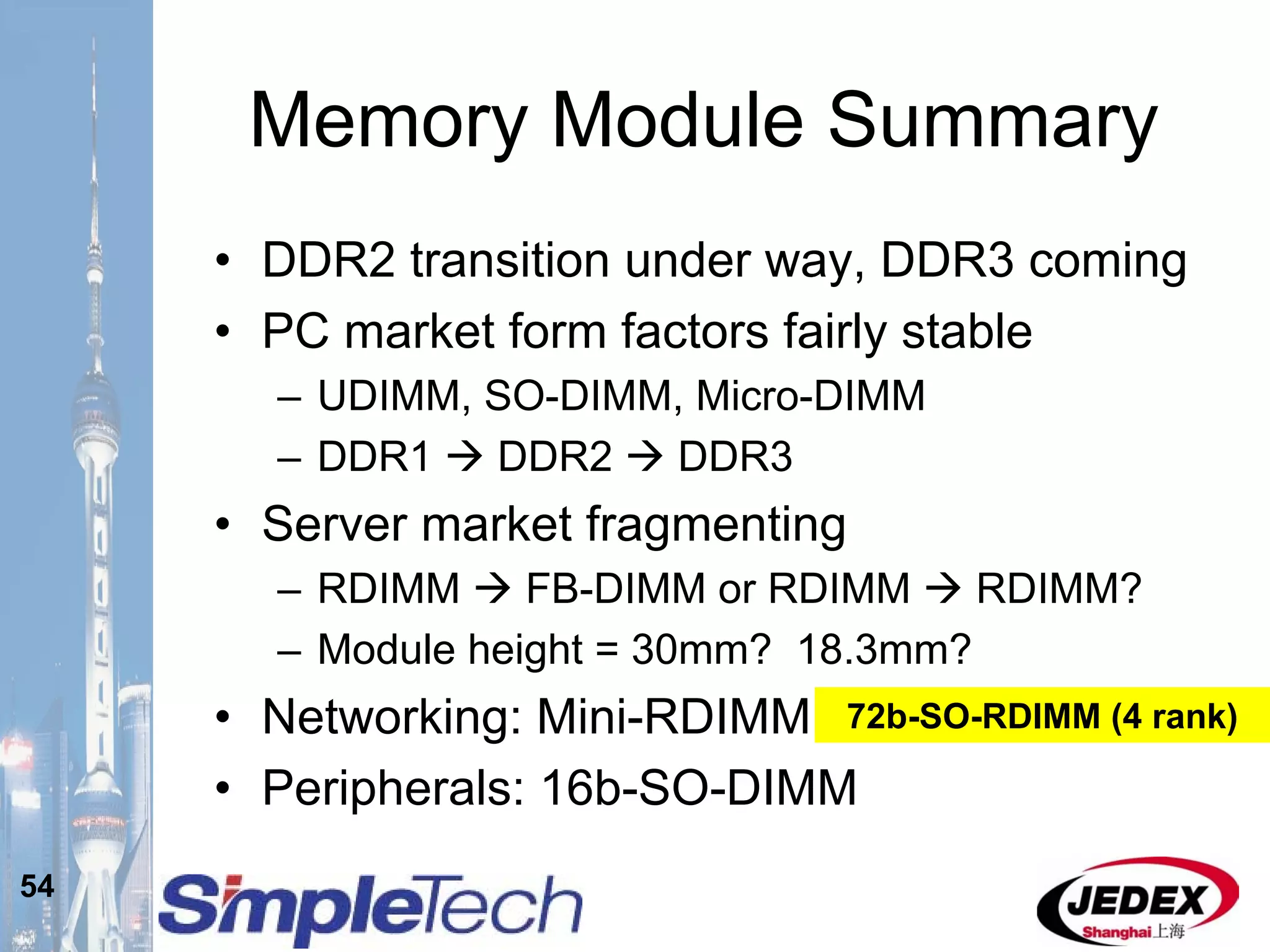
Memory Module Summary
• DDR2 transition under way, DDR3 coming
• PC market form factors fairly stable
– UDIMM, SO-DIMM, Micro-DIMM
– DDR1 DDR2 DDR3
• Server market fragmenting
– RDIMM FB-DIMM or RDIMM RDIMM?
– Module height = 30mm? 18.3mm?
• Networking: Mini-RDIMM
• Peripherals: 16b-SO-DIMM
72b-SO-RDIMM (4 rank)
55
Thank You
Questions?

Jedex stec DRAM Module Market Overview

  • 1.
    1 DRAM Module Market Overview BillGervasi Vice President, DRAM Technology SimpleTech
  • 2.
  • 3.
    3 Agenda • Terminology review •DRAM Market Factors • Market: Personal Computers • Market: Servers & Workstations – FB-DIMM or RDIMM? • Market: Routers & Communications • Market: Peripherals
  • 4.
    4 DDR2 Speed Grading X64/x72bit data bus * chip speed 200 MHz DDR2-400 266 MHz DDR2-533 333 MHz DDR2-667 400 MHz DDR2-800 Clock Speed Chip Bin 400 MT/s 533 MT/s 667 MT/s 800 MT/s Data Rate PC2-3200 PC2-4200 PC2-5300 PC2-6400 Module Bin
  • 5.
    5 DDR3 Speed Grading X64/x72bit data bus * chip speed 400 MHz DDR3-800 533 MHz DDR3-1066 667 MHz DDR3-1333 800 MHz DDR3-1600 Clock Speed Chip Bin 800 MT/s 1066 MT/s 1333 MT/s 1600 MT/s Data Rate PC3-6400 PC3-8500 PC3-10600 PC3-12800 Module Bin
  • 6.
    6 Terminology DIMM = DualInline Memory Module • UDIMM = Unbuffered: Address bus connected directly to DRAMs, limited to 18 chips per DIMM, 2 slots • RDIMM = Registered: Address bus redriven to DRAMs, enables 72 DRAMs per DIMM, 2 slots • FB-DIMM = Fully Buffered: Address and data buses packetized and redriven to DRAMs, enables 36 DRAMs per DIMM, 8 slots
  • 7.
    7 Terminology • ECC =Error Correction Code • Chip Kill (also SDDC) = enhanced variant of ECC • Rank = DRAMs sharing a select line – 1 rank of x8 DRAMs = 8 chips for x64 bus 9 chips for x72 bus (ECC) – 1 rank of x4 DRAMs = 18 chips for x72 bus – 2Rx4 = 36 DRAMs – 4Rx4 = 72 DRAMs
  • 8.
    8 English or Metric? SDRAMDDR1 DDR2 & DDR3 5.25 x 1.7” 2.66 x 1.25” 67.6 x 31.75mm 67.6 x 30mm 5.25 x 1.2” 133.35 x 30mm 133.35 x 18.3mm5.25 x 0.72” DIMM VLP SO-DIMM n/a Metric conversion finally complete…
  • 9.
    9 Module Configurations Registered DIMM(4 rank) Unbuffered DIMM SO-DIMM Micro-DIMM 32b-DIMM 16b-SO-DIMM Registered DIMM (4 rank) Mini-RDIMM (4 rank) Unbuffered DIMM FB-DIMM SO-DIMM Micro-DIMM 16b/32b-SO-DIMM Registered DIMM Mini-RDIMM (4 rank) Unbuffered DIMM FB-DIMM SO-DIMM Micro-DIMM 16b/32b-SO-DIMM DDR2 DDR1 DDR3 72b-SO-RDIMM (4 rank)
  • 10.
    10 DRAM Market Overview &Impact on Memory Modules
  • 11.
    11 DRAM Density 1Gb transitionhindered by the Perfect Storm DDR1/DDR2 split on suppliers & designs 110 90nm transition difficulties 10% die penalty for 8 banks 512Mb DRAM will be the sweet spot through 2006! Implications include 2GB/slot for 2Rx4 4 Rank Modules will increase market share Stacking will be the lowest cost path to 4GB11
  • 12.
  • 13.
    13 Postage Stamp Features Cavity Substrate Cavity Substrate HighReliability Ball-less Vertical Interconnect High Reliability Ball-less Vertical Interconnect Decoupling Capacitors Decoupling Capacitors Probe Points on All Signals and Voltages Probe Points on All Signals and Voltages 2 DRAMs (one under cavity) 2 DRAMs (one under cavity)
  • 14.
    14 Postage Stamp Thermal Improvements Thermalpath to all ground planes then to surface copper flood – entire DIMM becomes a heat spreader
  • 15.
    15 Designing for Performance Planarsingle sided SimpleTech Postage Stamp stack Transmission line stack Planar double sided Unequal Trace Lengths Equal Trace Lengths
  • 16.
  • 17.
    17 PC Market: UnifiedView 2005 2006 2007 Desktop PC Notebook PC Subnotebook PC DDR2-667 UDIMM 2 Rank DDR2-667 SO-DIMM 2 or 4 Rank DDR2-667 Micro-DIMM 2 or 4 Rank DDR2-800 UDIMM 2 Rank DDR2-800 SO-DIMM 2 or 4 Rank DDR2-800 Micro-DIMM 2 or 4 Rank DDR3-1066 UDIMM 2 Rank DDR3-1066 SO-DIMM 2 or 4 Rank DDR3-1066 Micro-DIMM 2 or 4 Rank DDR3 Transition
  • 18.
    18 Why SO- andMicro-DIMM? DDR2 SO-DIMM with Edge Connector Socket DDR2 Micro-DIMM with Mezzanine Connector 30 67.6 71.1 35 24.4 x 54 = 1318 mm2 26 x 63.6 = 1654 mm2 54 30 Thickness = 5.2 mm 2D Layout efficiency = 1654 / 2489 = 66% 1GB 79KB/mm3 Thickness = 5.65 mm 2D Layout efficiency = 1318 / 1620 = 81% 1GB 112KB/mm3 142% cubic density ratio advantage using Micro-DIMM versus SO-DIMM
  • 19.
  • 20.
    20 Fragmentation Diverging views inserver segment 1. RDIMM FB-DIMM in all segments; DDR2 FB-DIMM a huge success 2. DDR2 DDR3 RDIMM; FB-DIMM not “real” until DDR3 if at all JEDEC roadmaps support either path
  • 21.
    21 2005 2006 2007 HEServer Mid Server LE Server DDR2-400 RDIMM 2 Rank DDR2-400 RDIMM 2 Rank DDR2-400 RDIMM 2 Rank DDR2-533 FB-DIMM DDR2-667 FB-DIMM DDR3-800 FB-DIMM Server Market View #1 “RDIMM is obsolete next year” HPC DDR2-533 UDIMM 2 Rank DDR2-667 UDIMM 2 Rank DDR3-1333 UDIMM 2 Rank
  • 22.
    22 2005 2006 2007 HEServer Mid Server LE Server DDR1-266 RDIMM 4 Rank DDR1-333 RDIMM 4 Rank DDR1-400 RDIMM 4 Rank DDR2-533 RDIMM 4 Rank DDR2-667 RDIMM 4 Rank DDR2-667 RDIMM 4 Rank Server Market View #2 DDR3-1333 RDIMM 4 Rank DDR3-1333 RDIMM 4 Rank HPC DDR1-400 UDIMM 2 Rank DDR2-667 UDIMM 2 Rank DDR3-1333 UDIMM 2 Rank FB-DIMM in 2008?
  • 23.
    23 Form Factor Wars •1.2” (30mm) standard chosen in 1999 based on 1U server market projections • But, market fragmenting – Blade needs 18.3mm (VLP) – 1U needs 30mm (LP) – 2U can use 38mm or taller • OEMs “demand” one size fits all … but …
  • 24.
    24 Blade Server, 1.2”Module Angled Socket 17,700 mm2 CoolAir HeatedAir Top View CPU CPU 30 mm DIMM Blade Server
  • 25.
    25 Blade Server, VLPDIMM Angled Socket Vertical Socket 7,000 mm2 = 60% Reduction! CoolAir HeatedAir 30 mm DIMM 18.3 mm DIMM Top View CPU CPU Blade Server
  • 26.
    26 The VLP FormFactor 133.35 mm (5.25”) 4 mm (0.158”) 14.3 mm (0.56”) Usable Layout Area 18.3 mm (0.72”)
  • 27.
    27 4 Rank RDIMM Requires2 extra rank select signals routed on motherboard BIOS updated to detect SPD byte 5 = ‘4’ DDR1 & DDR2 4 rank specs approved From 8 ranks (16GB) max for dual CPU… … to 32 ranks (64GB) max for dual CPU CPU CPU CPU CPU MemoryCtlr
  • 28.
  • 29.
    29 Motivation for FB-DIMM Asspeeds increase, the number of RDIMMs per channel decreaseSpeed Slots RDIMM FB-DIMM FB-DIMM supports 8 slots per channel at any speed
  • 30.
    30 Fully Buffered DIMM ☺Solves stub bus timing challenges ☺ 16GB per channel (8 DIMMs per channel) ☺ Eases DDR2 DDR3 transition Cost and thermal issues may limit use Single DIMM failure can cause channel failure Intellectual property questions delay approval Could be DDR2 Could be DDR3
  • 31.
    31 4.8GHz 9.6GHz 5-7W ofpower Center of module – no good direction for cooling Constantly draining power through termination Expensive 655 ball BGA package Requires heat sink Very tricky thermal design challenge FB-DIMM Design
  • 32.
    32 Under Consideration • VLPFB-DIMM – Repackaging the AMB to 14mm for VLP • 4 Rank support – 4GB per slot 8GB per slot • Spare bit lane – Increased reliability for non-stop mission critical systems
  • 33.
  • 34.
    34 Typical System Configuration Twoslots per channel Dual channel memory controller Unbuffered: 2 ranks per slot Registered: 4 ranks per slot 8GB 16GB
  • 35.
    35 DDR3 Unbuffered Modules VTT Skew trained outat init Address, Cmd, Clks Data VLP Form Factor Impractical!!!
  • 36.
    36 DDR3 RDIMM Fly-By VTTVTT Supportfor 2 ranks (36 DRAMs) and 4 ranks (72 DRAMs) – VLP enabled Register/PLL Reduced Skew Data
  • 37.
    37 Registering Clock Driver Address Command Parity Logic Registers/Redrivers InputOutput OutputInput Par_In Err_Out# CK CK# CKn/CKn# Phase Locked Loop Control Registers
  • 38.
  • 39.
    39 Address Bus Routing Soclean it’s beautiful!
  • 40.
    40 DDR3 RDIMM Summary •Compatible with UDIMM controller – Eases adoption for existing controllers • Single low pin count register/PLL – Lower cost – Simpler layout – Size enables VLP (18.3mm) RDIMM • Integrated PLL with only 4 output pairs – Lower power • 4 rank support designed in
  • 41.
    41 Industry Wide Support Rawcard A: 1Rx8 (1-4 GB) Micron Raw card B: 2Rx8 (2-8 GB) Samsung Raw card C: 1Rx4 (2-8 GB) Elpida Raw card D: 2Rx4 (4-16 GB) – Stacked SimpleTech Raw card E: 2Rx4 (4-16 GB) – Planar Infineon
  • 42.
    42 What Happens inServer & Workstation Market?
  • 43.
    43 FB-DIMM or RDIMM? 8DIMMs per channel X 2GB per DIMM = 16GB per channel • Low pin count • High cost • High heat 2 DIMMs per channel X 4GB per DIMM = 8GB per channel • High pin count • Low cost • Low heat Biggest volume is 4-8 slots total Too early to determine which will be the next mainstream server memory.
  • 44.
  • 45.
    45 Router & Networking 20052006 2007 High End Routers DDR1 RDIMM DDR2 Mini-RDIMM • Split between those that need ECC and those that don’t need ECC DDR3 Mini-RDIMM Low End Routers DDR1 SO-DIMM DDR2 SO-DIMM DDR3 SO-DIMM • FB-DIMM not a fit for this market 72b-SO-RDIMM (4 rank)
  • 46.
    46 Mini-RDIMM Form Factor •JEDEC ballot in process to add: – Support for address/command parity – Support for 4 ranks of memory • Task group for DDR3 Mini-RDIMM 82mm versus 133mm = 40% reduction in size versus full size RDIMM
  • 47.
    47 New! 72b-SO-RDIMM • SO-DIMMsized module with 72 bit bus • Reuse existing mobile sockets (right angle) with no voltage key change • Performance to DDR2-667 • 512MB/1GB sweet spot, 2GB capable
  • 48.
    48 72b-SO-RDIMM Pinout Not pin compatiblewith 64bit SO-DIMM, but no damage occurs on accidental mismatch
  • 49.
    49 Mini-RDIMM vs 72b-SO-RDIMM •Module = 82 x 30mm • Component area = 78 x 26mm • 244 pins, 0.6 mm pitch • Module = 67.6 x 30mm • Component area = 63.6 x 26mm • 200 pins, 0.6 mm pitch
  • 50.
    50 Key Differences • X4DRAM supported • 4 rank supported (proposed) • 8GB max • 3 clock pairs unbuffered supported • Address/command parity supported (proposed) • X4 DRAM not supported • 4 rank supported • 4GB max • One clock pair PLL needed • Address/command parity not possible (no pins) Mini-RDIMM 72b-SO-RDIMM
  • 51.
  • 52.
    52 Peripherals 2005 2006 2007 Peripherals DDR132b- DIMM DDR1 16b- SO-DIMM DDR2 16b- SO-DIMM • Devices that need smaller granularity – A single 512Mb chip contains 64MB of data! • Small footprint is desirable – 1 to 4 DRAMs typical • Reuses SDRAM 144-pin SO-DIMM form • Common pinout for DDR1/2/3 and 16/32 bits DDR2 32b- SO-DIMM
  • 53.
  • 54.
    54 Memory Module Summary •DDR2 transition under way, DDR3 coming • PC market form factors fairly stable – UDIMM, SO-DIMM, Micro-DIMM – DDR1 DDR2 DDR3 • Server market fragmenting – RDIMM FB-DIMM or RDIMM RDIMM? – Module height = 30mm? 18.3mm? • Networking: Mini-RDIMM • Peripherals: 16b-SO-DIMM 72b-SO-RDIMM (4 rank)
  • 55.