Fastsocket 
Speed up your socket 
SINA 
Xiaofeng Lin 
jerrylin.lxf@gmail.com
Contributor 
SINA: 
Xiaofeng Lin 
Xiaodong Li 
Tsinghua: 
Yu Chen 
Junjie Mao 
Jiaquan He
Socket API Problem 
Socket API is fundamental for most network applications 
• Kernel eats too much CPU cycles 
• Less CPU cycles left to Application 
• Call for more efficient kernel socket API
Performance on Multicore System 
Theoretical Overall Performance: 
Single core performance * Available CPU cores 
How close can we reach the limit: Scalability.
Outline 
• Scalability Performance 
• Single Core Performance 
• Production System Feasibility 
• Future Work
Fastsocket 
• Scalability Performance 
• Single Core Performance 
• Production System Feasibility 
• Future Work
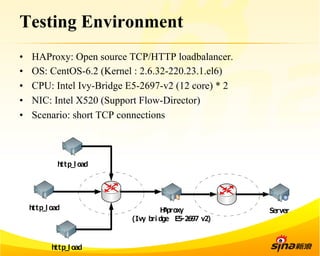
Testing Environment 
• HAProxy: Open source TCP/HTTP loadbalancer. 
• OS: CentOS-6.2 (Kernel : 2.6.32-220.23.1.el6) 
• CPU: Intel Ivy-Bridge E5-2697-v2 (12 core) * 2 
• NIC: Intel X520 (Support Flow-Director) 
• Scenario: short TCP connections 
Server 
http_̲l oad 
HAproxy 
(Ivy bri dge E5-‐‑‒2697 v2) 
http_̲l oad 
http_̲l oad
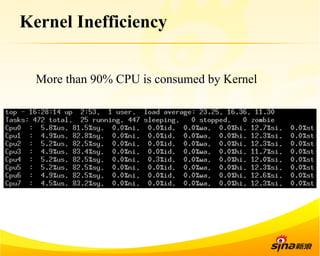
Kernel Inefficiency 
More than 90% CPU is consumed by Kernel
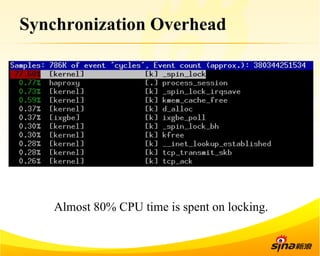
Synchronization Overhead 
Almost 80% CPU time is spent on locking.
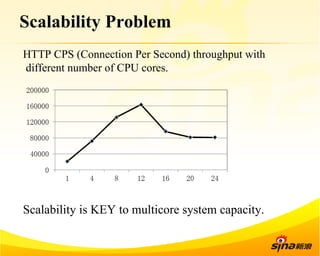
Scalability Problem 
HTTP CPS (Connection Per Second) throughput with 
different number of CPU cores. 
Scalability is KEY to multicore system capacity.
Dilemma 
How to update single machine capacity? 
• Spend more for more CPU cores 
• Capacity dose not improve but get worse 
• Just awkward
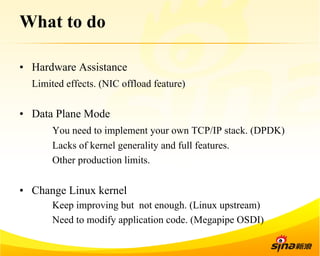
What to do 
• Hardware Assistance 
Limited effects. (NIC offload feature) 
• Data Plane Mode 
You need to implement your own TCP/IP stack. (DPDK) 
Lacks of kernel generality and full features. 
Other production limits. 
• Change Linux kernel 
Keep improving but not enough. (Linux upstream) 
Need to modify application code. (Megapipe OSDI)
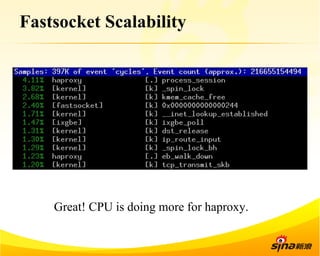
Fastsocket Scalability 
Great! CPU is doing more for haproxy.
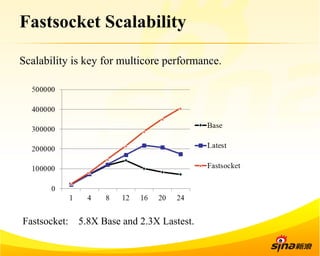
Fastsocket Scalability 
Scalability is key for multicore performance. 
Fastsocket: 5.8X Base and 2.3X Lastest.
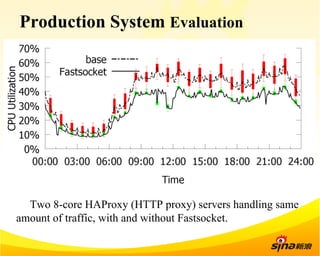
Production System Evaluation 
Two 8-core HAProxy (HTTP proxy) servers handling same 
amount of traffic, with and without Fastsocket.
Kernel Bottleneck 
• Non Local Process of Connections 
• Global TCP Control Block (TCB) Management 
• Synchronization Overhead from VFS
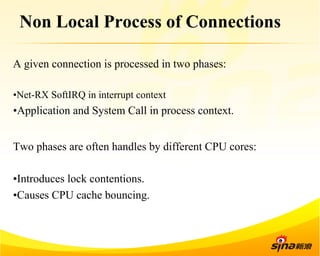
Non Local Process of Connections 
A given connection is processed in two phases: 
• Net-RX SoftIRQ in interrupt context 
• Application and System Call in process context. 
Two phases are often handles by different CPU cores: 
• Introduces lock contentions. 
• Causes CPU cache bouncing.
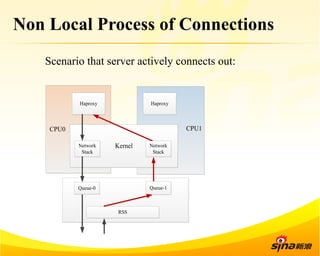
Non Local Process of Connections 
Scenario that server actively connects out: 
Haproxy Haproxy 
CPU  CPU0 1 
Network Kernel 
Stack 
Network 
Stack 
Queue-0 Queue-1 
RSS
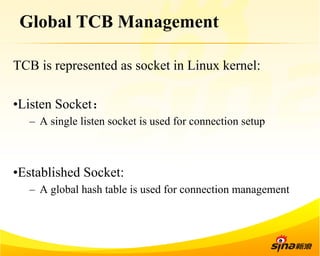
Global TCB Management 
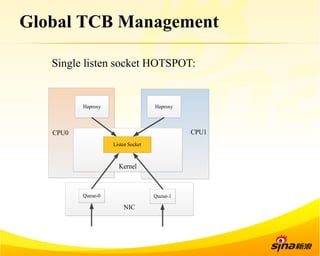
TCB is represented as socket in Linux kernel: 
• Listen Socket: 
– A single listen socket is used for connection setup 
• Established Socket: 
– A global hash table is used for connection management
Global TCB Management 
Single listen socket HOTSPOT: 
CPU  CPU0 1 
Listen Socket 
Kernel 
Haproxy 
NIC 
Haproxy 
Queue-0 Queue-1
VFS Overhead 
• Socket is abstracted under VFS 
• Intensive synchronization for Inode and Dentry in VFS 
• These overhead are inherited by socket
Methodology 
• Resources Partition 
• Local Processing
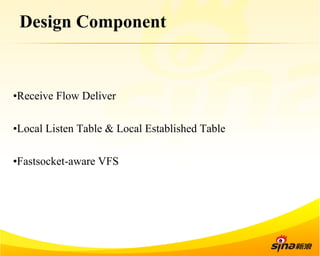
Design Component 
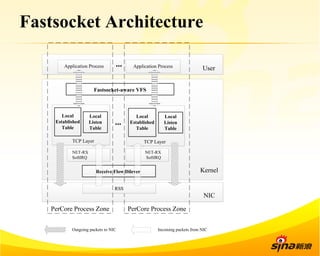
• Receive Flow Deliver 
• Local Listen Table & Local Established Table 
• Fastsocket-aware VFS
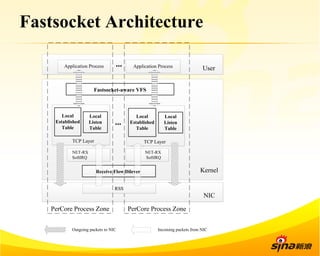
Fastsocket Architecture 
Application Process 
Local 
Established 
Table 
Faassttssoocckkeett--aawaarree VFSS 
Local 
Listen 
Table 
TCP Layer 
... 
Application Process 
User Kernel 
NIC 
... 
Local 
Established 
Table 
Local 
Listen 
Table 
Receive Flow Dilever 
PerCore Process Zone 
NET-RX 
SoftIRQ 
RSS 
TCP Layer 
NET-RX 
SoftIRQ 
PerCore Process Zone 
Outgoing packets to NIC Incoming packets from NIC
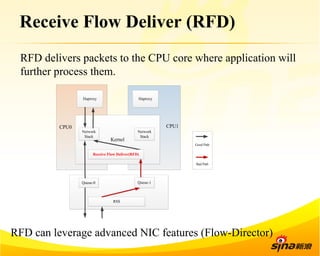
Receive Flow Deliver (RFD) 
RFD delivers packets to the CPU core where application will 
further process them. 
Haproxy Haproxy 
CPU  CPU0 1 
Kernel 
Network 
Stack 
Network 
Stack 
Receive Flow Deliver(RFD) 
Queue-0 Queue-1 
RSS 
Good Path 
Bad Path 
RFD can leverage advanced NIC features (Flow-Director)
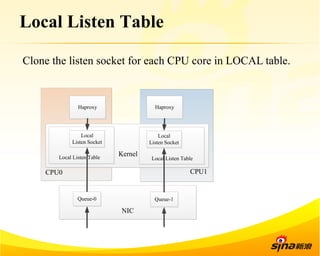
Local Listen Table 
Clone the listen socket for each CPU core in LOCAL table. 
Kernel 
Haproxy 
Local 
Listen Socket 
Local Listen Table 
Local 
Listen Socket 
Local Listen Table 
CPU  CPU0 1 
NIC 
Haproxy 
Queue-0 Queue-1
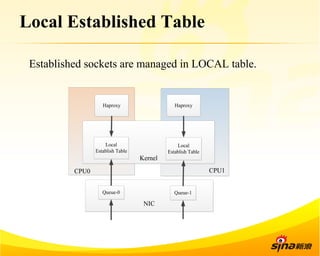
Local Established Table 
Established sockets are managed in LOCAL table. 
CPU1 
CPU0 
Kernel 
Haproxy 
Local 
Establish Table 
NIC 
Haproxy 
Local 
Establish Table 
Queue-0 Queue-1
Fastsocket-aware VFS 
Provide a FAST path for socket in VFS: 
• Inode and Dentry are useless for socket 
• Bypass the unnecessary lock-intensive routines 
• Retain enough to be compatible
Fastsocket Architecture 
Application Process 
Local 
Established 
Table 
Faassttssoocckkeett--aawaarree VFSS 
Local 
Listen 
Table 
TCP Layer 
... 
Application Process 
User Kernel 
NIC 
... 
Local 
Established 
Table 
Local 
Listen 
Table 
Receive Flow Dilever 
PerCore Process Zone 
NET-RX 
SoftIRQ 
RSS 
TCP Layer 
NET-RX 
SoftIRQ 
PerCore Process Zone 
Outgoing packets to NIC Incoming packets from NIC
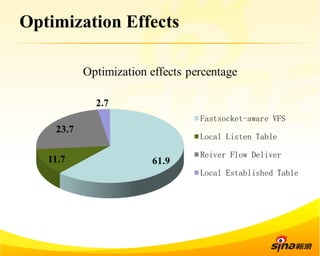
Optimization Effects
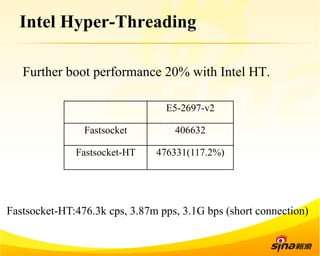
Intel Hyper-Threading 
Further boot performance 20% with Intel HT. 
E5-2697-v2 
Fastsocket 406632 
Fastsocket-HT 476331(117.2%) 
Fastsocket-HT:476.3k cps, 3.87m pps, 3.1G bps (short connection)
Fastsocket 
• Scalability Performance 
• Single Core Performance 
• Production System Feasibility 
• Future Work
Methodology 
• Network Specialization 
• Cross-Layer Design
Network Specialization 
General service provided inside Linux kernel: 
• Slab 
• Epoll 
• VFS 
• Timer etc. 
Customize these general services for Network
Fastsocket Skb-Pool 
• Percore skb pool 
• Combine skb header and data 
• Local Pool and Recycle Pool (Flow-Director)
Fastsocket Fast-Epoll 
Motivation: 
• Epoll entries are managed in RB-Tree 
• Search the RB-Tree each time when calling epoll_ctl() 
• Memory access is a killer for performance 
Solution: 
• TCP Connection rarely shared across processes 
• Cache Epoll entry in file structure to save the search
Cross-Layer Optimization 
• What is cross-layer optimization? 
• Overall optimization with Cross-Layer design 
– Direct-TCP 
– Receive-CPU-Selection
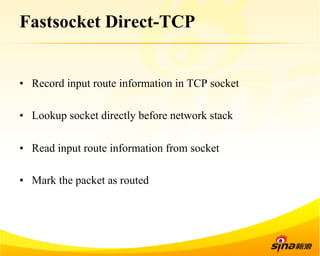
Fastsocket Direct-TCP 
• Record input route information in TCP socket 
• Lookup socket directly before network stack 
• Read input route information from socket 
• Mark the packet as routed
Fastsocket Receive-CPU-Selection 
Similar to Google RFS 
• Application marks current CPU id in the socket 
• Lookup socket directly before network stack 
• Read CPU id from socket and deliver accordingly 
Lighter, more accurate and thus faster than Google RFS
Redis Benchmark 
Testing Environment: 
• Redis: Key-value cache and store 
• CPU: Intel E5 2640 v2 (6 core) * 2 
• NIC: Intel X520 
Configuration: 
• Persist TCP connections 
• 8 redis instances serving on difference ports 
• Only 8 CPU cores are used
Redis Benchmark 
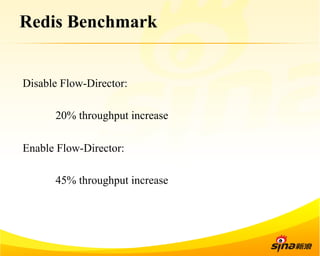
Disable Flow-Director: 
20% throughput increase 
Enable Flow-Director: 
45% throughput increase
Fastsocket 
• Scalability Performance 
• Single Core Performance 
• Production System Feasibility 
• Future Work
Compatibility & Generality 
• Full BSD-Socket API compatible 
• Full kernel network feature support 
• Require no change of application code 
• Nginx, HAProxy, Lighttpd, Redis, Memcached, etc.
Deployment 
• Install RPM (Kernel, fastsocket.ko and libfsocket.so) 
• Load fastsocket.ko 
• Start application with PRELOAD libfsocket.so 
LD_PRELOAD=./libfsocket.so haproxy
Maintainability 
• Flexible Control 
– Selectively enable Fastsocket to certain applications (nginx) 
– Compatible with regular socket (ssh) 
• Quick Rollback 
– Restart the application without libfsocket.so 
• Easy Updating 
– Most of codes are in fastsocket.ko 
– Updating fastsocket.ko and libfsocket.so is enough
SINA Deployment 
• Adopted in HTTP load balance service (HAProxy) 
• Deployed in half of the major IDCs 
• Stable running for 8 months 
• Fastsocket will update all HAPoxy by the end of year
Fastsocket 
• Scalability Performance 
• Single Core Performance 
• Production System Feasibility 
• Future Work
Future Work 
• Make it faster 
– Improving Interrupt Mechanism 
– System-Call Batching 
– Zero Copy 
– Further Customization and Cross-Layer Optimization 
• Linux Mainstream
Open Source 
https://github.com/fastos/fastsocket
Recruitment 
Join us ! 
xiaodong2@staff.sina.com
Fastsocket 
Thank you! 
Q & A

Fastsocket Linxiaofeng

  • 1.
    Fastsocket Speed upyour socket SINA Xiaofeng Lin jerrylin.lxf@gmail.com
  • 2.
    Contributor SINA: XiaofengLin Xiaodong Li Tsinghua: Yu Chen Junjie Mao Jiaquan He
  • 3.
    Socket API Problem Socket API is fundamental for most network applications • Kernel eats too much CPU cycles • Less CPU cycles left to Application • Call for more efficient kernel socket API
  • 4.
    Performance on MulticoreSystem Theoretical Overall Performance: Single core performance * Available CPU cores How close can we reach the limit: Scalability.
  • 5.
    Outline • ScalabilityPerformance • Single Core Performance • Production System Feasibility • Future Work
  • 6.
    Fastsocket • ScalabilityPerformance • Single Core Performance • Production System Feasibility • Future Work
  • 7.
    Testing Environment •HAProxy: Open source TCP/HTTP loadbalancer. • OS: CentOS-6.2 (Kernel : 2.6.32-220.23.1.el6) • CPU: Intel Ivy-Bridge E5-2697-v2 (12 core) * 2 • NIC: Intel X520 (Support Flow-Director) • Scenario: short TCP connections Server http_̲l oad HAproxy (Ivy bri dge E5-‐‑‒2697 v2) http_̲l oad http_̲l oad
  • 8.
    Kernel Inefficiency Morethan 90% CPU is consumed by Kernel
  • 9.
    Synchronization Overhead Almost80% CPU time is spent on locking.
  • 10.
    Scalability Problem HTTPCPS (Connection Per Second) throughput with different number of CPU cores. Scalability is KEY to multicore system capacity.
  • 11.
    Dilemma How toupdate single machine capacity? • Spend more for more CPU cores • Capacity dose not improve but get worse • Just awkward
  • 12.
    What to do • Hardware Assistance Limited effects. (NIC offload feature) • Data Plane Mode You need to implement your own TCP/IP stack. (DPDK) Lacks of kernel generality and full features. Other production limits. • Change Linux kernel Keep improving but not enough. (Linux upstream) Need to modify application code. (Megapipe OSDI)
  • 13.
    Fastsocket Scalability Great!CPU is doing more for haproxy.
  • 14.
    Fastsocket Scalability Scalabilityis key for multicore performance. Fastsocket: 5.8X Base and 2.3X Lastest.
  • 15.
    Production System Evaluation Two 8-core HAProxy (HTTP proxy) servers handling same amount of traffic, with and without Fastsocket.
  • 16.
    Kernel Bottleneck •Non Local Process of Connections • Global TCP Control Block (TCB) Management • Synchronization Overhead from VFS
  • 17.
    Non Local Processof Connections A given connection is processed in two phases: • Net-RX SoftIRQ in interrupt context • Application and System Call in process context. Two phases are often handles by different CPU cores: • Introduces lock contentions. • Causes CPU cache bouncing.
  • 18.
    Non Local Processof Connections Scenario that server actively connects out: Haproxy Haproxy CPU CPU0 1 Network Kernel Stack Network Stack Queue-0 Queue-1 RSS
  • 19.
    Global TCB Management TCB is represented as socket in Linux kernel: • Listen Socket: – A single listen socket is used for connection setup • Established Socket: – A global hash table is used for connection management
  • 20.
    Global TCB Management Single listen socket HOTSPOT: CPU CPU0 1 Listen Socket Kernel Haproxy NIC Haproxy Queue-0 Queue-1
  • 21.
    VFS Overhead •Socket is abstracted under VFS • Intensive synchronization for Inode and Dentry in VFS • These overhead are inherited by socket
  • 22.
    Methodology • ResourcesPartition • Local Processing
  • 23.
    Design Component •Receive Flow Deliver • Local Listen Table & Local Established Table • Fastsocket-aware VFS
  • 24.
    Fastsocket Architecture ApplicationProcess Local Established Table Faassttssoocckkeett--aawaarree VFSS Local Listen Table TCP Layer ... Application Process User Kernel NIC ... Local Established Table Local Listen Table Receive Flow Dilever PerCore Process Zone NET-RX SoftIRQ RSS TCP Layer NET-RX SoftIRQ PerCore Process Zone Outgoing packets to NIC Incoming packets from NIC
  • 25.
    Receive Flow Deliver(RFD) RFD delivers packets to the CPU core where application will further process them. Haproxy Haproxy CPU CPU0 1 Kernel Network Stack Network Stack Receive Flow Deliver(RFD) Queue-0 Queue-1 RSS Good Path Bad Path RFD can leverage advanced NIC features (Flow-Director)
  • 26.
    Local Listen Table Clone the listen socket for each CPU core in LOCAL table. Kernel Haproxy Local Listen Socket Local Listen Table Local Listen Socket Local Listen Table CPU CPU0 1 NIC Haproxy Queue-0 Queue-1
  • 27.
    Local Established Table Established sockets are managed in LOCAL table. CPU1 CPU0 Kernel Haproxy Local Establish Table NIC Haproxy Local Establish Table Queue-0 Queue-1
  • 28.
    Fastsocket-aware VFS Providea FAST path for socket in VFS: • Inode and Dentry are useless for socket • Bypass the unnecessary lock-intensive routines • Retain enough to be compatible
  • 29.
    Fastsocket Architecture ApplicationProcess Local Established Table Faassttssoocckkeett--aawaarree VFSS Local Listen Table TCP Layer ... Application Process User Kernel NIC ... Local Established Table Local Listen Table Receive Flow Dilever PerCore Process Zone NET-RX SoftIRQ RSS TCP Layer NET-RX SoftIRQ PerCore Process Zone Outgoing packets to NIC Incoming packets from NIC
  • 30.
  • 31.
    Intel Hyper-Threading Furtherboot performance 20% with Intel HT. E5-2697-v2 Fastsocket 406632 Fastsocket-HT 476331(117.2%) Fastsocket-HT:476.3k cps, 3.87m pps, 3.1G bps (short connection)
  • 32.
    Fastsocket • ScalabilityPerformance • Single Core Performance • Production System Feasibility • Future Work
  • 33.
    Methodology • NetworkSpecialization • Cross-Layer Design
  • 34.
    Network Specialization Generalservice provided inside Linux kernel: • Slab • Epoll • VFS • Timer etc. Customize these general services for Network
  • 35.
    Fastsocket Skb-Pool •Percore skb pool • Combine skb header and data • Local Pool and Recycle Pool (Flow-Director)
  • 36.
    Fastsocket Fast-Epoll Motivation: • Epoll entries are managed in RB-Tree • Search the RB-Tree each time when calling epoll_ctl() • Memory access is a killer for performance Solution: • TCP Connection rarely shared across processes • Cache Epoll entry in file structure to save the search
  • 37.
    Cross-Layer Optimization •What is cross-layer optimization? • Overall optimization with Cross-Layer design – Direct-TCP – Receive-CPU-Selection
  • 38.
    Fastsocket Direct-TCP •Record input route information in TCP socket • Lookup socket directly before network stack • Read input route information from socket • Mark the packet as routed
  • 39.
    Fastsocket Receive-CPU-Selection Similarto Google RFS • Application marks current CPU id in the socket • Lookup socket directly before network stack • Read CPU id from socket and deliver accordingly Lighter, more accurate and thus faster than Google RFS
  • 40.
    Redis Benchmark TestingEnvironment: • Redis: Key-value cache and store • CPU: Intel E5 2640 v2 (6 core) * 2 • NIC: Intel X520 Configuration: • Persist TCP connections • 8 redis instances serving on difference ports • Only 8 CPU cores are used
  • 41.
    Redis Benchmark DisableFlow-Director: 20% throughput increase Enable Flow-Director: 45% throughput increase
  • 42.
    Fastsocket • ScalabilityPerformance • Single Core Performance • Production System Feasibility • Future Work
  • 43.
    Compatibility & Generality • Full BSD-Socket API compatible • Full kernel network feature support • Require no change of application code • Nginx, HAProxy, Lighttpd, Redis, Memcached, etc.
  • 44.
    Deployment • InstallRPM (Kernel, fastsocket.ko and libfsocket.so) • Load fastsocket.ko • Start application with PRELOAD libfsocket.so LD_PRELOAD=./libfsocket.so haproxy
  • 45.
    Maintainability • FlexibleControl – Selectively enable Fastsocket to certain applications (nginx) – Compatible with regular socket (ssh) • Quick Rollback – Restart the application without libfsocket.so • Easy Updating – Most of codes are in fastsocket.ko – Updating fastsocket.ko and libfsocket.so is enough
  • 46.
    SINA Deployment •Adopted in HTTP load balance service (HAProxy) • Deployed in half of the major IDCs • Stable running for 8 months • Fastsocket will update all HAPoxy by the end of year
  • 47.
    Fastsocket • ScalabilityPerformance • Single Core Performance • Production System Feasibility • Future Work
  • 48.
    Future Work •Make it faster – Improving Interrupt Mechanism – System-Call Batching – Zero Copy – Further Customization and Cross-Layer Optimization • Linux Mainstream
  • 49.
  • 50.
    Recruitment Join us! xiaodong2@staff.sina.com
  • 51.