Manasa Rath
Rutgers University, New Brunswick
manasarath@gmail.com
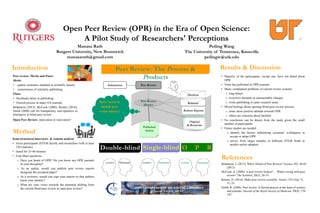
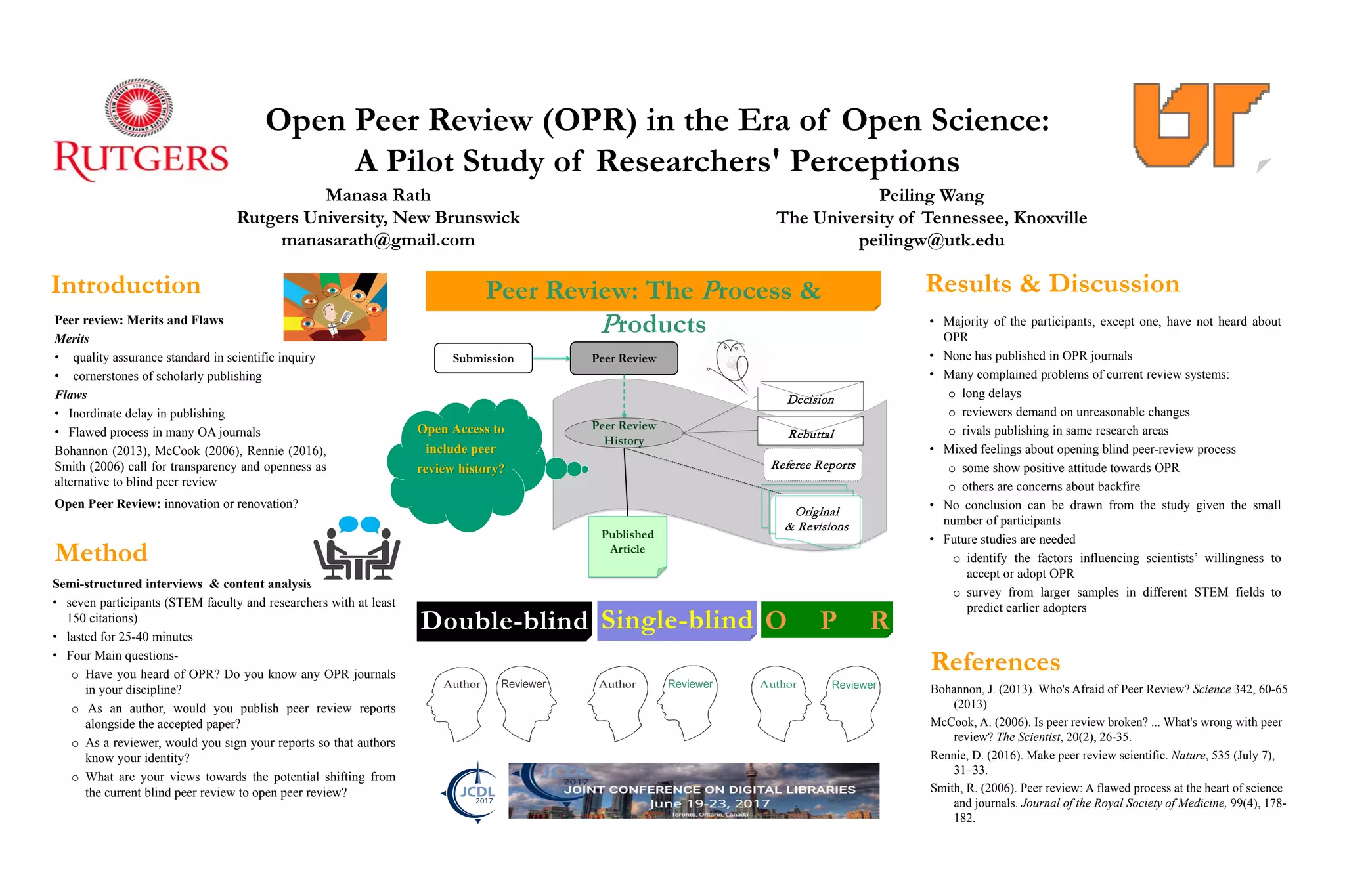
Peer Review: The Process &
Products
Open Peer Review (OPR) in the Era of Open Science:
A Pilot Study of Researchers' Perceptions
Peiling Wang
The University of Tennessee, Knoxville
peilingw@utk.edu
Introduction
Method
Semi-structured interviews & content analysis
• seven participants (STEM faculty and researchers with at least
150 citations)
• lasted for 25-40 minutes
• Four Main questions-
o Have you heard of OPR? Do you know any OPR journals
in your discipline?
o As an author, would you publish peer review reports
alongside the accepted paper?
o As a reviewer, would you sign your reports so that authors
know your identity?
o What are your views towards the potential shifting from
the current blind peer review to open peer review?
Peer review: Merits and Flaws
Merits
• quality assurance standard in scientific inquiry
• cornerstones of scholarly publishing
Flaws
• Inordinate delay in publishing
• Flawed process in many OA journals
Bohannon (2013), McCook (2006), Rennie (2016),
Smith (2006) call for transparency and openness as
alternative to blind peer review
Open Peer Review: innovation or renovation?
Peer Review
Submission
Peer Review
History
Published
Article
Original
& Revisions
Referee Reports
Decision
Rebuttal
Results & Discussion
References
Bohannon, J. (2013). Who's Afraid of Peer Review? Science 342, 60-65
(2013)
McCook, A. (2006). Is peer review broken? ... What's wrong with peer
review? The Scientist, 20(2), 26-35.
Rennie, D. (2016). Make peer review scientific. Nature, 535 (July 7),
31–33.
Smith, R. (2006). Peer review: A flawed process at the heart of science
and journals. Journal of the Royal Society of Medicine, 99(4), 178-
182.
• Majority of the participants, except one, have not heard about
OPR
• None has published in OPR journals
• Many complained problems of current review systems:
o long delays
o reviewers demand on unreasonable changes
o rivals publishing in same research areas
• Mixed feelings about opening blind peer-review process
o some show positive attitude towards OPR
o others are concerns about backfire
• No conclusion can be drawn from the study given the small
number of participants
• Future studies are needed
o identify the factors influencing scientists’ willingness to
accept or adopt OPR
o survey from larger samples in different STEM fields to
predict earlier adopters
O P R
Single-blind
Double-blind
Open Access to
include peer
review history?

Jcdl2017 Poster

  • 1.
    Manasa Rath Rutgers University,New Brunswick manasarath@gmail.com Peer Review: The Process & Products Open Peer Review (OPR) in the Era of Open Science: A Pilot Study of Researchers' Perceptions Peiling Wang The University of Tennessee, Knoxville peilingw@utk.edu Introduction Method Semi-structured interviews & content analysis • seven participants (STEM faculty and researchers with at least 150 citations) • lasted for 25-40 minutes • Four Main questions- o Have you heard of OPR? Do you know any OPR journals in your discipline? o As an author, would you publish peer review reports alongside the accepted paper? o As a reviewer, would you sign your reports so that authors know your identity? o What are your views towards the potential shifting from the current blind peer review to open peer review? Peer review: Merits and Flaws Merits • quality assurance standard in scientific inquiry • cornerstones of scholarly publishing Flaws • Inordinate delay in publishing • Flawed process in many OA journals Bohannon (2013), McCook (2006), Rennie (2016), Smith (2006) call for transparency and openness as alternative to blind peer review Open Peer Review: innovation or renovation? Peer Review Submission Peer Review History Published Article Original & Revisions Referee Reports Decision Rebuttal Results & Discussion References Bohannon, J. (2013). Who's Afraid of Peer Review? Science 342, 60-65 (2013) McCook, A. (2006). Is peer review broken? ... What's wrong with peer review? The Scientist, 20(2), 26-35. Rennie, D. (2016). Make peer review scientific. Nature, 535 (July 7), 31–33. Smith, R. (2006). Peer review: A flawed process at the heart of science and journals. Journal of the Royal Society of Medicine, 99(4), 178- 182. • Majority of the participants, except one, have not heard about OPR • None has published in OPR journals • Many complained problems of current review systems: o long delays o reviewers demand on unreasonable changes o rivals publishing in same research areas • Mixed feelings about opening blind peer-review process o some show positive attitude towards OPR o others are concerns about backfire • No conclusion can be drawn from the study given the small number of participants • Future studies are needed o identify the factors influencing scientists’ willingness to accept or adopt OPR o survey from larger samples in different STEM fields to predict earlier adopters O P R Single-blind Double-blind Open Access to include peer review history?