Doing
Quantitative Research
in Social Sciences
Khalid Mahmood, PhD
Professor
University of the Punjab
1
 Professor of Information Management at University
of the Punjab, Pakistan
 Post-doctoral research fellow at University of
California, Los Angeles, USA
 160+ publications
 Supervised many doctoral, M.Phil. and master
theses
 Worked for many research journals as editor,
reviewer and editorial board member
 Conducted many trainings on research methods
About me
2
Acknowledgment
 I have prepared this presentation
with the help of many books,
presentations and Websites.
 I pay my sincere gratitude to all
authors, professors and experts for
their efforts and contributions.
3
Introduction
 Systematic scientific investigation of
data and their relationships
 Quantity versus quality
 Numbers and statistics allow precise and
exact comparisons
 Generalization of findings
4
Philosophy of quantitative
research
 Positivism
 Absolute reality; Empiricism; Objectivity; Replication;
Realism (Social reality is knowable)
 Post-positivism
 Researchers cannot be entirely neutral; Critical
realism (Social reality is knowable only in an
imperfect and probabilistic manner)
 Inductive and deductive reasoning
 Purposes of research
 Exploratory; Descriptive; Explanatory
5
Steps in quantitative research
1. Selecting a problem
2. Reviewing the literature
3. Formulating research
question
4. Constructing hypotheses
5. Identifying and labeling
variables
6. Constructing operational
definitions of variables
7. Constructing a research
design
8. Identifying population
and sample
9. Designing instruments
10. Selecting statistical test
for testing the
hypothesis
11. Collecting data
12. Analyzing data
13. Writing the report
6
Quantitative designs
 Survey
 Cross-sectional
 Data are collected from selected individuals at a single point in
time
 Longitudinal
 Trend survey examines changes over time in a particular
population defined by some particular trait
 Cohort survey involves one population selected at a particular
time period but multiple samples taken and surveyed at different
points in time
 Panel survey involves a sample in which the same individuals
are studied over time
 Follow-up survey addresses development or change in a
previously studied population, some time after the original survey
was given 7
Quantitative designs
 Correlational
 Causal-comparative
 Cause already exists and is not manipulated
 Experimental
 Manipulation of independent variable
 Quasi-experimental
 Lacking randomization or control
8
Populations and samples
 Units of analysis
 Probability sampling methods
 Simple random, stratified random,
cluster, systematic
 Sample size
9
Quantitative measurement
 Concept
 Abstract thinking to distinguish it from other
elements
 Construct
 Theoretical definition of a concept; must be
observable or measurable
 Variable
 Presented in research questions and hypotheses
 Types: Independent, dependent, intervening/
mediating, moderating, confounding/ extraneous
 Operationalization
 Specifically how the variable is observed or measured
10
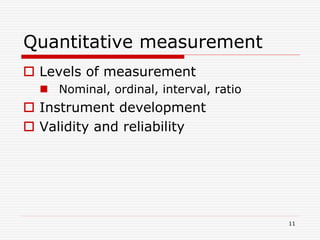
Quantitative measurement
 Levels of measurement
 Nominal, ordinal, interval, ratio
 Instrument development
 Validity and reliability
11
Data analysis
 Descriptive statistics
 Measures of central tendency
 Measures of variability or dispersion
 Inferential statistics
 Hypothesis testing
 Hypothesis
 Parametric and non-parametric tests
 Statistical significance
12
13
Best of luck for your
research endeavors!

Doing quantitative research in social sciences

  • 1.
    Doing Quantitative Research in SocialSciences Khalid Mahmood, PhD Professor University of the Punjab 1
  • 2.
     Professor ofInformation Management at University of the Punjab, Pakistan  Post-doctoral research fellow at University of California, Los Angeles, USA  160+ publications  Supervised many doctoral, M.Phil. and master theses  Worked for many research journals as editor, reviewer and editorial board member  Conducted many trainings on research methods About me 2
  • 3.
    Acknowledgment  I haveprepared this presentation with the help of many books, presentations and Websites.  I pay my sincere gratitude to all authors, professors and experts for their efforts and contributions. 3
  • 4.
    Introduction  Systematic scientificinvestigation of data and their relationships  Quantity versus quality  Numbers and statistics allow precise and exact comparisons  Generalization of findings 4
  • 5.
    Philosophy of quantitative research Positivism  Absolute reality; Empiricism; Objectivity; Replication; Realism (Social reality is knowable)  Post-positivism  Researchers cannot be entirely neutral; Critical realism (Social reality is knowable only in an imperfect and probabilistic manner)  Inductive and deductive reasoning  Purposes of research  Exploratory; Descriptive; Explanatory 5
  • 6.
    Steps in quantitativeresearch 1. Selecting a problem 2. Reviewing the literature 3. Formulating research question 4. Constructing hypotheses 5. Identifying and labeling variables 6. Constructing operational definitions of variables 7. Constructing a research design 8. Identifying population and sample 9. Designing instruments 10. Selecting statistical test for testing the hypothesis 11. Collecting data 12. Analyzing data 13. Writing the report 6
  • 7.
    Quantitative designs  Survey Cross-sectional  Data are collected from selected individuals at a single point in time  Longitudinal  Trend survey examines changes over time in a particular population defined by some particular trait  Cohort survey involves one population selected at a particular time period but multiple samples taken and surveyed at different points in time  Panel survey involves a sample in which the same individuals are studied over time  Follow-up survey addresses development or change in a previously studied population, some time after the original survey was given 7
  • 8.
    Quantitative designs  Correlational Causal-comparative  Cause already exists and is not manipulated  Experimental  Manipulation of independent variable  Quasi-experimental  Lacking randomization or control 8
  • 9.
    Populations and samples Units of analysis  Probability sampling methods  Simple random, stratified random, cluster, systematic  Sample size 9
  • 10.
    Quantitative measurement  Concept Abstract thinking to distinguish it from other elements  Construct  Theoretical definition of a concept; must be observable or measurable  Variable  Presented in research questions and hypotheses  Types: Independent, dependent, intervening/ mediating, moderating, confounding/ extraneous  Operationalization  Specifically how the variable is observed or measured 10
  • 11.
    Quantitative measurement  Levelsof measurement  Nominal, ordinal, interval, ratio  Instrument development  Validity and reliability 11
  • 12.
    Data analysis  Descriptivestatistics  Measures of central tendency  Measures of variability or dispersion  Inferential statistics  Hypothesis testing  Hypothesis  Parametric and non-parametric tests  Statistical significance 12
  • 13.
    13 Best of luckfor your research endeavors!