RESEARCH POSTER PRESENTATION DESIGN © 2012
www.PosterPresentations.com
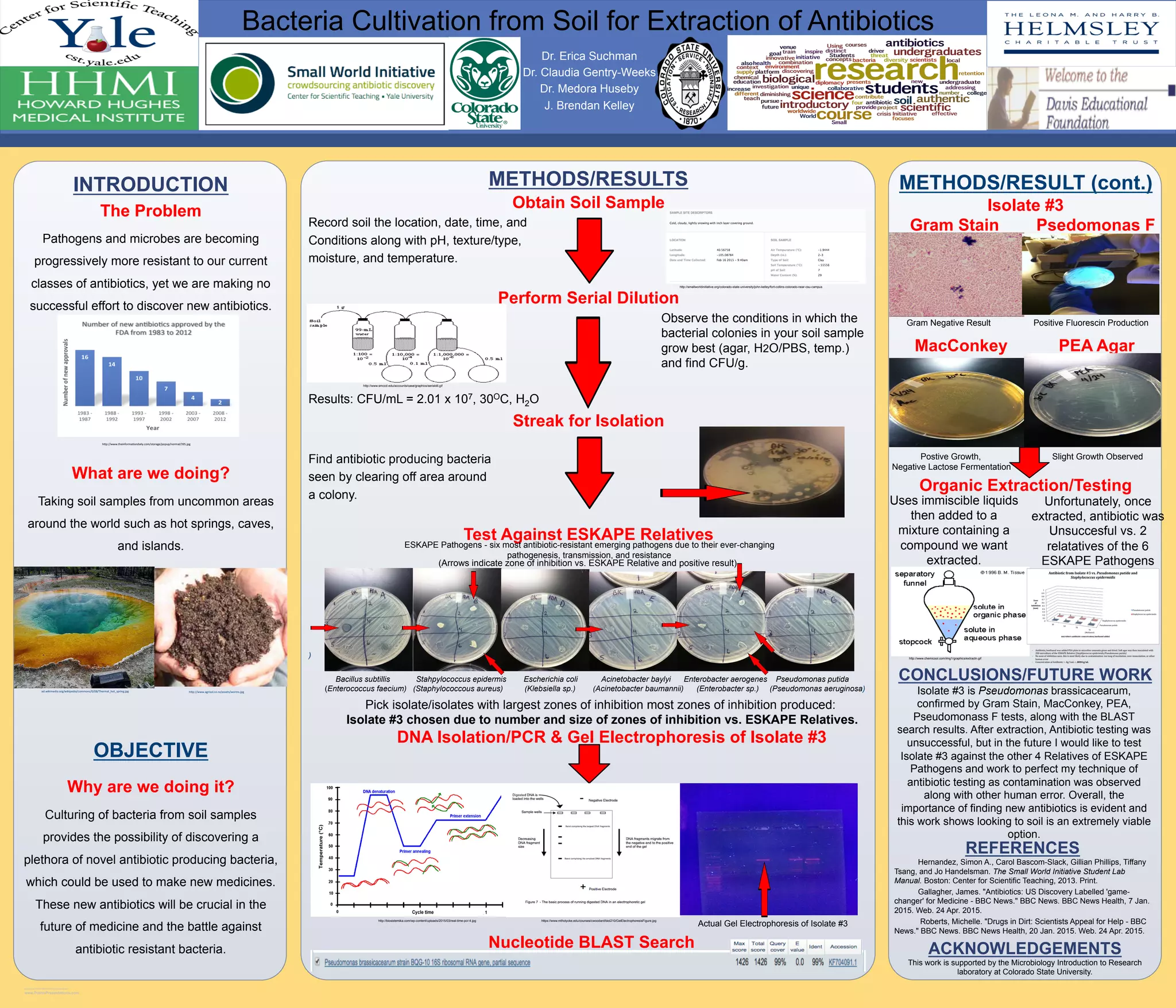
The Problem
Pathogens and microbes are becoming
progressively more resistant to our current
classes of antibiotics, yet we are making no
successful effort to discover new antibiotics.
What are we doing?
Taking soil samples from uncommon areas
around the world such as hot springs, caves,
and islands.
OBJECTIVE
Why are we doing it?
Culturing of bacteria from soil samples
provides the possibility of discovering a
plethora of novel antibiotic producing bacteria,
which could be used to make new medicines.
These new antibiotics will be crucial in the
future of medicine and the battle against
antibiotic resistant bacteria.
INTRODUCTION
Obtain Soil Sample
Record soil the location, date, time, and
Conditions along with pH, texture/type,
moisture, and temperature.
Perform Serial Dilution
Observe the conditions in which the
bacterial colonies in your soil sample
grow best (agar, H2O/PBS, temp.)
and find CFU/g.
Results: CFU/mL = 2.01 x 10⁷, 30OC, H2O
Streak for Isolation
Find antibiotic producing bacteria
seen by clearing off area around
a colony.
Test Against ESKAPE Relatives
)
DNA Isolation/PCR & Gel Electrophoresis of Isolate #3
METHODS/RESULTS
CONCLUSIONS/FUTURE WORK
METHODS/RESULT (cont.)
REFERENCES
Hernandez, Simon A., Carol Bascom-Slack, Gillian Phillips, Tiffany
Tsang, and Jo Handelsman. The Small World Initiative Student Lab
Manual. Boston: Center for Scientific Teaching, 2013. Print.
Gallagher, James. "Antibiotics: US Discovery Labelled 'game-
changer' for Medicine - BBC News." BBC News. BBC News Health, 7 Jan.
2015. Web. 24 Apr. 2015.
Roberts, Michelle. "Drugs in Dirt: Scientists Appeal for Help - BBC
News." BBC News. BBC News Health, 20 Jan. 2015. Web. 24 Apr. 2015.
ACKNOWLEDGEMENTS
This work is supported by the Microbiology Introduction to Research
laboratory at Colorado State University.
Dr. Erica Suchman
Dr. Claudia Gentry-Weeks
Dr. Medora Huseby
J. Brendan Kelley
	
  
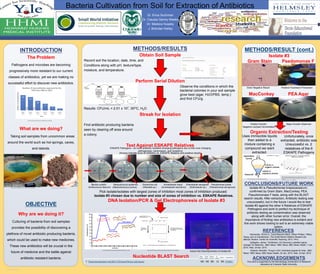
Bacteria Cultivation from Soil for Extraction of Antibiotics
http://smallworldinitiative.org/colorado-state-university/john-kelley/fort-collins-colorado-near-csu-campus
http://www.smccd.edu/accounts/case/graphics/serialdil.gif
https://www.mtholyoke.edu/courses/cwoodard/biol210/GelElectrophoresisFigure.jpg
Isolate #3
Gram Stain Psedomonas F
MacConkey PEA Agar
Organic Extraction/Testing
Pick isolate/isolates with largest zones of inhibition most zones of inhibition produced:
Isolate #3 chosen due to number and size of zones of inhibition vs. ESKAPE Relatives.
Isolate #3 is Pseudomonas brassicacearum,
confirmed by Gram Stain, MacConkey, PEA,
Pseudomonass F tests, along with the BLAST
search results. After extraction, Antibiotic testing was
unsuccessful, but in the future I would like to test
Isolate #3 against the other 4 Relatives of ESKAPE
Pathogens and work to perfect my technique of
antibiotic testing as contamination was observed
along with other human error. Overall, the
importance of finding new antibiotics is evident and
this work shows looking to soil is an extremely viable
option.
http://www.chemicool.com/img1/graphics/extractn.gif
Actual Gel Electrophoresis of Isolate #3
(Arrows indicate zone of inhibition vs. ESKAPE Relative and positive result)
Gram Negative Result Positive Fluorescin Production
http://biosistemika.com/wp-content/uploads/2015/03/real-time-pcr-4.jpg
hHp://www.theinforma/ondaily.com/storage/popup/normal/395.jpg
hHp://www.agrisol.co.nz/assets/worms.jpgad.wikimedia.org/wikipedia/commons/0/08/Thermal_hot_spring.jpg
Postive Growth, Slight Growth Observed
Negative Lactose Fermentation
Uses immiscible liquids
then added to a
mixture containing a
compound we want
extracted.
!
Pseudomonas!putida!
Staphylococcus!epidermidis!0!
0.1!
0.2!
0.3!
0.4!
0.5!
0.6!
0.7!
0.8!
0.9!
1!
30!
50!
70!
70!
(Methanol)!
0!
0!
0!
0!
0!
0!
0!
0!
Zone%%
of%
%Inhibition%
(mm)%%
%
microliters%antibiotic%conecetration/methanol%added%
Antibiotic%from%Isolate%#3%vs.%Pseudomonas*putida%and%
Staphylococcus*epidermidis%
Pseudomonas!putida!
Staphylococcus!epidermidis!
B Antibiotic/methanol!was!added!PDA!plate!in!microliter!amounts!given!and!dried.!Soft!agar!was!then!inoculated!with!
200!microliters!of!the!ESKAPE!Relative!(Staphlyococcus,epidermidis/Pseudomonas,putida),
B No!zone!of!inhibition!seen,!this!is!most!likely!due!to!contamination,!too!long!of!incubation,!overBinnoculation,!or!other!
human!error,
B Concentration!of!Antibiotic!=!.4g/1mL!=!.0004%g/uL,
Unfortunately, once
extracted, antibiotic was
Unsuccesful vs. 2
relatatives of the 6
ESKAPE Pathogens
Nucleotide BLAST Search
ESKAPE Pathogens - six most antibiotic-resistant emerging pathogens due to their ever-changing
pathogenesis, transmission, and resistance
Bacillus subtillis Stahpylococcus epidermis Escherichia coli Acinetobacter baylyi Enterobacter aerogenes Pseudomonas putida
(Enterococcus faecium) (Staphylococcous aureus) (Klebsiella sp.) (Acinetobacter baumannii) (Enterobacter sp.) (Pseudomonas aeruginosa)

JBK Soil Research

  • 1.
    RESEARCH POSTER PRESENTATIONDESIGN © 2012 www.PosterPresentations.com The Problem Pathogens and microbes are becoming progressively more resistant to our current classes of antibiotics, yet we are making no successful effort to discover new antibiotics. What are we doing? Taking soil samples from uncommon areas around the world such as hot springs, caves, and islands. OBJECTIVE Why are we doing it? Culturing of bacteria from soil samples provides the possibility of discovering a plethora of novel antibiotic producing bacteria, which could be used to make new medicines. These new antibiotics will be crucial in the future of medicine and the battle against antibiotic resistant bacteria. INTRODUCTION Obtain Soil Sample Record soil the location, date, time, and Conditions along with pH, texture/type, moisture, and temperature. Perform Serial Dilution Observe the conditions in which the bacterial colonies in your soil sample grow best (agar, H2O/PBS, temp.) and find CFU/g. Results: CFU/mL = 2.01 x 10⁷, 30OC, H2O Streak for Isolation Find antibiotic producing bacteria seen by clearing off area around a colony. Test Against ESKAPE Relatives ) DNA Isolation/PCR & Gel Electrophoresis of Isolate #3 METHODS/RESULTS CONCLUSIONS/FUTURE WORK METHODS/RESULT (cont.) REFERENCES Hernandez, Simon A., Carol Bascom-Slack, Gillian Phillips, Tiffany Tsang, and Jo Handelsman. The Small World Initiative Student Lab Manual. Boston: Center for Scientific Teaching, 2013. Print. Gallagher, James. "Antibiotics: US Discovery Labelled 'game- changer' for Medicine - BBC News." BBC News. BBC News Health, 7 Jan. 2015. Web. 24 Apr. 2015. Roberts, Michelle. "Drugs in Dirt: Scientists Appeal for Help - BBC News." BBC News. BBC News Health, 20 Jan. 2015. Web. 24 Apr. 2015. ACKNOWLEDGEMENTS This work is supported by the Microbiology Introduction to Research laboratory at Colorado State University. Dr. Erica Suchman Dr. Claudia Gentry-Weeks Dr. Medora Huseby J. Brendan Kelley   Bacteria Cultivation from Soil for Extraction of Antibiotics http://smallworldinitiative.org/colorado-state-university/john-kelley/fort-collins-colorado-near-csu-campus http://www.smccd.edu/accounts/case/graphics/serialdil.gif https://www.mtholyoke.edu/courses/cwoodard/biol210/GelElectrophoresisFigure.jpg Isolate #3 Gram Stain Psedomonas F MacConkey PEA Agar Organic Extraction/Testing Pick isolate/isolates with largest zones of inhibition most zones of inhibition produced: Isolate #3 chosen due to number and size of zones of inhibition vs. ESKAPE Relatives. Isolate #3 is Pseudomonas brassicacearum, confirmed by Gram Stain, MacConkey, PEA, Pseudomonass F tests, along with the BLAST search results. After extraction, Antibiotic testing was unsuccessful, but in the future I would like to test Isolate #3 against the other 4 Relatives of ESKAPE Pathogens and work to perfect my technique of antibiotic testing as contamination was observed along with other human error. Overall, the importance of finding new antibiotics is evident and this work shows looking to soil is an extremely viable option. http://www.chemicool.com/img1/graphics/extractn.gif Actual Gel Electrophoresis of Isolate #3 (Arrows indicate zone of inhibition vs. ESKAPE Relative and positive result) Gram Negative Result Positive Fluorescin Production http://biosistemika.com/wp-content/uploads/2015/03/real-time-pcr-4.jpg hHp://www.theinforma/ondaily.com/storage/popup/normal/395.jpg hHp://www.agrisol.co.nz/assets/worms.jpgad.wikimedia.org/wikipedia/commons/0/08/Thermal_hot_spring.jpg Postive Growth, Slight Growth Observed Negative Lactose Fermentation Uses immiscible liquids then added to a mixture containing a compound we want extracted. ! Pseudomonas!putida! Staphylococcus!epidermidis!0! 0.1! 0.2! 0.3! 0.4! 0.5! 0.6! 0.7! 0.8! 0.9! 1! 30! 50! 70! 70! (Methanol)! 0! 0! 0! 0! 0! 0! 0! 0! Zone%% of% %Inhibition% (mm)%% % microliters%antibiotic%conecetration/methanol%added% Antibiotic%from%Isolate%#3%vs.%Pseudomonas*putida%and% Staphylococcus*epidermidis% Pseudomonas!putida! Staphylococcus!epidermidis! B Antibiotic/methanol!was!added!PDA!plate!in!microliter!amounts!given!and!dried.!Soft!agar!was!then!inoculated!with! 200!microliters!of!the!ESKAPE!Relative!(Staphlyococcus,epidermidis/Pseudomonas,putida), B No!zone!of!inhibition!seen,!this!is!most!likely!due!to!contamination,!too!long!of!incubation,!overBinnoculation,!or!other! human!error, B Concentration!of!Antibiotic!=!.4g/1mL!=!.0004%g/uL, Unfortunately, once extracted, antibiotic was Unsuccesful vs. 2 relatatives of the 6 ESKAPE Pathogens Nucleotide BLAST Search ESKAPE Pathogens - six most antibiotic-resistant emerging pathogens due to their ever-changing pathogenesis, transmission, and resistance Bacillus subtillis Stahpylococcus epidermis Escherichia coli Acinetobacter baylyi Enterobacter aerogenes Pseudomonas putida (Enterococcus faecium) (Staphylococcous aureus) (Klebsiella sp.) (Acinetobacter baumannii) (Enterobacter sp.) (Pseudomonas aeruginosa)