BIOSURFACTANTSBIOSURFACTANTS ( RHAMNOLIPIDS )( RHAMNOLIPIDS )
OUTLINEOUTLINE
• Definition of Biosurfactants
• Microbes that Produce Biosurfactants
• Rhamnolipids
• Production method
• Current Applications of Biosurfactants
• Future Applications of Biosurfactants
• Conclusion
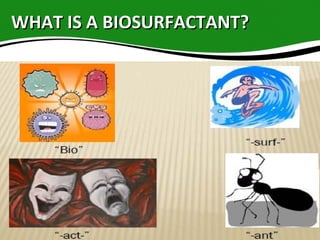
WHAT IS A BIOSURFACTANT?WHAT IS A BIOSURFACTANT?
PROBLEM DESCRIPTION & MARKET NEEDPROBLEM DESCRIPTION & MARKET NEED
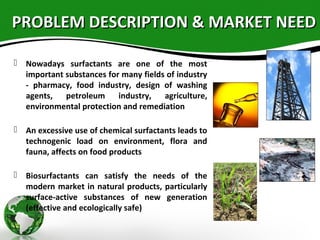
 Nowadays surfactants are one of the most
important substances for many fields of industry
- pharmacy, food industry, design of washing
agents, petroleum industry, agriculture,
environmental protection and remediation
 An excessive use of chemical surfactants leads to
technogenic load on environment, flora and
fauna, affects on food products
 Biosurfactants can satisfy the needs of the
modern market in natural products, particularly
surface-active substances of new generation
(effective and ecologically safe)
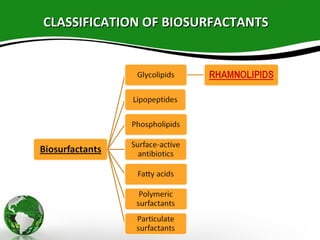
CLASSIFICATION OF BIOSURFACTANTSCLASSIFICATION OF BIOSURFACTANTS
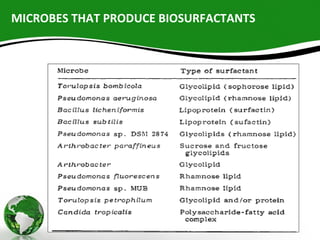
MICROBES THAT PRODUCE BIOSURFACTANTS
RHAMNOLIPIDSRHAMNOLIPIDS
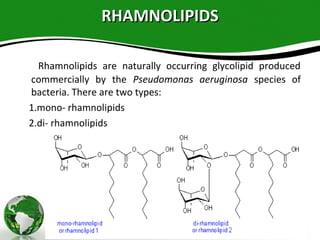
Rhamnolipids are naturally occurring glycolipid produced
commercially by the Pseudomonas aeruginosa species of
bacteria. There are two types:
1.mono- rhamnolipids
2.di- rhamnolipids 
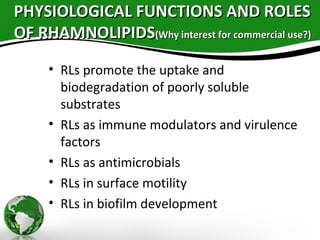
PHYSIOLOGICAL FUNCTIONS AND ROLESPHYSIOLOGICAL FUNCTIONS AND ROLES
OF RHAMNOLIPIDSOF RHAMNOLIPIDS(Why interest for commercial use?)(Why interest for commercial use?)
• RLs promote the uptake and
biodegradation of poorly soluble
substrates
• RLs as immune modulators and virulence
factors
• RLs as antimicrobials
• RLs in surface motility
• RLs in biofilm development
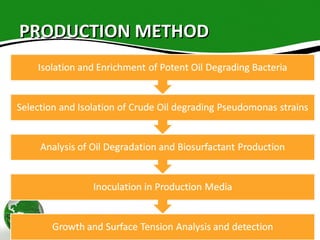
PRODUCTION METHODPRODUCTION METHOD
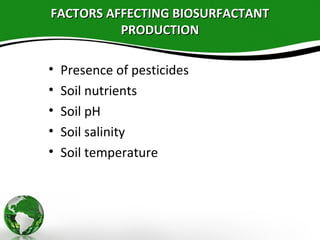
FACTORS AFFECTING BIOSURFACTANTFACTORS AFFECTING BIOSURFACTANT
PRODUCTIONPRODUCTION
• Presence of pesticides
• Soil nutrients
• Soil pH
• Soil salinity
• Soil temperature
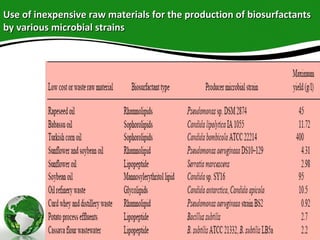
Use of inexpensive raw materials for the production of biosurfactantsUse of inexpensive raw materials for the production of biosurfactants
by various microbial strainsby various microbial strains
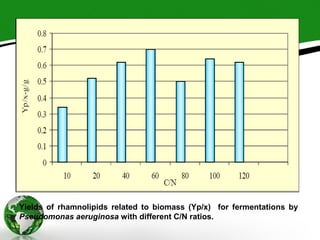
Yields of rhamnolipids related to biomass (Yp/x) for fermentations by
Pseudomonas aeruginosa with different C/N ratios.
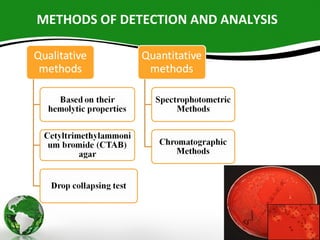
METHODS OF DETECTION AND ANALYSIS
CURRENT APPLICATIONS OFCURRENT APPLICATIONS OF
BIOSURFACTANTSBIOSURFACTANTS
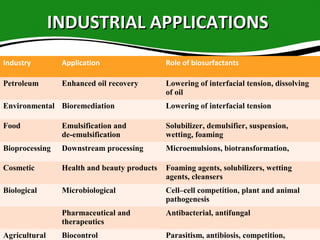
INDUSTRIAL APPLICATIONSINDUSTRIAL APPLICATIONS
Industry Application Role of biosurfactants
Petroleum Enhanced oil recovery Lowering of interfacial tension, dissolving
of oil
Environmental Bioremediation Lowering of interfacial tension
Food Emulsification and
de-emulsification
Solubilizer, demulsifier, suspension,
wetting, foaming
Bioprocessing Downstream processing Microemulsions, biotransformation,
Cosmetic Health and beauty products Foaming agents, solubilizers, wetting
agents, cleansers
Biological Microbiological Cell–cell competition, plant and animal
pathogenesis
Pharmaceutical and
therapeutics
Antibacterial, antifungal
Agricultural Biocontrol Parasitism, antibiosis, competition,
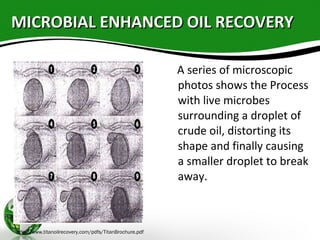
MICROBIAL ENHANCED OIL RECOVERYMICROBIAL ENHANCED OIL RECOVERY
A series of microscopic
photos shows the Process
with live microbes
surrounding a droplet of
crude oil, distorting its
shape and finally causing
a smaller droplet to break
away.
http://www.titanoilrecovery.com/pdfs/TitanBrochure.pdf
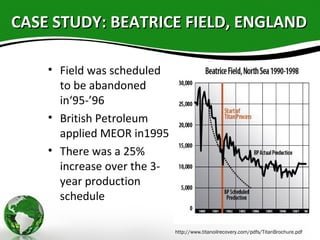
CASE STUDY: BEATRICE FIELD, ENGLANDCASE STUDY: BEATRICE FIELD, ENGLAND
• Field was scheduled
to be abandoned
in‘95-’96
• British Petroleum
applied MEOR in1995
• There was a 25%
increase over the 3-
year production
schedule
http://www.titanoilrecovery.com/pdfs/TitanBrochure.pdf
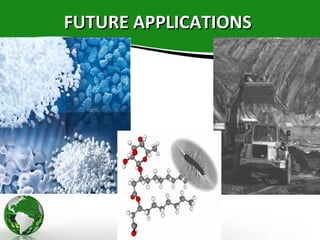
FUTURE APPLICATIONSFUTURE APPLICATIONS
CURRENT DIRECTIONS OF R&DCURRENT DIRECTIONS OF R&D
 BioengineeringBioengineering
Biosynthesis and studying of microbial enzymes and their compositions.
Investigation of synthesis of biosurfactants, their properties and application
in biomedicine, agriculture, food, pharmaceutical and cosmetic industry.
 Chemistry/ MaterialsChemistry/ Materials
Creation and investigation of new polymeric materials.
 ChemistryChemistry
Investigation of catalytic oxidation of hydrocarbon derivatives.
 Chemical/Environmental EngineeringChemical/Environmental Engineering
Development of methods of bioremediation of water and soil.
Emulsification of HC’s (adherence), lowering interfacial tension, metal
sequestration, dispersion, foaming agent,
Monitoring of petroleum-contaminated water and soil.
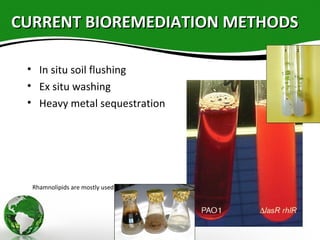
CURRENT BIOREMEDIATION METHODSCURRENT BIOREMEDIATION METHODS
• In situ soil flushing
• Ex situ washing
• Heavy metal sequestration
Rhamnolipids are mostly used.
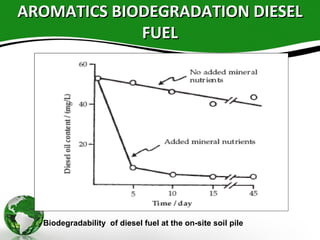
AROMATICS BIODEGRADATION DIESELAROMATICS BIODEGRADATION DIESEL
FUELFUEL
Biodegradability of diesel fuel at the on-site soil pile
ADVANTAGESADVANTAGES
 Recovery of pure Rhamnolipids without
antifoam contamination for use in ecological
washing and cleaning agents or cosmetics
 Reuse of cells by repeated batch-process
leads to an economic and high-yield
production of Rhamnolipids
 Use of renewable sources (e.g. vegetable oils)
instead of petroleum-based chemicals
 Possibility to recover rhamnose sugar by
direct hydrolysis of the crude product, e.g.
for furaneol synthesis or use as flavors
CONCLUSIONCONCLUSION
 Lower yields.
 Still more expensive than chemical surfactants.
 Process and production optimization needs to be improved.
 Cheaper substrates + optimal growth and production conditions +
novel efficient multi-step downstream + recombinant and mutant
hyper producing microbial strains
 Future applications as:
- fine specialty chemicals
- biological control agents,
- new generation molecules for pharmaceutical, cosmetic and health
care industries.
 Ecofriendly synthesis of silver nanoparticles and stabilizer before
addition.
 Ecofriendly product for flocculation and dispersion of high solid
contents of micro particles.
REFERENCESREFERENCES
 Olivera, N.L., Commendatore, M.G., Moran, A.C. and Esteves J.L. 2000.
Biosurfactant-enhanced degradation of residual hydrocarbons from ship bilge
wastes, Journal of Industrial Microbiology and Biotechnology 25: 70-73
 Mulligan, C.N., Environmental applications for biosurfactants. Environmental
Pollution 133: 183–198
 Schippers, C., Gener, K., Muller, T. and Scheper, T. (2000) Microbial degradation
of phenanthrene by addition of a sophorolipid mixture, Journal of
Biotechnology 83:189-198
 Tecon, R. and van der Meer J.R. .2009. Effect of two types of biosurfactants on
phenanthrene availability to the bacterial bioreporter Burkholderia sartisoli
strain RP037. App. Microbiol Biotech- online DOI 10.1007/s00253-009-2216-0
 Muthusamy, K., Gopalakrishnan S., Ravi, T.K. and Sivachidambaram, P. 2008.
Biosurfactants: Properties, commercial production and application. Review
Article. Current Science 94- 6: 736-747
 Kosaric, N., 2001. Biosurfactants and their application for soil bioremediation.
Food Technol. Biotechnol., 39:295-304.
 Qinhong Wang, Xiangdong Fang, Baojun Bai, Xiaolin Liang, Patrick J. Shuler,
William A. Goddard III, Yongchun Tang Received 23 January 2007; revision
received 5 April 2007; accepted 6 April 2007 DOI 10.1002/bit.21462
RHAMNOLIPIDS biosurfactants

RHAMNOLIPIDS biosurfactants

  • 1.
  • 2.
    OUTLINEOUTLINE • Definition ofBiosurfactants • Microbes that Produce Biosurfactants • Rhamnolipids • Production method • Current Applications of Biosurfactants • Future Applications of Biosurfactants • Conclusion
  • 3.
    WHAT IS ABIOSURFACTANT?WHAT IS A BIOSURFACTANT?
  • 4.
    PROBLEM DESCRIPTION &MARKET NEEDPROBLEM DESCRIPTION & MARKET NEED  Nowadays surfactants are one of the most important substances for many fields of industry - pharmacy, food industry, design of washing agents, petroleum industry, agriculture, environmental protection and remediation  An excessive use of chemical surfactants leads to technogenic load on environment, flora and fauna, affects on food products  Biosurfactants can satisfy the needs of the modern market in natural products, particularly surface-active substances of new generation (effective and ecologically safe)
  • 5.
  • 6.
    MICROBES THAT PRODUCEBIOSURFACTANTS
  • 7.
    RHAMNOLIPIDSRHAMNOLIPIDS Rhamnolipids are naturallyoccurring glycolipid produced commercially by the Pseudomonas aeruginosa species of bacteria. There are two types: 1.mono- rhamnolipids 2.di- rhamnolipids 
  • 8.
    PHYSIOLOGICAL FUNCTIONS ANDROLESPHYSIOLOGICAL FUNCTIONS AND ROLES OF RHAMNOLIPIDSOF RHAMNOLIPIDS(Why interest for commercial use?)(Why interest for commercial use?) • RLs promote the uptake and biodegradation of poorly soluble substrates • RLs as immune modulators and virulence factors • RLs as antimicrobials • RLs in surface motility • RLs in biofilm development
  • 9.
  • 10.
    FACTORS AFFECTING BIOSURFACTANTFACTORSAFFECTING BIOSURFACTANT PRODUCTIONPRODUCTION • Presence of pesticides • Soil nutrients • Soil pH • Soil salinity • Soil temperature
  • 11.
    Use of inexpensiveraw materials for the production of biosurfactantsUse of inexpensive raw materials for the production of biosurfactants by various microbial strainsby various microbial strains
  • 12.
    Yields of rhamnolipidsrelated to biomass (Yp/x) for fermentations by Pseudomonas aeruginosa with different C/N ratios.
  • 13.
  • 14.
    CURRENT APPLICATIONS OFCURRENTAPPLICATIONS OF BIOSURFACTANTSBIOSURFACTANTS
  • 15.
    INDUSTRIAL APPLICATIONSINDUSTRIAL APPLICATIONS IndustryApplication Role of biosurfactants Petroleum Enhanced oil recovery Lowering of interfacial tension, dissolving of oil Environmental Bioremediation Lowering of interfacial tension Food Emulsification and de-emulsification Solubilizer, demulsifier, suspension, wetting, foaming Bioprocessing Downstream processing Microemulsions, biotransformation, Cosmetic Health and beauty products Foaming agents, solubilizers, wetting agents, cleansers Biological Microbiological Cell–cell competition, plant and animal pathogenesis Pharmaceutical and therapeutics Antibacterial, antifungal Agricultural Biocontrol Parasitism, antibiosis, competition,
  • 16.
    MICROBIAL ENHANCED OILRECOVERYMICROBIAL ENHANCED OIL RECOVERY A series of microscopic photos shows the Process with live microbes surrounding a droplet of crude oil, distorting its shape and finally causing a smaller droplet to break away. http://www.titanoilrecovery.com/pdfs/TitanBrochure.pdf
  • 17.
    CASE STUDY: BEATRICEFIELD, ENGLANDCASE STUDY: BEATRICE FIELD, ENGLAND • Field was scheduled to be abandoned in‘95-’96 • British Petroleum applied MEOR in1995 • There was a 25% increase over the 3- year production schedule http://www.titanoilrecovery.com/pdfs/TitanBrochure.pdf
  • 18.
  • 19.
    CURRENT DIRECTIONS OFR&DCURRENT DIRECTIONS OF R&D  BioengineeringBioengineering Biosynthesis and studying of microbial enzymes and their compositions. Investigation of synthesis of biosurfactants, their properties and application in biomedicine, agriculture, food, pharmaceutical and cosmetic industry.  Chemistry/ MaterialsChemistry/ Materials Creation and investigation of new polymeric materials.  ChemistryChemistry Investigation of catalytic oxidation of hydrocarbon derivatives.  Chemical/Environmental EngineeringChemical/Environmental Engineering Development of methods of bioremediation of water and soil. Emulsification of HC’s (adherence), lowering interfacial tension, metal sequestration, dispersion, foaming agent, Monitoring of petroleum-contaminated water and soil.
  • 20.
    CURRENT BIOREMEDIATION METHODSCURRENTBIOREMEDIATION METHODS • In situ soil flushing • Ex situ washing • Heavy metal sequestration Rhamnolipids are mostly used.
  • 21.
    AROMATICS BIODEGRADATION DIESELAROMATICSBIODEGRADATION DIESEL FUELFUEL Biodegradability of diesel fuel at the on-site soil pile
  • 22.
    ADVANTAGESADVANTAGES  Recovery ofpure Rhamnolipids without antifoam contamination for use in ecological washing and cleaning agents or cosmetics  Reuse of cells by repeated batch-process leads to an economic and high-yield production of Rhamnolipids  Use of renewable sources (e.g. vegetable oils) instead of petroleum-based chemicals  Possibility to recover rhamnose sugar by direct hydrolysis of the crude product, e.g. for furaneol synthesis or use as flavors
  • 23.
    CONCLUSIONCONCLUSION  Lower yields. Still more expensive than chemical surfactants.  Process and production optimization needs to be improved.  Cheaper substrates + optimal growth and production conditions + novel efficient multi-step downstream + recombinant and mutant hyper producing microbial strains  Future applications as: - fine specialty chemicals - biological control agents, - new generation molecules for pharmaceutical, cosmetic and health care industries.  Ecofriendly synthesis of silver nanoparticles and stabilizer before addition.  Ecofriendly product for flocculation and dispersion of high solid contents of micro particles.
  • 24.
    REFERENCESREFERENCES  Olivera, N.L.,Commendatore, M.G., Moran, A.C. and Esteves J.L. 2000. Biosurfactant-enhanced degradation of residual hydrocarbons from ship bilge wastes, Journal of Industrial Microbiology and Biotechnology 25: 70-73  Mulligan, C.N., Environmental applications for biosurfactants. Environmental Pollution 133: 183–198  Schippers, C., Gener, K., Muller, T. and Scheper, T. (2000) Microbial degradation of phenanthrene by addition of a sophorolipid mixture, Journal of Biotechnology 83:189-198  Tecon, R. and van der Meer J.R. .2009. Effect of two types of biosurfactants on phenanthrene availability to the bacterial bioreporter Burkholderia sartisoli strain RP037. App. Microbiol Biotech- online DOI 10.1007/s00253-009-2216-0  Muthusamy, K., Gopalakrishnan S., Ravi, T.K. and Sivachidambaram, P. 2008. Biosurfactants: Properties, commercial production and application. Review Article. Current Science 94- 6: 736-747  Kosaric, N., 2001. Biosurfactants and their application for soil bioremediation. Food Technol. Biotechnol., 39:295-304.  Qinhong Wang, Xiangdong Fang, Baojun Bai, Xiaolin Liang, Patrick J. Shuler, William A. Goddard III, Yongchun Tang Received 23 January 2007; revision received 5 April 2007; accepted 6 April 2007 DOI 10.1002/bit.21462