• Definition

• History
• Classification
• Treatment consideration
• Assessment
• Treatment planning

• Complications
A true resultant deformity of the jaw
bone/bones due to congenital anomalies
or acquired during the growth and
development of an individual (trauma,
habbits, familial, pathology or post cancer
surgery).
Function - Chewing
Swallowing
Speech
Airway related
Malnourishment
Esthetics
Social acceptance
•

The first known correction of jaw deformity was carried out without
anaesthesia in the mid 19th century by an American, General
Surgeon Simon Hullihen.

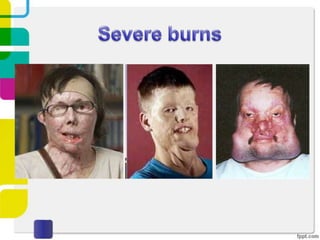
• He was referred a patient with gross facial deformities as the result of
scarring from burns early in childhood, with a history of multiple
previous operations.
• He undertook initially an osteotomy of the mandible, repositioning
the anterior segment to correct an anterior open bite and
subsequently he carried out soft tissue surgery to improve the overall
appearance and functionality of the soft tissues of the lips, chin and
neck to return them to their normal position thus achieving lip closure
and a relatively normal facial profile. That was in 1848 .
• Maxillary surgery for tumour removal had been carried out in the
19th century by von Langenbeck in Germany and by Cheever in the
US.
• It was not until the 1920’s that midface surgery as previously described
in the 19th century was specifically used to correct maxillary
deformity where there was severe maxillary retrusion often in
association with cleft palate problems.
• Martin Wassmund and Georg Axhausen were the first in Germany
to develop the procedure for midface deformity .
• Le Fort I osteotomy became widely accepted for the correction of low
midface deformity often in conjunction with mandibular surgery.
1. Congenital
2. Acquired
3. Pseudo/ Other Causes…
(Related to soft tissues)
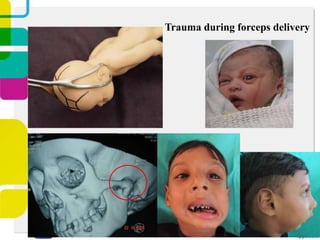
1. Trauma during forceps delivery
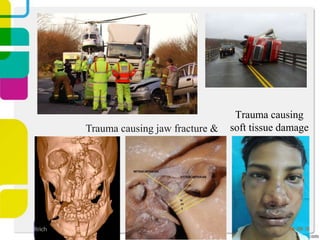
2. Trauma causing soft tissue damage
3. Trauma causing jaw fracture
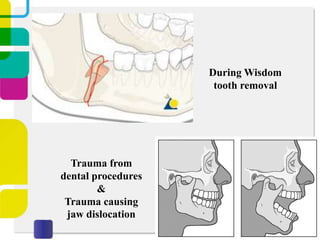
4. Trauma causing jaw dislocation
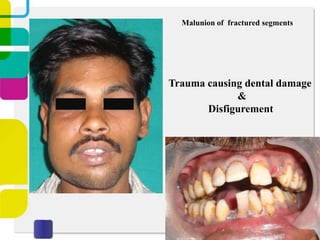
5. Trauma causing dental damage
6. Trauma from dental procedures
7. During Wisdom tooth removal
Trauma during forceps delivery
Trauma causing jaw fracture &

Trauma causing
soft tissue damage
Malunion of fractured segments

Trauma causing dental damage
&
Disfigurement
During Wisdom
tooth removal

Trauma from
dental procedures
&
Trauma causing
jaw dislocation
1. Dental caries

2. Dental abscess
3. Wisdom teeth

4. Infection of jaw bone (osteomyelitis)
5. Dental cyst

6. Poor dental hygiene
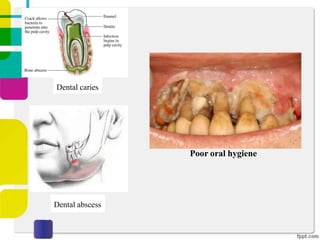
Dental caries

Poor oral hygiene

Dental abscess
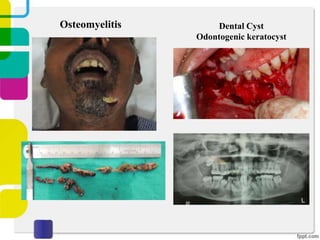
Osteomyelitis

Dental Cyst
Odontogenic keratocyst
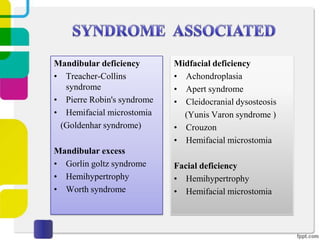
Mandibular deficiency
• Treacher-Collins
syndrome
• Pierre Robin's syndrome
• Hemifacial microstomia
(Goldenhar syndrome)
Mandibular excess
• Gorlin goltz syndrome
• Hemihypertrophy
• Worth syndrome

Midfacial deficiency
• Achondroplasia
• Apert syndrome
• Cleidocranial dysosteosis
(Yunis Varon syndrome )
• Crouzon
• Hemifacial microstomia
Facial deficiency
• Hemihypertrophy
• Hemifacial microstomia
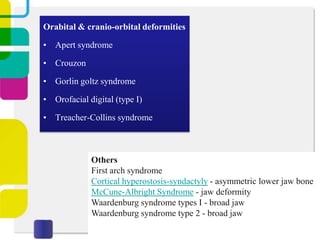
Orabital & cranio-orbital deformities
• Apert syndrome
• Crouzon
• Gorlin goltz syndrome
• Orofacial digital (type I)
• Treacher-Collins syndrome

Others
First arch syndrome
Cortical hyperostosis-syndactyly - asymmetric lower jaw bone
McCune-Albright Syndrome - jaw deformity
Waardenburg syndrome types I - broad jaw
Waardenburg syndrome type 2 - broad jaw
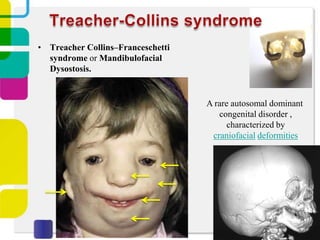
• Treacher Collins–Franceschetti
syndrome or Mandibulofacial
Dysostosis.

A rare autosomal dominant
congenital disorder ,
characterized by
craniofacial deformities
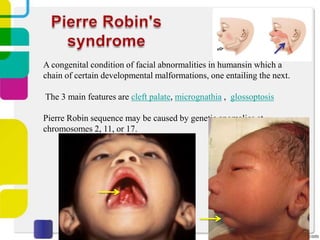
A congenital condition of facial abnormalities in humansin which a
chain of certain developmental malformations, one entailing the next.

The 3 main features are cleft palate, micrognathia , glossoptosis
Pierre Robin sequence may be caused by genetic anomalies at
chromosomes 2, 11, or 17.
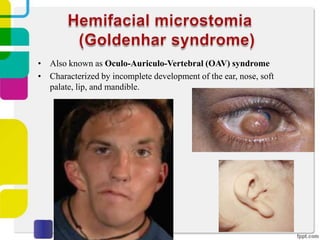
• Also known as Oculo-Auriculo-Vertebral (OAV) syndrome
• Characterized by incomplete development of the ear, nose, soft
palate, lip, and mandible.
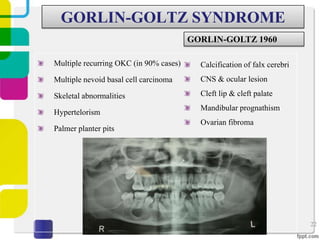
GORLIN-GOLTZ SYNDROME
GORLIN-GOLTZ 1960
Multiple recurring OKC (in 90% cases)

Calcification of falx cerebri

Multiple nevoid basal cell carcinoma

CNS & ocular lesion

Skeletal abnormalities
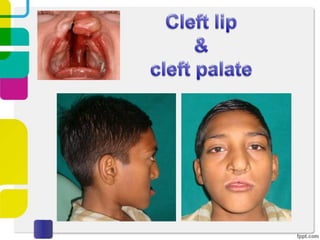
Cleft lip & cleft palate

Hypertelorism
Palmer planter pits

Mandibular prognathism
Ovarian fibroma

22
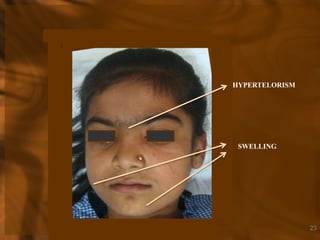
HYPERTELORISM

SWELLING

23
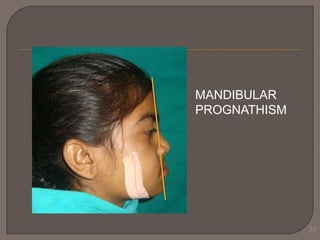
MANDIBULAR
PROGNATHISM

24
25
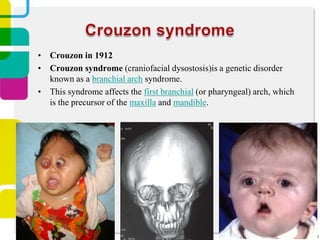
• Crouzon in 1912
• Crouzon syndrome (craniofacial dysostosis)is a genetic disorder
known as a branchial arch syndrome.
• This syndrome affects the first branchial (or pharyngeal) arch, which
is the precursor of the maxilla and mandible.
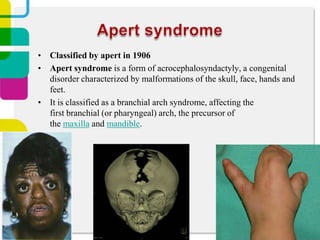
• Classified by apert in 1906
• Apert syndrome is a form of acrocephalosyndactyly, a congenital
disorder characterized by malformations of the skull, face, hands and
feet.
• It is classified as a branchial arch syndrome, affecting the
first branchial (or pharyngeal) arch, the precursor of
the maxilla and mandible.
•
•
•
•
•

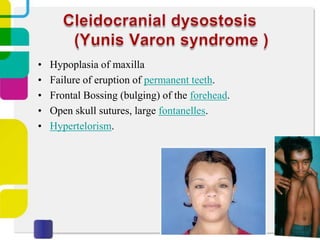
Hypoplasia of maxilla
Failure of eruption of permanent teeth.
Frontal Bossing (bulging) of the forehead.
Open skull sutures, large fontanelles.
Hypertelorism.
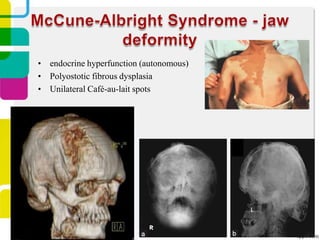
• endocrine hyperfunction (autonomous)
• Polyostotic fibrous dysplasia
• Unilateral Café-au-lait spots
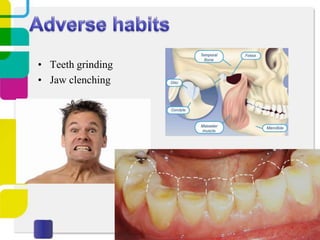
• Teeth grinding
• Jaw clenching
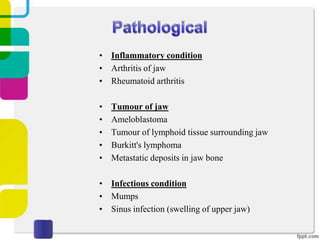
• Inflammatory condition
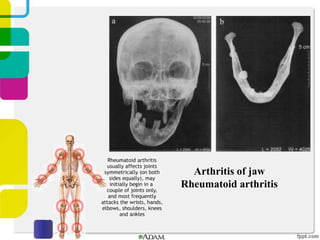
• Arthritis of jaw
• Rheumatoid arthritis
•
•
•
•
•

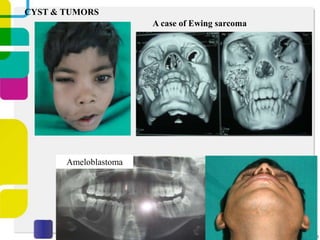
Tumour of jaw
Ameloblastoma
Tumour of lymphoid tissue surrounding jaw
Burkitt's lymphoma
Metastatic deposits in jaw bone

• Infectious condition
• Mumps
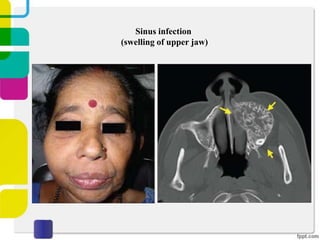
• Sinus infection (swelling of upper jaw)
Arthritis of jaw
Rheumatoid arthritis
CYST & TUMORS
A case of Ewing sarcoma

Ameloblastoma
Sinus infection
(swelling of upper jaw)
Jaw  deformities
Jaw  deformities
Jaw  deformities
Jaw  deformities
Jaw  deformities
Jaw  deformities
Jaw  deformities

Jaw deformities

  • 2.
    • Definition • History •Classification • Treatment consideration • Assessment • Treatment planning • Complications
  • 3.
    A true resultantdeformity of the jaw bone/bones due to congenital anomalies or acquired during the growth and development of an individual (trauma, habbits, familial, pathology or post cancer surgery).
  • 4.
    Function - Chewing Swallowing Speech Airwayrelated Malnourishment Esthetics Social acceptance
  • 5.
    • The first knowncorrection of jaw deformity was carried out without anaesthesia in the mid 19th century by an American, General Surgeon Simon Hullihen. • He was referred a patient with gross facial deformities as the result of scarring from burns early in childhood, with a history of multiple previous operations. • He undertook initially an osteotomy of the mandible, repositioning the anterior segment to correct an anterior open bite and subsequently he carried out soft tissue surgery to improve the overall appearance and functionality of the soft tissues of the lips, chin and neck to return them to their normal position thus achieving lip closure and a relatively normal facial profile. That was in 1848 .
  • 6.
    • Maxillary surgeryfor tumour removal had been carried out in the 19th century by von Langenbeck in Germany and by Cheever in the US. • It was not until the 1920’s that midface surgery as previously described in the 19th century was specifically used to correct maxillary deformity where there was severe maxillary retrusion often in association with cleft palate problems. • Martin Wassmund and Georg Axhausen were the first in Germany to develop the procedure for midface deformity . • Le Fort I osteotomy became widely accepted for the correction of low midface deformity often in conjunction with mandibular surgery.
  • 7.
    1. Congenital 2. Acquired 3.Pseudo/ Other Causes… (Related to soft tissues)
  • 9.
    1. Trauma duringforceps delivery 2. Trauma causing soft tissue damage 3. Trauma causing jaw fracture 4. Trauma causing jaw dislocation 5. Trauma causing dental damage 6. Trauma from dental procedures 7. During Wisdom tooth removal
  • 10.
  • 11.
    Trauma causing jawfracture & Trauma causing soft tissue damage
  • 12.
    Malunion of fracturedsegments Trauma causing dental damage & Disfigurement
  • 13.
    During Wisdom tooth removal Traumafrom dental procedures & Trauma causing jaw dislocation
  • 14.
    1. Dental caries 2.Dental abscess 3. Wisdom teeth 4. Infection of jaw bone (osteomyelitis) 5. Dental cyst 6. Poor dental hygiene
  • 15.
    Dental caries Poor oralhygiene Dental abscess
  • 16.
  • 17.
    Mandibular deficiency • Treacher-Collins syndrome •Pierre Robin's syndrome • Hemifacial microstomia (Goldenhar syndrome) Mandibular excess • Gorlin goltz syndrome • Hemihypertrophy • Worth syndrome Midfacial deficiency • Achondroplasia • Apert syndrome • Cleidocranial dysosteosis (Yunis Varon syndrome ) • Crouzon • Hemifacial microstomia Facial deficiency • Hemihypertrophy • Hemifacial microstomia
  • 18.
    Orabital & cranio-orbitaldeformities • Apert syndrome • Crouzon • Gorlin goltz syndrome • Orofacial digital (type I) • Treacher-Collins syndrome Others First arch syndrome Cortical hyperostosis-syndactyly - asymmetric lower jaw bone McCune-Albright Syndrome - jaw deformity Waardenburg syndrome types I - broad jaw Waardenburg syndrome type 2 - broad jaw
  • 19.
    • Treacher Collins–Franceschetti syndromeor Mandibulofacial Dysostosis. A rare autosomal dominant congenital disorder , characterized by craniofacial deformities
  • 20.
    A congenital conditionof facial abnormalities in humansin which a chain of certain developmental malformations, one entailing the next. The 3 main features are cleft palate, micrognathia , glossoptosis Pierre Robin sequence may be caused by genetic anomalies at chromosomes 2, 11, or 17.
  • 21.
    • Also knownas Oculo-Auriculo-Vertebral (OAV) syndrome • Characterized by incomplete development of the ear, nose, soft palate, lip, and mandible.
  • 22.
    GORLIN-GOLTZ SYNDROME GORLIN-GOLTZ 1960 Multiplerecurring OKC (in 90% cases) Calcification of falx cerebri Multiple nevoid basal cell carcinoma CNS & ocular lesion Skeletal abnormalities Cleft lip & cleft palate Hypertelorism Palmer planter pits Mandibular prognathism Ovarian fibroma 22
  • 23.
  • 24.
  • 25.
  • 26.
    • Crouzon in1912 • Crouzon syndrome (craniofacial dysostosis)is a genetic disorder known as a branchial arch syndrome. • This syndrome affects the first branchial (or pharyngeal) arch, which is the precursor of the maxilla and mandible.
  • 27.
    • Classified byapert in 1906 • Apert syndrome is a form of acrocephalosyndactyly, a congenital disorder characterized by malformations of the skull, face, hands and feet. • It is classified as a branchial arch syndrome, affecting the first branchial (or pharyngeal) arch, the precursor of the maxilla and mandible.
  • 28.
    • • • • • Hypoplasia of maxilla Failureof eruption of permanent teeth. Frontal Bossing (bulging) of the forehead. Open skull sutures, large fontanelles. Hypertelorism.
  • 29.
    • endocrine hyperfunction(autonomous) • Polyostotic fibrous dysplasia • Unilateral Café-au-lait spots
  • 32.
  • 34.
    • Inflammatory condition •Arthritis of jaw • Rheumatoid arthritis • • • • • Tumour of jaw Ameloblastoma Tumour of lymphoid tissue surrounding jaw Burkitt's lymphoma Metastatic deposits in jaw bone • Infectious condition • Mumps • Sinus infection (swelling of upper jaw)
  • 35.
  • 36.
    CYST & TUMORS Acase of Ewing sarcoma Ameloblastoma
  • 37.

Editor's Notes

  • #20 Decribed in 1900 by Treacher-Collins.Termed mandibulofacialdysosteosis by franceschetti & klein 1944 & 1949.a rare autosomal dominant congenital disorder characterized by craniofacial deformities, such as absent cheekbones.
  • #21 Pierre Robin syndrome (abbreviated to PRS, and also known as Pierre Robin malformation, Pierre Robin sequence,Pierre Robin anomaly or Pierre Robin anomalad), is a congenital condition of facial abnormalities in humans. PRS is a sequence, i.e. a chain of certain developmental malformations, one entailing the next. The 3 main features are cleft palate,micrognathia (a small jaw) and glossoptosis (airway obstruction caused by backwards displacement of the tongue base). A genetic cause to PRS was recently identified. Pierre Robin sequence may be caused by genetic anomalies at chromosomes 2, 11, or 17.
  • #22 Goldenhar syndrome (also known as Oculo-Auriculo-Vertebral (OAV) syndrome) is a rare congenital defectcharacterized by incomplete development of the ear, nose, soft palate, lip, and mandible. It is associated with anomalous development of the first branchial arch and second branchial arch.[1] Common clinical manifestations include limbaldermoids, preauricular skin tags, and strabismus.[2]Chief markers of Goldenhar syndrome are incomplete development of the ear, nose, soft palate, lip, and mandible on usually one side of the body. Additionally, some patients will have growing issues with internal organs, especially heart, kidneys, and lungs. 
  • #27 Crouzon syndrome is a genetic disorder known as a branchial arch syndrome. This syndrome affects the first branchial (or pharyngeal) arch, which is the precursor of the maxilla and mandible. Since the branchial arches are important developmental features in a growing embryo, disturbances in their development create lasting and widespread effects.
  • #30 Crouzon syndrome is a genetic disorder known as a branchial arch syndrome. Specifically, this syndrome affects the first branchial (or pharyngeal) arch, which is the precursor of the maxilla and mandible. Since the branchial arches are important developmental features in a growing embryo, disturbances in their development create lasting and widespread effects.
  • #37 Fibrous dysplasia (FD) is a slowly progressive condition characterized by replacement of normal bone with an amalgamate of cellular fibrous tissue and irregular bony trabeculae.Genetically, there is a post-zygotic mutation of the gene GNAS1, on the long (q) arm of chromosome 20 at position 13.3, which is involved in G-protein signalling.[4] This mutation, often a mosaicism, prevents downregulation of cAMP signalling.Polyostotic fibrous dysplasia is usually caused by mosaicism for a mutation in a gene called GNAS1 (Guanine Nucleotide binding protein, Alpha Stimulating activity polypeptide 1).