Chapter 5 Methods


Liang, Introduction to Java Programming, Ninth Edition, (c) 2013 Pearson Education, Inc. All
                                     rights reserved.
                                                                                               1
Opening Problem
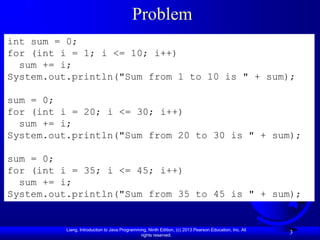
Find the sum of integers from 1 to 10, from 20 to 30, and
from 35 to 45, respectively.


           Liang, Introduction to Java Programming, Ninth Edition, (c) 2013 Pearson Education, Inc. All
                                                rights reserved.
                                                                                                          2
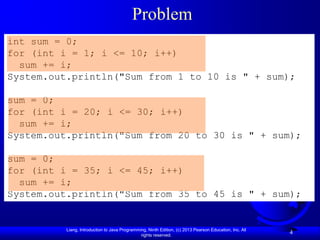
Problem
int sum = 0;
for (int i = 1; i <= 10; i++)
  sum += i;
System.out.println("Sum from 1 to 10 is " + sum);

sum = 0;
for (int i = 20; i <= 30; i++)
  sum += i;
System.out.println("Sum from 20 to 30 is " + sum);

sum = 0;
for (int i = 35; i <= 45; i++)
  sum += i;
System.out.println("Sum from 35 to 45 is " + sum);


          Liang, Introduction to Java Programming, Ninth Edition, (c) 2013 Pearson Education, Inc. All
                                               rights reserved.
                                                                                                         3
Problem
int sum = 0;
for (int i = 1; i <= 10; i++)
  sum += i;
System.out.println("Sum from 1 to 10 is " + sum);

sum = 0;
for (int i = 20; i <= 30; i++)
  sum += i;
System.out.println("Sum from 20 to 30 is " + sum);

sum = 0;
for (int i = 35; i <= 45; i++)
  sum += i;
System.out.println("Sum from 35 to 45 is " + sum);


          Liang, Introduction to Java Programming, Ninth Edition, (c) 2013 Pearson Education, Inc. All
                                               rights reserved.
                                                                                                         4
Solution
public static int sum(int i1, int i2) {
  int sum = 0;
  for (int i = i1; i <= i2; i++)
   sum += i;
  return sum;
}

public static void main(String[] args) {
  System.out.println("Sum from 1 to 10 is " + sum(1, 10));
  System.out.println("Sum from 20 to 30 is " + sum(20, 30));
  System.out.println("Sum from 35 to 45 is " + sum(35, 45));
}
            Liang, Introduction to Java Programming, Ninth Edition, (c) 2013 Pearson Education, Inc. All
                                                 rights reserved.
                                                                                                           5
Objectives
   To define methods with formal parameters (§5.2).
   To invoke methods with actual parameters (i.e., arguments) (§5.2).
   To define methods with a return value (§5.3).
   To define methods without a return value (§5.4).
   To pass arguments by value (§5.5).
   To develop reusable code that is modular, easy to read, easy to debug, and
    easy to maintain (§5.6).
   To write a method that converts decimals to hexadecimals (§5.7).
   To use method overloading and understand ambiguous overloading (§5.8).
   To determine the scope of variables (§5.9).
   To solve mathematics problems using the methods in the Math class
    (§§5.10–5.11).
   To apply the concept of method abstraction in software development (§5.12).
   To design and implement methods using stepwise refinement (§5.12).

             Liang, Introduction to Java Programming, Ninth Edition, (c) 2013 Pearson Education, Inc. All
                                                  rights reserved.
                                                                                                            6
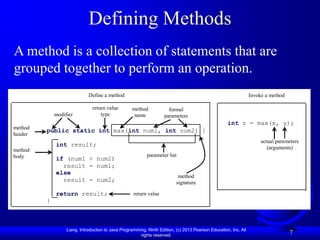
Defining Methods
A method is a collection of statements that are
grouped together to perform an operation.
                             Define a method                                                                     Invoke a method

                               return value        method             formal
             modifier              type             name            parameters
                                                                                                    int z = max(x, y);
method
         public static int max(int num1, int num2) {
header
                                                                                                                      actual parameters
             int result;                                                                                                 (arguments)
method
body                                                       parameter list
             if (num1 > num2)
               result = num1;
             else
                                                                           method
               result = num2;                                             signature

             return result;                         return value
         }


                  Liang, Introduction to Java Programming, Ninth Edition, (c) 2013 Pearson Education, Inc. All
                                                       rights reserved.
                                                                                                                                   7
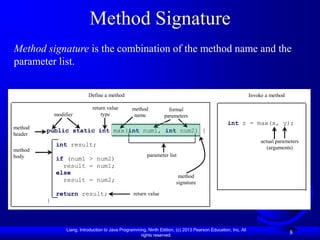
Method Signature
Method signature is the combination of the method name and the
parameter list.


                             Define a method                                                                     Invoke a method

                               return value        method             formal
             modifier              type             name            parameters
                                                                                                    int z = max(x, y);
method
         public static int max(int num1, int num2) {
header
                                                                                                                      actual parameters
             int result;                                                                                                 (arguments)
method
body                                                       parameter list
             if (num1 > num2)
               result = num1;
             else
                                                                           method
               result = num2;                                             signature

             return result;                         return value
         }


                  Liang, Introduction to Java Programming, Ninth Edition, (c) 2013 Pearson Education, Inc. All
                                                       rights reserved.
                                                                                                                                   8
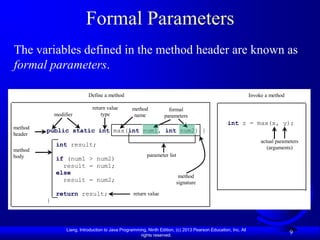
Formal Parameters
The variables defined in the method header are known as
formal parameters.

                             Define a method                                                                     Invoke a method

                               return value        method             formal
             modifier              type             name            parameters
                                                                                                    int z = max(x, y);
method
         public static int max(int num1, int num2) {
header
                                                                                                                      actual parameters
             int result;                                                                                                 (arguments)
method
body                                                       parameter list
             if (num1 > num2)
               result = num1;
             else
                                                                           method
               result = num2;                                             signature

             return result;                         return value
         }


                  Liang, Introduction to Java Programming, Ninth Edition, (c) 2013 Pearson Education, Inc. All
                                                       rights reserved.
                                                                                                                                   9
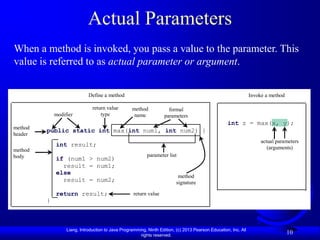
Actual Parameters
When a method is invoked, you pass a value to the parameter. This
value is referred to as actual parameter or argument.


                             Define a method                                                                     Invoke a method

                               return value        method             formal
             modifier              type             name            parameters
                                                                                                    int z = max(x, y);
method
         public static int max(int num1, int num2) {
header
                                                                                                                      actual parameters
             int result;                                                                                                 (arguments)
method
body                                                       parameter list
             if (num1 > num2)
               result = num1;
             else
                                                                           method
               result = num2;                                             signature

             return result;                         return value
         }


                  Liang, Introduction to Java Programming, Ninth Edition, (c) 2013 Pearson Education, Inc. All
                                                       rights reserved.
                                                                                                                                   10
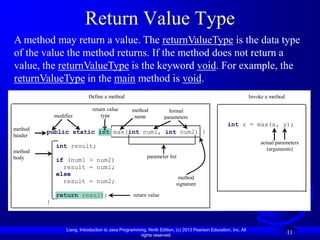
Return Value Type
A method may return a value. The returnValueType is the data type
of the value the method returns. If the method does not return a
value, the returnValueType is the keyword void. For example, the
returnValueType in the main method is void.
                             Define a method                                                                     Invoke a method

                               return value        method             formal
             modifier              type             name            parameters
                                                                                                    int z = max(x, y);
method
         public static int max(int num1, int num2) {
header
                                                                                                                      actual parameters
             int result;                                                                                                 (arguments)
method
body                                                       parameter list
             if (num1 > num2)
               result = num1;
             else
                                                                           method
               result = num2;                                             signature

             return result;                         return value
         }


                  Liang, Introduction to Java Programming, Ninth Edition, (c) 2013 Pearson Education, Inc. All
                                                       rights reserved.
                                                                                                                                   11
Calling Methods
Testing the max method
This program demonstrates calling a method max
to return the largest of the int values


             TestMax                                                               Run


        Liang, Introduction to Java Programming, Ninth Edition, (c) 2013 Pearson Education, Inc. All
                                             rights reserved.
                                                                                                       12
animation

                    Calling Methods, cont.

                                                                                            pass the value of i
                                                                                                                  pass the value of j


 public static void main(String[] args) {                          public static int max(int num1, int num2) {
   int i = 5;                                                        int result;
   int j = 2;
   int k = max(i, j);                                                  if (num1 > num2)
                                                                         result = num1;
     System.out.println(                                               else
      "The maximum between " + i +                                       result = num2;
      " and " + j + " is " + k);
 }                                                                     return result;
                                                                   }


                  Liang, Introduction to Java Programming, Ninth Edition, (c) 2013 Pearson Education, Inc. All
                                                       rights reserved.
                                                                                                                            13
animation

                    Trace Method Invocation
                                                        i is now 5


public static void main(String[] args) {                          public static int max(int num1, int num2) {
  int i = 5;                                                        int result;
  int j = 2;
  int k = max(i, j);                                                  if (num1 > num2)
                                                                        result = num1;
    System.out.println(                                               else
     "The maximum between " + i +                                       result = num2;
     " and " + j + " is " + k);
}                                                                     return result;
                                                                  }


                   Liang, Introduction to Java Programming, Ninth Edition, (c) 2013 Pearson Education, Inc. All
                                                        rights reserved.
                                                                                                                  14
animation

                    Trace Method Invocation
                                                        j is now 2


public static void main(String[] args) {                          public static int max(int num1, int num2) {
  int i = 5;                                                        int result;
  int j = 2;
  int k = max(i, j);                                                  if (num1 > num2)
                                                                        result = num1;
    System.out.println(                                               else
     "The maximum between " + i +                                       result = num2;
     " and " + j + " is " + k);
}                                                                     return result;
                                                                  }


                   Liang, Introduction to Java Programming, Ninth Edition, (c) 2013 Pearson Education, Inc. All
                                                        rights reserved.
                                                                                                                  15
animation

                    Trace Method Invocation
                                                   invoke max(i, j)


public static void main(String[] args) {                          public static int max(int num1, int num2) {
  int i = 5;                                                        int result;
  int j = 2;
  int k = max(i, j);                                                  if (num1 > num2)
                                                                        result = num1;
    System.out.println(                                               else
     "The maximum between " + i +                                       result = num2;
     " and " + j + " is " + k);
}                                                                     return result;
                                                                  }


                   Liang, Introduction to Java Programming, Ninth Edition, (c) 2013 Pearson Education, Inc. All
                                                        rights reserved.
                                                                                                                  16
animation

                    Trace Method Invocation
                                                invoke max(i, j)
                                          Pass the value of i to num1
                                          Pass the value of j to num2

public static void main(String[] args) {                          public static int max(int num1, int num2) {
  int i = 5;                                                        int result;
  int j = 2;
  int k = max(i, j);                                                  if (num1 > num2)
                                                                        result = num1;
    System.out.println(                                               else
     "The maximum between " + i +                                       result = num2;
     " and " + j + " is " + k);
}                                                                     return result;
                                                                  }


                   Liang, Introduction to Java Programming, Ninth Edition, (c) 2013 Pearson Education, Inc. All
                                                        rights reserved.
                                                                                                                  17
animation

                    Trace Method Invocation
                                              declare variable result


public static void main(String[] args) {                          public static int max(int num1, int num2) {
  int i = 5;                                                        int result;
  int j = 2;
  int k = max(i, j);                                                  if (num1 > num2)
                                                                        result = num1;
    System.out.println(                                               else
     "The maximum between " + i +                                       result = num2;
     " and " + j + " is " + k);
}                                                                     return result;
                                                                  }


                   Liang, Introduction to Java Programming, Ninth Edition, (c) 2013 Pearson Education, Inc. All
                                                        rights reserved.
                                                                                                                  18
animation

                    Trace Method Invocation
                                    (num1 > num2) is true since num1
                                           is 5 and num2 is 2


public static void main(String[] args) {                          public static int max(int num1, int num2) {
  int i = 5;                                                        int result;
  int j = 2;
  int k = max(i, j);                                                  if (num1 > num2)
                                                                        result = num1;
    System.out.println(                                               else
     "The maximum between " + i +                                       result = num2;
     " and " + j + " is " + k);
}                                                                     return result;
                                                                  }


                   Liang, Introduction to Java Programming, Ninth Edition, (c) 2013 Pearson Education, Inc. All
                                                        rights reserved.
                                                                                                                  19
animation

                    Trace Method Invocation
                                                    result is now 5


public static void main(String[] args) {                          public static int max(int num1, int num2) {
  int i = 5;                                                        int result;
  int j = 2;
  int k = max(i, j);                                                  if (num1 > num2)
                                                                        result = num1;
    System.out.println(                                               else
     "The maximum between " + i +                                       result = num2;
     " and " + j + " is " + k);
}                                                                     return result;
                                                                  }


                   Liang, Introduction to Java Programming, Ninth Edition, (c) 2013 Pearson Education, Inc. All
                                                        rights reserved.
                                                                                                                  20
animation

                    Trace Method Invocation
                                             return result, which is 5


public static void main(String[] args) {                          public static int max(int num1, int num2) {
  int i = 5;                                                        int result;
  int j = 2;
  int k = max(i, j);                                                  if (num1 > num2)
                                                                        result = num1;
    System.out.println(                                               else
     "The maximum between " + i +                                       result = num2;
     " and " + j + " is " + k);
}                                                                     return result;
                                                                  }


                   Liang, Introduction to Java Programming, Ninth Edition, (c) 2013 Pearson Education, Inc. All
                                                        rights reserved.
                                                                                                                  21
animation

                    Trace Method Invocation
                                        return max(i, j) and assign the
                                               return value to k


public static void main(String[] args) {                          public static int max(int num1, int num2) {
  int i = 5;                                                        int result;
  int j = 2;
  int k = max(i, j);                                                  if (num1 > num2)
                                                                        result = num1;
    System.out.println(                                               else
     "The maximum between " + i +                                       result = num2;
     " and " + j + " is " + k);
}                                                                     return result;
                                                                  }


                   Liang, Introduction to Java Programming, Ninth Edition, (c) 2013 Pearson Education, Inc. All
                                                        rights reserved.
                                                                                                                  22
animation

                    Trace Method Invocation
                                          Execute the print statement


public static void main(String[] args) {                          public static int max(int num1, int num2) {
  int i = 5;                                                        int result;
  int j = 2;
  int k = max(i, j);                                                  if (num1 > num2)
                                                                        result = num1;
    System.out.println(                                               else
     "The maximum between " + i +                                       result = num2;
     " and " + j + " is " + k);
}                                                                     return result;
                                                                  }


                   Liang, Introduction to Java Programming, Ninth Edition, (c) 2013 Pearson Education, Inc. All
                                                        rights reserved.
                                                                                                                  23
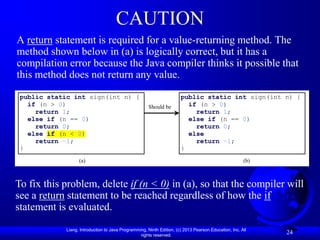
CAUTION
A return statement is required for a value-returning method. The
method shown below in (a) is logically correct, but it has a
compilation error because the Java compiler thinks it possible that
this method does not return any value.
 public static int sign(int n) {                                       public static int sign(int n) {
   if (n > 0)                                          Should be         if (n > 0)
     return 1;                                                             return 1;
   else if (n == 0)                                                      else if (n == 0)
     return 0;                                                             return 0;
   else if (n < 0)                                                       else
     return –1;                                                            return –1;
 }                                                                     }
                   (a)                                                                                 (b)


To fix this problem, delete if (n < 0) in (a), so that the compiler will
see a return statement to be reached regardless of how the if
statement is evaluated.
             Liang, Introduction to Java Programming, Ninth Edition, (c) 2013 Pearson Education, Inc. All
                                                  rights reserved.
                                                                                                             24
Reuse Methods from Other Classes
NOTE: One of the benefits of methods is for reuse. The max
method can be invoked from any class besides TestMax. If
you create a new class Test, you can invoke the max method
using ClassName.methodName (e.g., TestMax.max).


          Liang, Introduction to Java Programming, Ninth Edition, (c) 2013 Pearson Education, Inc. All
                                               rights reserved.
                                                                                                         25
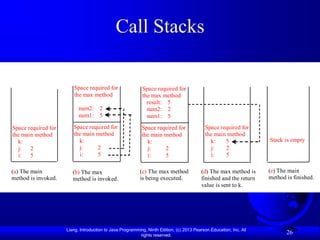
Call Stacks

                        Space required for                 Space required for
                        the max method                     the max method
                                                             result: 5
                           num2: 2                           num2: 2
                           num1: 5                           num1: 5
Space required for      Space required for                 Space required for              Space required for
the main method         the main method                    the main method                 the main method
  k:                      k:                                 k:                              k:    5                Stack is empty
  j:   2                  j:     2                           j:     2                        j:    2
  i:   5                  i:     5                           i:     5                        i:    5

(a) The main            (b) The max                       (c) The max method              (d) The max method is     (e) The main
method is invoked.      method is invoked.                is being executed.              finished and the return   method is finished.
                                                                                          value is sent to k.


                     Liang, Introduction to Java Programming, Ninth Edition, (c) 2013 Pearson Education, Inc. All
                                                          rights reserved.
                                                                                                                           26
animation

                                      Trace Call Stack
                                                                            i is declared and initialized


public static void main(String[] args) {
  int i = 5;
  int j = 2;
  int k = max(i, j);
    System.out.println(
     "The maximum between " + i +
     " and " + j + " is " + k);
}

public static int max(int num1, int num2) {
  int result;                                                                                                            i: 5

    if (num1 > num2)
      result = num1;                                                                                   The main method
    else                                                                                               is invoked.
      result = num2;
    return result;
}


                     Liang, Introduction to Java Programming, Ninth Edition, (c) 2013 Pearson Education, Inc. All
                                                          rights reserved.
                                                                                                                                27
animation

                                      Trace Call Stack
                                                                            j is declared and initialized


public static void main(String[] args) {
  int i = 5;
  int j = 2;
  int k = max(i, j);
    System.out.println(
     "The maximum between " + i +
     " and " + j + " is " + k);
}

public static int max(int num1, int num2) {                                                                              j: 2
  int result;                                                                                                            i: 5

    if (num1 > num2)
      result = num1;                                                                                   The main method
    else                                                                                               is invoked.
      result = num2;
    return result;
}


                     Liang, Introduction to Java Programming, Ninth Edition, (c) 2013 Pearson Education, Inc. All
                                                          rights reserved.
                                                                                                                                28
animation

                                      Trace Call Stack
                                                                                          Declare k


public static void main(String[] args) {
  int i = 5;
  int j = 2;
  int k = max(i, j);
    System.out.println(
     "The maximum between " + i +
     " and " + j + " is " + k);
}                                                                                                     Space required for the
                                                                                                      main method
                                                                                                                          k:
public static int max(int num1, int num2) {                                                                              j: 2
  int result;                                                                                                            i: 5

    if (num1 > num2)
      result = num1;                                                                                   The main method
    else                                                                                               is invoked.
      result = num2;
    return result;
}


                     Liang, Introduction to Java Programming, Ninth Edition, (c) 2013 Pearson Education, Inc. All
                                                          rights reserved.
                                                                                                                                29
animation

                                      Trace Call Stack
                                                                                     Invoke max(i, j)


public static void main(String[] args) {
  int i = 5;
  int j = 2;
  int k = max(i, j);
    System.out.println(
     "The maximum between " + i +
     " and " + j + " is " + k);
}                                                                                                     Space required for the
                                                                                                      main method
                                                                                                                          k:
public static int max(int num1, int num2) {                                                                              j: 2
  int result;                                                                                                            i: 5

    if (num1 > num2)
      result = num1;                                                                                   The main method
    else                                                                                               is invoked.
      result = num2;
    return result;
}


                     Liang, Introduction to Java Programming, Ninth Edition, (c) 2013 Pearson Education, Inc. All
                                                          rights reserved.
                                                                                                                                30
animation

                                      Trace Call Stack
                                                                       pass the values of i and j to num1
                                                                                   and num2

public static void main(String[] args) {
  int i = 5;
  int j = 2;
  int k = max(i, j);
    System.out.println(
     "The maximum between " + i +
     " and " + j + " is " + k);                                                                                     num2: 2
}                                                                                                                   num1: 5
                                                                                                 Space required for the
public static int max(int num1, int num2) {
  int result;                                                                                    main method
                                                                                                                     k:
    if (num1 > num2)                                                                                                j: 2
      result = num1;                                                                                                i: 5
    else
      result = num2;
    return result;                                                                                 The max method is
}                                                                                                  invoked.


                     Liang, Introduction to Java Programming, Ninth Edition, (c) 2013 Pearson Education, Inc. All
                                                          rights reserved.
                                                                                                                              31
animation

                                      Trace Call Stack

                                                                                       Declare result


public static void main(String[] args) {
  int i = 5;
  int j = 2;
  int k = max(i, j);
    System.out.println(
     "The maximum between " + i +                                                                                   result:
     " and " + j + " is " + k);                                                                                     num2: 2
}                                                                                                                   num1: 5
                                                                                                 Space required for the
public static int max(int num1, int num2) {
  int result;                                                                                    main method
                                                                                                                     k:
    if (num1 > num2)                                                                                                j: 2
      result = num1;                                                                                                i: 5
    else
      result = num2;
    return result;                                                                                 The max method is
}                                                                                                  invoked.


                     Liang, Introduction to Java Programming, Ninth Edition, (c) 2013 Pearson Education, Inc. All
                                                          rights reserved.
                                                                                                                              32
animation

                                      Trace Call Stack

                                                                                (num1 > num2) is true


public static void main(String[] args) {
  int i = 5;
  int j = 2;
  int k = max(i, j);
    System.out.println(
     "The maximum between " + i +                                                                                   result:
     " and " + j + " is " + k);                                                                                     num2: 2
}                                                                                                                   num1: 5
                                                                                                 Space required for the
public static int max(int num1, int num2) {
  int result;                                                                                    main method
                                                                                                                     k:
    if (num1 > num2)                                                                                                j: 2
      result = num1;                                                                                                i: 5
    else
      result = num2;
    return result;                                                                                 The max method is
}                                                                                                  invoked.


                     Liang, Introduction to Java Programming, Ninth Edition, (c) 2013 Pearson Education, Inc. All
                                                          rights reserved.
                                                                                                                              33
animation

                                      Trace Call Stack

                                                                                Assign num1 to result


public static void main(String[] args) {
  int i = 5;
  int j = 2;
  int k = max(i, j);
                                                                                                 Space required for the
    System.out.println(                                                                          max method
     "The maximum between " + i +                                                                              result: 5
     " and " + j + " is " + k);                                                                                num2: 2
}                                                                                                              num1: 5
                                                                                                 Space required for the
public static int max(int num1, int num2) {
  int result;                                                                                    main method
                                                                                                                     k:
    if (num1 > num2)                                                                                                j: 2
      result = num1;                                                                                                i: 5
    else
      result = num2;
    return result;                                                                                 The max method is
}                                                                                                  invoked.


                     Liang, Introduction to Java Programming, Ninth Edition, (c) 2013 Pearson Education, Inc. All
                                                          rights reserved.
                                                                                                                           34
animation

                                      Trace Call Stack

                                                                         Return result and assign it to k


public static void main(String[] args) {
  int i = 5;
  int j = 2;
  int k = max(i, j);
                                                                                                 Space required for the
    System.out.println(                                                                          max method
     "The maximum between " + i +                                                                              result: 5
     " and " + j + " is " + k);                                                                                num2: 2
}                                                                                                              num1: 5
                                                                                                 Space required for the
public static int max(int num1, int num2) {
  int result;                                                                                    main method
                                                                                                                    k:5
    if (num1 > num2)                                                                                                j: 2
      result = num1;                                                                                                i: 5
    else
      result = num2;
    return result;                                                                                 The max method is
}                                                                                                  invoked.


                     Liang, Introduction to Java Programming, Ninth Edition, (c) 2013 Pearson Education, Inc. All
                                                          rights reserved.
                                                                                                                           35
animation

                                      Trace Call Stack
                                                                               Execute print statement


public static void main(String[] args) {
  int i = 5;
  int j = 2;
  int k = max(i, j);
    System.out.println(
     "The maximum between " + i +
     " and " + j + " is " + k);
}                                                                                                     Space required for the
                                                                                                      main method
                                                                                                                         k:5
public static int max(int num1, int num2) {                                                                              j: 2
  int result;                                                                                                            i: 5

    if (num1 > num2)
      result = num1;                                                                                   The main method
    else                                                                                               is invoked.
      result = num2;
    return result;
}


                     Liang, Introduction to Java Programming, Ninth Edition, (c) 2013 Pearson Education, Inc. All
                                                          rights reserved.
                                                                                                                                36
void Method Example
This type of method does not return a value. The method
performs some actions.


        TestVoidMethod                                                                 Run


          Liang, Introduction to Java Programming, Ninth Edition, (c) 2013 Pearson Education, Inc. All
                                               rights reserved.
                                                                                                         37
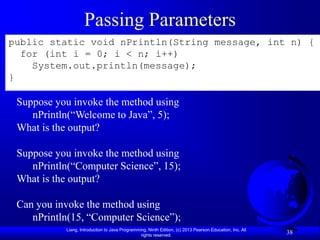
Passing Parameters
public static void nPrintln(String message, int n) {
  for (int i = 0; i < n; i++)
    System.out.println(message);
}

 Suppose you invoke the method using
    nPrintln(“Welcome to Java”, 5);
 What is the output?

 Suppose you invoke the method using
    nPrintln(“Computer Science”, 15);
 What is the output?

 Can you invoke the method using
    nPrintln(15, “Computer Science”);
           Liang, Introduction to Java Programming, Ninth Edition, (c) 2013 Pearson Education, Inc. All
                                                rights reserved.
                                                                                                          38
Pass by Value

This program demonstrates passing values
to the methods.


        Increment                                                                 Run


     Liang, Introduction to Java Programming, Ninth Edition, (c) 2013 Pearson Education, Inc. All
                                          rights reserved.
                                                                                                    39
Pass by Value

Testing Pass by value
This program demonstrates passing values
to the methods.


    TestPassByValue                                                               Run


     Liang, Introduction to Java Programming, Ninth Edition, (c) 2013 Pearson Education, Inc. All
                                          rights reserved.
                                                                                                    40
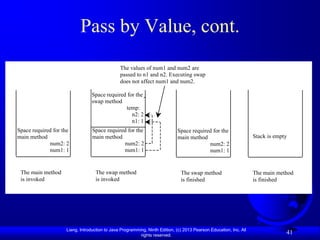
Pass by Value, cont.
                                               The values of num1 and num2 are
                                               passed to n1 and n2. Executing swap
                                               does not affect num1 and num2.

                                Space required for the
                                swap method
                                              temp:
                                                 n2: 2
                                                 n1: 1
Space required for the           Space required for the                     Space required for the
main method                      main method                                main method                            Stack is empty
             num2: 2                          num2: 2                                    num2: 2
             num1: 1                          num1: 1                                    num1: 1


 The main method                  The swap method                             The swap method                      The main method
 is invoked                       is invoked                                  is finished                          is finished


                    Liang, Introduction to Java Programming, Ninth Edition, (c) 2013 Pearson Education, Inc. All
                                                         rights reserved.
                                                                                                                                41
Modularizing Code
Methods can be used to reduce redundant coding
and enable code reuse. Methods can also be used to
modularize code and improve the quality of the
program.
                         GreatestCommonDivisorMethod

                                              Run


                         PrimeNumberMethod

                                              Run

         Liang, Introduction to Java Programming, Ninth Edition, (c) 2013 Pearson Education, Inc. All
                                              rights reserved.
                                                                                                        42
Problem: Converting Decimals to
            Hexadecimals
Write a method that converts a decimal integer to
a hexadecimal.


  Decimal2HexConversion                                                              Run


        Liang, Introduction to Java Programming, Ninth Edition, (c) 2013 Pearson Education, Inc. All
                                             rights reserved.
                                                                                                       43
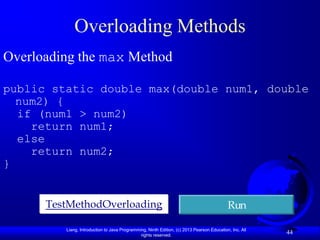
Overloading Methods
Overloading the max Method

public static double max(double num1, double
  num2) {
  if (num1 > num2)
    return num1;
  else
    return num2;
}


      TestMethodOverloading                                                                Run

         Liang, Introduction to Java Programming, Ninth Edition, (c) 2013 Pearson Education, Inc. All
                                              rights reserved.
                                                                                                        44
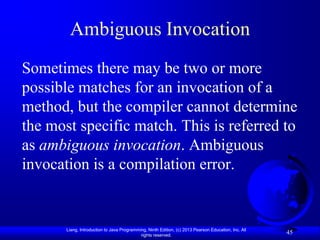
Ambiguous Invocation
Sometimes there may be two or more
possible matches for an invocation of a
method, but the compiler cannot determine
the most specific match. This is referred to
as ambiguous invocation. Ambiguous
invocation is a compilation error.


       Liang, Introduction to Java Programming, Ninth Edition, (c) 2013 Pearson Education, Inc. All
                                            rights reserved.
                                                                                                      45
Ambiguous Invocation
public class AmbiguousOverloading {
  public static void main(String[] args) {
    System.out.println(max(1, 2));
  }

    public static double max(int num1, double num2) {
      if (num1 > num2)
        return num1;
      else
        return num2;
    }

    public static double max(double num1, int num2) {
      if (num1 > num2)
        return num1;
      else
        return num2;
    }
}
          Liang, Introduction to Java Programming, Ninth Edition, (c) 2013 Pearson Education, Inc. All
                                               rights reserved.
                                                                                                         46
Scope of Local Variables
A local variable: a variable defined inside a
 method.
Scope: the part of the program where the
 variable can be referenced.
The scope of a local variable starts from its
 declaration and continues to the end of the
 block that contains the variable. A local
 variable must be declared before it can be
 used.
        Liang, Introduction to Java Programming, Ninth Edition, (c) 2013 Pearson Education, Inc. All
                                             rights reserved.
                                                                                                       47
Scope of Local Variables, cont.
You can declare a local variable with the
same name multiple times in different non-
nesting blocks in a method, but you cannot
declare a local variable twice in nested
blocks.


       Liang, Introduction to Java Programming, Ninth Edition, (c) 2013 Pearson Education, Inc. All
                                            rights reserved.
                                                                                                      48
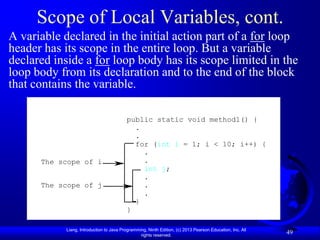
Scope of Local Variables, cont.
A variable declared in the initial action part of a for loop
header has its scope in the entire loop. But a variable
declared inside a for loop body has its scope limited in the
loop body from its declaration and to the end of the block
that contains the variable.

                                         public static void method1() {
                                           .
                                           .
                                           for (int i = 1; i < 10; i++) {
                                             .
      The scope of i                         .
                                             int j;
                                             .
      The scope of j                         .
                                             .
                                           }
                                         }

           Liang, Introduction to Java Programming, Ninth Edition, (c) 2013 Pearson Education, Inc. All
                                                rights reserved.
                                                                                                          49
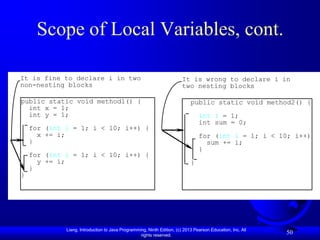
Scope of Local Variables, cont.

It is fine to declare i in two                                          It is wrong to declare i in
non-nesting blocks                                                      two nesting blocks

public static void method1() {                                              public static void method2() {
  int x = 1;
  int y = 1;                                                                    int i = 1;
                                                                                int sum = 0;
    for (int i = 1; i < 10; i++) {
      x += i;                                                                   for (int i = 1; i < 10; i++) {
    }                                                                             sum += i;
                                                                                }
    for (int i = 1; i < 10; i++) {
      y += i;                                                               }
    }
}


             Liang, Introduction to Java Programming, Ninth Edition, (c) 2013 Pearson Education, Inc. All
                                                  rights reserved.
                                                                                                            50
Scope of Local Variables, cont.
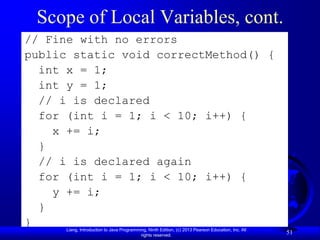
// Fine with no errors
public static void correctMethod() {
  int x = 1;
  int y = 1;
  // i is declared
  for (int i = 1; i < 10; i++) {
    x += i;
  }
  // i is declared again
  for (int i = 1; i < 10; i++) {
    y += i;
  }
}     Liang, Introduction to Java Programming, Ninth Edition, (c) 2013 Pearson Education, Inc. All
                                           rights reserved.
                                                                                                     51
Scope of Local Variables, cont.
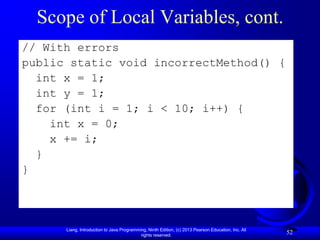
// With errors
public static void incorrectMethod() {
  int x = 1;
  int y = 1;
  for (int i = 1; i < 10; i++) {
    int x = 0;
    x += i;
  }
}


      Liang, Introduction to Java Programming, Ninth Edition, (c) 2013 Pearson Education, Inc. All
                                           rights reserved.
                                                                                                     52
Method Abstraction
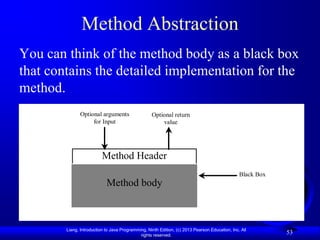
You can think of the method body as a black box
that contains the detailed implementation for the
method.
               Optional arguments                  Optional return
                    for Input                          value


                          Method Header
                                                                                                Black Box
                            Method body


        Liang, Introduction to Java Programming, Ninth Edition, (c) 2013 Pearson Education, Inc. All
                                             rights reserved.
                                                                                                            53
Benefits of Methods
• Write a method once and reuse it anywhere.
• Information hiding. Hide the implementation
  from the user.
• Reduce complexity.


        Liang, Introduction to Java Programming, Ninth Edition, (c) 2013 Pearson Education, Inc. All
                                             rights reserved.
                                                                                                       54
The Math Class
 Class   constants:
  – PI
  –E
 Class   methods:
  – Trigonometric Methods
  – Exponent Methods
  – Rounding Methods
  – min, max, abs, and random Methods


      Liang, Introduction to Java Programming, Ninth Edition, (c) 2013 Pearson Education, Inc. All
                                           rights reserved.
                                                                                                     55
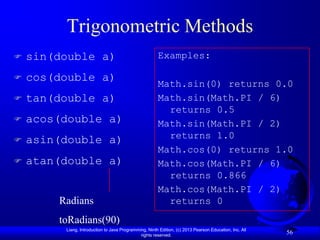
Trigonometric Methods
   sin(double a)                                      Examples:

   cos(double a)
                                                       Math.sin(0) returns 0.0
   tan(double a)                                      Math.sin(Math.PI / 6)
                                                         returns 0.5
   acos(double a)                                     Math.sin(Math.PI / 2)
   asin(double a)                                       returns 1.0
                                                       Math.cos(0) returns 1.0
   atan(double a)                                     Math.cos(Math.PI / 6)
                                                         returns 0.866
                                                       Math.cos(Math.PI / 2)
        Radians                                          returns 0
        toRadians(90)
         Liang, Introduction to Java Programming, Ninth Edition, (c) 2013 Pearson Education, Inc. All
                                              rights reserved.
                                                                                                        56
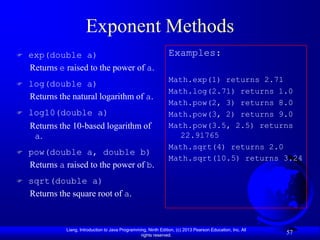
Exponent Methods
   exp(double a)                                                 Examples:
    Returns e raised to the power of a.
                                                                  Math.exp(1) returns 2.71
   log(double a)
                                                                  Math.log(2.71) returns 1.0
    Returns the natural logarithm of a.
                                                                  Math.pow(2, 3) returns 8.0
   log10(double a)                                               Math.pow(3, 2) returns 9.0
    Returns the 10-based logarithm of                             Math.pow(3.5, 2.5) returns
     a.                                                             22.91765
                                                                  Math.sqrt(4) returns 2.0
   pow(double a, double b)
                                                                  Math.sqrt(10.5) returns 3.24
    Returns a raised to the power of b.
   sqrt(double a)
    Returns the square root of a.


              Liang, Introduction to Java Programming, Ninth Edition, (c) 2013 Pearson Education, Inc. All
                                                   rights reserved.
                                                                                                             57
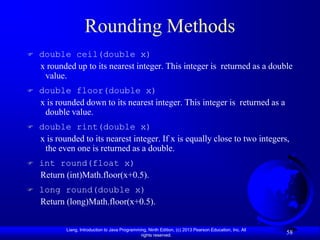
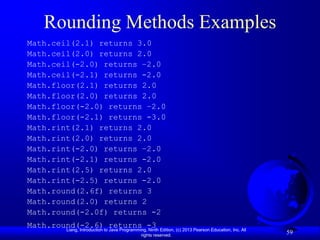
Rounding Methods
   double ceil(double x)
    x rounded up to its nearest integer. This integer is returned as a double
     value.
   double floor(double x)
    x is rounded down to its nearest integer. This integer is returned as a
     double value.
   double rint(double x)
    x is rounded to its nearest integer. If x is equally close to two integers,
     the even one is returned as a double.
   int round(float x)
    Return (int)Math.floor(x+0.5).
   long round(double x)
    Return (long)Math.floor(x+0.5).


            Liang, Introduction to Java Programming, Ninth Edition, (c) 2013 Pearson Education, Inc. All
                                                 rights reserved.
                                                                                                           58
Rounding Methods Examples
Math.ceil(2.1) returns 3.0
Math.ceil(2.0) returns 2.0
Math.ceil(-2.0) returns –2.0
Math.ceil(-2.1) returns -2.0
Math.floor(2.1) returns 2.0
Math.floor(2.0) returns 2.0
Math.floor(-2.0) returns –2.0
Math.floor(-2.1) returns -3.0
Math.rint(2.1) returns 2.0
Math.rint(2.0) returns 2.0
Math.rint(-2.0) returns –2.0
Math.rint(-2.1) returns -2.0
Math.rint(2.5) returns 2.0
Math.rint(-2.5) returns -2.0
Math.round(2.6f) returns 3
Math.round(2.0) returns 2
Math.round(-2.0f) returns -2
Math.round(-2.6)to returns -3 Edition, (c) 2013 Pearson Education, Inc. All
        Liang, Introduction Java Programming, Ninth
                                       rights reserved.
                                                                              59
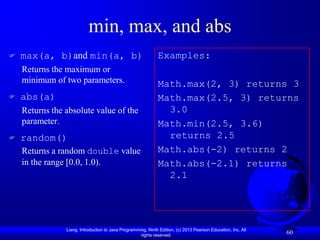
min, max, and abs
   max(a, b)and min(a, b)                                    Examples:
    Returns the maximum or
    minimum of two parameters.                                Math.max(2, 3) returns 3
   abs(a)                                                    Math.max(2.5, 3) returns
    Returns the absolute value of the                           3.0
    parameter.                                                Math.min(2.5, 3.6)
   random()                                                    returns 2.5
    Returns a random double value                             Math.abs(-2) returns 2
    in the range [0.0, 1.0).                                  Math.abs(-2.1) returns
                                                                2.1


                Liang, Introduction to Java Programming, Ninth Edition, (c) 2013 Pearson Education, Inc. All
                                                     rights reserved.
                                                                                                               60
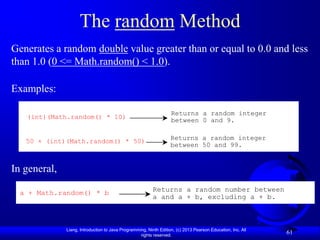
The random Method
Generates a random double value greater than or equal to 0.0 and less
than 1.0 (0 <= Math.random() < 1.0).

Examples:

                                                                   Returns a random integer
   (int)(Math.random() * 10)
                                                                   between 0 and 9.


   50 + (int)(Math.random() * 50)                                  Returns a random integer
                                                                   between 50 and 99.


In general,

  a + Math.random() * b                                   Returns a random number between
                                                          a and a + b, excluding a + b.


              Liang, Introduction to Java Programming, Ninth Edition, (c) 2013 Pearson Education, Inc. All
                                                   rights reserved.
                                                                                                             61
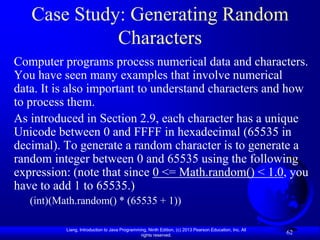
Case Study: Generating Random
             Characters
Computer programs process numerical data and characters.
You have seen many examples that involve numerical
data. It is also important to understand characters and how
to process them.
As introduced in Section 2.9, each character has a unique
Unicode between 0 and FFFF in hexadecimal (65535 in
decimal). To generate a random character is to generate a
random integer between 0 and 65535 using the following
expression: (note that since 0 <= Math.random() < 1.0, you
have to add 1 to 65535.)
   (int)(Math.random() * (65535 + 1))

           Liang, Introduction to Java Programming, Ninth Edition, (c) 2013 Pearson Education, Inc. All
                                                rights reserved.
                                                                                                          62
Case Study: Generating Random
          Characters, cont.
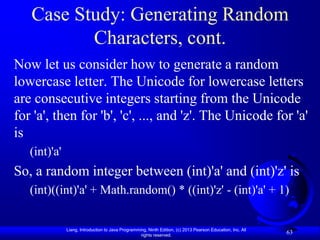
Now let us consider how to generate a random
lowercase letter. The Unicode for lowercase letters
are consecutive integers starting from the Unicode
for 'a', then for 'b', 'c', ..., and 'z'. The Unicode for 'a'
is
   (int)'a'
So, a random integer between (int)'a' and (int)'z' is
   (int)((int)'a' + Math.random() * ((int)'z' - (int)'a' + 1)


              Liang, Introduction to Java Programming, Ninth Edition, (c) 2013 Pearson Education, Inc. All
                                                   rights reserved.
                                                                                                             63
Case Study: Generating Random
          Characters, cont.
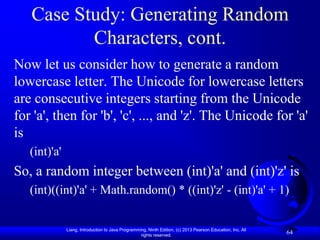
Now let us consider how to generate a random
lowercase letter. The Unicode for lowercase letters
are consecutive integers starting from the Unicode
for 'a', then for 'b', 'c', ..., and 'z'. The Unicode for 'a'
is
   (int)'a'
So, a random integer between (int)'a' and (int)'z' is
   (int)((int)'a' + Math.random() * ((int)'z' - (int)'a' + 1)


              Liang, Introduction to Java Programming, Ninth Edition, (c) 2013 Pearson Education, Inc. All
                                                   rights reserved.
                                                                                                             64
Case Study: Generating Random
          Characters, cont.
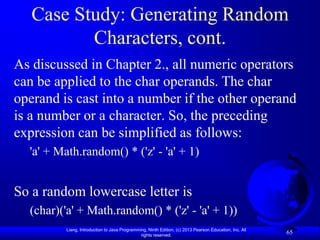
As discussed in Chapter 2., all numeric operators
can be applied to the char operands. The char
operand is cast into a number if the other operand
is a number or a character. So, the preceding
expression can be simplified as follows:
  'a' + Math.random() * ('z' - 'a' + 1)


So a random lowercase letter is
  (char)('a' + Math.random() * ('z' - 'a' + 1))
         Liang, Introduction to Java Programming, Ninth Edition, (c) 2013 Pearson Education, Inc. All
                                              rights reserved.
                                                                                                        65
Case Study: Generating Random
          Characters, cont.
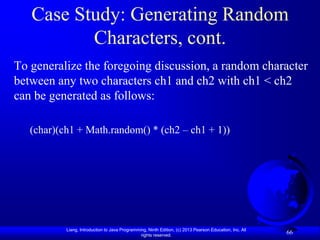
To generalize the foregoing discussion, a random character
between any two characters ch1 and ch2 with ch1 < ch2
can be generated as follows:

   (char)(ch1 + Math.random() * (ch2 – ch1 + 1))


           Liang, Introduction to Java Programming, Ninth Edition, (c) 2013 Pearson Education, Inc. All
                                                rights reserved.
                                                                                                          66
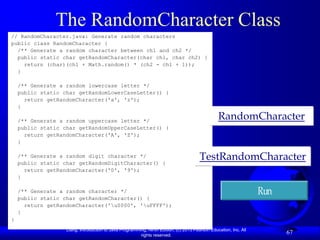
The RandomCharacter Class
// RandomCharacter.java: Generate random characters
public class RandomCharacter {
  /** Generate a random character between ch1 and ch2 */
  public static char getRandomCharacter(char ch1, char ch2) {
    return (char)(ch1 + Math.random() * (ch2 - ch1 + 1));
  }

    /** Generate a random lowercase letter */
    public static char getRandomLowerCaseLetter() {
      return getRandomCharacter('a', 'z');
    }

    /** Generate a random uppercase letter */
                                                                                                RandomCharacter
    public static char getRandomUpperCaseLetter() {
      return getRandomCharacter('A', 'Z');
    }

    /** Generate a random digit character */
    public static char getRandomDigitCharacter() {
                                                                                       TestRandomCharacter
      return getRandomCharacter('0', '9');
    }

    /** Generate a random character */                                                                            Run
    public static char getRandomCharacter() {
      return getRandomCharacter('u0000', 'uFFFF');
    }
}
                   Liang, Introduction to Java Programming, Ninth Edition, (c) 2013 Pearson Education, Inc. All
                                                        rights reserved.
                                                                                                                        67
Stepwise Refinement (Optional)
The concept of method abstraction can be applied
to the process of developing programs. When
writing a large program, you can use the “divide
and conquer” strategy, also known as stepwise
refinement, to decompose it into subproblems. The
subproblems can be further decomposed into
smaller, more manageable problems.


        Liang, Introduction to Java Programming, Ninth Edition, (c) 2013 Pearson Education, Inc. All
                                             rights reserved.
                                                                                                       68
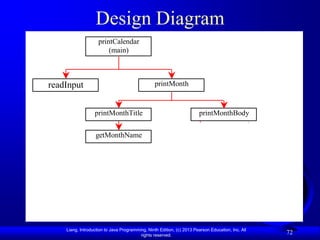
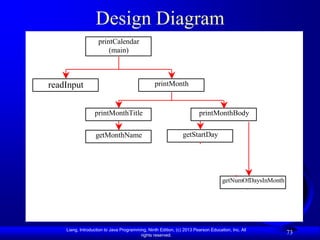
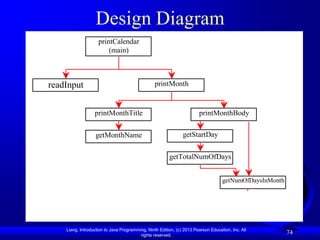
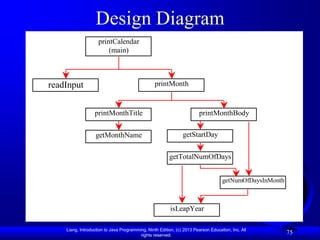
PrintCalender Case Study
Let us use the PrintCalendar example to demonstrate the
stepwise refinement approach.


                    PrintCalendar                                                            Run

         Liang, Introduction to Java Programming, Ninth Edition, (c) 2013 Pearson Education, Inc. All
                                              rights reserved.
                                                                                                        69
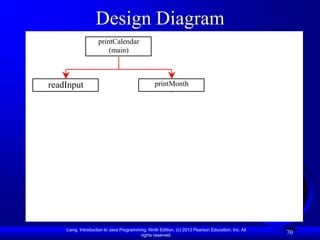
Design Diagram
                    printCalendar
                        (main)


readInput                                        printMonth


                  printMonthTitle                                      printMonthBody

                  getMonthName                                 getStartDay

                                                        getTotalNumOfDays


                                                                                   getNumOfDaysInMonth


                                                         isLeapYear

    Liang, Introduction to Java Programming, Ninth Edition, (c) 2013 Pearson Education, Inc. All
                                         rights reserved.
                                                                                                         70
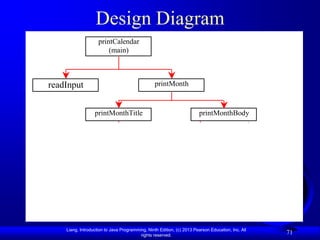
Design Diagram
                    printCalendar
                        (main)


readInput                                        printMonth


                  printMonthTitle                                      printMonthBody

                  getMonthName                                 getStartDay

                                                        getTotalNumOfDays


                                                                                   getNumOfDaysInMonth


                                                         isLeapYear

    Liang, Introduction to Java Programming, Ninth Edition, (c) 2013 Pearson Education, Inc. All
                                         rights reserved.
                                                                                                         71
Design Diagram
                    printCalendar
                        (main)


readInput                                        printMonth


                  printMonthTitle                                      printMonthBody

                  getMonthName                                 getStartDay

                                                        getTotalNumOfDays


                                                                                   getNumOfDaysInMonth


                                                         isLeapYear

    Liang, Introduction to Java Programming, Ninth Edition, (c) 2013 Pearson Education, Inc. All
                                         rights reserved.
                                                                                                         72
Design Diagram
                    printCalendar
                        (main)


readInput                                        printMonth


                  printMonthTitle                                      printMonthBody

                  getMonthName                                 getStartDay

                                                        getTotalNumOfDays


                                                                                   getNumOfDaysInMonth


                                                         isLeapYear

    Liang, Introduction to Java Programming, Ninth Edition, (c) 2013 Pearson Education, Inc. All
                                         rights reserved.
                                                                                                         73
Design Diagram
                    printCalendar
                        (main)


readInput                                        printMonth


                  printMonthTitle                                      printMonthBody

                  getMonthName                                 getStartDay

                                                        getTotalNumOfDays


                                                                                   getNumOfDaysInMonth


                                                         isLeapYear

    Liang, Introduction to Java Programming, Ninth Edition, (c) 2013 Pearson Education, Inc. All
                                         rights reserved.
                                                                                                         74
Design Diagram
                    printCalendar
                        (main)


readInput                                        printMonth


                  printMonthTitle                                      printMonthBody

                  getMonthName                                 getStartDay

                                                        getTotalNumOfDays


                                                                                   getNumOfDaysInMonth


                                                         isLeapYear

    Liang, Introduction to Java Programming, Ninth Edition, (c) 2013 Pearson Education, Inc. All
                                         rights reserved.
                                                                                                         75
Implementation: Top-Down
Top-down approach is to implement one method in the
structure chart at a time from the top to the bottom. Stubs
can be used for the methods waiting to be implemented. A
stub is a simple but incomplete version of a method. The
use of stubs enables you to test invoking the method from
a caller. Implement the main method first and then use a
stub for the printMonth method. For example, let
printMonth display the year and the month in the stub.
Thus, your program may begin like this:

                                                      A Skeleton for printCalendar

          Liang, Introduction to Java Programming, Ninth Edition, (c) 2013 Pearson Education, Inc. All
                                               rights reserved.
                                                                                                         76
Implementation: Bottom-Up
Bottom-up approach is to implement one method in the
structure chart at a time from the bottom to the top. For
each method implemented, write a test program to test it.
Both top-down and bottom-up methods are fine. Both
approaches implement the methods incrementally and
help to isolate programming errors and makes debugging
easy. Sometimes, they can be used together.


          Liang, Introduction to Java Programming, Ninth Edition, (c) 2013 Pearson Education, Inc. All
                                               rights reserved.
                                                                                                         77

JavaYDL5

  • 1.
    Chapter 5 Methods Liang,Introduction to Java Programming, Ninth Edition, (c) 2013 Pearson Education, Inc. All rights reserved. 1
  • 2.
    Opening Problem Find thesum of integers from 1 to 10, from 20 to 30, and from 35 to 45, respectively. Liang, Introduction to Java Programming, Ninth Edition, (c) 2013 Pearson Education, Inc. All rights reserved. 2
  • 3.
    Problem int sum =0; for (int i = 1; i <= 10; i++) sum += i; System.out.println("Sum from 1 to 10 is " + sum); sum = 0; for (int i = 20; i <= 30; i++) sum += i; System.out.println("Sum from 20 to 30 is " + sum); sum = 0; for (int i = 35; i <= 45; i++) sum += i; System.out.println("Sum from 35 to 45 is " + sum); Liang, Introduction to Java Programming, Ninth Edition, (c) 2013 Pearson Education, Inc. All rights reserved. 3
  • 4.
    Problem int sum =0; for (int i = 1; i <= 10; i++) sum += i; System.out.println("Sum from 1 to 10 is " + sum); sum = 0; for (int i = 20; i <= 30; i++) sum += i; System.out.println("Sum from 20 to 30 is " + sum); sum = 0; for (int i = 35; i <= 45; i++) sum += i; System.out.println("Sum from 35 to 45 is " + sum); Liang, Introduction to Java Programming, Ninth Edition, (c) 2013 Pearson Education, Inc. All rights reserved. 4
  • 5.
    Solution public static intsum(int i1, int i2) { int sum = 0; for (int i = i1; i <= i2; i++) sum += i; return sum; } public static void main(String[] args) { System.out.println("Sum from 1 to 10 is " + sum(1, 10)); System.out.println("Sum from 20 to 30 is " + sum(20, 30)); System.out.println("Sum from 35 to 45 is " + sum(35, 45)); } Liang, Introduction to Java Programming, Ninth Edition, (c) 2013 Pearson Education, Inc. All rights reserved. 5
  • 6.
    Objectives  To define methods with formal parameters (§5.2).  To invoke methods with actual parameters (i.e., arguments) (§5.2).  To define methods with a return value (§5.3).  To define methods without a return value (§5.4).  To pass arguments by value (§5.5).  To develop reusable code that is modular, easy to read, easy to debug, and easy to maintain (§5.6).  To write a method that converts decimals to hexadecimals (§5.7).  To use method overloading and understand ambiguous overloading (§5.8).  To determine the scope of variables (§5.9).  To solve mathematics problems using the methods in the Math class (§§5.10–5.11).  To apply the concept of method abstraction in software development (§5.12).  To design and implement methods using stepwise refinement (§5.12). Liang, Introduction to Java Programming, Ninth Edition, (c) 2013 Pearson Education, Inc. All rights reserved. 6
  • 7.
    Defining Methods A methodis a collection of statements that are grouped together to perform an operation. Define a method Invoke a method return value method formal modifier type name parameters int z = max(x, y); method public static int max(int num1, int num2) { header actual parameters int result; (arguments) method body parameter list if (num1 > num2) result = num1; else method result = num2; signature return result; return value } Liang, Introduction to Java Programming, Ninth Edition, (c) 2013 Pearson Education, Inc. All rights reserved. 7
  • 8.
    Method Signature Method signatureis the combination of the method name and the parameter list. Define a method Invoke a method return value method formal modifier type name parameters int z = max(x, y); method public static int max(int num1, int num2) { header actual parameters int result; (arguments) method body parameter list if (num1 > num2) result = num1; else method result = num2; signature return result; return value } Liang, Introduction to Java Programming, Ninth Edition, (c) 2013 Pearson Education, Inc. All rights reserved. 8
  • 9.
    Formal Parameters The variablesdefined in the method header are known as formal parameters. Define a method Invoke a method return value method formal modifier type name parameters int z = max(x, y); method public static int max(int num1, int num2) { header actual parameters int result; (arguments) method body parameter list if (num1 > num2) result = num1; else method result = num2; signature return result; return value } Liang, Introduction to Java Programming, Ninth Edition, (c) 2013 Pearson Education, Inc. All rights reserved. 9
  • 10.
    Actual Parameters When amethod is invoked, you pass a value to the parameter. This value is referred to as actual parameter or argument. Define a method Invoke a method return value method formal modifier type name parameters int z = max(x, y); method public static int max(int num1, int num2) { header actual parameters int result; (arguments) method body parameter list if (num1 > num2) result = num1; else method result = num2; signature return result; return value } Liang, Introduction to Java Programming, Ninth Edition, (c) 2013 Pearson Education, Inc. All rights reserved. 10
  • 11.
    Return Value Type Amethod may return a value. The returnValueType is the data type of the value the method returns. If the method does not return a value, the returnValueType is the keyword void. For example, the returnValueType in the main method is void. Define a method Invoke a method return value method formal modifier type name parameters int z = max(x, y); method public static int max(int num1, int num2) { header actual parameters int result; (arguments) method body parameter list if (num1 > num2) result = num1; else method result = num2; signature return result; return value } Liang, Introduction to Java Programming, Ninth Edition, (c) 2013 Pearson Education, Inc. All rights reserved. 11
  • 12.
    Calling Methods Testing themax method This program demonstrates calling a method max to return the largest of the int values TestMax Run Liang, Introduction to Java Programming, Ninth Edition, (c) 2013 Pearson Education, Inc. All rights reserved. 12
  • 13.
    animation Calling Methods, cont. pass the value of i pass the value of j public static void main(String[] args) { public static int max(int num1, int num2) { int i = 5; int result; int j = 2; int k = max(i, j); if (num1 > num2) result = num1; System.out.println( else "The maximum between " + i + result = num2; " and " + j + " is " + k); } return result; } Liang, Introduction to Java Programming, Ninth Edition, (c) 2013 Pearson Education, Inc. All rights reserved. 13
  • 14.
    animation Trace Method Invocation i is now 5 public static void main(String[] args) { public static int max(int num1, int num2) { int i = 5; int result; int j = 2; int k = max(i, j); if (num1 > num2) result = num1; System.out.println( else "The maximum between " + i + result = num2; " and " + j + " is " + k); } return result; } Liang, Introduction to Java Programming, Ninth Edition, (c) 2013 Pearson Education, Inc. All rights reserved. 14
  • 15.
    animation Trace Method Invocation j is now 2 public static void main(String[] args) { public static int max(int num1, int num2) { int i = 5; int result; int j = 2; int k = max(i, j); if (num1 > num2) result = num1; System.out.println( else "The maximum between " + i + result = num2; " and " + j + " is " + k); } return result; } Liang, Introduction to Java Programming, Ninth Edition, (c) 2013 Pearson Education, Inc. All rights reserved. 15
  • 16.
    animation Trace Method Invocation invoke max(i, j) public static void main(String[] args) { public static int max(int num1, int num2) { int i = 5; int result; int j = 2; int k = max(i, j); if (num1 > num2) result = num1; System.out.println( else "The maximum between " + i + result = num2; " and " + j + " is " + k); } return result; } Liang, Introduction to Java Programming, Ninth Edition, (c) 2013 Pearson Education, Inc. All rights reserved. 16
  • 17.
    animation Trace Method Invocation invoke max(i, j) Pass the value of i to num1 Pass the value of j to num2 public static void main(String[] args) { public static int max(int num1, int num2) { int i = 5; int result; int j = 2; int k = max(i, j); if (num1 > num2) result = num1; System.out.println( else "The maximum between " + i + result = num2; " and " + j + " is " + k); } return result; } Liang, Introduction to Java Programming, Ninth Edition, (c) 2013 Pearson Education, Inc. All rights reserved. 17
  • 18.
    animation Trace Method Invocation declare variable result public static void main(String[] args) { public static int max(int num1, int num2) { int i = 5; int result; int j = 2; int k = max(i, j); if (num1 > num2) result = num1; System.out.println( else "The maximum between " + i + result = num2; " and " + j + " is " + k); } return result; } Liang, Introduction to Java Programming, Ninth Edition, (c) 2013 Pearson Education, Inc. All rights reserved. 18
  • 19.
    animation Trace Method Invocation (num1 > num2) is true since num1 is 5 and num2 is 2 public static void main(String[] args) { public static int max(int num1, int num2) { int i = 5; int result; int j = 2; int k = max(i, j); if (num1 > num2) result = num1; System.out.println( else "The maximum between " + i + result = num2; " and " + j + " is " + k); } return result; } Liang, Introduction to Java Programming, Ninth Edition, (c) 2013 Pearson Education, Inc. All rights reserved. 19
  • 20.
    animation Trace Method Invocation result is now 5 public static void main(String[] args) { public static int max(int num1, int num2) { int i = 5; int result; int j = 2; int k = max(i, j); if (num1 > num2) result = num1; System.out.println( else "The maximum between " + i + result = num2; " and " + j + " is " + k); } return result; } Liang, Introduction to Java Programming, Ninth Edition, (c) 2013 Pearson Education, Inc. All rights reserved. 20
  • 21.
    animation Trace Method Invocation return result, which is 5 public static void main(String[] args) { public static int max(int num1, int num2) { int i = 5; int result; int j = 2; int k = max(i, j); if (num1 > num2) result = num1; System.out.println( else "The maximum between " + i + result = num2; " and " + j + " is " + k); } return result; } Liang, Introduction to Java Programming, Ninth Edition, (c) 2013 Pearson Education, Inc. All rights reserved. 21
  • 22.
    animation Trace Method Invocation return max(i, j) and assign the return value to k public static void main(String[] args) { public static int max(int num1, int num2) { int i = 5; int result; int j = 2; int k = max(i, j); if (num1 > num2) result = num1; System.out.println( else "The maximum between " + i + result = num2; " and " + j + " is " + k); } return result; } Liang, Introduction to Java Programming, Ninth Edition, (c) 2013 Pearson Education, Inc. All rights reserved. 22
  • 23.
    animation Trace Method Invocation Execute the print statement public static void main(String[] args) { public static int max(int num1, int num2) { int i = 5; int result; int j = 2; int k = max(i, j); if (num1 > num2) result = num1; System.out.println( else "The maximum between " + i + result = num2; " and " + j + " is " + k); } return result; } Liang, Introduction to Java Programming, Ninth Edition, (c) 2013 Pearson Education, Inc. All rights reserved. 23
  • 24.
    CAUTION A return statementis required for a value-returning method. The method shown below in (a) is logically correct, but it has a compilation error because the Java compiler thinks it possible that this method does not return any value. public static int sign(int n) { public static int sign(int n) { if (n > 0) Should be if (n > 0) return 1; return 1; else if (n == 0) else if (n == 0) return 0; return 0; else if (n < 0) else return –1; return –1; } } (a) (b) To fix this problem, delete if (n < 0) in (a), so that the compiler will see a return statement to be reached regardless of how the if statement is evaluated. Liang, Introduction to Java Programming, Ninth Edition, (c) 2013 Pearson Education, Inc. All rights reserved. 24
  • 25.
    Reuse Methods fromOther Classes NOTE: One of the benefits of methods is for reuse. The max method can be invoked from any class besides TestMax. If you create a new class Test, you can invoke the max method using ClassName.methodName (e.g., TestMax.max). Liang, Introduction to Java Programming, Ninth Edition, (c) 2013 Pearson Education, Inc. All rights reserved. 25
  • 26.
    Call Stacks Space required for Space required for the max method the max method result: 5 num2: 2 num2: 2 num1: 5 num1: 5 Space required for Space required for Space required for Space required for the main method the main method the main method the main method k: k: k: k: 5 Stack is empty j: 2 j: 2 j: 2 j: 2 i: 5 i: 5 i: 5 i: 5 (a) The main (b) The max (c) The max method (d) The max method is (e) The main method is invoked. method is invoked. is being executed. finished and the return method is finished. value is sent to k. Liang, Introduction to Java Programming, Ninth Edition, (c) 2013 Pearson Education, Inc. All rights reserved. 26
  • 27.
    animation Trace Call Stack i is declared and initialized public static void main(String[] args) { int i = 5; int j = 2; int k = max(i, j); System.out.println( "The maximum between " + i + " and " + j + " is " + k); } public static int max(int num1, int num2) { int result; i: 5 if (num1 > num2) result = num1; The main method else is invoked. result = num2; return result; } Liang, Introduction to Java Programming, Ninth Edition, (c) 2013 Pearson Education, Inc. All rights reserved. 27
  • 28.
    animation Trace Call Stack j is declared and initialized public static void main(String[] args) { int i = 5; int j = 2; int k = max(i, j); System.out.println( "The maximum between " + i + " and " + j + " is " + k); } public static int max(int num1, int num2) { j: 2 int result; i: 5 if (num1 > num2) result = num1; The main method else is invoked. result = num2; return result; } Liang, Introduction to Java Programming, Ninth Edition, (c) 2013 Pearson Education, Inc. All rights reserved. 28
  • 29.
    animation Trace Call Stack Declare k public static void main(String[] args) { int i = 5; int j = 2; int k = max(i, j); System.out.println( "The maximum between " + i + " and " + j + " is " + k); } Space required for the main method k: public static int max(int num1, int num2) { j: 2 int result; i: 5 if (num1 > num2) result = num1; The main method else is invoked. result = num2; return result; } Liang, Introduction to Java Programming, Ninth Edition, (c) 2013 Pearson Education, Inc. All rights reserved. 29
  • 30.
    animation Trace Call Stack Invoke max(i, j) public static void main(String[] args) { int i = 5; int j = 2; int k = max(i, j); System.out.println( "The maximum between " + i + " and " + j + " is " + k); } Space required for the main method k: public static int max(int num1, int num2) { j: 2 int result; i: 5 if (num1 > num2) result = num1; The main method else is invoked. result = num2; return result; } Liang, Introduction to Java Programming, Ninth Edition, (c) 2013 Pearson Education, Inc. All rights reserved. 30
  • 31.
    animation Trace Call Stack pass the values of i and j to num1 and num2 public static void main(String[] args) { int i = 5; int j = 2; int k = max(i, j); System.out.println( "The maximum between " + i + " and " + j + " is " + k); num2: 2 } num1: 5 Space required for the public static int max(int num1, int num2) { int result; main method k: if (num1 > num2) j: 2 result = num1; i: 5 else result = num2; return result; The max method is } invoked. Liang, Introduction to Java Programming, Ninth Edition, (c) 2013 Pearson Education, Inc. All rights reserved. 31
  • 32.
    animation Trace Call Stack Declare result public static void main(String[] args) { int i = 5; int j = 2; int k = max(i, j); System.out.println( "The maximum between " + i + result: " and " + j + " is " + k); num2: 2 } num1: 5 Space required for the public static int max(int num1, int num2) { int result; main method k: if (num1 > num2) j: 2 result = num1; i: 5 else result = num2; return result; The max method is } invoked. Liang, Introduction to Java Programming, Ninth Edition, (c) 2013 Pearson Education, Inc. All rights reserved. 32
  • 33.
    animation Trace Call Stack (num1 > num2) is true public static void main(String[] args) { int i = 5; int j = 2; int k = max(i, j); System.out.println( "The maximum between " + i + result: " and " + j + " is " + k); num2: 2 } num1: 5 Space required for the public static int max(int num1, int num2) { int result; main method k: if (num1 > num2) j: 2 result = num1; i: 5 else result = num2; return result; The max method is } invoked. Liang, Introduction to Java Programming, Ninth Edition, (c) 2013 Pearson Education, Inc. All rights reserved. 33
  • 34.
    animation Trace Call Stack Assign num1 to result public static void main(String[] args) { int i = 5; int j = 2; int k = max(i, j); Space required for the System.out.println( max method "The maximum between " + i + result: 5 " and " + j + " is " + k); num2: 2 } num1: 5 Space required for the public static int max(int num1, int num2) { int result; main method k: if (num1 > num2) j: 2 result = num1; i: 5 else result = num2; return result; The max method is } invoked. Liang, Introduction to Java Programming, Ninth Edition, (c) 2013 Pearson Education, Inc. All rights reserved. 34
  • 35.
    animation Trace Call Stack Return result and assign it to k public static void main(String[] args) { int i = 5; int j = 2; int k = max(i, j); Space required for the System.out.println( max method "The maximum between " + i + result: 5 " and " + j + " is " + k); num2: 2 } num1: 5 Space required for the public static int max(int num1, int num2) { int result; main method k:5 if (num1 > num2) j: 2 result = num1; i: 5 else result = num2; return result; The max method is } invoked. Liang, Introduction to Java Programming, Ninth Edition, (c) 2013 Pearson Education, Inc. All rights reserved. 35
  • 36.
    animation Trace Call Stack Execute print statement public static void main(String[] args) { int i = 5; int j = 2; int k = max(i, j); System.out.println( "The maximum between " + i + " and " + j + " is " + k); } Space required for the main method k:5 public static int max(int num1, int num2) { j: 2 int result; i: 5 if (num1 > num2) result = num1; The main method else is invoked. result = num2; return result; } Liang, Introduction to Java Programming, Ninth Edition, (c) 2013 Pearson Education, Inc. All rights reserved. 36
  • 37.
    void Method Example Thistype of method does not return a value. The method performs some actions. TestVoidMethod Run Liang, Introduction to Java Programming, Ninth Edition, (c) 2013 Pearson Education, Inc. All rights reserved. 37
  • 38.
    Passing Parameters public staticvoid nPrintln(String message, int n) { for (int i = 0; i < n; i++) System.out.println(message); } Suppose you invoke the method using nPrintln(“Welcome to Java”, 5); What is the output? Suppose you invoke the method using nPrintln(“Computer Science”, 15); What is the output? Can you invoke the method using nPrintln(15, “Computer Science”); Liang, Introduction to Java Programming, Ninth Edition, (c) 2013 Pearson Education, Inc. All rights reserved. 38
  • 39.
    Pass by Value Thisprogram demonstrates passing values to the methods. Increment Run Liang, Introduction to Java Programming, Ninth Edition, (c) 2013 Pearson Education, Inc. All rights reserved. 39
  • 40.
    Pass by Value TestingPass by value This program demonstrates passing values to the methods. TestPassByValue Run Liang, Introduction to Java Programming, Ninth Edition, (c) 2013 Pearson Education, Inc. All rights reserved. 40
  • 41.
    Pass by Value,cont. The values of num1 and num2 are passed to n1 and n2. Executing swap does not affect num1 and num2. Space required for the swap method temp: n2: 2 n1: 1 Space required for the Space required for the Space required for the main method main method main method Stack is empty num2: 2 num2: 2 num2: 2 num1: 1 num1: 1 num1: 1 The main method The swap method The swap method The main method is invoked is invoked is finished is finished Liang, Introduction to Java Programming, Ninth Edition, (c) 2013 Pearson Education, Inc. All rights reserved. 41
  • 42.
    Modularizing Code Methods canbe used to reduce redundant coding and enable code reuse. Methods can also be used to modularize code and improve the quality of the program. GreatestCommonDivisorMethod Run PrimeNumberMethod Run Liang, Introduction to Java Programming, Ninth Edition, (c) 2013 Pearson Education, Inc. All rights reserved. 42
  • 43.
    Problem: Converting Decimalsto Hexadecimals Write a method that converts a decimal integer to a hexadecimal. Decimal2HexConversion Run Liang, Introduction to Java Programming, Ninth Edition, (c) 2013 Pearson Education, Inc. All rights reserved. 43
  • 44.
    Overloading Methods Overloading themax Method public static double max(double num1, double num2) { if (num1 > num2) return num1; else return num2; } TestMethodOverloading Run Liang, Introduction to Java Programming, Ninth Edition, (c) 2013 Pearson Education, Inc. All rights reserved. 44
  • 45.
    Ambiguous Invocation Sometimes theremay be two or more possible matches for an invocation of a method, but the compiler cannot determine the most specific match. This is referred to as ambiguous invocation. Ambiguous invocation is a compilation error. Liang, Introduction to Java Programming, Ninth Edition, (c) 2013 Pearson Education, Inc. All rights reserved. 45
  • 46.
    Ambiguous Invocation public classAmbiguousOverloading { public static void main(String[] args) { System.out.println(max(1, 2)); } public static double max(int num1, double num2) { if (num1 > num2) return num1; else return num2; } public static double max(double num1, int num2) { if (num1 > num2) return num1; else return num2; } } Liang, Introduction to Java Programming, Ninth Edition, (c) 2013 Pearson Education, Inc. All rights reserved. 46
  • 47.
    Scope of LocalVariables A local variable: a variable defined inside a method. Scope: the part of the program where the variable can be referenced. The scope of a local variable starts from its declaration and continues to the end of the block that contains the variable. A local variable must be declared before it can be used. Liang, Introduction to Java Programming, Ninth Edition, (c) 2013 Pearson Education, Inc. All rights reserved. 47
  • 48.
    Scope of LocalVariables, cont. You can declare a local variable with the same name multiple times in different non- nesting blocks in a method, but you cannot declare a local variable twice in nested blocks. Liang, Introduction to Java Programming, Ninth Edition, (c) 2013 Pearson Education, Inc. All rights reserved. 48
  • 49.
    Scope of LocalVariables, cont. A variable declared in the initial action part of a for loop header has its scope in the entire loop. But a variable declared inside a for loop body has its scope limited in the loop body from its declaration and to the end of the block that contains the variable. public static void method1() { . . for (int i = 1; i < 10; i++) { . The scope of i . int j; . The scope of j . . } } Liang, Introduction to Java Programming, Ninth Edition, (c) 2013 Pearson Education, Inc. All rights reserved. 49
  • 50.
    Scope of LocalVariables, cont. It is fine to declare i in two It is wrong to declare i in non-nesting blocks two nesting blocks public static void method1() { public static void method2() { int x = 1; int y = 1; int i = 1; int sum = 0; for (int i = 1; i < 10; i++) { x += i; for (int i = 1; i < 10; i++) { } sum += i; } for (int i = 1; i < 10; i++) { y += i; } } } Liang, Introduction to Java Programming, Ninth Edition, (c) 2013 Pearson Education, Inc. All rights reserved. 50
  • 51.
    Scope of LocalVariables, cont. // Fine with no errors public static void correctMethod() { int x = 1; int y = 1; // i is declared for (int i = 1; i < 10; i++) { x += i; } // i is declared again for (int i = 1; i < 10; i++) { y += i; } } Liang, Introduction to Java Programming, Ninth Edition, (c) 2013 Pearson Education, Inc. All rights reserved. 51
  • 52.
    Scope of LocalVariables, cont. // With errors public static void incorrectMethod() { int x = 1; int y = 1; for (int i = 1; i < 10; i++) { int x = 0; x += i; } } Liang, Introduction to Java Programming, Ninth Edition, (c) 2013 Pearson Education, Inc. All rights reserved. 52
  • 53.
    Method Abstraction You canthink of the method body as a black box that contains the detailed implementation for the method. Optional arguments Optional return for Input value Method Header Black Box Method body Liang, Introduction to Java Programming, Ninth Edition, (c) 2013 Pearson Education, Inc. All rights reserved. 53
  • 54.
    Benefits of Methods •Write a method once and reuse it anywhere. • Information hiding. Hide the implementation from the user. • Reduce complexity. Liang, Introduction to Java Programming, Ninth Edition, (c) 2013 Pearson Education, Inc. All rights reserved. 54
  • 55.
    The Math Class Class constants: – PI –E  Class methods: – Trigonometric Methods – Exponent Methods – Rounding Methods – min, max, abs, and random Methods Liang, Introduction to Java Programming, Ninth Edition, (c) 2013 Pearson Education, Inc. All rights reserved. 55
  • 56.
    Trigonometric Methods  sin(double a) Examples:  cos(double a) Math.sin(0) returns 0.0  tan(double a) Math.sin(Math.PI / 6) returns 0.5  acos(double a) Math.sin(Math.PI / 2)  asin(double a) returns 1.0 Math.cos(0) returns 1.0  atan(double a) Math.cos(Math.PI / 6) returns 0.866 Math.cos(Math.PI / 2) Radians returns 0 toRadians(90) Liang, Introduction to Java Programming, Ninth Edition, (c) 2013 Pearson Education, Inc. All rights reserved. 56
  • 57.
    Exponent Methods  exp(double a) Examples: Returns e raised to the power of a. Math.exp(1) returns 2.71  log(double a) Math.log(2.71) returns 1.0 Returns the natural logarithm of a. Math.pow(2, 3) returns 8.0  log10(double a) Math.pow(3, 2) returns 9.0 Returns the 10-based logarithm of Math.pow(3.5, 2.5) returns a. 22.91765 Math.sqrt(4) returns 2.0  pow(double a, double b) Math.sqrt(10.5) returns 3.24 Returns a raised to the power of b.  sqrt(double a) Returns the square root of a. Liang, Introduction to Java Programming, Ninth Edition, (c) 2013 Pearson Education, Inc. All rights reserved. 57
  • 58.
    Rounding Methods  double ceil(double x) x rounded up to its nearest integer. This integer is returned as a double value.  double floor(double x) x is rounded down to its nearest integer. This integer is returned as a double value.  double rint(double x) x is rounded to its nearest integer. If x is equally close to two integers, the even one is returned as a double.  int round(float x) Return (int)Math.floor(x+0.5).  long round(double x) Return (long)Math.floor(x+0.5). Liang, Introduction to Java Programming, Ninth Edition, (c) 2013 Pearson Education, Inc. All rights reserved. 58
  • 59.
    Rounding Methods Examples Math.ceil(2.1)returns 3.0 Math.ceil(2.0) returns 2.0 Math.ceil(-2.0) returns –2.0 Math.ceil(-2.1) returns -2.0 Math.floor(2.1) returns 2.0 Math.floor(2.0) returns 2.0 Math.floor(-2.0) returns –2.0 Math.floor(-2.1) returns -3.0 Math.rint(2.1) returns 2.0 Math.rint(2.0) returns 2.0 Math.rint(-2.0) returns –2.0 Math.rint(-2.1) returns -2.0 Math.rint(2.5) returns 2.0 Math.rint(-2.5) returns -2.0 Math.round(2.6f) returns 3 Math.round(2.0) returns 2 Math.round(-2.0f) returns -2 Math.round(-2.6)to returns -3 Edition, (c) 2013 Pearson Education, Inc. All Liang, Introduction Java Programming, Ninth rights reserved. 59
  • 60.
    min, max, andabs  max(a, b)and min(a, b) Examples: Returns the maximum or minimum of two parameters. Math.max(2, 3) returns 3  abs(a) Math.max(2.5, 3) returns Returns the absolute value of the 3.0 parameter. Math.min(2.5, 3.6)  random() returns 2.5 Returns a random double value Math.abs(-2) returns 2 in the range [0.0, 1.0). Math.abs(-2.1) returns 2.1 Liang, Introduction to Java Programming, Ninth Edition, (c) 2013 Pearson Education, Inc. All rights reserved. 60
  • 61.
    The random Method Generatesa random double value greater than or equal to 0.0 and less than 1.0 (0 <= Math.random() < 1.0). Examples: Returns a random integer (int)(Math.random() * 10) between 0 and 9. 50 + (int)(Math.random() * 50) Returns a random integer between 50 and 99. In general, a + Math.random() * b Returns a random number between a and a + b, excluding a + b. Liang, Introduction to Java Programming, Ninth Edition, (c) 2013 Pearson Education, Inc. All rights reserved. 61
  • 62.
    Case Study: GeneratingRandom Characters Computer programs process numerical data and characters. You have seen many examples that involve numerical data. It is also important to understand characters and how to process them. As introduced in Section 2.9, each character has a unique Unicode between 0 and FFFF in hexadecimal (65535 in decimal). To generate a random character is to generate a random integer between 0 and 65535 using the following expression: (note that since 0 <= Math.random() < 1.0, you have to add 1 to 65535.) (int)(Math.random() * (65535 + 1)) Liang, Introduction to Java Programming, Ninth Edition, (c) 2013 Pearson Education, Inc. All rights reserved. 62
  • 63.
    Case Study: GeneratingRandom Characters, cont. Now let us consider how to generate a random lowercase letter. The Unicode for lowercase letters are consecutive integers starting from the Unicode for 'a', then for 'b', 'c', ..., and 'z'. The Unicode for 'a' is (int)'a' So, a random integer between (int)'a' and (int)'z' is (int)((int)'a' + Math.random() * ((int)'z' - (int)'a' + 1) Liang, Introduction to Java Programming, Ninth Edition, (c) 2013 Pearson Education, Inc. All rights reserved. 63
  • 64.
    Case Study: GeneratingRandom Characters, cont. Now let us consider how to generate a random lowercase letter. The Unicode for lowercase letters are consecutive integers starting from the Unicode for 'a', then for 'b', 'c', ..., and 'z'. The Unicode for 'a' is (int)'a' So, a random integer between (int)'a' and (int)'z' is (int)((int)'a' + Math.random() * ((int)'z' - (int)'a' + 1) Liang, Introduction to Java Programming, Ninth Edition, (c) 2013 Pearson Education, Inc. All rights reserved. 64
  • 65.
    Case Study: GeneratingRandom Characters, cont. As discussed in Chapter 2., all numeric operators can be applied to the char operands. The char operand is cast into a number if the other operand is a number or a character. So, the preceding expression can be simplified as follows: 'a' + Math.random() * ('z' - 'a' + 1) So a random lowercase letter is (char)('a' + Math.random() * ('z' - 'a' + 1)) Liang, Introduction to Java Programming, Ninth Edition, (c) 2013 Pearson Education, Inc. All rights reserved. 65
  • 66.
    Case Study: GeneratingRandom Characters, cont. To generalize the foregoing discussion, a random character between any two characters ch1 and ch2 with ch1 < ch2 can be generated as follows: (char)(ch1 + Math.random() * (ch2 – ch1 + 1)) Liang, Introduction to Java Programming, Ninth Edition, (c) 2013 Pearson Education, Inc. All rights reserved. 66
  • 67.
    The RandomCharacter Class //RandomCharacter.java: Generate random characters public class RandomCharacter { /** Generate a random character between ch1 and ch2 */ public static char getRandomCharacter(char ch1, char ch2) { return (char)(ch1 + Math.random() * (ch2 - ch1 + 1)); } /** Generate a random lowercase letter */ public static char getRandomLowerCaseLetter() { return getRandomCharacter('a', 'z'); } /** Generate a random uppercase letter */ RandomCharacter public static char getRandomUpperCaseLetter() { return getRandomCharacter('A', 'Z'); } /** Generate a random digit character */ public static char getRandomDigitCharacter() { TestRandomCharacter return getRandomCharacter('0', '9'); } /** Generate a random character */ Run public static char getRandomCharacter() { return getRandomCharacter('u0000', 'uFFFF'); } } Liang, Introduction to Java Programming, Ninth Edition, (c) 2013 Pearson Education, Inc. All rights reserved. 67
  • 68.
    Stepwise Refinement (Optional) Theconcept of method abstraction can be applied to the process of developing programs. When writing a large program, you can use the “divide and conquer” strategy, also known as stepwise refinement, to decompose it into subproblems. The subproblems can be further decomposed into smaller, more manageable problems. Liang, Introduction to Java Programming, Ninth Edition, (c) 2013 Pearson Education, Inc. All rights reserved. 68
  • 69.
    PrintCalender Case Study Letus use the PrintCalendar example to demonstrate the stepwise refinement approach. PrintCalendar Run Liang, Introduction to Java Programming, Ninth Edition, (c) 2013 Pearson Education, Inc. All rights reserved. 69
  • 70.
    Design Diagram printCalendar (main) readInput printMonth printMonthTitle printMonthBody getMonthName getStartDay getTotalNumOfDays getNumOfDaysInMonth isLeapYear Liang, Introduction to Java Programming, Ninth Edition, (c) 2013 Pearson Education, Inc. All rights reserved. 70
  • 71.
    Design Diagram printCalendar (main) readInput printMonth printMonthTitle printMonthBody getMonthName getStartDay getTotalNumOfDays getNumOfDaysInMonth isLeapYear Liang, Introduction to Java Programming, Ninth Edition, (c) 2013 Pearson Education, Inc. All rights reserved. 71
  • 72.
    Design Diagram printCalendar (main) readInput printMonth printMonthTitle printMonthBody getMonthName getStartDay getTotalNumOfDays getNumOfDaysInMonth isLeapYear Liang, Introduction to Java Programming, Ninth Edition, (c) 2013 Pearson Education, Inc. All rights reserved. 72
  • 73.
    Design Diagram printCalendar (main) readInput printMonth printMonthTitle printMonthBody getMonthName getStartDay getTotalNumOfDays getNumOfDaysInMonth isLeapYear Liang, Introduction to Java Programming, Ninth Edition, (c) 2013 Pearson Education, Inc. All rights reserved. 73
  • 74.
    Design Diagram printCalendar (main) readInput printMonth printMonthTitle printMonthBody getMonthName getStartDay getTotalNumOfDays getNumOfDaysInMonth isLeapYear Liang, Introduction to Java Programming, Ninth Edition, (c) 2013 Pearson Education, Inc. All rights reserved. 74
  • 75.
    Design Diagram printCalendar (main) readInput printMonth printMonthTitle printMonthBody getMonthName getStartDay getTotalNumOfDays getNumOfDaysInMonth isLeapYear Liang, Introduction to Java Programming, Ninth Edition, (c) 2013 Pearson Education, Inc. All rights reserved. 75
  • 76.
    Implementation: Top-Down Top-down approachis to implement one method in the structure chart at a time from the top to the bottom. Stubs can be used for the methods waiting to be implemented. A stub is a simple but incomplete version of a method. The use of stubs enables you to test invoking the method from a caller. Implement the main method first and then use a stub for the printMonth method. For example, let printMonth display the year and the month in the stub. Thus, your program may begin like this: A Skeleton for printCalendar Liang, Introduction to Java Programming, Ninth Edition, (c) 2013 Pearson Education, Inc. All rights reserved. 76
  • 77.
    Implementation: Bottom-Up Bottom-up approachis to implement one method in the structure chart at a time from the bottom to the top. For each method implemented, write a test program to test it. Both top-down and bottom-up methods are fine. Both approaches implement the methods incrementally and help to isolate programming errors and makes debugging easy. Sometimes, they can be used together. Liang, Introduction to Java Programming, Ninth Edition, (c) 2013 Pearson Education, Inc. All rights reserved. 77