Interface
• Interface canbe created using the keyword interface.
• Interfaces are syntactically similar to classes.
• Interface does not have instance variables.
• The methods in interface are declared without any body.
– Interface never implements methods.
• Any number of classes can implement an interface.
• One class can implement any number of interfaces.
– This helps to achieve multiple inheritance.
3
4.
Interface(contd.)
• To implementan interface,
– a class must create and define the complete set of methods that
are declared by the interface.
• Each class can have its own implementation of the methods.
• By providing the interface keyword, Java allows you to fully
utilize the “one interface, multiple methods” aspect of
polymorphism.
• Interfaces support dynamic method resolution at run time.
4
5.
Interface(contd.)
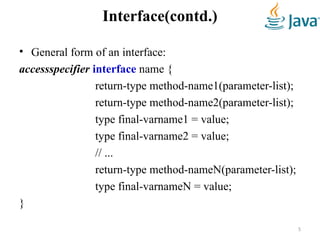
• General formof an interface:
accessspecifier interface name {
return-type method-name1(parameter-list);
return-type method-name2(parameter-list);
type final-varname1 = value;
type final-varname2 = value;
// ...
return-type method-nameN(parameter-list);
type final-varnameN = value;
}
5
6.
Interface(contd.)
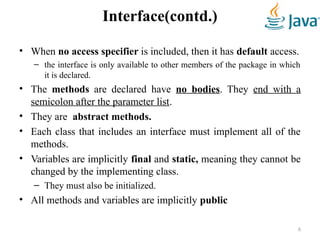
• When noaccess specifier is included, then it has default access.
– the interface is only available to other members of the package in which
it is declared.
• The methods are declared have no bodies. They end with a
semicolon after the parameter list.
• They are abstract methods.
• Each class that includes an interface must implement all of the
methods.
• Variables are implicitly final and static, meaning they cannot be
changed by the implementing class.
– They must also be initialized.
• All methods and variables are implicitly public
6
Implementing Interfaces
• Afteran interface has been defined, one or more classes can
implement that interface.
– For that include the implements clause in a class definition
• General form of a class that includes the implements clause
class classname [extends superclass] [implements interface [,interface...]]
{
// class-body
}
//square bracket denotes optional
• If a class implements more than one interface, the interfaces are
separated with a comma
• When we implement an interface method, it must be declared as
public.
8
9.
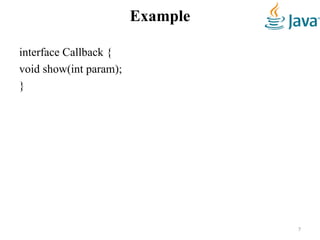
interface Callback
{
void show(intparam);
}
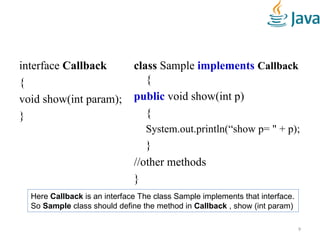
class Sample implements Callback
{
public void show(int p)
{
System.out.println(“show p= " + p);
}
//other methods
}
9
Here Callback is an interface The class Sample implements that interface.
So Sample class should define the method in Callback , show (int param)
10.
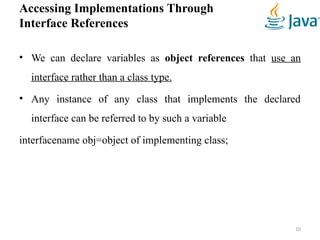
Accessing Implementations Through
InterfaceReferences
• We can declare variables as object references that use an
interface rather than a class type.
• Any instance of any class that implements the declared
interface can be referred to by such a variable
interfacename obj=object of implementing class;
10
11.
interface Callback
{
void show(intparam);
}
class Sample implements Callback
{
public void show(int p)
{
System.out.println(“show p= " + p);
}
//other methods
}
class Test{
public static void main(String args[])
{
Callback c = new Sample();
c.show(42);
}
}
11
Here c is an interface reference variable .It has only has
knowledge of the methods declared by its interface
declaration.
12.
Partial Implementations
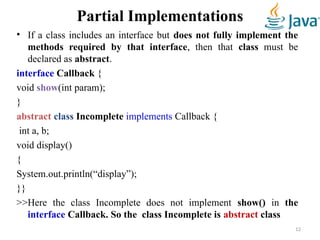
• Ifa class includes an interface but does not fully implement the
methods required by that interface, then that class must be
declared as abstract.
interface Callback {
void show(int param);
}
abstract class Incomplete implements Callback {
int a, b;
void display()
{
System.out.println(“display”);
}}
>>Here the class Incomplete does not implement show() in the
interface Callback. So the class Incomplete is abstract class
12
13.
Nested Interfaces
• Aninterface can be declared a member of a class or
another interface. Such an interface is called a member
interface or a nested interface.
• A nested interface can be declared as public, private, or
protected.
– The top level interface must either be declared as public or
use the default access level.
13
14.
Nested Interfaces
• Ifwe want to use a nested interface outside of its
enclosing scope, the nested interface must be qualified by
the name of the class or interface of which it is a member.
14
15.
Nested Interfaces
class A{
// this is a nested interface
public interface NestedIF
{
boolean isNotNeg(int x);
}
}
class B implements A.NestedIF {
public boolean isNotNeg (int x) {
return x < 0 ? false: true;
}
}
class NestedIFDemo {
public static void main(String args[])
{
A.NestedIF nif = new B();
if(nif.isNotNeg(10))
System.out.println("10 is not negative");
}
}
15
Variables in Interfaces
•When we include an interface in a class (using
“implement” the interface), all of those variable names in
the interface will be in scope as constants.
– That is they are imported to class name space as final
variables.
•
17
18.
Interfaces Can BeExtended
import java.util.Random;
interface Interf {
int NO = 0;
int YES = 1;
}
class Question implements Interf
{
Random rand = new Random();
int ask() {
int prob = (int) (100 * rand.nextDouble());
if (prob < 50)
return NO; // 30%
else
return YES;
}
}
class AskMe implements Interf
{
static void answer(int result) {
switch(result) {
case NO:
System.out.println("No");
break;
case YES:
System.out.println("Yes");
break; } }
public static void main(String args[])
{
Question q = new Question();
answer(q.ask()); }
} 18
19.
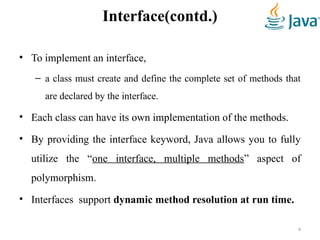
Interfaces Can BeExtended
• One interface can inherit another by use of the keyword
extends.
• When a class class1 implements an interface interface1
that inherits another interface interface2, then class1 must
provide implementations for all methods defined within
the interface inheritance chain(both interface1 and
interface2).
19
20.
// One interfacecan extend another-E.g.
.
interface A {
void meth1();
void meth2();
}
interface B extends A {
void meth3();
}
class MyClass implements B
{
public void meth1()
{
System.out.println("Implement
meth1().");
}
public void meth2() {
System.out.println("Implement meth2().");
}
public void meth3() {
System.out.println("Implement meth3().");}
}
class IFExtend {
public static void main(String arg[])
{
MyClass ob = new MyClass();
ob.meth1();
ob.meth2();
ob.meth3();
}
}
20
21.
Key Properties ofInterface:
• The interface in Java is a mechanism to achieve abstraction.
• By default, variables in an interface are public, static, and
final.
• It is used to achieve multiple inheritance in Java.
• It supports loose coupling (classes depend on behavior, not
implementation).
• Interfaces primarily define methods that other classes must
implement.
• Interfaces are designed to support dynamic method
resolution at run time
21
22.
Interface – Multipleinheritance
interface PI1
{
default void show()
{
System.out.println(" PI1");
}
}
interface PI2
{
default void show()
{
System.out.println(" PI2");
}
}
class TestClass implements PI1, PI2
{
// Overriding default show method
@Override
public void show()
{ PI1.super.show();
PI2.super.show();
}
public void showOfPI1()
{ PI1.super.show();
}
public static void main(String args[])
{ TestClass d = new TestClass();
d.show();
d.showOfPI1();
}
}
22


![Implementing Interfaces
• After an interface has been defined, one or more classes can
implement that interface.
– For that include the implements clause in a class definition
• General form of a class that includes the implements clause
class classname [extends superclass] [implements interface [,interface...]]
{
// class-body
}
//square bracket denotes optional
• If a class implements more than one interface, the interfaces are
separated with a comma
• When we implement an interface method, it must be declared as
public.
8](https://image.slidesharecdn.com/1-250927033053-afe3332c/85/Java-Interface-B-Tech-CS-Branch-Semester-3-Notes-8-320.jpg)
![interface Callback
{
void show(int param);
}
class Sample implements Callback
{
public void show(int p)
{
System.out.println(“show p= " + p);
}
//other methods
}
class Test{
public static void main(String args[])
{
Callback c = new Sample();
c.show(42);
}
}
11
Here c is an interface reference variable .It has only has
knowledge of the methods declared by its interface
declaration.](https://image.slidesharecdn.com/1-250927033053-afe3332c/85/Java-Interface-B-Tech-CS-Branch-Semester-3-Notes-11-320.jpg)
![Nested Interfaces
class A {
// this is a nested interface
public interface NestedIF
{
boolean isNotNeg(int x);
}
}
class B implements A.NestedIF {
public boolean isNotNeg (int x) {
return x < 0 ? false: true;
}
}
class NestedIFDemo {
public static void main(String args[])
{
A.NestedIF nif = new B();
if(nif.isNotNeg(10))
System.out.println("10 is not negative");
}
}
15](https://image.slidesharecdn.com/1-250927033053-afe3332c/85/Java-Interface-B-Tech-CS-Branch-Semester-3-Notes-15-320.jpg)
![Interfaces Can Be Extended
import java.util.Random;
interface Interf {
int NO = 0;
int YES = 1;
}
class Question implements Interf
{
Random rand = new Random();
int ask() {
int prob = (int) (100 * rand.nextDouble());
if (prob < 50)
return NO; // 30%
else
return YES;
}
}
class AskMe implements Interf
{
static void answer(int result) {
switch(result) {
case NO:
System.out.println("No");
break;
case YES:
System.out.println("Yes");
break; } }
public static void main(String args[])
{
Question q = new Question();
answer(q.ask()); }
} 18](https://image.slidesharecdn.com/1-250927033053-afe3332c/85/Java-Interface-B-Tech-CS-Branch-Semester-3-Notes-18-320.jpg)
![// One interface can extend another-E.g.
.
interface A {
void meth1();
void meth2();
}
interface B extends A {
void meth3();
}
class MyClass implements B
{
public void meth1()
{
System.out.println("Implement
meth1().");
}
public void meth2() {
System.out.println("Implement meth2().");
}
public void meth3() {
System.out.println("Implement meth3().");}
}
class IFExtend {
public static void main(String arg[])
{
MyClass ob = new MyClass();
ob.meth1();
ob.meth2();
ob.meth3();
}
}
20](https://image.slidesharecdn.com/1-250927033053-afe3332c/85/Java-Interface-B-Tech-CS-Branch-Semester-3-Notes-20-320.jpg)
![Interface – Multiple inheritance
interface PI1
{
default void show()
{
System.out.println(" PI1");
}
}
interface PI2
{
default void show()
{
System.out.println(" PI2");
}
}
class TestClass implements PI1, PI2
{
// Overriding default show method
@Override
public void show()
{ PI1.super.show();
PI2.super.show();
}
public void showOfPI1()
{ PI1.super.show();
}
public static void main(String args[])
{ TestClass d = new TestClass();
d.show();
d.showOfPI1();
}
}
22](https://image.slidesharecdn.com/1-250927033053-afe3332c/85/Java-Interface-B-Tech-CS-Branch-Semester-3-Notes-22-320.jpg)