© 2000 Prentice Hall, Inc. All rights reserved.
Chapter 16: Classes and Data
Abstraction
Outline
16.1 Introduction
16.2 Implementing a Time Abstract Data Type with a Class
16.3 Class Scope and Accessing Class Members
16.4 Separating Interface from Implementation
16.5 Controlling Access to Members
16.6 Access Functions and Utility Functions
16.7 Initializing Class Objects: Constructors
16.8 Using Default Arguments with Constructors
16.9 Using Destructors
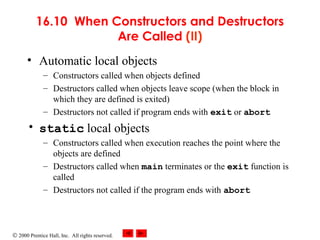
16.10 When Constructors and Destructors Are Called
16.11 Using Data Members and Member Functions
16.12 A Subtle Trap: Returning a Reference to a private
Data Member
16.13 Assignment by Default Memberwise Copy
16.14 Software Reusability
© 2000 Prentice Hall, Inc. All rights reserved.
16.1 Introduction
• Object-oriented programming (OOP)
– Encapsulates data (attributes) and functions (behavior) into
packages called classes
– Data and functions closely related
• Information hiding
– Implementation details are hidden within the classes themselves
• Unit of C++ programming: the class
– A class is like a blueprint – reusable
– Objects are instantiated (created) from the class
– For example, a house is an instance of a “blueprint class”
– C programmers concentrate on functions
© 2000 Prentice Hall, Inc. All rights reserved.
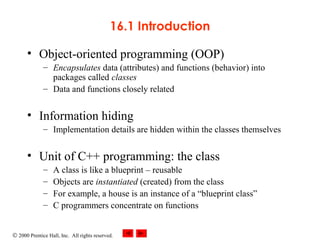
1 class Time {
2 public:
3 Time();
4 void setTime( int, int, int );
5 void printMilitary();
6 void printStandard();
7 private:
8 int hour; // 0 - 23
9 int minute; // 0 - 59
10 int second; // 0 - 59
11 };
16.2 Implementing a Time Abstract Data
Type with a Class
• Classes
– Model objects that have attributes (data members) and
behaviors (member functions)
– Defined using keyword class
Public: and Private: are
member-access specifiers.
setTime, printMilitary, and
printStandard are member
functions.
Time is the constructor.
hour, minute, and
second are data members.
© 2000 Prentice Hall, Inc. All rights reserved.
16.2 Implementing a Time Abstract Data
Type with a Class (II)
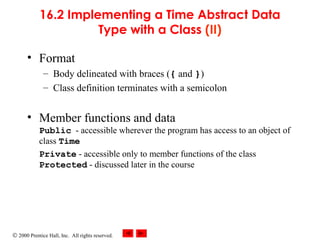
• Format
– Body delineated with braces ({ and })
– Class definition terminates with a semicolon
• Member functions and data
Public - accessible wherever the program has access to an object of
class Time
Private - accessible only to member functions of the class
Protected - discussed later in the course
© 2000 Prentice Hall, Inc. All rights reserved.
16.2 Implementing a Time Abstract Data
Type with a Class (III)
• Constructor
– Special member function that initializes data members of a class
object
– Constructors cannot return values
– Same name as the class
• Declarations
– Once class defined, can be used as a data type
Time sunset, // object of type Time
arrayOfTimes[ 5 ], // array of Time objects
*pointerToTime, // pointer to a Time object
&dinnerTime = sunset; // reference to a Time object
Note: The class
name becomes the
new type specifier.
© 2000 Prentice Hall, Inc. All rights reserved.
16.2 Implementing a Time Abstract Data
Type with a Class (IV)
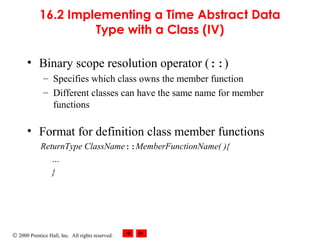
• Binary scope resolution operator (::)
– Specifies which class owns the member function
– Different classes can have the same name for member
functions
• Format for definition class member functions
ReturnType ClassName::MemberFunctionName( ){
…
}
© 2000 Prentice Hall, Inc. All rights reserved.
16.2 Implementing a Time Abstract Data
Type with a Class (V)
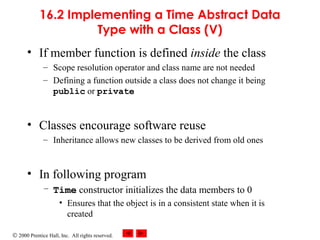
• If member function is defined inside the class
– Scope resolution operator and class name are not needed
– Defining a function outside a class does not change it being
public or private
• Classes encourage software reuse
– Inheritance allows new classes to be derived from old ones
• In following program
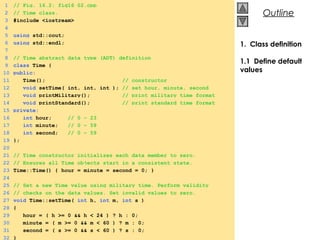
– Time constructor initializes the data members to 0
• Ensures that the object is in a consistent state when it is
created
© 2000 Prentice Hall, Inc. All rights reserved.
OutlineOutline
1 // Fig. 16.2: fig16_02.cpp
2 // Time class.
3 #include <iostream>
4
5 using std::cout;
6 using std::endl;
7
8 // Time abstract data type (ADT) definition
9 class Time {
10 public:
11 Time(); // constructor
12 void setTime( int, int, int ); // set hour, minute, second
13 void printMilitary(); // print military time format
14 void printStandard(); // print standard time format
15 private:
16 int hour; // 0 – 23
17 int minute; // 0 – 59
18 int second; // 0 – 59
19 };
20
21 // Time constructor initializes each data member to zero.
22 // Ensures all Time objects start in a consistent state.
23 Time::Time() { hour = minute = second = 0; }
24
25 // Set a new Time value using military time. Perform validity
26 // checks on the data values. Set invalid values to zero.
27 void Time::setTime( int h, int m, int s )
28 {
29 hour = ( h >= 0 && h < 24 ) ? h : 0;
30 minute = ( m >= 0 && m < 60 ) ? m : 0;
31 second = ( s >= 0 && s < 60 ) ? s : 0;
32 }
1. Class definition
1.1 Define default
values
© 2000 Prentice Hall, Inc. All rights reserved.
OutlineOutline
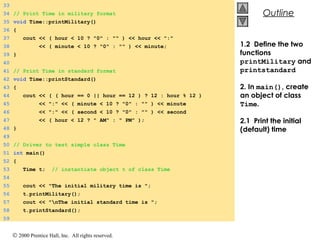
33
34 // Print Time in military format
35 void Time::printMilitary()
36 {
37 cout << ( hour < 10 ? "0" : "" ) << hour << ":"
38 << ( minute < 10 ? "0" : "" ) << minute;
39 }
40
41 // Print Time in standard format
42 void Time::printStandard()
43 {
44 cout << ( ( hour == 0 || hour == 12 ) ? 12 : hour % 12 )
45 << ":" << ( minute < 10 ? "0" : "" ) << minute
46 << ":" << ( second < 10 ? "0" : "" ) << second
47 << ( hour < 12 ? " AM" : " PM" );
48 }
49
50 // Driver to test simple class Time
51 int main()
52 {
53 Time t; // instantiate object t of class Time
54
55 cout << "The initial military time is ";
56 t.printMilitary();
57 cout << "nThe initial standard time is ";
58 t.printStandard();
59
1.2 Define the two
functions
printMilitary and
printstandard
2. In main(), create
an object of class
Time.
2.1 Print the initial
(default) time
© 2000 Prentice Hall, Inc. All rights reserved.
OutlineOutline
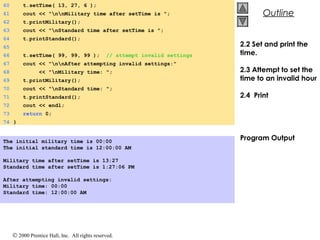
60 t.setTime( 13, 27, 6 );
61 cout << "nnMilitary time after setTime is ";
62 t.printMilitary();
63 cout << "nStandard time after setTime is ";
64 t.printStandard();
65
66 t.setTime( 99, 99, 99 ); // attempt invalid settings
67 cout << "nnAfter attempting invalid settings:"
68 << "nMilitary time: ";
69 t.printMilitary();
70 cout << "nStandard time: ";
71 t.printStandard();
72 cout << endl;
73 return 0;
74 }
The initial military time is 00:00
The initial standard time is 12:00:00 AM
Military time after setTime is 13:27
Standard time after setTime is 1:27:06 PM
After attempting invalid settings:
Military time: 00:00
Standard time: 12:00:00 AM
2.2 Set and print the
time.
2.3 Attempt to set the
time to an invalid hour
2.4 Print
Program Output
© 2000 Prentice Hall, Inc. All rights reserved.
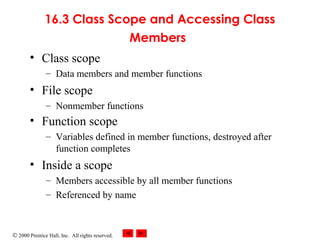
16.3 Class Scope and Accessing Class
Members
• Class scope
– Data members and member functions
• File scope
– Nonmember functions
• Function scope
– Variables defined in member functions, destroyed after
function completes
• Inside a scope
– Members accessible by all member functions
– Referenced by name
© 2000 Prentice Hall, Inc. All rights reserved.
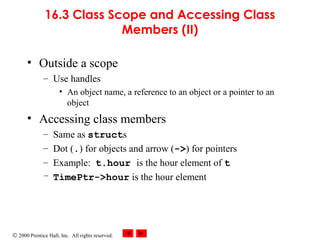
16.3 Class Scope and Accessing Class
Members (II)
• Outside a scope
– Use handles
• An object name, a reference to an object or a pointer to an
object
• Accessing class members
– Same as structs
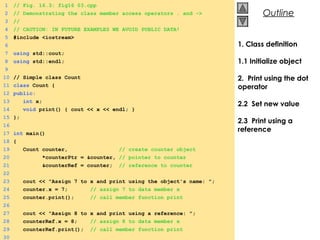
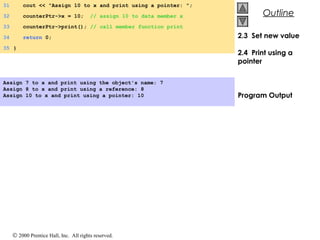
– Dot (.) for objects and arrow (->) for pointers
– Example: t.hour is the hour element of t
– TimePtr->hour is the hour element
© 2000 Prentice Hall, Inc. All rights reserved.
OutlineOutline
1. Class definition
1.1 Initialize object
2. Print using the dot
operator
2.2 Set new value
2.3 Print using a
reference
1 // Fig. 16.3: fig16_03.cpp
2 // Demonstrating the class member access operators . and ->
3 //
4 // CAUTION: IN FUTURE EXAMPLES WE AVOID PUBLIC DATA!
5 #include <iostream>
6
7 using std::cout;
8 using std::endl;
9
10 // Simple class Count
11 class Count {
12 public:
13 int x;
14 void print() { cout << x << endl; }
15 };
16
17 int main()
18 {
19 Count counter, // create counter object
20 *counterPtr = &counter, // pointer to counter
21 &counterRef = counter; // reference to counter
22
23 cout << "Assign 7 to x and print using the object's name: ";
24 counter.x = 7; // assign 7 to data member x
25 counter.print(); // call member function print
26
27 cout << "Assign 8 to x and print using a reference: ";
28 counterRef.x = 8; // assign 8 to data member x
29 counterRef.print(); // call member function print
30
© 2000 Prentice Hall, Inc. All rights reserved.
OutlineOutline
2.3 Set new value
2.4 Print using a
pointer
Program Output
31 cout << "Assign 10 to x and print using a pointer: ";
32 counterPtr->x = 10; // assign 10 to data member x
33 counterPtr->print(); // call member function print
34 return 0;
35 }
Assign 7 to x and print using the object's name: 7
Assign 8 to x and print using a reference: 8
Assign 10 to x and print using a pointer: 10
© 2000 Prentice Hall, Inc. All rights reserved.
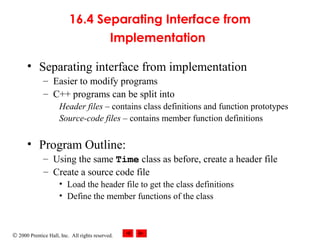
16.4 Separating Interface from
Implementation
• Separating interface from implementation
– Easier to modify programs
– C++ programs can be split into
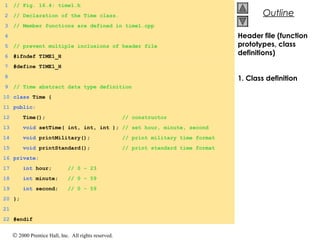
Header files – contains class definitions and function prototypes
Source-code files – contains member function definitions
• Program Outline:
– Using the same Time class as before, create a header file
– Create a source code file
• Load the header file to get the class definitions
• Define the member functions of the class
© 2000 Prentice Hall, Inc. All rights reserved.
OutlineOutline
1 // Fig. 16.4: time1.h
2 // Declaration of the Time class.
3 // Member functions are defined in time1.cpp
4
5 // prevent multiple inclusions of header file
6 #ifndef TIME1_H
7 #define TIME1_H
8
9 // Time abstract data type definition
10 class Time {
11 public:
12 Time(); // constructor
13 void setTime( int, int, int ); // set hour, minute, second
14 void printMilitary(); // print military time format
15 void printStandard(); // print standard time format
16 private:
17 int hour; // 0 - 23
18 int minute; // 0 - 59
19 int second; // 0 - 59
20 };
21
22 #endif
Header file (function
prototypes, class
definitions)
1. Class definition
© 2000 Prentice Hall, Inc. All rights reserved.
OutlineOutline
Source code file
(function definitions)
2.1 Load the header
2.2. Define the
member functions
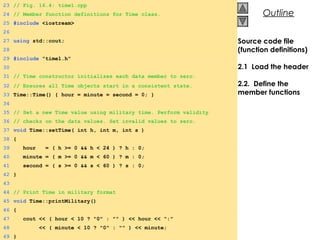
23 // Fig. 16.4: time1.cpp
24 // Member function definitions for Time class.
25 #include <iostream>
26
27 using std::cout;
28
29 #include "time1.h"
30
31 // Time constructor initializes each data member to zero.
32 // Ensures all Time objects start in a consistent state.
33 Time::Time() { hour = minute = second = 0; }
34
35 // Set a new Time value using military time. Perform validity
36 // checks on the data values. Set invalid values to zero.
37 void Time::setTime( int h, int m, int s )
38 {
39 hour = ( h >= 0 && h < 24 ) ? h : 0;
40 minute = ( m >= 0 && m < 60 ) ? m : 0;
41 second = ( s >= 0 && s < 60 ) ? s : 0;
42 }
43
44 // Print Time in military format
45 void Time::printMilitary()
46 {
47 cout << ( hour < 10 ? "0" : "" ) << hour << ":"
48 << ( minute < 10 ? "0" : "" ) << minute;
49 }
© 2000 Prentice Hall, Inc. All rights reserved.
OutlineOutline
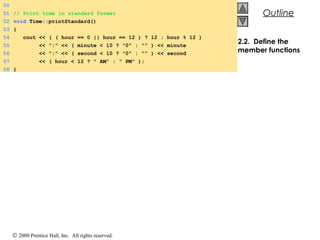
2.2. Define the
member functions
50
51 // Print time in standard format
52 void Time::printStandard()
53 {
54 cout << ( ( hour == 0 || hour == 12 ) ? 12 : hour % 12 )
55 << ":" << ( minute < 10 ? "0" : "" ) << minute
56 << ":" << ( second < 10 ? "0" : "" ) << second
57 << ( hour < 12 ? " AM" : " PM" );
58 }
© 2000 Prentice Hall, Inc. All rights reserved.
OutlineOutline
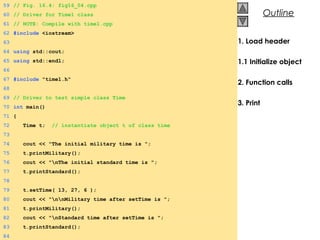
1. Load header
1.1 Initialize object
2. Function calls
3. Print
59 // Fig. 16.4: fig16_04.cpp
60 // Driver for Time1 class
61 // NOTE: Compile with time1.cpp
62 #include <iostream>
63
64 using std::cout;
65 using std::endl;
66
67 #include "time1.h"
68
69 // Driver to test simple class Time
70 int main()
71 {
72 Time t; // instantiate object t of class time
73
74 cout << "The initial military time is ";
75 t.printMilitary();
76 cout << "nThe initial standard time is ";
77 t.printStandard();
78
79 t.setTime( 13, 27, 6 );
80 cout << "nnMilitary time after setTime is ";
81 t.printMilitary();
82 cout << "nStandard time after setTime is ";
83 t.printStandard();
84
© 2000 Prentice Hall, Inc. All rights reserved.
OutlineOutline
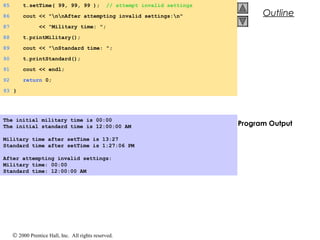
Program Output
85 t.setTime( 99, 99, 99 ); // attempt invalid settings
86 cout << "nnAfter attempting invalid settings:n"
87 << "Military time: ";
88 t.printMilitary();
89 cout << "nStandard time: ";
90 t.printStandard();
91 cout << endl;
92 return 0;
93 }
The initial military time is 00:00
The initial standard time is 12:00:00 AM
Military time after setTime is 13:27
Standard time after setTime is 1:27:06 PM
After attempting invalid settings:
Military time: 00:00
Standard time: 12:00:00 AM
© 2000 Prentice Hall, Inc. All rights reserved.
16.5 Controlling Access to Members
• Purpose of public
– Give clients a view of the services the class provides
(interface)
• Purpose of private
– Default setting
– Hide details of how the class accomplishes its tasks
(implementation)
– Private members only accessible through the public
interface using public member functions
© 2000 Prentice Hall, Inc. All rights reserved.
OutlineOutline
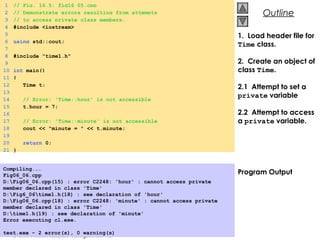
1. Load header file for
Time class.
2. Create an object of
class Time.
2.1 Attempt to set a
private variable
2.2 Attempt to access
a private variable.
Program Output
1 // Fig. 16.5: fig16_05.cpp
2 // Demonstrate errors resulting from attempts
3 // to access private class members.
4 #include <iostream>
5
6 using std::cout;
7
8 #include "time1.h"
9
10 int main()
11 {
12 Time t;
13
14 // Error: 'Time::hour' is not accessible
15 t.hour = 7;
16
17 // Error: 'Time::minute' is not accessible
18 cout << "minute = " << t.minute;
19
20 return 0;
21 }
Compiling...
Fig06_06.cpp
D:Fig06_06.cpp(15) : error C2248: 'hour' : cannot access private
member declared in class 'Time'
D:Fig6_06time1.h(18) : see declaration of 'hour'
D:Fig06_06.cpp(18) : error C2248: 'minute' : cannot access private
member declared in class 'Time'
D:time1.h(19) : see declaration of 'minute'
Error executing cl.exe.
 
test.exe - 2 error(s), 0 warning(s) 
© 2000 Prentice Hall, Inc. All rights reserved.
16.6 Access Functions and Utility Functions
• Utility functions
– private functions that support the operation of public functions
– Not intended to be used directly by clients
• Access functions
– public functions that read/display data or check conditions
– For a container, it could call the isEmpty function
• Next
– Program to take in monthly sales and output the total
– Implementation not shown, only access functions
© 2000 Prentice Hall, Inc. All rights reserved.
OutlineOutline
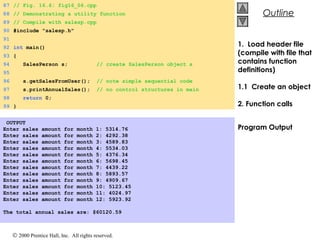
1. Load header file
(compile with file that
contains function
definitions)
1.1 Create an object
2. Function calls
Program Output
87 // Fig. 16.6: fig16_06.cpp
88 // Demonstrating a utility function
89 // Compile with salesp.cpp
90 #include "salesp.h"
91
92 int main()
93 {
94 SalesPerson s; // create SalesPerson object s
95
96 s.getSalesFromUser(); // note simple sequential code
97 s.printAnnualSales(); // no control structures in main
98 return 0;
99 }
OUTPUT
Enter sales amount for month 1: 5314.76
Enter sales amount for month 2: 4292.38
Enter sales amount for month 3: 4589.83
Enter sales amount for month 4: 5534.03
Enter sales amount for month 5: 4376.34
Enter sales amount for month 6: 5698.45
Enter sales amount for month 7: 4439.22
Enter sales amount for month 8: 5893.57
Enter sales amount for month 9: 4909.67
Enter sales amount for month 10: 5123.45
Enter sales amount for month 11: 4024.97
Enter sales amount for month 12: 5923.92
 
The total annual sales are: $60120.59
© 2000 Prentice Hall, Inc. All rights reserved.
16.7 Initializing Class Objects: Constructors
• Constructor function
– Can initialize class members
– Same name as the class, no return type
– Member variables can be initialized by the constructor or set
afterwards
• Declaring objects
– Initializers can be provided
– Initializers passed as arguments to the class’ constructor
© 2000 Prentice Hall, Inc. All rights reserved.
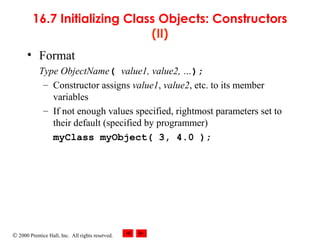
16.7 Initializing Class Objects: Constructors
(II)
• Format
Type ObjectName( value1, value2, …);
– Constructor assigns value1, value2, etc. to its member
variables
– If not enough values specified, rightmost parameters set to
their default (specified by programmer)
myClass myObject( 3, 4.0 );
© 2000 Prentice Hall, Inc. All rights reserved.
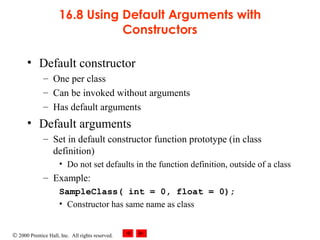
16.8 Using Default Arguments with
Constructors
• Default constructor
– One per class
– Can be invoked without arguments
– Has default arguments
• Default arguments
– Set in default constructor function prototype (in class
definition)
• Do not set defaults in the function definition, outside of a class
– Example:
SampleClass( int = 0, float = 0);
• Constructor has same name as class
© 2000 Prentice Hall, Inc. All rights reserved.
OutlineOutline
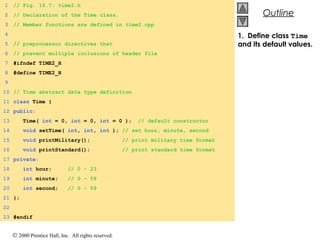
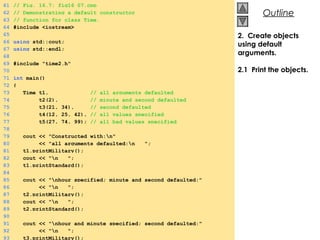
1. Define class Time
and its default values.
1 // Fig. 16.7: time2.h
2 // Declaration of the Time class.
3 // Member functions are defined in time2.cpp
4
5 // preprocessor directives that
6 // prevent multiple inclusions of header file
7 #ifndef TIME2_H
8 #define TIME2_H
9
10 // Time abstract data type definition
11 class Time {
12 public:
13 Time( int = 0, int = 0, int = 0 ); // default constructor
14 void setTime( int, int, int ); // set hour, minute, second
15 void printMilitary(); // print military time format
16 void printStandard(); // print standard time format
17 private:
18 int hour; // 0 - 23
19 int minute; // 0 - 59
20 int second; // 0 - 59
21 };
22
23 #endif
© 2000 Prentice Hall, Inc. All rights reserved.
OutlineOutline
61 // Fig. 16.7: fig16_07.cpp
62 // Demonstrating a default constructor
63 // function for class Time.
64 #include <iostream>
65
66 using std::cout;
67 using std::endl;
68
69 #include "time2.h"
70
71 int main()
72 {
73 Time t1, // all arguments defaulted
74 t2(2), // minute and second defaulted
75 t3(21, 34), // second defaulted
76 t4(12, 25, 42), // all values specified
77 t5(27, 74, 99); // all bad values specified
78
79 cout << "Constructed with:n"
80 << "all arguments defaulted:n ";
81 t1.printMilitary();
82 cout << "n ";
83 t1.printStandard();
84
85 cout << "nhour specified; minute and second defaulted:"
86 << "n ";
87 t2.printMilitary();
88 cout << "n ";
89 t2.printStandard();
90
91 cout << "nhour and minute specified; second defaulted:"
92 << "n ";
93 t3.printMilitary();
2. Create objects
using default
arguments.
2.1 Print the objects.
© 2000 Prentice Hall, Inc. All rights reserved.
OutlineOutline
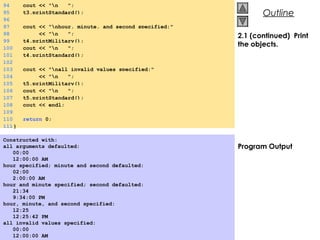
2.1 (continued) Print
the objects.
Program Output
Constructed with:
all arguments defaulted:
00:00
12:00:00 AM
hour specified; minute and second defaulted:
02:00
2:00:00 AM
hour and minute specified; second defaulted:
21:34
9:34:00 PM
hour, minute, and second specified:
12:25
12:25:42 PM
all invalid values specified:
00:00
12:00:00 AM
94 cout << "n ";
95 t3.printStandard();
96
97 cout << "nhour, minute, and second specified:"
98 << "n ";
99 t4.printMilitary();
100 cout << "n ";
101 t4.printStandard();
102
103 cout << "nall invalid values specified:"
104 << "n ";
105 t5.printMilitary();
106 cout << "n ";
107 t5.printStandard();
108 cout << endl;
109
110 return 0;
111}
© 2000 Prentice Hall, Inc. All rights reserved.
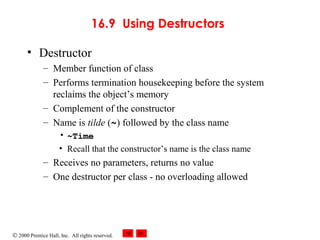
16.9 Using Destructors
• Destructor
– Member function of class
– Performs termination housekeeping before the system
reclaims the object’s memory
– Complement of the constructor
– Name is tilde (~) followed by the class name
• ~Time
• Recall that the constructor’s name is the class name
– Receives no parameters, returns no value
– One destructor per class - no overloading allowed
© 2000 Prentice Hall, Inc. All rights reserved.
16.10 When Constructors and Destructors
Are Called
• Constructors and destructors called automatically
– Order depends on scope of objects
• Global scope objects
– Constructors called before any other function (including
main)
– Destructors called when main terminates (or exit function
called)
– Destructors not called if program terminates with abort
© 2000 Prentice Hall, Inc. All rights reserved.
16.10 When Constructors and Destructors
Are Called (II)
• Automatic local objects
– Constructors called when objects defined
– Destructors called when objects leave scope (when the block in
which they are defined is exited)
– Destructors not called if program ends with exit or abort
• static local objects
– Constructors called when execution reaches the point where the
objects are defined
– Destructors called when main terminates or the exit function is
called
– Destructors not called if the program ends with abort
© 2000 Prentice Hall, Inc. All rights reserved.
OutlineOutline
1. Create header file
1.1 Function
prototypes
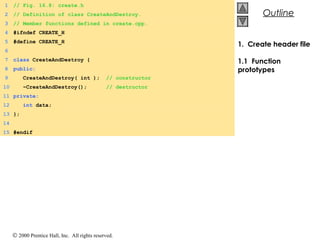
1 // Fig. 16.8: create.h
2 // Definition of class CreateAndDestroy.
3 // Member functions defined in create.cpp.
4 #ifndef CREATE_H
5 #define CREATE_H
6
7 class CreateAndDestroy {
8 public:
9 CreateAndDestroy( int ); // constructor
10 ~CreateAndDestroy(); // destructor
11 private:
12 int data;
13 };
14
15 #endif
© 2000 Prentice Hall, Inc. All rights reserved.
OutlineOutline
1. Load header
1.1 Function definitions
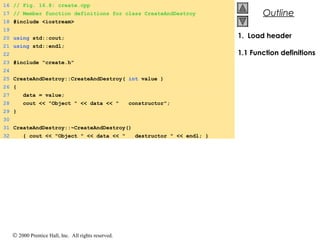
16 // Fig. 16.8: create.cpp
17 // Member function definitions for class CreateAndDestroy
18 #include <iostream>
19
20 using std::cout;
21 using std::endl;
22
23 #include "create.h"
24
25 CreateAndDestroy::CreateAndDestroy( int value )
26 {
27 data = value;
28 cout << "Object " << data << " constructor";
29 }
30
31 CreateAndDestroy::~CreateAndDestroy()
32 { cout << "Object " << data << " destructor " << endl; }
© 2000 Prentice Hall, Inc. All rights reserved.
OutlineOutline
1. Load header
1.1 Initialize objects
2. Print
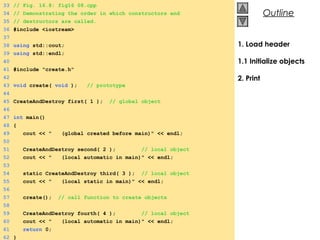
33 // Fig. 16.8: fig16_08.cpp
34 // Demonstrating the order in which constructors and
35 // destructors are called.
36 #include <iostream>
37
38 using std::cout;
39 using std::endl;
40
41 #include "create.h"
42
43 void create( void ); // prototype
44
45 CreateAndDestroy first( 1 ); // global object
46
47 int main()
48 {
49 cout << " (global created before main)" << endl;
50
51 CreateAndDestroy second( 2 ); // local object
52 cout << " (local automatic in main)" << endl;
53
54 static CreateAndDestroy third( 3 ); // local object
55 cout << " (local static in main)" << endl;
56
57 create(); // call function to create objects
58
59 CreateAndDestroy fourth( 4 ); // local object
60 cout << " (local automatic in main)" << endl;
61 return 0;
62 }
© 2000 Prentice Hall, Inc. All rights reserved.
OutlineOutline
3. Function definition
Program Output
63
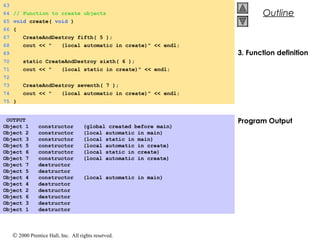
64 // Function to create objects
65 void create( void )
66 {
67 CreateAndDestroy fifth( 5 );
68 cout << " (local automatic in create)" << endl;
69
70 static CreateAndDestroy sixth( 6 );
71 cout << " (local static in create)" << endl;
72
73 CreateAndDestroy seventh( 7 );
74 cout << " (local automatic in create)" << endl;
75 }
OUTPUT
Object 1 constructor (global created before main)
Object 2 constructor (local automatic in main)
Object 3 constructor (local static in main)
Object 5 constructor (local automatic in create)
Object 6 constructor (local static in create)
Object 7 constructor (local automatic in create)
Object 7 destructor
Object 5 destructor
Object 4 constructor (local automatic in main)
Object 4 destructor
Object 2 destructor
Object 6 destructor
Object 3 destructor
Object 1 destructor
© 2000 Prentice Hall, Inc. All rights reserved.
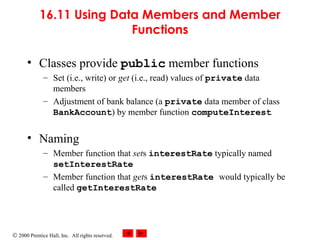
16.11 Using Data Members and Member
Functions
• Classes provide public member functions
– Set (i.e., write) or get (i.e., read) values of private data
members
– Adjustment of bank balance (a private data member of class
BankAccount) by member function computeInterest
• Naming
– Member function that sets interestRate typically named
setInterestRate
– Member function that gets interestRate would typically be
called getInterestRate
© 2000 Prentice Hall, Inc. All rights reserved.
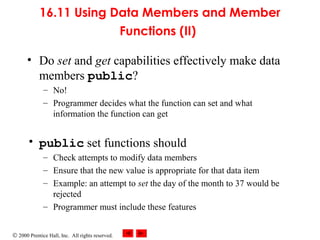
16.11 Using Data Members and Member
Functions (II)
• Do set and get capabilities effectively make data
members public?
– No!
– Programmer decides what the function can set and what
information the function can get
• public set functions should
– Check attempts to modify data members
– Ensure that the new value is appropriate for that data item
– Example: an attempt to set the day of the month to 37 would be
rejected
– Programmer must include these features
© 2000 Prentice Hall, Inc. All rights reserved.
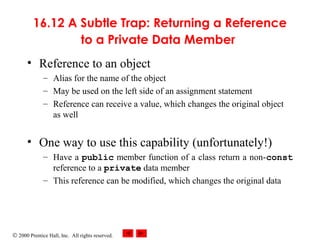
16.12 A Subtle Trap: Returning a Reference
to a Private Data Member
• Reference to an object
– Alias for the name of the object
– May be used on the left side of an assignment statement
– Reference can receive a value, which changes the original object
as well
• One way to use this capability (unfortunately!)
– Have a public member function of a class return a non-const
reference to a private data member
– This reference can be modified, which changes the original data
© 2000 Prentice Hall, Inc. All rights reserved.
OutlineOutline
1. Define class
1.1 Function
prototypes
1.2 badSetHour
returns a reference
1.3 Member variables
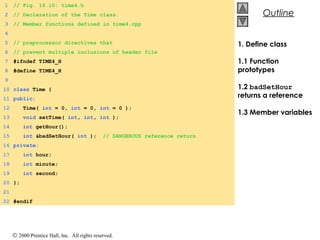
1 // Fig. 16.10: time4.h
2 // Declaration of the Time class.
3 // Member functions defined in time4.cpp
4
5 // preprocessor directives that
6 // prevent multiple inclusions of header file
7 #ifndef TIME4_H
8 #define TIME4_H
9
10 class Time {
11 public:
12 Time( int = 0, int = 0, int = 0 );
13 void setTime( int, int, int );
14 int getHour();
15 int &badSetHour( int ); // DANGEROUS reference return
16 private:
17 int hour;
18 int minute;
19 int second;
20 };
21
22 #endif
© 2000 Prentice Hall, Inc. All rights reserved.
OutlineOutline
1. Load header
1.1 Function definitions
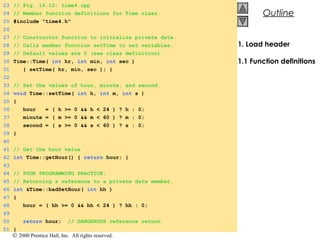
23 // Fig. 16.10: time4.cpp
24 // Member function definitions for Time class.
25 #include "time4.h"
26
27 // Constructor function to initialize private data.
28 // Calls member function setTime to set variables.
29 // Default values are 0 (see class definition).
30 Time::Time( int hr, int min, int sec )
31 { setTime( hr, min, sec ); }
32
33 // Set the values of hour, minute, and second.
34 void Time::setTime( int h, int m, int s )
35 {
36 hour = ( h >= 0 && h < 24 ) ? h : 0;
37 minute = ( m >= 0 && m < 60 ) ? m : 0;
38 second = ( s >= 0 && s < 60 ) ? s : 0;
39 }
40
41 // Get the hour value
42 int Time::getHour() { return hour; }
43
44 // POOR PROGRAMMING PRACTICE:
45 // Returning a reference to a private data member.
46 int &Time::badSetHour( int hh )
47 {
48 hour = ( hh >= 0 && hh < 24 ) ? hh : 0;
49
50 return hour; // DANGEROUS reference return
51 }
© 2000 Prentice Hall, Inc. All rights reserved.
OutlineOutline
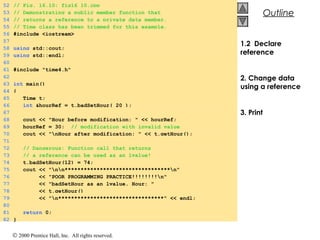
52 // Fig. 16.10: fig16_10.cpp
53 // Demonstrating a public member function that
54 // returns a reference to a private data member.
55 // Time class has been trimmed for this example.
56 #include <iostream>
57
58 using std::cout;
59 using std::endl;
60
61 #include "time4.h"
62
63 int main()
64 {
65 Time t;
66 int &hourRef = t.badSetHour( 20 );
67
68 cout << "Hour before modification: " << hourRef;
69 hourRef = 30; // modification with invalid value
70 cout << "nHour after modification: " << t.getHour();
71
72 // Dangerous: Function call that returns
73 // a reference can be used as an lvalue!
74 t.badSetHour(12) = 74;
75 cout << "nn*********************************n"
76 << "POOR PROGRAMMING PRACTICE!!!!!!!!n"
77 << "badSetHour as an lvalue, Hour: "
78 << t.getHour()
79 << "n*********************************" << endl;
80
81 return 0;
82 }
1.2 Declare
reference
2. Change data
using a reference
3. Print
© 2000 Prentice Hall, Inc. All rights reserved.
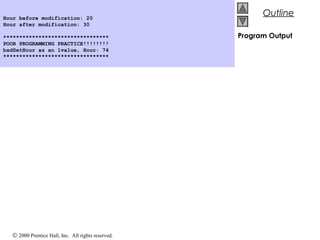
OutlineOutlineHour before modification: 20
Hour after modification: 30
*********************************
POOR PROGRAMMING PRACTICE!!!!!!!!
badSetHour as an lvalue, Hour: 74
*********************************
Program Output
© 2000 Prentice Hall, Inc. All rights reserved.
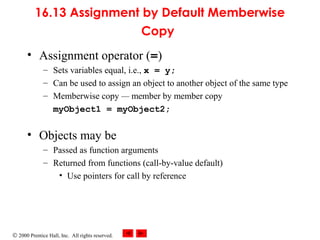
16.13 Assignment by Default Memberwise
Copy
• Assignment operator (=)
– Sets variables equal, i.e., x = y;
– Can be used to assign an object to another object of the same type
– Memberwise copy — member by member copy
myObject1 = myObject2;
• Objects may be
– Passed as function arguments
– Returned from functions (call-by-value default)
• Use pointers for call by reference
© 2000 Prentice Hall, Inc. All rights reserved.
OutlineOutline
1. Define class
1.1 Define member
functions
1 // Fig. 16.11: fig16_11.cpp
2 // Demonstrating that class objects can be assigned
3 // to each other using default memberwise copy
4 #include <iostream>
5
6 using std::cout;
7 using std::endl;
8
9 // Simple Date class
10 class Date {
11 public:
12 Date( int = 1, int = 1, int = 1990 ); // default constructor
13 void print();
14 private:
15 int month;
16 int day;
17 int year;
18 };
19
20 // Simple Date constructor with no range checking
21 Date::Date( int m, int d, int y )
22 {
23 month = m;
24 day = d;
25 year = y;
26 }
27
28 // Print the Date in the form mm-dd-yyyy
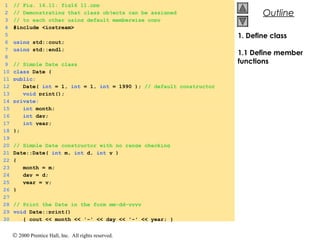
29 void Date::print()
30 { cout << month << '-' << day << '-' << year; }
© 2000 Prentice Hall, Inc. All rights reserved.
OutlineOutline
2. Create Date objects
2.1 Memberwise copy
3. Print values
Program Output
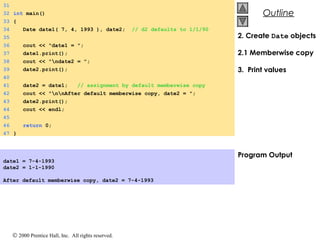
31
32 int main()
33 {
34 Date date1( 7, 4, 1993 ), date2; // d2 defaults to 1/1/90
35
36 cout << "date1 = ";
37 date1.print();
38 cout << "ndate2 = ";
39 date2.print();
40
41 date2 = date1; // assignment by default memberwise copy
42 cout << "nnAfter default memberwise copy, date2 = ";
43 date2.print();
44 cout << endl;
45
46 return 0;
47 }
date1 = 7-4-1993
date2 = 1-1-1990
After default memberwise copy, date2 = 7-4-1993
© 2000 Prentice Hall, Inc. All rights reserved.
16.14 Software Reusability
• Object-oriented programmers
– Concentrate on implementing useful classes
• Tremendous opportunity to capture and catalog
classes
– Accessed by large segments of the programming community
– Class libraries exist for this purpose
• Software
– Constructed from existing, well-defined, carefully tested, portable,
widely available components
– Speeds development of powerful, high-quality software

Classes and data abstraction

  • 1.
    © 2000 PrenticeHall, Inc. All rights reserved. Chapter 16: Classes and Data Abstraction Outline 16.1 Introduction 16.2 Implementing a Time Abstract Data Type with a Class 16.3 Class Scope and Accessing Class Members 16.4 Separating Interface from Implementation 16.5 Controlling Access to Members 16.6 Access Functions and Utility Functions 16.7 Initializing Class Objects: Constructors 16.8 Using Default Arguments with Constructors 16.9 Using Destructors 16.10 When Constructors and Destructors Are Called 16.11 Using Data Members and Member Functions 16.12 A Subtle Trap: Returning a Reference to a private Data Member 16.13 Assignment by Default Memberwise Copy 16.14 Software Reusability
  • 2.
    © 2000 PrenticeHall, Inc. All rights reserved. 16.1 Introduction • Object-oriented programming (OOP) – Encapsulates data (attributes) and functions (behavior) into packages called classes – Data and functions closely related • Information hiding – Implementation details are hidden within the classes themselves • Unit of C++ programming: the class – A class is like a blueprint – reusable – Objects are instantiated (created) from the class – For example, a house is an instance of a “blueprint class” – C programmers concentrate on functions
  • 3.
    © 2000 PrenticeHall, Inc. All rights reserved. 1 class Time { 2 public: 3 Time(); 4 void setTime( int, int, int ); 5 void printMilitary(); 6 void printStandard(); 7 private: 8 int hour; // 0 - 23 9 int minute; // 0 - 59 10 int second; // 0 - 59 11 }; 16.2 Implementing a Time Abstract Data Type with a Class • Classes – Model objects that have attributes (data members) and behaviors (member functions) – Defined using keyword class Public: and Private: are member-access specifiers. setTime, printMilitary, and printStandard are member functions. Time is the constructor. hour, minute, and second are data members.
  • 4.
    © 2000 PrenticeHall, Inc. All rights reserved. 16.2 Implementing a Time Abstract Data Type with a Class (II) • Format – Body delineated with braces ({ and }) – Class definition terminates with a semicolon • Member functions and data Public - accessible wherever the program has access to an object of class Time Private - accessible only to member functions of the class Protected - discussed later in the course
  • 5.
    © 2000 PrenticeHall, Inc. All rights reserved. 16.2 Implementing a Time Abstract Data Type with a Class (III) • Constructor – Special member function that initializes data members of a class object – Constructors cannot return values – Same name as the class • Declarations – Once class defined, can be used as a data type Time sunset, // object of type Time arrayOfTimes[ 5 ], // array of Time objects *pointerToTime, // pointer to a Time object &dinnerTime = sunset; // reference to a Time object Note: The class name becomes the new type specifier.
  • 6.
    © 2000 PrenticeHall, Inc. All rights reserved. 16.2 Implementing a Time Abstract Data Type with a Class (IV) • Binary scope resolution operator (::) – Specifies which class owns the member function – Different classes can have the same name for member functions • Format for definition class member functions ReturnType ClassName::MemberFunctionName( ){ … }
  • 7.
    © 2000 PrenticeHall, Inc. All rights reserved. 16.2 Implementing a Time Abstract Data Type with a Class (V) • If member function is defined inside the class – Scope resolution operator and class name are not needed – Defining a function outside a class does not change it being public or private • Classes encourage software reuse – Inheritance allows new classes to be derived from old ones • In following program – Time constructor initializes the data members to 0 • Ensures that the object is in a consistent state when it is created
  • 8.
    © 2000 PrenticeHall, Inc. All rights reserved. OutlineOutline 1 // Fig. 16.2: fig16_02.cpp 2 // Time class. 3 #include <iostream> 4 5 using std::cout; 6 using std::endl; 7 8 // Time abstract data type (ADT) definition 9 class Time { 10 public: 11 Time(); // constructor 12 void setTime( int, int, int ); // set hour, minute, second 13 void printMilitary(); // print military time format 14 void printStandard(); // print standard time format 15 private: 16 int hour; // 0 – 23 17 int minute; // 0 – 59 18 int second; // 0 – 59 19 }; 20 21 // Time constructor initializes each data member to zero. 22 // Ensures all Time objects start in a consistent state. 23 Time::Time() { hour = minute = second = 0; } 24 25 // Set a new Time value using military time. Perform validity 26 // checks on the data values. Set invalid values to zero. 27 void Time::setTime( int h, int m, int s ) 28 { 29 hour = ( h >= 0 && h < 24 ) ? h : 0; 30 minute = ( m >= 0 && m < 60 ) ? m : 0; 31 second = ( s >= 0 && s < 60 ) ? s : 0; 32 } 1. Class definition 1.1 Define default values
  • 9.
    © 2000 PrenticeHall, Inc. All rights reserved. OutlineOutline 33 34 // Print Time in military format 35 void Time::printMilitary() 36 { 37 cout << ( hour < 10 ? "0" : "" ) << hour << ":" 38 << ( minute < 10 ? "0" : "" ) << minute; 39 } 40 41 // Print Time in standard format 42 void Time::printStandard() 43 { 44 cout << ( ( hour == 0 || hour == 12 ) ? 12 : hour % 12 ) 45 << ":" << ( minute < 10 ? "0" : "" ) << minute 46 << ":" << ( second < 10 ? "0" : "" ) << second 47 << ( hour < 12 ? " AM" : " PM" ); 48 } 49 50 // Driver to test simple class Time 51 int main() 52 { 53 Time t; // instantiate object t of class Time 54 55 cout << "The initial military time is "; 56 t.printMilitary(); 57 cout << "nThe initial standard time is "; 58 t.printStandard(); 59 1.2 Define the two functions printMilitary and printstandard 2. In main(), create an object of class Time. 2.1 Print the initial (default) time
  • 10.
    © 2000 PrenticeHall, Inc. All rights reserved. OutlineOutline 60 t.setTime( 13, 27, 6 ); 61 cout << "nnMilitary time after setTime is "; 62 t.printMilitary(); 63 cout << "nStandard time after setTime is "; 64 t.printStandard(); 65 66 t.setTime( 99, 99, 99 ); // attempt invalid settings 67 cout << "nnAfter attempting invalid settings:" 68 << "nMilitary time: "; 69 t.printMilitary(); 70 cout << "nStandard time: "; 71 t.printStandard(); 72 cout << endl; 73 return 0; 74 } The initial military time is 00:00 The initial standard time is 12:00:00 AM Military time after setTime is 13:27 Standard time after setTime is 1:27:06 PM After attempting invalid settings: Military time: 00:00 Standard time: 12:00:00 AM 2.2 Set and print the time. 2.3 Attempt to set the time to an invalid hour 2.4 Print Program Output
  • 11.
    © 2000 PrenticeHall, Inc. All rights reserved. 16.3 Class Scope and Accessing Class Members • Class scope – Data members and member functions • File scope – Nonmember functions • Function scope – Variables defined in member functions, destroyed after function completes • Inside a scope – Members accessible by all member functions – Referenced by name
  • 12.
    © 2000 PrenticeHall, Inc. All rights reserved. 16.3 Class Scope and Accessing Class Members (II) • Outside a scope – Use handles • An object name, a reference to an object or a pointer to an object • Accessing class members – Same as structs – Dot (.) for objects and arrow (->) for pointers – Example: t.hour is the hour element of t – TimePtr->hour is the hour element
  • 13.
    © 2000 PrenticeHall, Inc. All rights reserved. OutlineOutline 1. Class definition 1.1 Initialize object 2. Print using the dot operator 2.2 Set new value 2.3 Print using a reference 1 // Fig. 16.3: fig16_03.cpp 2 // Demonstrating the class member access operators . and -> 3 // 4 // CAUTION: IN FUTURE EXAMPLES WE AVOID PUBLIC DATA! 5 #include <iostream> 6 7 using std::cout; 8 using std::endl; 9 10 // Simple class Count 11 class Count { 12 public: 13 int x; 14 void print() { cout << x << endl; } 15 }; 16 17 int main() 18 { 19 Count counter, // create counter object 20 *counterPtr = &counter, // pointer to counter 21 &counterRef = counter; // reference to counter 22 23 cout << "Assign 7 to x and print using the object's name: "; 24 counter.x = 7; // assign 7 to data member x 25 counter.print(); // call member function print 26 27 cout << "Assign 8 to x and print using a reference: "; 28 counterRef.x = 8; // assign 8 to data member x 29 counterRef.print(); // call member function print 30
  • 14.
    © 2000 PrenticeHall, Inc. All rights reserved. OutlineOutline 2.3 Set new value 2.4 Print using a pointer Program Output 31 cout << "Assign 10 to x and print using a pointer: "; 32 counterPtr->x = 10; // assign 10 to data member x 33 counterPtr->print(); // call member function print 34 return 0; 35 } Assign 7 to x and print using the object's name: 7 Assign 8 to x and print using a reference: 8 Assign 10 to x and print using a pointer: 10
  • 15.
    © 2000 PrenticeHall, Inc. All rights reserved. 16.4 Separating Interface from Implementation • Separating interface from implementation – Easier to modify programs – C++ programs can be split into Header files – contains class definitions and function prototypes Source-code files – contains member function definitions • Program Outline: – Using the same Time class as before, create a header file – Create a source code file • Load the header file to get the class definitions • Define the member functions of the class
  • 16.
    © 2000 PrenticeHall, Inc. All rights reserved. OutlineOutline 1 // Fig. 16.4: time1.h 2 // Declaration of the Time class. 3 // Member functions are defined in time1.cpp 4 5 // prevent multiple inclusions of header file 6 #ifndef TIME1_H 7 #define TIME1_H 8 9 // Time abstract data type definition 10 class Time { 11 public: 12 Time(); // constructor 13 void setTime( int, int, int ); // set hour, minute, second 14 void printMilitary(); // print military time format 15 void printStandard(); // print standard time format 16 private: 17 int hour; // 0 - 23 18 int minute; // 0 - 59 19 int second; // 0 - 59 20 }; 21 22 #endif Header file (function prototypes, class definitions) 1. Class definition
  • 17.
    © 2000 PrenticeHall, Inc. All rights reserved. OutlineOutline Source code file (function definitions) 2.1 Load the header 2.2. Define the member functions 23 // Fig. 16.4: time1.cpp 24 // Member function definitions for Time class. 25 #include <iostream> 26 27 using std::cout; 28 29 #include "time1.h" 30 31 // Time constructor initializes each data member to zero. 32 // Ensures all Time objects start in a consistent state. 33 Time::Time() { hour = minute = second = 0; } 34 35 // Set a new Time value using military time. Perform validity 36 // checks on the data values. Set invalid values to zero. 37 void Time::setTime( int h, int m, int s ) 38 { 39 hour = ( h >= 0 && h < 24 ) ? h : 0; 40 minute = ( m >= 0 && m < 60 ) ? m : 0; 41 second = ( s >= 0 && s < 60 ) ? s : 0; 42 } 43 44 // Print Time in military format 45 void Time::printMilitary() 46 { 47 cout << ( hour < 10 ? "0" : "" ) << hour << ":" 48 << ( minute < 10 ? "0" : "" ) << minute; 49 }
  • 18.
    © 2000 PrenticeHall, Inc. All rights reserved. OutlineOutline 2.2. Define the member functions 50 51 // Print time in standard format 52 void Time::printStandard() 53 { 54 cout << ( ( hour == 0 || hour == 12 ) ? 12 : hour % 12 ) 55 << ":" << ( minute < 10 ? "0" : "" ) << minute 56 << ":" << ( second < 10 ? "0" : "" ) << second 57 << ( hour < 12 ? " AM" : " PM" ); 58 }
  • 19.
    © 2000 PrenticeHall, Inc. All rights reserved. OutlineOutline 1. Load header 1.1 Initialize object 2. Function calls 3. Print 59 // Fig. 16.4: fig16_04.cpp 60 // Driver for Time1 class 61 // NOTE: Compile with time1.cpp 62 #include <iostream> 63 64 using std::cout; 65 using std::endl; 66 67 #include "time1.h" 68 69 // Driver to test simple class Time 70 int main() 71 { 72 Time t; // instantiate object t of class time 73 74 cout << "The initial military time is "; 75 t.printMilitary(); 76 cout << "nThe initial standard time is "; 77 t.printStandard(); 78 79 t.setTime( 13, 27, 6 ); 80 cout << "nnMilitary time after setTime is "; 81 t.printMilitary(); 82 cout << "nStandard time after setTime is "; 83 t.printStandard(); 84
  • 20.
    © 2000 PrenticeHall, Inc. All rights reserved. OutlineOutline Program Output 85 t.setTime( 99, 99, 99 ); // attempt invalid settings 86 cout << "nnAfter attempting invalid settings:n" 87 << "Military time: "; 88 t.printMilitary(); 89 cout << "nStandard time: "; 90 t.printStandard(); 91 cout << endl; 92 return 0; 93 } The initial military time is 00:00 The initial standard time is 12:00:00 AM Military time after setTime is 13:27 Standard time after setTime is 1:27:06 PM After attempting invalid settings: Military time: 00:00 Standard time: 12:00:00 AM
  • 21.
    © 2000 PrenticeHall, Inc. All rights reserved. 16.5 Controlling Access to Members • Purpose of public – Give clients a view of the services the class provides (interface) • Purpose of private – Default setting – Hide details of how the class accomplishes its tasks (implementation) – Private members only accessible through the public interface using public member functions
  • 22.
    © 2000 PrenticeHall, Inc. All rights reserved. OutlineOutline 1. Load header file for Time class. 2. Create an object of class Time. 2.1 Attempt to set a private variable 2.2 Attempt to access a private variable. Program Output 1 // Fig. 16.5: fig16_05.cpp 2 // Demonstrate errors resulting from attempts 3 // to access private class members. 4 #include <iostream> 5 6 using std::cout; 7 8 #include "time1.h" 9 10 int main() 11 { 12 Time t; 13 14 // Error: 'Time::hour' is not accessible 15 t.hour = 7; 16 17 // Error: 'Time::minute' is not accessible 18 cout << "minute = " << t.minute; 19 20 return 0; 21 } Compiling... Fig06_06.cpp D:Fig06_06.cpp(15) : error C2248: 'hour' : cannot access private member declared in class 'Time' D:Fig6_06time1.h(18) : see declaration of 'hour' D:Fig06_06.cpp(18) : error C2248: 'minute' : cannot access private member declared in class 'Time' D:time1.h(19) : see declaration of 'minute' Error executing cl.exe.   test.exe - 2 error(s), 0 warning(s) 
  • 23.
    © 2000 PrenticeHall, Inc. All rights reserved. 16.6 Access Functions and Utility Functions • Utility functions – private functions that support the operation of public functions – Not intended to be used directly by clients • Access functions – public functions that read/display data or check conditions – For a container, it could call the isEmpty function • Next – Program to take in monthly sales and output the total – Implementation not shown, only access functions
  • 24.
    © 2000 PrenticeHall, Inc. All rights reserved. OutlineOutline 1. Load header file (compile with file that contains function definitions) 1.1 Create an object 2. Function calls Program Output 87 // Fig. 16.6: fig16_06.cpp 88 // Demonstrating a utility function 89 // Compile with salesp.cpp 90 #include "salesp.h" 91 92 int main() 93 { 94 SalesPerson s; // create SalesPerson object s 95 96 s.getSalesFromUser(); // note simple sequential code 97 s.printAnnualSales(); // no control structures in main 98 return 0; 99 } OUTPUT Enter sales amount for month 1: 5314.76 Enter sales amount for month 2: 4292.38 Enter sales amount for month 3: 4589.83 Enter sales amount for month 4: 5534.03 Enter sales amount for month 5: 4376.34 Enter sales amount for month 6: 5698.45 Enter sales amount for month 7: 4439.22 Enter sales amount for month 8: 5893.57 Enter sales amount for month 9: 4909.67 Enter sales amount for month 10: 5123.45 Enter sales amount for month 11: 4024.97 Enter sales amount for month 12: 5923.92   The total annual sales are: $60120.59
  • 25.
    © 2000 PrenticeHall, Inc. All rights reserved. 16.7 Initializing Class Objects: Constructors • Constructor function – Can initialize class members – Same name as the class, no return type – Member variables can be initialized by the constructor or set afterwards • Declaring objects – Initializers can be provided – Initializers passed as arguments to the class’ constructor
  • 26.
    © 2000 PrenticeHall, Inc. All rights reserved. 16.7 Initializing Class Objects: Constructors (II) • Format Type ObjectName( value1, value2, …); – Constructor assigns value1, value2, etc. to its member variables – If not enough values specified, rightmost parameters set to their default (specified by programmer) myClass myObject( 3, 4.0 );
  • 27.
    © 2000 PrenticeHall, Inc. All rights reserved. 16.8 Using Default Arguments with Constructors • Default constructor – One per class – Can be invoked without arguments – Has default arguments • Default arguments – Set in default constructor function prototype (in class definition) • Do not set defaults in the function definition, outside of a class – Example: SampleClass( int = 0, float = 0); • Constructor has same name as class
  • 28.
    © 2000 PrenticeHall, Inc. All rights reserved. OutlineOutline 1. Define class Time and its default values. 1 // Fig. 16.7: time2.h 2 // Declaration of the Time class. 3 // Member functions are defined in time2.cpp 4 5 // preprocessor directives that 6 // prevent multiple inclusions of header file 7 #ifndef TIME2_H 8 #define TIME2_H 9 10 // Time abstract data type definition 11 class Time { 12 public: 13 Time( int = 0, int = 0, int = 0 ); // default constructor 14 void setTime( int, int, int ); // set hour, minute, second 15 void printMilitary(); // print military time format 16 void printStandard(); // print standard time format 17 private: 18 int hour; // 0 - 23 19 int minute; // 0 - 59 20 int second; // 0 - 59 21 }; 22 23 #endif
  • 29.
    © 2000 PrenticeHall, Inc. All rights reserved. OutlineOutline 61 // Fig. 16.7: fig16_07.cpp 62 // Demonstrating a default constructor 63 // function for class Time. 64 #include <iostream> 65 66 using std::cout; 67 using std::endl; 68 69 #include "time2.h" 70 71 int main() 72 { 73 Time t1, // all arguments defaulted 74 t2(2), // minute and second defaulted 75 t3(21, 34), // second defaulted 76 t4(12, 25, 42), // all values specified 77 t5(27, 74, 99); // all bad values specified 78 79 cout << "Constructed with:n" 80 << "all arguments defaulted:n "; 81 t1.printMilitary(); 82 cout << "n "; 83 t1.printStandard(); 84 85 cout << "nhour specified; minute and second defaulted:" 86 << "n "; 87 t2.printMilitary(); 88 cout << "n "; 89 t2.printStandard(); 90 91 cout << "nhour and minute specified; second defaulted:" 92 << "n "; 93 t3.printMilitary(); 2. Create objects using default arguments. 2.1 Print the objects.
  • 30.
    © 2000 PrenticeHall, Inc. All rights reserved. OutlineOutline 2.1 (continued) Print the objects. Program Output Constructed with: all arguments defaulted: 00:00 12:00:00 AM hour specified; minute and second defaulted: 02:00 2:00:00 AM hour and minute specified; second defaulted: 21:34 9:34:00 PM hour, minute, and second specified: 12:25 12:25:42 PM all invalid values specified: 00:00 12:00:00 AM 94 cout << "n "; 95 t3.printStandard(); 96 97 cout << "nhour, minute, and second specified:" 98 << "n "; 99 t4.printMilitary(); 100 cout << "n "; 101 t4.printStandard(); 102 103 cout << "nall invalid values specified:" 104 << "n "; 105 t5.printMilitary(); 106 cout << "n "; 107 t5.printStandard(); 108 cout << endl; 109 110 return 0; 111}
  • 31.
    © 2000 PrenticeHall, Inc. All rights reserved. 16.9 Using Destructors • Destructor – Member function of class – Performs termination housekeeping before the system reclaims the object’s memory – Complement of the constructor – Name is tilde (~) followed by the class name • ~Time • Recall that the constructor’s name is the class name – Receives no parameters, returns no value – One destructor per class - no overloading allowed
  • 32.
    © 2000 PrenticeHall, Inc. All rights reserved. 16.10 When Constructors and Destructors Are Called • Constructors and destructors called automatically – Order depends on scope of objects • Global scope objects – Constructors called before any other function (including main) – Destructors called when main terminates (or exit function called) – Destructors not called if program terminates with abort
  • 33.
    © 2000 PrenticeHall, Inc. All rights reserved. 16.10 When Constructors and Destructors Are Called (II) • Automatic local objects – Constructors called when objects defined – Destructors called when objects leave scope (when the block in which they are defined is exited) – Destructors not called if program ends with exit or abort • static local objects – Constructors called when execution reaches the point where the objects are defined – Destructors called when main terminates or the exit function is called – Destructors not called if the program ends with abort
  • 34.
    © 2000 PrenticeHall, Inc. All rights reserved. OutlineOutline 1. Create header file 1.1 Function prototypes 1 // Fig. 16.8: create.h 2 // Definition of class CreateAndDestroy. 3 // Member functions defined in create.cpp. 4 #ifndef CREATE_H 5 #define CREATE_H 6 7 class CreateAndDestroy { 8 public: 9 CreateAndDestroy( int ); // constructor 10 ~CreateAndDestroy(); // destructor 11 private: 12 int data; 13 }; 14 15 #endif
  • 35.
    © 2000 PrenticeHall, Inc. All rights reserved. OutlineOutline 1. Load header 1.1 Function definitions 16 // Fig. 16.8: create.cpp 17 // Member function definitions for class CreateAndDestroy 18 #include <iostream> 19 20 using std::cout; 21 using std::endl; 22 23 #include "create.h" 24 25 CreateAndDestroy::CreateAndDestroy( int value ) 26 { 27 data = value; 28 cout << "Object " << data << " constructor"; 29 } 30 31 CreateAndDestroy::~CreateAndDestroy() 32 { cout << "Object " << data << " destructor " << endl; }
  • 36.
    © 2000 PrenticeHall, Inc. All rights reserved. OutlineOutline 1. Load header 1.1 Initialize objects 2. Print 33 // Fig. 16.8: fig16_08.cpp 34 // Demonstrating the order in which constructors and 35 // destructors are called. 36 #include <iostream> 37 38 using std::cout; 39 using std::endl; 40 41 #include "create.h" 42 43 void create( void ); // prototype 44 45 CreateAndDestroy first( 1 ); // global object 46 47 int main() 48 { 49 cout << " (global created before main)" << endl; 50 51 CreateAndDestroy second( 2 ); // local object 52 cout << " (local automatic in main)" << endl; 53 54 static CreateAndDestroy third( 3 ); // local object 55 cout << " (local static in main)" << endl; 56 57 create(); // call function to create objects 58 59 CreateAndDestroy fourth( 4 ); // local object 60 cout << " (local automatic in main)" << endl; 61 return 0; 62 }
  • 37.
    © 2000 PrenticeHall, Inc. All rights reserved. OutlineOutline 3. Function definition Program Output 63 64 // Function to create objects 65 void create( void ) 66 { 67 CreateAndDestroy fifth( 5 ); 68 cout << " (local automatic in create)" << endl; 69 70 static CreateAndDestroy sixth( 6 ); 71 cout << " (local static in create)" << endl; 72 73 CreateAndDestroy seventh( 7 ); 74 cout << " (local automatic in create)" << endl; 75 } OUTPUT Object 1 constructor (global created before main) Object 2 constructor (local automatic in main) Object 3 constructor (local static in main) Object 5 constructor (local automatic in create) Object 6 constructor (local static in create) Object 7 constructor (local automatic in create) Object 7 destructor Object 5 destructor Object 4 constructor (local automatic in main) Object 4 destructor Object 2 destructor Object 6 destructor Object 3 destructor Object 1 destructor
  • 38.
    © 2000 PrenticeHall, Inc. All rights reserved. 16.11 Using Data Members and Member Functions • Classes provide public member functions – Set (i.e., write) or get (i.e., read) values of private data members – Adjustment of bank balance (a private data member of class BankAccount) by member function computeInterest • Naming – Member function that sets interestRate typically named setInterestRate – Member function that gets interestRate would typically be called getInterestRate
  • 39.
    © 2000 PrenticeHall, Inc. All rights reserved. 16.11 Using Data Members and Member Functions (II) • Do set and get capabilities effectively make data members public? – No! – Programmer decides what the function can set and what information the function can get • public set functions should – Check attempts to modify data members – Ensure that the new value is appropriate for that data item – Example: an attempt to set the day of the month to 37 would be rejected – Programmer must include these features
  • 40.
    © 2000 PrenticeHall, Inc. All rights reserved. 16.12 A Subtle Trap: Returning a Reference to a Private Data Member • Reference to an object – Alias for the name of the object – May be used on the left side of an assignment statement – Reference can receive a value, which changes the original object as well • One way to use this capability (unfortunately!) – Have a public member function of a class return a non-const reference to a private data member – This reference can be modified, which changes the original data
  • 41.
    © 2000 PrenticeHall, Inc. All rights reserved. OutlineOutline 1. Define class 1.1 Function prototypes 1.2 badSetHour returns a reference 1.3 Member variables 1 // Fig. 16.10: time4.h 2 // Declaration of the Time class. 3 // Member functions defined in time4.cpp 4 5 // preprocessor directives that 6 // prevent multiple inclusions of header file 7 #ifndef TIME4_H 8 #define TIME4_H 9 10 class Time { 11 public: 12 Time( int = 0, int = 0, int = 0 ); 13 void setTime( int, int, int ); 14 int getHour(); 15 int &badSetHour( int ); // DANGEROUS reference return 16 private: 17 int hour; 18 int minute; 19 int second; 20 }; 21 22 #endif
  • 42.
    © 2000 PrenticeHall, Inc. All rights reserved. OutlineOutline 1. Load header 1.1 Function definitions 23 // Fig. 16.10: time4.cpp 24 // Member function definitions for Time class. 25 #include "time4.h" 26 27 // Constructor function to initialize private data. 28 // Calls member function setTime to set variables. 29 // Default values are 0 (see class definition). 30 Time::Time( int hr, int min, int sec ) 31 { setTime( hr, min, sec ); } 32 33 // Set the values of hour, minute, and second. 34 void Time::setTime( int h, int m, int s ) 35 { 36 hour = ( h >= 0 && h < 24 ) ? h : 0; 37 minute = ( m >= 0 && m < 60 ) ? m : 0; 38 second = ( s >= 0 && s < 60 ) ? s : 0; 39 } 40 41 // Get the hour value 42 int Time::getHour() { return hour; } 43 44 // POOR PROGRAMMING PRACTICE: 45 // Returning a reference to a private data member. 46 int &Time::badSetHour( int hh ) 47 { 48 hour = ( hh >= 0 && hh < 24 ) ? hh : 0; 49 50 return hour; // DANGEROUS reference return 51 }
  • 43.
    © 2000 PrenticeHall, Inc. All rights reserved. OutlineOutline 52 // Fig. 16.10: fig16_10.cpp 53 // Demonstrating a public member function that 54 // returns a reference to a private data member. 55 // Time class has been trimmed for this example. 56 #include <iostream> 57 58 using std::cout; 59 using std::endl; 60 61 #include "time4.h" 62 63 int main() 64 { 65 Time t; 66 int &hourRef = t.badSetHour( 20 ); 67 68 cout << "Hour before modification: " << hourRef; 69 hourRef = 30; // modification with invalid value 70 cout << "nHour after modification: " << t.getHour(); 71 72 // Dangerous: Function call that returns 73 // a reference can be used as an lvalue! 74 t.badSetHour(12) = 74; 75 cout << "nn*********************************n" 76 << "POOR PROGRAMMING PRACTICE!!!!!!!!n" 77 << "badSetHour as an lvalue, Hour: " 78 << t.getHour() 79 << "n*********************************" << endl; 80 81 return 0; 82 } 1.2 Declare reference 2. Change data using a reference 3. Print
  • 44.
    © 2000 PrenticeHall, Inc. All rights reserved. OutlineOutlineHour before modification: 20 Hour after modification: 30 ********************************* POOR PROGRAMMING PRACTICE!!!!!!!! badSetHour as an lvalue, Hour: 74 ********************************* Program Output
  • 45.
    © 2000 PrenticeHall, Inc. All rights reserved. 16.13 Assignment by Default Memberwise Copy • Assignment operator (=) – Sets variables equal, i.e., x = y; – Can be used to assign an object to another object of the same type – Memberwise copy — member by member copy myObject1 = myObject2; • Objects may be – Passed as function arguments – Returned from functions (call-by-value default) • Use pointers for call by reference
  • 46.
    © 2000 PrenticeHall, Inc. All rights reserved. OutlineOutline 1. Define class 1.1 Define member functions 1 // Fig. 16.11: fig16_11.cpp 2 // Demonstrating that class objects can be assigned 3 // to each other using default memberwise copy 4 #include <iostream> 5 6 using std::cout; 7 using std::endl; 8 9 // Simple Date class 10 class Date { 11 public: 12 Date( int = 1, int = 1, int = 1990 ); // default constructor 13 void print(); 14 private: 15 int month; 16 int day; 17 int year; 18 }; 19 20 // Simple Date constructor with no range checking 21 Date::Date( int m, int d, int y ) 22 { 23 month = m; 24 day = d; 25 year = y; 26 } 27 28 // Print the Date in the form mm-dd-yyyy 29 void Date::print() 30 { cout << month << '-' << day << '-' << year; }
  • 47.
    © 2000 PrenticeHall, Inc. All rights reserved. OutlineOutline 2. Create Date objects 2.1 Memberwise copy 3. Print values Program Output 31 32 int main() 33 { 34 Date date1( 7, 4, 1993 ), date2; // d2 defaults to 1/1/90 35 36 cout << "date1 = "; 37 date1.print(); 38 cout << "ndate2 = "; 39 date2.print(); 40 41 date2 = date1; // assignment by default memberwise copy 42 cout << "nnAfter default memberwise copy, date2 = "; 43 date2.print(); 44 cout << endl; 45 46 return 0; 47 } date1 = 7-4-1993 date2 = 1-1-1990 After default memberwise copy, date2 = 7-4-1993
  • 48.
    © 2000 PrenticeHall, Inc. All rights reserved. 16.14 Software Reusability • Object-oriented programmers – Concentrate on implementing useful classes • Tremendous opportunity to capture and catalog classes – Accessed by large segments of the programming community – Class libraries exist for this purpose • Software – Constructed from existing, well-defined, carefully tested, portable, widely available components – Speeds development of powerful, high-quality software