THE SMARTEST
BATTERY
IN THE ROOM
U n i v e r s i t y o f T a s m a n i a
A G E N D A
U n i v e r s i t y o f Ta s m a n i a
There is no
agenda
S TA K E H O L D E R S
• The University of Tasmania are leading a number of concurrent low load and variable
speed diesel initiatives, with funding provided by the ARC, ENA and ONRG
• Hydro Tasmania are currently hosting our largest demonstration, the 1.2MW King Island low
load diesel pilot.
• Opportunities for host and commercialisation partner exist to support co-funded utility
scale deployments.
• We are also working with ACEP, HNEI, ComAp, Siemens, Juwi, EDL
A L O T O F B S
U n i v e r s i t y o f Ta s m a n i ahttp://www.energystorageexchange.org/projects
M O R E B S
U n i v e r s i t y o f Ta s m a n i ahttp://www.energystorageexchange.org/projects
T H E G R O U N D R U L E S
U n i v e r s i t y o f Ta s m a n i a
Keep It
Simple
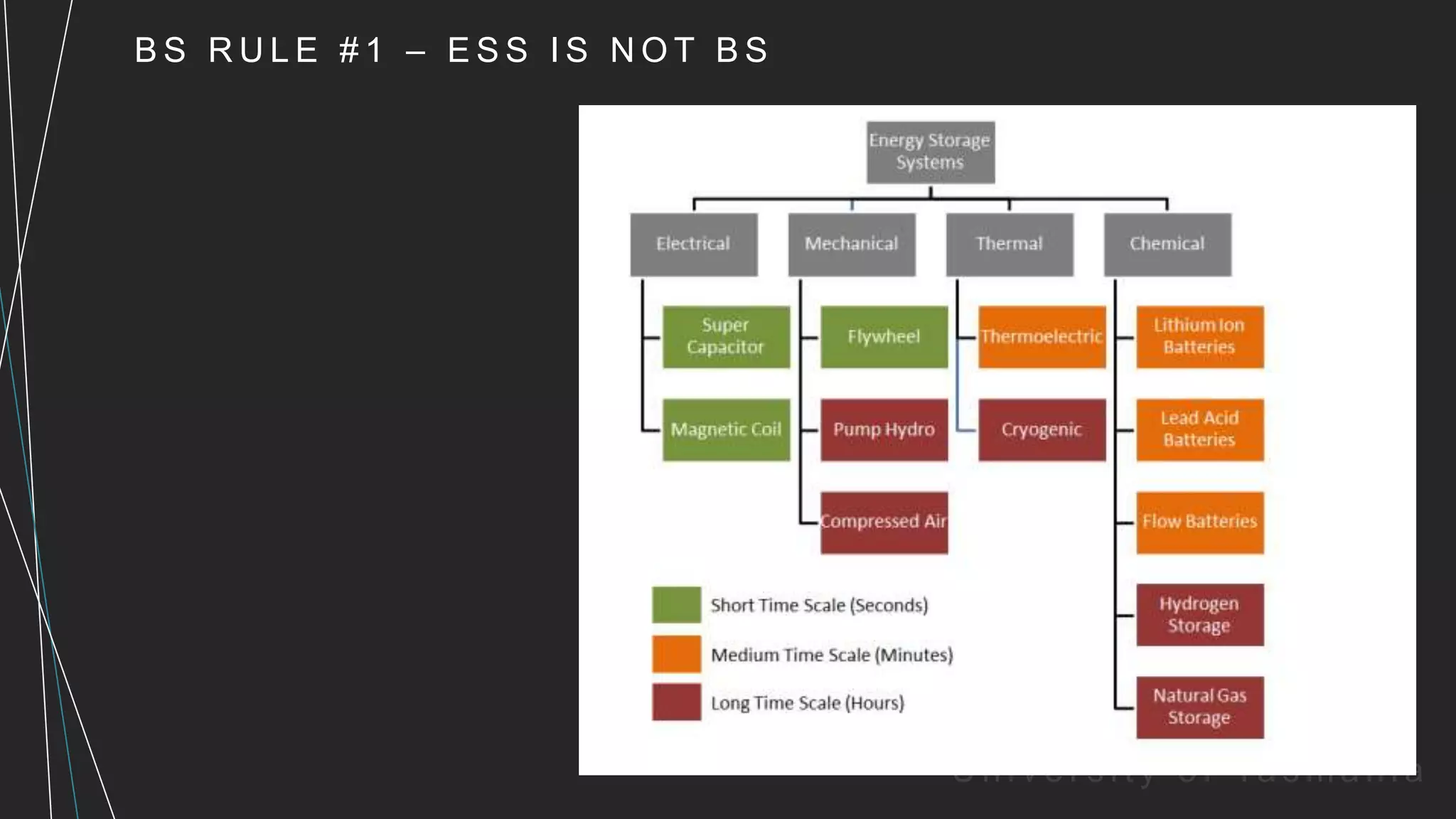
B S R U L E # 1 – E S S I S N O T B S
U n i v e r s i t y o f Ta s m a n i a
B S R U L E # 2 – B S I S N O T L i o n
U n i v e r s i t y o f Ta s m a n i aSource: Battery Storage for Renewables, IRENA, Jan 15
B S R U L E # 3 – L i o n I S N O T E N E R G Y O R P O W E R
U n i v e r s i t y o f Ta s m a n i aSource: US DOE, 2017
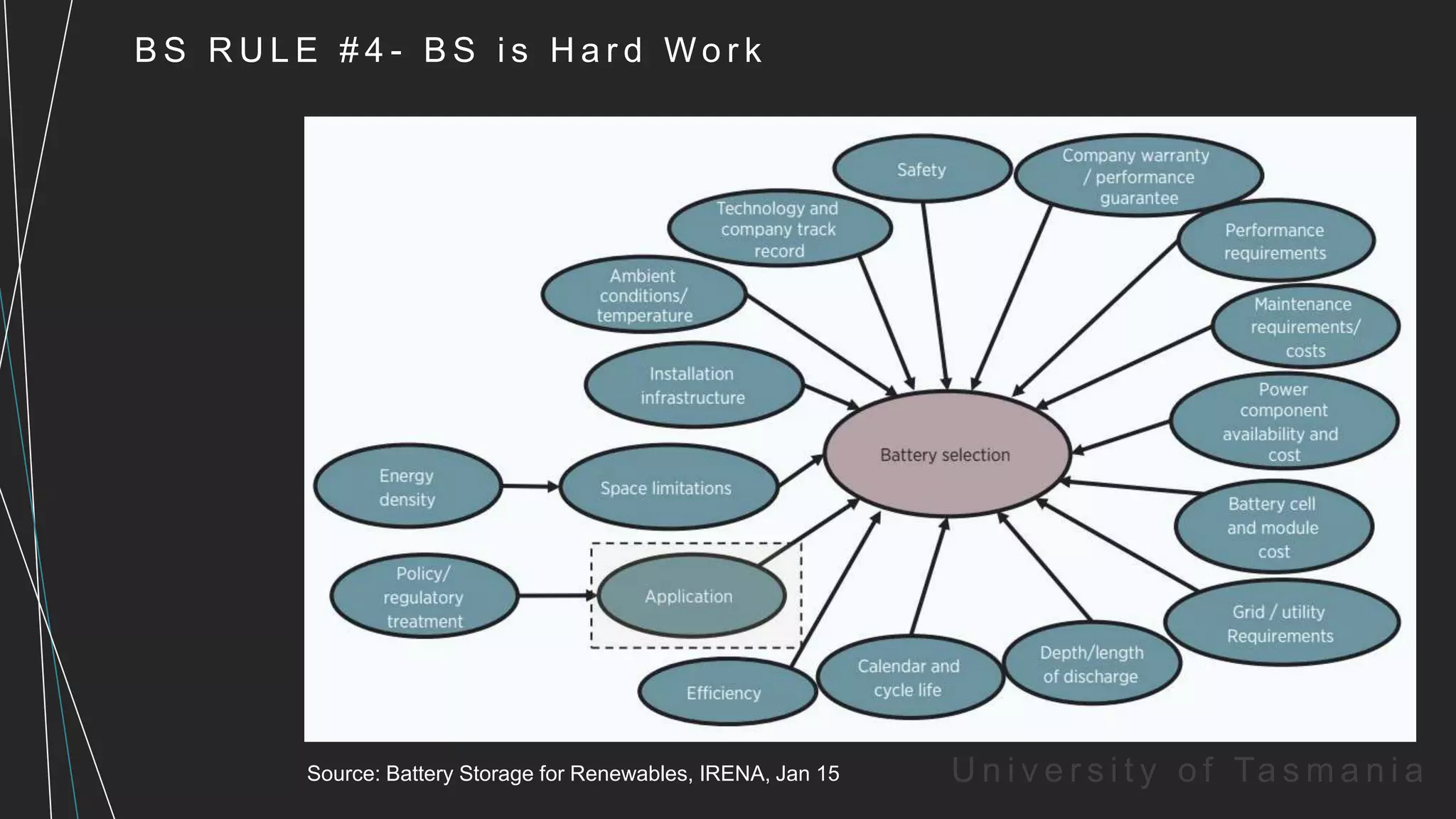
B S R U L E # 4 - B S i s H a r d W o r k
U n i v e r s i t y o f Ta s m a n i aSource: Battery Storage for Renewables, IRENA, Jan 15
W h a t C a n W e D o W i t h o u t S t o r a g e
U n i v e r s i t y o f Ta s m a n i a
Start
Here
A Ta l e o f T h r e e I s l a n d s
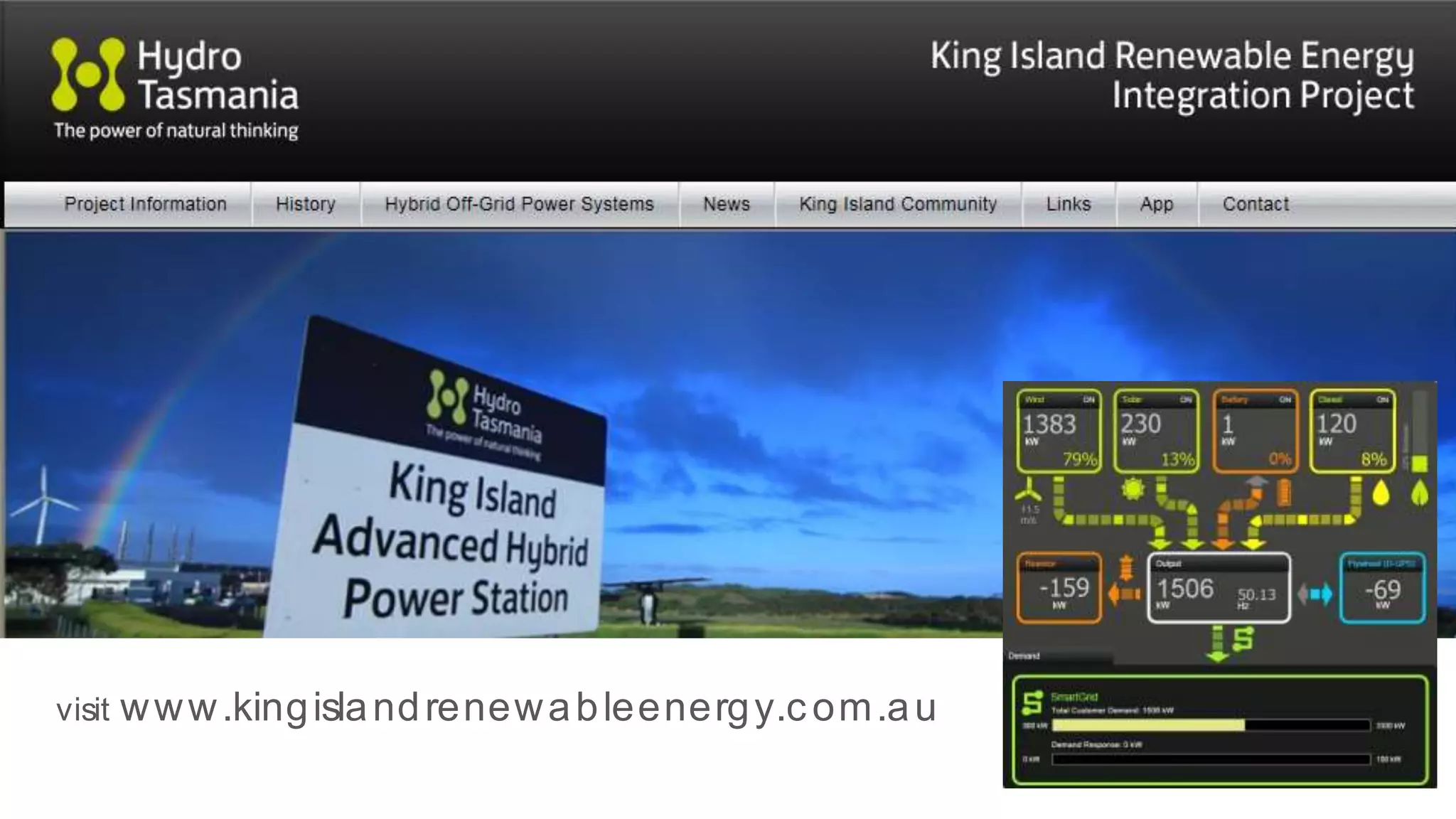
King Island, Tasmania is Australia’s most prestigious
MW scale island power project. Integrating wind from as
early as1992, the island runs 65%-75% renewable on an
annual average basis.
http://www.kingislandrenewableenergy.com.au
Flinders Island, Tasmania, represents a modernised
King Island power system, deployed as a modular,
containerised technology suite.
https://itunes.apple.com/au/app/flinders-island-energy-
hub/id1372617413?mt=8
Rottnest Island, Western Australia, is the most
recent Australian high renewable penetration island. Able
to run 45-55% renewable p.a. the island is unique given
the absence of any storage enablers.
https://indicium-dynamics.com.au/projects.html
visit www.kingislandrenewableenergy.com.au
P R O B L E M C U R AT I O N
High
Cost
Energy
Suppliers
Policy
Makers
Utilities
Developers
Reduce
Diesel
Burn
RE
Integration
Solar PV
Wind
DSM
BS
Solar PV
Lower
Cost
Energy
Solar PV
COST
COMPLEXITY
COMMUNITY
http:/ / www.rottnestisland.com/ the-island/ travel-tools-and-tips/ appshttp:/ / www.rottnestisland.com/ the-island/ travel-tools-and-tips/ apps
M y t h O n e o f F o u r
Diesel engines are inflexible and unable to operate at low loads
Modern diesel engines can operate sustainably across their full load range.
During sustained operation at low load a purge routine will be required to
discharge carbon from the system. One hour every 8 to 12 hours of low load
operation is typical.
References:
A. E. Surosky, "The Effects of Long Term High Idle Operation on Diesel Engines," Belvoir Research and Development Center, 1983.
R. Welz, "Low Load Operation for s1600 gendrive engines," Application Newsletter 15-005, MTU Friedrichshafen 21/04/2015.
M. Jensen, “Low Load Operation,” Service Letter SL11-544/MTS, MAN Diesel & Turbo, June 2011.
M y t h Tw o o f F o u r
Diesel engines operate inefficiently at low loads
Fixed speed diesel engines consume more fuel per kWh at low loads. The
solution is to release the engine from the fixed speed environment. Variable
speed diesel concepts offer dramatic efficiency gains, and are able to use
stock standard diesel engine technologies.
References:
D. H. Wang, C. V. Nayar, and C. Wang, "Modeling of stand-alone variable speed diesel generator using doubly-fed induction generator," in 2nd
International Symposium on Power Electronics for Distributed Generation Systems, PEDG 2010, June 16, 2010 - June 18, 2010, Hefei, China, 2010, pp. 1-
6.
M y t h T h r e e o f F o u r
Engines wear and emissions prohibit low load application
Emissions intensity resultant from low cylinder temperature and pressure
have historically been problematic. However, a range of approaches can
stabilise cylinder temperature and pressure under low load operation.
References:
Danvest, "CAT PON Performance Test Report 41711," August 2015.
M y t h F o u r o f F o u r
Manufacturer warranties prohibit low load operation
Fixed speed diesel engines consume more fuel per kWh at low loads. The
solution is to release the engine from the fixed speed environment. Variable
speed diesel concepts offer dramatic efficiency gains, and are able to use
stock standard diesel engine technologies.
References:
P. Brooks, "Limitations on low load operation for fixed speed engines," in Cummins marine application bulletin, 2005.
L o w L o a d D i e s e l
• Running diesel assets lightly for improved RE utilisation.
• Typically returns a 20-30% improvement in RE penetration, extracting improved value from low
penetrations systems.
• Engine temperature and purge frequency are key metrics.
• King Island anticipating a 10% fuel savings.
K i n g I s l a n d L L D P i l o t
• MTU1.2MW 12V4000 DS1650 3B diesel generator
• 70% single step load application, within 2Hz deviation
Va r i a b l e S p e e d D i e s e l
• Technology solution adopted from modern MW scale wind turbines.
• Standard components in isolation – a diesel engine coupled to a permanent magnet generator
and full power converter.
• Integrated they represent an innovative new technology.
• Variable load cooling improves low load thermal inertia.
• Fuel savings exceeding 50% are observed.
H o b a r t , Ta s m a n i a
• 1 x 12kW variable speed diesel generator set
• 1 x 15 kw fixed speed diesel generator set
Thank
you
T H E E N D
j a m e s . h a m i l t o n @ u t a s . e d u . a u
I s l a n d C o m p a r i s o n
King Island renewable
energy integration
project
Flinders Island hybrid
energy hub
Rottnest Island water
and renewable energy
nexus
Lord Howe Island
Hybrid Renewable
Energy System
Garden Island Microgrid
Project (excludes wave
energy R&D
technologies)
Generation Configuration
Peak Load (MW) 2.5 1.3 1.2 0.5
Average Load (MW) 1.4 0.8 0.6 0.3
Annual Generation (GWh p.a.) 12 6.7 5 2.1
Generation Capacity Total (MW) 8.35 4.4 3.3 1.9 4.6
Generation Capacity Renewable (MW) 2.35 1.4 1.2 1 2
Renewable Capacity (MW) WIND 2.25 1.2 0.6 0.55 0
Renewable Capacity (MW) Solar PV 0.1 0.2 0.6 0.45 2
Battery ESS Capacity (MW,MWh) 3, 1.6 0.75, 0.3 n/a 0.4, 0.4 2, 0.5
Flywheel System Yes Yes No No No
Renewable Energy Penetration (% p.a.) 65% 60% 50% 70% 40%
Development Period 1998-2015 2014-2017 2016-2017 current current
Utility Network Connection No No No No Yes
Capital Cost ($m) 28.15 15.38 9.81 11.6 7.49
Capital Cost ($m/per MW installed) 11.98 10.99 8.18 11.6 3.745

James hamilton ips connect-hamilton

  • 1.
    THE SMARTEST BATTERY IN THEROOM U n i v e r s i t y o f T a s m a n i a
  • 2.
    A G EN D A U n i v e r s i t y o f Ta s m a n i a There is no agenda
  • 3.
    S TA KE H O L D E R S • The University of Tasmania are leading a number of concurrent low load and variable speed diesel initiatives, with funding provided by the ARC, ENA and ONRG • Hydro Tasmania are currently hosting our largest demonstration, the 1.2MW King Island low load diesel pilot. • Opportunities for host and commercialisation partner exist to support co-funded utility scale deployments. • We are also working with ACEP, HNEI, ComAp, Siemens, Juwi, EDL
  • 4.
    A L OT O F B S U n i v e r s i t y o f Ta s m a n i ahttp://www.energystorageexchange.org/projects
  • 5.
    M O RE B S U n i v e r s i t y o f Ta s m a n i ahttp://www.energystorageexchange.org/projects
  • 6.
    T H EG R O U N D R U L E S U n i v e r s i t y o f Ta s m a n i a Keep It Simple
  • 7.
    B S RU L E # 1 – E S S I S N O T B S U n i v e r s i t y o f Ta s m a n i a
  • 8.
    B S RU L E # 2 – B S I S N O T L i o n U n i v e r s i t y o f Ta s m a n i aSource: Battery Storage for Renewables, IRENA, Jan 15
  • 9.
    B S RU L E # 3 – L i o n I S N O T E N E R G Y O R P O W E R U n i v e r s i t y o f Ta s m a n i aSource: US DOE, 2017
  • 10.
    B S RU L E # 4 - B S i s H a r d W o r k U n i v e r s i t y o f Ta s m a n i aSource: Battery Storage for Renewables, IRENA, Jan 15
  • 11.
    W h at C a n W e D o W i t h o u t S t o r a g e U n i v e r s i t y o f Ta s m a n i a Start Here
  • 12.
    A Ta le o f T h r e e I s l a n d s King Island, Tasmania is Australia’s most prestigious MW scale island power project. Integrating wind from as early as1992, the island runs 65%-75% renewable on an annual average basis. http://www.kingislandrenewableenergy.com.au Flinders Island, Tasmania, represents a modernised King Island power system, deployed as a modular, containerised technology suite. https://itunes.apple.com/au/app/flinders-island-energy- hub/id1372617413?mt=8 Rottnest Island, Western Australia, is the most recent Australian high renewable penetration island. Able to run 45-55% renewable p.a. the island is unique given the absence of any storage enablers. https://indicium-dynamics.com.au/projects.html
  • 13.
  • 14.
    P R OB L E M C U R AT I O N High Cost Energy Suppliers Policy Makers Utilities Developers Reduce Diesel Burn RE Integration Solar PV Wind DSM BS Solar PV Lower Cost Energy Solar PV COST COMPLEXITY COMMUNITY
  • 15.
    http:/ / www.rottnestisland.com/the-island/ travel-tools-and-tips/ appshttp:/ / www.rottnestisland.com/ the-island/ travel-tools-and-tips/ apps
  • 16.
    M y th O n e o f F o u r Diesel engines are inflexible and unable to operate at low loads Modern diesel engines can operate sustainably across their full load range. During sustained operation at low load a purge routine will be required to discharge carbon from the system. One hour every 8 to 12 hours of low load operation is typical. References: A. E. Surosky, "The Effects of Long Term High Idle Operation on Diesel Engines," Belvoir Research and Development Center, 1983. R. Welz, "Low Load Operation for s1600 gendrive engines," Application Newsletter 15-005, MTU Friedrichshafen 21/04/2015. M. Jensen, “Low Load Operation,” Service Letter SL11-544/MTS, MAN Diesel & Turbo, June 2011.
  • 17.
    M y th Tw o o f F o u r Diesel engines operate inefficiently at low loads Fixed speed diesel engines consume more fuel per kWh at low loads. The solution is to release the engine from the fixed speed environment. Variable speed diesel concepts offer dramatic efficiency gains, and are able to use stock standard diesel engine technologies. References: D. H. Wang, C. V. Nayar, and C. Wang, "Modeling of stand-alone variable speed diesel generator using doubly-fed induction generator," in 2nd International Symposium on Power Electronics for Distributed Generation Systems, PEDG 2010, June 16, 2010 - June 18, 2010, Hefei, China, 2010, pp. 1- 6.
  • 18.
    M y th T h r e e o f F o u r Engines wear and emissions prohibit low load application Emissions intensity resultant from low cylinder temperature and pressure have historically been problematic. However, a range of approaches can stabilise cylinder temperature and pressure under low load operation. References: Danvest, "CAT PON Performance Test Report 41711," August 2015.
  • 19.
    M y th F o u r o f F o u r Manufacturer warranties prohibit low load operation Fixed speed diesel engines consume more fuel per kWh at low loads. The solution is to release the engine from the fixed speed environment. Variable speed diesel concepts offer dramatic efficiency gains, and are able to use stock standard diesel engine technologies. References: P. Brooks, "Limitations on low load operation for fixed speed engines," in Cummins marine application bulletin, 2005.
  • 20.
    L o wL o a d D i e s e l • Running diesel assets lightly for improved RE utilisation. • Typically returns a 20-30% improvement in RE penetration, extracting improved value from low penetrations systems. • Engine temperature and purge frequency are key metrics. • King Island anticipating a 10% fuel savings.
  • 21.
    K i ng I s l a n d L L D P i l o t • MTU1.2MW 12V4000 DS1650 3B diesel generator • 70% single step load application, within 2Hz deviation
  • 22.
    Va r ia b l e S p e e d D i e s e l • Technology solution adopted from modern MW scale wind turbines. • Standard components in isolation – a diesel engine coupled to a permanent magnet generator and full power converter. • Integrated they represent an innovative new technology. • Variable load cooling improves low load thermal inertia. • Fuel savings exceeding 50% are observed.
  • 23.
    H o ba r t , Ta s m a n i a • 1 x 12kW variable speed diesel generator set • 1 x 15 kw fixed speed diesel generator set
  • 25.
    Thank you T H EE N D j a m e s . h a m i l t o n @ u t a s . e d u . a u
  • 26.
    I s la n d C o m p a r i s o n King Island renewable energy integration project Flinders Island hybrid energy hub Rottnest Island water and renewable energy nexus Lord Howe Island Hybrid Renewable Energy System Garden Island Microgrid Project (excludes wave energy R&D technologies) Generation Configuration Peak Load (MW) 2.5 1.3 1.2 0.5 Average Load (MW) 1.4 0.8 0.6 0.3 Annual Generation (GWh p.a.) 12 6.7 5 2.1 Generation Capacity Total (MW) 8.35 4.4 3.3 1.9 4.6 Generation Capacity Renewable (MW) 2.35 1.4 1.2 1 2 Renewable Capacity (MW) WIND 2.25 1.2 0.6 0.55 0 Renewable Capacity (MW) Solar PV 0.1 0.2 0.6 0.45 2 Battery ESS Capacity (MW,MWh) 3, 1.6 0.75, 0.3 n/a 0.4, 0.4 2, 0.5 Flywheel System Yes Yes No No No Renewable Energy Penetration (% p.a.) 65% 60% 50% 70% 40% Development Period 1998-2015 2014-2017 2016-2017 current current Utility Network Connection No No No No Yes Capital Cost ($m) 28.15 15.38 9.81 11.6 7.49 Capital Cost ($m/per MW installed) 11.98 10.99 8.18 11.6 3.745

Editor's Notes

  • #16  Here’s one I prepared earlier ([click] to animate, [esc] to exit). Its King Island at a 10% low load level: And it would save the King Island community 160,000 litres of diesel per year. 160,000L of diesel that doesn’t have to bought into Tasmania. So what is low load diesel?