Mekelle university
EIT-M
Department of Chemical Engineering
(Biochemical Engineering Stream)
Sustainable Energy Technology (Cheng5201)
Title: Hydropower Energy Potential in
Africa and Ethiopia Share
Prepared by: Group member -1-
1
Outline
1
• Introduction
• Hydropower potential in Africa
2
• Hydropower potential in Ethiopia
• GERD
3
• Advantages and disadvantages
2
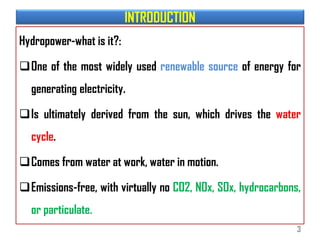
INTRODUCTION
Hydropower-what is it?:
One of the most widely used renewable source of energy for
generating electricity.
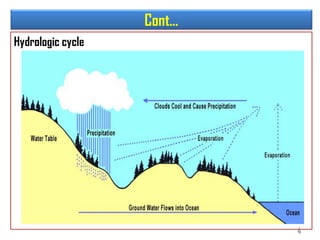
Is ultimately derived from the sun, which drives the water
cycle.
Comes from water at work, water in motion.
Emissions-free, with virtually no CO2, NOx, SOx, hydrocarbons,
or particulate.
3
Cont…
Hydrologic cycle
4
Cont…
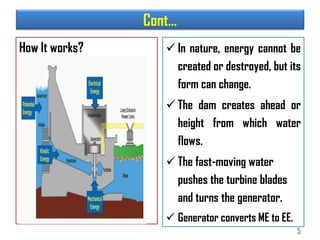
How It works?  In nature, energy cannot be
created or destroyed, but its
form can change.
 The dam creates ahead or
height from which water
flows.
 The fast-moving water
pushes the turbine blades
and turns the generator.
 Generator converts ME to EE.
5
Cont…
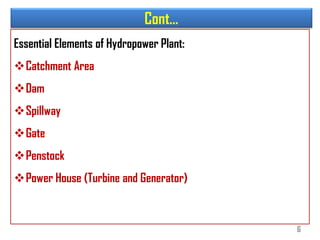
Essential Elements of Hydropower Plant:
Catchment Area
Dam
Spillway
Gate
Penstock
Power House (Turbine and Generator)
6
Cont…
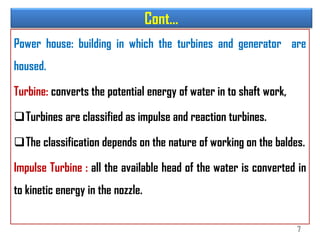
Power house: building in which the turbines and generator are
housed.
Turbine: converts the potential energy of water in to shaft work,
Turbines are classified as impulse and reaction turbines.
The classification depends on the nature of working on the baldes.
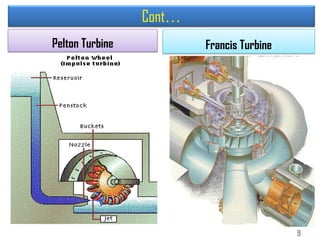
Impulse Turbine : all the available head of the water is converted in
to kinetic energy in the nozzle.
7
Cont…
The water shoots out of the nozzle in a free jet in to a bucket.
They are Suitable for high head and low flow applications.
Reaction turbine: the entire flow takes place in a closed conduit
system.
The runner converts both the KE and PE in to mechanical energy.
They are Suitable for lower H and higher Q applications.
 Example: GERD is planned to use reaction turbine.
8
Cont…
Pelton Turbine Francis Turbine
9
Cont…
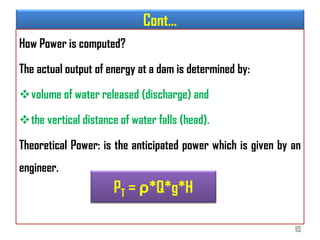
How Power is computed?
The actual output of energy at a dam is determined by:
volume of water released (discharge) and
the vertical distance of water falls (head).
Theoretical Power: is the anticipated power which is given by an
engineer.
PT = ρ*Q*g*H
10
Cont…
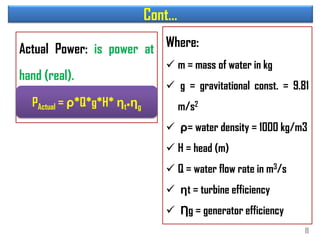
Actual Power: is power at
hand (real).
Where:
 m = mass of water in kg
 g = gravitational const. = 9.81
m/s2
 ρ= water density = 1000 kg/m3
 H = head (m)
 Q = water flow rate in m3/s
 ηt = turbine efficiency
 Ƞg = generator efficiency
PActual = ρ*Q*g*H* ηt*ηg
11
Cont…
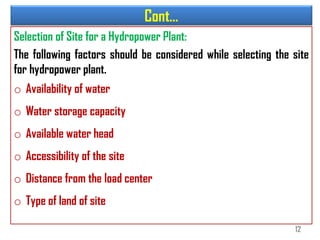
Selection of Site for a Hydropower Plant:
The following factors should be considered while selecting the site
for hydropower plant.
o Availability of water
o Water storage capacity
o Available water head
o Accessibility of the site
o Distance from the load center
o Type of land of site
12
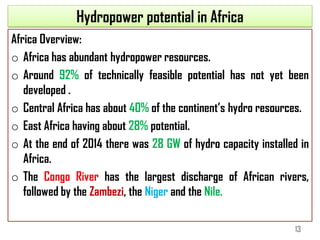
Hydropower potential in Africa
Africa Overview:
o Africa has abundant hydropower resources.
o Around 92% of technically feasible potential has not yet been
developed .
o Central Africa has about 40% of the continent’s hydro resources.
o East Africa having about 28% potential.
o At the end of 2014 there was 28 GW of hydro capacity installed in
Africa.
o The Congo River has the largest discharge of African rivers,
followed by the Zambezi, the Niger and the Nile.
13
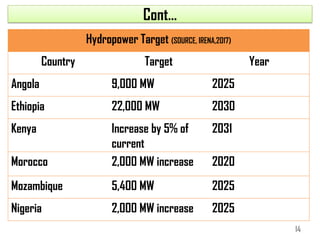
Cont…
Hydropower Target (SOURCE, IRENA,2017)
Country Target Year
Angola 9,000 MW 2025
Ethiopia 22,000 MW 2030
Kenya Increase by 5% of
current
2031
Morocco 2,000 MW increase 2020
Mozambique 5,400 MW 2025
Nigeria 2,000 MW increase 2025
14
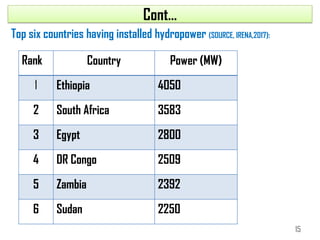
Cont…
Top six countries having installed hydropower (SOURCE, IRENA,2017):
Rank Country Power (MW)
1 Ethiopia 4050
2 South Africa 3583
3 Egypt 2800
4 DR Congo 2509
5 Zambia 2392
6 Sudan 2250
15
Cont…
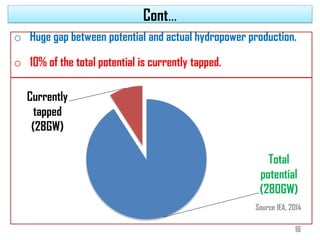
Total
potential
(280GW)
Currently
tapped
(28GW)
16
o Huge gap between potential and actual hydropower production.
o 10% of the total potential is currently tapped.
Source IEA, 2014
Hydropower potential in Ethiopia
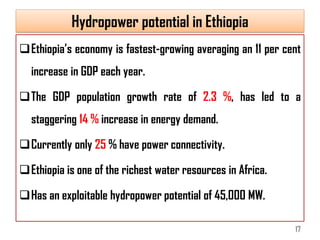
Ethiopia’s economy is fastest-growing averaging an 11 per cent
increase in GDP each year.
The GDP population growth rate of 2.3 %, has led to a
staggering 14 % increase in energy demand.
Currently only 25 % have power connectivity.
Ethiopia is one of the richest water resources in Africa.
Has an exploitable hydropower potential of 45,000 MW.
17
Cont..
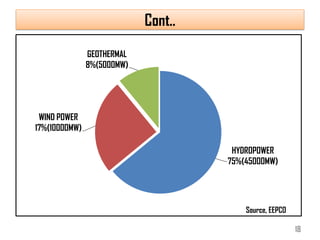
HYDROPOWER
75%(45000MW)
WIND POWER
17%(10000MW)
GEOTHERMAL
8%(5000MW)
Source, EEPCO
18
Cont…
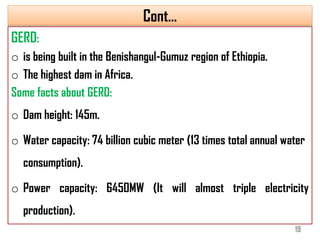
GERD:
o is being built in the Benishangul-Gumuz region of Ethiopia.
o The highest dam in Africa.
Some facts about GERD:
o Dam height: 145m.
o Water capacity: 74 billion cubic meter (13 times total annual water
consumption).
o Power capacity: 6450MW (It will almost triple electricity
production).
19
Cont…
GERD and its Potential Impacts:
The positive and negative potential impacts of GERD are seen as;
Energy
 Biodiversity
Water flow
Agriculture
Social impact
20
Advantages and Disadvantages
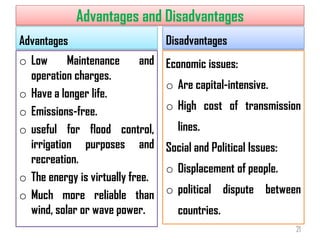
Advantages
o Low Maintenance and
operation charges.
o Have a longer life.
o Emissions-free.
o useful for flood control,
irrigation purposes and
recreation.
o The energy is virtually free.
o Much more reliable than
wind, solar or wave power.
Disadvantages
Economic issues:
o Are capital-intensive.
o High cost of transmission
lines.
Social and Political Issues:
o Displacement of people.
o political dispute between
countries.
21
22

Hydropower ppt Teklemariam Negash

  • 1.
    Mekelle university EIT-M Department ofChemical Engineering (Biochemical Engineering Stream) Sustainable Energy Technology (Cheng5201) Title: Hydropower Energy Potential in Africa and Ethiopia Share Prepared by: Group member -1- 1
  • 2.
    Outline 1 • Introduction • Hydropowerpotential in Africa 2 • Hydropower potential in Ethiopia • GERD 3 • Advantages and disadvantages 2
  • 3.
    INTRODUCTION Hydropower-what is it?: Oneof the most widely used renewable source of energy for generating electricity. Is ultimately derived from the sun, which drives the water cycle. Comes from water at work, water in motion. Emissions-free, with virtually no CO2, NOx, SOx, hydrocarbons, or particulate. 3
  • 4.
  • 5.
    Cont… How It works? In nature, energy cannot be created or destroyed, but its form can change.  The dam creates ahead or height from which water flows.  The fast-moving water pushes the turbine blades and turns the generator.  Generator converts ME to EE. 5
  • 6.
    Cont… Essential Elements ofHydropower Plant: Catchment Area Dam Spillway Gate Penstock Power House (Turbine and Generator) 6
  • 7.
    Cont… Power house: buildingin which the turbines and generator are housed. Turbine: converts the potential energy of water in to shaft work, Turbines are classified as impulse and reaction turbines. The classification depends on the nature of working on the baldes. Impulse Turbine : all the available head of the water is converted in to kinetic energy in the nozzle. 7
  • 8.
    Cont… The water shootsout of the nozzle in a free jet in to a bucket. They are Suitable for high head and low flow applications. Reaction turbine: the entire flow takes place in a closed conduit system. The runner converts both the KE and PE in to mechanical energy. They are Suitable for lower H and higher Q applications.  Example: GERD is planned to use reaction turbine. 8
  • 9.
  • 10.
    Cont… How Power iscomputed? The actual output of energy at a dam is determined by: volume of water released (discharge) and the vertical distance of water falls (head). Theoretical Power: is the anticipated power which is given by an engineer. PT = ρ*Q*g*H 10
  • 11.
    Cont… Actual Power: ispower at hand (real). Where:  m = mass of water in kg  g = gravitational const. = 9.81 m/s2  ρ= water density = 1000 kg/m3  H = head (m)  Q = water flow rate in m3/s  ηt = turbine efficiency  Ƞg = generator efficiency PActual = ρ*Q*g*H* ηt*ηg 11
  • 12.
    Cont… Selection of Sitefor a Hydropower Plant: The following factors should be considered while selecting the site for hydropower plant. o Availability of water o Water storage capacity o Available water head o Accessibility of the site o Distance from the load center o Type of land of site 12
  • 13.
    Hydropower potential inAfrica Africa Overview: o Africa has abundant hydropower resources. o Around 92% of technically feasible potential has not yet been developed . o Central Africa has about 40% of the continent’s hydro resources. o East Africa having about 28% potential. o At the end of 2014 there was 28 GW of hydro capacity installed in Africa. o The Congo River has the largest discharge of African rivers, followed by the Zambezi, the Niger and the Nile. 13
  • 14.
    Cont… Hydropower Target (SOURCE,IRENA,2017) Country Target Year Angola 9,000 MW 2025 Ethiopia 22,000 MW 2030 Kenya Increase by 5% of current 2031 Morocco 2,000 MW increase 2020 Mozambique 5,400 MW 2025 Nigeria 2,000 MW increase 2025 14
  • 15.
    Cont… Top six countrieshaving installed hydropower (SOURCE, IRENA,2017): Rank Country Power (MW) 1 Ethiopia 4050 2 South Africa 3583 3 Egypt 2800 4 DR Congo 2509 5 Zambia 2392 6 Sudan 2250 15
  • 16.
    Cont… Total potential (280GW) Currently tapped (28GW) 16 o Huge gapbetween potential and actual hydropower production. o 10% of the total potential is currently tapped. Source IEA, 2014
  • 17.
    Hydropower potential inEthiopia Ethiopia’s economy is fastest-growing averaging an 11 per cent increase in GDP each year. The GDP population growth rate of 2.3 %, has led to a staggering 14 % increase in energy demand. Currently only 25 % have power connectivity. Ethiopia is one of the richest water resources in Africa. Has an exploitable hydropower potential of 45,000 MW. 17
  • 18.
  • 19.
    Cont… GERD: o is beingbuilt in the Benishangul-Gumuz region of Ethiopia. o The highest dam in Africa. Some facts about GERD: o Dam height: 145m. o Water capacity: 74 billion cubic meter (13 times total annual water consumption). o Power capacity: 6450MW (It will almost triple electricity production). 19
  • 20.
    Cont… GERD and itsPotential Impacts: The positive and negative potential impacts of GERD are seen as; Energy  Biodiversity Water flow Agriculture Social impact 20
  • 21.
    Advantages and Disadvantages Advantages oLow Maintenance and operation charges. o Have a longer life. o Emissions-free. o useful for flood control, irrigation purposes and recreation. o The energy is virtually free. o Much more reliable than wind, solar or wave power. Disadvantages Economic issues: o Are capital-intensive. o High cost of transmission lines. Social and Political Issues: o Displacement of people. o political dispute between countries. 21
  • 22.